
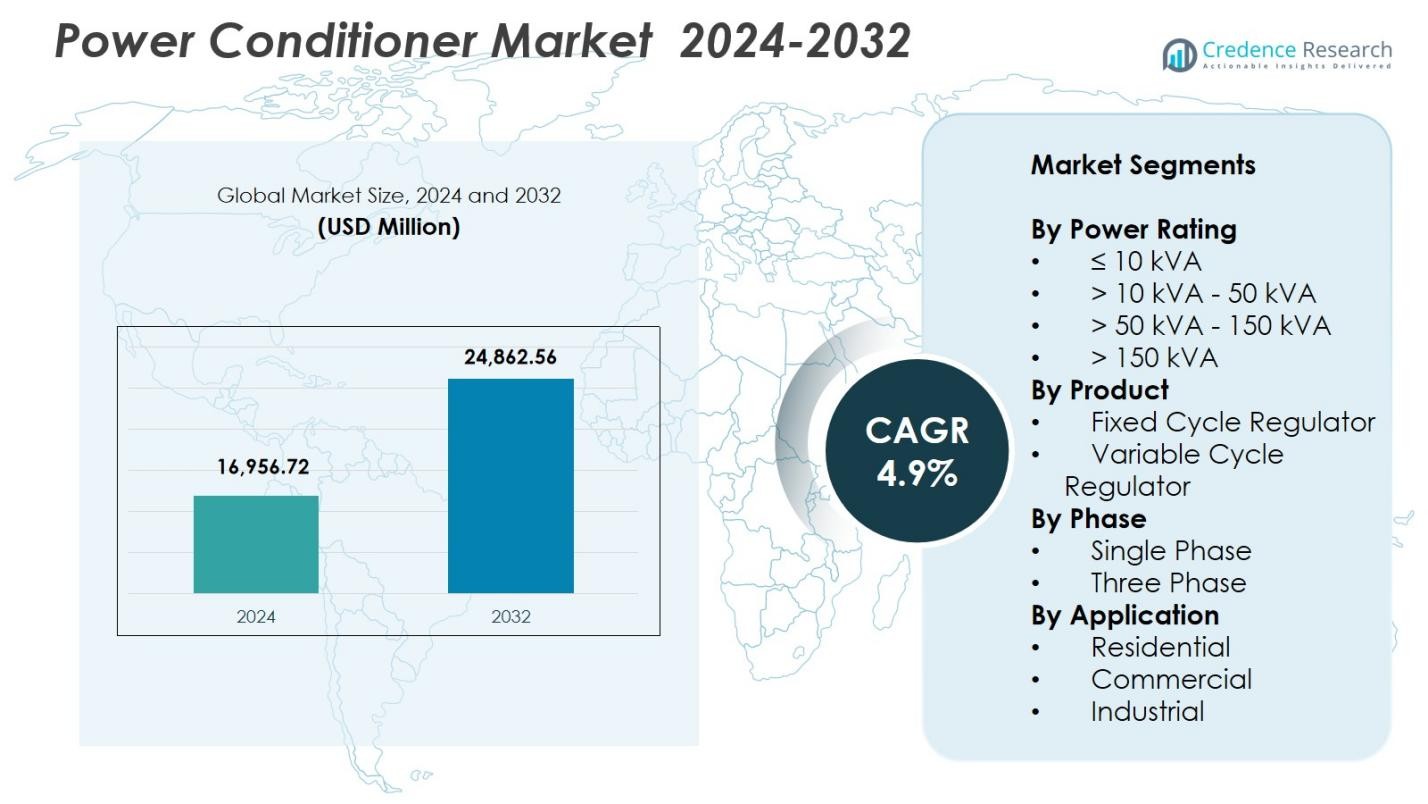
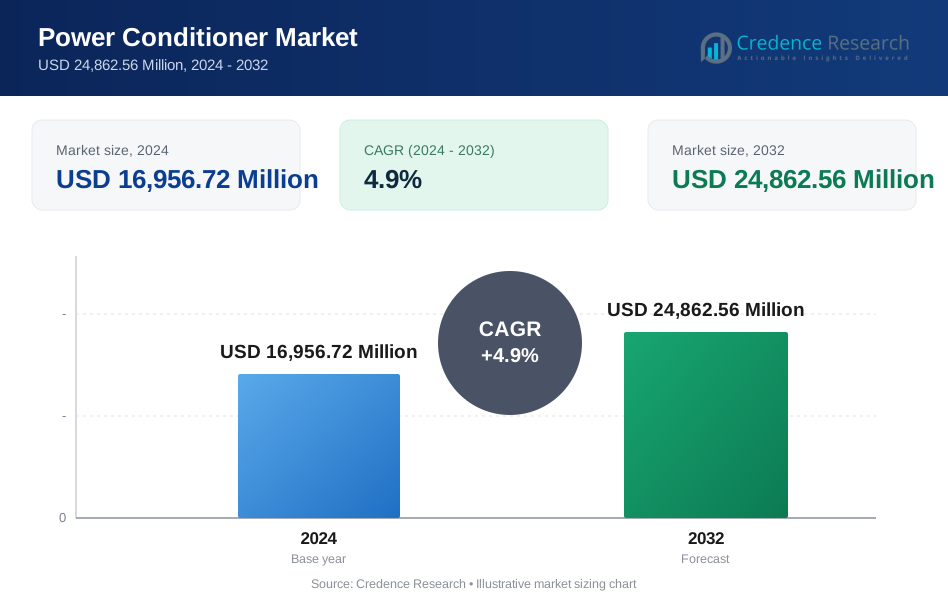
Power Conditioner Market size was valued at USD 16,956.72 Million in 2024 and is anticipated to reach USD 24,862.56 Million by 2032, at a CAGR of 4.9% during the forecast period.
| REPORT ATTRIBUTE | DETAILS |
|---|---|
| Historical Period | 2020-2023 |
| Base Year | 2024 |
| Forecast Period | 2025-2032 |
| Power Conditioner Market Size 2024 | USD 16,956.72 Million |
| Power Conditioner Market, CAGR | 4.9% |
| Power Conditioner Market Size 2032 | USD 24,862.56 Million |
Power Conditioner Market features leading players such as AMETEK, Delta Electronics, Eaton, Emerson Electric, Farmax Technologies, Fuji Electric, Hubbell, Legrand, Mitsubishi Electric Corporation, and Panasonic Industry, each strengthening their presence through technology upgrades, energy-efficient designs, and IoT-enabled monitoring capabilities. These companies focus on expanding product portfolios to address rising demand across industrial, commercial, and residential sectors. North America led the market with 34.7% share, driven by strong adoption of advanced power-quality systems in data centers, telecom, and manufacturing. Asia-Pacific followed closely with 29.4% share, supported by rapid industrialization and expanding digital infrastructure.
Market Insights
- Power Conditioner Market reached USD 16,956.72 Million in 2024 and will grow at a CAGR of 4.9% through 2032, driven by rising demand for high-quality power regulation.
- Market growth is fueled by the increasing use of sensitive electronics, industrial automation expansion, and greater adoption of renewable energy systems requiring stable voltage support, with the ≤10 kVA segment holding 41.6% share.
- Key trends include the shift toward IoT-enabled conditioners, advanced monitoring features, and strong demand for energy-efficient and eco-friendly regulator designs across commercial and industrial environments.
- Major players such as AMETEK, Eaton, Emerson Electric, Delta Electronics, Legrand, and Mitsubishi Electric focus on technological enhancements, wider product offerings, and strategic expansions to strengthen market presence globally.
- North America led with 34.7% share, followed by Asia-Pacific at 29.4% and Europe at 27.9%, reflecting strong adoption in data centers, telecom, and automated manufacturing facilities, while Latin America and Middle East & Africa show steady emerging demand.
Market Segmentation Analysis:
By Power Rating
The ≤10 kVA segment accounted for 41.6% share, making it the dominant category in the Power Conditioner Market due to its widespread use across commercial offices, telecom sites, retail outlets, and residential environments requiring stable voltage regulation. Its strong adoption is driven by rising deployment of sensitive electronic equipment, expansion of SMEs, and increasing reliance on connected devices that require uninterrupted and clean power. Higher segments such as >10 kVA – 50 kVA and >50 kVA – 150 kVA continue to grow, supported by industrial automation and data center expansion.
- For instance, Schneider Electric’s APC line includes power conditioners specifically designed for small office environments and telecom racks, ensuring consistent voltage for IT equipment.
By Product
The Fixed Cycle Regulator segment commanded 58.3% share, emerging as the leading product type owing to its reliability, stable voltage control, and lower maintenance requirements across industrial, commercial, and institutional landscapes. This segment grows strongly as industries prioritize power quality enhancement, protection from voltage fluctuations, and long service-life solutions. Meanwhile, the Variable Cycle Regulator segment expands steadily, supported by demand for precise voltage adjustments in manufacturing facilities, medical equipment, and high-precision electronics, where advanced regulation performance becomes essential for operational efficiency.
- For instance, ABB’s PCS100 AVC platform has been widely adopted in manufacturing plants for stabilizing voltage under fluctuating grid conditions.
By Phase
The Three Phase segment held 63.4% share, dominating the Power Conditioner Market due to its critical role in industrial plants, large commercial buildings, and data centers that operate high-capacity machinery and sensitive automation systems. Its growth is driven by rapid industrialization, expansion of heavy electrical infrastructure, and rising integration of power-intensive applications requiring stable voltage profiles. The Single Phase segment, while smaller in comparison, remains vital for residential and small-business applications, supported by increasing consumer electronics penetration and growing need for consistent power conditioning across basic load environments.
Key Growth Drivers
Rising Demand for Clean and Stable Power Supply
Growing dependence on sensitive electronic equipment across industries, commercial facilities, and residential environments drives strong demand for clean and stable power supply. Power conditioners play a critical role in mitigating voltage fluctuations, harmonics, and electrical noise that can damage high-value systems. The expansion of digital infrastructure, including data centers, telecom networks, and automated manufacturing units, further accelerates adoption. As operational uptime becomes a priority and equipment protection gains strategic importance, organizations increasingly integrate power conditioning systems to maintain performance, reduce downtime, and extend asset life.
- For instance, Schneider Electric’s AccuSine PCS+ solution has been used in hospitals and research facilities to mitigate electrical disturbances and protect mission-critical devices.
Expansion of Industrial Automation and Smart Manufacturing
Industrial automation continues to advance, creating a significant need for consistent power quality to support robotics, PLCs, CNC machines, and precision-driven production lines. Power conditioners enable uninterrupted operations and safeguard automation technologies from distortions and transient surges that disrupt efficiency. Smart factories integrating IIoT-driven systems rely heavily on regulated power to maintain real-time communication and machine-to-machine workflows. As industries pursue higher productivity, lean manufacturing, and reduced energy waste, demand for advanced power conditioning solutions strengthens across automotive, electronics, pharmaceuticals, and heavy engineering sectors.
- For instance, SolaHD’s Constant Voltage Transformers (CVS Series) used in industrial automation and control equipment, which filter harmonics and regulate voltage to prevent downtime and protect sensitive electronic loads in factory automation.
Growing Adoption of Renewable Energy Systems
The rapid installation of solar and wind power systems increases the need for stable voltage regulation, as renewable sources often generate variable output. Power conditioners help maintain consistent power flow, protect inverters, and enhance overall grid quality, supporting smooth integration of renewable assets. The shift toward decentralized energy, microgrids, and hybrid power systems further amplifies requirements for conditioning technologies to stabilize intermittent supply. As governments intensify renewable deployment targets and industries adopt green power for cost and sustainability benefits, power conditioner demand rises significantly.
Key Trends & Opportunities
Integration of Intelligent Monitoring and IoT Capabilities
The adoption of IoT-enabled power conditioners is rising as end users prioritize real-time monitoring, predictive diagnostics, and remote control capabilities. Smart conditioners allow facility managers to detect faults, analyze power quality trends, and schedule maintenance more efficiently, reducing unplanned downtime. Integration with energy management platforms unlocks opportunities for optimization and performance insights. Manufacturers increasingly embed analytics-driven features, enabling customized regulation modes for specific applications. This shift toward intelligent, connected solutions creates strong opportunities in data centers, high-tech manufacturing, telecom infrastructure, and commercial facilities.
- For instance, Siemens Energy partnered with AWS to deploy the Connected Factory platform using AWS IoT SiteWise Edge, connecting legacy equipment in 18 factories for real-time asset data analysis, which cut manual data collection time by 50% and reduced maintenance costs by 25%.
Growing Preference for Energy-Efficient and Eco-Friendly Designs
A strong trend toward energy-efficient power conditioning technologies is emerging as organizations seek to lower operational costs and comply with evolving sustainability regulations. Manufacturers are introducing advanced designs that reduce heat loss, improve efficiency ratios, and ensure minimal environmental impact. Opportunities expand across industries adopting ESG-focused procurement and upgrading outdated electrical infrastructure. Demand is especially strong in regions prioritizing green buildings, industrial decarbonization, and renewable integration. As end users aim to enhance power reliability while reducing energy consumption, efficient power conditioners gain substantial market traction.
- For instance, integration of silicon carbide (SiC) and gallium nitride (GaN) based inverters in power conditioning systems supports high-power utility-scale applications with improved DC-DC conversion efficiency for energy storage.
Key Challenges
High Installation and Maintenance Costs
One of the major challenges for the Power Conditioner Market is the high upfront cost associated with installation, particularly in industrial and large commercial settings requiring multi-phase, high-capacity systems. Ongoing maintenance costs also add to budget pressures, restricting adoption among SMEs and cost-sensitive sectors. Complex infrastructure integration, customization needs, and long cabling requirements further elevate project expenses. These financial barriers often delay upgrade cycles and limit market penetration in developing regions where capital allocation for power-quality solutions remains constrained.
Limited Awareness and Technical Expertise in Emerging Markets
In several developing regions, limited awareness of power quality issues and inadequate technical expertise hinder the adoption of power conditioners. Many small enterprises fail to recognize the long-term financial impact of voltage inconsistencies, equipment failures, and downtime. Additionally, the shortage of trained professionals to install, configure, and maintain advanced conditioning systems restricts market expansion. Lack of structured standards and inconsistent enforcement of electrical regulations further complicate implementation. Addressing knowledge gaps and improving field-level technical support remain essential to unlocking growth in these markets.
Regional Analysis
North America
North America held 34.7% market share, driven by the widespread adoption of advanced electronic systems across data centers, telecom infrastructure, and industrial automation environments requiring stable and high-quality power. Strong regulatory focus on energy efficiency and electrical reliability accelerates modernization of commercial buildings and manufacturing facilities. The U.S. leads the region due to rapid expansion in IT workloads, cloud infrastructure, and smart manufacturing investments. Rising integration of renewable energy systems and continued upgrades to aging electrical networks further strengthen demand for power conditioners across commercial, residential, and industrial sectors.
Europe
Europe accounted for 27.9% market share, supported by stringent power quality standards, industrial automation growth, and widespread modernization of electrical infrastructure across Germany, the U.K., and France. The region benefits from strong adoption of energy-efficient power conditioning solutions aligned with EU sustainability frameworks. Expansion of EV charging infrastructure, renewable energy integration, and smart grid upgrades increases the requirement for stable voltage regulation. Manufacturing hubs, pharmaceutical plants, and advanced research facilities drive continued demand, while increasing digitalization and data center construction boost adoption across Western and Northern Europe.
Asia-Pacific
Asia-Pacific emerged as the fastest-growing region with 29.4% market share, propelled by rapid industrialization, expanding telecom networks, and rising deployment of consumer and industrial electronics. China, India, Japan, and South Korea contribute significantly due to large-scale manufacturing activity and increasing dependence on automated systems requiring stable power. Growth in cloud infrastructure, data centers, and renewable energy installations amplifies the need for advanced conditioning technologies. Urbanization, infrastructure upgrades, and expansion of commercial buildings further strengthen demand, positioning the region as a major long-term contributor to global market growth.
Latin America
Latin America captured 4.2% market share, driven by increasing adoption of voltage regulation solutions across industrial plants, utilities, and commercial centers. Brazil and Mexico lead the region due to ongoing investment in manufacturing, oil and gas operations, and telecom expansion requiring consistent power quality. Infrastructure modernization initiatives and rising awareness of equipment protection expand opportunities for power conditioners. However, budget constraints and uneven technical expertise limit adoption in smaller enterprises. Growth is supported by expanding renewable energy capacity and increasing digitization across large corporate and public-sector facilities.
Middle East & Africa
The Middle East & Africa region accounted for 3.8% market share, supported by growing industrial activity, infrastructure development, and rising deployment of automation technologies in utilities, oil and gas, and large commercial establishments. GCC countries lead adoption due to major investments in smart cities, large construction projects, and data center expansion. Africa shows gradual progress driven by power instability issues that heighten the need for conditioning systems. While demand grows steadily, challenges such as limited technical resources and capital constraints slow broader penetration across emerging markets.
Market Segmentations:
By Power Rating
- ≤ 10 kVA
- > 10 kVA - 50 kVA
- > 50 kVA - 150 kVA
- > 150 kVA
By Product
- Fixed Cycle Regulator
- Variable Cycle Regulator
By Phase
- Single Phase
- Three Phase
By Application
- Residential
- Commercial
- Industrial
By Geography
- North America
- U.S.
- Canada
- Mexico
- Europe
- Germany
- France
- U.K.
- Italy
- Spain
- Rest of Europe
- Asia Pacific
- China
- Japan
- India
- South Korea
- South-east Asia
- Rest of Asia Pacific
- Latin America
- Brazil
- Argentina
- Rest of Latin America
- Middle East & Africa
- GCC Countries
- South Africa
- Rest of the Middle East and Africa
Competitive Landscape
The competitive landscape of the Power Conditioner Market features key players such as AMETEK, Delta Electronics, Eaton, Emerson Electric, Farmax Technologies, Fuji Electric, Hubbell, Legrand, Mitsubishi Electric Corporation, and Panasonic Industry, each contributing to innovation and product expansion. The market exhibits strong technological advancement as manufacturers focus on improving energy efficiency, integrating IoT-enabled monitoring, and enhancing voltage regulation accuracy to support industrial automation and digital infrastructure. Companies invest heavily in R&D to develop compact, high-performance conditioners tailored for data centers, telecom networks, and precision manufacturing environments. Strategic initiatives—including portfolio diversification, global distribution expansion, and partnerships with utility companies—strengthen competitive positioning. Growing emphasis on renewable energy integration and sustainable electrical systems encourages players to introduce environmentally efficient designs. Additionally, rising customer demand for reliability, long lifecycle products, and real-time power quality analytics drives continual innovation, enabling manufacturers to differentiate offerings and capture emerging opportunities across industrial, commercial, and residential sectors.
Key Player Analysis
- Farmax Technologies
- Panasonic Industry
- Emerson Electric
- Legrand
- Delta Electronics
- Hubbell
- Fuji Electric
- Mitsubishi Electric Corporation
- Eaton
- AMETEK
Recent Developments
- In July 2025, Eaton announced its acquisition of Resilient Power Systems Inc., a U.S.-based company specializing in advanced medium-voltage power conversion and solid-state transformer technologies, expanding its power management portfolio.
- In October 2025, ABB launched a new 600 V/690 V version of its PCS100 AVC-40 active voltage conditioner tailored for heavy industrial applications.
- In December 2024, ABB signed an agreement to acquire the power-electronics business of Gamesa Electric (previously part of Siemens Gamesa), a move that broadens ABB’s capabilities in renewable-power conversion and utility-scale power conditioning solutions.
Report Coverage
The research report offers an in-depth analysis based on Power Rating, Product, Phase, Application and Geography. It details leading market players, providing an overview of their business, product offerings, investments, revenue streams, and key applications. Additionally, the report includes insights into the competitive environment, SWOT analysis, current market trends, as well as the primary drivers and constraints. Furthermore, it discusses various factors that have driven market expansion in recent years. The report also explores market dynamics, regulatory scenarios, and technological advancements that are shaping the industry. It assesses the impact of external factors and global economic changes on market growth. Lastly, it provides strategic recommendations for new entrants and established companies to navigate the complexities of the market.
Future Outlook
- The market will experience steady demand as industries prioritize consistent power quality to protect automation and digital infrastructure.
- Adoption of intelligent, IoT-enabled power conditioners will expand as end users seek real-time monitoring and predictive maintenance.
- Growth in data centers and cloud facilities will drive higher deployment of three-phase and high-capacity conditioning systems.
- Increasing integration of renewable energy sources will boost the need for advanced voltage stabilization technologies.
- Manufacturers will focus on energy-efficient and eco-friendly product designs to meet sustainability targets.
- Expansion of smart manufacturing and Industry 4.0 initiatives will elevate demand for precision power conditioning solutions.
- Rising urbanization and commercial infrastructure development will strengthen adoption across developing regions.
- Advances in semiconductor materials and control electronics will improve efficiency and performance.
- Growing reliance on sensitive medical, telecom, and research equipment will accelerate market penetration.
- Strategic partnerships and product innovation will reinforce the market’s long-term technological evolution.
Request a Free Sample
Fill in your details and we'll send you a free sample report.
- Sample data tables & charts
- Research methodology
Need a Custom Version of This Report?
Tailor the scope, geography, or segments to your exact requirements.
- Custom geography or segment scope
- Direct access to our analyst team
Frequently Asked Questions
What is the current market size for Power Conditioner Market, and what is its projected size in 2032?
At what Compound Annual Growth Rate is the Power Conditioner Market projected to grow between 2025 and 2032?
Which Power Conditioner Market segment held the largest share in 2024?
What are the primary factors fueling the growth of the Power Conditioner Market?
Who are the leading companies in the Power Conditioner Market?
Which region commanded the largest share of the Power Conditioner Market in 2024?
Table of Content
Chapter 1. Report Introduction
- 1.1 Report Description & Purpose
- 1.1.1 Report Title & Market Definition
- 1.1.2 Unique Selling Propositions (USP) & Key Differentiators
- 1.1.3 Value Proposition for Stakeholders
- 1.2 Research Objectives
- 1.2.1 Market Sizing Objectives (Volume & Revenue)
- 1.2.2 Segmentation Objectives
- 1.2.3 Competitive Intelligence Objectives
- 1.2.4 Forecast & Scenario Objectives
- 1.3 Report Scope
- 1.3.1 Power Conditioner Scope – Types & Subtypes Covered
- 1.3.2 Geographic Scope – Regions & Countries Covered
- 1.3.3 Historical Period, Base Year & Forecast Period (2024; forecast to 2032)
- 1.3.4 Inclusions & Exclusions
- 1.4 HS Code & Classification Framework
- 1.5 Currency, Units & Pricing Basis
- 1.6 Target Stakeholders
- 1.7 Limitations & Assumptions
Chapter 2. Executive Summary
- 2.1 Global Power Conditioner Market Snapshot
- 2.1.1 Market Size – Historical (2024) & Forecast (2024-2032) (2024: USD 16,956.72 Million → 2032: USD 24,862.56 Million)
- 2.1.2 Volume & Revenue – Global Totals
- 2.1.3 Key Market Highlights – Top Five Facts
- 2.2 Power Conditioner Market Segmentation Snapshot
- 2.2.1 Market Split by Region – 2024 vs. 2032
- 2.3 Competitive Snapshot
- 2.3.1 Top 10 Players by Revenue Share – 2024
- 2.3.2 Top 10 Players by Volume Share – 2024
- 2.3.3 Recent Strategic Developments (18-Month Summary)
- 2.4 Key Investment Highlights & Strategic Conclusions
Chapter 3. Power Conditioner Market Dynamics & Industry Analysis
- 3.1 Market Overview & Context
- 3.1.1 Power Conditioner Market Position in the Broader Automotive Value Chain
- 3.1.2 OEM vs. Replacement Market Dynamics
- 3.1.3 Market Maturity & Development Stage by Region
- 3.2 Power Conditioner Market Drivers
- 3.3 Power Conditioner Market Restraints & Challenges
- 3.4 Power Conditioner Market Opportunities
- 3.5 Porter's Five Forces Analysis
- 3.5.1 Threat of New Entrants
- 3.5.2 Bargaining Power of Suppliers
- 3.5.3 Bargaining Power of Buyers
- 3.5.4 Threat of Substitutes
- 3.5.5 Competitive Rivalry – Intensity Assessment
- 3.6 Power Conditioner Value Chain Analysis
- 3.6.1 Upstream – Raw Material/Input Suppliers
- 3.6.1.1 Raw Material/Input 1
- 3.6.1.2 Raw Material/Input 2
- 3.6.1.3 Raw Material/Input 3
- 3.6.2 Midstream – Production/Manufacturing/Service Delivery
- 3.6.2.1 Production/Process Overview
- 3.6.2.2 Key Facility Locations & Capacity by Manufacturer
- 3.6.3 Downstream – Distribution & End Consumer
- 3.6.3.1 Primary Channel – B2B/OEM
- 3.6.3.2 Secondary Channels – Dealer, Retail, Online, Direct
- 3.6.4 Value Chain Profitability Analysis
- 3.6.1 Upstream – Raw Material/Input Suppliers
- 3.7 PESTEL Analysis
- 3.7.1 Political Factors
- 3.7.2 Economic Factors
- 3.7.3 Social Factors
- 3.7.4 Technological Factors
- 3.7.5 Environmental Factors
- 3.7.6 Legal Factors
- 3.8 Power Conditioner Supply Chain Analysis
- 3.8.1 Raw Material/Input Supply Risk Assessment
- 3.8.2 Manufacturing Concentration Risk (Geographic Exposure)
- 3.8.3 Trade Disruption Impact Analysis
- 3.9 Regulatory & Policy Landscape
Note: The regulatory and policy landscape section covers regulations based on their applicability to the market, Power Conditioner category, geography, and scope of the study. Only regulatory frameworks with a material impact on operations, compliance, trade, sustainability, or market access are analyzed in detail.
Chapter 4. Key Investment Pockets & Opportunity Analysis
- 4.1 Power Conditioner Market Attractiveness Analysis
- 4.1.1 By Region – Investment Attractiveness Matrix (Volume × CAGR)
- 4.2 Absolute Revenue Growth Opportunity
- 4.2.1 By Region – Absolute USD Growth Through 2032
- 4.3 Incremental Volume Opportunity
- 4.3.1 By Region – Incremental Volume Through 2032
- 4.3.2 Segment – Incremental Volume
- 4.4 Emerging Submarket Opportunity Deep Dive (Subject to Applicability)
- 4.5 Emerging Market Opportunity Scorecards
- 4.5.1 United States
- 4.5.2 Europe
- 4.5.3 Asia
- 4.5.4 Middle East & Africa
Note: Emerging Market Opportunity Scorecards will be included based on relevance and strategic importance. Regions listed are indicative and may vary depending on data availability and market dynamics.
Chapter 5. Power Conditioner Import-Export Analysis & Trade Flows
- 5.1 Global Trade Overview
- 5.1.1 Global Export Value by Country (2024)
- 5.1.2 Global Export Volume by Country (2024)
- 5.1.3 Global Import Value by Country (2024)
- 5.1.4 Global Import Volume by Country (2024)
- 5.1.5 Net Trade Balance by Country (2024)
- 5.2 Export Analysis – Segment
- 5.2.1 Type 1 (HS Code)
- 5.2.2 Type 2 (HS Code)
- 5.2.3 Type 3 (HS Code)
- 5.2.4 Type 4 (HS Code)
- 5.2.5 Type 5 (HS Code)
- 5.3 Import Analysis – Segment
- 5.3.1 Type 1 (HS Code)
- 5.3.2 Type 2 (HS Code)
- 5.3.3 Type 3 (HS Code)
- 5.3.4 Type 4 (HS Code)
- 5.3.5 Type 5 (HS Code)
- 5.4 Average Unit Trade Prices
- 5.4.1 Average Export Price – Segment & Country
- 5.4.2 Average Import Price – Segment & Source Country
- 5.4.3 Price Trends (2024)
- 5.5 Key Trade Route Analysis
- 5.5.1 Trade Route 1
- 5.5.2 Trade Route 2
- 5.5.3 Trade Route 3
- 5.5.4 Trade Route 4
- 5.5.5 Trade Route 5
- 5.6 Trade Policy Impact Assessment
- 5.6.1 US Anti-Dumping & Section 301 Tariffs
- 5.6.2 EU Customs Union Impact
- 5.6.3 Major Free Trade Agreements
- 5.6.4 USMCA Rules of Origin
Note: Trade policy analysis will be included only where relevant to the Power Conditioner market.
Chapter 6. Competitive Landscape & Company Benchmarking
- 6.1 Power Conditioner Market Concentration & Structure
- 6.1.1 Herfindahl-Hirschman Index (HHI) – vs. 2024
- 6.1.2 Tier 1, Tier 2 & Tier 3 Market Structure
- 6.1.3 Global, Regional & Local Player Dynamics
- 6.2 Power Conditioner Market Share Analysis – 2024
- 6.2.1 Global Revenue Share by Company
- 6.2.2 Global Volume Share by Company
- 6.2.3 Regional Revenue Share
- 6.2.4 Market Share Evolution ( vs. 2024)
- 6.2.5 OEM Segment Share by Company
- 6.2.6 Replacement Segment Share by Company
- 6.3 Production/Delivery Capacity & Facility Analysis
- 6.3.1 Global Installed Capacity
- 6.3.2 Capacity Utilization Rates
- 6.3.3 Production/Output Volume
- 6.3.4 Facility Locations & Capacity Map
- 6.3.5 Planned Capacity Additions
- 6.4 Power Conditioner Competitive Benchmarking Matrix
- 6.4.1 Revenue, Volume, CAGR & Profitability Comparison
- 6.4.2 Channel Revenue Mix
- 6.4.3 Geographic Revenue Exposure
- 6.4.4 R&D Intensity
- 6.4.5 Sustainability Maturity
- 6.5 Strategic Developments in Power Conditioner (Last 24 Months)
- 6.5.1 Mergers, Acquisitions & Divestments
- 6.5.2 New Power Conditioner Launches
- 6.5.3 Facility Expansions
- 6.5.4 Strategic Alliances, Joint Ventures & Partnerships
- 6.5.5 Distribution Expansion & Market Entry
- 6.5.6 Sustainability & ESG Initiatives
- 6.6 Competitive Strategy Mapping
- 6.6.1 Leader, Challenger, Follower & Niche Classification
- 6.6.2 Pricing Strategy Comparison
- 6.6.3 Channel Strategy Matrix
Note: Strategic developments are included based on their materiality and the availability of reliable information.
Chapter 7. Global Power Conditioner Market – By Distribution Channel
- 7.1 Segment Overview
- 7.1.1 Volume & Revenue Split by Channel (2024 & 2032)
- 7.1.2 Channel Mix Evolution (2024-2032)
Chapter 8. Regional Market Analysis – Global Overview
- 8.1 Global Regional Overview
- 8.1.1 Regional Volume Share
- 8.1.2 Regional Revenue Share
- 8.1.3 Regional Volume by Region
- 8.1.4 Regional Revenue by Region
- 8.1.5 Regional Forecast Through 2032
- 8.2 Cross-Regional Segment Analysis
- 8.2.1 By Distribution Channel
- 8.2.2 By Brand/Price Tier
Chapter 9. North America Power Conditioner Market
- 9.1 United States
- 9.2 Canada
- 9.3 Mexico
Chapter 10. Europe Power Conditioner Market
- 10.1 Germany
- 10.2 France
- 10.3 Italy
- 10.4 United Kingdom
- 10.5 Spain
- 10.6 Poland
- 10.7 Russia
- 10.8 Netherlands
- 10.9 Belgium
- 10.10 Sweden
- 10.11 Denmark
- 10.12 Norway
- 10.13 Rest of Europe
Chapter 11. Asia Pacific Power Conditioner Market
- 11.1 China
- 11.2 India
- 11.3 Japan
- 11.4 South Korea
- 11.5 Thailand
- 11.6 Indonesia
- 11.7 Vietnam
- 11.8 Malaysia
- 11.9 Australia
- 11.10 Rest of Asia Pacific
Chapter 12. Latin America Power Conditioner Market
- 12.1 Brazil
- 12.2 Argentina
- 12.3 Colombia
- 12.4 Chile
- 12.5 Rest of Latin America
Chapter 13. Middle East Power Conditioner Market
- 13.1 Saudi Arabia
- 13.2 United Arab Emirates
- 13.3 Turkey
- 13.4 Israel
- 13.5 Iran
- 13.6 Rest of the Middle East
Chapter 14. Africa Power Conditioner Market
- 14.1 South Africa
- 14.2 Egypt
- 14.3 Nigeria
- 14.4 Morocco
- 14.5 Rest of Africa
Chapter 15. Power Conditioner Company Profiles
- 15.1 [Company 01]
- 15.1.1 Company Overview
- 15.1.2 Key Management Personnel
- 15.1.3 Products & Services Portfolio
- 15.1.4 Financial Performance
- 15.1.5 Key Market Focus & Geographic Presence
- 15.1.6 Recent Developments & Strategic Initiatives
Note: The company profile list is preliminary and may change based on research findings, market developments, data availability, and client requirements.
Chapter 16. Appendices
- Appendix A – List of Abbreviations & Acronyms
- Appendix B – Industry Classification Code Reference – Full Series
- Appendix C – Production & Capacity Data Tables
- Appendix D – End-Use & Demand Base Tables
- Appendix E – Consumption & Replacement Rate Assumptions
- Appendix F – ASP Reference Tables
- Appendix G – Manufacturing & Facility Database
- Appendix H – Import-Export Data Tables
- Appendix I – Regulatory Summary Tables
- Appendix J – Primary Research Participant List (Anonymized)
- Appendix K – Primary Research Questionnaire Framework
- Appendix L – Data Sources & Bibliography
- Appendix M – Market Size Divergence & Source Comparison
Chapter 17. Research Methodology
- 17.1 Research Framework & Philosophy
- 17.2 Secondary Research – Sources, Hierarchy & Data Extraction
- 17.3 Data Modeling – Bottom-Up & Top-Down Market Sizing
- 17.4 Primary Research – Stakeholder Framework, LOI & Sample Sizes
- 17.5 Forecast Methodology – Regression, Scenario & Sensitivity Analysis
- 17.6 Quality Control – Four-Layer Validation Framework
- 17.7 Limitations & Standard Assumptions
- 17.8 Disclaimer
