
Market Overview
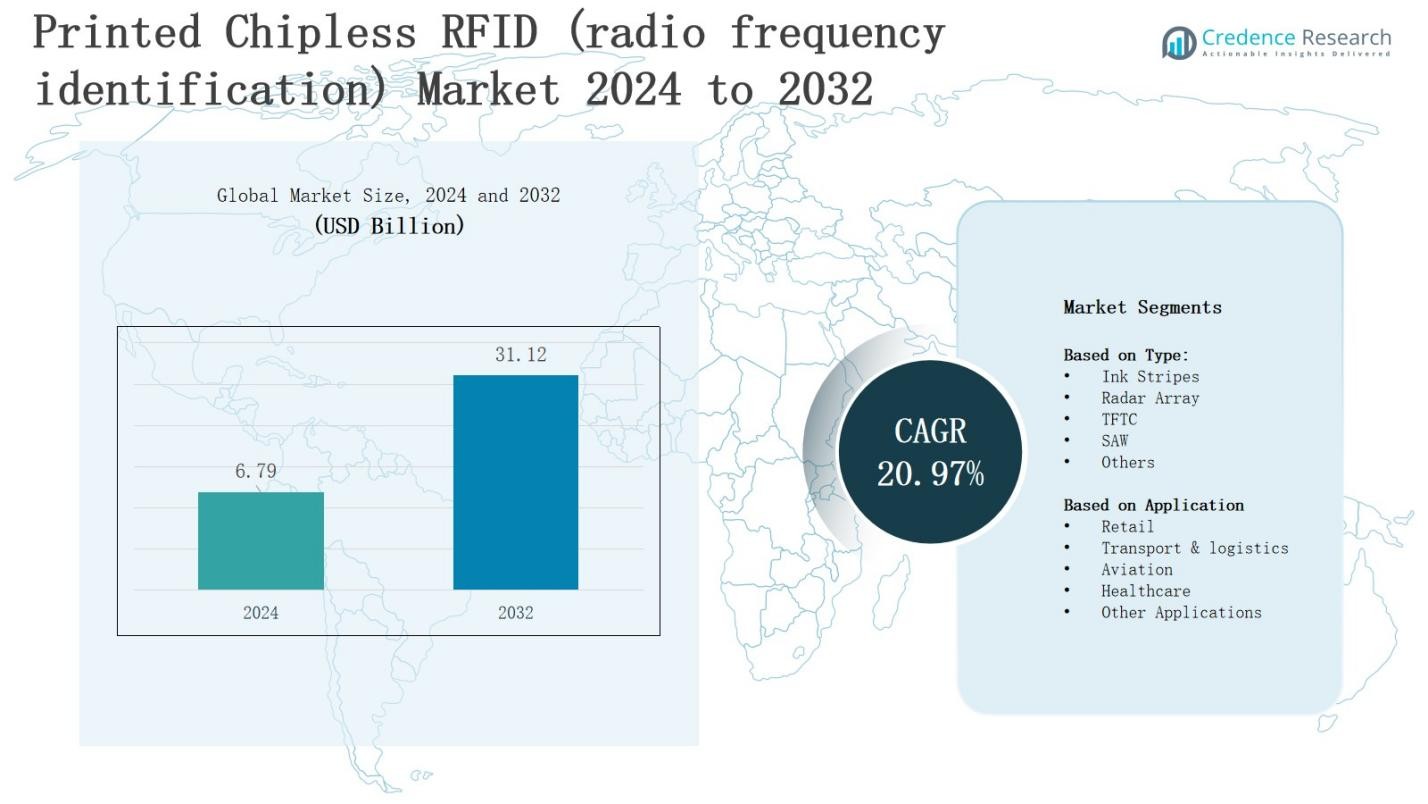
The Printed and Chipless RFID (radio frequency identification) market is projected to grow from USD 6.79 billion in 2024 to USD 31.12 billion by 2032, registering a robust CAGR of 20.97%.
| REPORT ATTRIBUTE | DETAILS |
|---|---|
| Historical Period | 2020-2024 |
| Base Year | 2024 |
| Forecast Period | 2025-2032 |
| Printed and Chipless RFID (radio frequency identification) Market Size 2024 | USD 6.79 billion |
| Printed and Chipless RFID (radio frequency identification) Market, CAGR | 20.97%. |
| Printed and Chipless RFID (radio frequency identification) Market Size 2032 | USD 31.12 billion |
The printed chipless RFID radio frequency identification market is gaining momentum driven by rising demand for cost-effective and scalable tracking solutions across industries such as retail, logistics, and healthcare. Companies are adopting chipless RFID for its advantages, including low production costs, eco-friendly manufacturing, and easy integration into packaging and labels. Growing emphasis on supply chain transparency and real-time inventory management further accelerates adoption. Additionally, technological advancements in printed electronics and conductive inks are enhancing performance and durability of chipless RFID tags. These trends collectively position the market for rapid growth and widespread industrial implementation in the coming years.
The printed chipless RFID radio frequency identification market shows diverse geographical adoption with North America leading, followed by Europe and Asia-Pacific, while the Middle East & Africa and Latin America witness steady growth. North America and Europe drive demand through retail, healthcare, and aviation, whereas Asia-Pacific benefits from strong e-commerce and manufacturing expansion. The Middle East & Africa leverage aviation and smart infrastructure, while Latin America advances through retail and logistics. Key players include Alien Technology, Avery Dennison Corporation, CCL Industries, Impinj Inc., NXP Semiconductors, Smartrac N.V., and Honeywell International Inc.
Market Insights
- The printed chipless RFID radio frequency identification market will expand from USD 6.79 billion in 2024 to USD 31.12 billion by 2032, growing at a CAGR of 20.97%.
- Ink Stripes dominate the type segment with 38% share, while Retail leads applications with 40%, driven by cost-effective integration, automated checkout, and demand for scalable inventory management solutions.
- North America holds 34% share, Europe 27%, Asia-Pacific 28%, Middle East & Africa 6%, and Latin America 5%, reflecting diverse adoption patterns across industries and regions.
- Strong demand arises from retail, logistics, healthcare, and aviation, with emphasis on supply chain transparency, anti-counterfeiting, and real-time tracking strengthening industry-wide adoption and application scope.
- Key players include Alien Technology, Avery Dennison Corporation, CCL Industries, Checkpoint Systems Inc., Confidex Ltd., GAO RFID Inc., HID Global, Honeywell International, Impinj Inc., Invengo, NXP Semiconductors, RFID4U, and Smartrac N.V.
Market Drivers
Rising Demand for Cost-Effective Identification Solutions
The printed chipless RFID radio frequency identification market is witnessing strong growth due to increasing need for low-cost alternatives to conventional RFID systems. It eliminates the requirement for silicon chips, reducing manufacturing expenses and enabling large-scale deployment. Businesses seek affordable identification technologies to manage high product volumes efficiently. It also supports easy integration into packaging, labels, and documents. Industries adopt it to replace traditional barcodes, offering superior data storage and durability benefits.
- For instance, Walmart employs RFID technology extensively for real-time inventory tracking, enabling increased operational efficiency and reduced out-of-stock situations.
Growing Emphasis on Supply Chain Efficiency
The printed chipless RFID radio frequency identification market benefits from rising pressure on companies to improve supply chain visibility and inventory control. It enables accurate, real-time tracking of goods, reducing errors and losses. Businesses gain operational efficiency by using it for faster scanning and improved logistics management. It enhances transparency by recording detailed product information throughout distribution networks. This feature allows industries to strengthen compliance standards and optimize resource utilization significantly.
- For instance, Walmart integrated RFID across categories like apparel and home goods in 2022, reporting improved shelf availability and reduced stockouts through real-time item-level tracking.
Technological Advancements in Printed Electronics
The printed chipless RFID radio frequency identification market experiences acceleration through continuous improvements in printed electronics and conductive materials. It benefits from better tag durability, enhanced read ranges, and scalable production methods. New ink formulations and substrates increase flexibility and reliability of tags. It supports wider applications in harsh conditions where traditional tags fail. Businesses invest in research to achieve improved functionality, helping it expand across diverse industrial use cases effectively.
Sustainability and Eco-Friendly Manufacturing Practices
The printed chipless RFID radio frequency identification market aligns with growing sustainability goals, encouraging industries to adopt eco-friendly solutions. It eliminates dependence on silicon-based chips, lowering electronic waste significantly. Manufacturers produce it using recyclable materials and energy-efficient processes. Businesses prioritize sustainable supply chains, and it supports these objectives by offering greener alternatives. Eco-conscious consumers influence industries to adopt environmentally responsible technologies, strengthening the market’s growth momentum in global applications consistently.
Market Trends
Integration into Smart Packaging and Labeling Applications
The printed chipless RFID radio frequency identification market is experiencing a strong trend toward integration into smart packaging and labeling. It allows manufacturers and retailers to embed product information directly into packaging, enhancing traceability and authentication. It supports brand protection efforts by reducing risks of counterfeiting. Retailers leverage it for real-time inventory checks and automated checkout systems. Consumers benefit from greater product transparency. This trend strengthens adoption across consumer goods, pharmaceuticals, and food industries globally.
- For instance, Wiliot partnered with the U.S. Department of Defense in 2023 to use battery-free RFID tags for real-time tracking of perishable goods through labels that sense temperature and location.
Expansion Across Healthcare and Pharmaceutical Sectors
The printed chipless RFID radio frequency identification market is witnessing increased traction in healthcare and pharmaceuticals due to its efficiency in patient safety and drug tracking. It enables secure identification of medical supplies, reducing errors in hospitals. It assists in managing expiration dates and regulatory compliance. Healthcare providers value it for asset tracking and improved logistics. The pharmaceutical industry adopts it to fight counterfeit drugs. This trend ensures wider acceptance in critical, high-value sectors worldwide.
- For instance, Fresenius Kabi integrated RFID smart labels on its intravenous medications in the U.S. to help hospitals automatically validate drug identity and reduce manual handling errors
Advancements in Conductive Inks and Materials
The printed chipless RFID radio frequency identification market benefits from ongoing innovation in conductive inks and substrate materials. It enhances performance by providing stronger signals, higher durability, and flexible designs. It supports mass production while maintaining low costs. Manufacturers develop new formulations for eco-friendly and recyclable tags. The trend drives adoption in industries requiring sustainability. Continuous improvements make it more adaptable to diverse conditions. These advancements expand opportunities across packaging, retail, and industrial applications.
Adoption Aligned with Sustainability Goals
The printed chipless RFID radio frequency identification market aligns with a broader trend toward sustainable and eco-conscious business practices. It reduces dependency on silicon-based chips, cutting electronic waste substantially. It is produced using recyclable or biodegradable materials. Businesses value it for supporting carbon reduction initiatives. Global industries prioritize green supply chains, and this technology complements those goals. Consumer demand for environmentally responsible solutions accelerates adoption. This trend reinforces long-term growth prospects in multiple sectors.
Market Challenges Analysis
Limitations in Performance and Read Range
The printed chipless RFID radio frequency identification market faces challenges due to limitations in read range and performance compared to conventional RFID systems. It often struggles with signal strength in environments with interference from metals, liquids, or dense packaging. Businesses expect high-speed scanning across wide areas, yet it sometimes fails to meet these standards. It requires further development in materials and antenna design to enhance accuracy. These limitations restrict adoption in sectors demanding consistent, large-scale tracking capabilities.
Concerns Over Standardization and Interoperability
The printed chipless RFID radio frequency identification market also encounters difficulties related to lack of standardization and interoperability across regions. It lacks universal protocols, making integration with existing supply chain systems more complex. Businesses hesitate to invest heavily without clear standards that guarantee compatibility. It creates uncertainty in scalability for global operations. Vendors must collaborate to establish unified guidelines and frameworks. Without resolution, these challenges can slow adoption and limit the market’s broader potential.
Market Opportunities
Adoption Across Retail and Consumer Goods
The printed chipless RFID radio frequency identification market holds significant opportunities in retail and consumer goods sectors where businesses demand affordable and scalable tracking solutions. It enables real-time visibility of products, supports automated checkout systems, and enhances inventory accuracy. It strengthens anti-counterfeiting measures by embedding unique identifiers into packaging. Retailers can improve customer experience through faster transactions and transparent product information. With increasing focus on digital supply chains, it becomes a practical solution for mass-market applications.
Expansion into Emerging Economies and Industrial Applications
The printed chipless RFID radio frequency identification market is positioned for growth in emerging economies where industries seek cost-effective and eco-friendly technologies. It offers a viable option for companies in logistics, manufacturing, and healthcare to improve operational efficiency. It supports governments and organizations that emphasize traceability and compliance. Industrial sectors benefit from its durability and low-cost production. By enabling affordable adoption at scale, it opens new pathways for market penetration and long-term development globally.
Market Segmentation Analysis:
By Type
The printed chipless RFID radio frequency identification market, when segmented by type, is dominated by Ink Stripes, which account for nearly 38% of the market share. Ink stripes are widely adopted due to their low cost, ease of manufacturing, and compatibility with packaging and labeling. Radar Array holds around 25% share, driven by its reliability in high-density environments. SAW captures nearly 15% share with strong adoption in industrial applications, while TFTC contributes about 12% share due to precision advantages. The remaining 10% share comes from other niche technologies, catering to specialized use cases.
- For instance, Thinfilm Electronics demonstrated ink-based printed memories and RFID labels for smart packaging used by global consumer brands like Diageo to verify authenticity of liquor bottles.
By Application
The printed chipless RFID radio frequency identification market, by application, is led by the Retail segment, commanding nearly 40% of the total share due to rising adoption for inventory management, automated checkout, and anti-counterfeiting. Transport and logistics represent around 22% share, supported by the growing need for real-time shipment visibility. Aviation contributes about 15% share, leveraging the technology for baggage and asset tracking. Healthcare holds approximately 13% share, focusing on drug authentication and patient safety. The remaining 10% share belongs to other applications, including industrial and government sectors.
- For instance, Fresenius Medical Care integrates RFID tags into its dialysis products to ensure error-free matching of patients with the correct machines and consumables.
Segments:
Based on Type:
- Ink Stripes
- Radar Array
- TFTC
- SAW
- Others
Based on Application
- Retail
- Transport & logistics
- Aviation
- Healthcare
- Other Applications
Based on the Geography:
- North America
- U.S.
- Canada
- Mexico
- Europe
- Germany
- France
- U.K.
- Italy
- Spain
- Rest of Europe
- Asia Pacific
- China
- Japan
- India
- South Korea
- South-east Asia
- Rest of Asia Pacific
- Latin America
- Brazil
- Argentina
- Rest of Latin America
- Middle East & Africa
- GCC Countries
- South Africa
- Rest of the Middle East and Africa
Regional Analysis
North America
North America holds the leading position in the printed chipless RFID radio frequency identification market with 34% share. Strong demand from retail, logistics, and healthcare industries drives adoption in the region. It benefits from early technological advancements and a well-established supply chain infrastructure. Companies in the United States invest heavily in research to enhance tag durability and reduce costs. It also gains traction in aviation, where airports implement advanced tracking systems. Widespread emphasis on automation strengthens its role in industrial operations.
Europe
Europe accounts for 27% share of the printed chipless RFID radio frequency identification market, supported by regulatory focus on traceability and sustainable practices. It is increasingly used in packaging and labeling applications, particularly in food, beverages, and pharmaceuticals. The presence of established technology providers contributes to steady adoption. Industries in Germany, France, and the UK prioritize it for supply chain efficiency. The aviation sector also implements it for baggage management. Continuous innovation in printed electronics accelerates its deployment across industries.
Asia-Pacific
Asia-Pacific represents 28% share of the printed chipless RFID radio frequency identification market, reflecting rapid industrial growth and rising demand for low-cost solutions. It gains strong traction in retail and transport sectors due to high e-commerce activity. China, Japan, and India lead adoption, supported by large-scale manufacturing and logistics networks. It aligns well with regional initiatives promoting digital supply chains. Strong government support for smart technology integration enhances deployment. Expanding urbanization further fuels market growth across multiple applications.
Middle East & Africa
The Middle East & Africa region contributes 6% share of the printed chipless RFID radio frequency identification market. It is driven by gradual adoption in retail, aviation, and logistics sectors. Governments invest in smart infrastructure projects that create opportunities for technology providers. The aviation industry in Gulf countries increasingly applies it to improve passenger and baggage tracking. It also finds applications in healthcare for monitoring critical supplies. Growing awareness of cost-effective identification technologies supports future expansion.
Latin America
Latin America holds 5% share of the printed chipless RFID radio frequency identification market, with growth led by retail and logistics adoption. Brazil and Mexico act as primary markets due to expanding trade activities. It helps companies enhance supply chain visibility and reduce counterfeit risks. Regional businesses value its low production cost, enabling wider access. Healthcare organizations explore it for pharmaceutical tracking. Continued investment in digital infrastructure supports gradual but steady growth in the region.
Key Player Analysis
- Confidex Ltd.
- Alien Technology
- Honeywell International Inc.
- RFID4U
- CCL Industries Inc.
- NXP Semiconductors N.V.
- HID Global Corporation
- Avery Dennison Corporation
- Smartrac N.V.
- GAO RFID Inc.
- Checkpoint Systems, Inc.
- Impinj, Inc.
Competitive Analysis
The printed chipless RFID radio frequency identification market is characterized by strong competition among global players focusing on cost efficiency, innovation, and scalability. Companies such as Alien Technology, Avery Dennison Corporation, CCL Industries Inc., Checkpoint Systems Inc., Confidex Ltd., GAO RFID Inc., HID Global Corporation, Honeywell International Inc., Impinj Inc., Invengo Technology Pte. Ltd., NXP Semiconductors N.V., RFID4U, and Smartrac N.V. drive advancements through product development and strategic partnerships. It emphasizes low-cost manufacturing and eco-friendly production, positioning itself as a viable alternative to traditional RFID. It supports diverse applications, from retail and logistics to aviation and healthcare, encouraging companies to expand product portfolios and strengthen regional presence. Competitive strategies include investment in conductive materials, supply chain integration, and solutions that improve read range and durability. It fosters collaborations with technology providers and end-users to accelerate adoption across industries. The presence of established multinational corporations alongside innovative niche players ensures a dynamic market environment where continuous innovation and strategic alliances define long-term growth opportunities.
Recent Developments
- In October 2024, Tageos launched a new NFC and HF inlay based on NXP’s ICODE 3 technology, strengthening its portfolio in near-field communication applications within the printed chipless RFID radio frequency identification market.
- In 2024, Avery Dennison Corporation launched a new range of sustainable RFID tags, focusing on eco-friendly materials to reduce environmental impact in retail and logistics.
- In July 2024, Pulpotronics developed a metal-free RFID tag designed specifically for apparel. This new chipless RFID tag uses advanced materials that eliminate the need for metal, making it more environmentally friendly and compatible with textile recycling processes.
Market Concentration & Characteristics
The printed chipless RFID radio frequency identification market demonstrates moderate to high concentration, with a mix of global leaders and specialized firms shaping competitive dynamics. It features strong participation from companies such as Alien Technology, Avery Dennison Corporation, Impinj Inc., NXP Semiconductors, Smartrac N.V., and Honeywell International Inc., which leverage scale, R&D capabilities, and distribution networks to maintain dominance. It emphasizes low-cost, eco-friendly, and scalable identification solutions, making it attractive for industries such as retail, logistics, aviation, and healthcare. Market characteristics include rapid innovation in conductive inks and printed electronics, diverse application adoption, and regional variations in growth momentum. It reflects a balance of established multinational corporations and emerging technology providers, ensuring continuous evolution of solutions. It remains shaped by demand for supply chain transparency, operational efficiency, and sustainable practices, highlighting its role in enabling cost-effective and environmentally responsible identification technologies across multiple industries worldwide.
Report Coverage
The research report offers an in-depth analysis based on Type, Application and Geography. It details leading market players, providing an overview of their business, product offerings, investments, revenue streams, and key applications. Additionally, the report includes insights into the competitive environment, SWOT analysis, current market trends, as well as the primary drivers and constraints. Furthermore, it discusses various factors that have driven market expansion in recent years. The report also explores market dynamics, regulatory scenarios, and technological advancements that are shaping the industry. It assesses the impact of external factors and global economic changes on market growth. Lastly, it provides strategic recommendations for new entrants and established companies to navigate the complexities of the market.
Future Outlook
- The printed chipless RFID radio frequency identification market will see wider adoption in retail for inventory accuracy and automated checkout solutions.
- It will expand strongly in logistics with growing demand for real-time shipment visibility and supply chain transparency.
- It will gain momentum in healthcare for drug authentication, patient safety, and medical asset tracking.
- It will witness increased use in aviation for baggage handling and operational efficiency.
- It will benefit from advancements in conductive inks and substrates that enhance performance and durability.
- It will align with global sustainability goals through eco-friendly production and recyclable materials.
- It will see strong penetration in emerging economies with rising e-commerce and industrial growth.
- It will encourage collaboration between technology developers and end-users to create sector-specific solutions.
- It will attract more investments in research and development for improving read range and reliability.
- It will remain competitive with established players and innovative firms driving technological breakthroughs.

Request a Free Sample
Fill in your details and we'll send you a free sample report.
- Sample data tables & charts
- Research methodology
Market Dynamics
Rising Demand for Cost-Effective Identification Solutions
Printed and chipless RFID eliminates the need for silicon chips, significantly reducing production costs and enabling large-scale, affordable deployment for high-volume industries such as retail and logistics.
Growing Emphasis on Supply Chain Efficiency
Businesses are increasingly adopting printed chipless RFID to achieve real-time inventory tracking, reduce errors, and enhance transparency throughout distribution networks, which is critical for operational efficiency and compliance.
Technological Advancements in Printed Electronics
Continuous improvements in conductive inks and printed electronics are enhancing the durability, read range, and scalability of chipless RFID tags, making them more reliable and suitable for diverse industrial applications.
Sustainability and Eco-Friendly Manufacturing Practices
The market is driven by the shift toward sustainable supply chains, as printed chipless RFID tags are produced using recyclable materials and energy-efficient processes, aligning with global environmental goals and reducing electronic waste.
Integration into Smart Packaging and Labeling
The ability to embed RFID functionality directly into packaging and labels supports anti-counterfeiting, product authentication, and automated checkout, driving adoption across consumer goods, pharmaceuticals, and food industries.
Need a Custom Version of This Report?
Tailor the scope, geography, or segments to your exact requirements.
- Custom geography or segment scope
- Direct access to our analyst team
Frequently Asked Questions
What is the current market size for printed chipless RFID radio frequency identification market, and what is its projected size in 2032?
At what Compound Annual Growth Rate is the printed chipless RFID radio frequency identification market projected to grow between 2025 and 2032?
Which printed chipless RFID radio frequency identification market segment held the largest share in 2024?
What are the primary factors fueling the growth of the printed chipless RFID radio frequency identification market?
Who are the leading companies in the printed chipless RFID radio frequency identification market?
Which region commanded the largest share of the printed chipless RFID radio frequency identification market in 2024?
Table of Content
Chapter 1 Market Segmentation
- 1.1 Segmentation Framework
- 1.1.1 Product and Service Classification
- 1.1.2 Application and End-Use Classification
- 1.1.3 Technology and Solution Classification
- 1.1.4 Customer and Distribution Channel Classification
- 1.1.5 Geographic Segmentation
- 1.1.6 Market Segment Definitions and Boundaries
- 1.2 By Type
- 1.2.1 Ink Stripes
- 1.2.2 Radar Array
- 1.2.3 TFTC
- 1.2.4 SAW
- 1.2.5 Others
- 1.3 By Application
- 1.3.1 Retail
- 1.3.2 Transport & logistics
- 1.3.3 Aviation
- 1.3.4 Healthcare
- 1.3.5 Other Applications
Chapter 2 Introduction
- 2.1 Report Objectives and Scope
- 2.2 Product Definition and Industry Terminology
- 2.3 Market Inclusions and Exclusions
- 2.4 Research Process
- 2.4.1 Primary Research and Expert Interviews
- 2.4.2 Secondary Research and Source Review
- 2.4.3 Top-Down and Bottom-Up Estimation
- 2.4.4 Data Triangulation and Verification
- 2.5 Market Size Measurement Basis
- 2.5.1 2024: USD 6.79 billion → 2032: USD 31.12 billion
- 2.6 Historical and Forecast Reference Periods
- 2.6.1 Base Year: 2024
- 2.6.2 Forecast Period: 2024-2032
- 2.7 Research Assumptions and Limitations
Chapter 3 Executive Summary
- 3.1 Market Snapshot and Key Findings
- 3.2 Base-Year Market Size, 2024
- 3.3 Forecast Market Size, 2032
- 3.4 Revenue and Volume Growth Outlook
- 3.5 Key Demand and Supply Indicators
- 3.6 Leading Market Segments
- 3.7 Fastest-Growing Market Opportunities
- 3.8 Regional Performance Highlights
- 3.9 Technology and Industry Transformation
- 3.10 Competitive Landscape Summary
- 3.11 Analyst View and Strategic Implications
Chapter 4 Global Printed and Chipless RFID Market Trends and Developments
- 4.1 Historical Industry Development
- 4.2 Recent Market Trends and Developments
- 4.3 Demand and Customer Behavior Trends
- 4.4 Technology and Product Innovation
- 4.5 Artificial Intelligence, Automation and Digitalization
- 4.6 Local Manufacturing and Supply Chain Realignment
- 4.7 Industry Partnerships, Mergers and Acquisitions
- 4.8 Sustainability and Circular Economy Developments
- 4.9 Government and Private Sector Investment Trends
- 4.10 Emerging Business Models and Commercialization
- 4.11 Industry Developments and Announcements
Chapter 5 Global Printed and Chipless RFID Market Production, Supply and Demand Analysis
- 5.1 Demand Trend and Consumption Analysis
- 5.2 Demand Forecast, 2024-2032
- 5.3 Production and Output Trend
- 5.4 Production and Output Forecast, 2024-2032
- 5.5 Installed Capacity and Capacity Utilization
- 5.6 Company-Wise Production Plants and Statistics
- 5.6.1 Installed Production Capacity
- 5.6.2 Actual Production
- 5.6.3 Planned Capacity and Expansion Targets
- 5.7 Supply Chain Structure and Procurement Trends
- 5.8 Supply-Demand Gap and Bottlenecks
- 5.9 Import Dependence and Sourcing Structure
- 5.10 Contract Manufacturing and Outsourcing
- 5.11 Regional Supply and Demand Concentration
Chapter 6 Global Printed and Chipless RFID Market Pricing Analysis
- 6.1 Pricing Structure and Measurement
- 6.2 Historical Pricing Trends
- 6.3 Pricing Outlook, 2024-2032
- 6.4 Average Selling Price and Unit Economics
- 6.5 Pricing by Product and Market Segment
- 6.6 Geographic Pricing Differences
- 6.7 Key Input, Energy, Labor and Logistics Costs
- 6.8 Contract Pricing and Purchasing Models
- 6.9 Pricing Sensitivity and Competitive Positioning
- 6.10 Price, Margin and Profitability Implications
Chapter 7 Global Printed and Chipless RFID Market Dynamics
- 7.1 Market Growth Drivers
- 7.1.1 Demand-Side Drivers
- 7.1.2 Technology and Innovation Drivers
- 7.1.3 Infrastructure and Investment Drivers
- 7.1.4 Regulatory and Policy Drivers
- 7.2 Market Restraints
- 7.2.1 Cost and Affordability Constraints
- 7.2.2 Technology and Adoption Barriers
- 7.2.3 Supply Chain and Operational Constraints
- 7.3 Market Challenges
- 7.3.1 Competitive Pressure and Margin Erosion
- 7.3.2 Skills, Infrastructure and Implementation Gaps
- 7.4 Emerging Market Opportunities
- 7.5 Market Dynamics Impact and Time-Horizon Assessment
Chapter 8 Global Printed and Chipless RFID Value Chain Analysis
- 8.1 Industry Value Chain Overview
- 8.2 Upstream Suppliers and Critical Inputs
- 8.3 Technology and Component Providers
- 8.4 Manufacturing or Service Delivery
- 8.5 Distribution, Channel Partners and Integrators
- 8.6 Downstream Applications and End Users
- 8.7 Value Addition and Profit Pools
- 8.8 Vertical Integration and Outsourcing
- 8.9 Supplier Concentration and Risk
- 8.10 Supply Chain Localization and Resilience
Chapter 9 Global Printed and Chipless RFID Market Regulations and Policies
- 9.1 Relevant Laws, Standards and Compliance Frameworks
- 9.2 Product, Service, Safety and Quality Requirements
- 9.3 Government Policies, Incentives and Subsidies
- 9.4 Imports, Exports and Trade Barriers
- 9.5 Public Procurement and Local Content Requirements
- 9.6 Environmental and Sustainability Compliance
- 9.7 Upcoming Policy Changes and Market Implications
Chapter 10 Global Printed and Chipless RFID Market Hotspots and Opportunities
- 10.1 Market Opportunity Mapping and Growth Hotspots
- 10.2 High-Growth Applications and Customer Groups
- 10.3 Underserved Markets and White-Space Opportunities
- 10.4 Emerging Technology and Product Opportunities
- 10.5 New Capacity and Investment Hotspots
- 10.6 Market Entry and Expansion Opportunities
- 10.7 Distribution and Partnership Opportunities
- 10.8 Near-Term and Long-Term Commercial Potential
- 10.9 Opportunity Attractiveness and Execution Risks
Chapter 11 Global Printed and Chipless RFID Market Outlook, 2024-2032
- 11.1 Market Size and Analysis
- 11.1.1 Revenue (Market Measurement: 2024: USD 6.79 billion → 2032: USD 31.12 billion)
- 11.1.2 Market Volume and Quantity Sold
- 11.1.3 Historical Market Size
- 11.1.4 Base-Year Market Size, 2024
- 11.2 Market Forecast, 2024-2032
- 11.2.1 Revenue Forecast to 2032
- 11.2.2 Volume Forecast to 2032
- 11.2.3 CAGR and Year-on-Year Growth
- 11.2.4 Incremental Revenue Opportunity
- 11.3 Forecast Assumptions and Scenario Analysis
- 11.3.1 Base-Case Forecast
- 11.3.2 Optimistic and Conservative Scenarios
- 11.3.3 Technology, Pricing and Policy Sensitivities
- 11.4 Market Attractiveness and Growth Outlook
Chapter 12 Global Printed and Chipless RFID Market Segmentation and Outlook
- 12.1 Segmentation Summary and Market Shares, 2024
- 12.2 Largest and Fastest-Growing Segments
- 12.3 By Type - Market Size and Forecast, 2024-2032
- 12.3.1 Segment Definition and Scope
- 12.3.2 Historical Market Size
- 12.3.3 Revenue Forecast, 2024-2032
- 12.3.4 Volume Forecast, 2024-2032
- 12.3.5 Base-Year Market Share, 2024
- 12.3.6 Segment CAGR and Growth Drivers
- 12.3.7 Subsegment Market Size and Forecast
- 12.3.7.1 Ink Stripes
- 12.3.7.2 Radar Array
- 12.3.7.3 TFTC
- 12.3.7.4 SAW
- 12.3.7.5 Others
- 12.3.8 Subsegment Pricing and Adoption Trends
- 12.3.9 Leading Suppliers and Competition
- 12.3.10 Regional Demand and Opportunities
- 12.4 By Application - Market Size and Forecast, 2024-2032
- 12.4.1 Segment Definition and Scope
- 12.4.2 Historical Market Size
- 12.4.3 Revenue Forecast, 2024-2032
- 12.4.4 Volume Forecast, 2024-2032
- 12.4.5 Base-Year Market Share, 2024
- 12.4.6 Segment CAGR and Growth Drivers
- 12.4.7 Subsegment Market Size and Forecast
- 12.4.7.1 Retail
- 12.4.7.2 Transport & logistics
- 12.4.7.3 Aviation
- 12.4.7.4 Healthcare
- 12.4.7.5 Other Applications
- 12.4.8 Subsegment Pricing and Adoption Trends
- 12.4.9 Leading Suppliers and Competition
- 12.4.10 Regional Demand and Opportunities
- 12.5 Segment Growth Comparison
- 12.6 Segment Attractiveness and Priority Matrix
Chapter 13 Global Printed and Chipless RFID End-Use and Application Market Outlook
- 13.1 End-Use Industry and Customer Demand Structure
- 13.2 Leading Applications and Customer Groups
- 13.3 End-Use Market Size, Share and Forecast
- 13.4 Major End-Use Industry Deep Dives
- 13.4.1 Customer Requirements and Use Cases
- 13.4.2 Demand and Replacement Cycles
- 13.4.3 Technical and Regulatory Considerations
- 13.4.4 Purchasing and Procurement Models
- 13.4.5 Leading Vendors and Distribution Channels
- 13.4.6 Forecast and Commercial Opportunities
- 13.5 Emerging Applications and Cross-Segment Demand
- 13.6 End-Use Industry Investment Priorities
Chapter 14 Global Printed and Chipless RFID Geographic Market Outlook, 2024-2032
- 14.1 Regional Market Size and Share, 2024
- 14.2 Regional Market Forecast, 2024-2032
- 14.3 Regional Pricing, Production and Demand Differences
- 14.4 North America
- 14.4.1 United States
- 14.4.2 Canada
- 14.4.3 Mexico
- 14.5 Europe
- 14.5.1 Germany
- 14.5.2 France
- 14.5.3 Italy
- 14.5.4 United Kingdom
- 14.5.5 Spain
- 14.5.6 Poland
- 14.5.7 Russia
- 14.5.8 Netherlands
- 14.5.9 Belgium
- 14.5.10 Sweden
- 14.5.11 Denmark
- 14.5.12 Norway
- 14.5.13 Rest of Europe
- 14.6 Asia Pacific
- 14.6.1 China
- 14.6.2 India
- 14.6.3 Japan
- 14.6.4 South Korea
- 14.6.5 Thailand
- 14.6.6 Indonesia
- 14.6.7 Vietnam
- 14.6.8 Malaysia
- 14.6.9 Australia
- 14.6.10 Rest of Asia Pacific
- 14.7 Latin America
- 14.7.1 Brazil
- 14.7.2 Argentina
- 14.7.3 Colombia
- 14.7.4 Chile
- 14.7.5 Rest of Latin America
- 14.8 Middle East
- 14.8.1 Saudi Arabia
- 14.8.2 United Arab Emirates
- 14.8.3 Turkey
- 14.8.4 Israel
- 14.8.5 Iran
- 14.8.6 Rest of the Middle East
- 14.9 Africa
- 14.9.1 South Africa
- 14.9.2 Egypt
- 14.9.3 Nigeria
- 14.9.4 Morocco
- 14.9.5 Rest of Africa
- 14.10 Regional Investment, Policy and Supply Chain Differences
- 14.11 Regional Competitive Landscape
- 14.12 Geographic Growth Hotspots
Chapter 15 Global Printed and Chipless RFID Technology, Innovation and Sustainability Outlook
- 15.1 Technology Landscape and Maturity
- 15.2 Product, Process and Service Innovation
- 15.3 AI, Automation and Digital Tools in the Industry
- 15.4 Technology Adoption and Performance Benchmarking
- 15.5 Innovation Pipeline and R&D Investment
- 15.6 Patent and Intellectual Property Trends
- 15.7 Energy Efficiency and Resource Management
- 15.8 Sustainability, Recycling and Circularity
- 15.9 Technology Roadmap, 2024-2032
- 15.10 Risks of Obsolescence and Technology Substitution
Chapter 16 Global Printed and Chipless RFID Market Key Strategic Imperatives
- 16.1 Growth and Market Entry Priorities
- 16.2 High-Return Products and Segments
- 16.3 Pricing, Profitability and Cost Optimization
- 16.4 Technology Investment and Product Differentiation
- 16.5 Supply Chain Localization and Resilience
- 16.6 Distribution and Customer Acquisition
- 16.7 Partnership, Acquisition and Capacity Strategy
- 16.8 Regional Expansion Priorities
- 16.9 Short-, Medium- and Long-Term Actions
Chapter 17 Competition Outlook
- 17.1 Industry Competition Characteristics
- 17.2 Market Structure and Concentration
- 17.3 Market Share and Competitive Positioning, 2024
- 17.4 Company-Wise Revenue and Product Benchmarking
- 17.5 Production and Service Capacity Benchmarking
- 17.6 Technology, Pricing and Differentiation
- 17.7 Regional Footprint and Distribution Strength
- 17.8 Mergers, Acquisitions and Strategic Alliances
- 17.9 New Entrants and Competitive Threats
- 17.10 Porter's Five Forces and Industry Attractiveness
- 17.11 Competitive Outlook, 2024-2032
Chapter 18 Company Profiles
- 18.1 Company Coverage and Selection Criteria
- 18.2 Alien Technology
- 18.2.1 Business Description
- 18.2.2 Company Ownership and Geographic Presence
- 18.2.3 Product and Service Portfolio
- 18.2.4 Manufacturing and Operating Footprint
- 18.2.5 Production Capacity and Expansion Plans
- 18.2.6 Financial Performance and Investment
- 18.2.7 Market Share and Competitive Position
- 18.2.8 Technology and Innovation Capabilities
- 18.2.9 Strategic Alliances or Partnerships
- 18.2.10 Recent Developments
- 18.2.11 Growth Strategy and Outlook
- 18.3 Avery Dennison Corporation
- 18.4 CCL Industries Inc.
- 18.5 Impinj Inc.
- 18.6 NXP Semiconductors N.V.
- 18.7 Smartrac N.V.
- 18.8 Honeywell International Inc.
- 18.9 Checkpoint Systems Inc.
- 18.10 Confidex Ltd.
- 18.11 GAO RFID Inc.
- 18.12 Other Relevant Market Participants
Note: Every listed company is profiled on the structure shown under the first company. The company list is preliminary and may change based on research findings, market developments, data availability and client requirements.
Chapter 19 Disclaimer
- 19.1 Research and Forecast Disclaimer
- 19.2 Data Source and Estimation Limitations
Note: The depth of individual sections depends on data availability for this market. Volume, capacity, trade and other unit-based metrics are included where applicable.

