
Market Overview:
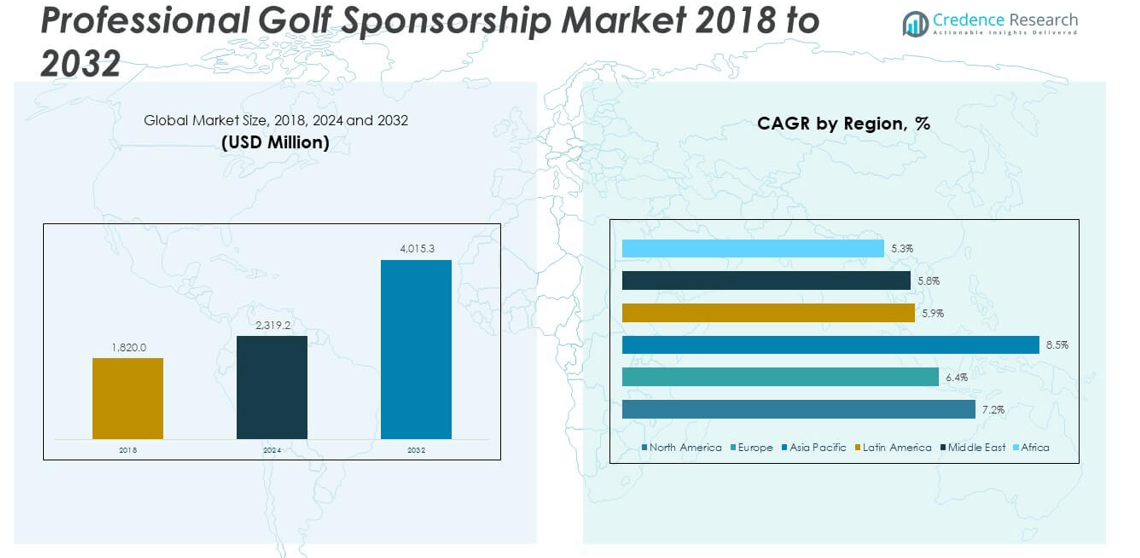
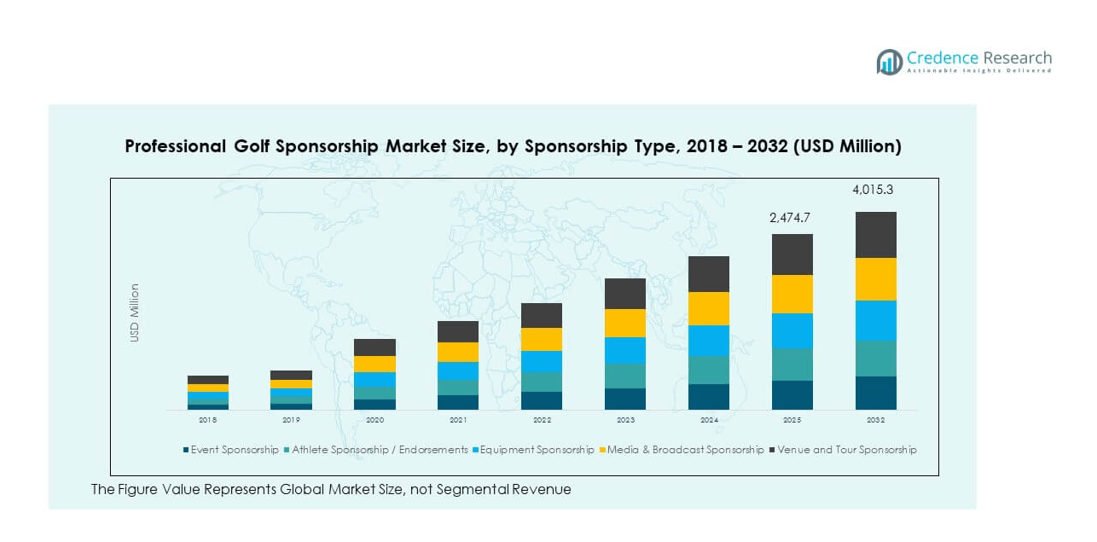
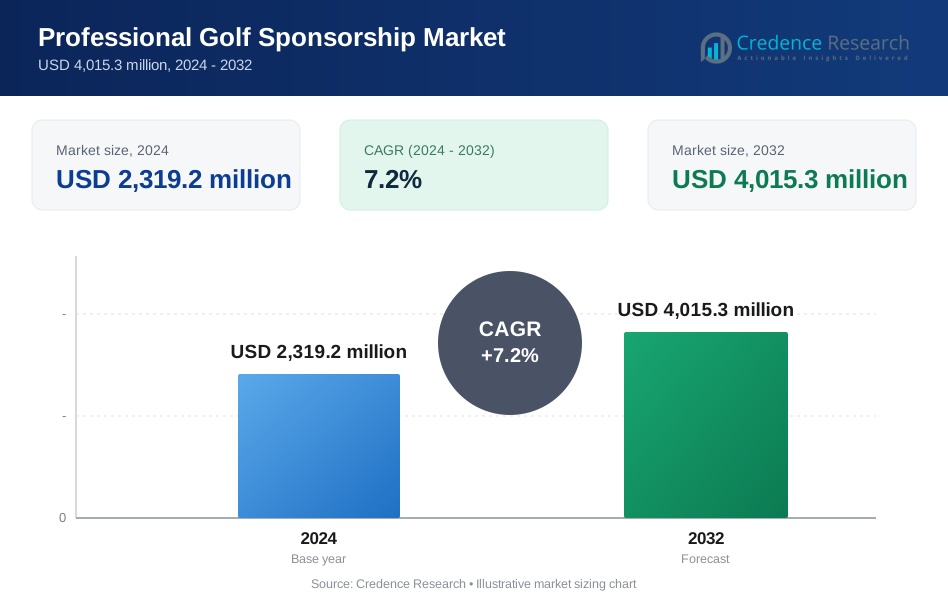
The Professional Golf Sponsorship Market size was valued at USD 1,820.0 million in 2018 to USD 2,319.2 million in 2024 and is anticipated to reach USD 4,015.3 million by 2032, at a CAGR of 7.2% during the forecast period.
| REPORT ATTRIBUTE | DETAILS |
|---|---|
| Historical Period | 2020-2023 |
| Base Year | 2024 |
| Forecast Period | 2025-2032 |
| Professional Golf Sponsorship Market Size 2024 | USD 2,319.2 million |
| Professional Golf Sponsorship Market, CAGR | 7.2% |
| Professional Golf Sponsorship Market Size 2032 | USD 4,015.3 million |
The market is primarily driven by the rising global popularity of professional golf tournaments and the growing involvement of corporate brands seeking premium visibility. Companies are increasingly leveraging golf sponsorships to enhance brand association, target affluent demographics, and strengthen international presence. The rise in broadcasting deals, digital fan engagement, and expansion of women’s professional golf events are also fueling demand, while investments in emerging talent and sustainability initiatives by sponsors further support market growth.
Regionally, North America leads the market, driven by established tournaments such as the PGA Tour and high corporate spending on sports marketing. Europe follows closely with sponsorships tied to events like the Ryder Cup and The Open Championship, reflecting strong regional interest. Asia-Pacific is emerging as a fast-growing market, supported by rising golf tourism, increasing investments in golf infrastructure, and growing sponsorship opportunities in countries like Japan, South Korea, and China, where younger audiences are embracing golf as both a sport and lifestyle.
Market Insights:
- The Professional Golf Sponsorship Market was valued at USD 2,319.2 million in 2024 and is projected to reach USD 4,015.3 million by 2032, growing at a CAGR of 7.2%.
- Strong global tournaments and rising corporate demand for premium visibility continue to drive market expansion.
- Sponsors target affluent demographics, aligning brand identity with golf’s prestige and global recognition.
- High sponsorship costs and uncertain return on investment remain key restraints limiting smaller entrants.
- North America leads with a 37.9% share in 2024, supported by established tournaments and high corporate spending.
- Europe maintains strength through heritage-driven events like The Open and Ryder Cup, while Asia Pacific emerges as the fastest-growing region.
- Expanding women’s golf and digital fan engagement open new avenues for sustained sponsorship growth.
Market Drivers:
Rising Global Popularity of Golf Tournaments Enhancing Sponsorship Investments
The Professional Golf Sponsorship Market benefits from the strong appeal of global tournaments that attract massive audiences and elite players. Major events such as the PGA Tour and The Open generate worldwide coverage, providing sponsors with unmatched exposure. Companies recognize golf as a premium platform to associate their brands with excellence and prestige. Sponsorship deals often include broadcast rights, hospitality packages, and event branding, making them highly attractive to corporations. Golf’s established reputation for integrity and tradition reinforces its value to sponsors seeking long-term engagement. It has become a preferred choice for companies targeting high-income consumers. The consistent growth of international tournaments fuels sponsorship demand and strengthens brand visibility across diverse regions.
- For example, Aon maintains a multi-year global partnership with the PGA Tour and LPGA Tour through the “Aon Risk Reward Challenge,” a season-long competition featured across tournaments on both tours, showcasing players’ strategic decision-making and enhancing Aon’s brand visibility.
Strong Corporate Focus on Targeting Affluent Demographics Through Golf Sponsorships
The Professional Golf Sponsorship Market grows due to its strong connection with affluent and influential audiences. Golf appeals to decision-makers, business leaders, and high-net-worth individuals, creating a lucrative sponsorship environment. Companies across finance, luxury goods, and technology sectors increasingly allocate significant budgets toward golf sponsorships. It offers opportunities to cultivate brand loyalty among premium consumers. Luxury brands, in particular, see golf sponsorships as a natural alignment with their image of sophistication. Corporations view it as a direct pathway to building long-lasting consumer trust. Sponsorships also reinforce corporate reputation by linking brands to a sport known for discipline and respect. This alignment encourages businesses to expand their golf-related investments consistently.
Growing Role of Media Broadcasting and Digital Platforms in Driving Sponsorship Revenues
The Professional Golf Sponsorship Market gains momentum from rising media coverage and digital platforms that extend audience reach. Live broadcasting of tournaments across global networks increases brand visibility for sponsors. Online streaming and mobile platforms enable real-time engagement with fans across geographies. It provides sponsors with opportunities to integrate targeted advertisements and interactive campaigns. Social media platforms amplify brand messaging by connecting directly with golf enthusiasts. Partnerships between media companies and organizers ensure long-term growth of sponsorship revenues. Technology-driven innovations in fan engagement make sponsorships more impactful and measurable. The expanding ecosystem of traditional and digital media elevates the sponsorship value proposition significantly.
- For example, NBC Sports announced it will present more than 500 hours of live LPGA Tour coverage in the 2025 season across its platforms, including NBC, Golf Channel, USA Network, and Peacock
Expanding Role of Women’s Golf and Emerging Talent in Attracting Sponsorships
The Professional Golf Sponsorship Market is strengthened by the rising prominence of women’s tournaments and emerging talent. Women’s professional golf has gained visibility through international tours and star athletes, attracting new sponsors. It encourages brands to diversify their sponsorship portfolios and connect with broader demographics. The presence of young and promising players increases the appeal of events for a younger audience. Sponsors recognize the value of supporting future stars, ensuring long-term brand association. The diversification of tournaments across genders enhances inclusivity and boosts sponsorship demand. It allows corporations to align with themes of equality and diversity. This trend significantly widens the market’s potential for growth in sponsorship investments.
Market Trends:
Integration of Technology and Data Analytics into Sponsorship Campaigns
The Professional Golf Sponsorship Market shows a clear trend toward the use of technology and data analytics. Sponsors now rely on advanced analytics to measure brand exposure and audience reach during tournaments. Digital scorecards, smart wearables, and performance tracking systems create new engagement avenues. It allows companies to personalize campaigns and strengthen their return on investment. Data-driven insights guide sponsors in selecting events that maximize visibility. The use of technology enhances accountability and transparency in sponsorship deals. Brands leverage this information to refine long-term marketing strategies. This integration signals a fundamental shift toward precision-driven sponsorship management.
Increasing Role of Experiential Marketing in Golf Sponsorship Programs
The Professional Golf Sponsorship Market experiences growth in experiential marketing, where brands design unique experiences for fans and clients. Hospitality lounges, VIP suites, and exclusive networking sessions enhance brand presence. Companies seek to build deeper emotional connections with audiences through immersive events. It transforms sponsorships from mere visibility platforms into relationship-building opportunities. Premium fan experiences drive higher retention and consumer loyalty. Corporate clients benefit from golf events as valuable spaces for business development. Tailored experiences amplify sponsor recognition and deliver sustained value. This trend positions golf sponsorships as both marketing and engagement strategies.
- For example, Rolex, a Worldwide Partner of the 2023 Ryder Cup and Presenting Partner of the Ryder Cup Points Standings, reinforced its long-standing commitment to golf by supporting the event and strengthening its association with the sport’s heritage.
Expansion of Sustainability and Green Initiatives in Golf Sponsorship Deals
The Professional Golf Sponsorship Market reflects a trend of aligning sponsorships with sustainability and environmental responsibility. Brands emphasize eco-friendly practices in event partnerships to reinforce corporate values. Golf tournaments increasingly adopt green initiatives such as water conservation and renewable energy use. It encourages sponsors to promote their sustainability commitments alongside the sport. Consumers respond positively to brands that support environmentally responsible practices. Sustainability-driven sponsorships create differentiation in competitive markets. Companies leverage this trend to enhance corporate reputation and social responsibility credentials. The alignment of golf with green initiatives strengthens both brand equity and sport image.
Growing Influence of Globalization and Cross-Border Sponsorship Agreements
The Professional Golf Sponsorship Market evolves through the globalization of events and cross-border deals. Multinational companies engage in sponsorships that cover multiple tours and international tournaments. It helps brands gain exposure across diverse audiences simultaneously. Golf’s global appeal ensures sponsorships generate value across established and emerging markets. International agreements provide long-term stability and scalability for sponsors. The rise of multinational sponsorship contracts enhances revenue streams for event organizers. Brands secure consistent messaging and identity across different geographies. This globalization trend highlights golf’s transformation into a unified commercial platform.
- For example, HSBC reinforced its global golf sponsorship portfolio in 2023 by renewing partnerships that include the HSBC Women’s World Championship in Singapore, the WGC-HSBC Champions in Shanghai, and the CGA-HSBC China Junior Golf Programme.
Market Challenges Analysis:
High Sponsorship Costs and Uncertain Return on Investment Limiting Market Expansion
The Professional Golf Sponsorship Market faces challenges from high costs associated with securing major sponsorship deals. Corporations often allocate large budgets, but the actual return on investment remains uncertain. Measuring the direct impact on sales or consumer behavior is complex. It creates hesitation among new entrants considering sponsorship commitments. Companies require advanced tracking tools to validate spending, which adds further complexity. Economic fluctuations can reduce marketing budgets, limiting sponsorship opportunities. The need for substantial financial commitments narrows the pool of potential sponsors. These challenges restrict growth potential for smaller brands seeking visibility in the sport.
Competition from Alternative Sports and Shifts in Consumer Entertainment Preferences
The Professional Golf Sponsorship Market contends with competition from other sports that attract younger audiences. Soccer, basketball, and e-sports offer dynamic engagement models appealing to digital-native generations. It puts pressure on golf to maintain relevance and retain sponsor interest. The slower pace of golf compared to high-energy sports challenges its appeal among younger fans. Shifts in entertainment consumption patterns emphasize digital platforms and interactive experiences. Sponsors increasingly evaluate multiple sports before committing resources to golf. The need to modernize fan engagement strategies becomes critical for golf to sustain sponsorship levels. This competition presents an ongoing challenge for the market’s expansion.
Market Opportunities:
Rising Golf Tourism and Expansion of International Tournaments Creating New Avenues
The Professional Golf Sponsorship Market holds opportunities through the rapid rise of golf tourism and international tournaments. Destinations across Asia, the Middle East, and Latin America invest in world-class golf courses. It draws international audiences and creates new sponsorship platforms. Global tournaments hosted in emerging markets attract multinational sponsors seeking untapped exposure. Brands leverage these events to establish strong connections with new consumer bases. Golf tourism provides corporate sponsors with additional avenues for hospitality-driven marketing. The synergy between tourism growth and tournament expansion strengthens the sponsorship ecosystem significantly.
Emergence of Digital Engagement Platforms and Growing Role of Influencer Marketing
The Professional Golf Sponsorship Market benefits from opportunities driven by digital platforms and influencer marketing. Online content, interactive apps, and social media campaigns enable sponsors to connect with younger audiences. It creates channels for real-time fan engagement and long-term brand loyalty. Golf influencers and professional players with strong online followings amplify sponsor messages effectively. Companies capitalize on these partnerships to expand brand awareness beyond traditional audiences. Digital tools offer measurable outcomes and targeted campaigns, encouraging higher sponsorship investments. This digital expansion positions golf sponsorships as relevant and impactful in the modern marketing landscape.
Market Segmentation Analysis:
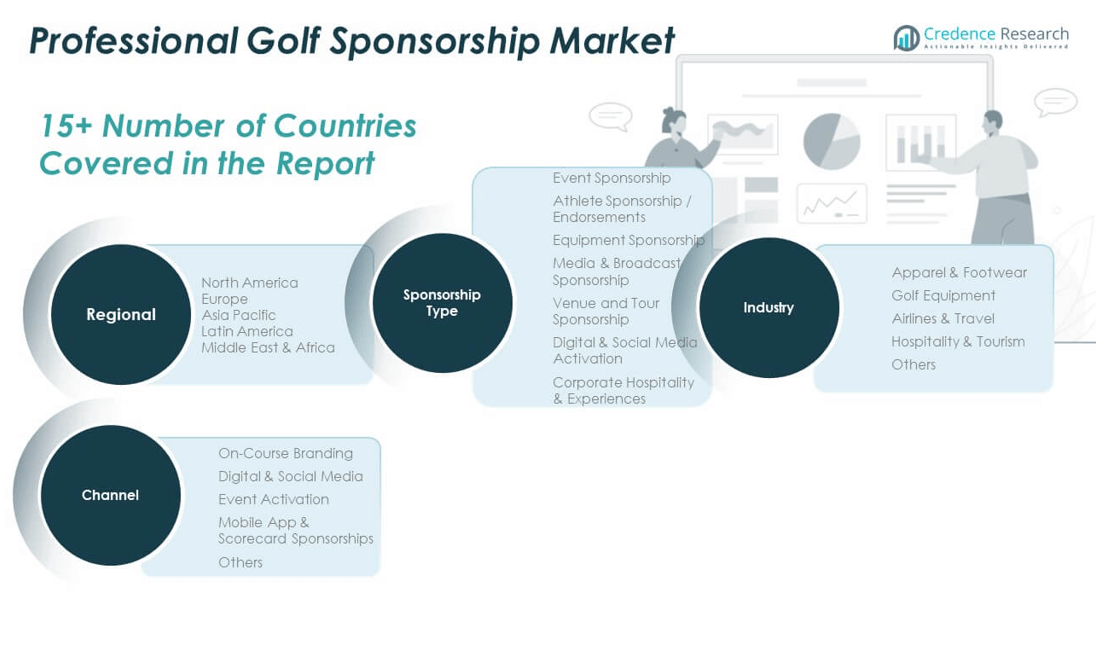
The Professional Golf Sponsorship Market demonstrates strong diversification across type, industry, and channel segments, reflecting the wide spectrum of opportunities for brands and stakeholders.
By type, event sponsorship remains a dominant category, supported by global tournaments that deliver high visibility for corporate partners. Athlete sponsorship and endorsements create direct consumer influence by linking brand identity with star players. Equipment sponsorship strengthens brand credibility within the golfing community, while media and broadcast sponsorship maximize global reach through extensive coverage. Venue and tour sponsorship enhance long-term associations, digital and social media activation drive direct fan interaction, and corporate hospitality provides premium networking value for enterprises.
- For instance, Nike maintained a 27-year apparel and endorsement partnership with Tiger Woods, spanning from 1996 until 2023. Over that period, Woods earned roughly USD 500 million through several contract renewals, including a 10-year deal signed in 2013 valued at about USD 200 million, making it one of the most lucrative individual sponsorships in golf history.
By industry, apparel and footwear companies lead with significant investments to showcase performance-driven and lifestyle products. Golf equipment manufacturers reinforce their market presence through strong alignment with professional tournaments. Airlines and travel companies secure exposure by connecting with golf tourism and premium traveler segments. Hospitality and tourism players gain by hosting international events that attract affluent audiences. Other industries, including beverages and financial services, use sponsorships to diversify engagement strategies and extend brand visibility across multiple demographics.
By channel, on-course branding remains a preferred avenue for its direct spectator visibility, while digital and social media platforms provide interactive and measurable engagement opportunities. Event activation strategies amplify sponsor value through experiential marketing campaigns, while mobile app and scorecard sponsorships introduce technology-driven engagement. Other sponsorship formats continue to offer flexibility for niche campaigns. The Professional Golf Sponsorship Market reflects a balanced segmentation structure that allows stakeholders to target specific objectives with tailored strategies.
- For example, Callaway extended its partnership with Phil Mickelson by signing a "lifetime extension" agreement, ensuring he played a full complement of Callaway golf equipment throughout his competitive career including clubs and balls
Segmentation:
By Type
- Event Sponsorship
- Athlete Sponsorship / Endorsements
- Equipment Sponsorship
- Media & Broadcast Sponsorship
- Venue and Tour Sponsorship
- Digital & Social Media Activation
- Corporate Hospitality & Experiences
By Industry
- Apparel & Footwear
- Golf Equipment
- Airlines & Travel
- Hospitality & Tourism
- Others
By Channel
- On-Course Branding
- Digital & Social Media
- Event Activation
- Mobile App & Scorecard Sponsorships
- Others
By Region
- North America
- U.S.
- Canada
- Mexico
- Europe
- UK
- France
- Germany
- Italy
- Spain
- Russia
- Belgium
- Netherlands
- Austria
- Sweden
- Poland
- Denmark
- Switzerland
- Rest of Europe
- Asia Pacific
- China
- Japan
- South Korea
- India
- Australia
- Thailand
- Indonesia
- Vietnam
- Malaysia
- Philippines
- Taiwan
- Rest of Asia Pacific
- Latin America
- Brazil
- Argentina
- Peru
- Chile
- Colombia
- Rest of Latin America
- Middle East
- UAE
- KSA
- Israel
- Turkey
- Iran
- Rest of Middle East
- Africa
- Egypt
- Nigeria
- Algeria
- Morocco
- Rest of Africa
Regional Analysis:
North America
The North America Professional Golf Sponsorship Market size was valued at USD 698.9 million in 2018 to USD 880.4 million in 2024 and is anticipated to reach USD 1,521.9 million by 2032, at a CAGR of 7.2% during the forecast period. North America holds a market share of 37.9% in 2024, driven by its established dominance in professional golf. The region benefits from world-class tournaments such as the PGA Tour and Masters, which attract high-profile sponsors across diverse industries. Corporations in finance, automotive, and luxury goods sectors maintain long-standing partnerships, reinforcing the market’s strength. It continues to thrive on extensive broadcasting rights and strong digital fan engagement. High disposable income and a large base of golf enthusiasts ensure sponsorships deliver premium returns. Corporate hospitality at major tournaments offers unique networking opportunities, sustaining sponsorship growth. The region remains the benchmark for sponsorship innovation and long-term brand partnerships.
Europe
The Europe Professional Golf Sponsorship Market size was valued at USD 483.8 million in 2018 to USD 592.7 million in 2024 and is anticipated to reach USD 969.9 million by 2032, at a CAGR of 6.4% during the forecast period. Europe accounts for 25.5% of the market share in 2024, supported by prestigious tournaments such as The Open Championship and the Ryder Cup. Strong cultural affinity for golf across the UK, Germany, France, and Spain ensures steady sponsor engagement. Leading brands in luxury, automotive, and lifestyle industries maintain significant investments in European golf. It benefits from cross-border sponsorships and a well-developed golf tourism industry. The region continues to emphasize tradition and heritage, enhancing the value proposition for corporate sponsors. Broadcast reach across European networks extends sponsor visibility significantly. Hospitality-driven sponsorships remain an integral part of the market. Europe maintains a strong position as a global hub for international sponsorship collaborations.
Asia Pacific
The Asia Pacific Professional Golf Sponsorship Market size was valued at USD 434.1 million in 2018 to USD 578.3 million in 2024 and is anticipated to reach USD 1,103.9 million by 2032, at a CAGR of 8.5% during the forecast period. Asia Pacific holds a market share of 24.9% in 2024, reflecting rapid expansion across emerging economies. Countries like Japan, South Korea, China, and India are investing heavily in golf infrastructure and international tournaments. Rising disposable income and growing golf tourism fuel sponsor demand in the region. It benefits from young talent gaining international recognition and increasing female participation in professional golf. Regional brands in apparel, technology, and airlines actively pursue partnerships to expand visibility. Digital platforms enhance fan engagement, creating opportunities for innovative sponsorship formats. Asia Pacific is becoming an attractive hub for multinational sponsors seeking new audiences. The region continues to strengthen its position as a growth leader in the global market.
Latin America
The Latin America Professional Golf Sponsorship Market size was valued at USD 93.2 million in 2018 to USD 117.3 million in 2024 and is anticipated to reach USD 185.0 million by 2032, at a CAGR of 5.9% during the forecast period. Latin America accounts for 5.0% of the market share in 2024, with growth driven by Brazil, Argentina, and Mexico. Golf tourism is expanding, supported by new course developments and regional tournaments. Sponsorship activity remains focused on airlines, travel, and hospitality companies targeting high-value tourists. It benefits from increasing broadcast coverage of international tournaments across Latin American media networks. The presence of international players from the region has raised visibility and sponsor interest. Corporate sponsorships often emphasize lifestyle branding and regional identity. Though smaller in size, the market provides untapped opportunities for brands seeking differentiated engagement. Latin America’s steady economic reforms and sports investments create a favorable outlook for sponsorship expansion.
Middle East
The Middle East Professional Golf Sponsorship Market size was valued at USD 70.8 million in 2018 to USD 84.6 million in 2024 and is anticipated to reach USD 132.5 million by 2032, at a CAGR of 5.8% during the forecast period. The region holds a market share of 3.6% in 2024, supported by its strategic investments in sports tourism and international events. Countries such as the UAE and Saudi Arabia host high-profile tournaments that attract global sponsors. Luxury brands, airlines, and financial institutions dominate sponsorship activity in the region. It benefits from government-led initiatives promoting sports diversification and global partnerships. Golf events are positioned as premium attractions in line with tourism strategies. The Middle East also emphasizes corporate hospitality, aligning golf events with elite networking experiences. Expanding digital platforms are improving fan engagement across younger demographics. The region is steadily carving out a niche in the global sponsorship landscape.
Africa
The Africa Professional Golf Sponsorship Market size was valued at USD 39.3 million in 2018 to USD 65.9 million in 2024 and is anticipated to reach USD 102.0 million by 2032, at a CAGR of 5.3% during the forecast period. Africa represents 2.9% of the market share in 2024, with South Africa leading due to its established golf infrastructure and international tournaments. Sponsorship activity is largely centered on local hospitality, airlines, and beverage companies. It benefits from increasing investments in sports tourism and government support for international exposure. Regional tournaments provide valuable platforms for domestic and international sponsors. Broadcast partnerships are gradually expanding sponsor reach across African markets. Global brands are beginning to explore opportunities as golf’s presence broadens. Corporate sponsorships emphasize community development and inclusivity in sports. Africa remains a growing but relatively untapped region with long-term potential for professional golf sponsorship.
Key Player Analysis:
- Nike
- Adidas
- Callaway
- TaylorMade
- Skechers
- RBC (Royal Bank of Canada)
- FedEx
- DP World
- Rolex
- American Express
- Johnnie Walker
- Michelob ULTRA
- Delta Airlines
- Lexus
- BMW
- Omega
- Marriott Bonvoy
Competitive Analysis:
The Professional Golf Sponsorship Market is characterized by strong competition among global brands, luxury companies, and corporate sponsors across industries. Key players such as Nike, Adidas, Callaway, TaylorMade, Rolex, BMW, FedEx, and American Express invest heavily in securing long-term visibility through major tournaments and athlete endorsements. It thrives on the presence of multinational corporations that leverage golf’s premium audience to reinforce brand identity and expand market reach. Strategic developments include sponsorship renewals, digital activation campaigns, and expanded hospitality offerings at flagship events. The competition intensifies with the rise of regional players in Asia Pacific and the Middle East, which strengthens diversification in sponsor profiles. Market leaders maintain a focus on innovation, sustainability, and cross-border sponsorship agreements to sustain their dominance.
Recent Developments:
- In August 2025, Skechers was named the title sponsor of the PGA TOUR-sanctioned World Champions Cup, with Shriners Children's simultaneously announced as the official charity partner of the event. The tournament is scheduled to take place at Feather Sound Country Club in Clearwater, Florida from December 4–7, 2025, marking a significant partnership that aims to elevate the fan experience through immersive on-site activations and support for volunteer programs.
- On July 31, 2025, LIV Golf announced a global partnership with HSBC, adding the banking giant to its growing roster of blue-chip sponsors that also includes Salesforce and Qualcomm. This expansion signifies a transformational year for LIV Golf’s sponsorship strategy, with HSBC now sponsoring teams like Majesticks and Crushers GC.
- In February 2025, Nike announced an apparel endorsement deal with Florida State’s top-ranked amateur golfer Luke Clanton. Clanton, fresh off four top-10 finishes on the PGA TOUR in 2024, signed before his upcoming appearance at the Cognizant Classic, joining Nike’s lineup with stars like Rory McIlroy and Tommy Fleetwood.
- In March 2025, Callaway entered a major partnership with Sky Sports to be the official sponsor for key men’s and women’s golf events including The Masters and the U.S. Open. This strengthens Callaway’s brand visibility across the Sky Sports Golf podcast and tournament coverage.
Market Concentration & Characteristics:
The Professional Golf Sponsorship Market exhibits a moderately concentrated structure, dominated by established multinational corporations and luxury brands. It is shaped by long-term contracts with leading tournaments, strong brand recognition, and high financial barriers to entry. Market characteristics highlight premium positioning, reliance on global media coverage, and growing integration of digital engagement platforms. Sponsorships are often influenced by heritage, prestige, and alignment with affluent demographics, which reinforce the sport’s exclusivity. Competitive intensity is balanced by the steady entry of new sponsors seeking exposure in emerging regions.
Report Coverage:
The research report offers an in-depth analysis based on Type, Industry and Channel. It details leading market players, providing an overview of their business, product offerings, investments, revenue streams, and key applications. Additionally, the report includes insights into the competitive environment, SWOT analysis, current market trends, as well as the primary drivers and constraints. Furthermore, it discusses various factors that have driven market expansion in recent years. The report also explores market dynamics, regulatory scenarios, and technological advancements that are shaping the industry. It assesses the impact of external factors and global economic changes on market growth. Lastly, it provides strategic recommendations for new entrants and established companies to navigate the complexities of the market.
Future Outlook:
- The Professional Golf Sponsorship Market will expand with stronger integration of digital platforms that enhance fan interaction and deliver measurable returns for sponsors.
- Brands will prioritize personalized sponsorship strategies using data analytics to target specific demographics and optimize exposure.
- Athlete endorsements will gain momentum, with younger players and women professionals attracting diversified sponsorship portfolios.
- Sustainability initiatives will influence sponsorship decisions, with companies aligning brand identity to eco-conscious tournaments and practices.
- Corporate hospitality will evolve into premium experiential platforms, strengthening networking opportunities for high-value clients.
- Media and broadcast sponsorships will diversify into streaming and mobile platforms, extending visibility beyond traditional television coverage.
- Cross-border sponsorship agreements will increase, with multinational brands seeking global consistency across multiple tours and regions.
- Emerging economies in Asia Pacific, Middle East, and Latin America will create new growth hubs for sponsorship investments.
- Lifestyle and luxury brands will expand their presence, leveraging golf’s prestige to reinforce brand equity and consumer loyalty.
- The market will adopt innovative activation strategies, integrating AR, VR, and immersive experiences to elevate fan engagement.
Request a Free Sample
Fill in your details and we'll send you a free sample report.
- Sample data tables & charts
- Research methodology
Need a Custom Version of This Report?
Tailor the scope, geography, or segments to your exact requirements.
- Custom geography or segment scope
- Direct access to our analyst team
Frequently Asked Questions
What is the current market size for Professional Golf Sponsorship Market, and what is its projected size in 2032?
At what Compound Annual Growth Rate is the Professional Golf Sponsorship Market projected to grow between 2024 and 2032?
What are the primary factors fueling the growth of the Professional Golf Sponsorship Market?
Who are the leading companies in the Professional Golf Sponsorship Market?
Table of Content
Chapter 1. Report Introduction
- 1.1 Report Description & Purpose
- 1.1.1 Report Title & Market Definition
- 1.1.2 Unique Selling Propositions (USP) & Key Differentiators
- 1.1.3 Value Proposition for Stakeholders
- 1.2 Research Objectives
- 1.2.1 Market Sizing Objectives (Volume & Revenue)
- 1.2.2 Segmentation Objectives
- 1.2.3 Competitive Intelligence Objectives
- 1.2.4 Forecast & Scenario Objectives
- 1.3 Report Scope
- 1.3.1 Professional Golf Sponsorship Scope – Types & Subtypes Covered
- 1.3.2 Geographic Scope – Regions & Countries Covered
- 1.3.3 Historical Period, Base Year & Forecast Period (2024; forecast to 2032)
- 1.3.4 Inclusions & Exclusions
- 1.4 HS Code & Classification Framework
- 1.5 Currency, Units & Pricing Basis
- 1.6 Target Stakeholders
- 1.7 Limitations & Assumptions
Chapter 2. Executive Summary
- 2.1 Global Professional Golf Sponsorship Market Snapshot
- 2.1.1 Market Size – Historical (2024) & Forecast (2024-2032) (2024: USD 2,319.2 million → 2032: USD 4,015.3 million)
- 2.1.2 Volume & Revenue – Global Totals
- 2.1.3 Key Market Highlights – Top Five Facts
- 2.2 Professional Golf Sponsorship Market Segmentation Snapshot
- 2.2.1 Market Split by Region – 2024 vs. 2032
- 2.3 Competitive Snapshot
- 2.3.1 Top 10 Players by Revenue Share – 2024
- 2.3.2 Top 10 Players by Volume Share – 2024
- 2.3.3 Recent Strategic Developments (18-Month Summary)
- 2.4 Key Investment Highlights & Strategic Conclusions
Chapter 3. Professional Golf Sponsorship Market Dynamics & Industry Analysis
- 3.1 Market Overview & Context
- 3.1.1 Professional Golf Sponsorship Market Position in the Broader Automotive Value Chain
- 3.1.2 OEM vs. Replacement Market Dynamics
- 3.1.3 Market Maturity & Development Stage by Region
- 3.2 Professional Golf Sponsorship Market Drivers
- 3.3 Professional Golf Sponsorship Market Restraints & Challenges
- 3.4 Professional Golf Sponsorship Market Opportunities
- 3.5 Porter's Five Forces Analysis
- 3.5.1 Threat of New Entrants
- 3.5.2 Bargaining Power of Suppliers
- 3.5.3 Bargaining Power of Buyers
- 3.5.4 Threat of Substitutes
- 3.5.5 Competitive Rivalry – Intensity Assessment
- 3.6 Professional Golf Sponsorship Value Chain Analysis
- 3.6.1 Upstream – Raw Material/Input Suppliers
- 3.6.1.1 Raw Material/Input 1
- 3.6.1.2 Raw Material/Input 2
- 3.6.1.3 Raw Material/Input 3
- 3.6.2 Midstream – Production/Manufacturing/Service Delivery
- 3.6.2.1 Production/Process Overview
- 3.6.2.2 Key Facility Locations & Capacity by Manufacturer
- 3.6.3 Downstream – Distribution & End Consumer
- 3.6.3.1 Primary Channel – B2B/OEM
- 3.6.3.2 Secondary Channels – Dealer, Retail, Online, Direct
- 3.6.4 Value Chain Profitability Analysis
- 3.6.1 Upstream – Raw Material/Input Suppliers
- 3.7 PESTEL Analysis
- 3.7.1 Political Factors
- 3.7.2 Economic Factors
- 3.7.3 Social Factors
- 3.7.4 Technological Factors
- 3.7.5 Environmental Factors
- 3.7.6 Legal Factors
- 3.8 Professional Golf Sponsorship Supply Chain Analysis
- 3.8.1 Raw Material/Input Supply Risk Assessment
- 3.8.2 Manufacturing Concentration Risk (Geographic Exposure)
- 3.8.3 Trade Disruption Impact Analysis
- 3.9 Regulatory & Policy Landscape
Note: The regulatory and policy landscape section covers regulations based on their applicability to the market, Professional Golf Sponsorship category, geography, and scope of the study. Only regulatory frameworks with a material impact on operations, compliance, trade, sustainability, or market access are analyzed in detail.
Chapter 4. Key Investment Pockets & Opportunity Analysis
- 4.1 Professional Golf Sponsorship Market Attractiveness Analysis
- 4.1.1 By Region – Investment Attractiveness Matrix (Volume × CAGR)
- 4.2 Absolute Revenue Growth Opportunity
- 4.2.1 By Region – Absolute USD Growth Through 2032
- 4.3 Incremental Volume Opportunity
- 4.3.1 By Region – Incremental Volume Through 2032
- 4.3.2 Segment – Incremental Volume
- 4.4 Emerging Submarket Opportunity Deep Dive (Subject to Applicability)
- 4.5 Emerging Market Opportunity Scorecards
- 4.5.1 United States
- 4.5.2 Europe
- 4.5.3 Asia
- 4.5.4 Middle East & Africa
Note: Emerging Market Opportunity Scorecards will be included based on relevance and strategic importance. Regions listed are indicative and may vary depending on data availability and market dynamics.
Chapter 5. Professional Golf Sponsorship Import-Export Analysis & Trade Flows
- 5.1 Global Trade Overview
- 5.1.1 Global Export Value by Country (2024)
- 5.1.2 Global Export Volume by Country (2024)
- 5.1.3 Global Import Value by Country (2024)
- 5.1.4 Global Import Volume by Country (2024)
- 5.1.5 Net Trade Balance by Country (2024)
- 5.2 Export Analysis – Segment
- 5.2.1 Type 1 (HS Code)
- 5.2.2 Type 2 (HS Code)
- 5.2.3 Type 3 (HS Code)
- 5.2.4 Type 4 (HS Code)
- 5.2.5 Type 5 (HS Code)
- 5.3 Import Analysis – Segment
- 5.3.1 Type 1 (HS Code)
- 5.3.2 Type 2 (HS Code)
- 5.3.3 Type 3 (HS Code)
- 5.3.4 Type 4 (HS Code)
- 5.3.5 Type 5 (HS Code)
- 5.4 Average Unit Trade Prices
- 5.4.1 Average Export Price – Segment & Country
- 5.4.2 Average Import Price – Segment & Source Country
- 5.4.3 Price Trends (2024)
- 5.5 Key Trade Route Analysis
- 5.5.1 Trade Route 1
- 5.5.2 Trade Route 2
- 5.5.3 Trade Route 3
- 5.5.4 Trade Route 4
- 5.5.5 Trade Route 5
- 5.6 Trade Policy Impact Assessment
- 5.6.1 US Anti-Dumping & Section 301 Tariffs
- 5.6.2 EU Customs Union Impact
- 5.6.3 Major Free Trade Agreements
- 5.6.4 USMCA Rules of Origin
Note: Trade policy analysis will be included only where relevant to the Professional Golf Sponsorship market.
Chapter 6. Competitive Landscape & Company Benchmarking
- 6.1 Professional Golf Sponsorship Market Concentration & Structure
- 6.1.1 Herfindahl-Hirschman Index (HHI) – vs. 2024
- 6.1.2 Tier 1, Tier 2 & Tier 3 Market Structure
- 6.1.3 Global, Regional & Local Player Dynamics
- 6.2 Professional Golf Sponsorship Market Share Analysis – 2024
- 6.2.1 Global Revenue Share by Company
- 6.2.2 Global Volume Share by Company
- 6.2.3 Regional Revenue Share
- 6.2.4 Market Share Evolution ( vs. 2024)
- 6.2.5 OEM Segment Share by Company
- 6.2.6 Replacement Segment Share by Company
- 6.3 Production/Delivery Capacity & Facility Analysis
- 6.3.1 Global Installed Capacity
- 6.3.2 Capacity Utilization Rates
- 6.3.3 Production/Output Volume
- 6.3.4 Facility Locations & Capacity Map
- 6.3.5 Planned Capacity Additions
- 6.4 Professional Golf Sponsorship Competitive Benchmarking Matrix
- 6.4.1 Revenue, Volume, CAGR & Profitability Comparison
- 6.4.2 Channel Revenue Mix
- 6.4.3 Geographic Revenue Exposure
- 6.4.4 R&D Intensity
- 6.4.5 Sustainability Maturity
- 6.5 Strategic Developments in Professional Golf Sponsorship (Last 24 Months)
- 6.5.1 Mergers, Acquisitions & Divestments
- 6.5.2 New Professional Golf Sponsorship Launches
- 6.5.3 Facility Expansions
- 6.5.4 Strategic Alliances, Joint Ventures & Partnerships
- 6.5.5 Distribution Expansion & Market Entry
- 6.5.6 Sustainability & ESG Initiatives
- 6.6 Competitive Strategy Mapping
- 6.6.1 Leader, Challenger, Follower & Niche Classification
- 6.6.2 Pricing Strategy Comparison
- 6.6.3 Channel Strategy Matrix
Note: Strategic developments are included based on their materiality and the availability of reliable information.
Chapter 7. Global Professional Golf Sponsorship Market – By Distribution Channel
- 7.1 Segment Overview
- 7.1.1 Volume & Revenue Split by Channel (2024 & 2032)
- 7.1.2 Channel Mix Evolution (2024-2032)
Chapter 8. Regional Market Analysis – Global Overview
- 8.1 Global Regional Overview
- 8.1.1 Regional Volume Share
- 8.1.2 Regional Revenue Share
- 8.1.3 Regional Volume by Region
- 8.1.4 Regional Revenue by Region
- 8.1.5 Regional Forecast Through 2032
- 8.2 Cross-Regional Segment Analysis
- 8.2.1 By Distribution Channel
- 8.2.2 By Brand/Price Tier
Chapter 9. North America Professional Golf Sponsorship Market
- 9.1 United States
- 9.2 Canada
- 9.3 Mexico
Chapter 10. Europe Professional Golf Sponsorship Market
- 10.1 Germany
- 10.2 France
- 10.3 Italy
- 10.4 United Kingdom
- 10.5 Spain
- 10.6 Poland
- 10.7 Russia
- 10.8 Netherlands
- 10.9 Belgium
- 10.10 Sweden
- 10.11 Denmark
- 10.12 Norway
- 10.13 Rest of Europe
Chapter 11. Asia Pacific Professional Golf Sponsorship Market
- 11.1 China
- 11.2 India
- 11.3 Japan
- 11.4 South Korea
- 11.5 Thailand
- 11.6 Indonesia
- 11.7 Vietnam
- 11.8 Malaysia
- 11.9 Australia
- 11.10 Rest of Asia Pacific
Chapter 12. Latin America Professional Golf Sponsorship Market
- 12.1 Brazil
- 12.2 Argentina
- 12.3 Colombia
- 12.4 Chile
- 12.5 Rest of Latin America
Chapter 13. Middle East Professional Golf Sponsorship Market
- 13.1 Saudi Arabia
- 13.2 United Arab Emirates
- 13.3 Turkey
- 13.4 Israel
- 13.5 Iran
- 13.6 Rest of the Middle East
Chapter 14. Africa Professional Golf Sponsorship Market
- 14.1 South Africa
- 14.2 Egypt
- 14.3 Nigeria
- 14.4 Morocco
- 14.5 Rest of Africa
Chapter 15. Professional Golf Sponsorship Company Profiles
- 15.1 [Company 01]
- 15.1.1 Company Overview
- 15.1.2 Key Management Personnel
- 15.1.3 Products & Services Portfolio
- 15.1.4 Financial Performance
- 15.1.5 Key Market Focus & Geographic Presence
- 15.1.6 Recent Developments & Strategic Initiatives
Note: The company profile list is preliminary and may change based on research findings, market developments, data availability, and client requirements.
Chapter 16. Appendices
- Appendix A – List of Abbreviations & Acronyms
- Appendix B – Industry Classification Code Reference – Full Series
- Appendix C – Production & Capacity Data Tables
- Appendix D – End-Use & Demand Base Tables
- Appendix E – Consumption & Replacement Rate Assumptions
- Appendix F – ASP Reference Tables
- Appendix G – Manufacturing & Facility Database
- Appendix H – Import-Export Data Tables
- Appendix I – Regulatory Summary Tables
- Appendix J – Primary Research Participant List (Anonymized)
- Appendix K – Primary Research Questionnaire Framework
- Appendix L – Data Sources & Bibliography
- Appendix M – Market Size Divergence & Source Comparison
Chapter 17. Research Methodology
- 17.1 Research Framework & Philosophy
- 17.2 Secondary Research – Sources, Hierarchy & Data Extraction
- 17.3 Data Modeling – Bottom-Up & Top-Down Market Sizing
- 17.4 Primary Research – Stakeholder Framework, LOI & Sample Sizes
- 17.5 Forecast Methodology – Regression, Scenario & Sensitivity Analysis
- 17.6 Quality Control – Four-Layer Validation Framework
- 17.7 Limitations & Standard Assumptions
- 17.8 Disclaimer
