Recovery Footwear Market Overview:
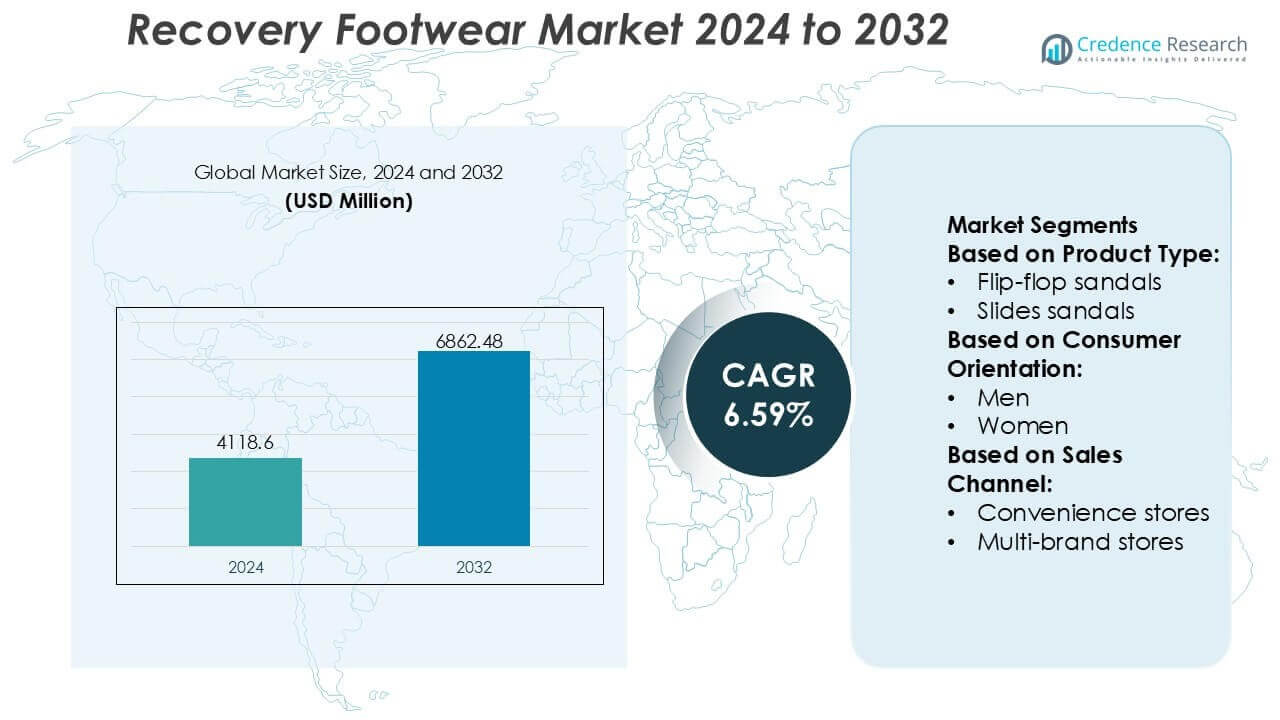
Recovery Footwear Market size was valued USD 4118.6 million in 2024 and is anticipated to reach USD 6862.48 million by 2032, at a CAGR of 6.59% during the forecast period. (Credence Research)
| REPORT ATTRIBUTE | DETAILS |
|---|---|
| Historical Period | 2020-2023 |
| Base Year | 2024 |
| Forecast Period | 2025-2032 |
| Recovery Footwear Market Size 2024 | USD 4118.6 million |
| Recovery Footwear Market, CAGR | 6.59% |
| Recovery Footwear Market Size 2032 | USD 6862.48 million |
Recovery Footwear Market Insights
- Growing participation in sports, fitness, and active lifestyles drives demand for recovery-focused footwear that reduces muscle fatigue and supports post-activity comfort.
- Product trends center on biomechanically optimized soles, lightweight foam technologies, and lifestyle-oriented designs, with closed-toed recovery shoes holding a leading segment share of around 42% due to all-day usability.
- The competitive landscape features global athletic brands and niche specialists competing through proprietary cushioning systems, athlete endorsements, and expanding direct-to-consumer channels.
- Regionally, North America leads with an exact 39% market share, supported by high consumer awareness, premium footwear spending, and a mature sports and wellness retail ecosystem.
Recovery Footwear Market Segmentation Analysis:
By Product Type
By product type, slide sandals dominate the Recovery Footwear Market, holding an estimated around 42% market share. Their leadership is driven by ease of wear, lightweight construction, and the ability to integrate thick EVA or PU-based cushioning with contoured footbeds that promote post-activity muscle recovery. Slides are widely preferred by athletes and casual users for quick relief after workouts or prolonged standing. Flip-flop sandals follow due to affordability and breathability, while closed-toed shoes gain traction among consumers seeking all-day recovery support with enhanced arch stability, heel cupping, and temperature regulation features.
- For instance, Crocs Retail, LLC engineers its recovery-oriented slides using Croslite™ foam with a density of approximately 0.25 g/cm³, enabling high energy absorption while keeping average product weight below 250 grams per pair, and incorporates footbeds molded with heel depths exceeding 25 millimeters to enhance pressure distribution and sustained underfoot support during prolonged use.
By Consumer Orientation
By consumer orientation, men represent the dominant sub-segment, accounting for approximately 45% market share. This dominance is supported by higher participation in sports, fitness training, and physically demanding occupations, which increases demand for recovery-focused footwear. Men typically prefer structured designs with pronounced arch support, shock absorption, and durability. Women form a fast-growing segment driven by rising fitness awareness and demand for recovery footwear that blends biomechanics with aesthetics. The children segment remains niche, primarily supported by pediatric foot-health awareness and lightweight cushioning designs for early mobility support.
- For instance, Adidas AG integrates its BOOST™ midsole technology in recovery-oriented footwear, delivering measured energy return values of 0.76 joules per compression cycle, while its men-focused structured footbeds are engineered to withstand over 100,000 flex cycles in laboratory fatigue testing, ensuring consistent support and cushioning durability across prolonged and intensive use scenarios.
By Sales Channel
By sales channel, online retailers lead the market with an estimated 38% market share, driven by broad product availability, detailed sizing guidance, and direct-to-consumer brand strategies. E-commerce platforms enable consumers to compare cushioning technologies, recovery claims, and ergonomic features efficiently. Multi-brand stores remain important for physical trial and expert recommendations, particularly for first-time buyers. Exclusive brand stores support premium positioning and consumer education, while convenience stores and other channels serve impulse and replacement purchases, especially in travel and sports-centric locations.
Key Growth Drivers
Rising Incidence of Foot, Joint, and Muscle Fatigue
The growing prevalence of foot fatigue, plantar fasciitis, and joint discomfort is a primary driver of the recovery footwear market. Sedentary work patterns combined with extended standing hours in healthcare, retail, and manufacturing have increased demand for footwear that supports post-activity recovery. Athletes and fitness enthusiasts also increasingly adopt recovery footwear to reduce muscle soreness and improve circulation after intense training. Medical professionals frequently recommend cushioned, anatomically contoured footwear to support rehabilitation, reinforcing credibility and accelerating adoption across both clinical and lifestyle consumer segments.
- For instance, Wolverine World Wide, Inc. engineers recovery-focused footbeds using multi-layer EVA systems with measured compression set values below 5 millimeters after 50,000 load cycles, integrates heel cushioning zones exceeding 30 millimeters in stack height, and validates outsole durability through abrasion testing surpassing 150,000 contact rotations, supporting sustained shock absorption and structural stability for users experiencing chronic foot and joint fatigue.
Expansion of Athleisure and Health-Focused Lifestyles
The continued expansion of athleisure and wellness-oriented lifestyles strongly supports recovery footwear demand. Consumers increasingly prioritize products that combine comfort, functionality, and everyday wearability. Recovery footwear benefits from this shift, as it aligns with consumer expectations for all-day comfort beyond athletic use. Growing awareness of preventive foot care, supported by social media fitness influencers and wellness platforms, further amplifies demand. As consumers seek products that support long-term mobility and comfort rather than short-term performance alone, recovery footwear gains relevance across broader age groups.
- For instance, ECCO Sko A/S applies FLUIDFORM™ Direct Comfort Technology in its recovery-inspired footwear, using single-density PU injected at pressures exceeding 150 bar to create anatomically contoured midsoles, while in-house biomechanical testing shows heel pressure reduction values of 18 newtons per square centimeter and material resilience maintained after 200,000 compression cycles, supporting sustained comfort for extended athleisure and lifestyle wear.
Product Innovation in Cushioning and Ergonomic Design
Technological advancements in cushioning materials and ergonomic design are significantly driving market growth. Manufacturers are investing in proprietary foam compounds, rocker soles, and biomechanically engineered footbeds that enhance pressure distribution and shock absorption. Improved durability and lightweight construction increase usage across indoor and outdoor settings. These innovations enable brands to differentiate their offerings while delivering measurable comfort benefits. Continuous R&D efforts strengthen performance claims, support premium pricing strategies, and encourage repeat purchases among consumers seeking evidence-based recovery solutions.
Key Trends & Opportunities
Integration of Medical and Performance Footwear Concepts
A key trend shaping the recovery footwear market is the convergence of medical-grade support with performance footwear aesthetics. Brands increasingly design products that meet orthopedic recommendations while maintaining modern, casual styling. This integration expands appeal beyond athletes to older adults, working professionals, and individuals managing chronic foot conditions. The opportunity lies in collaborating with podiatrists and physiotherapists to enhance clinical credibility while preserving lifestyle appeal. Such hybrid positioning broadens addressable markets and supports higher consumer trust.
- For instance, Nike, Inc. applies insights from its Sport Research Lab to recovery-oriented designs, using pressure-mapping systems sampling at 1,000 hertz to analyze plantar load, integrating foam systems tested to absorb forces above 800 newtons per foot strike, and validating stability through gait trials exceeding 10,000 controlled steps, enabling footwear that balances medical support parameters with performance-led visual and structural design.
Growth of Direct-to-Consumer and Digital Channels
The rapid growth of direct-to-consumer and digital sales channels presents a strong opportunity for recovery footwear brands. Online platforms enable detailed education around product benefits, fit guidance, and recovery science, improving conversion rates. Digital channels also support customization, subscription models, and data-driven customer engagement. As consumers increasingly research comfort and health benefits before purchase, brands that invest in digital storytelling and virtual fitting tools can strengthen brand loyalty and expand global reach with lower distribution costs.
- For instance, Skechers USA, Inc. utilizes Hyper Burst® midsoles produced through supercritical CO₂ processing, achieving foam densities near 0.12 g/cm³, incorporates Arch Fit® insoles developed from analysis of more than 120,000 foot scans, and validates cushioning durability through lab testing exceeding 100,000 compression cycles, ensuring sustained shock absorption and structural integrity during extended recovery and lifestyle wear.
Sustainability-Driven Product Development
Sustainability is emerging as a meaningful opportunity within the recovery footwear market. Consumers increasingly favor footwear made from recyclable foams, bio-based materials, and low-impact manufacturing processes. Brands integrating sustainability into recovery footwear design can appeal to environmentally conscious buyers without compromising comfort performance. Durable construction and longer product life cycles further align with sustainability goals. This trend enables differentiation while supporting brand values that resonate with younger consumers and premium buyers focused on responsible consumption.
Key Challenges
Balancing Performance Claims with Clinical Validation
A major challenge in the recovery footwear market is substantiating performance and recovery claims with credible clinical validation. Consumers are increasingly skeptical of exaggerated comfort or therapeutic benefits. Without standardized testing or medical endorsements, brands risk eroding trust. Achieving clinical validation requires investment in biomechanical studies and professional collaborations, which can increase development costs. Companies must carefully balance marketing narratives with scientifically supported claims to maintain credibility while avoiding regulatory scrutiny.
Price Sensitivity and Market Fragmentation
Price sensitivity remains a significant challenge, particularly in emerging markets and mass consumer segments. Advanced materials and specialized designs often result in premium pricing, limiting accessibility for price-conscious buyers. At the same time, the market is highly fragmented, with numerous brands offering visually similar products at varying price points. This intensifies competition and pressures margins. Brands must clearly communicate value, durability, and long-term comfort benefits to justify pricing and sustain differentiation in a crowded marketplace.
Regional Analysis
North America
North America leads the recovery footwear market with an estimated 38% market share, supported by high consumer awareness of sports recovery, foot health, and lifestyle wellness. Strong participation in running, gym training, and outdoor recreation sustains demand for post-exercise footwear designed to reduce muscle fatigue and joint stress. Premium pricing is widely accepted, driven by brand loyalty, podiatrist endorsements, and widespread distribution through specialty sports retailers and online platforms. The region also benefits from frequent product innovation, including advanced foam compounds and biomechanical designs, reinforcing replacement demand among athletes and health-conscious consumers.
Europe
Europe accounts for approximately 27% of the global recovery footwear market, driven by a mature athletic culture and strong emphasis on ergonomics and orthopedic wellness. Demand is particularly robust in Western Europe, where consumers prioritize comfort, durability, and medically informed footwear solutions. Walking, hiking, and recreational sports contribute significantly to adoption beyond professional athletics. Sustainability considerations, including recyclable materials and low-impact manufacturing, increasingly influence purchasing decisions. Well-established retail infrastructure and growing e-commerce penetration support steady sales, while collaborations with sports medicine professionals enhance product credibility across both performance and everyday use segments.
Asia-Pacific
Asia-Pacific represents around 24% of the recovery footwear market and remains the fastest-growing region due to rising disposable incomes, expanding fitness participation, and rapid urbanization. Countries such as China, Japan, South Korea, and India are witnessing increased interest in active lifestyles and preventive foot care. Younger consumers drive online sales, while international brands expand local manufacturing and distribution to improve affordability. Growing awareness of injury prevention and post-workout recovery among amateur athletes further supports demand. The region’s large population base and digital retail growth continue to unlock long-term expansion opportunities.
Latin America
Latin America holds nearly 7% of the global market, supported by growing sports participation and improving access to branded athletic footwear. Brazil and Mexico are key contributors, driven by expanding middle-class populations and increasing interest in fitness and casual athleisure wear. Recovery footwear adoption is rising among runners, football players, and gym users seeking comfort and injury mitigation. Price sensitivity remains a constraint, favoring mid-range products over premium offerings. However, improved retail penetration, regional e-commerce growth, and marketing through sports events are gradually strengthening market traction across urban centers.
Middle East & Africa
The Middle East & Africa accounts for approximately 4% of the recovery footwear market, reflecting early-stage adoption but improving fundamentals. Demand is concentrated in Gulf countries, where higher disposable incomes and growing health awareness support premium athletic and wellness products. Fitness centers, walking initiatives, and lifestyle sports drive interest in comfort-focused footwear. In Africa, market growth remains limited by lower purchasing power but benefits from gradual urbanization and expanding sports participation. International brands primarily drive sales through imports, while long-term growth depends on broader wellness adoption and retail development.
Recovery Footwear Market Segmentations:
By Product Type:
- Flip-flop sandals
- Slides sandals
By Consumer Orientation:
- Men
- Women
By Sales Channel:
- Convenience stores
- Multi-brand stores
By Geography
- North America
- U.S.
- Canada
- Mexico
- Europe
- Germany
- France
- U.K.
- Italy
- Spain
- Rest of Europe
- Asia Pacific
- China
- Japan
- India
- South Korea
- South-east Asia
- Rest of Asia Pacific
- Latin America
- Brazil
- Argentina
- Rest of Latin America
- Middle East & Africa
- GCC Countries
- South Africa
- Rest of the Middle East and Africa
Competitive Landscape
The recovery footwear market players such as Crocs Retail, LLC; Adidas AG; Wolverine World Wide, Inc.; ECCO Sko A/S; Nike, Inc.; Geox S.p.A; Skechers USA, Inc.; Puma SE; Timberland; Under Armour, Inc. The competitive landscape of the Recovery Footwear Market is shaped by intense competition centered on comfort engineering, material science, and brand-driven innovation. Market participants differentiate through advanced cushioning foams, ergonomic sole geometries, and biomechanically optimized footbeds designed to reduce plantar pressure and enhance post-activity recovery.
Continuous investment in lightweight, durable, and moisture-resistant materials supports product performance across athletic and casual use cases. Companies increasingly strengthen their positions through direct-to-consumer strategies, digital marketing, and rapid product iteration to respond to evolving consumer preferences. Strategic partnerships with sports professionals and wellness experts further reinforce credibility and product validation. As awareness of recovery, injury prevention, and everyday foot health grows, competitive success increasingly depends on the ability to deliver scientifically backed comfort, maintain cost-efficient production, and scale distribution across global retail and online channels.
Key Player Analysis
- Crocs Retail, LLC
- Adidas AG
- Wolverine World Wide, Inc.
- ECCO Sko A/S
- Nike, Inc.
- Geox S.p.A
- Skechers USA, Inc.
- Puma SE
- Timberland
- Under Armour, Inc.
Recent Developments
- In April 2025, Nike revealed its first line of recovery items, including a compression boot and vest, in collaboration with Hyperice. Initially, only a chosen few Nike athletes were meant to get these, because approximately 100 athletes used them during the 2024 Olympics.
- In November 2024, Kane Footwear, which leads in active recovery shoes, introduced its second model, the Kane Revive AC, for people who need footwear that works in every climate.
- In June 2024, Veeam Software, a key player in data protection and recovery industry, launched Veeam Data Cloud Vault. This newly developed cloud-based enhanced security storage service ensures secure storage of backup data in encrypted forms which adds extra layer of protection for critical business information and data sets.
- In February 2024, Cohesity, Inc. announced the agreement to acquire data protection unit of Veritas Technologies LLC, to expand the customer base to deliver reliable data protection services.
Report Coverage
The research report offers an in-depth analysis based on Product Type, Consumer Orientation, Sales Channel and Geography. It details leading market players, providing an overview of their business, product offerings, investments, revenue streams, and key applications. Additionally, the report includes insights into the competitive environment, SWOT analysis, current market trends, as well as the primary drivers and constraints. Furthermore, it discusses various factors that have driven market expansion in recent years. The report also explores market dynamics, regulatory scenarios, and technological advancements that are shaping the industry. It assesses the impact of external factors and global economic changes on market growth. Lastly, it provides strategic recommendations for new entrants and established companies to navigate the complexities of the market.
Future Outlook
- Recovery footwear adoption will expand beyond athletes as everyday consumers increasingly prioritize foot health, comfort, and long-duration wear.
- Product innovation will accelerate with advanced foam compounds, responsive cushioning systems, and biomechanically optimized sole geometries.
- Brands will intensify clinical validation and podiatry-backed design to strengthen credibility among medical and wellness-oriented consumers.
- Sustainability will become a core differentiator, with wider use of recyclable foams, bio-based materials, and low-impact manufacturing processes.
- Smart manufacturing and digital design tools will shorten product development cycles and enable faster customization.
- Direct-to-consumer and online channels will gain importance, supported by data-driven personalization and virtual fitting technologies.
- Women-specific and lifestyle-focused designs will see stronger emphasis, expanding use cases beyond post-workout recovery.
- Asia-Pacific will emerge as a key growth engine due to rising fitness participation and urban wellness trends.
- Strategic collaborations with sports organizations, healthcare professionals, and wellness platforms will increase brand visibility.
- Competitive intensity will rise as established footwear brands and niche specialists continue to invest in performance-driven recovery solutions.

Request a Free Sample
Fill in your details and we'll send you a free sample report.
- Sample data tables & charts
- Research methodology
Need a Custom Version of This Report?
Tailor the scope, geography, or segments to your exact requirements.
- Custom geography or segment scope
- Direct access to our analyst team
Frequently Asked Questions
What is the current market size for the Recovery Footwear Market, and what is its projected size in 2032?
At what Compound Annual Growth Rate is the Recovery Footwear Market projected to grow between 2024 and 2032?
Which Recovery Footwear Market segment held the largest share in 2024?
What are the primary factors fueling the growth of the Recovery Footwear Market?
Who are the leading companies in the Recovery Footwear Market?
Which region commanded the largest share of the Recovery Footwear Market in 2024?
Table of Content
Chapter 1 Market Segmentation
- 1.1 Segmentation Framework
- 1.1.1 Product and Service Classification
- 1.1.2 Application and End-Use Classification
- 1.1.3 Technology and Solution Classification
- 1.1.4 Customer and Distribution Channel Classification
- 1.1.5 Geographic Segmentation
- 1.1.6 Market Segment Definitions and Boundaries
Chapter 2 Introduction
- 2.1 Report Objectives and Scope
- 2.2 Product Definition and Industry Terminology
- 2.3 Market Inclusions and Exclusions
- 2.4 Research Process
- 2.4.1 Primary Research and Expert Interviews
- 2.4.2 Secondary Research and Source Review
- 2.4.3 Top-Down and Bottom-Up Estimation
- 2.4.4 Data Triangulation and Verification
- 2.5 Market Size Measurement Basis
- 2.5.1 2024: USD 4118.6 million → 2032: USD 6862.48 million
- 2.6 Historical and Forecast Reference Periods
- 2.6.1 Base Year: 2024
- 2.6.2 Forecast Period: 2024-2032
- 2.7 Research Assumptions and Limitations
Chapter 3 Executive Summary
- 3.1 Market Snapshot and Key Findings
- 3.2 Base-Year Market Size, 2024
- 3.3 Forecast Market Size, 2032
- 3.4 Revenue and Volume Growth Outlook
- 3.5 Key Demand and Supply Indicators
- 3.6 Leading Market Segments
- 3.7 Fastest-Growing Market Opportunities
- 3.8 Regional Performance Highlights
- 3.9 Technology and Industry Transformation
- 3.10 Competitive Landscape Summary
- 3.11 Analyst View and Strategic Implications
Chapter 4 Global Recovery Footwear Market Trends and Developments
- 4.1 Historical Industry Development
- 4.2 Recent Market Trends and Developments
- 4.3 Demand and Customer Behavior Trends
- 4.4 Technology and Product Innovation
- 4.5 Artificial Intelligence, Automation and Digitalization
- 4.6 Local Manufacturing and Supply Chain Realignment
- 4.7 Industry Partnerships, Mergers and Acquisitions
- 4.8 Sustainability and Circular Economy Developments
- 4.9 Government and Private Sector Investment Trends
- 4.10 Emerging Business Models and Commercialization
- 4.11 Industry Developments and Announcements
Chapter 5 Global Recovery Footwear Market Production, Supply and Demand Analysis
- 5.1 Demand Trend and Consumption Analysis
- 5.2 Demand Forecast, 2024-2032
- 5.3 Production and Output Trend
- 5.4 Production and Output Forecast, 2024-2032
- 5.5 Installed Capacity and Capacity Utilization
- 5.6 Company-Wise Production Plants and Statistics
- 5.6.1 Installed Production Capacity
- 5.6.2 Actual Production
- 5.6.3 Planned Capacity and Expansion Targets
- 5.7 Supply Chain Structure and Procurement Trends
- 5.8 Supply-Demand Gap and Bottlenecks
- 5.9 Import Dependence and Sourcing Structure
- 5.10 Contract Manufacturing and Outsourcing
- 5.11 Regional Supply and Demand Concentration
Chapter 6 Global Recovery Footwear Market Pricing Analysis
- 6.1 Pricing Structure and Measurement
- 6.2 Historical Pricing Trends
- 6.3 Pricing Outlook, 2024-2032
- 6.4 Average Selling Price and Unit Economics
- 6.5 Pricing by Product and Market Segment
- 6.6 Geographic Pricing Differences
- 6.7 Key Input, Energy, Labor and Logistics Costs
- 6.8 Contract Pricing and Purchasing Models
- 6.9 Pricing Sensitivity and Competitive Positioning
- 6.10 Price, Margin and Profitability Implications
Chapter 7 Global Recovery Footwear Market Dynamics
- 7.1 Market Growth Drivers
- 7.1.1 Demand-Side Drivers
- 7.1.2 Technology and Innovation Drivers
- 7.1.3 Infrastructure and Investment Drivers
- 7.1.4 Regulatory and Policy Drivers
- 7.2 Market Restraints
- 7.2.1 Cost and Affordability Constraints
- 7.2.2 Technology and Adoption Barriers
- 7.2.3 Supply Chain and Operational Constraints
- 7.3 Market Challenges
- 7.3.1 Competitive Pressure and Margin Erosion
- 7.3.2 Skills, Infrastructure and Implementation Gaps
- 7.4 Emerging Market Opportunities
- 7.5 Market Dynamics Impact and Time-Horizon Assessment
Chapter 8 Global Recovery Footwear Value Chain Analysis
- 8.1 Industry Value Chain Overview
- 8.2 Upstream Suppliers and Critical Inputs
- 8.3 Technology and Component Providers
- 8.4 Manufacturing or Service Delivery
- 8.5 Distribution, Channel Partners and Integrators
- 8.6 Downstream Applications and End Users
- 8.7 Value Addition and Profit Pools
- 8.8 Vertical Integration and Outsourcing
- 8.9 Supplier Concentration and Risk
- 8.10 Supply Chain Localization and Resilience
Chapter 9 Global Recovery Footwear Market Regulations and Policies
- 9.1 Relevant Laws, Standards and Compliance Frameworks
- 9.2 Product, Service, Safety and Quality Requirements
- 9.3 Government Policies, Incentives and Subsidies
- 9.4 Imports, Exports and Trade Barriers
- 9.5 Public Procurement and Local Content Requirements
- 9.6 Environmental and Sustainability Compliance
- 9.7 Upcoming Policy Changes and Market Implications
Chapter 10 Global Recovery Footwear Market Hotspots and Opportunities
- 10.1 Market Opportunity Mapping and Growth Hotspots
- 10.2 High-Growth Applications and Customer Groups
- 10.3 Underserved Markets and White-Space Opportunities
- 10.4 Emerging Technology and Product Opportunities
- 10.5 New Capacity and Investment Hotspots
- 10.6 Market Entry and Expansion Opportunities
- 10.7 Distribution and Partnership Opportunities
- 10.8 Near-Term and Long-Term Commercial Potential
- 10.9 Opportunity Attractiveness and Execution Risks
Chapter 11 Global Recovery Footwear Market Outlook, 2024-2032
- 11.1 Market Size and Analysis
- 11.1.1 Revenue (Market Measurement: 2024: USD 4118.6 million → 2032: USD 6862.48 million)
- 11.1.2 Market Volume and Quantity Sold
- 11.1.3 Historical Market Size
- 11.1.4 Base-Year Market Size, 2024
- 11.2 Market Forecast, 2024-2032
- 11.2.1 Revenue Forecast to 2032
- 11.2.2 Volume Forecast to 2032
- 11.2.3 CAGR and Year-on-Year Growth
- 11.2.4 Incremental Revenue Opportunity
- 11.3 Forecast Assumptions and Scenario Analysis
- 11.3.1 Base-Case Forecast
- 11.3.2 Optimistic and Conservative Scenarios
- 11.3.3 Technology, Pricing and Policy Sensitivities
- 11.4 Market Attractiveness and Growth Outlook
Chapter 12 Global Recovery Footwear Market Segmentation and Outlook
- 12.1 Segmentation Summary and Market Shares, 2024
- 12.2 Largest and Fastest-Growing Segments
- 12.3 Segment Growth Comparison
- 12.4 Segment Attractiveness and Priority Matrix
Chapter 13 Global Recovery Footwear Geographic Market Outlook, 2024-2032
- 13.1 Regional Market Size and Share, 2024
- 13.2 Regional Market Forecast, 2024-2032
- 13.3 Regional Pricing, Production and Demand Differences
- 13.4 North America
- 13.4.1 United States
- 13.4.2 Canada
- 13.4.3 Mexico
- 13.5 Europe
- 13.5.1 Germany
- 13.5.2 France
- 13.5.3 Italy
- 13.5.4 United Kingdom
- 13.5.5 Spain
- 13.5.6 Poland
- 13.5.7 Russia
- 13.5.8 Netherlands
- 13.5.9 Belgium
- 13.5.10 Sweden
- 13.5.11 Denmark
- 13.5.12 Norway
- 13.5.13 Rest of Europe
- 13.6 Asia Pacific
- 13.6.1 China
- 13.6.2 India
- 13.6.3 Japan
- 13.6.4 South Korea
- 13.6.5 Thailand
- 13.6.6 Indonesia
- 13.6.7 Vietnam
- 13.6.8 Malaysia
- 13.6.9 Australia
- 13.6.10 Rest of Asia Pacific
- 13.7 Latin America
- 13.7.1 Brazil
- 13.7.2 Argentina
- 13.7.3 Colombia
- 13.7.4 Chile
- 13.7.5 Rest of Latin America
- 13.8 Middle East
- 13.8.1 Saudi Arabia
- 13.8.2 United Arab Emirates
- 13.8.3 Turkey
- 13.8.4 Israel
- 13.8.5 Iran
- 13.8.6 Rest of the Middle East
- 13.9 Africa
- 13.9.1 South Africa
- 13.9.2 Egypt
- 13.9.3 Nigeria
- 13.9.4 Morocco
- 13.9.5 Rest of Africa
- 13.10 Regional Investment, Policy and Supply Chain Differences
- 13.11 Regional Competitive Landscape
- 13.12 Geographic Growth Hotspots
Chapter 14 Global Recovery Footwear Technology, Innovation and Sustainability Outlook
- 14.1 Technology Landscape and Maturity
- 14.2 Product, Process and Service Innovation
- 14.3 AI, Automation and Digital Tools in the Industry
- 14.4 Technology Adoption and Performance Benchmarking
- 14.5 Innovation Pipeline and R&D Investment
- 14.6 Patent and Intellectual Property Trends
- 14.7 Energy Efficiency and Resource Management
- 14.8 Sustainability, Recycling and Circularity
- 14.9 Technology Roadmap, 2024-2032
- 14.10 Risks of Obsolescence and Technology Substitution
Chapter 15 Global Recovery Footwear Market Key Strategic Imperatives
- 15.1 Growth and Market Entry Priorities
- 15.2 High-Return Products and Segments
- 15.3 Pricing, Profitability and Cost Optimization
- 15.4 Technology Investment and Product Differentiation
- 15.5 Supply Chain Localization and Resilience
- 15.6 Distribution and Customer Acquisition
- 15.7 Partnership, Acquisition and Capacity Strategy
- 15.8 Regional Expansion Priorities
- 15.9 Short-, Medium- and Long-Term Actions
Chapter 16 Competition Outlook
- 16.1 Industry Competition Characteristics
- 16.2 Market Structure and Concentration
- 16.3 Market Share and Competitive Positioning, 2024
- 16.4 Company-Wise Revenue and Product Benchmarking
- 16.5 Production and Service Capacity Benchmarking
- 16.6 Technology, Pricing and Differentiation
- 16.7 Regional Footprint and Distribution Strength
- 16.8 Mergers, Acquisitions and Strategic Alliances
- 16.9 New Entrants and Competitive Threats
- 16.10 Porter's Five Forces and Industry Attractiveness
- 16.11 Competitive Outlook, 2024-2032
Chapter 17 Company Profiles
- 17.1 Company Coverage and Selection Criteria
- 17.2 Leading Market Participants – Standard Profile Structure
- 17.2.1 Business Description
- 17.2.2 Company Ownership and Geographic Presence
- 17.2.3 Product and Service Portfolio
- 17.2.4 Manufacturing and Operating Footprint
- 17.2.5 Production Capacity and Expansion Plans
- 17.2.6 Financial Performance and Investment
- 17.2.7 Market Share and Competitive Position
- 17.2.8 Technology and Innovation Capabilities
- 17.2.9 Strategic Alliances or Partnerships
- 17.2.10 Recent Developments
- 17.2.11 Growth Strategy and Outlook
- 17.3 Other Relevant Market Participants
Note: Every listed company is profiled on the structure shown under the first company. The company list is preliminary and may change based on research findings, market developments, data availability and client requirements.
Chapter 18 Disclaimer
- 18.1 Research and Forecast Disclaimer
- 18.2 Data Source and Estimation Limitations
Note: The depth of individual sections depends on data availability for this market. Volume, capacity, trade and other unit-based metrics are included where applicable.