
Market Overview
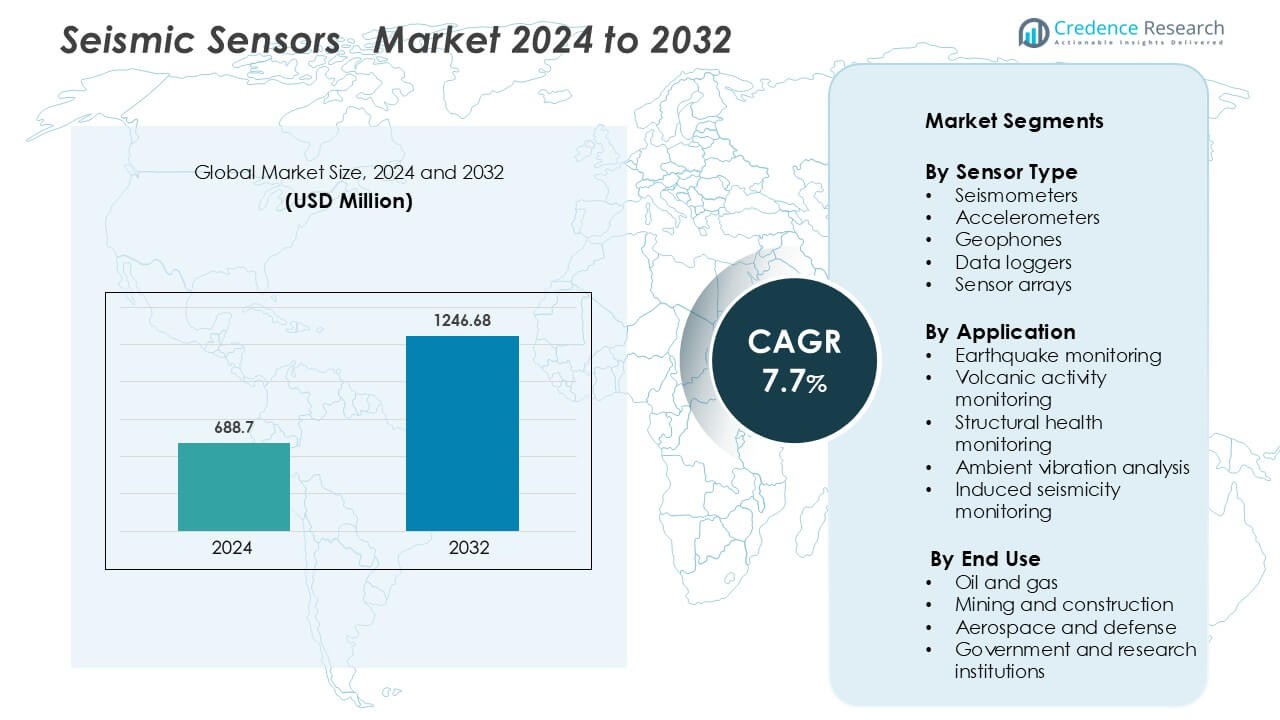
Seismic Sensors Market was valued at USD 688.7 million in 2024 and is anticipated to reach USD 1246.68 million by 2032, growing at a CAGR of 7.7 % during the forecast period.
| REPORT ATTRIBUTE | DETAILS |
|---|---|
| Historical Period | 2020-2023 |
| Base Year | 2024 |
| Forecast Period | 2025-2032 |
| Seismic Sensors Market Size 2024 | USD 688.7 Million |
| Seismic Sensors Market, CAGR | 7.7 % |
| Seismic Sensors Market Size 2032 | USD 1246.68 Million |
The seismic sensors market features strong competition among leading players such as MAURER SE, Freyssinet, Bridgestone, Taylor Devices Inc., OILES CORPORATION, Earthquake Protection Systems (EPS), THK Co., Ltd., Kawakin Core-Tech Co., Ltd., Mageba, and FIP Industriale SpA. These companies focus on developing advanced seismic isolation systems, vibration control devices, and smart sensor networks for structural safety and monitoring. Continuous R&D investment and global partnerships enhance product performance and compliance with international safety standards. North America dominates the market with a 34% share in 2024, supported by large-scale deployment of earthquake monitoring systems and increased government spending on resilient infrastructure.
Market Insights
- The seismic sensors market was valued at USD 688.7 million in 2024 and is projected to reach USD 1246.68 million by 2032, growing at a CAGR of 7.7% during the forecast period.
- Increasing demand for earthquake early warning systems and structural health monitoring drives steady market growth across industrial and government sectors.
- Advancements in MEMS-based and IoT-enabled sensor technologies enhance real-time monitoring, improving accuracy and reducing maintenance costs.
- The market is competitive, with key players such as MAURER SE, Bridgestone, and THK Co., Ltd. focusing on smart vibration control and global expansion.
- North America leads with a 34% regional share, followed by Europe at 27%, while Asia-Pacific holds 24%; by sensor type, seismometers dominate with 41% share, supported by widespread use in earthquake and infrastructure monitoring application.
Market Segmentation Analysis:
By Sensor Type
Seismometers dominate the seismic sensors market due to their high sensitivity and wide application in seismic event detection. They are essential for monitoring ground motion, enabling accurate magnitude and depth measurements. The increasing deployment of broadband seismometers for global and regional seismic networks drives their market share. These sensors support both scientific and industrial applications, ensuring precise data collection for disaster preparedness. Demand for accelerometers and geophones also grows with expanding industrial and construction monitoring projects.
- For instance, Trillium Horizon 120 by Nanometrics Inc. offers a nominal sensitivity of 1202.5 V·s/m and a bandwidth from 120 seconds to 150 Hz, demonstrating its capability for both regional and teleseismic studies.
By Application
Earthquake monitoring represents the largest application segment, supported by global initiatives to enhance seismic safety and urban resilience. Seismic networks increasingly rely on real-time data from distributed sensors for early warning systems. Continuous upgrades in geophysical instrumentation improve detection accuracy, allowing faster public alerts. Governments and research bodies prioritize these systems to minimize human and economic losses. Other key applications, such as volcanic and structural health monitoring, also gain traction due to the need for predictive infrastructure analysis.
- For instance, the GeoNet (New Zealand) network uses over 1,000 seismic instruments, detecting more than 20,000 earthquakes annually, thereby enabling prompt notification to users.
By End Use
The oil and gas sector leads the market owing to extensive use of seismic sensors in exploration and drilling operations. These sensors enable subsurface mapping and fault detection, enhancing extraction efficiency and safety. Companies increasingly integrate digital seismic arrays with advanced analytics to improve exploration accuracy. Mining and construction industries follow, utilizing sensors for vibration control and ground stability assessment. Government and research institutions continue to invest heavily in sensor networks to strengthen natural disaster monitoring and response systems.
Key Growth Drivers
Rising Demand for Earthquake Early Warning Systems
Growing concerns about seismic hazards are driving demand for advanced earthquake early warning systems. Governments and organizations across seismic-prone regions are expanding national and regional monitoring networks to enhance preparedness and response. Modern sensors provide high-resolution data that supports rapid event detection and early public alerts. For instance, Japan’s Meteorological Agency and the U.S. Geological Survey have invested heavily in dense seismic networks equipped with digital accelerometers and broadband seismometers. These systems help mitigate risks to infrastructure and populations by delivering early notifications to transportation systems, industrial facilities, and emergency services. The growing focus on urban resilience and disaster management policies globally continues to boost the installation of seismic sensors across critical areas.
- For instance, the Japan Meteorological Agency (JMA) operates about 200 seismographs and 600 seismic-intensity meters, gathering data from over 3,600 local-government stations for rapid alerts.
Expanding Exploration in Oil and Gas Sector
The oil and gas industry significantly contributes to the growing adoption of seismic sensors for exploration and drilling applications. Seismic surveys utilize advanced geophones and sensor arrays to map subsurface formations with higher accuracy. Companies are adopting 4D seismic technologies to optimize hydrocarbon recovery and reduce exploration risks. For instance, Schlumberger and Halliburton have integrated digital seismic monitoring solutions to enhance real-time data interpretation and drilling precision. These technologies support cost-efficient exploration in deepwater and unconventional reserves. Additionally, energy companies are increasingly investing in automated and wireless seismic networks for continuous asset monitoring. The expansion of offshore exploration activities, coupled with increased energy demand, further fuels the adoption of seismic sensors worldwide.
- For instance, Schlumberger’s RT-ISM (Real-Time Induced Seismicity Monitoring) system uses fibre-optic DAS (distributed acoustic sensing) to continuously monitor micro-seismic events and alert operators in real time.
Infrastructure Development and Structural Health Monitoring
Rapid urbanization and infrastructure growth are boosting the demand for seismic sensors in structural health monitoring systems. Governments and private developers are deploying these sensors in bridges, tunnels, dams, and skyscrapers to assess vibration levels and detect early signs of structural stress. The integration of IoT-enabled seismic sensors provides continuous data collection, enabling predictive maintenance and reducing catastrophic failure risks. For instance, Honeywell and Kinemetrics have developed smart monitoring systems that combine accelerometers and data loggers for real-time performance tracking. Increased public investment in smart cities and resilient infrastructure projects also drives sensor adoption. The shift toward data-driven construction management and safety compliance continues to expand the role of seismic monitoring systems in modern infrastructure management.
Key Trends & Opportunities
Integration of IoT and Cloud-Based Seismic Networks
The integration of IoT and cloud computing in seismic monitoring systems is transforming data acquisition and analysis. IoT-enabled sensors transmit data in real-time to cloud platforms, facilitating faster event detection and remote monitoring. This trend enhances data accessibility, reduces latency, and allows centralized system management. Companies like Nanometrics and Güralp Systems are introducing scalable IoT-based sensor networks designed for large-scale deployments. Cloud integration supports predictive analytics, enabling authorities to identify seismic patterns and prevent potential disasters. The trend also opens opportunities for subscription-based data services and smart monitoring solutions for industrial and urban safety applications.
- For instance, Güralp Systems deployed a 21 km SMART subsea cable with three instrumented repeaters at 6 km intervals, each housing a Certimus seismometer and Fortimus accelerometer, to stream live seismic and pressure data from the Ionian Sea floor.
Advancements in MEMS and Low-Cost Sensor Technology
The growing use of microelectromechanical systems (MEMS) technology is enabling the development of compact, energy-efficient, and affordable seismic sensors. MEMS-based accelerometers and geophones offer high sensitivity at lower costs, making them suitable for dense sensor network installations. Research institutions and private firms are leveraging these advancements to expand coverage in remote and high-risk zones. For instance, companies like Silicon Designs and Omron are developing MEMS sensors optimized for long-term environmental durability. This innovation drives widespread adoption across both scientific and commercial sectors. The availability of low-cost sensors also supports government-led monitoring initiatives and educational research programs.
- For instance, Silicon Designs introduced the Model 2220 series MEMS accelerometers, offering a measurement range up to ±400 g with a frequency response of 0–2000 Hz and a noise density of 7 µg/√Hz. Omron’s D7S MEMS seismic sensor, using a 3-axis accelerometer, detects seismic intensity above 0.15 m/s² and supports IoT-based structural health monitoring.
Key Challenges
High Installation and Maintenance Costs
Despite technological progress, the high installation and maintenance costs of seismic sensors remain a major challenge. Establishing dense monitoring networks requires significant investments in hardware, calibration, and data transmission infrastructure. Maintenance is complex, especially in remote or harsh environments where accessibility is limited. For instance, ocean-bottom seismic networks used for offshore monitoring demand specialized equipment and frequent servicing. These factors increase operational expenses, limiting adoption in developing regions with budget constraints. To address this, manufacturers are focusing on developing modular and energy-efficient systems that lower lifecycle costs. However, cost barriers continue to restrain widespread deployment across smaller research institutions and municipal monitoring projects.
Data Management and Integration Complexity
Managing and integrating massive volumes of seismic data from distributed sensor networks present another key challenge. Data inconsistency, noise interference, and limited interoperability between systems hinder accurate event interpretation. Integrating diverse sensor types such as geophones, accelerometers, and data loggers-requires standardized protocols and advanced analytics tools. Organizations often face difficulties in synchronizing real-time data across cloud and edge systems. For instance, regional networks using legacy systems struggle to merge with newer digital platforms, reducing overall system efficiency. The industry is increasingly investing in AI-driven data analytics and edge computing to overcome these limitations, but technical and infrastructural gaps still pose constraints to seamless seismic data management.
Regional Analysis
North America
North America holds the largest share of the seismic sensors market at 34% in 2024, driven by strong government investments in earthquake monitoring and oil exploration. The U.S. Geological Survey’s dense seismic network and Canada’s resource exploration programs fuel sensor demand. Leading companies deploy advanced broadband seismometers and MEMS-based accelerometers for early warning and structural monitoring. The region’s mature infrastructure, stringent safety regulations, and continuous R&D funding enhance market stability. Increasing shale exploration and disaster preparedness initiatives further strengthen North America’s leadership in the global seismic sensor market.
Europe
Europe accounts for 27% of the global seismic sensors market, supported by active research and strict construction safety standards. Countries such as Italy, Greece, and Turkey are upgrading seismic networks to improve disaster resilience. The region’s energy sector also utilizes seismic sensors for offshore exploration in the North Sea. European manufacturers emphasize sensor precision, durability, and IoT integration for structural and environmental monitoring. Continuous EU funding for seismic hazard assessment and sustainable infrastructure development sustains long-term growth. The adoption of low-cost digital arrays further accelerates deployment across research and civil engineering projects.
Asia-Pacific
Asia-Pacific captures 24% of the seismic sensors market, led by Japan, China, and India. Rapid urbanization and frequent seismic activity in the Pacific Ring of Fire drive high demand for monitoring solutions. Japan’s extensive early warning systems and China’s investment in regional seismic stations boost market expansion. Industrial applications, including mining and construction, also contribute to strong growth. Local manufacturers increasingly develop cost-efficient MEMS sensors to enhance accessibility. Government programs supporting smart infrastructure and public safety reinforce Asia-Pacific’s role as the fastest-growing region in the seismic sensors industry.
Latin America
Latin America represents 9% of the global seismic sensors market, driven by increasing investments in earthquake-prone regions such as Chile, Mexico, and Peru. National seismic networks are being upgraded to improve real-time event detection and emergency response. The oil and mining industries further support market growth through seismic surveys and exploration. Regional initiatives, including public–private collaborations for hazard monitoring, foster steady adoption. However, limited funding and technological dependence on imports constrain large-scale deployments. Continued partnerships with North American and European sensor firms are expected to enhance Latin America’s technological capabilities.
Middle East & Africa
The Middle East & Africa region accounts for 6% of the seismic sensors market, with growth driven by oil and gas exploration, mining, and infrastructure projects. Countries such as Saudi Arabia, South Africa, and the UAE are investing in advanced seismic monitoring for both industrial and environmental applications. Seismic sensors assist in detecting subsurface faults and monitoring construction vibrations in major projects. However, limited regional expertise and high installation costs pose challenges. Growing collaborations with global technology providers and government-backed exploration programs are expected to improve adoption and regional capabilities.
Market Segmentations:
By Sensor Type
- Seismometers
- Accelerometers
- Geophones
- Data loggers
- Sensor arrays
By Application
- Earthquake monitoring
- Volcanic activity monitoring
- Structural health monitoring
- Ambient vibration analysis
- Induced seismicity monitoring
By End Use
- Oil and gas
- Mining and construction
- Aerospace and defense
- Government and research institutions
By Geography
- North America
- U.S.
- Canada
- Mexico
- Europe
- Germany
- France
- U.K.
- Italy
- Spain
- Rest of Europe
- Asia Pacific
- China
- Japan
- India
- South Korea
- South-east Asia
- Rest of Asia Pacific
- Latin America
- Brazil
- Argentina
- Rest of Latin America
- Middle East & Africa
- GCC Countries
- South Africa
- Rest of the Middle East and Africa
Competitive Landscape
The seismic sensors market is competitive, with key players emphasizing advanced vibration control, durability, and real-time monitoring technologies. MAURER SE and Freyssinet lead with precision-engineered seismic isolation and damping systems tailored for large infrastructure projects. Bridgestone and Taylor Devices Inc. focus on high-performance elastomeric and hydraulic dampers that enhance structural resilience under dynamic loads. OILES CORPORATION and THK Co., Ltd. integrate smart sensor technologies into seismic bearings for automated data collection and predictive maintenance. Earthquake Protection Systems (EPS) and Mageba specialize in base isolation systems combining mechanical and digital sensing for optimal performance during seismic events. Kawakin Core-Tech Co., Ltd. and FIP Industriale SpA expand their product lines with advanced displacement sensors and energy dissipation devices suited for bridges and high-rise structures. Companies are investing in IoT-enabled seismic monitoring, AI-driven data analytics, and global project collaborations to improve safety, compliance, and adaptive infrastructure resilience.
Key Player Analysis
- MAURER SE
- Freyssinet
- Bridgestone
- Taylor Devices Inc.
- OILES CORPORATION
- Earthquake Protection Systems (EPS)
- THK Co., Ltd.
- Kawakin Core-Tech Co., Ltd.
- Mageba
- FIP Industriale SpA
Recent Developments
- In April 2024, Caltech introduced a seismic sensor specifically designed to detect moonquakes. This innovation highlights advancements in seismic monitoring technology for extraterrestrial environments.
- In January 2024, the National High-Speed Rail Corporation (NHSRCL) announced plans to install twenty-eight seismometers along the Mumbai-Ahmedabad bullet train corridor. This initiative aims to enhance earthquake monitoring and safety using advanced Japanese Shinkansen technology.
- In September 2023, Google launched an earthquake alert system for Android devices in India. This system utilizes smartphone sensors to detect seismic activity and provide early warnings.
Report Coverage
The research report offers an in-depth analysis based on Sensor Type, Application, End-Use and Geography. It details leading market players, providing an overview of their business, product offerings, investments, revenue streams, and key applications. Additionally, the report includes insights into the competitive environment, SWOT analysis, current market trends, as well as the primary drivers and constraints. Furthermore, it discusses various factors that have driven market expansion in recent years. The report also explores market dynamics, regulatory scenarios, and technological advancements that are shaping the industry. It assesses the impact of external factors and global economic changes on market growth. Lastly, it provides strategic recommendations for new entrants and established companies to navigate the complexities of the market.
Future Outlook
- Growing adoption of IoT-enabled seismic sensors will improve real-time monitoring accuracy.
- Governments will expand early warning systems to enhance public safety and disaster readiness.
- Integration of AI and machine learning will enable faster seismic data interpretation.
- MEMS-based sensor technology will continue reducing device size and energy consumption.
- Demand from oil, gas, and mining sectors will rise for exploration and safety monitoring.
- Structural health monitoring in smart cities will boost long-term sensor installations.
- Cloud-based seismic data platforms will enhance remote analysis and collaboration.
- Partnerships between research institutions and industry players will drive innovation.
- Growing infrastructure resilience programs will increase funding for seismic sensor networks.
- Asia-Pacific will emerge as the fastest-growing region due to rapid urbanization and seismic risk.

Request a Free Sample
Fill in your details and we'll send you a free sample report.
- Sample data tables & charts
- Research methodology
Need a Custom Version of This Report?
Tailor the scope, geography, or segments to your exact requirements.
- Custom geography or segment scope
- Direct access to our analyst team
Frequently Asked Questions
What is the current market size for the Seismic Sensors Market, and what is its projected size in 2032?
At what Compound Annual Growth Rate is the Seismic Sensors Market projected to grow between 2025 and 2032?
Which sensor segment held the largest share in 2024?
What are the primary factors fueling the growth of the Seismic Sensors Market?
Who are the leading companies in the Seismic Sensors Market?
Which region commanded the largest share of the Seismic Sensors Market in 2024?
Table of Content
Chapter 1 Market Segmentation
- 1.1 Segmentation Framework
- 1.1.1 Product and Service Classification
- 1.1.2 Application and End-Use Classification
- 1.1.3 Technology and Solution Classification
- 1.1.4 Customer and Distribution Channel Classification
- 1.1.5 Geographic Segmentation
- 1.1.6 Market Segment Definitions and Boundaries
Chapter 2 Introduction
- 2.1 Report Objectives and Scope
- 2.2 Product Definition and Industry Terminology
- 2.3 Market Inclusions and Exclusions
- 2.4 Research Process
- 2.4.1 Primary Research and Expert Interviews
- 2.4.2 Secondary Research and Source Review
- 2.4.3 Top-Down and Bottom-Up Estimation
- 2.4.4 Data Triangulation and Verification
- 2.5 Market Size Measurement Basis
- 2.5.1 2024: USD 688.7 million → 2032: USD 1246.68 million
- 2.6 Historical and Forecast Reference Periods
- 2.6.1 Base Year: 2024
- 2.6.2 Forecast Period: 2024-2032
- 2.7 Research Assumptions and Limitations
Chapter 3 Executive Summary
- 3.1 Market Snapshot and Key Findings
- 3.2 Base-Year Market Size, 2024
- 3.3 Forecast Market Size, 2032
- 3.4 Revenue and Volume Growth Outlook
- 3.5 Key Demand and Supply Indicators
- 3.6 Leading Market Segments
- 3.7 Fastest-Growing Market Opportunities
- 3.8 Regional Performance Highlights
- 3.9 Technology and Industry Transformation
- 3.10 Competitive Landscape Summary
- 3.11 Analyst View and Strategic Implications
Chapter 4 Global Seismic Sensors Market Trends and Developments
- 4.1 Historical Industry Development
- 4.2 Recent Market Trends and Developments
- 4.3 Demand and Customer Behavior Trends
- 4.4 Technology and Product Innovation
- 4.5 Artificial Intelligence, Automation and Digitalization
- 4.6 Local Manufacturing and Supply Chain Realignment
- 4.7 Industry Partnerships, Mergers and Acquisitions
- 4.8 Sustainability and Circular Economy Developments
- 4.9 Government and Private Sector Investment Trends
- 4.10 Emerging Business Models and Commercialization
- 4.11 Industry Developments and Announcements
Chapter 5 Global Seismic Sensors Market Production, Supply and Demand Analysis
- 5.1 Demand Trend and Consumption Analysis
- 5.2 Demand Forecast, 2024-2032
- 5.3 Production and Output Trend
- 5.4 Production and Output Forecast, 2024-2032
- 5.5 Installed Capacity and Capacity Utilization
- 5.6 Company-Wise Production Plants and Statistics
- 5.6.1 Installed Production Capacity
- 5.6.2 Actual Production
- 5.6.3 Planned Capacity and Expansion Targets
- 5.7 Supply Chain Structure and Procurement Trends
- 5.8 Supply-Demand Gap and Bottlenecks
- 5.9 Import Dependence and Sourcing Structure
- 5.10 Contract Manufacturing and Outsourcing
- 5.11 Regional Supply and Demand Concentration
Chapter 6 Global Seismic Sensors Market Pricing Analysis
- 6.1 Pricing Structure and Measurement
- 6.2 Historical Pricing Trends
- 6.3 Pricing Outlook, 2024-2032
- 6.4 Average Selling Price and Unit Economics
- 6.5 Pricing by Product and Market Segment
- 6.6 Geographic Pricing Differences
- 6.7 Key Input, Energy, Labor and Logistics Costs
- 6.8 Contract Pricing and Purchasing Models
- 6.9 Pricing Sensitivity and Competitive Positioning
- 6.10 Price, Margin and Profitability Implications
Chapter 7 Global Seismic Sensors Market Dynamics
- 7.1 Market Growth Drivers
- 7.1.1 Demand-Side Drivers
- 7.1.2 Technology and Innovation Drivers
- 7.1.3 Infrastructure and Investment Drivers
- 7.1.4 Regulatory and Policy Drivers
- 7.2 Market Restraints
- 7.2.1 Cost and Affordability Constraints
- 7.2.2 Technology and Adoption Barriers
- 7.2.3 Supply Chain and Operational Constraints
- 7.3 Market Challenges
- 7.3.1 Competitive Pressure and Margin Erosion
- 7.3.2 Skills, Infrastructure and Implementation Gaps
- 7.4 Emerging Market Opportunities
- 7.5 Market Dynamics Impact and Time-Horizon Assessment
Chapter 8 Global Seismic Sensors Value Chain Analysis
- 8.1 Industry Value Chain Overview
- 8.2 Upstream Suppliers and Critical Inputs
- 8.3 Technology and Component Providers
- 8.4 Manufacturing or Service Delivery
- 8.5 Distribution, Channel Partners and Integrators
- 8.6 Downstream Applications and End Users
- 8.7 Value Addition and Profit Pools
- 8.8 Vertical Integration and Outsourcing
- 8.9 Supplier Concentration and Risk
- 8.10 Supply Chain Localization and Resilience
Chapter 9 Global Seismic Sensors Market Regulations and Policies
- 9.1 Relevant Laws, Standards and Compliance Frameworks
- 9.2 Product, Service, Safety and Quality Requirements
- 9.3 Government Policies, Incentives and Subsidies
- 9.4 Imports, Exports and Trade Barriers
- 9.5 Public Procurement and Local Content Requirements
- 9.6 Environmental and Sustainability Compliance
- 9.7 Upcoming Policy Changes and Market Implications
Chapter 10 Global Seismic Sensors Market Hotspots and Opportunities
- 10.1 Market Opportunity Mapping and Growth Hotspots
- 10.2 High-Growth Applications and Customer Groups
- 10.3 Underserved Markets and White-Space Opportunities
- 10.4 Emerging Technology and Product Opportunities
- 10.5 New Capacity and Investment Hotspots
- 10.6 Market Entry and Expansion Opportunities
- 10.7 Distribution and Partnership Opportunities
- 10.8 Near-Term and Long-Term Commercial Potential
- 10.9 Opportunity Attractiveness and Execution Risks
Chapter 11 Global Seismic Sensors Market Outlook, 2024-2032
- 11.1 Market Size and Analysis
- 11.1.1 Revenue (Market Measurement: 2024: USD 688.7 million → 2032: USD 1246.68 million)
- 11.1.2 Market Volume and Quantity Sold
- 11.1.3 Historical Market Size
- 11.1.4 Base-Year Market Size, 2024
- 11.2 Market Forecast, 2024-2032
- 11.2.1 Revenue Forecast to 2032
- 11.2.2 Volume Forecast to 2032
- 11.2.3 CAGR and Year-on-Year Growth
- 11.2.4 Incremental Revenue Opportunity
- 11.3 Forecast Assumptions and Scenario Analysis
- 11.3.1 Base-Case Forecast
- 11.3.2 Optimistic and Conservative Scenarios
- 11.3.3 Technology, Pricing and Policy Sensitivities
- 11.4 Market Attractiveness and Growth Outlook
Chapter 12 Global Seismic Sensors Market Segmentation and Outlook
- 12.1 Segmentation Summary and Market Shares, 2024
- 12.2 Largest and Fastest-Growing Segments
- 12.3 Segment Growth Comparison
- 12.4 Segment Attractiveness and Priority Matrix
Chapter 13 Global Seismic Sensors Geographic Market Outlook, 2024-2032
- 13.1 Regional Market Size and Share, 2024
- 13.2 Regional Market Forecast, 2024-2032
- 13.3 Regional Pricing, Production and Demand Differences
- 13.4 North America
- 13.4.1 United States
- 13.4.2 Canada
- 13.4.3 Mexico
- 13.5 Europe
- 13.5.1 Germany
- 13.5.2 France
- 13.5.3 Italy
- 13.5.4 United Kingdom
- 13.5.5 Spain
- 13.5.6 Poland
- 13.5.7 Russia
- 13.5.8 Netherlands
- 13.5.9 Belgium
- 13.5.10 Sweden
- 13.5.11 Denmark
- 13.5.12 Norway
- 13.5.13 Rest of Europe
- 13.6 Asia Pacific
- 13.6.1 China
- 13.6.2 India
- 13.6.3 Japan
- 13.6.4 South Korea
- 13.6.5 Thailand
- 13.6.6 Indonesia
- 13.6.7 Vietnam
- 13.6.8 Malaysia
- 13.6.9 Australia
- 13.6.10 Rest of Asia Pacific
- 13.7 Latin America
- 13.7.1 Brazil
- 13.7.2 Argentina
- 13.7.3 Colombia
- 13.7.4 Chile
- 13.7.5 Rest of Latin America
- 13.8 Middle East
- 13.8.1 Saudi Arabia
- 13.8.2 United Arab Emirates
- 13.8.3 Turkey
- 13.8.4 Israel
- 13.8.5 Iran
- 13.8.6 Rest of the Middle East
- 13.9 Africa
- 13.9.1 South Africa
- 13.9.2 Egypt
- 13.9.3 Nigeria
- 13.9.4 Morocco
- 13.9.5 Rest of Africa
- 13.10 Regional Investment, Policy and Supply Chain Differences
- 13.11 Regional Competitive Landscape
- 13.12 Geographic Growth Hotspots
Chapter 14 Global Seismic Sensors Technology, Innovation and Sustainability Outlook
- 14.1 Technology Landscape and Maturity
- 14.2 Product, Process and Service Innovation
- 14.3 AI, Automation and Digital Tools in the Industry
- 14.4 Technology Adoption and Performance Benchmarking
- 14.5 Innovation Pipeline and R&D Investment
- 14.6 Patent and Intellectual Property Trends
- 14.7 Energy Efficiency and Resource Management
- 14.8 Sustainability, Recycling and Circularity
- 14.9 Technology Roadmap, 2024-2032
- 14.10 Risks of Obsolescence and Technology Substitution
Chapter 15 Global Seismic Sensors Market Key Strategic Imperatives
- 15.1 Growth and Market Entry Priorities
- 15.2 High-Return Products and Segments
- 15.3 Pricing, Profitability and Cost Optimization
- 15.4 Technology Investment and Product Differentiation
- 15.5 Supply Chain Localization and Resilience
- 15.6 Distribution and Customer Acquisition
- 15.7 Partnership, Acquisition and Capacity Strategy
- 15.8 Regional Expansion Priorities
- 15.9 Short-, Medium- and Long-Term Actions
Chapter 16 Competition Outlook
- 16.1 Industry Competition Characteristics
- 16.2 Market Structure and Concentration
- 16.3 Market Share and Competitive Positioning, 2024
- 16.4 Company-Wise Revenue and Product Benchmarking
- 16.5 Production and Service Capacity Benchmarking
- 16.6 Technology, Pricing and Differentiation
- 16.7 Regional Footprint and Distribution Strength
- 16.8 Mergers, Acquisitions and Strategic Alliances
- 16.9 New Entrants and Competitive Threats
- 16.10 Porter's Five Forces and Industry Attractiveness
- 16.11 Competitive Outlook, 2024-2032
Chapter 17 Company Profiles
- 17.1 Company Coverage and Selection Criteria
- 17.2 Leading Market Participants – Standard Profile Structure
- 17.2.1 Business Description
- 17.2.2 Company Ownership and Geographic Presence
- 17.2.3 Product and Service Portfolio
- 17.2.4 Manufacturing and Operating Footprint
- 17.2.5 Production Capacity and Expansion Plans
- 17.2.6 Financial Performance and Investment
- 17.2.7 Market Share and Competitive Position
- 17.2.8 Technology and Innovation Capabilities
- 17.2.9 Strategic Alliances or Partnerships
- 17.2.10 Recent Developments
- 17.2.11 Growth Strategy and Outlook
- 17.3 Other Relevant Market Participants
Note: Every listed company is profiled on the structure shown under the first company. The company list is preliminary and may change based on research findings, market developments, data availability and client requirements.
Chapter 18 Disclaimer
- 18.1 Research and Forecast Disclaimer
- 18.2 Data Source and Estimation Limitations
Note: The depth of individual sections depends on data availability for this market. Volume, capacity, trade and other unit-based metrics are included where applicable.

