
Shilajit Market Overview:
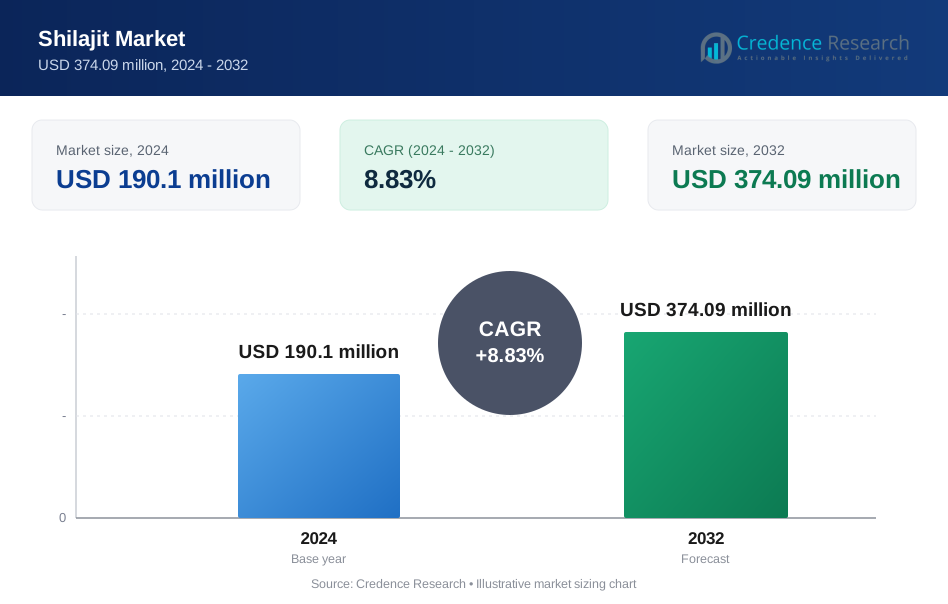
The global shilajit market was valued at USD 190.1 million in 2024 and is anticipated to reach USD 374.09 million by 2032, expanding at a CAGR of 8.83% during the forecast period.
| REPORT ATTRIBUTE | DETAILS |
|---|---|
| Historical Period | 2020-2023 |
| Base Year | 2024 |
| Forecast Period | 2025-2032 |
| Shilajit Market Size 2024 | USD 190.1 million |
| Shilajit Market, CAGR | 8.83% |
| Shilajit Market Size 2032 | USD 374.09 million |
Shilajit Market Insights
- Market growth is primarily driven by rising consumer preference for natural and traditional supplements, increasing awareness of shilajit’s adaptogenic, mineral-rich properties, and strong demand from sexual health and vitality applications, which represent the dominant application segment due to high consumer association with energy and reproductive wellness benefits.
- Key market trends include rapid premiumization, increased adoption of capsules/tablets as the leading form segment due to convenience and standardized dosing, and growing online distribution dominance supported by direct-to-consumer wellness brands and cross-border e-commerce.
- Competitive dynamics center on quality assurance, Himalayan sourcing authenticity, advanced purification, and standardized fulvic acid content, with leading players differentiating through certifications, clean-label positioning, and digital marketing rather than price competition.
- Regionally, Asia-Pacific dominates with approximately 42% market share, driven by traditional usage and production strength, followed by North America at 24% and Europe at 18%, while Latin America and the Middle East & Africa collectively account for the remaining share with steady adoption growth.
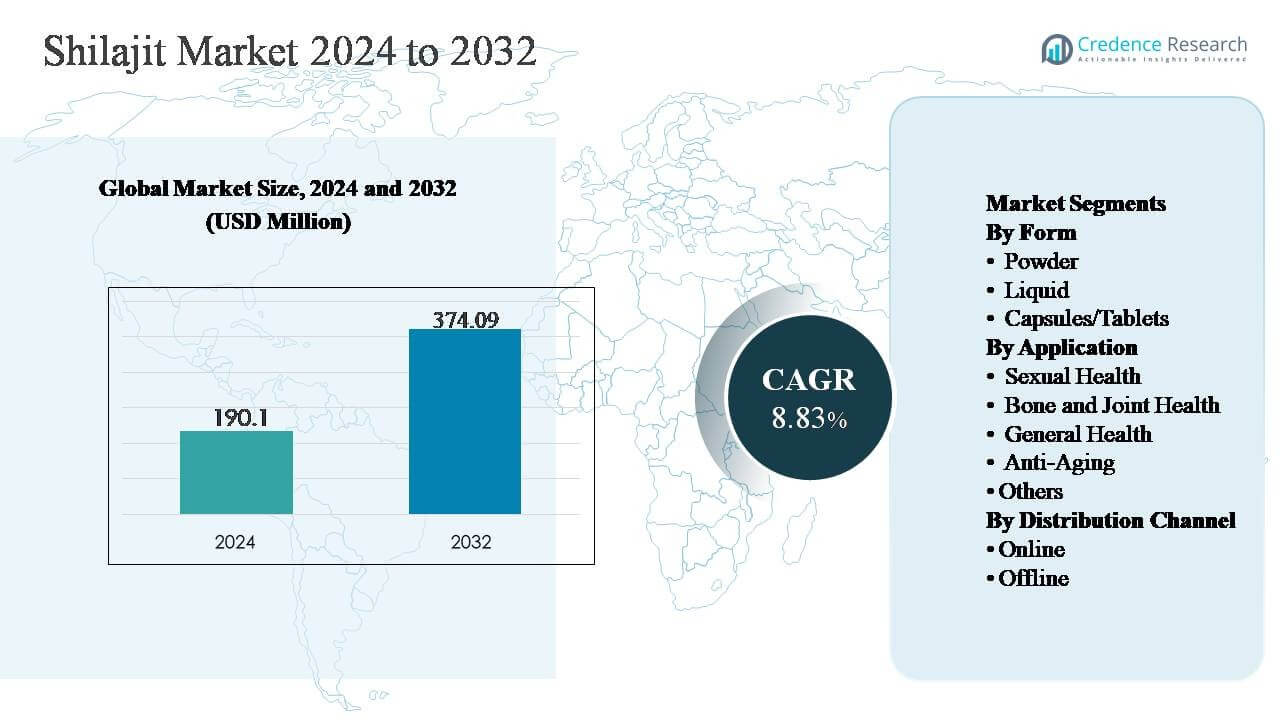
Shilajit Market Segmentation Analysis:
By Form:
By form, capsules/tablets represent the dominant sub-segment in the shilajit market, accounting for the largest market share due to their standardized dosing, convenience, and wider acceptance among urban and international consumers. Capsules and tablets offer improved taste masking, longer shelf life, and easier compliance compared to raw forms, making them highly suitable for daily supplementation. Powdered shilajit maintains relevance among traditional users who prefer mixing it with milk or herbal formulations, while liquid forms are gaining traction for faster absorption. However, pharmaceutical-style presentation, regulatory familiarity, and growing nutraceutical branding continue to drive capsules/tablets as the leading form.
- For instance, Undersun Biomedtech Corp. manufactures resin-extracted shilajit capsules typically dosed at 250 mg, utilizing a multi-stage aqueous purification process that includes micron filtration and heavy-metal screening (Lead, Mercury, Cadmium, Arsenic).
By Application:
By application, sexual health dominates the shilajit market, holding the highest market share, supported by strong consumer association with vitality enhancement, testosterone support, and reproductive wellness. Shilajit’s rich fulvic acid and mineral profile underpins its widespread use in male sexual health supplements, particularly in Asia-Pacific and emerging markets. General health and anti-aging applications follow, driven by rising demand for adaptogenic and energy-support products among aging populations. Bone and joint health applications are expanding steadily, supported by increased focus on mobility and musculoskeletal wellness, while other niche applications continue to evolve through formulation innovation.
- For instance, in a controlled human intervention conducted with purified shilajit supplied by Natreon Inc. (PrimaVie®), male participants consumed 250 mg capsules twice daily for 90 consecutive days, with biochemical assessments conducted at baseline, day 45, and day 90, measuring serum total testosterone, free testosterone, and dehydroepiandrosterone levels using standardized immunoassay methods, providing clinically validated evidence that underpins shilajit’s positioning in sexual health–focused nutraceutical applications.
By Distribution Channel:
By distribution channel, online sales constitute the dominant sub-segment, capturing a significant share of the global shilajit market due to expanding e-commerce penetration, direct-to-consumer wellness brands, and improved access to international products. Online platforms enable detailed product education, transparent ingredient sourcing, and subscription-based purchasing, which strongly resonate with health-conscious consumers. Offline channels, including pharmacies, Ayurvedic stores, and specialty health retailers, remain important in traditional markets where in-person trust and practitioner recommendations influence purchasing decisions. Nevertheless, digital marketing, influencer-driven awareness, and cross-border shipping efficiencies continue to strengthen online dominance.
Key Growth Driver
Rising Preference for Natural and Traditional Supplements
The increasing global shift toward natural, plant- and mineral-based wellness solutions is a primary growth driver for the shilajit market. Consumers are actively moving away from synthetic supplements due to concerns over long-term side effects, favoring traditional remedies with established historical use. Shilajit’s long-standing role in Ayurveda and traditional medicine systems positions it as a trusted adaptogen for energy, vitality, and overall wellness. Growing awareness of holistic health, preventive healthcare practices, and daily supplementation routines has strengthened demand across both developed and emerging markets. This trend is particularly pronounced among aging populations and wellness-focused consumers seeking sustainable, naturally sourced ingredients with broad physiological benefits.
- For instance, Natreon Inc. (now Kerry Group) sources raw shilajit resin from Himalayan altitudes exceeding 16,000 feet, processing it via a patented water-only extraction system that maintains low temperatures (below 40 °C) to preserve nutrient integrity.
Expanding Application in Sexual Health and Vitality Products
Shilajit’s strong association with sexual health, stamina, and vitality significantly drives market expansion. The ingredient is increasingly incorporated into male wellness, testosterone support, and reproductive health formulations, benefiting from rising consumer openness toward sexual health supplements. Lifestyle stress, sedentary habits, and increasing incidence of fatigue-related concerns have amplified demand for natural performance enhancers. Supplement manufacturers are leveraging shilajit’s mineral richness and adaptogenic positioning to develop premium, targeted formulations. This application-driven demand is particularly strong in Asia-Pacific and the Middle East, while North America and Europe are witnessing growing acceptance through clinically positioned nutraceutical products.
- For instance, Alpspure Lifesciences (via its consumer brand Alpspure Nutra) formulates shilajit softgels standardized at 500 mg per serving. Produced using controlled resin purification to ensure high fulvic acid content, the extracts are subjected to multi-parameter laboratory testing for heavy metals, microbial load, and moisture content.
Growth of E-Commerce and Direct-to-Consumer Wellness Brands
The rapid expansion of e-commerce and direct-to-consumer (DTC) wellness brands has substantially improved shilajit’s market accessibility and visibility. Online platforms allow manufacturers to educate consumers about sourcing, purification processes, and quality certifications, addressing historical trust barriers associated with raw shilajit products. Subscription models, influencer marketing, and personalized wellness positioning have further accelerated adoption. Digital channels also enable global reach for niche Ayurvedic products, supporting cross-border sales and premium pricing strategies. As consumers increasingly rely on online research and purchasing for supplements, e-commerce continues to act as a critical catalyst for sustained market growth.
Key Trend & Opportunity
Product Standardization and Purification Innovation
Standardization and purification advancements represent a key opportunity in the shilajit market, addressing long-standing quality and safety concerns. Manufacturers are increasingly investing in advanced filtration, resin purification, and heavy-metal removal technologies to deliver standardized fulvic acid content and consistent potency. These improvements support regulatory compliance and enhance consumer trust, particularly in Western markets. Standardized formulations also enable broader incorporation into capsules, tablets, and functional blends, facilitating entry into mainstream nutraceutical channels. As quality transparency becomes a purchasing priority, companies that emphasize purity testing, certification, and traceable sourcing are well positioned to gain competitive advantage.
- For instance, Xi’an Changyue Biological Technology(also known as Xi'an Changyue Phytochemistry) utilizes a multi-stage aqueous extraction and purification process for its shilajit extracts. To achieve pharmaceutical-grade standards, the process incorporates membrane filtration (typically using 0.22 μm filters to remove suspended particles) and vacuum concentration.
Premiumization and Functional Blends
The market is witnessing a growing trend toward premium shilajit products and functional blends targeting specific health outcomes. Brands are combining shilajit with adaptogens, minerals, and herbal extracts to create differentiated formulations for energy, anti-aging, immunity, and cognitive wellness. Premium packaging, clean-label positioning, and science-backed branding are attracting high-income and urban consumers willing to pay for perceived efficacy and quality. This trend opens opportunities for value-added product development and higher margins, particularly in mature supplement markets where consumers increasingly seek multifunctional and performance-oriented wellness solutions.
- For instance, Advanced Himalayan shilajit resin is often processed through multi-stage aqueous extraction to maximize soluble bioactive recovery. To maintain structural and bioactive integrity, high-quality manufacturers such as those producing standardized extracts (e.g., PrimaVie™ or specialized Ayurvedic resins) limit heating to below 40 °C.
Key Challenge
Quality Variability and Adulteration Risks
Quality inconsistency remains a significant challenge in the shilajit market due to variations in geographic sourcing, extraction methods, and purification standards. Adulteration with fillers, resins, or synthetic compounds has historically undermined consumer trust and raised safety concerns. Inconsistent fulvic acid levels and contamination risks complicate regulatory acceptance and limit adoption in stricter markets. These issues create barriers for reputable manufacturers that must invest heavily in quality control and testing while competing against low-cost, unverified products. Addressing quality variability is critical for sustaining long-term market credibility and growth.
Regulatory Uncertainty and Limited Clinical Validation
Regulatory ambiguity and limited large-scale clinical validation pose ongoing challenges for the shilajit market. Regulatory frameworks for traditional supplements vary widely across regions, affecting product approvals, labeling claims, and marketing practices. In many developed markets, the lack of extensive clinical trials restricts the ability to make strong health claims, slowing mainstream adoption. Manufacturers must navigate evolving compliance requirements while investing in research to substantiate efficacy and safety. Overcoming these regulatory and scientific barriers is essential for expanding shilajit’s acceptance beyond traditional and niche wellness segments.
Regional Analysis
Asia-Pacific:
Asia-Pacific dominates the global shilajit market, accounting for approximately 42% of total market share, supported by deep-rooted traditional medicine practices and strong consumer familiarity with Ayurvedic supplements. India remains the core production and consumption hub, driven by Himalayan sourcing, established herbal brands, and widespread domestic use. Rising disposable incomes, growing preventive healthcare awareness, and expansion of organized nutraceutical retail further support demand across China, Southeast Asia, and Japan. The region also benefits from export-oriented manufacturers supplying purified and standardized shilajit products to Western markets, reinforcing Asia-Pacific’s leadership position.
North America:
North America represents around 24% of the global shilajit market, driven by rising adoption of natural supplements, functional wellness trends, and male vitality products. Consumers increasingly seek adaptogens and mineral-based formulations for energy, stress management, and healthy aging. The United States leads regional demand, supported by strong e-commerce penetration, premium supplement brands, and influencer-led health awareness. Regulatory scrutiny encourages higher-quality, purified shilajit products, favoring established nutraceutical players. Growing acceptance of Ayurvedic ingredients within mainstream wellness routines continues to expand shilajit’s consumer base across the region.
Europe:
Europe accounts for approximately 18% of the global shilajit market, supported by growing interest in herbal supplements, clean-label nutrition, and holistic health solutions. Demand is strongest in Germany, the United Kingdom, France, and Italy, where consumers increasingly adopt adaptogenic and anti-aging products. Strict regulatory frameworks emphasize product safety, traceability, and standardized formulations, encouraging premium positioning. Capsules and tablets dominate due to pharmaceutical-style preferences. While awareness remains lower than in Asia-Pacific, rising natural wellness trends and increased availability through online platforms are steadily strengthening Europe’s market presence.
Latin America:
Latin America holds nearly 9% of the global shilajit market, with growth driven by increasing awareness of natural remedies and expanding dietary supplement consumption. Brazil and Mexico are key markets, supported by a young population, rising fitness culture, and interest in vitality-enhancing products. Distribution remains fragmented, with online channels playing a growing role in market access. Although shilajit awareness is still emerging, its positioning within energy, sexual health, and general wellness supplements supports gradual adoption. Improving retail infrastructure and digital marketing are expected to enhance regional penetration.
Middle East & Africa:
The Middle East & Africa region accounts for about 7% of the global shilajit market, driven by cultural acceptance of traditional remedies and rising interest in male health and vitality supplements. Demand is concentrated in Gulf Cooperation Council countries, where higher disposable incomes support premium nutraceutical consumption. Online retail channels significantly improve access to imported shilajit products, while specialty herbal stores remain influential. In Africa, adoption remains limited but is gradually increasing with urbanization and health awareness initiatives. The region’s growth is supported by expanding wellness trends and cross-border e-commerce availability.
Shilajit Market Segmentations:
By Form
- Powder
- Liquid
- Capsules/Tablets
By Application
- Sexual Health
- Bone and Joint Health
- General Health
- Anti-Aging
- Others
By Distribution Channel
- Online
- Offline
By Geography
- North America
- U.S.
- Canada
- Mexico
- Europe
- Germany
- France
- U.K.
- Italy
- Spain
- Rest of Europe
- Asia Pacific
- China
- Japan
- India
- South Korea
- South-east Asia
- Rest of Asia Pacific
- Latin America
- Brazil
- Argentina
- Rest of Latin America
- Middle East & Africa
- GCC Countries
- South Africa
- Rest of the Middle East and Africa
Competitive Landscape
The competitive landscape of the shilajit market is characterized by the presence of a mix of established Ayurvedic manufacturers, nutraceutical brands, and emerging direct-to-consumer wellness companies competing on quality, sourcing, and brand credibility. Market participants focus heavily on Himalayan sourcing authenticity, advanced purification processes, and standardized fulvic acid content to differentiate their offerings. Leading players invest in third-party testing, clean-label certifications, and transparent supply chains to build consumer trust and comply with regulatory requirements. Product innovation centers on capsules, tablets, and premium resin forms, often supported by targeted positioning in sexual health, vitality, and anti-aging segments. Digital-first brands leverage e-commerce platforms, influencer marketing, and subscription models to expand global reach, while traditional Ayurvedic companies rely on strong domestic distribution and practitioner endorsement. Overall, competition intensifies around premiumization, quality assurance, and brand-led consumer engagement rather than price alone.
Key Player Analysis
- CYMBIOTIKA LLC
- Undersun Biomedtech Corp.
- Botanic Healthcare
- Shaanxi Huachen Biotech
- Blisque Inc.
- Alpspure Lifesciences
- Xi'an Changyue Biological Technology
- VISTERRA
- Mufan Biology
- HERBOIL CHEM
Recent Developments
- In June 17, 2025, CYMBIOTIKA launched a Shilajit Liquid Complex designed for enhanced energy, mental clarity, and muscle recovery, packaged in single-serve packets with 200 mg of high-altitude Himalayan shilajit per packet. The formula incorporates organic honey, cacao, hazelnut butter, and Icelandic sea salt to improve palatability and nutrient delivery, targeting modern consumers seeking convenient, ready-to-use adaptogen blends.
- In 2025, VISTERRA Life Sciences is reported in competitive market analyses as a supplier of standardized shilajit extracts positioned for anti-aging and energy applications, reflecting active engagement in providing extract grades suitable for functional and dietary supplement integration across markets. Supplier materials document VISTERRA’s focus on controlled purification and formulation readiness for export and bulk nutraceutical use.
Report Coverage
The research report offers an in-depth analysis based on Form, Application, Distribution channel and Geography. It details leading market players, providing an overview of their business, product offerings, investments, revenue streams, and key applications. Additionally, the report includes insights into the competitive environment, SWOT analysis, current market trends, as well as the primary drivers and constraints. Furthermore, it discusses various factors that have driven market expansion in recent years. The report also explores market dynamics, regulatory scenarios, and technological advancements that are shaping the industry. It assesses the impact of external factors and global economic changes on market growth. Lastly, it provides strategic recommendations for new entrants and established companies to navigate the complexities of the market.
Future Outlook
- Demand for shilajit will continue to expand as consumers increasingly prioritize natural, mineral-based, and adaptogenic supplements in daily wellness routines.
- Product standardization and purification advancements will strengthen consumer trust and support wider regulatory acceptance across developed markets.
- Capsules and tablets will remain the preferred form due to convenience, consistent dosing, and compatibility with mainstream nutraceutical channels.
- Sexual health and vitality applications will continue to drive consumption, supported by growing openness toward preventive and performance-focused wellness products.
- Premium and clinically positioned shilajit formulations will gain traction among urban and health-conscious consumers.
- Online and direct-to-consumer channels will further dominate distribution, driven by digital education, subscriptions, and global accessibility.
- Increased integration of shilajit into functional blends will support diversified application growth.
- Asia-Pacific will retain leadership due to sourcing advantages and traditional usage, while Western markets will see faster awareness-driven adoption.
- Regulatory clarity and quality certifications will increasingly influence brand differentiation and market entry.
- Investment in research, traceability, and sustainable sourcing will shape long-term competitiveness.
Request a Free Sample
Fill in your details and we'll send you a free sample report.
- Sample data tables & charts
- Research methodology
Need a Custom Version of This Report?
Tailor the scope, geography, or segments to your exact requirements.
- Custom geography or segment scope
- Direct access to our analyst team
Frequently Asked Questions
What is the current market size for Shilajit, and what is its projected size in 2032?
At what Compound Annual Growth Rate is the Shilajit projected to grow between 2024 and 2032?
Which Shilajit segment held the largest share in 2024?
What are the primary factors fueling the growth of the Shilajit market?
Who are the leading companies in the Shilajit market?
Which region commanded the largest share of the Shilajit market in 2024?
Table of Content
Chapter 1. Report Introduction
- 1.1 Report Description & Purpose
- 1.1.1 Report Title & Market Definition
- 1.1.2 Unique Selling Propositions (USP) & Key Differentiators
- 1.1.3 Value Proposition for Stakeholders
- 1.2 Research Objectives
- 1.2.1 Market Sizing Objectives (Volume & Revenue) (Volume Where Applicable)
- 1.2.2 Segmentation Objectives
- 1.2.3 Competitive Intelligence Objectives
- 1.2.4 Forecast & Scenario Objectives
- 1.3 Report Scope
- 1.3.1 Shilajit Scope – Segments & Subsegments Covered
- 1.3.2 Geographic Scope – Regions & Countries Covered
- 1.3.3 Historical Period, Base Year & Forecast Period (2024; forecast to 2032)
- 1.3.4 Inclusions & Exclusions
- 1.4 Industry Classification & Applicable Codes
- 1.5 Currency, Measurement Units & Valuation Basis
- 1.6 Target Stakeholders
- 1.7 Limitations & Assumptions
Chapter 2. Executive Summary
- 2.1 Global Shilajit Market Snapshot
- 2.1.1 Market Size – Historical (2024) & Forecast (2024-2032) (2024: USD 190.1 million → 2032: USD 374.09 million)
- 2.1.2 Volume & Revenue – Global Totals (Volume Where Applicable)
- 2.1.3 Key Market Highlights – Top Five Facts
- 2.2 Shilajit Market Segmentation Snapshot
- 2.2.1 Market Split by Region – 2024 vs. 2032
- 2.3 Competitive Snapshot
- 2.3.1 Top 10 Players by Revenue Share – 2024
- 2.3.2 Top 10 Players by Volume Share – 2024 (Volume Where Applicable)
- 2.3.3 Recent Strategic Developments (18-Month Summary)
- 2.4 Key Investment Highlights & Strategic Conclusions
Chapter 3. Shilajit Market Dynamics & Industry Analysis
- 3.1 Market Overview & Context
- 3.1.1 Shilajit Market Position in the Broader Industry Value Chain
- 3.1.2 Demand Structure & Purchasing Dynamics
- 3.1.3 Market Maturity & Development Stage by Region
- 3.2 Shilajit Market Drivers
- 3.3 Shilajit Market Restraints & Challenges
- 3.4 Shilajit Market Opportunities
- 3.5 Porter's Five Forces Analysis
- 3.5.1 Threat of New Entrants
- 3.5.2 Bargaining Power of Suppliers
- 3.5.3 Bargaining Power of Buyers
- 3.5.4 Threat of Substitutes
- 3.5.5 Competitive Rivalry – Intensity Assessment
- 3.6 Shilajit Value Chain Analysis
- 3.6.1 Upstream – Key Inputs, Resources & Suppliers
- 3.6.1.1 Key Input/Resource 1
- 3.6.1.2 Key Input/Resource 2
- 3.6.1.3 Key Input/Resource 3
- 3.6.2 Midstream – Core Operations & Value Creation
- 3.6.2.1 Operating Model & Process Overview
- 3.6.2.2 Key Operating Locations & Capabilities by Company
- 3.6.3 Downstream – Market Channels & End Users
- 3.6.3.1 Direct Sales & Customer Engagement Channels
- 3.6.3.2 Indirect Sales, Intermediaries & Partner Channels
- 3.6.4 Value Chain Profitability Analysis
- 3.6.1 Upstream – Key Inputs, Resources & Suppliers
- 3.7 PESTEL Analysis
- 3.7.1 Political Factors
- 3.7.2 Economic Factors
- 3.7.3 Social Factors
- 3.7.4 Technological Factors
- 3.7.5 Environmental Factors
- 3.7.6 Legal Factors
- 3.8 Shilajit Supply Chain Analysis
- 3.8.1 Critical Input & Resource Availability Risk Assessment
- 3.8.2 Supplier & Operational Concentration Risk (Geographic Exposure)
- 3.8.3 Supply & Service Disruption Impact Analysis
- 3.9 Regulatory & Policy Landscape
Note: The regulatory and policy landscape section covers regulations based on their applicability to the market, Shilajit category, geography, and scope of the study. Only regulatory frameworks with a material impact on operations, compliance, trade, sustainability, or market access are analyzed in detail.
Chapter 4. Key Investment Pockets & Opportunity Analysis
- 4.1 Shilajit Market Attractiveness Analysis
- 4.1.1 By Region – Investment Attractiveness Matrix (Market Size × CAGR)
- 4.2 Absolute Revenue Growth Opportunity
- 4.2.1 By Region – Absolute Revenue Growth Through 2032
- 4.3 Incremental Demand Opportunity
- 4.3.1 By Region – Incremental Demand Through 2032
- 4.3.2 Segment – Incremental Demand
- 4.4 Emerging Submarket Opportunity Deep Dive (Subject to Applicability)
- 4.5 Priority Market Opportunity Scorecards
- 4.5.1 United States
- 4.5.2 Europe
- 4.5.3 Asia
- 4.5.4 Middle East & Africa
Note: Priority market opportunity scorecards reflect the geographic scope and strategic relevance of the study. Listed markets are indicative and may be adapted to the industry.
Chapter 5. Shilajit Cross-Border Trade & Market Access Analysis
- 5.1 International Trade & Cross-Border Activity Overview
- 5.1.1 Global Export Value by Country (2024)
- 5.1.2 Global Export Volume by Country (2024) (Volume Where Applicable)
- 5.1.3 Global Import Value by Country (2024)
- 5.1.4 Global Import Volume by Country (2024) (Volume Where Applicable)
- 5.1.5 Net Trade Balance by Country (2024)
- 5.2 Export Analysis – Segment
- 5.2.1 Category 1 (Applicable Classification Code)
- 5.2.2 Category 2 (Applicable Classification Code)
- 5.2.3 Category 3 (Applicable Classification Code)
- 5.2.4 Category 4 (Applicable Classification Code)
- 5.2.5 Category 5 (Applicable Classification Code)
- 5.3 Import Analysis – Segment
- 5.3.1 Category 1 (Applicable Classification Code)
- 5.3.2 Category 2 (Applicable Classification Code)
- 5.3.3 Category 3 (Applicable Classification Code)
- 5.3.4 Category 4 (Applicable Classification Code)
- 5.3.5 Category 5 (Applicable Classification Code)
- 5.4 Cross-Border Pricing & Transaction Benchmarks
- 5.4.1 Export Pricing – Segment & Country
- 5.4.2 Import Pricing – Segment & Source Country
- 5.4.3 Price Trends (2024)
- 5.5 Key Cross-Border Trade & Delivery Routes
- 5.5.1 Cross-Border Trade/Delivery Route 1
- 5.5.2 Cross-Border Trade/Delivery Route 2
- 5.5.3 Cross-Border Trade/Delivery Route 3
- 5.5.4 Cross-Border Trade/Delivery Route 4
- 5.5.5 Cross-Border Trade/Delivery Route 5
- 5.6 Trade Policy & Market Access Impact Assessment
- 5.6.1 Tariff & Non-Tariff Barriers
- 5.6.2 Regional Trade & Economic Integration Frameworks
- 5.6.3 Bilateral & Multilateral Trade Agreements
- 5.6.4 Cross-Border Operating, Licensing & Localization Requirements
Note: This chapter applies where cross-border trade or delivery is relevant to Shilajit. Goods, services, and digital offerings are assessed using applicable classifications and transaction measures. Import-export volumes, trade balances, and route analyses are included only where meaningful to the market.
Chapter 6. Competitive Landscape & Company Benchmarking
- 6.1 Shilajit Market Concentration & Structure
- 6.1.1 Herfindahl-Hirschman Index (HHI) – vs. 2024
- 6.1.2 Leading, Mid-Sized & Emerging Player Structure
- 6.1.3 Global, Regional & Local Player Dynamics
- 6.2 Shilajit Market Share Analysis – 2024
- 6.2.1 Global Revenue Share by Company
- 6.2.2 Global Volume Share by Company (Volume Where Applicable)
- 6.2.3 Regional Revenue Share
- 6.2.4 Market Share Evolution ( vs. 2024)
- 6.2.5 Company Market Share by Key Segment
- 6.2.6 Company Market Share by Customer Group
- 6.3 Operating Scale, Capacity & Infrastructure Analysis
- 6.3.1 Global Operating Scale & Supply Capacity
- 6.3.2 Resource Utilization & Operating Efficiency
- 6.3.3 Output, Service Delivery & Activity Metrics
- 6.3.4 Operating Footprint & Infrastructure Map
- 6.3.5 Planned Operational & Capacity Expansion
- 6.4 Shilajit Competitive Benchmarking Matrix
- 6.4.1 Revenue, Growth, Profitability & Operating Metric Comparison
- 6.4.2 Channel Revenue Mix
- 6.4.3 Geographic Revenue Exposure
- 6.4.4 R&D Intensity
- 6.4.5 Sustainability Maturity
- 6.5 Strategic Developments in Shilajit (Last 24 Months)
- 6.5.1 Mergers, Acquisitions & Divestments
- 6.5.2 New Products, Services & Solutions in Shilajit
- 6.5.3 Operational & Infrastructure Expansions
- 6.5.4 Strategic Alliances, Joint Ventures & Partnerships
- 6.5.5 Distribution Expansion & Market Entry
- 6.5.6 Sustainability & ESG Initiatives
- 6.6 Competitive Strategy Mapping
- 6.6.1 Leader, Challenger, Follower & Niche Classification
- 6.6.2 Pricing Strategy Comparison
- 6.6.3 Channel Strategy Matrix
Note: Strategic developments are included based on their materiality and the availability of reliable information.
Chapter 7. Global Shilajit Market – By Sales & Delivery Channel
- 7.1 Segment Overview
- 7.1.1 Volume & Revenue Split by Channel (2024 & 2032) (Volume Where Applicable)
- 7.1.2 Channel Mix Evolution (2024-2032)
Chapter 8. Regional Market Analysis – Global Overview
- 8.1 Global Regional Overview
- 8.1.1 Regional Volume Share (Volume Where Applicable)
- 8.1.2 Regional Revenue Share
- 8.1.3 Regional Volume by Region (Volume Where Applicable)
- 8.1.4 Regional Revenue by Region
- 8.1.5 Regional Forecast Through 2032
- 8.2 Cross-Regional Segment Analysis
- 8.2.1 By Sales & Delivery Channel
- 8.2.2 By Competitive Positioning & Price Tier
Chapter 9. North America Shilajit Market
- 9.1 United States
- 9.2 Canada
- 9.3 Mexico
Chapter 10. Europe Shilajit Market
- 10.1 Germany
- 10.2 France
- 10.3 Italy
- 10.4 United Kingdom
- 10.5 Spain
- 10.6 Poland
- 10.7 Russia
- 10.8 Netherlands
- 10.9 Belgium
- 10.10 Sweden
- 10.11 Denmark
- 10.12 Norway
- 10.13 Rest of Europe
Chapter 11. Asia Pacific Shilajit Market
- 11.1 China
- 11.2 India
- 11.3 Japan
- 11.4 South Korea
- 11.5 Thailand
- 11.6 Indonesia
- 11.7 Vietnam
- 11.8 Malaysia
- 11.9 Australia
- 11.10 Rest of Asia Pacific
Chapter 12. Latin America Shilajit Market
- 12.1 Brazil
- 12.2 Argentina
- 12.3 Colombia
- 12.4 Chile
- 12.5 Rest of Latin America
Chapter 13. Middle East Shilajit Market
- 13.1 Saudi Arabia
- 13.2 United Arab Emirates
- 13.3 Turkey
- 13.4 Israel
- 13.5 Iran
- 13.6 Rest of the Middle East
Chapter 14. Africa Shilajit Market
- 14.1 South Africa
- 14.2 Egypt
- 14.3 Nigeria
- 14.4 Morocco
- 14.5 Rest of Africa
Chapter 15. Shilajit Company Profiles
- 15.1 [Company 01]
- 15.1.1 Company Overview
- 15.1.2 Key Management Personnel
- 15.1.3 Products & Services Portfolio
- 15.1.4 Financial Performance
- 15.1.5 Key Market Focus & Geographic Presence
- 15.1.6 Recent Developments & Strategic Initiatives
Note: The company profile list is preliminary and may change based on research findings, market developments, data availability, and client requirements.
Chapter 16. Appendices
- Appendix A – List of Abbreviations & Acronyms
- Appendix B – Industry Classification Code Reference – Full Series
- Appendix C – Supply, Output & Operating Capacity Data Tables
- Appendix D – End-Use & Demand Base Tables
- Appendix E – Demand, Adoption & Usage Assumptions
- Appendix F – Pricing & Revenue Metric Reference Tables
- Appendix G – Company Operations & Infrastructure Database
- Appendix H – Cross-Border Trade & Activity Data Tables (Where Applicable)
- Appendix I – Regulatory Summary Tables
- Appendix J – Primary Research Participant List (Anonymized)
- Appendix K – Primary Research Questionnaire Framework
- Appendix L – Data Sources & Bibliography
- Appendix M – Market Size Divergence & Source Comparison
Chapter 17. Research Methodology
- 17.1 Research Framework & Philosophy
- 17.2 Secondary Research – Sources, Hierarchy & Data Extraction
- 17.3 Data Modeling – Bottom-Up & Top-Down Market Sizing
- 17.4 Primary Research – Stakeholder Framework, LOI & Sample Sizes
- 17.5 Forecast Methodology – Regression, Scenario & Sensitivity Analysis
- 17.6 Quality Control – Four-Layer Validation Framework
- 17.7 Limitations & Standard Assumptions
- 17.8 Disclaimer
