
Market Overview
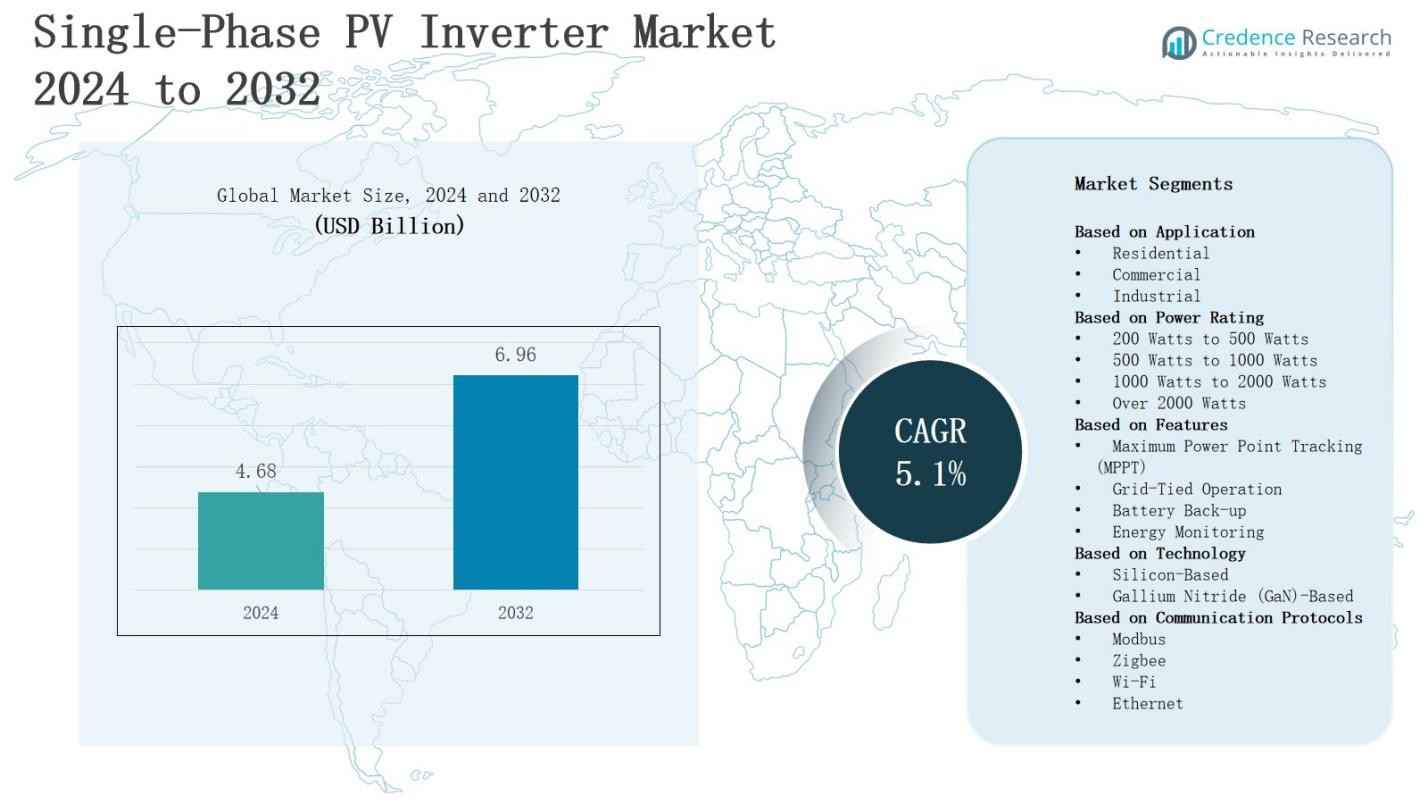
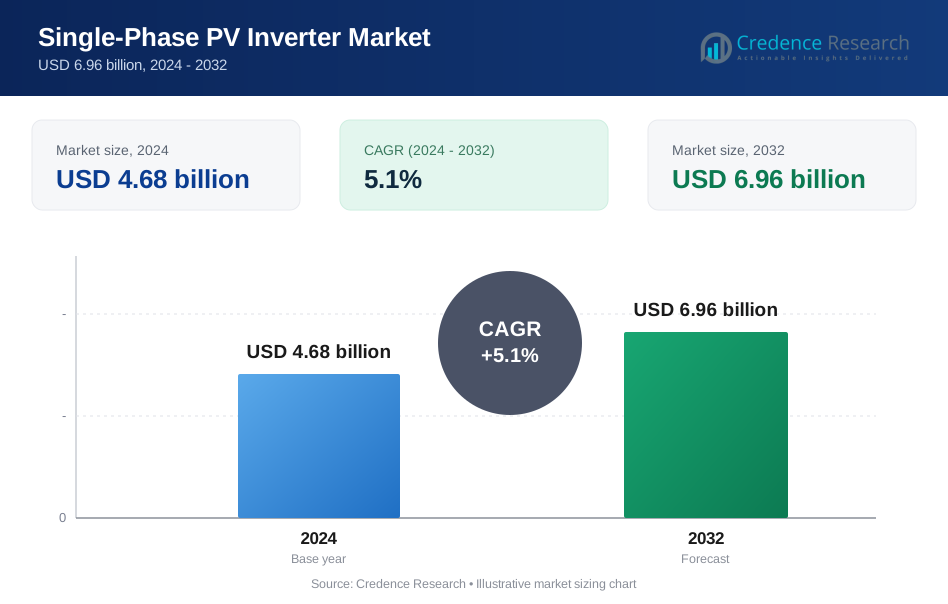
In the single-phase PV inverter market, revenue is projected to grow from USD 4.68 billion in 2024 to USD 6.96 billion by 2032, registering a CAGR of 5.1%.
| REPORT ATTRIBUTE | DETAILS |
|---|---|
| Historical Period | 2020-2024 |
| Base Year | 2024 |
| Forecast Period | 2025-2032 |
| Single-Phase PV Inverter Market Size 2024 | USD 4.68 Billion |
| Single-Phase PV Inverter Market, CAGR | 5.1% |
| Single-Phase PV Inverter Market Size 2032 | USD 6.96 Billion |
The single-phase PV inverter market is driven by the growing adoption of residential and small-scale commercial solar systems, supported by government incentives and declining solar panel costs. Rising awareness of renewable energy and the need to reduce carbon emissions further boost demand. Technological advancements, such as smart inverters with real-time monitoring and grid-tied capabilities, enhance system efficiency and reliability. Additionally, increasing electricity costs encourage consumers to invest in self-generation solutions. Trends include the integration of energy storage, improved power conversion efficiency, and digitalization for predictive maintenance, positioning single-phase PV inverters as a key component in decentralized renewable energy deployment.
The single-phase PV inverter market shows strong growth across North America, Europe, Asia-Pacific, and the Rest of the World, driven by residential and small commercial solar adoption. North America and Europe lead with supportive policies and high electricity costs, while Asia-Pacific experiences rapid uptake in emerging economies. The Rest of the World focuses on off-grid and hybrid solutions. Key players such as Enphase Energy, Fronius, Ingeteam, Mitsui Seiki, Schneider Electric, Huawei, TMEIC, Hyundai Electric Energy Systems, Soltec, Sungrow, and GoodWe actively expand their presence across these regions through innovation, partnerships, and tailored product offerings.
Market Insights
- The single-phase PV inverter market is projected to grow from USD 4.68 billion in 2024 to USD 6.96 billion by 2032, registering a CAGR of 5.1%, driven by rising residential solar adoption.
- Residential applications lead with 55% market share, followed by commercial at 30% and industrial at 15%, fueled by rooftop solar adoption, cost savings, and supportive government incentives.
- Inverters rated 500–1000 Watts dominate with 40% share, while 1000–2000 Watts hold 30%, and 200–500 Watts and over 2000 Watts segments capture 15% each, emphasizing efficiency and scalability.
- Maximum Power Point Tracking (MPPT) inverters hold 45% share, grid-tied 35%, battery back-up 15%, and energy monitoring 5%, reflecting consumer preference for efficiency, reliability, and smart energy features.
- North America leads with 35% share, Europe 30%, Asia-Pacific 25%, and Rest of the World 10%, with key players like Enphase Energy, Fronius, Huawei, Sungrow, and Schneider Electric driving regional growth.
Market Drivers
Rising Adoption of Residential and Small-Scale Solar Systems
The single-phase PV inverter market benefits from increased deployment of residential and small commercial solar installations. Homeowners and small businesses seek energy independence and reduced electricity bills, driving demand for reliable inverters. It enables efficient conversion of DC power from solar panels to usable AC power, ensuring stable energy supply. Government incentives, subsidies, and supportive regulations encourage investments in solar solutions. Consumers prioritize systems with high efficiency, low maintenance, and seamless integration with existing electrical networks. It also supports off-grid and backup power applications, broadening market opportunities.
- For instance, Enphase Energy’s microinverters offer high efficiency and modular design that enables homeowners to install solar panels incrementally with real-time monitoring features.
Technological Advancements and Smart Features
Technological innovation fuels growth in the single-phase PV inverter market. Manufacturers develop inverters with real-time monitoring, grid-tied capabilities, and intelligent fault detection, improving system performance. It enhances energy efficiency and ensures reliable power delivery for residential and commercial users. Digital tools allow predictive maintenance, minimizing downtime and operational costs. Innovations in inverter design reduce size and noise while increasing durability. It enables seamless integration with energy storage solutions, making solar systems more versatile. Consumers increasingly demand smart and connected devices to optimize energy management.
- For instance, Huawei’s single-phase SUN2000 inverters include AI-powered arc-fault circuit interrupters and smart monitoring that helps prevent fire risks, improving safety and uptime
Government Policies and Renewable Energy Incentives
Government policies and renewable energy programs drive investment in the single-phase PV inverter market. It receives strong support through subsidies, tax credits, and feed-in tariffs that reduce upfront costs. Regulatory frameworks promote clean energy adoption and carbon emission reduction. It aligns with national and regional targets for renewable energy capacity expansion. Public awareness campaigns and incentives for distributed generation encourage residential and small commercial users to install solar systems. It contributes to energy security, supports local manufacturing, and stimulates employment in the renewable sector. Policy certainty attracts long-term investments and market stability.
Rising Electricity Costs and Environmental Awareness
Increasing electricity prices motivate consumers to adopt solar power, benefiting the single-phase PV inverter market. It enables cost savings by reducing reliance on conventional grid electricity. Growing environmental awareness drives investment in sustainable energy solutions that lower carbon footprints. Consumers prefer inverters with higher efficiency, reliability, and compatibility with emerging technologies. It plays a key role in supporting decentralized energy generation and storage systems. Rising concerns over climate change and energy security push both households and small businesses to adopt solar-based solutions, fueling market growth.
Market Trends
Integration with Energy Storage Solutions
The single-phase PV inverter market experiences a strong trend toward integration with energy storage systems. It allows users to store excess solar energy for use during peak hours or grid outages, enhancing energy reliability. Consumers increasingly demand inverters compatible with batteries to optimize self-consumption and reduce dependence on the grid. It supports time-of-use energy management, enabling households and small businesses to lower electricity costs. Manufacturers focus on seamless integration and user-friendly interfaces. This trend strengthens the adoption of solar solutions and increases system versatility, supporting energy resilience and sustainability.
- For instance, Solis offers single-phase hybrid inverters in the 3-8 kW range designed for residential PV energy storage, featuring integrated battery management and timed charge/discharge functions that extend battery life and support seamless solar-battery-grid interaction.
Smart and Connected Inverters
The adoption of smart and connected inverters drives significant growth in the single-phase PV inverter market. It enables remote monitoring, diagnostics, and real-time performance tracking through mobile or web applications. Consumers gain precise control over energy generation and consumption, improving operational efficiency. It incorporates fault detection and predictive maintenance capabilities, minimizing downtime. Integration with home automation and IoT platforms enhances system intelligence. Manufacturers develop inverters with adaptive features to respond to changing grid conditions. Smart inverters contribute to energy optimization and system reliability, meeting modern energy management demands.
- For instance, Retgen’s mobile app, which provides on-the-go access to real-time data and notifications, facilitating quicker decision-making and efficient issue resolution for solar inverter systems.
Enhanced Efficiency and Power Conversion
Efficiency improvements in inverter technology remain a key trend in the single-phase PV inverter market. It delivers higher power conversion rates, ensuring maximum utilization of solar energy. Manufacturers focus on reducing energy losses and enhancing thermal management to improve system performance. It supports wider voltage ranges and fluctuating solar inputs, maintaining stable power output. Advanced components and optimized designs increase durability and reduce operational costs. Consumers prefer efficient inverters that deliver long-term savings and reliable performance. This trend promotes adoption in both residential and small commercial applications.
Focus on Decentralized and Grid-Tied Solutions
The single-phase PV inverter market increasingly emphasizes decentralized and grid-tied solar systems. It allows users to generate electricity on-site while maintaining grid connectivity for backup support. Consumers prioritize inverters that provide seamless synchronization with local grids and ensure power stability. It supports distributed generation models and enhances energy security at a local level. Manufacturers offer flexible solutions suitable for different roof sizes and energy demands. This trend aligns with global renewable energy goals, enabling efficient integration of solar power into existing infrastructure. It strengthens the transition to sustainable and resilient energy networks.
Market Challenges Analysis
High Initial Investment and Cost Constraints
The single-phase PV inverter market faces challenges from high upfront costs, which can limit adoption among price-sensitive consumers. It requires substantial investment in quality inverters, installation, and supporting components, making residential and small commercial users cautious. Limited access to financing or favorable loan options further restricts market penetration. Consumers evaluate long-term savings against initial expenses before committing to solar installations. Manufacturers strive to balance cost reduction with performance and reliability. Price competition among suppliers puts pressure on profit margins. It remains critical for stakeholders to offer cost-effective solutions without compromising efficiency or durability.
Grid Compatibility and Technical Limitations
Grid compatibility and technical constraints pose additional challenges for the single-phase PV inverter market. It must comply with varying regional regulations and grid codes, which complicates design and deployment. Fluctuations in voltage or frequency can affect inverter performance and system reliability. Consumers may face difficulties in integrating inverters with older electrical systems. Technical support and maintenance services are essential to address faults and ensure smooth operation. Manufacturers invest in robust testing and certification to meet standards. It requires continuous innovation to overcome limitations and maintain stable energy output, ensuring customer confidence and system longevity.
Market Opportunities
Expansion in Emerging Residential and Small Commercial Segments
The single-phase PV inverter market presents significant opportunities in emerging residential and small commercial segments. It enables homeowners and small businesses to adopt solar power with limited space and lower energy requirements. Growing awareness of renewable energy and rising electricity costs motivate investments in self-generation solutions. It supports off-grid and hybrid systems, providing flexibility for diverse energy needs. Manufacturers can target untapped regions with favorable solar conditions. Customized solutions for small rooftops and local energy demands strengthen market penetration. It also encourages partnerships with installers and energy service companies to expand reach and adoption.
Integration with Smart Grids and Energy Storage Systems
Opportunities in the single-phase PV inverter market arise from integration with smart grids and energy storage solutions. It allows users to store surplus energy, optimize consumption, and reduce dependence on the conventional grid. Consumers increasingly seek inverters compatible with batteries and home automation platforms. It enables participation in demand response programs and time-of-use energy management, enhancing system value. Manufacturers can offer advanced features such as remote monitoring and predictive maintenance to differentiate products. It supports the transition toward decentralized and resilient energy networks. Strategic innovation in storage-compatible and smart inverter technologies drives long-term growth and adoption.
Market Segmentation Analysis:
By Application
In the single-phase PV inverter market, the residential segment leads with approximately 55% share in 2024, driven by rising rooftop solar adoption and homeowners seeking cost savings. Commercial applications hold 30%, supported by small businesses reducing energy expenses. Industrial applications account for 15%, targeting micro and small-scale units requiring reliable solar solutions. Incentives, falling panel costs, and rising electricity prices fuel growth.
- For instance, Tesla’s Powerwall paired with its Solar Roof has been widely adopted across U.S. households, enabling energy independence during peak hours.
By Rating
Inverters rated 500 Watts to 1000 Watts dominate the single-phase PV inverter market with 40% share, ideal for typical residential systems. The 1000–2000 Watts segment captures 30%, preferred by larger households and small commercial users. 200–500 Watts inverters hold 15%, suitable for compact setups, while over 2000 Watts accounts for 15%, serving microgrid and industrial needs. Efficiency and scalability drive adoption.
- For instance, SolarEdge Technologies unveiled a new three-phase solar inverter in 2024 capable of supporting up to 20kW, designed specifically for residential use with backup capabilities, highlighting the innovation in this segment.
By Features
Maximum Power Point Tracking (MPPT) inverters dominate with 45% share, ensuring higher energy yield and efficiency. Grid-tied operation inverters follow with 35%, allowing integration with local grids. Battery back-up systems hold 15%, supporting off-grid reliability, while energy monitoring inverters account for 5%, enabling performance tracking and smart energy management. Consumers prioritize efficiency, reliability, and technology-driven features for solar adoption.
Segments:
Based on Application
- Residential
- Commercial
- Industrial
Based on Power Rating
- 200 Watts to 500 Watts
- 500 Watts to 1000 Watts
- 1000 Watts to 2000 Watts
- Over 2000 Watts
Based on Features
- Maximum Power Point Tracking (MPPT)
- Grid-Tied Operation
- Battery Back-up
- Energy Monitoring
Based on Technology
- Silicon-Based
- Gallium Nitride (GaN)-Based
Based on Communication Protocols
- Modbus
- Zigbee
- Wi-Fi
- Ethernet
Based on the Geography:
- North America
- U.S.
- Canada
- Mexico
- Europe
- Germany
- France
- U.K.
- Italy
- Spain
- Rest of Europe
- Asia Pacific
- China
- Japan
- India
- South Korea
- South-east Asia
- Rest of Asia Pacific
- Latin America
- Brazil
- Argentina
- Rest of Latin America
- Middle East & Africa
- GCC Countries
- South Africa
- Rest of the Middle East and Africa
Regional Analysis
North America
North America holds 35% share of the single-phase PV inverter market in 2024, driven by strong residential solar adoption and supportive government policies. It benefits from incentives, tax credits, and net metering programs that encourage homeowners to invest in solar solutions. High electricity costs push small businesses and households toward self-generation. It incorporates advanced inverters with smart monitoring and grid-tied features. Manufacturers focus on reliable and efficient systems suitable for varying climates. Consumer awareness and energy security priorities further boost adoption.
Europe
Europe captures 30% share of the single-phase PV inverter market, led by countries with aggressive renewable energy targets. It emphasizes residential and small commercial solar installations supported by subsidies and green energy programs. It integrates with energy storage and grid-tied solutions to enhance energy efficiency and reliability. Demand rises from households seeking cost savings and carbon footprint reduction. Manufacturers develop compact, high-efficiency inverters compatible with decentralized energy networks. Regulatory support and technological advancements drive market growth.
Asia-Pacific
Asia-Pacific accounts for 25% share in the single-phase PV inverter market, fueled by rapid solar adoption in emerging economies. It experiences high demand in residential and small commercial sectors due to increasing electricity costs and renewable energy awareness. It includes inverters compatible with battery storage and hybrid systems. Government incentives and supportive policies encourage widespread deployment. Manufacturers target urban and semi-urban households with scalable solutions. Rapid urbanization and investments in clean energy infrastructure strengthen market opportunities.
Rest of the World
The Rest of the World region holds 10% share of the single-phase PV inverter market, supported by gradual adoption in Latin America, the Middle East, and Africa. It focuses on off-grid and small-scale commercial installations where grid access is limited. Consumers seek reliable and efficient inverters for energy independence. It integrates with battery systems to ensure consistent power supply. Market growth depends on infrastructure development, government support, and awareness of renewable energy benefits. Manufacturers explore untapped regions for expansion opportunities.
Key Player Analysis
- Sungrow
- Mitsui Seiki
- Enphase Energy
- GoodWe
- Hyundai Electric Energy Systems
- Fronius
- Soltec
- TMEIC
- Ingeteam
- Huawei
- Schneider Electric
Competitive Analysis
The single-phase PV inverter market remains highly competitive, with key players focusing on innovation, efficiency, and reliability to maintain market leadership. Companies such as Enphase Energy, Fronius, Ingeteam, Mitsui Seiki, Schneider Electric, Huawei, TMEIC, Hyundai Electric Energy Systems, Soltec, Sungrow, and GoodWe drive growth through advanced inverter technologies, smart grid integration, and energy storage compatibility. It emphasizes high-performance inverters with Maximum Power Point Tracking (MPPT), grid-tied operation, and battery backup capabilities to meet residential and small commercial demands. Strategic partnerships, regional expansions, and product launches allow companies to strengthen market presence and respond to rising electricity costs and renewable energy adoption. It encourages manufacturers to offer user-friendly, durable, and scalable solutions to address diverse energy requirements. Continuous investment in research and development ensures enhanced efficiency, reduced power losses, and reliable performance under varying environmental conditions. It also focuses on digitalization, remote monitoring, and predictive maintenance to improve operational efficiency and customer satisfaction. Competitive differentiation depends on technology leadership, brand reputation, and ability to meet evolving regulatory and consumer demands.
Recent Developments
- In 2025, GoodWe launched its EHB single-phase hybrid inverter in Australia and New Zealand, designed for residential energy storage systems with enhanced performance, safety, and flexibility.
- In October 2023, Sungrow introduced the SH8.0RS and SH10RS single-phase hybrid inverters at All-Energy Australia, offering high protection, compatibility with large-capacity batteries, and improved energy security for households.
- On January 21, 2025, Solis launched its Solarator Series in India, a hybrid inverter lineup for residential and commercial use, featuring single-phase configurations and advanced functionalities.
- On April 23, 2025, Sunora entered the solar inverter market at RenewX 2025, unveiling a 15kW three-phase grid-connected inverter, demonstrating active innovation in the broader inverter segment.
Market Concentration & Characteristics
The single-phase PV inverter market exhibits a moderately concentrated competitive structure, dominated by key players including Enphase Energy, Fronius, Ingeteam, Mitsui Seiki, Schneider Electric, Huawei, TMEIC, Hyundai Electric Energy Systems, Soltec, Sungrow, and GoodWe. It focuses on technological innovation, high efficiency, and reliability to differentiate products in residential and small commercial applications. It emphasizes Maximum Power Point Tracking (MPPT), grid-tied operation, and battery back-up capabilities to meet diverse consumer needs. Manufacturers invest in research and development to enhance inverter performance, reduce energy losses, and ensure compatibility with energy storage and smart grid solutions. It relies on regional expansion, strategic partnerships, and product launches to strengthen market presence. The market demonstrates strong growth potential due to increasing renewable energy adoption, rising electricity costs, and supportive government policies, encouraging companies to offer durable, scalable, and cost-effective inverters for decentralized energy deployment.
Report Coverage
The research report offers an in-depth analysis based on Application, Power Rating, Features, Technology, Communication Protocols and Geography. It details leading market players, providing an overview of their business, product offerings, investments, revenue streams, and key applications. Additionally, the report includes insights into the competitive environment, SWOT analysis, current market trends, as well as the primary drivers and constraints. Furthermore, it discusses various factors that have driven market expansion in recent years. The report also explores market dynamics, regulatory scenarios, and technological advancements that are shaping the industry. It assesses the impact of external factors and global economic changes on market growth. Lastly, it provides strategic recommendations for new entrants and established companies to navigate the complexities of the market.
Future Outlook
- The single-phase PV inverter market will expand with higher adoption in residential and small commercial solar systems.
- It will gain from increasing government incentives, subsidies, and policies promoting renewable energy adoption globally.
- Technological innovations will improve inverter efficiency, reliability, and seamless integration with smart grids and monitoring systems.
- Energy storage compatibility will become a standard requirement, supporting hybrid systems and off-grid solar installations.
- Demand for grid-tied and off-grid hybrid systems will grow rapidly in emerging and developing economies.
- Manufacturers will focus on compact, user-friendly, durable, and scalable inverter designs suitable for diverse applications.
- Digital monitoring and predictive maintenance features will see wider adoption among residential and commercial consumers.
- Environmental awareness and increasing electricity costs will encourage households and businesses to invest in solar solutions.
- Regional expansion and strategic partnerships will help key players strengthen their global market presence.
- Continuous product innovation will support decentralized renewable energy deployment and resilient, sustainable power generation solutions.
Request a Free Sample
Fill in your details and we'll send you a free sample report.
- Sample data tables & charts
- Research methodology
Need a Custom Version of This Report?
Tailor the scope, geography, or segments to your exact requirements.
- Custom geography or segment scope
- Direct access to our analyst team
Frequently Asked Questions
What is the current market size for single-phase PV inverter market, and what is its projected size in 2032?
At what Compound Annual Growth Rate is the single-phase PV inverter market projected to grow between 2025 and 2032?
Which single-phase PV inverter market segment held the largest share in 2024?
What are the primary factors fueling the growth of the single-phase PV inverter market?
Who are the leading companies in the single-phase PV inverter market?
Which region commanded the largest share of the single-phase PV inverter market in 2024?
Table of Content
Chapter 1. Report Introduction
- 1.1 Report Description & Purpose
- 1.1.1 Report Title & Market Definition
- 1.1.2 Unique Selling Propositions (USP) & Key Differentiators
- 1.1.3 Value Proposition for Stakeholders
- 1.2 Research Objectives
- 1.2.1 Market Sizing Objectives (Volume & Revenue)
- 1.2.2 Segmentation Objectives
- 1.2.3 Competitive Intelligence Objectives
- 1.2.4 Forecast & Scenario Objectives
- 1.3 Report Scope
- 1.3.1 Single-Phase PV Inverter Scope – Types & Subtypes Covered
- 1.3.2 Geographic Scope – Regions & Countries Covered
- 1.3.3 Historical Period, Base Year & Forecast Period (2024; forecast to 2032)
- 1.3.4 Inclusions & Exclusions
- 1.4 HS Code & Classification Framework
- 1.5 Currency, Units & Pricing Basis
- 1.6 Target Stakeholders
- 1.7 Limitations & Assumptions
Chapter 2. Executive Summary
- 2.1 Global Single-Phase PV Inverter Market Snapshot
- 2.1.1 Market Size – Historical (2024) & Forecast (2024-2032) (2024: USD 4.68 billion → 2032: USD 6.96 billion)
- 2.1.2 Volume & Revenue – Global Totals
- 2.1.3 Key Market Highlights – Top Five Facts
- 2.2 Single-Phase PV Inverter Market Segmentation Snapshot
- 2.2.1 Market Split by Region – 2024 vs. 2032
- 2.3 Competitive Snapshot
- 2.3.1 Top 10 Players by Revenue Share – 2024
- 2.3.2 Top 10 Players by Volume Share – 2024
- 2.3.3 Recent Strategic Developments (18-Month Summary)
- 2.4 Key Investment Highlights & Strategic Conclusions
Chapter 3. Single-Phase PV Inverter Market Dynamics & Industry Analysis
- 3.1 Market Overview & Context
- 3.1.1 Single-Phase PV Inverter Market Position in the Broader Automotive Value Chain
- 3.1.2 OEM vs. Replacement Market Dynamics
- 3.1.3 Market Maturity & Development Stage by Region
- 3.2 Single-Phase PV Inverter Market Drivers
- 3.3 Single-Phase PV Inverter Market Restraints & Challenges
- 3.4 Single-Phase PV Inverter Market Opportunities
- 3.5 Porter's Five Forces Analysis
- 3.5.1 Threat of New Entrants
- 3.5.2 Bargaining Power of Suppliers
- 3.5.3 Bargaining Power of Buyers
- 3.5.4 Threat of Substitutes
- 3.5.5 Competitive Rivalry – Intensity Assessment
- 3.6 Single-Phase PV Inverter Value Chain Analysis
- 3.6.1 Upstream – Raw Material/Input Suppliers
- 3.6.1.1 Raw Material/Input 1
- 3.6.1.2 Raw Material/Input 2
- 3.6.1.3 Raw Material/Input 3
- 3.6.2 Midstream – Production/Manufacturing/Service Delivery
- 3.6.2.1 Production/Process Overview
- 3.6.2.2 Key Facility Locations & Capacity by Manufacturer
- 3.6.3 Downstream – Distribution & End Consumer
- 3.6.3.1 Primary Channel – B2B/OEM
- 3.6.3.2 Secondary Channels – Dealer, Retail, Online, Direct
- 3.6.4 Value Chain Profitability Analysis
- 3.6.1 Upstream – Raw Material/Input Suppliers
- 3.7 PESTEL Analysis
- 3.7.1 Political Factors
- 3.7.2 Economic Factors
- 3.7.3 Social Factors
- 3.7.4 Technological Factors
- 3.7.5 Environmental Factors
- 3.7.6 Legal Factors
- 3.8 Single-Phase PV Inverter Supply Chain Analysis
- 3.8.1 Raw Material/Input Supply Risk Assessment
- 3.8.2 Manufacturing Concentration Risk (Geographic Exposure)
- 3.8.3 Trade Disruption Impact Analysis
- 3.9 Regulatory & Policy Landscape
Note: The regulatory and policy landscape section covers regulations based on their applicability to the market, Single-Phase PV Inverter category, geography, and scope of the study. Only regulatory frameworks with a material impact on operations, compliance, trade, sustainability, or market access are analyzed in detail.
Chapter 4. Key Investment Pockets & Opportunity Analysis
- 4.1 Single-Phase PV Inverter Market Attractiveness Analysis
- 4.1.1 By Region – Investment Attractiveness Matrix (Volume × CAGR)
- 4.2 Absolute Revenue Growth Opportunity
- 4.2.1 By Region – Absolute USD Growth Through 2032
- 4.3 Incremental Volume Opportunity
- 4.3.1 By Region – Incremental Volume Through 2032
- 4.3.2 Segment – Incremental Volume
- 4.4 Emerging Submarket Opportunity Deep Dive (Subject to Applicability)
- 4.5 Emerging Market Opportunity Scorecards
- 4.5.1 United States
- 4.5.2 Europe
- 4.5.3 Asia
- 4.5.4 Middle East & Africa
Note: Emerging Market Opportunity Scorecards will be included based on relevance and strategic importance. Regions listed are indicative and may vary depending on data availability and market dynamics.
Chapter 5. Single-Phase PV Inverter Import-Export Analysis & Trade Flows
- 5.1 Global Trade Overview
- 5.1.1 Global Export Value by Country (2024)
- 5.1.2 Global Export Volume by Country (2024)
- 5.1.3 Global Import Value by Country (2024)
- 5.1.4 Global Import Volume by Country (2024)
- 5.1.5 Net Trade Balance by Country (2024)
- 5.2 Export Analysis – Segment
- 5.2.1 Type 1 (HS Code)
- 5.2.2 Type 2 (HS Code)
- 5.2.3 Type 3 (HS Code)
- 5.2.4 Type 4 (HS Code)
- 5.2.5 Type 5 (HS Code)
- 5.3 Import Analysis – Segment
- 5.3.1 Type 1 (HS Code)
- 5.3.2 Type 2 (HS Code)
- 5.3.3 Type 3 (HS Code)
- 5.3.4 Type 4 (HS Code)
- 5.3.5 Type 5 (HS Code)
- 5.4 Average Unit Trade Prices
- 5.4.1 Average Export Price – Segment & Country
- 5.4.2 Average Import Price – Segment & Source Country
- 5.4.3 Price Trends (2024)
- 5.5 Key Trade Route Analysis
- 5.5.1 Trade Route 1
- 5.5.2 Trade Route 2
- 5.5.3 Trade Route 3
- 5.5.4 Trade Route 4
- 5.5.5 Trade Route 5
- 5.6 Trade Policy Impact Assessment
- 5.6.1 US Anti-Dumping & Section 301 Tariffs
- 5.6.2 EU Customs Union Impact
- 5.6.3 Major Free Trade Agreements
- 5.6.4 USMCA Rules of Origin
Note: Trade policy analysis will be included only where relevant to the Single-Phase PV Inverter market.
Chapter 6. Competitive Landscape & Company Benchmarking
- 6.1 Single-Phase PV Inverter Market Concentration & Structure
- 6.1.1 Herfindahl-Hirschman Index (HHI) – vs. 2024
- 6.1.2 Tier 1, Tier 2 & Tier 3 Market Structure
- 6.1.3 Global, Regional & Local Player Dynamics
- 6.2 Single-Phase PV Inverter Market Share Analysis – 2024
- 6.2.1 Global Revenue Share by Company
- 6.2.2 Global Volume Share by Company
- 6.2.3 Regional Revenue Share
- 6.2.4 Market Share Evolution ( vs. 2024)
- 6.2.5 OEM Segment Share by Company
- 6.2.6 Replacement Segment Share by Company
- 6.3 Production/Delivery Capacity & Facility Analysis
- 6.3.1 Global Installed Capacity
- 6.3.2 Capacity Utilization Rates
- 6.3.3 Production/Output Volume
- 6.3.4 Facility Locations & Capacity Map
- 6.3.5 Planned Capacity Additions
- 6.4 Single-Phase PV Inverter Competitive Benchmarking Matrix
- 6.4.1 Revenue, Volume, CAGR & Profitability Comparison
- 6.4.2 Channel Revenue Mix
- 6.4.3 Geographic Revenue Exposure
- 6.4.4 R&D Intensity
- 6.4.5 Sustainability Maturity
- 6.5 Strategic Developments in Single-Phase PV Inverter (Last 24 Months)
- 6.5.1 Mergers, Acquisitions & Divestments
- 6.5.2 New Single-Phase PV Inverter Launches
- 6.5.3 Facility Expansions
- 6.5.4 Strategic Alliances, Joint Ventures & Partnerships
- 6.5.5 Distribution Expansion & Market Entry
- 6.5.6 Sustainability & ESG Initiatives
- 6.6 Competitive Strategy Mapping
- 6.6.1 Leader, Challenger, Follower & Niche Classification
- 6.6.2 Pricing Strategy Comparison
- 6.6.3 Channel Strategy Matrix
Note: Strategic developments are included based on their materiality and the availability of reliable information.
Chapter 7. Global Single-Phase PV Inverter Market – By Distribution Channel
- 7.1 Segment Overview
- 7.1.1 Volume & Revenue Split by Channel (2024 & 2032)
- 7.1.2 Channel Mix Evolution (2024-2032)
Chapter 8. Regional Market Analysis – Global Overview
- 8.1 Global Regional Overview
- 8.1.1 Regional Volume Share
- 8.1.2 Regional Revenue Share
- 8.1.3 Regional Volume by Region
- 8.1.4 Regional Revenue by Region
- 8.1.5 Regional Forecast Through 2032
- 8.2 Cross-Regional Segment Analysis
- 8.2.1 By Distribution Channel
- 8.2.2 By Brand/Price Tier
Chapter 9. North America Single-Phase PV Inverter Market
- 9.1 United States
- 9.2 Canada
- 9.3 Mexico
Chapter 10. Europe Single-Phase PV Inverter Market
- 10.1 Germany
- 10.2 France
- 10.3 Italy
- 10.4 United Kingdom
- 10.5 Spain
- 10.6 Poland
- 10.7 Russia
- 10.8 Netherlands
- 10.9 Belgium
- 10.10 Sweden
- 10.11 Denmark
- 10.12 Norway
- 10.13 Rest of Europe
Chapter 11. Asia Pacific Single-Phase PV Inverter Market
- 11.1 China
- 11.2 India
- 11.3 Japan
- 11.4 South Korea
- 11.5 Thailand
- 11.6 Indonesia
- 11.7 Vietnam
- 11.8 Malaysia
- 11.9 Australia
- 11.10 Rest of Asia Pacific
Chapter 12. Latin America Single-Phase PV Inverter Market
- 12.1 Brazil
- 12.2 Argentina
- 12.3 Colombia
- 12.4 Chile
- 12.5 Rest of Latin America
Chapter 13. Middle East Single-Phase PV Inverter Market
- 13.1 Saudi Arabia
- 13.2 United Arab Emirates
- 13.3 Turkey
- 13.4 Israel
- 13.5 Iran
- 13.6 Rest of the Middle East
Chapter 14. Africa Single-Phase PV Inverter Market
- 14.1 South Africa
- 14.2 Egypt
- 14.3 Nigeria
- 14.4 Morocco
- 14.5 Rest of Africa
Chapter 15. Single-Phase PV Inverter Company Profiles
- 15.1 [Company 01]
- 15.1.1 Company Overview
- 15.1.2 Key Management Personnel
- 15.1.3 Products & Services Portfolio
- 15.1.4 Financial Performance
- 15.1.5 Key Market Focus & Geographic Presence
- 15.1.6 Recent Developments & Strategic Initiatives
Note: The company profile list is preliminary and may change based on research findings, market developments, data availability, and client requirements.
Chapter 16. Appendices
- Appendix A – List of Abbreviations & Acronyms
- Appendix B – Industry Classification Code Reference – Full Series
- Appendix C – Production & Capacity Data Tables
- Appendix D – End-Use & Demand Base Tables
- Appendix E – Consumption & Replacement Rate Assumptions
- Appendix F – ASP Reference Tables
- Appendix G – Manufacturing & Facility Database
- Appendix H – Import-Export Data Tables
- Appendix I – Regulatory Summary Tables
- Appendix J – Primary Research Participant List (Anonymized)
- Appendix K – Primary Research Questionnaire Framework
- Appendix L – Data Sources & Bibliography
- Appendix M – Market Size Divergence & Source Comparison
Chapter 17. Research Methodology
- 17.1 Research Framework & Philosophy
- 17.2 Secondary Research – Sources, Hierarchy & Data Extraction
- 17.3 Data Modeling – Bottom-Up & Top-Down Market Sizing
- 17.4 Primary Research – Stakeholder Framework, LOI & Sample Sizes
- 17.5 Forecast Methodology – Regression, Scenario & Sensitivity Analysis
- 17.6 Quality Control – Four-Layer Validation Framework
- 17.7 Limitations & Standard Assumptions
- 17.8 Disclaimer
