
Single-Use Vape Battery Market Overview:
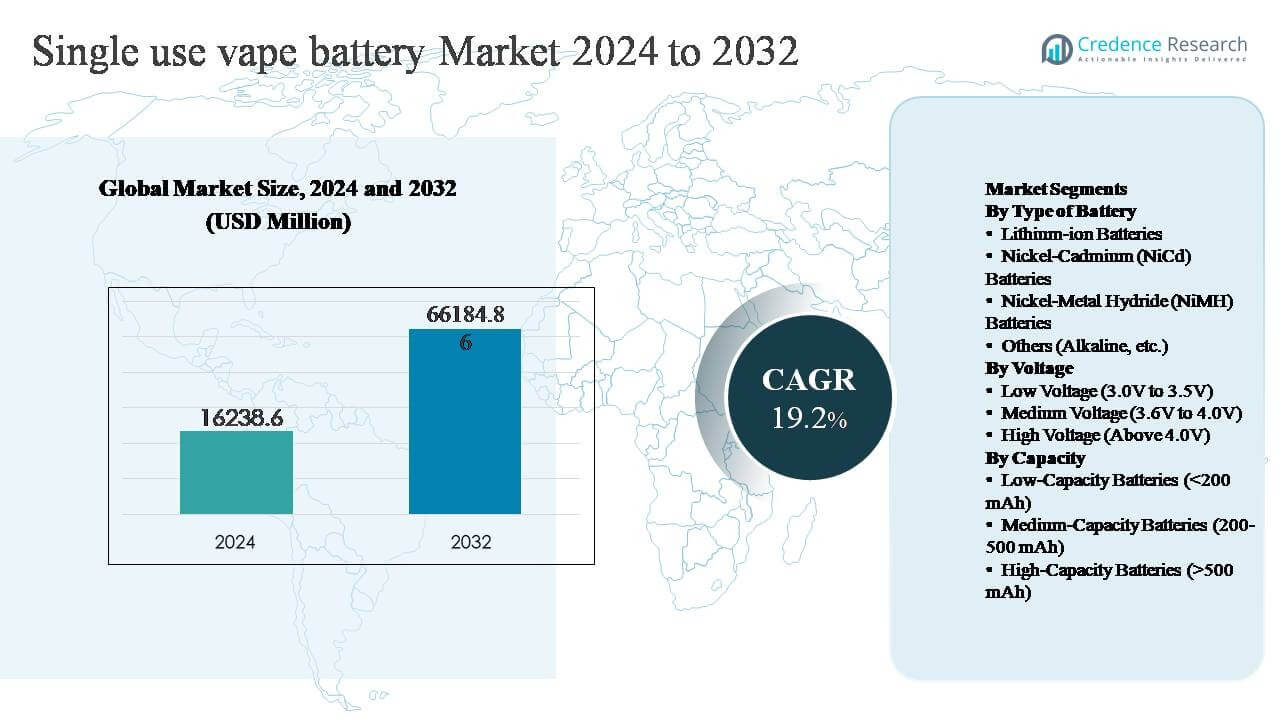
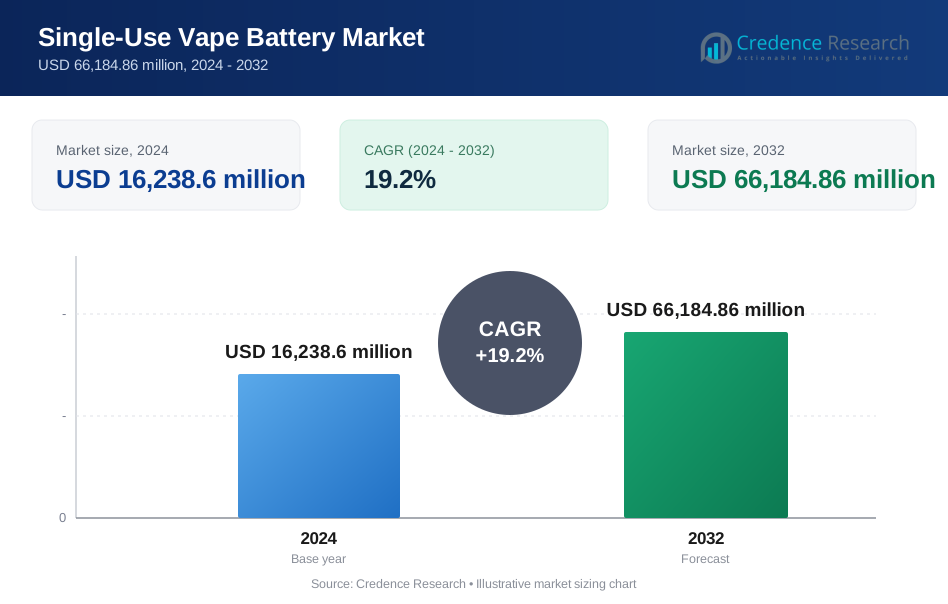
The global single-use vape battery market was valued at USD 16,238.6 million in 2024 and is anticipated to reach USD 66,184.86 million by 2032, expanding at a CAGR of 19.2% during the forecast period.
| REPORT ATTRIBUTE | DETAILS |
|---|---|
| Historical Period | 2020-2023 |
| Base Year | 2024 |
| Forecast Period | 2025-2032 |
| Single-Use Vape Battery Market Size 2024 | USD 16,238.6 million |
| Single-Use Vape Battery Market, CAGR | 19.2% |
| Single-Use Vape Battery Market Size 2032 | USD 66,184.86 million |
Single-Use Vape Battery Market Insights
- Market growth is primarily driven by rising consumer preference for convenient, maintenance-free disposable vapes, which directly increases demand for compact, medium-capacity lithium-ion batteries that offer stable performance and cost efficiency.
- Key trends include standardization toward lithium-ion batteries, which dominate the type segment, and medium-capacity batteries (200-500 mAh), holding the largest segment share due to balanced puff count, device size, and production scalability.
- The competitive landscape features strong participation from global battery manufacturers and vape brands, with competition centered on battery miniaturization, safety compliance, and high-volume manufacturing efficiency.
- Regionally, North America leads with ~34% market share, followed by Asia-Pacific at ~31% driven by manufacturing strength, and Europe at ~27%, while Latin America and the Middle East & Africa collectively account for the remaining share.
Single-Use Vape Battery Market Segmentation Analysis:
By Type of Battery:
By type of battery, lithium-ion batteries represent the dominant sub-segment in the single-use vape battery market, accounting for the majority of market share. Their dominance is driven by high energy density, stable discharge performance, compact form factor, and cost efficiency at scale. Lithium-ion cells support consistent vapor output across the device lifespan and enable slim, lightweight disposable vape designs favored by manufacturers. In contrast, NiCd and NiMH batteries hold limited shares due to lower energy density, memory effects, and regulatory pressure, while alkaline and other chemistries remain niche because of poor recharge and discharge characteristics for vaping applications.
- For instance, EVE Energy has commercialized lithium-ion polymer cells in the 400 mAh to 600 mAh range specifically optimized for disposable electronic devices, delivering nominal voltages of 3.7 V and continuous discharge currents above 2 A, which supports consistent vapor generation throughout the usable life of a single-use vape.
By Voltage:
By voltage, the medium-voltage range (3.6V to 4.0V) dominates the market, capturing the largest share due to its optimal balance between vapor production, battery safety, and device longevity. This voltage range aligns well with standard lithium-ion chemistry, delivering stable power output without excessive coil stress or overheating risks. Manufacturers favor medium-voltage configurations to ensure consistent flavor delivery and controlled aerosol generation across the full usage cycle. Low-voltage batteries are used in entry-level devices with modest vapor output, while high-voltage batteries remain limited to specialized designs due to higher thermal and safety management requirements.
- For instance, Shenzhen BAK Power Battery supplies rechargeable lithium-ion cells with a nominal voltage of 3.6 V or 3.7 V and an end-of-discharge cut-off at 2.5 V to 3.0 V, which can support steady current delivery of up to 2.5 A (and often significantly more, depending on the specific model) and are designed to maintain operating temperatures within controlled limits during continuous use."
By Capacity:
By capacity, medium-capacity batteries (200-500 mAh) lead the single-use vape battery market, holding the dominant share as they balance puff count, device size, and cost efficiency. This capacity range supports typical disposable vape lifespans while maintaining compact, pocket-friendly designs that appeal to mass consumers. Medium-capacity batteries also optimize material usage and production yields for manufacturers. Low-capacity batteries are primarily used in ultra-compact or low-puff products, whereas high-capacity batteries above 500 mAh are adopted in premium or extended-use disposables but face constraints related to size, weight, and regulatory scrutiny.
Key Growth Drivers
Rising Adoption of Disposable Vaping Devices
The rapid adoption of disposable vaping devices is a primary growth driver for the single-use vape battery market. Consumers increasingly prefer single-use vapes for their convenience, portability, and maintenance-free operation, which directly increases demand for compact, integrated battery solutions. Single-use batteries eliminate the need for recharging infrastructure and technical knowledge, making vaping more accessible to first-time and casual users. From a manufacturing perspective, disposable formats simplify device architecture by integrating pre-sized batteries with fixed power output, enabling high-volume, cost-efficient production. The fast replacement cycle of disposable vapes further accelerates battery consumption rates, as devices are discarded once depleted. This recurring demand model strongly supports battery shipments and capacity expansion across the supply chain, reinforcing sustained growth momentum for single-use vape battery manufacturers.
- For instance, SMOORE Technology has engineered integrated power modules for disposable devices that combine lithium-ion cells in the 500 mAh to 650 mAh range with fixed-output control chips, delivering stable power at 3.7 V without the need for user-adjustable settings or external charging interfaces.
Advancements in Lithium-Ion Battery Miniaturization
Technological progress in lithium-ion battery miniaturization significantly drives market growth by enabling higher energy density within smaller cell formats. Battery manufacturers continue to optimize electrode materials, cell stacking methods, and electrolyte stability, allowing disposable vape batteries to deliver consistent power in ultra-compact designs. These advancements support slimmer devices with higher puff counts, aligning with evolving consumer preferences for discreet and lightweight products. Improved battery efficiency also reduces material waste per unit of vapor output, benefiting manufacturers through better cost control and yield optimization. As disposable vape designs become more refined, the ability to integrate reliable, high-performance batteries into constrained form factors remains a critical enabler of product innovation and market expansion.
- For instance, Samsung SDI has reported gravimetric energy densities exceeding 240 Wh/kg in small-format lithium-ion cells through improved nickel-rich cathode chemistry and advanced separator technology.
Cost Efficiency and Scalable Manufacturing
Cost efficiency achieved through large-scale battery manufacturing is another major growth driver for the single-use vape battery market. Standardized battery sizes, simplified power management requirements, and predictable discharge profiles allow manufacturers to streamline production and reduce per-unit costs. High-volume procurement of lithium-ion cells and automated assembly lines further enhance scalability. For vape brands, affordable battery components support aggressive pricing strategies while maintaining acceptable performance levels. This cost structure enables rapid product launches, frequent design refreshes, and broad market penetration across price-sensitive consumer segments. As competition intensifies in the disposable vape space, battery suppliers that offer consistent quality at scale play a crucial role in sustaining market growth.
Key Trends & Opportunities
Shift Toward Optimized Medium-Voltage Battery Designs
A key trend shaping the single-use vape battery market is the industry-wide shift toward optimized medium-voltage battery configurations. Manufacturers increasingly standardize batteries within voltage ranges that balance vapor output, safety, and battery longevity. This trend creates opportunities for battery suppliers to develop application-specific cells tailored to disposable vape requirements, rather than repurposed general electronics batteries. Optimized voltage control enhances flavor consistency and coil lifespan, improving end-user experience. As device brands seek differentiation through performance stability rather than sheer power, demand grows for batteries engineered specifically for controlled, repeatable discharge behavior. This specialization opens opportunities for premium battery offerings and long-term supply partnerships with vape device manufacturers.
- For instance, Vaporesso, a brand under SMOORE Technology, integrates lithium-ion battery systems in its disposable platforms that operate at a nominal voltage of 3.7 V with regulated output circuits designed to maintain stable coil power throughout the discharge cycle.
Design Integration and Compact Device Innovation
Another major opportunity lies in deeper battery-to-device design integration. Vape manufacturers increasingly collaborate with battery suppliers early in the product development cycle to co-design batteries that fit unique device geometries. This trend supports the development of curved, ultra-thin, or modular disposable vapes that stand out in crowded retail environments. Integrated battery design also improves space utilization, allowing room for larger e-liquid reservoirs or airflow enhancements without increasing device size. As aesthetic differentiation becomes a competitive factor, battery customization emerges as a value-added opportunity rather than a commoditized component.
- For instance, Wismec has demonstrated advanced battery–device co-design through its compact multi-cell architectures, such as the Reuleaux platform, which integrates three 18650 lithium-ion cells within a contoured chassis while maintaining an overall device width of approximately 40 mm.
Key Challenges
Regulatory and Environmental Pressures
Regulatory scrutiny and environmental concerns pose a significant challenge to the single-use vape battery market. Disposable devices contribute to electronic waste due to embedded batteries that are rarely recycled, drawing attention from regulators and environmental groups. Increasing restrictions on disposable vaping products in certain regions directly threaten battery demand volumes. Compliance requirements related to battery safety, transportation, and disposal add complexity and cost for manufacturers. As sustainability expectations rise, battery producers face pressure to support recycling initiatives or alternative chemistries, which may disrupt established production models and increase operational burdens.
Safety and Quality Consistency Risks
Ensuring battery safety and consistent quality at high production volumes remains a critical challenge. Single-use vape batteries operate under repeated thermal and discharge stress, and any failure can damage brand reputation and trigger regulatory intervention. Variability in raw material quality, manufacturing tolerances, or assembly processes increases the risk of leakage, overheating, or performance degradation. Maintaining strict quality control while meeting aggressive cost targets is increasingly difficult as competition intensifies. Battery suppliers must continuously invest in testing, process automation, and supplier qualification to mitigate these risks, which can pressure margins and slow capacity expansion.
Regional Analysis
North America
North America holds a leading position in the single-use vape battery market, accounting for approximately 34% of global market share. The region benefits from strong consumer adoption of disposable vaping products, supported by established vape brands, advanced battery supply chains, and high purchasing power. The United States dominates regional demand due to widespread availability of disposable vapes across retail and online channels. Battery demand is driven by preference for compact, medium-capacity lithium-ion cells that deliver consistent performance. However, tightening regulatory scrutiny and environmental concerns influence product design and battery compliance standards, shaping innovation toward safer and more efficient battery configurations.
Europe
Europe represents around 27% of the global single-use vape battery market, driven by growing adult vaping populations and a shift toward regulated nicotine alternatives. Countries such as the United Kingdom, France, and Germany contribute significantly due to mature vaping ecosystems and structured regulatory frameworks. Demand centers on standardized lithium-ion batteries optimized for medium voltage and controlled output, aligning with safety-focused regulations. European manufacturers emphasize compliance, battery traceability, and quality assurance, influencing procurement strategies. While some markets face restrictions on disposable vapes, continued consumer demand and cross-border product distribution sustain battery consumption across the region.
Asia-Pacific
Asia-Pacific accounts for the largest share of the single-use vape battery market at approximately 31%, driven primarily by manufacturing concentration and rapid consumption growth. China dominates the region as both the largest producer of disposable vape batteries and a key exporter supplying global markets. Southeast Asian markets contribute rising demand due to increasing vape adoption among younger adult consumers. The region benefits from cost-efficient lithium-ion cell production, vertically integrated supply chains, and large-scale manufacturing capabilities. Asia-Pacific’s dominance is reinforced by continuous battery miniaturization, capacity optimization, and high-volume production that supports global disposable vape demand.
Latin America
Latin America holds an estimated 5% share of the global single-use vape battery market, reflecting emerging but uneven adoption of disposable vaping products. Markets such as Mexico, Brazil, and Chile drive regional demand, primarily through imported devices. Battery demand is influenced by price sensitivity, favoring low- to medium-capacity lithium-ion cells that support affordable disposable vape offerings. Regulatory uncertainty and varying enforcement across countries limit large-scale expansion, but urban consumer segments continue to adopt vaping alternatives. As distribution networks improve and awareness increases, battery demand in the region is expected to grow steadily from a smaller base.
Middle East & Africa
The Middle East & Africa region accounts for approximately 3% of the global single-use vape battery market, supported by gradual uptake of disposable vapes in select urban markets. Countries such as the UAE and South Africa lead regional consumption due to higher disposable incomes and established retail infrastructure. Battery demand is driven by imported disposable devices, with manufacturers favoring standardized lithium-ion batteries for reliability and shelf stability. Regulatory diversity and limited recycling infrastructure constrain rapid expansion. Nevertheless, increasing product availability and changing consumer preferences contribute to slow but consistent growth in regional battery demand.
Single-Use Vape Battery Market Segmentations:
By Type of Battery
- Lithium-ion Batteries
- Nickel-Cadmium (NiCd) Batteries
- Nickel-Metal Hydride (NiMH) Batteries
- Others (Alkaline, etc.)
By Voltage
- Low Voltage (3.0V to 3.5V)
- Medium Voltage (3.6V to 4.0V)
- High Voltage (Above 4.0V)
By Capacity
- Low-Capacity Batteries (<200 mAh)
- Medium-Capacity Batteries (200-500 mAh)
- High-Capacity Batteries (>500 mAh)
By Geography
- North America
- U.S.
- Canada
- Mexico
- Europe
- Germany
- France
- U.K.
- Italy
- Spain
- Rest of Europe
- Asia Pacific
- China
- Japan
- India
- South Korea
- South-east Asia
- Rest of Asia Pacific
- Latin America
- Brazil
- Argentina
- Rest of Latin America
- Middle East & Africa
- GCC Countries
- South Africa
- Rest of the Middle East and Africa
Competitive Landscape
The single-use vape battery market is characterized by intense competition among specialized lithium-ion battery manufacturers and vertically integrated vape device suppliers. Key players compete on battery miniaturization, energy density optimization, cost efficiency, and consistent discharge performance tailored to disposable vape applications. Manufacturers with large-scale production capabilities benefit from economies of scale, enabling them to supply standardized medium-voltage, medium-capacity batteries at competitive prices. Strategic partnerships between battery suppliers and vape brands are common, allowing early-stage co-development of battery formats aligned with specific device designs. Competitive differentiation increasingly centers on quality assurance, safety testing, and compliance with regional regulatory requirements. Companies also invest in automation and process control to maintain reliability at high output volumes. As regulatory scrutiny and environmental expectations intensify, players that can balance cost, performance, and compliance are better positioned to strengthen their market presence.
Key Player Analysis
- Samsung SDI
- Murata
- Sony
- Imperial Brands
- Aspire
- Vaporesso
- SMOK (Shenzhen IVPS Technology)
- Wismec
- Efest Battery Technology
- VapePower
Recent Developments
- In December 10, 2025, Samsung SDI’s U.S. subsidiary secured a deal to supply lithium iron phosphate (LFP) cells for energy storage systems, indicating strategic supply expansion in advanced battery formats. These cells will begin delivery in 2027, supporting grid-scale storage (important for battery ecosystem stability).
- In October 8, 2025, Murata Manufacturing Co. entered a joint development agreement with QuantumScape to explore next-generation solid-state lithium-metal battery technology, focusing on high-purity ceramic separators critical for scalable solid-state production. This impacts battery miniaturization potential for compact applications.
Report Coverage
The research report offers an in-depth analysis based on Type of battery, Voltage, Capacity and Geography. It details leading market players, providing an overview of their business, product offerings, investments, revenue streams, and key applications. Additionally, the report includes insights into the competitive environment, SWOT analysis, current market trends, as well as the primary drivers and constraints. Furthermore, it discusses various factors that have driven market expansion in recent years. The report also explores market dynamics, regulatory scenarios, and technological advancements that are shaping the industry. It assesses the impact of external factors and global economic changes on market growth. Lastly, it provides strategic recommendations for new entrants and established companies to navigate the complexities of the market.
Future Outlook
- Single-use vape battery demand will continue to grow alongside the expansion of disposable vaping devices across global consumer markets.
- Lithium-ion batteries will remain the preferred chemistry due to their energy density, reliability, and suitability for compact disposable designs.
- Medium-capacity batteries will maintain dominance as manufacturers balance puff count, device size, and cost efficiency.
- Battery miniaturization will advance further, enabling slimmer and more ergonomically designed disposable vape products.
- Standardized voltage ranges will gain wider adoption to ensure consistent vapor output and improved device safety.
- Manufacturers will increasingly integrate battery design with device engineering to optimize performance and space utilization.
- Automation and scale manufacturing will strengthen cost competitiveness and supply consistency among leading battery suppliers.
- Regulatory compliance and safety testing requirements will influence battery design and production processes.
- Environmental pressure will encourage exploration of recycling programs and lower-waste battery solutions.
- Strategic partnerships between battery manufacturers and vape brands will shape product development and market positioning.
Request a Free Sample
Fill in your details and we'll send you a free sample report.
- Sample data tables & charts
- Research methodology
Need a Custom Version of This Report?
Tailor the scope, geography, or segments to your exact requirements.
- Custom geography or segment scope
- Direct access to our analyst team
Frequently Asked Questions
What is the current market size for the single-use vape battery market, and what is its projected size in 2032?
At what Compound Annual Growth Rate is the single-use vape battery market projected to grow between 2024 and 2032?
Which single-use vape battery segment held the largest share in 2024?
What are the primary factors fueling the growth of the single-use vape battery market?
Who are the leading companies in the single-use vape battery market?
Which region commanded the largest share of the single-use vape battery market in 2024?
Table of Content
Chapter 1. Report Introduction
- 1.1 Report Description & Purpose
- 1.1.1 Report Title & Market Definition
- 1.1.2 Unique Selling Propositions (USP) & Key Differentiators
- 1.1.3 Value Proposition for Stakeholders
- 1.2 Research Objectives
- 1.2.1 Market Sizing Objectives (Volume & Revenue)
- 1.2.2 Segmentation Objectives
- 1.2.3 Competitive Intelligence Objectives
- 1.2.4 Forecast & Scenario Objectives
- 1.3 Report Scope
- 1.3.1 Single-Use Vape Battery Scope – Types & Subtypes Covered
- 1.3.2 Geographic Scope – Regions & Countries Covered
- 1.3.3 Historical Period, Base Year & Forecast Period (2024; forecast to 2032)
- 1.3.4 Inclusions & Exclusions
- 1.4 HS Code & Classification Framework
- 1.5 Currency, Units & Pricing Basis
- 1.6 Target Stakeholders
- 1.7 Limitations & Assumptions
Chapter 2. Executive Summary
- 2.1 Global Single-Use Vape Battery Market Snapshot
- 2.1.1 Market Size – Historical (2024) & Forecast (2024-2032) (2024: USD 16,238.6 million → 2032: USD 66,184.86 million)
- 2.1.2 Volume & Revenue – Global Totals
- 2.1.3 Key Market Highlights – Top Five Facts
- 2.2 Single-Use Vape Battery Market Segmentation Snapshot
- 2.2.1 Market Split by Region – 2024 vs. 2032
- 2.3 Competitive Snapshot
- 2.3.1 Top 10 Players by Revenue Share – 2024
- 2.3.2 Top 10 Players by Volume Share – 2024
- 2.3.3 Recent Strategic Developments (18-Month Summary)
- 2.4 Key Investment Highlights & Strategic Conclusions
Chapter 3. Single-Use Vape Battery Market Dynamics & Industry Analysis
- 3.1 Market Overview & Context
- 3.1.1 Single-Use Vape Battery Market Position in the Broader Automotive Value Chain
- 3.1.2 OEM vs. Replacement Market Dynamics
- 3.1.3 Market Maturity & Development Stage by Region
- 3.2 Single-Use Vape Battery Market Drivers
- 3.3 Single-Use Vape Battery Market Restraints & Challenges
- 3.4 Single-Use Vape Battery Market Opportunities
- 3.5 Porter's Five Forces Analysis
- 3.5.1 Threat of New Entrants
- 3.5.2 Bargaining Power of Suppliers
- 3.5.3 Bargaining Power of Buyers
- 3.5.4 Threat of Substitutes
- 3.5.5 Competitive Rivalry – Intensity Assessment
- 3.6 Single-Use Vape Battery Value Chain Analysis
- 3.6.1 Upstream – Raw Material/Input Suppliers
- 3.6.1.1 Raw Material/Input 1
- 3.6.1.2 Raw Material/Input 2
- 3.6.1.3 Raw Material/Input 3
- 3.6.2 Midstream – Production/Manufacturing/Service Delivery
- 3.6.2.1 Production/Process Overview
- 3.6.2.2 Key Facility Locations & Capacity by Manufacturer
- 3.6.3 Downstream – Distribution & End Consumer
- 3.6.3.1 Primary Channel – B2B/OEM
- 3.6.3.2 Secondary Channels – Dealer, Retail, Online, Direct
- 3.6.4 Value Chain Profitability Analysis
- 3.6.1 Upstream – Raw Material/Input Suppliers
- 3.7 PESTEL Analysis
- 3.7.1 Political Factors
- 3.7.2 Economic Factors
- 3.7.3 Social Factors
- 3.7.4 Technological Factors
- 3.7.5 Environmental Factors
- 3.7.6 Legal Factors
- 3.8 Single-Use Vape Battery Supply Chain Analysis
- 3.8.1 Raw Material/Input Supply Risk Assessment
- 3.8.2 Manufacturing Concentration Risk (Geographic Exposure)
- 3.8.3 Trade Disruption Impact Analysis
- 3.9 Regulatory & Policy Landscape
Note: The regulatory and policy landscape section covers regulations based on their applicability to the market, Single-Use Vape Battery category, geography, and scope of the study. Only regulatory frameworks with a material impact on operations, compliance, trade, sustainability, or market access are analyzed in detail.
Chapter 4. Key Investment Pockets & Opportunity Analysis
- 4.1 Single-Use Vape Battery Market Attractiveness Analysis
- 4.1.1 By Region – Investment Attractiveness Matrix (Volume × CAGR)
- 4.2 Absolute Revenue Growth Opportunity
- 4.2.1 By Region – Absolute USD Growth Through 2032
- 4.3 Incremental Volume Opportunity
- 4.3.1 By Region – Incremental Volume Through 2032
- 4.3.2 Segment – Incremental Volume
- 4.4 Emerging Submarket Opportunity Deep Dive (Subject to Applicability)
- 4.5 Emerging Market Opportunity Scorecards
- 4.5.1 United States
- 4.5.2 Europe
- 4.5.3 Asia
- 4.5.4 Middle East & Africa
Note: Emerging Market Opportunity Scorecards will be included based on relevance and strategic importance. Regions listed are indicative and may vary depending on data availability and market dynamics.
Chapter 5. Single-Use Vape Battery Import-Export Analysis & Trade Flows
- 5.1 Global Trade Overview
- 5.1.1 Global Export Value by Country (2024)
- 5.1.2 Global Export Volume by Country (2024)
- 5.1.3 Global Import Value by Country (2024)
- 5.1.4 Global Import Volume by Country (2024)
- 5.1.5 Net Trade Balance by Country (2024)
- 5.2 Export Analysis – Segment
- 5.2.1 Type 1 (HS Code)
- 5.2.2 Type 2 (HS Code)
- 5.2.3 Type 3 (HS Code)
- 5.2.4 Type 4 (HS Code)
- 5.2.5 Type 5 (HS Code)
- 5.3 Import Analysis – Segment
- 5.3.1 Type 1 (HS Code)
- 5.3.2 Type 2 (HS Code)
- 5.3.3 Type 3 (HS Code)
- 5.3.4 Type 4 (HS Code)
- 5.3.5 Type 5 (HS Code)
- 5.4 Average Unit Trade Prices
- 5.4.1 Average Export Price – Segment & Country
- 5.4.2 Average Import Price – Segment & Source Country
- 5.4.3 Price Trends (2024)
- 5.5 Key Trade Route Analysis
- 5.5.1 Trade Route 1
- 5.5.2 Trade Route 2
- 5.5.3 Trade Route 3
- 5.5.4 Trade Route 4
- 5.5.5 Trade Route 5
- 5.6 Trade Policy Impact Assessment
- 5.6.1 US Anti-Dumping & Section 301 Tariffs
- 5.6.2 EU Customs Union Impact
- 5.6.3 Major Free Trade Agreements
- 5.6.4 USMCA Rules of Origin
Note: Trade policy analysis will be included only where relevant to the Single-Use Vape Battery market.
Chapter 6. Competitive Landscape & Company Benchmarking
- 6.1 Single-Use Vape Battery Market Concentration & Structure
- 6.1.1 Herfindahl-Hirschman Index (HHI) – vs. 2024
- 6.1.2 Tier 1, Tier 2 & Tier 3 Market Structure
- 6.1.3 Global, Regional & Local Player Dynamics
- 6.2 Single-Use Vape Battery Market Share Analysis – 2024
- 6.2.1 Global Revenue Share by Company
- 6.2.2 Global Volume Share by Company
- 6.2.3 Regional Revenue Share
- 6.2.4 Market Share Evolution ( vs. 2024)
- 6.2.5 OEM Segment Share by Company
- 6.2.6 Replacement Segment Share by Company
- 6.3 Production/Delivery Capacity & Facility Analysis
- 6.3.1 Global Installed Capacity
- 6.3.2 Capacity Utilization Rates
- 6.3.3 Production/Output Volume
- 6.3.4 Facility Locations & Capacity Map
- 6.3.5 Planned Capacity Additions
- 6.4 Single-Use Vape Battery Competitive Benchmarking Matrix
- 6.4.1 Revenue, Volume, CAGR & Profitability Comparison
- 6.4.2 Channel Revenue Mix
- 6.4.3 Geographic Revenue Exposure
- 6.4.4 R&D Intensity
- 6.4.5 Sustainability Maturity
- 6.5 Strategic Developments in Single-Use Vape Battery (Last 24 Months)
- 6.5.1 Mergers, Acquisitions & Divestments
- 6.5.2 New Single-Use Vape Battery Launches
- 6.5.3 Facility Expansions
- 6.5.4 Strategic Alliances, Joint Ventures & Partnerships
- 6.5.5 Distribution Expansion & Market Entry
- 6.5.6 Sustainability & ESG Initiatives
- 6.6 Competitive Strategy Mapping
- 6.6.1 Leader, Challenger, Follower & Niche Classification
- 6.6.2 Pricing Strategy Comparison
- 6.6.3 Channel Strategy Matrix
Note: Strategic developments are included based on their materiality and the availability of reliable information.
Chapter 7. Global Single-Use Vape Battery Market – By Distribution Channel
- 7.1 Segment Overview
- 7.1.1 Volume & Revenue Split by Channel (2024 & 2032)
- 7.1.2 Channel Mix Evolution (2024-2032)
Chapter 8. Regional Market Analysis – Global Overview
- 8.1 Global Regional Overview
- 8.1.1 Regional Volume Share
- 8.1.2 Regional Revenue Share
- 8.1.3 Regional Volume by Region
- 8.1.4 Regional Revenue by Region
- 8.1.5 Regional Forecast Through 2032
- 8.2 Cross-Regional Segment Analysis
- 8.2.1 By Distribution Channel
- 8.2.2 By Brand/Price Tier
Chapter 9. North America Single-Use Vape Battery Market
- 9.1 United States
- 9.2 Canada
- 9.3 Mexico
Chapter 10. Europe Single-Use Vape Battery Market
- 10.1 Germany
- 10.2 France
- 10.3 Italy
- 10.4 United Kingdom
- 10.5 Spain
- 10.6 Poland
- 10.7 Russia
- 10.8 Netherlands
- 10.9 Belgium
- 10.10 Sweden
- 10.11 Denmark
- 10.12 Norway
- 10.13 Rest of Europe
Chapter 11. Asia Pacific Single-Use Vape Battery Market
- 11.1 China
- 11.2 India
- 11.3 Japan
- 11.4 South Korea
- 11.5 Thailand
- 11.6 Indonesia
- 11.7 Vietnam
- 11.8 Malaysia
- 11.9 Australia
- 11.10 Rest of Asia Pacific
Chapter 12. Latin America Single-Use Vape Battery Market
- 12.1 Brazil
- 12.2 Argentina
- 12.3 Colombia
- 12.4 Chile
- 12.5 Rest of Latin America
Chapter 13. Middle East Single-Use Vape Battery Market
- 13.1 Saudi Arabia
- 13.2 United Arab Emirates
- 13.3 Turkey
- 13.4 Israel
- 13.5 Iran
- 13.6 Rest of the Middle East
Chapter 14. Africa Single-Use Vape Battery Market
- 14.1 South Africa
- 14.2 Egypt
- 14.3 Nigeria
- 14.4 Morocco
- 14.5 Rest of Africa
Chapter 15. Single-Use Vape Battery Company Profiles
- 15.1 [Company 01]
- 15.1.1 Company Overview
- 15.1.2 Key Management Personnel
- 15.1.3 Products & Services Portfolio
- 15.1.4 Financial Performance
- 15.1.5 Key Market Focus & Geographic Presence
- 15.1.6 Recent Developments & Strategic Initiatives
Note: The company profile list is preliminary and may change based on research findings, market developments, data availability, and client requirements.
Chapter 16. Appendices
- Appendix A – List of Abbreviations & Acronyms
- Appendix B – Industry Classification Code Reference – Full Series
- Appendix C – Production & Capacity Data Tables
- Appendix D – End-Use & Demand Base Tables
- Appendix E – Consumption & Replacement Rate Assumptions
- Appendix F – ASP Reference Tables
- Appendix G – Manufacturing & Facility Database
- Appendix H – Import-Export Data Tables
- Appendix I – Regulatory Summary Tables
- Appendix J – Primary Research Participant List (Anonymized)
- Appendix K – Primary Research Questionnaire Framework
- Appendix L – Data Sources & Bibliography
- Appendix M – Market Size Divergence & Source Comparison
Chapter 17. Research Methodology
- 17.1 Research Framework & Philosophy
- 17.2 Secondary Research – Sources, Hierarchy & Data Extraction
- 17.3 Data Modeling – Bottom-Up & Top-Down Market Sizing
- 17.4 Primary Research – Stakeholder Framework, LOI & Sample Sizes
- 17.5 Forecast Methodology – Regression, Scenario & Sensitivity Analysis
- 17.6 Quality Control – Four-Layer Validation Framework
- 17.7 Limitations & Standard Assumptions
- 17.8 Disclaimer
