
Market Overview
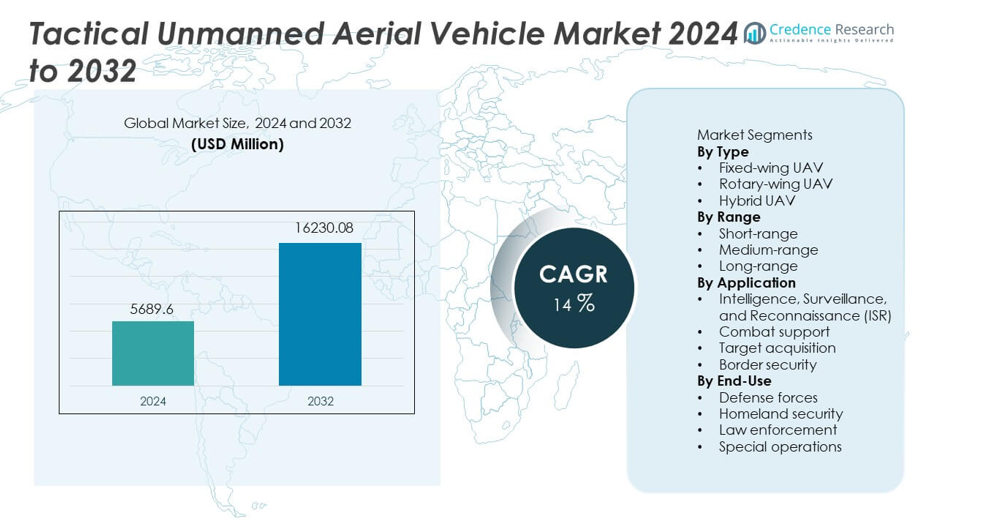
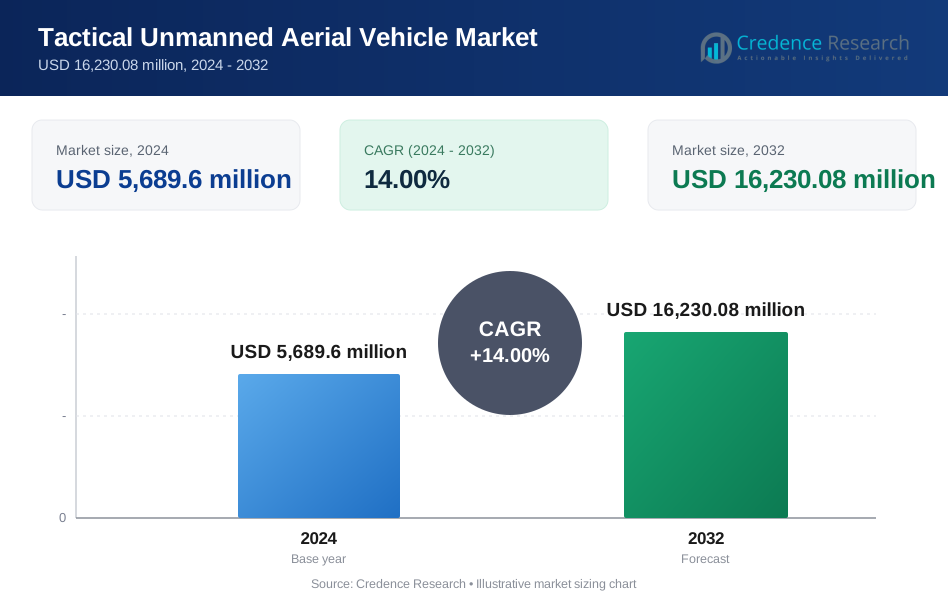
Tactical Unmanned Aerial Vehicle market size was valued at USD 5,689.6 million in 2024 and is projected to reach USD 16,230.08 million by 2032, registering a CAGR of 14% during the forecast period.
| REPORT ATTRIBUTE | DETAILS |
|---|---|
| Historical Period | 2020-2023 |
| Base Year | 2024 |
| Forecast Period | 2025-2032 |
| Tactical Unmanned Aerial Vehicle market Size 2024 | USD 5,689.6 million |
| Tactical Unmanned Aerial Vehicle market, CAGR | 14% |
| Tactical Unmanned Aerial Vehicle market Size 2032 | USD 16,230.08 million |
The top players in the Tactical Unmanned Aerial Vehicle market include Northrop Grumman Corporation, General Atomics Aeronautical Systems, Elbit Systems, Aerovironment Inc., Textron Systems, Thales Group, Israel Aerospace Industries, Lockheed Martin Corporation, Boeing Defense, and Saab AB. These companies lead the market through advanced UAV technologies, strong defense partnerships, and continuous innovation in ISR payloads, autonomous navigation, and long-endurance capabilities. North America remains the dominant region with a 38% market share, driven by high defense spending and large-scale UAV modernization programs. Europe and Asia Pacific follow with significant investments in border surveillance, multi-mission UAV fleets, and indigenous development programs.
Market Insights
- The Tactical Unmanned Aerial Vehicle market reached USD 5,689.6 million in 2024 and will grow at a CAGR of 14 percent through 2032.
- Rising defense focus on ISR missions drives adoption, with fixed-wing UAVs holding a 47 percent share due to long endurance and high payload capacity.
- AI-enabled autonomy, modular payloads, and multi-mission capabilities shape market trends as militaries seek flexible and rapidly deployable UAV platforms.
- Leading players strengthen competitiveness through advanced sensors, long-range communication systems, and improved propulsion technologies for tactical UAV performance.
- North America leads with a 38 percent share, followed by Europe at 27 percent and Asia Pacific at 26 percent, supported by strong defense modernization, growing border surveillance needs, and increasing procurement of tactical UAVs across mission-critical operations.
Market Segmentation Analysis:
By Type
Fixed-wing UAVs dominate this segment with a 47% share, driven by their long-endurance capabilities, higher payload capacity, and suitability for long-range surveillance missions. Defense agencies prefer fixed-wing systems for ISR operations, tactical reconnaissance, and border monitoring. Rotary-wing UAVs grow steadily due to their vertical takeoff ability and strong performance in urban or confined environments. Hybrid UAVs gain attention as they combine endurance with maneuverability, supporting multi-mission roles. Rising demand for adaptable platforms and expanding use of autonomous flight systems strengthen the overall segment.
- For instance, General Atomics developed the MQ-9A Reaper with an endurance of 27 hours. The platform supports a payload capacity of 1,746 kg across external and internal stations. The system operates at an altitude of 15,240 meters, supporting long-duration ISR tasks.
By Range
Long-range UAVs lead the range segment with a 44% share, supported by increasing need for extended surveillance, high-altitude monitoring, and cross-border intelligence missions. Their ability to cover wide areas without frequent refueling makes them essential for defense operations. Medium-range UAVs also see strong adoption as they support tactical missions requiring moderate endurance and mobility. Short-range UAVs remain vital for quick-response missions in confined or urban zones. Growing deployment in patrol missions, persistent ISR, and coastal security drives demand across all ranges.
- For instance, Israel Aerospace Industries developed the Heron UAV with a flight endurance of 45 hours. The system supports a mission radius exceeding 1,000 kilometers with satellite communication. The UAV operates at a service ceiling of 10,000 meters for wide-area monitoring.
By Application
ISR applications dominate the market with a 52% share, as tactical UAVs play a critical role in real-time intelligence gathering, threat detection, and battlefield awareness. Modern defense forces rely on UAV-based ISR to support mission planning and decision-making. Combat support applications grow with rising demand for precision targeting, logistics support, and electronic warfare missions. Target acquisition gains momentum as UAVs improve strike accuracy and mission coordination. Border security applications expand due to increased focus on surveillance, smuggling prevention, and perimeter monitoring.
Key Growth Drivers
Rising Demand for Advanced ISR Capabilities
Global defense forces increase investment in tactical UAVs to strengthen intelligence, surveillance, and reconnaissance operations. These systems capture high-resolution imagery, track threats, and support real-time decision-making in complex environments. Their ability to operate in high-risk zones without endangering personnel enhances operational safety. Governments adopt long-endurance UAVs to monitor borders, coastlines, and conflict zones. Expanding use of AI-driven analytics further boosts ISR efficiency, making UAVs essential for modern military operations.
- For instance, Northrop Grumman's RQ-4 Global Hawk carries sensors with very high resolution for detailed ground observation. The platform is a high-altitude, long-endurance system, capable of sustaining flight for well over a day at high altitudes, far above typical commercial air traffic.
Growing Deployment of UAVs in Combat Support Roles
Tactical UAVs gain traction as versatile platforms that support targeting, logistics, electronic warfare, and precision strike missions. Rising demand for unmanned systems in contested environments drives procurement of platforms capable of operating with minimal risk. Their ability to transmit real-time battlefield data improves coordination between ground forces and command centers. Adoption increases as militaries seek cost-effective alternatives to manned aircraft for tactical missions. Advancements in payload integration enhance mission flexibility and expand combat capabilities.
- For instance, Elbit Systems’ Hermes 900 supports a payload capacity of 350 kilograms. The UAV sustains endurance for 36 hours with multi-sensor and electronic warfare suites. The platform integrates laser designation for precision targeting support. These features strengthen combat support and strike coordination missions.
Increased Investment in Border and Homeland Security
Governments strengthen surveillance and security operations to manage rising cross-border threats, smuggling, and illegal infiltration. Tactical UAVs offer persistent monitoring, wide-area coverage, and rapid deployment for difficult terrains. Homeland security agencies use UAVs for patrol missions, emergency response, and perimeter protection. Their ability to integrate night vision, thermal sensors, and communication systems improves operational effectiveness. This growing need for continuous situational awareness accelerates investments in advanced UAV fleets.
Key Trends & Opportunities
Integration of AI and Autonomous Flight Technologies
AI-enabled navigation, object detection, and autonomous decision systems transform tactical UAV performance. Automated route planning and real-time data analysis improve mission accuracy and reduce operator workload. AI-driven threat recognition enhances situational awareness during ISR and combat missions. This trend opens opportunities for next-generation UAV platforms that adapt to dynamic environments, support swarm operations, and deliver predictive intelligence to command centers.
- For instance, Boeing integrated autonomous mission management into the MQ-25 Stingray test platform. The system executed autonomous aerial refueling with probe engagement accuracy within 25 centimeters. Onboard AI processed sensor data in under 200 milliseconds for flight adjustments.
Expansion of Multi-Mission and Modular UAV Designs
Defense agencies prefer UAVs that support multiple roles through modular payloads, enabling rapid configuration for ISR, target acquisition, or combat support tasks. This flexibility reduces fleet costs and increases operational readiness. Advances in lightweight materials, improved endurance, and hybrid propulsion systems further expand mission capabilities. Growth in joint-force operations creates strong opportunities for interoperable UAV designs compatible with land, air, and naval platforms.
- For instance, SAAB’s Skeldar V-200 supports modular payload integration up to 40 kilograms. The UAV sustains endurance of 5 hours while operating from naval decks without launch systems. The platform supports ISR, electronic surveillance, and communication relay payloads.
Key Challenges
Regulatory and Airspace Integration Barriers
Integrating tactical UAVs into controlled military and civilian airspace remains challenging due to strict regulations and safety requirements. Issues related to collision avoidance, communication reliability, and flight permissions delay large-scale deployment. Coordinating UAV operations with manned aircraft demands advanced traffic management systems. These barriers slow adoption, especially in regions with evolving aviation frameworks.
High Development, Procurement, and Maintenance Costs
Advanced UAVs require significant investment in sensors, communication systems, propulsion technologies, and autonomous software. Maintenance costs rise due to complex components and mission-critical reliability requirements. Budget constraints in developing regions limit procurement opportunities. Continuous upgrades needed to counter emerging threats further increase life-cycle costs. These financial challenges affect adoption rates among smaller military forces.
Regional Analysis
North America
North America holds a 38% share, driven by strong defense spending, rapid adoption of UAV-based ISR systems, and large-scale modernization programs across the United States. The region leads in developing advanced fixed-wing and hybrid UAV platforms with enhanced endurance, autonomous capabilities, and high-altitude performance. Expanding use of tactical UAVs in border security, counterterrorism, and coastal monitoring strengthens demand. Government investments in AI-enabled mission systems and improved communication networks further support market growth. Collaboration between defense agencies and UAV manufacturers accelerates deployment of next-generation tactical platforms across diverse mission areas.
Europe
Europe accounts for a 27% share, supported by increased defense cooperation among EU and NATO members and rising investment in reconnaissance and border surveillance programs. Countries adopt tactical UAVs for ISR, target acquisition, and battlefield monitoring to enhance situational awareness in evolving threat environments. Ongoing military modernization in France, Germany, and the United Kingdom boosts procurement of long-endurance and modular UAV platforms. Strong focus on joint-force interoperability and counterterrorism also advances UAV deployment. Government initiatives aimed at developing indigenous UAV technologies strengthen regional market expansion.
Asia Pacific
Asia Pacific holds a 26% share, driven by rising geopolitical tensions, expanding defense budgets, and accelerated military modernization across China, India, Japan, and South Korea. Regional forces adopt tactical UAVs for ISR missions, border management, and maritime patrol operations. Rapid growth of indigenous UAV manufacturing programs enhances availability and affordability of advanced systems. Increased use of UAVs for real-time intelligence and surveillance strengthens operational readiness. Investments in AI, autonomous navigation, and long-range capabilities further drive widespread adoption across defense agencies.
Latin America
Latin America captures a 5% share, with countries deploying tactical UAVs for border protection, counter-narcotics operations, and internal security missions. Adoption grows as governments enhance surveillance coverage in remote areas and coastal regions. Budget limitations restrict large-scale procurement, yet selected nations invest in medium-range and rotary-wing UAVs for ISR and tactical support. Growing interest in UAV-assisted disaster response and infrastructure monitoring also contributes to steady demand. Partnerships with global UAV manufacturers help expand access to modern technologies across the region.
Middle East & Africa
The Middle East & Africa region holds a 4% share, supported by rising defense spending and increased adoption of UAVs for surveillance, counterterrorism, and border monitoring. Gulf countries invest heavily in next-generation tactical UAVs with advanced sensors and long-range capabilities to strengthen situational awareness. African nations adopt UAVs for perimeter security, anti-poaching missions, and reconnaissance, though procurement remains limited by budget constraints. Expansion of regional conflicts and growing security needs drive continued deployment of UAV-based ISR systems across both military and homeland security sectors.
Market Segmentations:
By Type
- Fixed-wing UAV
- Rotary-wing UAV
- Hybrid UAV
By Range
- Short-range
- Medium-range
- Long-range
By Application
- Intelligence, Surveillance, and Reconnaissance (ISR)
- Combat support
- Target acquisition
- Border security
By End-Use
- Defense forces
- Homeland security
- Law enforcement
- Special operations
By Geography
- North America
- U.S.
- Canada
- Mexico
- Europe
- Germany
- France
- U.K.
- Italy
- Spain
- Rest of Europe
- Asia Pacific
- China
- Japan
- India
- South Korea
- South-east Asia
- Rest of Asia Pacific
- Latin America
- Brazil
- Argentina
- Rest of Latin America
- Middle East & Africa
- GCC Countries
- South Africa
- Rest of the Middle East and Africa
Competitive Landscape
The Tactical Unmanned Aerial Vehicle market is shaped by leading companies such as Northrop Grumman Corporation, General Atomics Aeronautical Systems, Elbit Systems, Aerovironment Inc., Textron Systems, Thales Group, Israel Aerospace Industries, Lockheed Martin Corporation, Boeing Defense, and Saab AB. These players compete by advancing UAV endurance, enhancing autonomous flight capabilities, and integrating high-performance ISR payloads. Many firms focus on modular designs that support multiple mission profiles, including surveillance, target acquisition, and combat support. Defense modernization programs worldwide drive strong demand for next-generation UAV platforms with improved communication systems, AI-enabled analytics, and secure data links. Companies strengthen their market presence through government contracts, international partnerships, and continuous R&D investment aimed at developing lightweight airframes, long-range propulsion systems, and advanced sensor integration. This competitive environment fuels rapid innovation and accelerates the global deployment of tactical UAV solutions.
Key Player Analysis
- Northrop Grumman Corporation
- General Atomics Aeronautical Systems
- Elbit Systems
- Aerovironment Inc.
- Textron Systems
- Thales Group
- Israel Aerospace Industries (IAI)
- Lockheed Martin Corporation
- Boeing Defense
- SAAB AB
Recent Developments
- In December 2025, Northrop Grumman unveiled Project Talon, a new autonomous loyal-wingman combat drone designed to fly with crewed fighters. The company aims to lower costs and accelerate tactical drone builds.
- In December 2025, General Atomics (GA) outlined plans for Collaborative Combat Aircraft (CCA) and MQ-9 upgrades, including evolving unmanned systems like CCA drones and discussing a strategy to ensure the MQ-9's relevance in a high-threat environment through 'standoff protection' using long-range sensors.
- In November 2025, General Atomics showcased the Gambit 6 strike variant, expanding its modular autonomous drone family for air-to-surface missions.
Report Coverage
The research report offers an in-depth analysis based on Type, Range, Application, End-Use and Geography. It details leading market players, providing an overview of their business, product offerings, investments, revenue streams, and key applications. Additionally, the report includes insights into the competitive environment, SWOT analysis, current market trends, as well as the primary drivers and constraints. Furthermore, it discusses various factors that have driven market expansion in recent years. The report also explores market dynamics, regulatory scenarios, and technological advancements that are shaping the industry. It assesses the impact of external factors and global economic changes on market growth. Lastly, it provides strategic recommendations for new entrants and established companies to navigate the complexities of the market.
Future Outlook
- Demand for long-endurance tactical UAVs will increase as defense missions expand.
- AI-enabled autonomy will enhance navigation, threat detection, and mission decision-making.
- Multi-mission UAV platforms will gain traction due to modular payload flexibility.
- Adoption of swarm UAV capabilities will grow for coordinated battlefield operations.
- Border surveillance agencies will continue to invest in advanced ISR UAV fleets.
- Hybrid propulsion systems will improve flight efficiency and operational range.
- Secure communication and anti-jamming technologies will become essential for mission safety.
- Indigenous UAV development programs will rise across emerging economies.
- Tactical UAVs will play a larger role in electronic warfare and target acquisition.
Increased collaboration between defense agencies and manufacturers will accelerate next-generation UAV deployment.
Request a Free Sample
Fill in your details and we'll send you a free sample report.
- Sample data tables & charts
- Research methodology
Need a Custom Version of This Report?
Tailor the scope, geography, or segments to your exact requirements.
- Custom geography or segment scope
- Direct access to our analyst team
Frequently Asked Questions
What is the current market size for the Tactical Unmanned Aerial Vehicle market, and what is its projected size in 2032?
At what Compound Annual Growth Rate is the Tactical Unmanned Aerial Vehicle market projected to grow between 2024 and 2032?
Which Tactical Unmanned Aerial Vehicle market segment held the largest share in 2024?
What are the primary factors fueling the growth of the Tactical Unmanned Aerial Vehicle market?
Who are the leading companies in the Tactical Unmanned Aerial Vehicle market?
Table of Content
Chapter 1. Report Introduction
- 1.1 Report Description & Purpose
- 1.1.1 Report Title & Market Definition
- 1.1.2 Unique Selling Propositions (USP) & Key Differentiators
- 1.1.3 Value Proposition for Stakeholders
- 1.2 Research Objectives
- 1.2.1 Market Sizing Objectives (Volume & Revenue)
- 1.2.2 Segmentation Objectives
- 1.2.3 Competitive Intelligence Objectives
- 1.2.4 Forecast & Scenario Objectives
- 1.3 Report Scope
- 1.3.1 Tactical Unmanned Aerial Vehicle Scope – Types & Subtypes Covered
- 1.3.2 Geographic Scope – Regions & Countries Covered
- 1.3.3 Historical Period, Base Year & Forecast Period (2024; forecast to 2032)
- 1.3.4 Inclusions & Exclusions
- 1.4 HS Code & Classification Framework
- 1.5 Currency, Units & Pricing Basis
- 1.6 Target Stakeholders
- 1.7 Limitations & Assumptions
Chapter 2. Executive Summary
- 2.1 Global Tactical Unmanned Aerial Vehicle Market Snapshot
- 2.1.1 Market Size – Historical (2024) & Forecast (2024-2032) (2024: USD 5,689.6 million → 2032: USD 16,230.08 million)
- 2.1.2 Volume & Revenue – Global Totals
- 2.1.3 Key Market Highlights – Top Five Facts
- 2.2 Tactical Unmanned Aerial Vehicle Market Segmentation Snapshot
- 2.2.1 Market Split by Region – 2024 vs. 2032
- 2.3 Competitive Snapshot
- 2.3.1 Top 10 Players by Revenue Share – 2024
- 2.3.2 Top 10 Players by Volume Share – 2024
- 2.3.3 Recent Strategic Developments (18-Month Summary)
- 2.4 Key Investment Highlights & Strategic Conclusions
Chapter 3. Tactical Unmanned Aerial Vehicle Market Dynamics & Industry Analysis
- 3.1 Market Overview & Context
- 3.1.1 Tactical Unmanned Aerial Vehicle Market Position in the Broader Automotive Value Chain
- 3.1.2 OEM vs. Replacement Market Dynamics
- 3.1.3 Market Maturity & Development Stage by Region
- 3.2 Tactical Unmanned Aerial Vehicle Market Drivers
- 3.3 Tactical Unmanned Aerial Vehicle Market Restraints & Challenges
- 3.4 Tactical Unmanned Aerial Vehicle Market Opportunities
- 3.5 Porter's Five Forces Analysis
- 3.5.1 Threat of New Entrants
- 3.5.2 Bargaining Power of Suppliers
- 3.5.3 Bargaining Power of Buyers
- 3.5.4 Threat of Substitutes
- 3.5.5 Competitive Rivalry – Intensity Assessment
- 3.6 Tactical Unmanned Aerial Vehicle Value Chain Analysis
- 3.6.1 Upstream – Raw Material/Input Suppliers
- 3.6.1.1 Raw Material/Input 1
- 3.6.1.2 Raw Material/Input 2
- 3.6.1.3 Raw Material/Input 3
- 3.6.2 Midstream – Production/Manufacturing/Service Delivery
- 3.6.2.1 Production/Process Overview
- 3.6.2.2 Key Facility Locations & Capacity by Manufacturer
- 3.6.3 Downstream – Distribution & End Consumer
- 3.6.3.1 Primary Channel – B2B/OEM
- 3.6.3.2 Secondary Channels – Dealer, Retail, Online, Direct
- 3.6.4 Value Chain Profitability Analysis
- 3.6.1 Upstream – Raw Material/Input Suppliers
- 3.7 PESTEL Analysis
- 3.7.1 Political Factors
- 3.7.2 Economic Factors
- 3.7.3 Social Factors
- 3.7.4 Technological Factors
- 3.7.5 Environmental Factors
- 3.7.6 Legal Factors
- 3.8 Tactical Unmanned Aerial Vehicle Supply Chain Analysis
- 3.8.1 Raw Material/Input Supply Risk Assessment
- 3.8.2 Manufacturing Concentration Risk (Geographic Exposure)
- 3.8.3 Trade Disruption Impact Analysis
- 3.9 Regulatory & Policy Landscape
Note: The regulatory and policy landscape section covers regulations based on their applicability to the market, Tactical Unmanned Aerial Vehicle category, geography, and scope of the study. Only regulatory frameworks with a material impact on operations, compliance, trade, sustainability, or market access are analyzed in detail.
Chapter 4. Key Investment Pockets & Opportunity Analysis
- 4.1 Tactical Unmanned Aerial Vehicle Market Attractiveness Analysis
- 4.1.1 By Region – Investment Attractiveness Matrix (Volume × CAGR)
- 4.2 Absolute Revenue Growth Opportunity
- 4.2.1 By Region – Absolute USD Growth Through 2032
- 4.3 Incremental Volume Opportunity
- 4.3.1 By Region – Incremental Volume Through 2032
- 4.3.2 Segment – Incremental Volume
- 4.4 Emerging Submarket Opportunity Deep Dive (Subject to Applicability)
- 4.5 Emerging Market Opportunity Scorecards
- 4.5.1 United States
- 4.5.2 Europe
- 4.5.3 Asia
- 4.5.4 Middle East & Africa
Note: Emerging Market Opportunity Scorecards will be included based on relevance and strategic importance. Regions listed are indicative and may vary depending on data availability and market dynamics.
Chapter 5. Tactical Unmanned Aerial Vehicle Import-Export Analysis & Trade Flows
- 5.1 Global Trade Overview
- 5.1.1 Global Export Value by Country (2024)
- 5.1.2 Global Export Volume by Country (2024)
- 5.1.3 Global Import Value by Country (2024)
- 5.1.4 Global Import Volume by Country (2024)
- 5.1.5 Net Trade Balance by Country (2024)
- 5.2 Export Analysis – Segment
- 5.2.1 Type 1 (HS Code)
- 5.2.2 Type 2 (HS Code)
- 5.2.3 Type 3 (HS Code)
- 5.2.4 Type 4 (HS Code)
- 5.2.5 Type 5 (HS Code)
- 5.3 Import Analysis – Segment
- 5.3.1 Type 1 (HS Code)
- 5.3.2 Type 2 (HS Code)
- 5.3.3 Type 3 (HS Code)
- 5.3.4 Type 4 (HS Code)
- 5.3.5 Type 5 (HS Code)
- 5.4 Average Unit Trade Prices
- 5.4.1 Average Export Price – Segment & Country
- 5.4.2 Average Import Price – Segment & Source Country
- 5.4.3 Price Trends (2024)
- 5.5 Key Trade Route Analysis
- 5.5.1 Trade Route 1
- 5.5.2 Trade Route 2
- 5.5.3 Trade Route 3
- 5.5.4 Trade Route 4
- 5.5.5 Trade Route 5
- 5.6 Trade Policy Impact Assessment
- 5.6.1 US Anti-Dumping & Section 301 Tariffs
- 5.6.2 EU Customs Union Impact
- 5.6.3 Major Free Trade Agreements
- 5.6.4 USMCA Rules of Origin
Note: Trade policy analysis will be included only where relevant to the Tactical Unmanned Aerial Vehicle market.
Chapter 6. Competitive Landscape & Company Benchmarking
- 6.1 Tactical Unmanned Aerial Vehicle Market Concentration & Structure
- 6.1.1 Herfindahl-Hirschman Index (HHI) – vs. 2024
- 6.1.2 Tier 1, Tier 2 & Tier 3 Market Structure
- 6.1.3 Global, Regional & Local Player Dynamics
- 6.2 Tactical Unmanned Aerial Vehicle Market Share Analysis – 2024
- 6.2.1 Global Revenue Share by Company
- 6.2.2 Global Volume Share by Company
- 6.2.3 Regional Revenue Share
- 6.2.4 Market Share Evolution ( vs. 2024)
- 6.2.5 OEM Segment Share by Company
- 6.2.6 Replacement Segment Share by Company
- 6.3 Production/Delivery Capacity & Facility Analysis
- 6.3.1 Global Installed Capacity
- 6.3.2 Capacity Utilization Rates
- 6.3.3 Production/Output Volume
- 6.3.4 Facility Locations & Capacity Map
- 6.3.5 Planned Capacity Additions
- 6.4 Tactical Unmanned Aerial Vehicle Competitive Benchmarking Matrix
- 6.4.1 Revenue, Volume, CAGR & Profitability Comparison
- 6.4.2 Channel Revenue Mix
- 6.4.3 Geographic Revenue Exposure
- 6.4.4 R&D Intensity
- 6.4.5 Sustainability Maturity
- 6.5 Strategic Developments in Tactical Unmanned Aerial Vehicle (Last 24 Months)
- 6.5.1 Mergers, Acquisitions & Divestments
- 6.5.2 New Tactical Unmanned Aerial Vehicle Launches
- 6.5.3 Facility Expansions
- 6.5.4 Strategic Alliances, Joint Ventures & Partnerships
- 6.5.5 Distribution Expansion & Market Entry
- 6.5.6 Sustainability & ESG Initiatives
- 6.6 Competitive Strategy Mapping
- 6.6.1 Leader, Challenger, Follower & Niche Classification
- 6.6.2 Pricing Strategy Comparison
- 6.6.3 Channel Strategy Matrix
Note: Strategic developments are included based on their materiality and the availability of reliable information.
Chapter 7. Global Tactical Unmanned Aerial Vehicle Market – By Distribution Channel
- 7.1 Segment Overview
- 7.1.1 Volume & Revenue Split by Channel (2024 & 2032)
- 7.1.2 Channel Mix Evolution (2024-2032)
Chapter 8. Regional Market Analysis – Global Overview
- 8.1 Global Regional Overview
- 8.1.1 Regional Volume Share
- 8.1.2 Regional Revenue Share
- 8.1.3 Regional Volume by Region
- 8.1.4 Regional Revenue by Region
- 8.1.5 Regional Forecast Through 2032
- 8.2 Cross-Regional Segment Analysis
- 8.2.1 By Distribution Channel
- 8.2.2 By Brand/Price Tier
Chapter 9. North America Tactical Unmanned Aerial Vehicle Market
- 9.1 United States
- 9.2 Canada
- 9.3 Mexico
Chapter 10. Europe Tactical Unmanned Aerial Vehicle Market
- 10.1 Germany
- 10.2 France
- 10.3 Italy
- 10.4 United Kingdom
- 10.5 Spain
- 10.6 Poland
- 10.7 Russia
- 10.8 Netherlands
- 10.9 Belgium
- 10.10 Sweden
- 10.11 Denmark
- 10.12 Norway
- 10.13 Rest of Europe
Chapter 11. Asia Pacific Tactical Unmanned Aerial Vehicle Market
- 11.1 China
- 11.2 India
- 11.3 Japan
- 11.4 South Korea
- 11.5 Thailand
- 11.6 Indonesia
- 11.7 Vietnam
- 11.8 Malaysia
- 11.9 Australia
- 11.10 Rest of Asia Pacific
Chapter 12. Latin America Tactical Unmanned Aerial Vehicle Market
- 12.1 Brazil
- 12.2 Argentina
- 12.3 Colombia
- 12.4 Chile
- 12.5 Rest of Latin America
Chapter 13. Middle East Tactical Unmanned Aerial Vehicle Market
- 13.1 Saudi Arabia
- 13.2 United Arab Emirates
- 13.3 Turkey
- 13.4 Israel
- 13.5 Iran
- 13.6 Rest of the Middle East
Chapter 14. Africa Tactical Unmanned Aerial Vehicle Market
- 14.1 South Africa
- 14.2 Egypt
- 14.3 Nigeria
- 14.4 Morocco
- 14.5 Rest of Africa
Chapter 15. Tactical Unmanned Aerial Vehicle Company Profiles
- 15.1 [Company 01]
- 15.1.1 Company Overview
- 15.1.2 Key Management Personnel
- 15.1.3 Products & Services Portfolio
- 15.1.4 Financial Performance
- 15.1.5 Key Market Focus & Geographic Presence
- 15.1.6 Recent Developments & Strategic Initiatives
Note: The company profile list is preliminary and may change based on research findings, market developments, data availability, and client requirements.
Chapter 16. Appendices
- Appendix A – List of Abbreviations & Acronyms
- Appendix B – Industry Classification Code Reference – Full Series
- Appendix C – Production & Capacity Data Tables
- Appendix D – End-Use & Demand Base Tables
- Appendix E – Consumption & Replacement Rate Assumptions
- Appendix F – ASP Reference Tables
- Appendix G – Manufacturing & Facility Database
- Appendix H – Import-Export Data Tables
- Appendix I – Regulatory Summary Tables
- Appendix J – Primary Research Participant List (Anonymized)
- Appendix K – Primary Research Questionnaire Framework
- Appendix L – Data Sources & Bibliography
- Appendix M – Market Size Divergence & Source Comparison
Chapter 17. Research Methodology
- 17.1 Research Framework & Philosophy
- 17.2 Secondary Research – Sources, Hierarchy & Data Extraction
- 17.3 Data Modeling – Bottom-Up & Top-Down Market Sizing
- 17.4 Primary Research – Stakeholder Framework, LOI & Sample Sizes
- 17.5 Forecast Methodology – Regression, Scenario & Sensitivity Analysis
- 17.6 Quality Control – Four-Layer Validation Framework
- 17.7 Limitations & Standard Assumptions
- 17.8 Disclaimer
