
Taiwan Kids Furniture Market Overview:
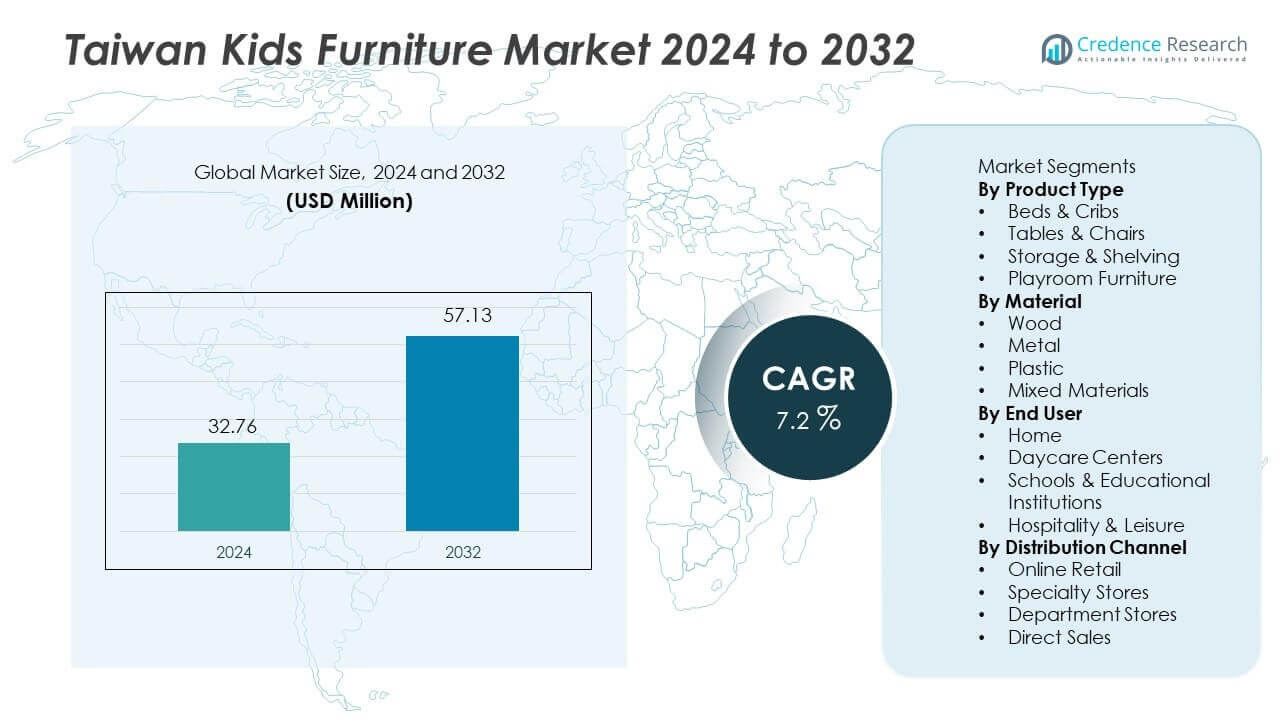
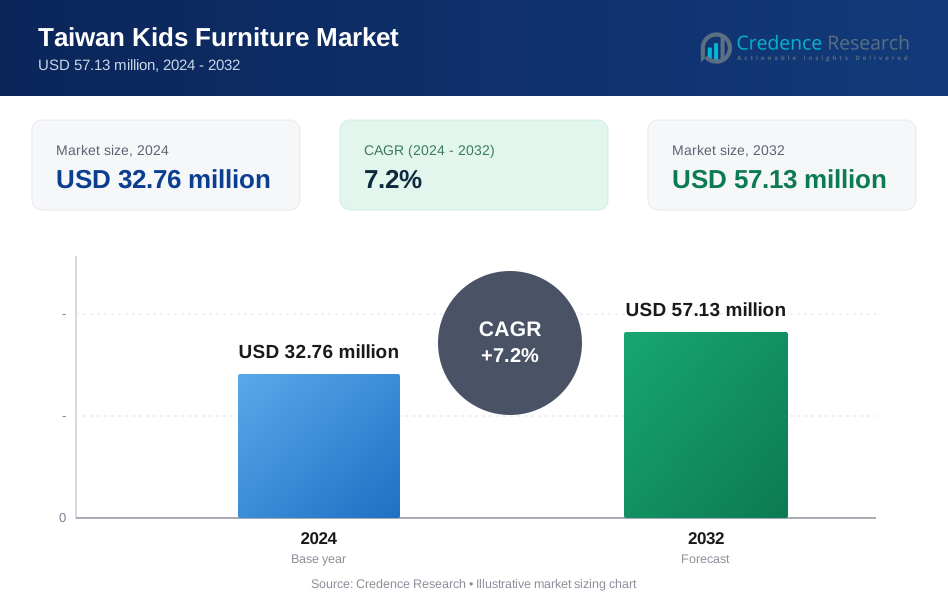
Taiwan Kids Furniture market size was valued at USD 32.76 million in 2024 and is projected to reach USD 57.13 million by 2032, registering a CAGR of 7.2% during the forecast period.
| REPORT ATTRIBUTE | DETAILS |
|---|---|
| Historical Period | 2020-2023 |
| Base Year | 2024 |
| Forecast Period | 2025-2032 |
| Taiwan Kids Furniture Market Size 2024 | USD 32.76 million |
| Taiwan Kids Furniture Market, CAGR | 7.2% |
| Taiwan Kids Furniture Market Size 2032 | USD 57.13 million |
Taiwan Kids Furniture Market Insights
- Rising parental focus on safety and ergonomics drives demand, with beds and cribs leading the product segment at a 41 % share due to strong adoption in home settings.
- Space-saving, multifunctional, and eco-friendly furniture trends shape purchasing behavior as urban families seek practical and sustainable solutions.
- Leading players enhance competitiveness through themed designs, modular systems, and online retail expansion while balancing cost, quality, and compliance with child safety standards.
- North Taiwan holds a 46 percent share, followed by Central Taiwan at 28 percent and South Taiwan at 21 percent, supported by strong retail networks, urbanization, and rising investments in children’s learning and play environments.
Taiwan Kids Furniture Market Segmentation Analysis:
By Product Type
Beds & cribs dominate this segment with a 41% share, driven by rising demand for safe, ergonomic, and space-saving designs that support child comfort and parental convenience. Taiwanese households prioritize multifunctional children’s beds with features such as adjustable height, storage units, and durable frames. Tables and chairs gain traction as learning-focused furniture purchases increase due to the growing emphasis on early education. Storage and shelving solutions expand as families adopt organizational products for compact living spaces. Playroom furniture also grows steadily as parents invest in themed and interactive designs to enhance creativity and indoor play.
- For instance, IKEA Taiwan offers the SNIGLAR and SUNDVIK cribs built from solid beech wood. Both models meet EN 716 safety standards for child furniture.
By Material
Wood leads the material segment with a 52% share, supported by its durability, aesthetic appeal, and strong consumer preference for natural and eco-friendly materials in children’s products. Manufacturers produce wooden beds, study desks, and storage units that align with safety standards and long-term usage needs. Plastic furniture grows due to its lightweight, colorful, and easy-to-clean properties, making it ideal for playrooms and daycare centers. Metal products maintain steady demand in institutional settings requiring sturdy designs. Mixed materials expand as hybrid constructions combine strength, flexibility, and modern styling.
- For instance, certain furniture manufacturers produce solid rubberwood children's beds and desks, often using wood that has been dried to industry standards for stability.
By End User
Home use dominates the end-user segment with a 64% share, driven by parents investing in customized, functional, and space-efficient furniture for children's bedrooms and study areas. Daycare centers also adopt durable, safety-certified furniture to support early learning environments. Schools and educational institutions increase demand for ergonomic seating, adjustable desks, and storage solutions to improve classroom experience. Hospitality and leisure facilities, including kids’ zones in hotels and shopping centers, expand adoption of playful and durable furniture. Rising focus on child safety, design innovation, and multi-purpose features supports strong growth across all end-user categories.
Major Key Growth Drivers
Rising Demand for Safe and Functional Children’s Furniture
Parents in Taiwan increasingly prioritize safety-certified and ergonomically designed furniture, driving strong demand for kids’ beds, study tables, and storage units. Growing awareness of child well-being encourages the use of non-toxic materials, rounded edges, and stability-focused designs. The shift toward multifunctional products that combine sleeping, learning, and storage features supports market expansion. Urban lifestyles also push families to adopt space-saving solutions that enhance room efficiency. This rising focus on quality and safety acts as a key driver for sustained growth in the kids’ furniture segment.
- For instance, any company selling children's beds in Taiwan, including HOLA Taiwan, must ensure its products are tested under relevant safety rules set by the Bureau of Standards, Metrology and Inspection (BSMI).
Increasing Focus on Early Education and Learning Spaces
The rise in early childhood education and at-home learning creates strong demand for study desks, ergonomic chairs, and organizational storage. Parents invest in dedicated learning spaces to support cognitive development and structured routines. Schools and daycare centers also upgrade classrooms with child-friendly furniture that promotes comfort and productivity. Government support for early education further stimulates institutional purchases. This growing emphasis on structured learning environments strengthens the demand for functional and durable kids’ furniture across the country.
- For instance, specific local companies, such as Gauss Furniture L.L.C. and Sunburst Furniture Co., Ltd., supply classroom furniture and components to educational institutions in Taiwan. These suppliers focus on customizable, durable solutions often incorporating steel, plastic, or composite wood materials, rather than exclusively thick solid pine panels.
Growth of Urban Living and Compact Household Spaces
Urbanization in Taiwan drives demand for compact and modular furniture that maximizes limited room sizes. Families prefer multifunctional beds, foldable tables, and stackable storage units that improve space utilization. Manufacturers respond with innovative designs tailored for small homes, enhancing practicality and appeal. Rising apartment living encourages investment in lightweight, rearrangeable furniture to optimize flexibility. This trend supports steady market growth as space-efficient solutions continue to gain popularity among modern households.
Key Trends & Opportunities
Shift Toward Eco-Friendly and Sustainable Materials
Consumers show growing interest in environmentally responsible children’s furniture made from certified wood, low-VOC finishes, and recyclable components. Manufacturers incorporate green materials to meet rising sustainability expectations and strengthen brand trust. This trend creates opportunities for premium eco-friendly product lines that appeal to health-conscious families. The use of biodegradable plastics and water-based coatings further supports market differentiation. As sustainability becomes a core purchasing criterion, companies that adopt green practices gain competitive advantage.
- For instance, Flexa uses FSC-certified birch and pine wood for its children’s furniture range. Flexa operates with water-based lacquers tested under EN 71-3 toy safety standards. The company reported testing furniture surfaces for more than 200 chemical substances to meet child safety limits.
Rising Popularity of Customizable and Themed Furniture Designs
Demand increases for personalized children’s furniture with adjustable heights, modular layouts, and customizable colors. Themed designs inspired by cartoons, nature, or interactive play experiences attract both children and parents. This trend opens opportunities for brands offering tailored solutions that enhance room aesthetics and engagement. Growing interest in experiential play encourages development of multifunctional playroom furniture. Manufacturers benefit by creating unique, design-focused collections that cater to evolving consumer preferences.
- For instance, Stokke designed the Tripp Trapp chair with adjustable seat and footplate settings. The product supports children from infancy to adulthood using one frame. Stokke confirmed sales of over 13 million Tripp Trapp units globally since launch.
Key Challenges
High Manufacturing Costs and Limited Economies of Scale
Kids’ furniture production requires high-quality materials, strict safety compliance, and specialized craftsmanship, increasing overall production costs. Smaller Taiwanese manufacturers face challenges achieving large-scale efficiency compared to global competitors. These factors elevate product prices and limit affordability for some households. Balancing safety, durability, and cost effectiveness remains difficult, slowing broader market penetration.
Competition from Low-Cost Imports
Low-cost imports from regional markets challenge local manufacturers by offering cheaper alternatives that appeal to budget-conscious consumers. Although imported products may lack the same safety standards, their pricing pressures domestic brands. This competition forces local companies to innovate, differentiate, and maintain higher quality standards to retain market share. Overcoming price competition remains a key barrier to market expansion.
Regional Analysis
North Taiwan
North Taiwan holds a 46% share, driven by high urban density, strong purchasing power, and rising demand for premium kids’ furniture in cities such as Taipei and New Taipei. Families living in compact apartments favor multifunctional and space-saving designs, encouraging manufacturers to offer modular beds, foldable desks, and efficient storage units. The region also benefits from a large concentration of daycare centers and private schools that invest in certified, durable furniture. Strong retail presence and growing online penetration further support market expansion across northern Taiwan.
Central Taiwan
Central Taiwan accounts for a 28% share, supported by a balanced mix of residential growth, expanding educational institutions, and rising demand for mid-range kids’ furniture. Taichung serves as a key manufacturing and distribution hub, enabling faster supply and wider product availability. Parents in the region prioritize durable, ergonomic products for study and home-learning environments. Increasing interest in eco-friendly wooden furniture and customizable designs strengthens demand. Growth in daycare facilities and lifestyle-focused retail outlets contributes to a steady rise in regional market adoption.
South Taiwan
South Taiwan holds a 21% share, driven by growing household expenditure, increasing young family populations, and expanding retail networks in cities such as Kaohsiung and Tainan. Consumers favor practical, affordable kids’ furniture designed for everyday use. The region also sees rising adoption of plastic and mixed-material furniture due to ease of maintenance and suitability for warm climates. Educational centers and community childcare facilities contribute to institutional demand. Ongoing urban development and improving economic conditions support continuous market expansion.
East Taiwan
East Taiwan captures a 5% share, influenced by lower population density but steady demand from households prioritizing durable and safe children’s furniture. Families in this region often choose wooden products due to their longevity and natural appeal. Although the market remains smaller compared to other regions, increased online shopping access expands product availability. Growth in tourism-related facilities, including family-friendly accommodations, also contributes to modest demand for functional and themed kids’ furniture. Efforts to improve logistics and distribution networks further support regional growth potential.
Taiwan Kids Furniture Market Segmentations:
By Product Type
- Beds & Cribs
- Tables & Chairs
- Storage & Shelving
- Playroom Furniture
By Material
- Wood
- Metal
- Plastic
- Mixed Materials
By End User
- Home
- Daycare Centers
- Schools & Educational Institutions
- Hospitality & Leisure
By Distribution Channel
- Online Retail
- Specialty Stores
- Department Stores
- Direct Sales
By Geography
- North Taiwan
- Central Taiwan
- South Taiwan
- East Taiwan
Competitive Landscape
The Taiwan Kids Furniture market is shaped by key players such as IKEA Taiwan, Sheng Yen Furniture, HOLA Taiwan, Wood Life Interior, Kika Furniture, Pali Baby Furniture, Quax Kids Furniture, Ubike Kids Furniture, Kidsmill, and SLH Home Furnishing. These companies compete by offering safe, durable, and ergonomic designs that meet child safety standards and align with evolving consumer preferences. Many brands focus on multifunctional and space-saving furniture to address the needs of compact urban households. Sustainability also becomes a competitive differentiator, with manufacturers adopting eco-friendly materials and low-VOC finishes. Retailers strengthen their presence through online channels, enhancing accessibility and customization options. Strategic product innovation in themed furniture, modular systems, and customizable designs supports brand differentiation. As consumer expectations increase, companies continue to invest in quality, design aesthetics, and pricing strategies to maintain a strong position in the growing Taiwan Kids Furniture market.
Key Player Analysis
- IKEA Taiwan
- Sheng Yen Furniture
- HOLA Taiwan
- Wood Life Interior
- Kika Furniture
- Pali Baby Furniture
- Quax Kids Furniture
- Ubike Kids Furniture
- Kidsmill
- SLH Home Furnishing
Recent Developments
- In 2025, IKEA Taiwan continued offering a wide range of children’s bedroom and study furniture online and in stores, including beds, desks, chairs, and storage designed for kids’ needs.
- In 2023, during Bed Bath & Beyond's bankruptcy proceedings, Dream on Me Industries acquired Buy Buy Baby's intellectual property and 11 store leases in separate transactions.
Report Coverage
The research report offers an in-depth analysis based on Product Type, Material, End User, Distribution Channel and Geography. It details leading market players, providing an overview of their business, product offerings, investments, revenue streams, and key applications. Additionally, the report includes insights into the competitive environment, SWOT analysis, current market trends, as well as the primary drivers and constraints. Furthermore, it discusses various factors that have driven market expansion in recent years. The report also explores market dynamics, regulatory scenarios, and technological advancements that are shaping the industry. It assesses the impact of external factors and global economic changes on market growth. Lastly, it provides strategic recommendations for new entrants and established companies to navigate the complexities of the market.
Future Outlook
- Demand for multifunctional and space-saving kids’ furniture will rise as urban living expands.
- Sustainable and eco-friendly materials will become a key focus for manufacturers.
- Customizable and themed furniture designs will gain popularity among modern families.
- Online retail channels will capture greater market share as digital shopping grows.
- Safety-certified and ergonomically designed furniture will remain a top priority for parents.
- Daycare centers and educational institutions will increase investments in durable, child-friendly furniture.
- Smart furniture features, such as adjustable study desks, will see higher adoption.
- Modular storage solutions will grow as households seek better organization in compact homes.
- Collaboration between local brands and international suppliers will strengthen product innovation.
- Rising birth rates in select regions and growing focus on child development will support long-term market growth.
Request a Free Sample
Fill in your details and we'll send you a free sample report.
- Sample data tables & charts
- Research methodology
Need a Custom Version of This Report?
Tailor the scope, geography, or segments to your exact requirements.
- Custom geography or segment scope
- Direct access to our analyst team
Frequently Asked Questions
What is the current market size for the Taiwan Kids Furniture market, and what is its projected size in 2032?
At what Compound Annual Growth Rate is the Taiwan Kids Furniture market projected to grow between 2024 and 2032?
Which Taiwan Kids Furniture market segment held the largest share in 2024?
What are the primary factors fueling the growth of the Taiwan Kids Furniture market?
Who are the leading companies in the Taiwan Kids Furniture market?
Which region commanded the largest share of the Taiwan Kids Furniture market in 2024?
Table of Content
Chapter 1. Report Introduction
- 1.1 Report Description & Purpose
- 1.1.1 Report Title & Market Definition
- 1.1.2 Unique Selling Propositions (USP) & Key Differentiators
- 1.1.3 Value Proposition for Stakeholders
- 1.2 Research Objectives
- 1.2.1 Market Sizing Objectives (Volume & Revenue)
- 1.2.2 Segmentation Objectives
- 1.2.3 Competitive Intelligence Objectives
- 1.2.4 Forecast & Scenario Objectives
- 1.3 Report Scope
- 1.3.1 Taiwan Kids Furniture Scope – Types & Subtypes Covered
- 1.3.2 Geographic Scope – Regions & Countries Covered
- 1.3.3 Historical Period, Base Year & Forecast Period (2024; forecast to 2032)
- 1.3.4 Inclusions & Exclusions
- 1.4 HS Code & Classification Framework
- 1.5 Currency, Units & Pricing Basis
- 1.6 Target Stakeholders
- 1.7 Limitations & Assumptions
Chapter 2. Executive Summary
- 2.1 Global Taiwan Kids Furniture Market Snapshot
- 2.1.1 Market Size – Historical (2024) & Forecast (2024-2032) (2024: USD 32.76 million → 2032: USD 57.13 million)
- 2.1.2 Volume & Revenue – Global Totals
- 2.1.3 Key Market Highlights – Top Five Facts
- 2.2 Taiwan Kids Furniture Market Segmentation Snapshot
- 2.2.1 Market Split by Region – 2024 vs. 2032
- 2.3 Competitive Snapshot
- 2.3.1 Top 10 Players by Revenue Share – 2024
- 2.3.2 Top 10 Players by Volume Share – 2024
- 2.3.3 Recent Strategic Developments (18-Month Summary)
- 2.4 Key Investment Highlights & Strategic Conclusions
Chapter 3. Taiwan Kids Furniture Market Dynamics & Industry Analysis
- 3.1 Market Overview & Context
- 3.1.1 Taiwan Kids Furniture Market Position in the Broader Automotive Value Chain
- 3.1.2 OEM vs. Replacement Market Dynamics
- 3.1.3 Market Maturity & Development Stage by Region
- 3.2 Taiwan Kids Furniture Market Drivers
- 3.3 Taiwan Kids Furniture Market Restraints & Challenges
- 3.4 Taiwan Kids Furniture Market Opportunities
- 3.5 Porter's Five Forces Analysis
- 3.5.1 Threat of New Entrants
- 3.5.2 Bargaining Power of Suppliers
- 3.5.3 Bargaining Power of Buyers
- 3.5.4 Threat of Substitutes
- 3.5.5 Competitive Rivalry – Intensity Assessment
- 3.6 Taiwan Kids Furniture Value Chain Analysis
- 3.6.1 Upstream – Raw Material/Input Suppliers
- 3.6.1.1 Raw Material/Input 1
- 3.6.1.2 Raw Material/Input 2
- 3.6.1.3 Raw Material/Input 3
- 3.6.2 Midstream – Production/Manufacturing/Service Delivery
- 3.6.2.1 Production/Process Overview
- 3.6.2.2 Key Facility Locations & Capacity by Manufacturer
- 3.6.3 Downstream – Distribution & End Consumer
- 3.6.3.1 Primary Channel – B2B/OEM
- 3.6.3.2 Secondary Channels – Dealer, Retail, Online, Direct
- 3.6.4 Value Chain Profitability Analysis
- 3.6.1 Upstream – Raw Material/Input Suppliers
- 3.7 PESTEL Analysis
- 3.7.1 Political Factors
- 3.7.2 Economic Factors
- 3.7.3 Social Factors
- 3.7.4 Technological Factors
- 3.7.5 Environmental Factors
- 3.7.6 Legal Factors
- 3.8 Taiwan Kids Furniture Supply Chain Analysis
- 3.8.1 Raw Material/Input Supply Risk Assessment
- 3.8.2 Manufacturing Concentration Risk (Geographic Exposure)
- 3.8.3 Trade Disruption Impact Analysis
- 3.9 Regulatory & Policy Landscape
Note: The regulatory and policy landscape section covers regulations based on their applicability to the market, Taiwan Kids Furniture category, geography, and scope of the study. Only regulatory frameworks with a material impact on operations, compliance, trade, sustainability, or market access are analyzed in detail.
Chapter 4. Key Investment Pockets & Opportunity Analysis
- 4.1 Taiwan Kids Furniture Market Attractiveness Analysis
- 4.1.1 By Region – Investment Attractiveness Matrix (Volume × CAGR)
- 4.2 Absolute Revenue Growth Opportunity
- 4.2.1 By Region – Absolute USD Growth Through 2032
- 4.3 Incremental Volume Opportunity
- 4.3.1 By Region – Incremental Volume Through 2032
- 4.3.2 Segment – Incremental Volume
- 4.4 Emerging Submarket Opportunity Deep Dive (Subject to Applicability)
- 4.5 Emerging Market Opportunity Scorecards
- 4.5.1 United States
- 4.5.2 Europe
- 4.5.3 Asia
- 4.5.4 Middle East & Africa
Note: Emerging Market Opportunity Scorecards will be included based on relevance and strategic importance. Regions listed are indicative and may vary depending on data availability and market dynamics.
Chapter 5. Taiwan Kids Furniture Import-Export Analysis & Trade Flows
- 5.1 Global Trade Overview
- 5.1.1 Global Export Value by Country (2024)
- 5.1.2 Global Export Volume by Country (2024)
- 5.1.3 Global Import Value by Country (2024)
- 5.1.4 Global Import Volume by Country (2024)
- 5.1.5 Net Trade Balance by Country (2024)
- 5.2 Export Analysis – Segment
- 5.2.1 Type 1 (HS Code)
- 5.2.2 Type 2 (HS Code)
- 5.2.3 Type 3 (HS Code)
- 5.2.4 Type 4 (HS Code)
- 5.2.5 Type 5 (HS Code)
- 5.3 Import Analysis – Segment
- 5.3.1 Type 1 (HS Code)
- 5.3.2 Type 2 (HS Code)
- 5.3.3 Type 3 (HS Code)
- 5.3.4 Type 4 (HS Code)
- 5.3.5 Type 5 (HS Code)
- 5.4 Average Unit Trade Prices
- 5.4.1 Average Export Price – Segment & Country
- 5.4.2 Average Import Price – Segment & Source Country
- 5.4.3 Price Trends (2024)
- 5.5 Key Trade Route Analysis
- 5.5.1 Trade Route 1
- 5.5.2 Trade Route 2
- 5.5.3 Trade Route 3
- 5.5.4 Trade Route 4
- 5.5.5 Trade Route 5
- 5.6 Trade Policy Impact Assessment
- 5.6.1 US Anti-Dumping & Section 301 Tariffs
- 5.6.2 EU Customs Union Impact
- 5.6.3 Major Free Trade Agreements
- 5.6.4 USMCA Rules of Origin
Note: Trade policy analysis will be included only where relevant to the Taiwan Kids Furniture market.
Chapter 6. Competitive Landscape & Company Benchmarking
- 6.1 Taiwan Kids Furniture Market Concentration & Structure
- 6.1.1 Herfindahl-Hirschman Index (HHI) – vs. 2024
- 6.1.2 Tier 1, Tier 2 & Tier 3 Market Structure
- 6.1.3 Global, Regional & Local Player Dynamics
- 6.2 Taiwan Kids Furniture Market Share Analysis – 2024
- 6.2.1 Global Revenue Share by Company
- 6.2.2 Global Volume Share by Company
- 6.2.3 Regional Revenue Share
- 6.2.4 Market Share Evolution ( vs. 2024)
- 6.2.5 OEM Segment Share by Company
- 6.2.6 Replacement Segment Share by Company
- 6.3 Production/Delivery Capacity & Facility Analysis
- 6.3.1 Global Installed Capacity
- 6.3.2 Capacity Utilization Rates
- 6.3.3 Production/Output Volume
- 6.3.4 Facility Locations & Capacity Map
- 6.3.5 Planned Capacity Additions
- 6.4 Taiwan Kids Furniture Competitive Benchmarking Matrix
- 6.4.1 Revenue, Volume, CAGR & Profitability Comparison
- 6.4.2 Channel Revenue Mix
- 6.4.3 Geographic Revenue Exposure
- 6.4.4 R&D Intensity
- 6.4.5 Sustainability Maturity
- 6.5 Strategic Developments in Taiwan Kids Furniture (Last 24 Months)
- 6.5.1 Mergers, Acquisitions & Divestments
- 6.5.2 New Taiwan Kids Furniture Launches
- 6.5.3 Facility Expansions
- 6.5.4 Strategic Alliances, Joint Ventures & Partnerships
- 6.5.5 Distribution Expansion & Market Entry
- 6.5.6 Sustainability & ESG Initiatives
- 6.6 Competitive Strategy Mapping
- 6.6.1 Leader, Challenger, Follower & Niche Classification
- 6.6.2 Pricing Strategy Comparison
- 6.6.3 Channel Strategy Matrix
Note: Strategic developments are included based on their materiality and the availability of reliable information.
Chapter 7. Global Taiwan Kids Furniture Market – By Distribution Channel
- 7.1 Segment Overview
- 7.1.1 Volume & Revenue Split by Channel (2024 & 2032)
- 7.1.2 Channel Mix Evolution (2024-2032)
Chapter 8. Regional Market Analysis – Global Overview
- 8.1 Global Regional Overview
- 8.1.1 Regional Volume Share
- 8.1.2 Regional Revenue Share
- 8.1.3 Regional Volume by Region
- 8.1.4 Regional Revenue by Region
- 8.1.5 Regional Forecast Through 2032
- 8.2 Cross-Regional Segment Analysis
- 8.2.1 By Distribution Channel
- 8.2.2 By Brand/Price Tier
Chapter 9. North America Taiwan Kids Furniture Market
- 9.1 United States
- 9.2 Canada
- 9.3 Mexico
Chapter 10. Europe Taiwan Kids Furniture Market
- 10.1 Germany
- 10.2 France
- 10.3 Italy
- 10.4 United Kingdom
- 10.5 Spain
- 10.6 Poland
- 10.7 Russia
- 10.8 Netherlands
- 10.9 Belgium
- 10.10 Sweden
- 10.11 Denmark
- 10.12 Norway
- 10.13 Rest of Europe
Chapter 11. Asia Pacific Taiwan Kids Furniture Market
- 11.1 China
- 11.2 India
- 11.3 Japan
- 11.4 South Korea
- 11.5 Thailand
- 11.6 Indonesia
- 11.7 Vietnam
- 11.8 Malaysia
- 11.9 Australia
- 11.10 Rest of Asia Pacific
Chapter 12. Latin America Taiwan Kids Furniture Market
- 12.1 Brazil
- 12.2 Argentina
- 12.3 Colombia
- 12.4 Chile
- 12.5 Rest of Latin America
Chapter 13. Middle East Taiwan Kids Furniture Market
- 13.1 Saudi Arabia
- 13.2 United Arab Emirates
- 13.3 Turkey
- 13.4 Israel
- 13.5 Iran
- 13.6 Rest of the Middle East
Chapter 14. Africa Taiwan Kids Furniture Market
- 14.1 South Africa
- 14.2 Egypt
- 14.3 Nigeria
- 14.4 Morocco
- 14.5 Rest of Africa
Chapter 15. Taiwan Kids Furniture Company Profiles
- 15.1 [Company 01]
- 15.1.1 Company Overview
- 15.1.2 Key Management Personnel
- 15.1.3 Products & Services Portfolio
- 15.1.4 Financial Performance
- 15.1.5 Key Market Focus & Geographic Presence
- 15.1.6 Recent Developments & Strategic Initiatives
Note: The company profile list is preliminary and may change based on research findings, market developments, data availability, and client requirements.
Chapter 16. Appendices
- Appendix A – List of Abbreviations & Acronyms
- Appendix B – Industry Classification Code Reference – Full Series
- Appendix C – Production & Capacity Data Tables
- Appendix D – End-Use & Demand Base Tables
- Appendix E – Consumption & Replacement Rate Assumptions
- Appendix F – ASP Reference Tables
- Appendix G – Manufacturing & Facility Database
- Appendix H – Import-Export Data Tables
- Appendix I – Regulatory Summary Tables
- Appendix J – Primary Research Participant List (Anonymized)
- Appendix K – Primary Research Questionnaire Framework
- Appendix L – Data Sources & Bibliography
- Appendix M – Market Size Divergence & Source Comparison
Chapter 17. Research Methodology
- 17.1 Research Framework & Philosophy
- 17.2 Secondary Research – Sources, Hierarchy & Data Extraction
- 17.3 Data Modeling – Bottom-Up & Top-Down Market Sizing
- 17.4 Primary Research – Stakeholder Framework, LOI & Sample Sizes
- 17.5 Forecast Methodology – Regression, Scenario & Sensitivity Analysis
- 17.6 Quality Control – Four-Layer Validation Framework
- 17.7 Limitations & Standard Assumptions
- 17.8 Disclaimer
