
Market Overview:
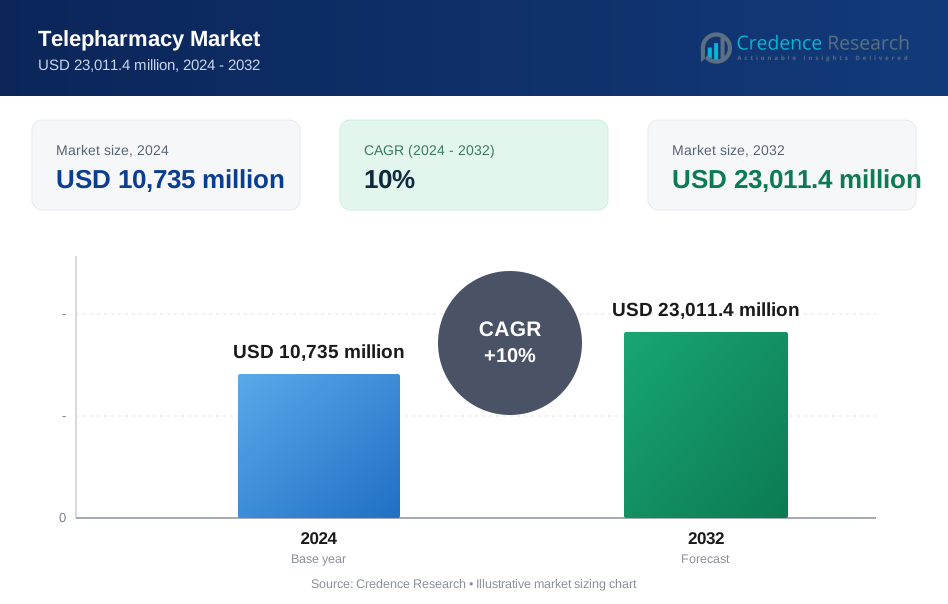
The Telepharmacy market is projected to grow from USD 10,735 million in 2024 to an estimated USD 23,011.4 million by 2032, with a compound annual growth rate (CAGR) of 10% from 2024 to 2032.
| REPORT ATTRIBUTE | DETAILS |
|---|---|
| Historical Period | 2019-2022 |
| Base Year | 2023 |
| Forecast Period | 2024-2032 |
| Telepharmacy Market Size 2024 | USD 10,735 million |
| Telepharmacy Market, CAGR | 10% |
| Telepharmacy Market Size 2032 | USD 23,011.4 million |
Rising demand for accessible pharmaceutical services, especially in rural and underserved areas, continues to drive the Telepharmacy market. Healthcare providers increasingly adopt telepharmacy platforms to reduce patient travel, ensure prescription accuracy, and improve medication adherence. The integration of advanced digital tools such as AI-based counseling, remote dispensing units, and real-time monitoring solutions further enhances operational efficiency. The shift toward value-based healthcare, coupled with increasing pharmacist shortages in remote areas, encourages hospitals and clinics to expand virtual pharmacy services to maintain care continuity and compliance with evolving healthcare regulations.
North America currently leads the telepharmacy market due to robust healthcare infrastructure, regulatory support, and high telemedicine adoption. Europe follows closely with strong digital health initiatives. Meanwhile, Asia-Pacific is emerging as a high-growth region, driven by expanding internet penetration, rising chronic disease burden, and government focus on rural healthcare accessibility. Countries such as India, China, and Indonesia are investing in telehealth frameworks, creating significant opportunities for telepharmacy expansion.
Market Insights:
- The Telepharmacy market was valued at USD 10,735 million in 2024 and is projected to reach USD 23,011.4 million by 2032, growing at a CAGR of 10% during the forecast period.
- Rising demand for remote pharmaceutical services in underserved areas drives widespread telepharmacy adoption across hospitals and small pharmacies.
- Increasing focus on chronic disease management and medication adherence supports long-term market expansion.
- Fragmented regulatory frameworks across regions and varying licensing requirements limit large-scale deployment.
- Infrastructure gaps, digital illiteracy, and limited connectivity in rural regions hinder adoption in developing economies.
- North America dominates the global market with over 41% share, supported by robust healthcare systems and regulatory support.
- Asia-Pacific emerges as the fastest-growing region, driven by public health investment, growing smartphone use, and expanding telehealth infrastructure.
Market Drivers:
Growing Need for Remote Medication Access in Underserved Regions Fuels Telepharmacy Adoption:
The rising healthcare disparity in rural and remote areas accelerates the demand for telepharmacy services. Many regions lack physical pharmacies or on-site pharmacists, which creates gaps in medication access and patient care. The Telepharmacy market addresses this challenge by enabling remote consultation, prescription, and dispensing. It allows hospitals and clinics to extend pharmacy coverage without expanding physical infrastructure. Patients benefit from quicker prescription fulfillment and improved medication adherence. Public health agencies increasingly support telepharmacy as part of rural health initiatives. The flexibility of telepharmacy platforms supports 24/7 service models, enhancing patient satisfaction. It strengthens continuity of care by connecting patients with licensed pharmacists on demand.
- For instance, the North Dakota Telepharmacy Project has served over 80,000 rural residents by linking remote pharmacy technicians with pharmacists via videoconferencing, enabling a 550% increase in on-call consultations within the first month of network implementation and reducing medication order entry time from 26.8 to 14 minutes per patient.
Integration of Digital Health Infrastructure Accelerates Virtual Pharmacy Expansion:
Healthcare systems are undergoing digital transformation, and pharmacy services form a critical component of that shift. Integration with EHRs (Electronic Health Records), clinical decision tools, and e-prescription platforms enhances the efficiency of telepharmacy operations. The Telepharmacy market gains momentum as hospitals and health networks adopt cloud-based solutions for medication management. Real-time data sharing allows for personalized care and improved monitoring. Pharmacists can detect potential drug interactions and ensure regulatory compliance more effectively. Governments and payers recognize the value of digitized pharmacy services, reinforcing reimbursement pathways. The growing focus on interoperability drives platform standardization and wider adoption. It ensures seamless workflows between healthcare providers and telepharmacists.
- For instance, a longitudinal study in California showed that telepharmacy integration with hospital EHRs cut medication verification cycles by up to 12 minutes per order and raised barcode technology usage to 97.7%, significantly improving safety and compliance in rural pharmaceuticals.
Increasing Focus on Chronic Disease Management Strengthens Telepharmacy Role:
Chronic diseases require long-term medication and continuous patient education. The Telepharmacy market supports this need by facilitating remote medication therapy management. Pharmacists use telepharmacy systems to guide patients on dosage, lifestyle impact, and side effects. It improves adherence and reduces hospital readmissions. Diabetes, hypertension, and cardiovascular conditions represent high-volume use cases. Telepharmacy also assists in monitoring prescription renewals and automated refills. With aging populations and rising chronic illness rates, demand for scalable pharmacy support continues to grow. Healthcare providers consider telepharmacy a critical pillar in chronic care models. It aligns with value-based care objectives by reducing costs and improving patient outcomes.
Pharmacist Shortages Drive Demand for Efficient Virtual Dispensing Models:
The global shortage of licensed pharmacists’ pressures healthcare systems to find alternatives. The Telepharmacy market helps address workforce constraints by allowing centralized pharmacists to serve multiple locations virtually. This model optimizes resource allocation without compromising service quality. Hospitals and retail chains deploy remote verification systems to manage prescription volumes efficiently. In disaster-hit or underserved regions, telepharmacy ensures uninterrupted access to essential medications. Automation tools such as robotic dispensing units further support productivity. It enables scalability without requiring on-site pharmacy staff. Healthcare administrators view telepharmacy as a sustainable staffing solution. It complements in-person services and fills geographic and operational gaps.
Market Trends:
Rising Adoption of AI-Powered Clinical Decision Support in Telepharmacy Platforms:
Telepharmacy providers are embedding AI tools to enhance pharmacist productivity and accuracy. Algorithms assist in identifying potential adverse drug interactions and medication errors. AI supports personalized dosing based on patient history and lab values. The Telepharmacy market sees increased demand for such intelligent systems, especially in high-volume or complex care environments. Pharmacists rely on AI to screen prescriptions efficiently. Predictive analytics also helps flag patients at risk of non-adherence. Real-time decision support minimizes consultation time and boosts workflow efficiency. It creates confidence among providers and regulators by improving patient safety. Integration with AI enhances the credibility and scalability of telepharmacy platforms.
- For instance, AI-powered platforms like those developed by Zipline Health reduced medication error rates through barcode scanning and algorithmic checks and cut order processing time by demonstrating considerable clinical decision support improvements.
Expansion of Home-Based Healthcare Services Elevates Demand for Virtual Pharmacy:
Home healthcare services are growing rapidly, driven by patient preference and cost-efficiency. The Telepharmacy market supports this shift by enabling medication access without in-person visits. Home care agencies integrate telepharmacy into their service models for real-time consultation and prescription support. Patients recovering from surgeries or managing chronic conditions benefit from doorstep medicine delivery backed by remote counseling. It supports elderly care, post-discharge follow-up, and palliative treatment. The trend reduces hospital dependency while ensuring continuous pharmaceutical care. Telepharmacy fits seamlessly into remote care ecosystems. It reinforces the homecare model by linking patients, pharmacists, and caregivers in real time.
- For instance, the University of Iowa Health Care’s TelePrEP program utilizes mHealth apps and telepharmacy to deliver and manage preventive HIV medications remotely, providing follow-up care calls that resulted in over 70% medication adherence rates sustained at six months among rural patients.
Pharmacy Chains and Health Systems Pursue Platform Consolidation and Centralization:
Large pharmacy networks and health systems seek to unify their digital pharmacy operations through central command centers. This trend strengthens the Telepharmacy market by promoting standardized practices and reduced duplication. Centralized models support consistent verification, audit compliance, and resource optimization. Retail chains deploy telepharmacy to serve satellite locations from one centralized hub. It enables uniformity in patient experience, medication counseling, and safety checks. Health systems leverage these setups to scale services without increasing physical presence. Cloud-based systems offer multi-location support with secured data exchange. Consolidation enhances operational control and data analytics. It ensures cohesive pharmacy performance across networks.
Growing Investments in Telepharmacy-Specific Regulatory Compliance and Security Frameworks:
Governments and health agencies recognize the need for clear telepharmacy regulations. The Telepharmacy market evolves alongside emerging compliance mandates around data protection, patient identity verification, and secure prescription transfer. Providers adopt encrypted communication tools and audit-ready documentation systems. Regulators issue state- or country-specific licenses and guidelines. Security and legal frameworks build public and professional trust in remote pharmacy models. Stakeholders invest in HIPAA, GDPR, and HITECH-compliant technologies. Cybersecurity upgrades form part of digital pharmacy expansion plans. Policymakers focus on ensuring equity in digital health access. Regulatory clarity drives formal adoption by hospitals, retail chains, and insurers.
Market Challenges Analysis:
Fragmented Regulatory Landscape and Limited Uniformity in Licensing Requirements:
One of the most significant barriers in the Telepharmacy market remains regulatory inconsistency. Different states or countries impose varying licensure, supervision, and practice requirements for remote pharmacy services. This fragmentation complicates scalability for providers aiming to operate across multiple regions. Startups and enterprises often face administrative hurdles in aligning with multiple standards. It leads to delays in service deployment and increases compliance costs. Healthcare institutions hesitate to fully integrate telepharmacy without regulatory clarity. Legal ambiguity limits investor confidence and cross-border partnerships. Harmonization of telepharmacy laws remains a work in progress. It remains a roadblock to widespread implementation and innovation.
Technological Infrastructure Gaps and Digital Literacy Barriers Affect Rural Uptake:
Despite its benefits, telepharmacy adoption faces obstacles in areas with weak digital infrastructure. Limited broadband access, outdated devices, or unreliable power supply hinder consistent usage. Patients may lack the digital literacy to interact effectively with virtual platforms. The Telepharmacy market must navigate these gaps through simplified interfaces and offline-support solutions. Elderly or low-income populations often require assistance in using telepharmacy tools. Language barriers and accessibility features remain underdeveloped in some platforms. Service providers must invest in training, education, and infrastructure partnerships. Without inclusive technology strategies, telepharmacy risks widening healthcare inequality. These challenges restrict full market penetration in high-need areas.
Market Opportunities:
Expansion of Government-Funded Rural Health Programs Creates New Avenues:
Public healthcare agencies across several countries are increasing investments in rural health access. The Telepharmacy market benefits from inclusion in national telemedicine frameworks and pilot projects. Governments fund remote dispensing kiosks, pharmacist training, and patient education programs. These initiatives support long-term infrastructure growth in underserved areas. Public-private partnerships emerge to operationalize telepharmacy in community clinics. Policy incentives reduce setup costs for providers. Expanded reimbursement policies encourage provider participation. These government-led programs position telepharmacy as a vital rural care enabler.
Growing Demand from Specialty Care and Mental Health Services Opens New Niches:
Specialty care areas such as oncology, psychiatry, and endocrinology increasingly require customized medication guidance. The Telepharmacy market gains traction in supporting complex prescription workflows. Mental health patients benefit from discreet, accessible pharmaceutical counseling. Pharmacists assist with side-effect management, therapy compliance, and medication switching. Providers explore niche offerings such as telepsychiatry-linked pharmacy services. This demand creates new verticals within the market. Telepharmacy platforms tailor services to suit condition-specific protocols. These specialized segments offer higher margins and sustained engagement.
Market Segmentation Analysis:
By Type
The Telepharmacy market includes four key types: Inpatient, Remote Dispensing, IV Admixture, and Remote Counseling. Among these, remote dispensing leads the segment due to its widespread implementation in rural clinics and satellite healthcare facilities. Remote counseling is gaining momentum with the increasing need for patient engagement and virtual pharmacist interactions. IV admixture supports critical care environments, while inpatient telepharmacy aids in improving workflow in hospitals with limited pharmacy staff.
- For instance, telepharmacy networks in rural North Carolina expanded remote counseling services during the COVID-19 pandemic and recorded a 65% increase in patient engagement via live video consultations for medication management, significantly improving the quality of pharmaceutical care.
By Component
The market is divided into Hardware and Software. Software dominates, driven by increased demand for interoperable, cloud-enabled pharmacy systems that offer prescription tracking, verification, and real-time pharmacist access. Hardware supports essential dispensing, communication, and monitoring infrastructure required in institutional and remote setups.
By Delivery Mode
Cloud-based telepharmacy solutions lead the delivery mode segment due to ease of deployment, scalability, and cost-efficiency. Web-based platforms are preferred by mid-sized pharmacies, while on-premises systems serve large hospitals with strict data control policies.
By Devices
Key devices include Computers, Smartphones, Tablets, and Kiosks. Computers and smartphones dominate due to their role in core telepharmacy operations. Tablets offer flexibility for mobile use in clinics, while kiosks support patient interaction in military and public health environments.
By Application/End-User
Major end users include Hospitals, Small Pharmacies, Nursing Homes, Prisons, Military Bases, and Warships. Hospitals and small pharmacies lead adoption, followed by institutional users seeking secure, remote pharmaceutical support. The Telepharmacy market continues to evolve across all segments to meet diverse care delivery needs.
Segmentation:
By Type:- Inpatient
- Remote Dispensing
- IV Admixture
- Remote Counseling
- Hardware
- Software
- On-premises
- Web-based
- Cloud-based
- Computers
- Smartphones
- Tablets
- Kiosks
- Hospitals
- Small Pharmacies
- Nursing Homes
- Prisons
- Military Bases
- Warships
By Region:
- North America
- U.S.
- Canada
- Mexico
- Europe
- Germany
- France
- U.K.
- Italy
- Spain
- Rest of Europe
- Asia Pacific
- China
- Japan
- India
- South Korea
- South-east Asia
- Rest of Asia Pacific
- Latin America
- Brazil
- Argentina
- Rest of Latin America
- Middle East & Africa
- GCC Countries
- South Africa
- Rest of the Middle East and Africa
Regional Analysis:
North America Leads with Strong Infrastructure and High Adoption
North America holds the largest share of the Telepharmacy market, accounting for 41.2% of the global market in 2024. The region benefits from advanced healthcare infrastructure, widespread internet access, and high acceptance of telehealth solutions. Regulatory frameworks in the United States and Canada support virtual pharmacy models, encouraging hospitals and retail chains to invest in telepharmacy platforms. The shortage of pharmacists in rural areas further drives demand. Major players such as McKesson Ventures, CVS Health, and Cardinal Health operate from this region, contributing to innovation and implementation at scale. North America continues to lead in reimbursement policy adoption and integration of AI in telepharmacy systems.
Europe Maintains Steady Growth with Emphasis on Digital Health
Europe accounts for 27.8% of the global Telepharmacy market in 2024. Countries like Germany, the United Kingdom, and the Netherlands are at the forefront of digital health integration, promoting secure electronic prescriptions and cross-border telepharmacy pilots. The European Union has initiated frameworks to streamline telehealth across member states, creating a more unified approach to virtual pharmaceutical care. Hospitals and outpatient clinics implement telepharmacy to increase operational efficiency and improve patient outcomes. Language diversity and data protection regulations influence platform design and deployment. The region’s focus on patient safety and workflow automation supports consistent adoption across public and private sectors.
Asia-Pacific Emerges as the Fastest-Growing Region
Asia-Pacific represents 21.3% of the global Telepharmacy market in 2024, driven by expanding healthcare access, digital infrastructure improvements, and a growing middle class. Countries such as India, China, and Indonesia are investing in nationwide telemedicine programs that include pharmacy services. Rural and semi-urban populations depend on mobile-based platforms for pharmaceutical consultations and medicine delivery. Government initiatives and rising smartphone penetration create a favorable environment for telepharmacy growth. Local players and startups partner with public health agencies to extend virtual care coverage. The region is expected to gain market share rapidly due to its scale, unmet healthcare needs, and technology adoption.
Key Player Analysis:
- PipelineRx
- McKesson Ventures
- AMN Healthcare
- TelePharm
- Cardinal Health
- Cerner Corporation
- Cisco Systems, Inc.
- Aspen RxHealth
- Medly Pharmacy
- Teladoc Health
- Comprehensive Pharmacy Services (CPS)
- Pharmacy Automation Systems
- MedTel Services
- Pharmalink
- CVS Health
Competitive Analysis:
The Telepharmacy market is highly competitive, featuring a mix of healthcare IT vendors, pharmacy service providers, and virtual care platforms. Leading companies such as PipelineRx, TelePharm, Cardinal Health, Cisco, and Cerner Corporation focus on expanding their telepharmacy infrastructure, integrating advanced software platforms, and offering end-to-end virtual dispensing services. These players emphasize regulatory compliance, security features, and EHR integration to enhance reliability and performance. New entrants and startups concentrate on niche services such as remote counseling and mobile-friendly platforms. The market sees a steady stream of product upgrades and service partnerships aimed at expanding rural reach and improving medication adherence. It continues to evolve through innovation and strategic collaborations.
Recent Developments:
- In McKesson Ventures (McKesson Corporation) - on July 15, 2025, McKesson introduced new and refreshed solutions for community pharmacies at its ideaShare event. This included launching the Vaccine Optimization Solution and integrating Pinpoint Community Solutions™-an inventory-management feature-into its McKesson Connect ordering portal.
- In June 2023, Cardinal Health announced a merger of its Outcomes™ business into Transaction Data Systems, though no recent acquisition or product launch specifically linked to telepharmacy was noted.
Market Concentration & Characteristics:
The Telepharmacy market displays moderate to high concentration, with key players controlling significant market share through integrated service offerings and robust distribution networks. It is characterized by rapid technological innovation, regulatory-driven adoption, and growing demand in underserved areas. Cloud infrastructure, mobile device compatibility, and interoperability define successful solutions. It remains attractive for new entrants due to scalable business models and evolving public health needs.
Report Coverage:
The research report offers an in-depth analysis based on ype, Component, Delivery Mode, Devices, and Application/End-User segments. It details leading market players, providing an overview of their business, product offerings, investments, revenue streams, and key applications. Additionally, the report includes insights into the competitive environment, SWOT analysis, current market trends, as well as the primary drivers and constraints. Furthermore, it discusses various factors that have driven market expansion in recent years. The report also explores market dynamics, regulatory scenarios, and technological advancements that are shaping the industry. It assesses the impact of external factors and global economic changes on market growth. Lastly, it provides strategic recommendations for new entrants and established companies to navigate the complexities of the market.
Future Outlook:
- Cloud-based deployment models will see wider adoption among hospitals and retail chains.
- Remote dispensing and counseling services will expand across rural and underserved regions.
- AI integration will enhance medication review, patient adherence, and clinical decision-making.
- Strategic partnerships will drive platform innovation and regional expansion.
- Telepharmacy regulations will continue to evolve, improving reimbursement and compliance.
- Mobile-first solutions will support growing demand among tech-savvy and aging populations.
- Cross-border telepharmacy models will emerge, especially in the EU and APAC.
- Demand from mental health and chronic disease care will open niche service segments.
- Cybersecurity and data integrity will remain central to platform development.
- New entrants will leverage modular and cost-effective solutions to disrupt legacy models.
Request a Free Sample
Fill in your details and we'll send you a free sample report.
- Sample data tables & charts
- Research methodology
Need a Custom Version of This Report?
Tailor the scope, geography, or segments to your exact requirements.
- Custom geography or segment scope
- Direct access to our analyst team
Frequently Asked Questions
What is the current market size for Telepharmacy market, and what is its projected size in 2032?
At what Compound Annual Growth Rate is the Telepharmacy market projected to grow between 2025 and 2032?
Which Telepharmacy market segment held the largest share in 2024?
Which region commanded the largest share of the Telepharmacy market in 2024?
Table of Content
Chapter 1. Report Introduction
- 1.1 Report Description & Purpose
- 1.1.1 Report Title & Market Definition
- 1.1.2 Unique Selling Propositions (USP) & Key Differentiators
- 1.1.3 Value Proposition for Stakeholders
- 1.2 Research Objectives
- 1.2.1 Market Sizing Objectives (Volume & Revenue) (Volume Where Applicable)
- 1.2.2 Segmentation Objectives
- 1.2.3 Competitive Intelligence Objectives
- 1.2.4 Forecast & Scenario Objectives
- 1.3 Report Scope
- 1.3.1 Telepharmacy Scope – Segments & Subsegments Covered
- 1.3.2 Geographic Scope – Regions & Countries Covered
- 1.3.3 Historical Period, Base Year & Forecast Period (2024; forecast to 2032)
- 1.3.4 Inclusions & Exclusions
- 1.4 Industry Classification & Applicable Codes
- 1.5 Currency, Measurement Units & Valuation Basis
- 1.6 Target Stakeholders
- 1.7 Limitations & Assumptions
Chapter 2. Executive Summary
- 2.1 Global Telepharmacy Market Snapshot
- 2.1.1 Market Size – Historical (2024) & Forecast (2024-2032) (2024: USD 10,735 million → 2032: USD 23,011.4 million)
- 2.1.2 Volume & Revenue – Global Totals (Volume Where Applicable)
- 2.1.3 Key Market Highlights – Top Five Facts
- 2.2 Telepharmacy Market Segmentation Snapshot
- 2.2.1 Market Split by Region – 2024 vs. 2032
- 2.3 Competitive Snapshot
- 2.3.1 Top 10 Players by Revenue Share – 2024
- 2.3.2 Top 10 Players by Volume Share – 2024 (Volume Where Applicable)
- 2.3.3 Recent Strategic Developments (18-Month Summary)
- 2.4 Key Investment Highlights & Strategic Conclusions
Chapter 3. Telepharmacy Market Dynamics & Industry Analysis
- 3.1 Market Overview & Context
- 3.1.1 Telepharmacy Market Position in the Broader Industry Value Chain
- 3.1.2 Demand Structure & Purchasing Dynamics
- 3.1.3 Market Maturity & Development Stage by Region
- 3.2 Telepharmacy Market Drivers
- 3.3 Telepharmacy Market Restraints & Challenges
- 3.4 Telepharmacy Market Opportunities
- 3.5 Porter's Five Forces Analysis
- 3.5.1 Threat of New Entrants
- 3.5.2 Bargaining Power of Suppliers
- 3.5.3 Bargaining Power of Buyers
- 3.5.4 Threat of Substitutes
- 3.5.5 Competitive Rivalry – Intensity Assessment
- 3.6 Telepharmacy Value Chain Analysis
- 3.6.1 Upstream – Key Inputs, Resources & Suppliers
- 3.6.1.1 Key Input/Resource 1
- 3.6.1.2 Key Input/Resource 2
- 3.6.1.3 Key Input/Resource 3
- 3.6.2 Midstream – Core Operations & Value Creation
- 3.6.2.1 Operating Model & Process Overview
- 3.6.2.2 Key Operating Locations & Capabilities by Company
- 3.6.3 Downstream – Market Channels & End Users
- 3.6.3.1 Direct Sales & Customer Engagement Channels
- 3.6.3.2 Indirect Sales, Intermediaries & Partner Channels
- 3.6.4 Value Chain Profitability Analysis
- 3.6.1 Upstream – Key Inputs, Resources & Suppliers
- 3.7 PESTEL Analysis
- 3.7.1 Political Factors
- 3.7.2 Economic Factors
- 3.7.3 Social Factors
- 3.7.4 Technological Factors
- 3.7.5 Environmental Factors
- 3.7.6 Legal Factors
- 3.8 Telepharmacy Supply Chain Analysis
- 3.8.1 Critical Input & Resource Availability Risk Assessment
- 3.8.2 Supplier & Operational Concentration Risk (Geographic Exposure)
- 3.8.3 Supply & Service Disruption Impact Analysis
- 3.9 Regulatory & Policy Landscape
Note: The regulatory and policy landscape section covers regulations based on their applicability to the market, Telepharmacy category, geography, and scope of the study. Only regulatory frameworks with a material impact on operations, compliance, trade, sustainability, or market access are analyzed in detail.
Chapter 4. Key Investment Pockets & Opportunity Analysis
- 4.1 Telepharmacy Market Attractiveness Analysis
- 4.1.1 By Region – Investment Attractiveness Matrix (Market Size × CAGR)
- 4.2 Absolute Revenue Growth Opportunity
- 4.2.1 By Region – Absolute Revenue Growth Through 2032
- 4.3 Incremental Demand Opportunity
- 4.3.1 By Region – Incremental Demand Through 2032
- 4.3.2 Segment – Incremental Demand
- 4.4 Emerging Submarket Opportunity Deep Dive (Subject to Applicability)
- 4.5 Priority Market Opportunity Scorecards
- 4.5.1 United States
- 4.5.2 Europe
- 4.5.3 Asia
- 4.5.4 Middle East & Africa
Note: Priority market opportunity scorecards reflect the geographic scope and strategic relevance of the study. Listed markets are indicative and may be adapted to the industry.
Chapter 5. Telepharmacy Cross-Border Trade & Market Access Analysis
- 5.1 International Trade & Cross-Border Activity Overview
- 5.1.1 Global Export Value by Country (2024)
- 5.1.2 Global Export Volume by Country (2024) (Volume Where Applicable)
- 5.1.3 Global Import Value by Country (2024)
- 5.1.4 Global Import Volume by Country (2024) (Volume Where Applicable)
- 5.1.5 Net Trade Balance by Country (2024)
- 5.2 Export Analysis – Segment
- 5.2.1 Category 1 (Applicable Classification Code)
- 5.2.2 Category 2 (Applicable Classification Code)
- 5.2.3 Category 3 (Applicable Classification Code)
- 5.2.4 Category 4 (Applicable Classification Code)
- 5.2.5 Category 5 (Applicable Classification Code)
- 5.3 Import Analysis – Segment
- 5.3.1 Category 1 (Applicable Classification Code)
- 5.3.2 Category 2 (Applicable Classification Code)
- 5.3.3 Category 3 (Applicable Classification Code)
- 5.3.4 Category 4 (Applicable Classification Code)
- 5.3.5 Category 5 (Applicable Classification Code)
- 5.4 Cross-Border Pricing & Transaction Benchmarks
- 5.4.1 Export Pricing – Segment & Country
- 5.4.2 Import Pricing – Segment & Source Country
- 5.4.3 Price Trends (2024)
- 5.5 Key Cross-Border Trade & Delivery Routes
- 5.5.1 Cross-Border Trade/Delivery Route 1
- 5.5.2 Cross-Border Trade/Delivery Route 2
- 5.5.3 Cross-Border Trade/Delivery Route 3
- 5.5.4 Cross-Border Trade/Delivery Route 4
- 5.5.5 Cross-Border Trade/Delivery Route 5
- 5.6 Trade Policy & Market Access Impact Assessment
- 5.6.1 Tariff & Non-Tariff Barriers
- 5.6.2 Regional Trade & Economic Integration Frameworks
- 5.6.3 Bilateral & Multilateral Trade Agreements
- 5.6.4 Cross-Border Operating, Licensing & Localization Requirements
Note: This chapter applies where cross-border trade or delivery is relevant to Telepharmacy. Goods, services, and digital offerings are assessed using applicable classifications and transaction measures. Import-export volumes, trade balances, and route analyses are included only where meaningful to the market.
Chapter 6. Competitive Landscape & Company Benchmarking
- 6.1 Telepharmacy Market Concentration & Structure
- 6.1.1 Herfindahl-Hirschman Index (HHI) – vs. 2024
- 6.1.2 Leading, Mid-Sized & Emerging Player Structure
- 6.1.3 Global, Regional & Local Player Dynamics
- 6.2 Telepharmacy Market Share Analysis – 2024
- 6.2.1 Global Revenue Share by Company
- 6.2.2 Global Volume Share by Company (Volume Where Applicable)
- 6.2.3 Regional Revenue Share
- 6.2.4 Market Share Evolution ( vs. 2024)
- 6.2.5 Company Market Share by Key Segment
- 6.2.6 Company Market Share by Customer Group
- 6.3 Operating Scale, Capacity & Infrastructure Analysis
- 6.3.1 Global Operating Scale & Supply Capacity
- 6.3.2 Resource Utilization & Operating Efficiency
- 6.3.3 Output, Service Delivery & Activity Metrics
- 6.3.4 Operating Footprint & Infrastructure Map
- 6.3.5 Planned Operational & Capacity Expansion
- 6.4 Telepharmacy Competitive Benchmarking Matrix
- 6.4.1 Revenue, Growth, Profitability & Operating Metric Comparison
- 6.4.2 Channel Revenue Mix
- 6.4.3 Geographic Revenue Exposure
- 6.4.4 R&D Intensity
- 6.4.5 Sustainability Maturity
- 6.5 Strategic Developments in Telepharmacy (Last 24 Months)
- 6.5.1 Mergers, Acquisitions & Divestments
- 6.5.2 New Products, Services & Solutions in Telepharmacy
- 6.5.3 Operational & Infrastructure Expansions
- 6.5.4 Strategic Alliances, Joint Ventures & Partnerships
- 6.5.5 Distribution Expansion & Market Entry
- 6.5.6 Sustainability & ESG Initiatives
- 6.6 Competitive Strategy Mapping
- 6.6.1 Leader, Challenger, Follower & Niche Classification
- 6.6.2 Pricing Strategy Comparison
- 6.6.3 Channel Strategy Matrix
Note: Strategic developments are included based on their materiality and the availability of reliable information.
Chapter 7. Global Telepharmacy Market – By Sales & Delivery Channel
- 7.1 Segment Overview
- 7.1.1 Volume & Revenue Split by Channel (2024 & 2032) (Volume Where Applicable)
- 7.1.2 Channel Mix Evolution (2024-2032)
Chapter 8. Regional Market Analysis – Global Overview
- 8.1 Global Regional Overview
- 8.1.1 Regional Volume Share (Volume Where Applicable)
- 8.1.2 Regional Revenue Share
- 8.1.3 Regional Volume by Region (Volume Where Applicable)
- 8.1.4 Regional Revenue by Region
- 8.1.5 Regional Forecast Through 2032
- 8.2 Cross-Regional Segment Analysis
- 8.2.1 By Sales & Delivery Channel
- 8.2.2 By Competitive Positioning & Price Tier
Chapter 9. North America Telepharmacy Market
- 9.1 United States
- 9.2 Canada
- 9.3 Mexico
Chapter 10. Europe Telepharmacy Market
- 10.1 Germany
- 10.2 France
- 10.3 Italy
- 10.4 United Kingdom
- 10.5 Spain
- 10.6 Poland
- 10.7 Russia
- 10.8 Netherlands
- 10.9 Belgium
- 10.10 Sweden
- 10.11 Denmark
- 10.12 Norway
- 10.13 Rest of Europe
Chapter 11. Asia Pacific Telepharmacy Market
- 11.1 China
- 11.2 India
- 11.3 Japan
- 11.4 South Korea
- 11.5 Thailand
- 11.6 Indonesia
- 11.7 Vietnam
- 11.8 Malaysia
- 11.9 Australia
- 11.10 Rest of Asia Pacific
Chapter 12. Latin America Telepharmacy Market
- 12.1 Brazil
- 12.2 Argentina
- 12.3 Colombia
- 12.4 Chile
- 12.5 Rest of Latin America
Chapter 13. Middle East Telepharmacy Market
- 13.1 Saudi Arabia
- 13.2 United Arab Emirates
- 13.3 Turkey
- 13.4 Israel
- 13.5 Iran
- 13.6 Rest of the Middle East
Chapter 14. Africa Telepharmacy Market
- 14.1 South Africa
- 14.2 Egypt
- 14.3 Nigeria
- 14.4 Morocco
- 14.5 Rest of Africa
Chapter 15. Telepharmacy Company Profiles
- 15.1 [Company 01]
- 15.1.1 Company Overview
- 15.1.2 Key Management Personnel
- 15.1.3 Products & Services Portfolio
- 15.1.4 Financial Performance
- 15.1.5 Key Market Focus & Geographic Presence
- 15.1.6 Recent Developments & Strategic Initiatives
Note: The company profile list is preliminary and may change based on research findings, market developments, data availability, and client requirements.
Chapter 16. Appendices
- Appendix A – List of Abbreviations & Acronyms
- Appendix B – Industry Classification Code Reference – Full Series
- Appendix C – Supply, Output & Operating Capacity Data Tables
- Appendix D – End-Use & Demand Base Tables
- Appendix E – Demand, Adoption & Usage Assumptions
- Appendix F – Pricing & Revenue Metric Reference Tables
- Appendix G – Company Operations & Infrastructure Database
- Appendix H – Cross-Border Trade & Activity Data Tables (Where Applicable)
- Appendix I – Regulatory Summary Tables
- Appendix J – Primary Research Participant List (Anonymized)
- Appendix K – Primary Research Questionnaire Framework
- Appendix L – Data Sources & Bibliography
- Appendix M – Market Size Divergence & Source Comparison
Chapter 17. Research Methodology
- 17.1 Research Framework & Philosophy
- 17.2 Secondary Research – Sources, Hierarchy & Data Extraction
- 17.3 Data Modeling – Bottom-Up & Top-Down Market Sizing
- 17.4 Primary Research – Stakeholder Framework, LOI & Sample Sizes
- 17.5 Forecast Methodology – Regression, Scenario & Sensitivity Analysis
- 17.6 Quality Control – Four-Layer Validation Framework
- 17.7 Limitations & Standard Assumptions
- 17.8 Disclaimer
