
Market Overview
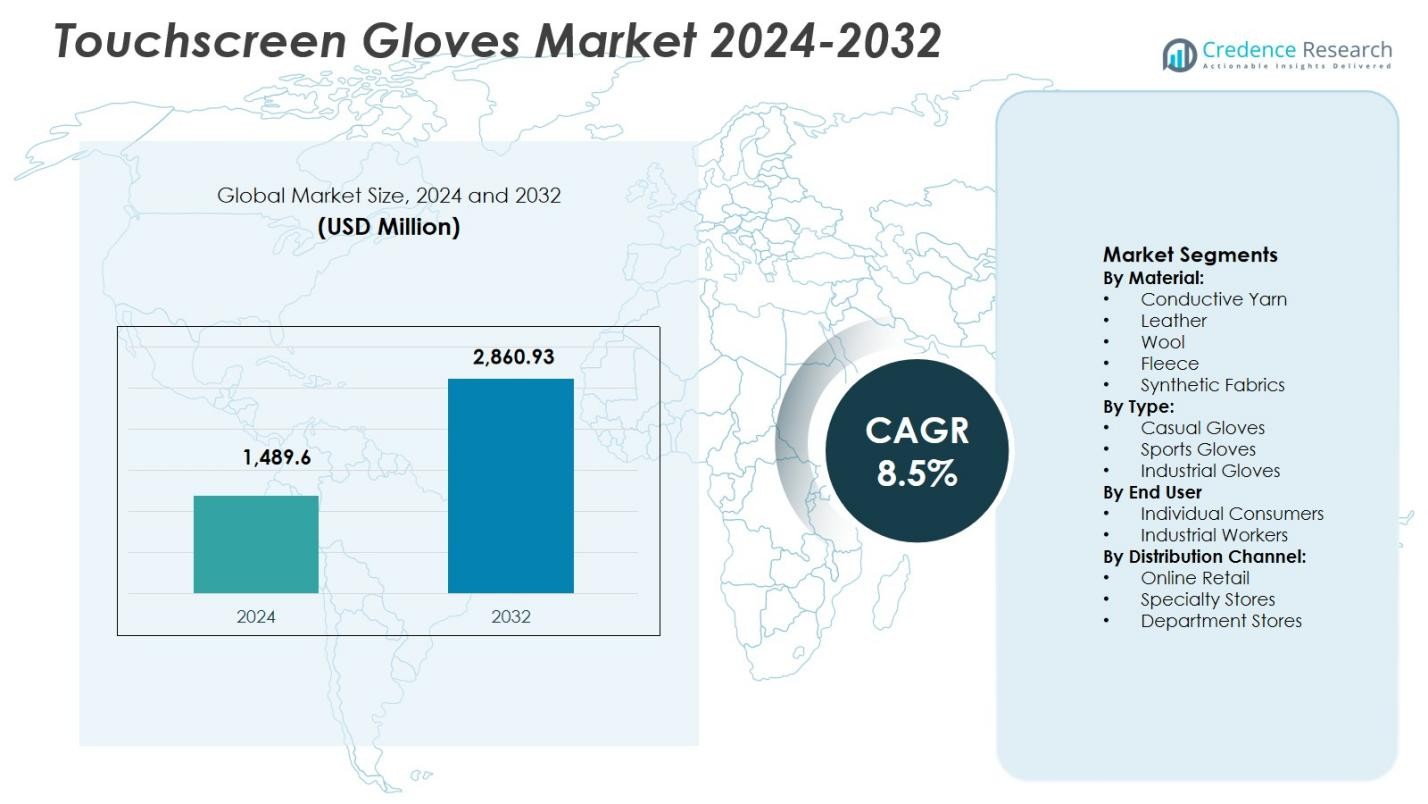
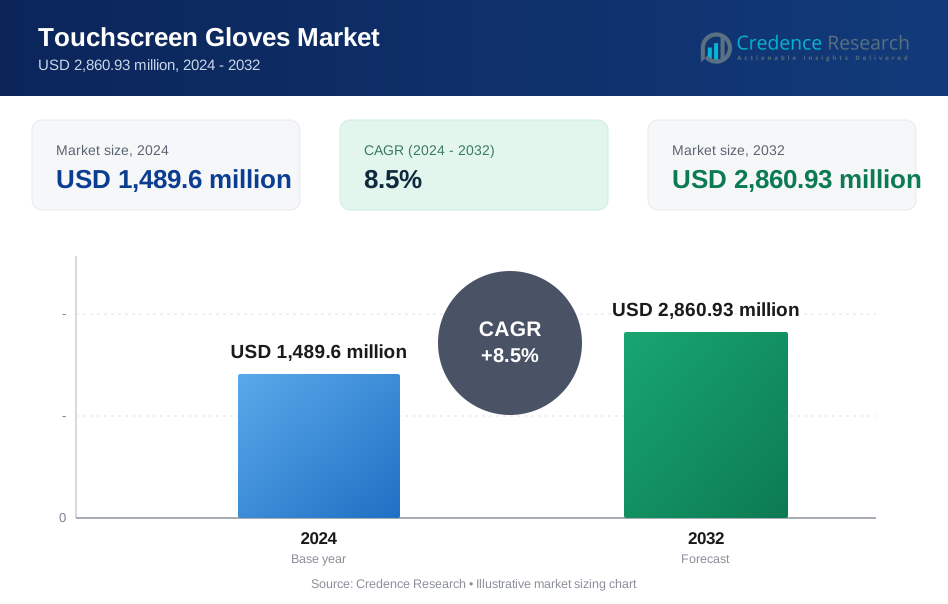
The Touchscreen Gloves Market size was valued at USD 1,489.6 million in 2024 and is anticipated to reach USD 2,860.93 million by 2032, growing at a CAGR of 8.5% during the forecast period.
| REPORT ATTRIBUTE | DETAILS |
|---|---|
| Historical Period | 2020-2023 |
| Base Year | 2024 |
| Forecast Period | 2025-2032 |
| Touchscreen Gloves Market Size 2024 | USD 1,489.6 Million |
| Touchscreen Gloves Market, CAGR | 8.5% |
| Touchscreen Gloves Market Size 2032 | USD 2,860.93 Million |
Touchscreen Gloves Market is shaped by the presence of established apparel, outdoor, and accessory brands such as The North Face, Columbia Sportswear, Nike, Adidas, Under Armour, Black Diamond Equipment, Carhartt, Mujjo, Moshi, and Agloves, which focus on material innovation, ergonomic design, and enhanced touch sensitivity. These companies leverage advanced conductive yarns, hybrid fabrics, and performance-oriented features to address casual, sports, and industrial demand. Strong brand recognition, diversified product portfolios, and expanding e-commerce channels support their market positioning. Regionally, North America leads the Touchscreen Gloves Market with a 34.8% share in 2024, driven by high smartphone penetration, strong outdoor sports participation, and widespread adoption of touch-enabled devices across consumer and industrial applications.
Market Insights
- Touchscreen Gloves Market was valued at USD 1,489.6 million in 2024 and is projected to grow at a CAGR of 8.5% during the forecast period, supported by rising demand across consumer and industrial applications.
- Market growth is driven by increasing smartphone and wearable device usage, along with expanding outdoor sports participation and industrial digitization requiring glove-based touchscreen interaction.
- Key trends include adoption of advanced conductive yarns and hybrid fabrics, with the conductive yarn material segment leading at 38.6% share and casual gloves dominating the type segment with 44.8% share.
- Market structure reflects strong brand-led participation, with companies focusing on product innovation, durability, and multi-touch accuracy to strengthen positioning across casual, sports, and industrial segments.
- Regionally, North America leads with 34.8% share, followed by Europe at 28.6% and Asia-Pacific at 24.1%, while Latin America and Middle East & Africa contribute steady growth through industrial and commercial demand.
Market Segmentation Analysis:
By Material:
The Touchscreen Gloves Market by material is led by conductive yarn, which accounted for 38.6% market share in 2024. Conductive yarn dominates due to its superior touch sensitivity, durability, and seamless integration into both lightweight and insulated gloves. Manufacturers widely prefer conductive yarn as it enables multi-touch compatibility without compromising comfort or flexibility. Strong demand from consumer electronics users and outdoor sports enthusiasts further supports growth. Leather followed with 21.4% share, driven by premium appeal, while synthetic fabrics gained traction due to cost efficiency and scalability in mass production.
- For instance, Ejendals incorporates conductive material into the fingertips of its TEGERA 8820 and 8821 dipped gloves, mimicking skin conductivity for reliable capacitive touchscreen interaction.
By Type:
By type, casual gloves held the dominant position with a 44.8% market share in 2024. Their leadership is driven by widespread everyday smartphone usage, increasing cold-climate urban populations, and rising preference for fashion-integrated functional accessories. Casual gloves offer a balance of affordability, aesthetics, and touchscreen responsiveness, making them suitable for daily commuting and leisure use. Sports gloves captured 31.6% share, supported by outdoor and fitness activities, while industrial gloves expanded steadily due to workplace digitization and growing adoption of touch-enabled industrial equipment.
- For instance, Glider Gloves offers insulated touchscreen-compatible models designed for texting in cold weather, integrating conductive fibers to maintain warmth without removing them.
By End User:
In terms of end users, individual consumers dominated the Touchscreen Gloves Market with a 67.9% share in 2024. This segment benefits from rising smartphone penetration, growing adoption of wearable technology, and increasing demand for cold-weather accessories compatible with touchscreens. E-commerce expansion and frequent product innovation further reinforce consumer demand. Industrial workers accounted for 32.1% share, driven by increased use of touch-operated machinery, handheld scanners, and digital control panels across manufacturing, logistics, and construction environments requiring protective yet functional gloves.
Key Growth Drivers
Rising Smartphone and Wearable Device Usage
The growing dependence on smartphones, tablets, and wearable devices is a major driver of the Touchscreen Gloves Market. Consumers increasingly seek uninterrupted device interaction in cold or outdoor environments, boosting demand for touchscreen-compatible gloves. Expanding use of mobile payments, navigation apps, fitness tracking, and remote communication strengthens daily touchscreen engagement. This behavior supports steady replacement demand and encourages manufacturers to enhance conductive materials for improved accuracy and durability. Rising smartphone penetration across urban and cold-climate regions continues to sustain long-term market growth.
- For instance, Superior Glove's Dexterity PS18TAWPUE features TenActiv engineered yarn for 360° ANSI A4 cut protection and a polyurethane palm coating that enables touchscreen compatibility with a bare-hand feel.
Expansion of Outdoor Sports and Recreational Activities
Increasing participation in outdoor sports and recreational activities strongly supports growth in the Touchscreen Gloves Market. Activities such as skiing, hiking, cycling, and winter running require frequent interaction with GPS devices, smartphones, and smartwatches. Adventure tourism and fitness-focused lifestyles further increase demand for gloves offering grip, insulation, and moisture resistance alongside touchscreen functionality. Manufacturers respond with sport-specific designs and performance-enhancing features, enabling product differentiation, premium pricing, and broader adoption across active consumer segments.
- For instance, Agloves' Original Sport model weaves 15% silver yarn throughout for whole-hand conductivity on capacitive screens, delivering antimicrobial properties and a breathable knit that fits hands measuring 6.5 to 7.5 inches around for versatile use in running or hiking.
Digital Transformation Across Industrial Work Environments
The accelerating digitalization of industrial operations is driving adoption of touchscreen gloves among industrial workers. Logistics, manufacturing, construction, and warehousing sectors increasingly use touch-enabled scanners, tablets, and control systems. Removing gloves to operate devices reduces productivity and safety, creating strong demand for durable touchscreen-compatible protective gloves. Workplace safety regulations and automation investments further support this trend. As industrial environments adopt smart technologies, demand for rugged, high-performance touchscreen gloves continues to rise.
Key Trends and Opportunities
Advancements in Conductive and Hybrid Materials
Ongoing innovation in conductive yarns, coatings, and hybrid fabrics represents a major trend in the Touchscreen Gloves Market. Manufacturers are developing materials that maintain multi-touch accuracy while improving thermal insulation, wash durability, and wear resistance. These advancements enable broader application across casual, sports, and industrial segments. Integration of antimicrobial finishes and sustainable materials further enhances product appeal, allowing brands to differentiate offerings and capture higher value segments.
- For instance, Ironclad Performance Wear infused abrasion-resistant synthetic leather with conductive carbon ions in their Command Series gloves.
Growth of E-commerce and Product Customization
The rapid expansion of e-commerce platforms creates significant opportunities for touchscreen glove manufacturers. Online channels improve global reach, reduce distribution costs, and support direct-to-consumer strategies. Brands increasingly offer customization options such as insulation levels, sizes, colors, and sensitivity settings to improve customer engagement. Digital marketing and data-driven personalization enhance conversion rates, enabling companies to strengthen brand loyalty and accelerate market penetration.
- For instance, Qingdao Snell Protective Products Co., Ltd. provides factory-direct touchscreen gloves through its e-commerce platform, offering customization like logo printing, color matching, and material adjustments such as nitrile or PU coatings for varied sensitivity.
Key Challenges
Maintaining Performance in Extreme Conditions
Ensuring consistent touchscreen responsiveness in extreme cold, wet, or rugged environments remains a critical challenge. Conductive materials may lose sensitivity when combined with heavy insulation or exposed to moisture and abrasion. Outdoor and industrial users demand reliable performance under harsh conditions, increasing design complexity. Balancing warmth, durability, protection, and touch accuracy raises production costs and slows innovation, limiting scalability in demanding applications.
Intense Price Competition and Limited Differentiation
The Touchscreen Gloves Market faces strong price competition due to the availability of low-cost products with basic touchscreen functionality. As touchscreen capability becomes a standard feature, differentiation based solely on touch sensitivity becomes difficult. Manufacturers must invest in material innovation, design, and branding to justify premium pricing. These investments pressure margins and create challenges for scaling operations in price-sensitive consumer markets.
Regional Analysis
North America
North America held a 34.8% market share in 2024 in the Touchscreen Gloves Market, driven by high smartphone penetration, strong adoption of wearable devices, and widespread participation in outdoor and winter sports. The region benefits from advanced retail infrastructure and strong presence of premium brands offering technologically advanced gloves. Industrial usage across logistics, construction, and warehousing further supports demand, as touch-enabled devices are integral to daily operations. Cold-weather conditions in the U.S. and Canada sustain seasonal demand, while growing preference for performance-oriented and branded accessories continues to reinforce regional market leadership.
Europe
Europe accounted for a 28.6% market share in 2024, supported by cold climatic conditions, high urban mobility, and strong demand for functional winter accessories. Countries such as Germany, the UK, France, and the Nordic nations drive consumption due to extensive smartphone usage during outdoor commuting. Sustainability-focused consumer behavior also encourages adoption of durable and premium touchscreen gloves. The region shows strong demand from cycling, skiing, and outdoor recreation segments. Additionally, industrial digitization across manufacturing and logistics sectors contributes to steady growth in professional-grade touchscreen gloves.
Asia-Pacific
Asia-Pacific captured a 24.1% market share in 2024, driven by rising smartphone penetration, expanding middle-class population, and rapid growth of e-commerce platforms. Countries including China, Japan, South Korea, and India contribute significantly due to increasing adoption of touchscreen devices in daily life and industrial operations. Growing urbanization and exposure to colder regions in East Asia support seasonal demand. Manufacturers benefit from large-scale production capabilities and cost-efficient supply chains. Expanding awareness of functional accessories and rising outdoor and sports participation further strengthen regional growth momentum.
Latin America
Latin America held a 7.1% market share in 2024, supported by increasing smartphone usage and gradual adoption of touchscreen-compatible accessories. Urban centers in Brazil, Mexico, and Chile drive demand through expanding digital lifestyles and mobile-based services. While colder climatic influence is limited, demand is supported by industrial usage in logistics and warehousing operations that require touchscreen interaction. Growth of organized retail and e-commerce platforms improves product accessibility. Rising awareness of convenience and functionality continues to support steady adoption across consumer and commercial segments.
Middle East & Africa
The Middle East & Africa accounted for a 5.4% market share in 2024, driven primarily by industrial and commercial applications rather than climatic demand. Logistics hubs, oil and gas operations, and construction activities increasingly use touch-enabled equipment, supporting demand for protective touchscreen gloves. Countries such as the UAE, Saudi Arabia, and South Africa lead regional adoption due to infrastructure development and digital transformation initiatives. Although consumer demand remains moderate, expanding smartphone usage and growth of organized retail channels contribute to gradual market expansion across the region.
Market Segmentations:
By Material:
- Conductive Yarn
- Leather
- Wool
- Fleece
- Synthetic Fabrics
By Type:
- Casual Gloves
- Sports Gloves
- Industrial Gloves
By End User
- Individual Consumers
- Industrial Workers
By Distribution Channel:
- Online Retail
- Specialty Stores
- Department Stores
By Geography
- North America
- U.S.
- Canada
- Mexico
- Europe
- Germany
- France
- U.K.
- Italy
- Spain
- Rest of Europe
- Asia Pacific
- China
- Japan
- India
- South Korea
- South-east Asia
- Rest of Asia Pacific
- Latin America
- Brazil
- Argentina
- Rest of Latin America
- Middle East & Africa
- GCC Countries
- South Africa
- Rest of the Middle East and Africa
Competitive Landscape
Competitive landscape analysis of the Touchscreen Gloves Market highlights the presence of key players such as The North Face, Columbia Sportswear, Nike, Adidas, Under Armour, Black Diamond Equipment, Carhartt, Mujjo, Moshi, and Agloves. The market demonstrates strong brand-driven competition, with companies focusing on material innovation, ergonomic design, and enhanced touchscreen sensitivity to differentiate their offerings. Leading brands leverage advanced conductive yarns, hybrid fabrics, and performance-oriented designs to target casual, sports, and industrial users. Strategic emphasis on product launches, seasonal collections, and expansion of e-commerce channels strengthens market positioning. Companies also invest in sustainability initiatives, premium aesthetics, and durability improvements to meet evolving consumer expectations. Strong retail networks and brand loyalty provide established players with a competitive advantage, while niche manufacturers focus on specialized applications and customization to gain market presence.
Key Player Analysis
- Black Diamond Equipment
- Nike
- Mujjo
- Carhartt
- Moshi
- Adidas
- Agloves
- Columbia Sportswear
- Under Armour
- The North Face
Recent Developments
- In March 2025, Burton announced a strategic partnership with Turtle Fur to co-develop a line of high-performance touchscreen gloves designed for winter sports, combining Burton’s outerwear expertise with Turtle Fur’s knit technology.
- In July 2025, Dyneema® (owned by Avient Corporation) launched its third-generation Dyneema® Diamond fiber technology that enables protective gloves including touchscreen-friendly designs to be stronger, lighter, and more comfortable.
Report Coverage
The research report offers an in-depth analysis based on Material, Type, End User, Distribution Channel and Geography. It details leading market players, providing an overview of their business, product offerings, investments, revenue streams, and key applications. Additionally, the report includes insights into the competitive environment, SWOT analysis, current market trends, as well as the primary drivers and constraints. Furthermore, it discusses various factors that have driven market expansion in recent years. The report also explores market dynamics, regulatory scenarios, and technological advancements that are shaping the industry. It assesses the impact of external factors and global economic changes on market growth. Lastly, it provides strategic recommendations for new entrants and established companies to navigate the complexities of the market.
Future Outlook
- Growing reliance on smartphones and wearable devices will sustain steady demand for touchscreen-compatible gloves across daily and professional use.
- Advancements in conductive yarns and hybrid fabrics will improve touch accuracy, durability, and thermal performance.
- Expanding outdoor sports and recreational activities will drive demand for performance-oriented touchscreen gloves.
- Increasing digitization of industrial workflows will accelerate adoption among logistics, manufacturing, and construction workers.
- E-commerce expansion will enhance product accessibility and support direct-to-consumer growth strategies.
- Customization options in fit, insulation, and sensitivity will gain importance in enhancing consumer engagement.
- Sustainability-focused materials and eco-friendly manufacturing will influence future product development.
- Integration of multifunctional features such as grip enhancement and weather resistance will strengthen product value.
- Brand differentiation through design, comfort, and long-term usability will become more critical as competition intensifies.
- Emerging markets will contribute incremental growth driven by rising smartphone penetration and urbanization.
Request a Free Sample
Fill in your details and we'll send you a free sample report.
- Sample data tables & charts
- Research methodology
Need a Custom Version of This Report?
Tailor the scope, geography, or segments to your exact requirements.
- Custom geography or segment scope
- Direct access to our analyst team
Frequently Asked Questions
What is the current market size for the Touchscreen Gloves Market, and what is its projected size in 2032?
At what Compound Annual Growth Rate is the Touchscreen Gloves Market projected to grow between 2024 and 2032?
Which Touchscreen Gloves Market segment held the largest share in 2024?
What are the primary factors fueling the growth of the Touchscreen Gloves Market?
Who are the leading companies in the Touchscreen Gloves Market?
Which region commanded the largest share of the Touchscreen Gloves Market in 2024?
Table of Content
Chapter 1. Report Introduction
- 1.1 Report Description & Purpose
- 1.1.1 Report Title & Market Definition
- 1.1.2 Unique Selling Propositions (USP) & Key Differentiators
- 1.1.3 Value Proposition for Stakeholders
- 1.2 Research Objectives
- 1.2.1 Market Sizing Objectives (Volume & Revenue)
- 1.2.2 Segmentation Objectives
- 1.2.3 Competitive Intelligence Objectives
- 1.2.4 Forecast & Scenario Objectives
- 1.3 Report Scope
- 1.3.1 Touchscreen Gloves Scope – Types & Subtypes Covered
- 1.3.2 Geographic Scope – Regions & Countries Covered
- 1.3.3 Historical Period, Base Year & Forecast Period (2024; forecast to 2032)
- 1.3.4 Inclusions & Exclusions
- 1.4 HS Code & Classification Framework
- 1.5 Currency, Units & Pricing Basis
- 1.6 Target Stakeholders
- 1.7 Limitations & Assumptions
Chapter 2. Executive Summary
- 2.1 Global Touchscreen Gloves Market Snapshot
- 2.1.1 Market Size – Historical (2024) & Forecast (2024-2032) (2024: USD 1,489.6 million → 2032: USD 2,860.93 million)
- 2.1.2 Volume & Revenue – Global Totals
- 2.1.3 Key Market Highlights – Top Five Facts
- 2.2 Touchscreen Gloves Market Segmentation Snapshot
- 2.2.1 Market Split by Region – 2024 vs. 2032
- 2.3 Competitive Snapshot
- 2.3.1 Top 10 Players by Revenue Share – 2024
- 2.3.2 Top 10 Players by Volume Share – 2024
- 2.3.3 Recent Strategic Developments (18-Month Summary)
- 2.4 Key Investment Highlights & Strategic Conclusions
Chapter 3. Touchscreen Gloves Market Dynamics & Industry Analysis
- 3.1 Market Overview & Context
- 3.1.1 Touchscreen Gloves Market Position in the Broader Automotive Value Chain
- 3.1.2 OEM vs. Replacement Market Dynamics
- 3.1.3 Market Maturity & Development Stage by Region
- 3.2 Touchscreen Gloves Market Drivers
- 3.3 Touchscreen Gloves Market Restraints & Challenges
- 3.4 Touchscreen Gloves Market Opportunities
- 3.5 Porter's Five Forces Analysis
- 3.5.1 Threat of New Entrants
- 3.5.2 Bargaining Power of Suppliers
- 3.5.3 Bargaining Power of Buyers
- 3.5.4 Threat of Substitutes
- 3.5.5 Competitive Rivalry – Intensity Assessment
- 3.6 Touchscreen Gloves Value Chain Analysis
- 3.6.1 Upstream – Raw Material/Input Suppliers
- 3.6.1.1 Raw Material/Input 1
- 3.6.1.2 Raw Material/Input 2
- 3.6.1.3 Raw Material/Input 3
- 3.6.2 Midstream – Production/Manufacturing/Service Delivery
- 3.6.2.1 Production/Process Overview
- 3.6.2.2 Key Facility Locations & Capacity by Manufacturer
- 3.6.3 Downstream – Distribution & End Consumer
- 3.6.3.1 Primary Channel – B2B/OEM
- 3.6.3.2 Secondary Channels – Dealer, Retail, Online, Direct
- 3.6.4 Value Chain Profitability Analysis
- 3.6.1 Upstream – Raw Material/Input Suppliers
- 3.7 PESTEL Analysis
- 3.7.1 Political Factors
- 3.7.2 Economic Factors
- 3.7.3 Social Factors
- 3.7.4 Technological Factors
- 3.7.5 Environmental Factors
- 3.7.6 Legal Factors
- 3.8 Touchscreen Gloves Supply Chain Analysis
- 3.8.1 Raw Material/Input Supply Risk Assessment
- 3.8.2 Manufacturing Concentration Risk (Geographic Exposure)
- 3.8.3 Trade Disruption Impact Analysis
- 3.9 Regulatory & Policy Landscape
Note: The regulatory and policy landscape section covers regulations based on their applicability to the market, Touchscreen Gloves category, geography, and scope of the study. Only regulatory frameworks with a material impact on operations, compliance, trade, sustainability, or market access are analyzed in detail.
Chapter 4. Key Investment Pockets & Opportunity Analysis
- 4.1 Touchscreen Gloves Market Attractiveness Analysis
- 4.1.1 By Region – Investment Attractiveness Matrix (Volume × CAGR)
- 4.2 Absolute Revenue Growth Opportunity
- 4.2.1 By Region – Absolute USD Growth Through 2032
- 4.3 Incremental Volume Opportunity
- 4.3.1 By Region – Incremental Volume Through 2032
- 4.3.2 Segment – Incremental Volume
- 4.4 Emerging Submarket Opportunity Deep Dive (Subject to Applicability)
- 4.5 Emerging Market Opportunity Scorecards
- 4.5.1 United States
- 4.5.2 Europe
- 4.5.3 Asia
- 4.5.4 Middle East & Africa
Note: Emerging Market Opportunity Scorecards will be included based on relevance and strategic importance. Regions listed are indicative and may vary depending on data availability and market dynamics.
Chapter 5. Touchscreen Gloves Import-Export Analysis & Trade Flows
- 5.1 Global Trade Overview
- 5.1.1 Global Export Value by Country (2024)
- 5.1.2 Global Export Volume by Country (2024)
- 5.1.3 Global Import Value by Country (2024)
- 5.1.4 Global Import Volume by Country (2024)
- 5.1.5 Net Trade Balance by Country (2024)
- 5.2 Export Analysis – Segment
- 5.2.1 Type 1 (HS Code)
- 5.2.2 Type 2 (HS Code)
- 5.2.3 Type 3 (HS Code)
- 5.2.4 Type 4 (HS Code)
- 5.2.5 Type 5 (HS Code)
- 5.3 Import Analysis – Segment
- 5.3.1 Type 1 (HS Code)
- 5.3.2 Type 2 (HS Code)
- 5.3.3 Type 3 (HS Code)
- 5.3.4 Type 4 (HS Code)
- 5.3.5 Type 5 (HS Code)
- 5.4 Average Unit Trade Prices
- 5.4.1 Average Export Price – Segment & Country
- 5.4.2 Average Import Price – Segment & Source Country
- 5.4.3 Price Trends (2024)
- 5.5 Key Trade Route Analysis
- 5.5.1 Trade Route 1
- 5.5.2 Trade Route 2
- 5.5.3 Trade Route 3
- 5.5.4 Trade Route 4
- 5.5.5 Trade Route 5
- 5.6 Trade Policy Impact Assessment
- 5.6.1 US Anti-Dumping & Section 301 Tariffs
- 5.6.2 EU Customs Union Impact
- 5.6.3 Major Free Trade Agreements
- 5.6.4 USMCA Rules of Origin
Note: Trade policy analysis will be included only where relevant to the Touchscreen Gloves market.
Chapter 6. Competitive Landscape & Company Benchmarking
- 6.1 Touchscreen Gloves Market Concentration & Structure
- 6.1.1 Herfindahl-Hirschman Index (HHI) – vs. 2024
- 6.1.2 Tier 1, Tier 2 & Tier 3 Market Structure
- 6.1.3 Global, Regional & Local Player Dynamics
- 6.2 Touchscreen Gloves Market Share Analysis – 2024
- 6.2.1 Global Revenue Share by Company
- 6.2.2 Global Volume Share by Company
- 6.2.3 Regional Revenue Share
- 6.2.4 Market Share Evolution ( vs. 2024)
- 6.2.5 OEM Segment Share by Company
- 6.2.6 Replacement Segment Share by Company
- 6.3 Production/Delivery Capacity & Facility Analysis
- 6.3.1 Global Installed Capacity
- 6.3.2 Capacity Utilization Rates
- 6.3.3 Production/Output Volume
- 6.3.4 Facility Locations & Capacity Map
- 6.3.5 Planned Capacity Additions
- 6.4 Touchscreen Gloves Competitive Benchmarking Matrix
- 6.4.1 Revenue, Volume, CAGR & Profitability Comparison
- 6.4.2 Channel Revenue Mix
- 6.4.3 Geographic Revenue Exposure
- 6.4.4 R&D Intensity
- 6.4.5 Sustainability Maturity
- 6.5 Strategic Developments in Touchscreen Gloves (Last 24 Months)
- 6.5.1 Mergers, Acquisitions & Divestments
- 6.5.2 New Touchscreen Gloves Launches
- 6.5.3 Facility Expansions
- 6.5.4 Strategic Alliances, Joint Ventures & Partnerships
- 6.5.5 Distribution Expansion & Market Entry
- 6.5.6 Sustainability & ESG Initiatives
- 6.6 Competitive Strategy Mapping
- 6.6.1 Leader, Challenger, Follower & Niche Classification
- 6.6.2 Pricing Strategy Comparison
- 6.6.3 Channel Strategy Matrix
Note: Strategic developments are included based on their materiality and the availability of reliable information.
Chapter 7. Global Touchscreen Gloves Market – By Distribution Channel
- 7.1 Segment Overview
- 7.1.1 Volume & Revenue Split by Channel (2024 & 2032)
- 7.1.2 Channel Mix Evolution (2024-2032)
Chapter 8. Regional Market Analysis – Global Overview
- 8.1 Global Regional Overview
- 8.1.1 Regional Volume Share
- 8.1.2 Regional Revenue Share
- 8.1.3 Regional Volume by Region
- 8.1.4 Regional Revenue by Region
- 8.1.5 Regional Forecast Through 2032
- 8.2 Cross-Regional Segment Analysis
- 8.2.1 By Distribution Channel
- 8.2.2 By Brand/Price Tier
Chapter 9. North America Touchscreen Gloves Market
- 9.1 United States
- 9.2 Canada
- 9.3 Mexico
Chapter 10. Europe Touchscreen Gloves Market
- 10.1 Germany
- 10.2 France
- 10.3 Italy
- 10.4 United Kingdom
- 10.5 Spain
- 10.6 Poland
- 10.7 Russia
- 10.8 Netherlands
- 10.9 Belgium
- 10.10 Sweden
- 10.11 Denmark
- 10.12 Norway
- 10.13 Rest of Europe
Chapter 11. Asia Pacific Touchscreen Gloves Market
- 11.1 China
- 11.2 India
- 11.3 Japan
- 11.4 South Korea
- 11.5 Thailand
- 11.6 Indonesia
- 11.7 Vietnam
- 11.8 Malaysia
- 11.9 Australia
- 11.10 Rest of Asia Pacific
Chapter 12. Latin America Touchscreen Gloves Market
- 12.1 Brazil
- 12.2 Argentina
- 12.3 Colombia
- 12.4 Chile
- 12.5 Rest of Latin America
Chapter 13. Middle East Touchscreen Gloves Market
- 13.1 Saudi Arabia
- 13.2 United Arab Emirates
- 13.3 Turkey
- 13.4 Israel
- 13.5 Iran
- 13.6 Rest of the Middle East
Chapter 14. Africa Touchscreen Gloves Market
- 14.1 South Africa
- 14.2 Egypt
- 14.3 Nigeria
- 14.4 Morocco
- 14.5 Rest of Africa
Chapter 15. Touchscreen Gloves Company Profiles
- 15.1 [Company 01]
- 15.1.1 Company Overview
- 15.1.2 Key Management Personnel
- 15.1.3 Products & Services Portfolio
- 15.1.4 Financial Performance
- 15.1.5 Key Market Focus & Geographic Presence
- 15.1.6 Recent Developments & Strategic Initiatives
Note: The company profile list is preliminary and may change based on research findings, market developments, data availability, and client requirements.
Chapter 16. Appendices
- Appendix A – List of Abbreviations & Acronyms
- Appendix B – Industry Classification Code Reference – Full Series
- Appendix C – Production & Capacity Data Tables
- Appendix D – End-Use & Demand Base Tables
- Appendix E – Consumption & Replacement Rate Assumptions
- Appendix F – ASP Reference Tables
- Appendix G – Manufacturing & Facility Database
- Appendix H – Import-Export Data Tables
- Appendix I – Regulatory Summary Tables
- Appendix J – Primary Research Participant List (Anonymized)
- Appendix K – Primary Research Questionnaire Framework
- Appendix L – Data Sources & Bibliography
- Appendix M – Market Size Divergence & Source Comparison
Chapter 17. Research Methodology
- 17.1 Research Framework & Philosophy
- 17.2 Secondary Research – Sources, Hierarchy & Data Extraction
- 17.3 Data Modeling – Bottom-Up & Top-Down Market Sizing
- 17.4 Primary Research – Stakeholder Framework, LOI & Sample Sizes
- 17.5 Forecast Methodology – Regression, Scenario & Sensitivity Analysis
- 17.6 Quality Control – Four-Layer Validation Framework
- 17.7 Limitations & Standard Assumptions
- 17.8 Disclaimer
