
Market Overview
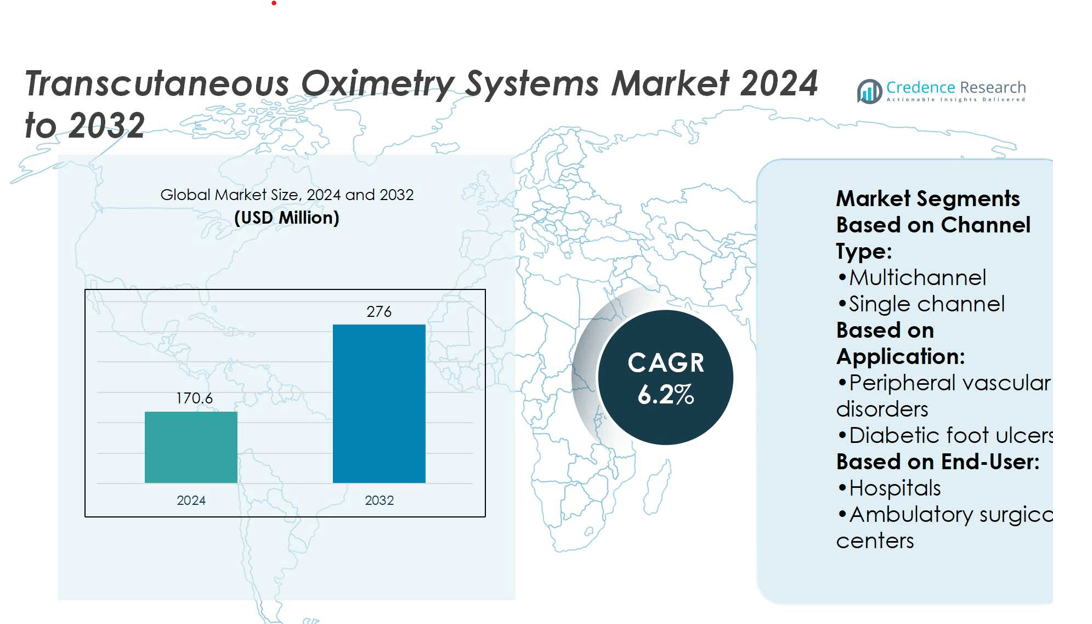
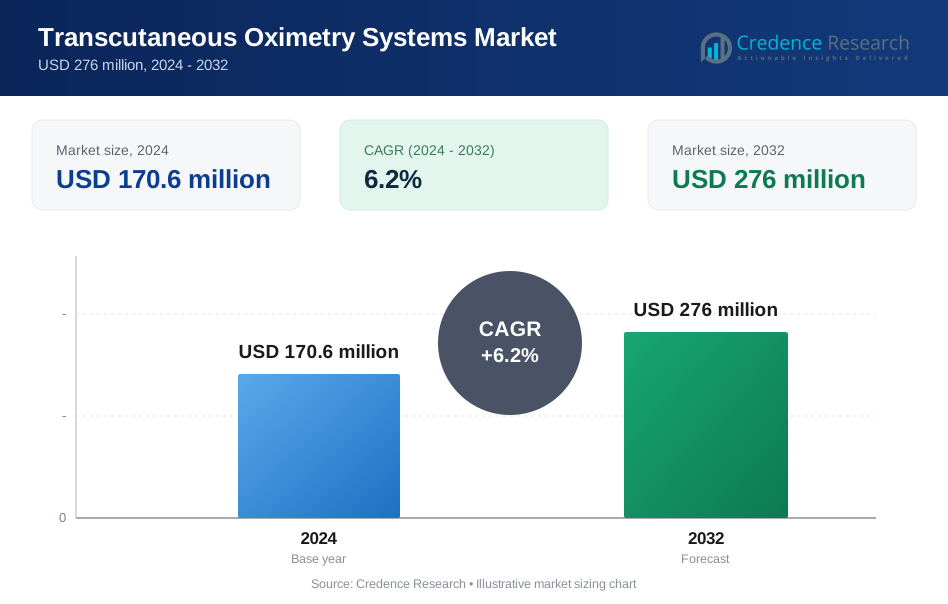
Transcutaneous Oximetry Systems Market size was valued at USD 170.6 million in 2024 and is anticipated to reach USD 276 million by 2032, at a CAGR of 6.2% during the forecast period.
| REPORT ATTRIBUTE | DETAILS |
|---|---|
| Historical Period | 2020-2023 |
| Base Year | 2024 |
| Forecast Period | 2025-2032 |
| Transcutaneous Oximetry Systems Market Size 2024 | USD 170.6 million |
| Transcutaneous Oximetry Systems Market, CAGR | 6.2% |
| Transcutaneous Oximetry Systems Market Size 2032 | USD 276 million |
The Transcutaneous Oximetry Systems Market grows steadily, driven by rising prevalence of peripheral vascular disorders, diabetic ulcers, and chronic wounds requiring precise oxygen monitoring. Increasing demand for non-invasive diagnostics encourages hospitals and clinics to adopt advanced systems. Aging populations and higher diabetes incidence further strengthen market expansion across developed and emerging regions. Manufacturers focus on wireless, portable, and AI-integrated devices that improve accuracy and clinical efficiency. Trends highlight growing adoption in neonatal care, reconstructive surgery, and outpatient settings. Expanding integration with telemedicine platforms also supports remote patient management, ensuring strong growth prospects for the market over the forecast period.
North America leads the Transcutaneous Oximetry Systems Market with advanced healthcare infrastructure and strong adoption in wound care and vascular diagnostics, while Europe follows with high integration in hospitals and clinics supported by government initiatives. Asia-Pacific shows the fastest growth, driven by rising diabetes prevalence and expanding healthcare access. Latin America and the Middle East & Africa record steady adoption through improving infrastructure. Key players active in this market include Medtronic, Philips, GE Healthcare, Masimo, Nihon Kohden, and Nonin Medical.
Market Insights
- Transcutaneous Oximetry Systems Market size was valued at USD 170.6 million in 2024 and is anticipated to reach USD 276 million by 2032, at a CAGR of 6.2%.
- Rising prevalence of peripheral vascular disorders, diabetic ulcers, and chronic wounds drives steady growth.
- Non-invasive diagnostics gain demand as hospitals and clinics prioritize advanced monitoring systems.
- Manufacturers focus on portable, wireless, and AI-integrated devices that enhance accuracy and efficiency.
- High device costs and limited reimbursement in some regions restrain wider adoption.
- North America leads with advanced infrastructure, Europe follows with government support, and Asia-Pacific shows fastest growth.
- Competitive landscape remains strong with players emphasizing innovation, partnerships, and broader clinical applications.
Market Drivers
Growing Need for Accurate Wound Healing Monitoring
The Transcutaneous Oximetry Systems Market expands due to rising demand for non-invasive wound assessment. Chronic wounds and vascular diseases increase pressure on healthcare providers to adopt reliable tools. Transcutaneous oximetry enables clinicians to measure skin oxygen levels, guiding treatment decisions effectively. It supports improved healing outcomes, reducing hospital stays and lowering costs. Hospitals and wound care centers view it as a valuable diagnostic aid. Growing patient populations with diabetes and peripheral artery disease strengthen adoption. It drives consistent demand in developed and emerging healthcare systems.
- For instance, Nihon Kohden offers the OLV-3100 pulse oximeter, a device designed for stable and accurate oxygen saturation (SpO2) monitoring in a variety of clinical settings, including the operating room, intensive care units, and general wards. It features technology to reduce noise and motion artifacts and is capable of storing trend data over a longer duration, rather than providing high-frequency, real-time data for wound analysis.
Rising Prevalence of Peripheral Vascular Disorders
The market benefits from the global increase in vascular and circulatory conditions. Rising incidence of diabetes and obesity leads to higher cases of peripheral artery disease. Physicians rely on transcutaneous oximetry systems to assess tissue oxygenation during diagnosis and treatment. It plays a vital role in evaluating limb salvage potential before surgical procedures. Demand grows among vascular surgeons and specialists for precision-driven monitoring. Rising healthcare awareness strengthens market penetration across hospital and clinic settings. It underlines the importance of preventive diagnostics in reducing amputation rates.
- For instance, General Electric’s LOGIQ E10 ultrasound system features advanced cSound architecture, providing 48 times more data throughput compared to the LOGIQ E9 model, enabling vascular surgeons to perform detailed peripheral artery assessments.
Technological Advancements and Integration of Digital Tools
Innovation strengthens the Transcutaneous Oximetry Systems Market by improving accuracy and user experience. Modern systems integrate wireless connectivity and digital interfaces for faster analysis. Hospitals prefer devices that sync with electronic health records, allowing streamlined patient management. It ensures clinicians can monitor progress and adjust therapy in real time. Portable and compact designs enable bedside and home-based use, expanding patient access. Continuous research fosters new sensor technologies with greater sensitivity. It enhances adoption across multiple medical specialties beyond wound care.
Growing Emphasis on Cost-Effective Healthcare Solutions
Healthcare providers prioritize technologies that lower long-term treatment costs. The Transcutaneous Oximetry Systems Market aligns with this shift by reducing unnecessary surgeries. Accurate oxygenation data helps avoid ineffective interventions and supports tailored therapies. It contributes to improved patient outcomes while reducing healthcare expenditure. Governments and insurers promote non-invasive diagnostics to improve efficiency in care delivery. Rising reimbursement support in several countries encourages hospital investments in these systems. It ensures long-term growth opportunities across both developed and emerging markets.
Market Trends
Increasing Focus on Non-Invasive Diagnostic Technologies
The Transcutaneous Oximetry Systems Market shows steady growth with the global shift toward non-invasive methods. Patients and clinicians prefer tools that reduce risks linked with invasive testing. Transcutaneous oximetry enables reliable skin oxygen measurement without discomfort. It supports wound care, vascular assessment, and surgical planning, improving diagnostic outcomes. The move toward patient-centered care strengthens adoption in hospitals and clinics. Demand rises further in home healthcare, where simple, safe devices are vital. It highlights the long-term trend toward patient comfort and safety.
- For instance, Omron Healthcare offers several clinically tested pulse oximeters for home use, including the Bluetooth-enabled P300 Intelli IT. These fingertip devices are designed for reliable and painless oxygenation monitoring, measuring blood oxygen saturation (SpO₂) and pulse rate.
Expansion in Chronic Disease Management Applications
The market trends upward with growing use in managing chronic conditions. Rising cases of diabetes, cardiovascular disease, and peripheral artery disorders expand demand. Transcutaneous oximetry systems play a key role in monitoring tissue oxygenation for these patients. It helps clinicians design targeted treatment strategies and monitor therapy effectiveness. Hospitals integrate these systems in multidisciplinary care programs, increasing relevance. The growing burden of lifestyle diseases reinforces their clinical value. It ensures wider adoption across specialized departments and outpatient care facilities.
- For instance, Nonin Medical’s Onyx Vantage 9590 pulse oximeter offers a clinically proven accuracy within ±2 digits for SpO₂ readings between 70–100% and is suitable for reliable spot-checking in various clinical and home-based settings.
Integration of Digital Health and Remote Monitoring Capabilities
The Transcutaneous Oximetry Systems Market benefits from integration with digital platforms. Systems now connect with hospital information systems and electronic health records. Clinicians gain instant access to patient oxygenation data for accurate decision-making. It improves workflow efficiency and supports personalized treatment pathways. Remote monitoring features allow real-time tracking outside hospitals, increasing patient convenience. Manufacturers focus on compact, portable devices that enhance usability. It positions the technology within the broader telehealth and remote diagnostics ecosystem.
Rising Investment in Technological Innovation and Product Development
Ongoing advancements mark a clear trend in the market’s development. Companies invest in sensors with higher precision and stability. The Transcutaneous Oximetry Systems Market embraces miniaturization, portability, and advanced software analytics. It increases device versatility for multiple clinical applications beyond wound care. Research efforts focus on enhancing user-friendly interfaces for wider adoption. Demand for cost-effective solutions drives innovation in both developed and emerging economies. It reflects the industry’s push to balance affordability with high performance.
Market Challenges Analysis
High Cost of Devices and Limited Reimbursement Frameworks
The Transcutaneous Oximetry Systems Market faces significant hurdles due to high equipment costs. Advanced devices require substantial investment, limiting access for smaller hospitals and clinics. It restricts adoption in regions with constrained healthcare budgets. Limited reimbursement policies in many countries add further barriers to uptake. Patients and providers often hesitate to use systems that lack clear financial coverage. High pricing also impacts procurement decisions in emerging economies. It creates a gap between technological availability and widespread implementation.
Technical Limitations and Shortage of Skilled Professionals
The market encounters obstacles linked to technical constraints and expertise shortages. Device performance can be influenced by external factors such as skin condition, temperature, and patient movement. It leads to inconsistent readings that affect clinical confidence. The shortage of trained professionals in handling and interpreting results remains a pressing issue. Hospitals in rural and underdeveloped areas struggle to integrate these systems effectively. The Transcutaneous Oximetry Systems Market must address usability challenges to achieve wider penetration. It highlights the ongoing need for training programs and improved device design.
Market Opportunities
Expanding Clinical Applications
The Transcutaneous Oximetry Systems Market holds significant opportunities through its widening clinical applications. These systems support chronic wound care, vascular diagnostics, and post-surgical monitoring, areas where demand continues to grow. Hospitals and specialized clinics adopt them to improve patient outcomes and reduce complications. It benefits from growing integration with telemedicine platforms that enable remote patient monitoring. Rising emphasis on preventive healthcare strengthens adoption across aging populations with higher risks of circulatory issues. Expanding applications across dermatology and plastic surgery also open new growth channels for manufacturers.
Technological Advancements and Market Penetration
Technological innovation creates strong opportunities for expanding the Transcutaneous Oximetry Systems Market in both developed and emerging regions. Integration of wireless connectivity, AI-driven analytics, and compact sensor designs enhances system usability. It enables healthcare professionals to access real-time diagnostic data more efficiently, driving faster clinical decisions. Growing investment in portable and home-care devices expands adoption beyond hospitals into outpatient settings. Rising healthcare expenditure in Asia-Pacific, Latin America, and the Middle East offers scope for deeper market penetration. Companies focusing on training and education programs also stand to accelerate adoption among healthcare practitioners.
Market Segmentation Analysis:
By Channel Type
The Transcutaneous Oximetry Systems Market divides into multichannel and single channel systems. Multichannel systems hold a larger share because they allow simultaneous monitoring across different sites, improving diagnostic accuracy in vascular and wound care. Hospitals and diagnostic centers prefer these systems for managing complex conditions. Single channel systems remain in demand for routine checks and point-of-care use. Their lower cost and portability make them suitable for smaller facilities and outpatient care. It continues to see balanced adoption across both types, with multichannel systems expected to expand faster due to rising need for advanced diagnostics.
- For instance, Contec Medical Systems offers the CMS60D handheld oximeter, a portable device for measuring oxygen saturation (SpO₂) and pulse rate in routine check mode or continuous monitoring mode. The device can be used with an external probe, is capable of storing up to 24 hours of data, and can transfer stored or real-time data to a PC for review.
By Application
The market segments into peripheral vascular disorders, diabetic foot ulcers, preterm births, and other applications. Peripheral vascular disorders represent the largest share as these systems support detection of oxygen deficits critical for treatment planning. Diabetic foot ulcers form another significant segment with rising cases linked to global diabetes prevalence. Preterm births create opportunities since monitoring skin oxygenation helps in neonatal care. Other applications include reconstructive surgery and post-operative monitoring. It benefits from broadening medical use cases that support its long-term growth across specialties.
- For instance, Masimo's SET® pulse oximetry technology is used to monitor more than 200 million patients annually in hospitals and surgical centers worldwide, and over 100 independent clinical studies support its superior performance.
By End User
End users include hospitals, ambulatory surgical centers, and diagnostic centers. Hospitals dominate adoption due to large patient volumes and high need for reliable monitoring tools in wound care and vascular surgery. Diagnostic centers show strong uptake as demand grows for specialized vascular testing. Ambulatory surgical centers adopt these systems to improve surgical outcomes and reduce post-operative risks. Each segment contributes uniquely, yet hospitals remain the primary growth driver. It continues to expand across all end-user categories, driven by rising emphasis on patient safety and precision diagnostics.
Segments:
Based on Channel Type:
- Multichannel
- Single channel
Based on Application:
- Peripheral vascular disorders
- Diabetic foot ulcers
Based on End-User:
- Hospitals
- Ambulatory surgical centers
Based on the Geography:
- North America
- U.S.
- Canada
- Mexico
- Europe
- UK
- France
- Germany
- Italy
- Spain
- Russia
- Belgium
- Netherlands
- Austria
- Sweden
- Poland
- Denmark
- Switzerland
- Rest of Europe
- Asia Pacific
- China
- Japan
- South Korea
- India
- Australia
- Thailand
- Indonesia
- Vietnam
- Malaysia
- Philippines
- Taiwan
- Rest of Asia Pacific
- Latin America
- Brazil
- Argentina
- Peru
- Chile
- Colombia
- Rest of Latin America
- Middle East
- UAE
- KSA
- Israel
- Turkey
- Iran
- Rest of Middle East
- Africa
- Egypt
- Nigeria
- Algeria
- Morocco
- Rest of Africa
Regional Analysis
North America
North America holds nearly 35 % of the global Transcutaneous Oximetry Systems Market, making it the leading region. The United States dominates regional demand due to its advanced healthcare infrastructure, broad insurance coverage, and emphasis on wound care management. Hospitals adopt multichannel systems widely to monitor vascular disorders and diabetic ulcers, both highly prevalent in this region. Canada contributes steadily, with a focus on preventive care and increasing government investments in advanced diagnostic tools. It benefits from strong collaborations between hospitals and device manufacturers that improve accessibility and clinical training. Research institutions in the region also drive continuous innovation, supporting wireless systems, digital reporting, and telehealth integration. This emphasis on R&D, combined with rising awareness of peripheral vascular disease, sustains North America’s leadership position.
Europe
Europe accounts for around 25 % of the Transcutaneous Oximetry Systems Market, supported by mature healthcare systems and high standards of patient care. Germany, France, and the United Kingdom lead adoption, with their hospitals integrating these systems into vascular diagnostics and diabetic foot ulcer management. It gains traction through government-funded programs that encourage the use of advanced diagnostic equipment in both hospitals and clinics. Strong clinical research networks across Europe also promote new applications such as reconstructive surgery monitoring and neonatal care. The aging population in countries like Italy and Spain drives steady demand, as older patients present higher risks of vascular complications. Europe’s regulatory landscape encourages manufacturers to launch safe, effective systems and pushes rapid product approvals. Growing collaboration between device companies and healthcare providers ensures wide adoption, while training initiatives further support skilled use of advanced monitoring technologies.
Asia-Pacific
Asia-Pacific holds close to 20 % of the global Transcutaneous Oximetry Systems Market and shows the fastest growth rate. Rising diabetes cases, particularly in China and India, contribute significantly to adoption, as diabetic ulcers become more frequent. Japan leads in technological uptake, with strong integration into vascular diagnostics and neonatal monitoring. It benefits from rapid urbanization, expanding healthcare infrastructure, and rising medical spending across Southeast Asia. Governments encourage wider availability of diagnostic devices through favorable programs, particularly in wound management and neonatal health. Manufacturers find opportunities in offering portable and cost-effective systems that suit smaller hospitals and outpatient clinics. The region shows increasing preference for telemedicine-enabled solutions, helping overcome geographic barriers to care. Growing partnerships with local distributors and training initiatives build awareness and expand penetration, especially in tier-2 and tier-3 cities.
Latin America
Latin America contributes roughly 10 % of the global market share, with Brazil, Mexico, and Argentina leading adoption. Hospitals in these countries adopt transcutaneous oximetry systems for managing vascular complications and wound care. It expands steadily through private healthcare investments and international partnerships. Awareness campaigns related to diabetes and peripheral vascular diseases support growth, particularly in urban centers. Governments in some nations provide partial support for advanced diagnostic systems, helping smaller hospitals access this technology. International manufacturers rely on distributors to strengthen presence in the region, while training programs build local expertise. Adoption in ambulatory surgical centers also increases, as clinics aim to improve surgical outcomes. The region shows strong potential but still faces challenges from economic instability and reimbursement limitations, which slow adoption outside major cities.
Middle East & Africa
The Middle East & Africa represents close to 10 % of the Transcutaneous Oximetry Systems Market, with uneven adoption across subregions. Gulf countries such as Saudi Arabia, UAE, and Qatar lead in adoption, driven by high healthcare spending and strong interest in advanced monitoring tools. Hospitals in these nations integrate multichannel systems into vascular and post-surgical diagnostics. Africa shows slower progress but steady improvements, especially in South Africa and Egypt, where governments support modernizing healthcare infrastructure. It benefits from international aid programs and collaborative training initiatives that raise awareness of oxygen monitoring in neonatal care and wound management. Suppliers often focus on building service networks and education programs to support adoption. While cost constraints limit penetration in lower-income countries, the market outlook remains positive due to rising demand for preventive care and increasing incidence of vascular conditions.
Key Player Analysis
- Nihon Kohden Corporation
- General Electric Company
- Omron healthcare, Inc.
- Nonin Medical, Inc.
- Contec Medical Systems Co., Ltd.
- Medtronic plc
- Masimo Corporation
- Smiths Group plc.
- Halma plc
- Koninklijke Philips N.V.
Competitive Analysis
The Transcutaneous Oximetry Systems Market features include Nihon Kohden Corporation, General Electric Company, Omron Healthcare, Inc., Nonin Medical, Inc., Contec Medical Systems Co., Ltd., Medtronic plc, Masimo Corporation, Smiths Group plc, Halma plc, and Koninklijke Philips N.V. The Transcutaneous Oximetry Systems Market demonstrates a highly competitive landscape shaped by technological innovation and expanding clinical demand. Companies emphasize advanced product development, focusing on accuracy, portability, and integration with digital healthcare platforms. Competition intensifies as manufacturers invest in wireless connectivity, AI-driven analytics, and telemedicine-ready solutions. The market also witnesses strong emphasis on training programs and service networks to enhance clinical adoption and trust among healthcare professionals. Price-sensitive regions create opportunities for cost-effective systems, while developed markets prioritize premium devices with advanced diagnostic capabilities. This balance between affordability and innovation defines the competitive dynamics and supports continuous growth across global healthcare sectors.
Recent Developments
- In January 2025, the United States Food and Drug Administration released guidelines for manufacturers regarding the calibration of their devices to better read pulse oxygen readings for people of color, by ensuring devices are tested across a variety of skin tones.
- In December 2024, Zynex, Inc., an innovative medical technology company specializing in the manufacture and sale of noninvasive medical devices for pain management, rehabilitation, and patient monitoring, announced its membership as an industry member in the Collaborative Community of the independently led Open Oximetry Project.
- In October 2024, Tenovi and Nonin Medical Partner announced a strategic partnership to advance health equity through remote patient monitoring for patients with chronic care needs. Research has shown that fingertip pulse oximeters from Nonin performed significantly better than competing models under conditions of dyspnea and low perfusion.
- In August 2024, Prevounce Health, a leading medical device provider, launched a remote patient-monitoring blood oxygen measurement device called Pylo OX1-LTE. The device is cellular connected, offering secure data collection, reliability and improved connectivity.
Report Coverage
The research report offers an in-depth analysis based on Channel Type, Application, End-User and Geography. It details leading market players, providing an overview of their business, product offerings, investments, revenue streams, and key applications. Additionally, the report includes insights into the competitive environment, SWOT analysis, current market trends, as well as the primary drivers and constraints. Furthermore, it discusses various factors that have driven market expansion in recent years. The report also explores market dynamics, regulatory scenarios, and technological advancements that are shaping the industry. It assesses the impact of external factors and global economic changes on market growth. Lastly, it provides strategic recommendations for new entrants and established companies to navigate the complexities of the market.
Future Outlook
- The market will grow through wider adoption in vascular and wound care management.
- Demand will rise as diabetes prevalence increases worldwide.
- Portable and wireless devices will gain strong acceptance in outpatient and home-care settings.
- Integration with telemedicine platforms will expand clinical accessibility.
- Technological upgrades will improve accuracy, usability, and patient comfort.
- Hospitals will remain the primary end users, while diagnostic centers gain momentum.
- Training and education programs will strengthen adoption among healthcare professionals.
- Emerging economies will see higher adoption due to affordable system offerings.
- Aging populations will drive consistent demand for advanced diagnostic monitoring.
- Strong competition will continue to focus on digital connectivity and AI-based solutions.
Request a Free Sample
Fill in your details and we'll send you a free sample report.
- Sample data tables & charts
- Research methodology
Need a Custom Version of This Report?
Tailor the scope, geography, or segments to your exact requirements.
- Custom geography or segment scope
- Direct access to our analyst team
Frequently Asked Questions
What is the current market size for Transcutaneous Oximetry Systems Market, and what is its projected size in 2032?
At what Compound Annual Growth Rate is the Transcutaneous Oximetry Systems Market projected to grow between 2025 and 2032?
What are the primary factors fueling the growth of the Transcutaneous Oximetry Systems Market?
Who are the leading companies in the Transcutaneous Oximetry Systems Market?
Table of Content
Chapter 1. Report Introduction
- 1.1 Report Description & Purpose
- 1.1.1 Report Title & Market Definition
- 1.1.2 Unique Selling Propositions (USP) & Key Differentiators
- 1.1.3 Value Proposition for Stakeholders
- 1.2 Research Objectives
- 1.2.1 Market Sizing Objectives (Volume & Revenue)
- 1.2.2 Segmentation Objectives
- 1.2.3 Competitive Intelligence Objectives
- 1.2.4 Forecast & Scenario Objectives
- 1.3 Report Scope
- 1.3.1 Transcutaneous Oximetry Systems Scope – Types & Subtypes Covered
- 1.3.2 Geographic Scope – Regions & Countries Covered
- 1.3.3 Historical Period, Base Year & Forecast Period (2024; forecast to 2032)
- 1.3.4 Inclusions & Exclusions
- 1.4 HS Code & Classification Framework
- 1.5 Currency, Units & Pricing Basis
- 1.6 Target Stakeholders
- 1.7 Limitations & Assumptions
Chapter 2. Executive Summary
- 2.1 Global Transcutaneous Oximetry Systems Market Snapshot
- 2.1.1 Market Size – Historical (2024) & Forecast (2024-2032) (2024: USD 170.6 million → 2032: USD 276 million)
- 2.1.2 Volume & Revenue – Global Totals
- 2.1.3 Key Market Highlights – Top Five Facts
- 2.2 Transcutaneous Oximetry Systems Market Segmentation Snapshot
- 2.2.1 Market Split by Region – 2024 vs. 2032
- 2.3 Competitive Snapshot
- 2.3.1 Top 10 Players by Revenue Share – 2024
- 2.3.2 Top 10 Players by Volume Share – 2024
- 2.3.3 Recent Strategic Developments (18-Month Summary)
- 2.4 Key Investment Highlights & Strategic Conclusions
Chapter 3. Transcutaneous Oximetry Systems Market Dynamics & Industry Analysis
- 3.1 Market Overview & Context
- 3.1.1 Transcutaneous Oximetry Systems Market Position in the Broader Automotive Value Chain
- 3.1.2 OEM vs. Replacement Market Dynamics
- 3.1.3 Market Maturity & Development Stage by Region
- 3.2 Transcutaneous Oximetry Systems Market Drivers
- 3.3 Transcutaneous Oximetry Systems Market Restraints & Challenges
- 3.4 Transcutaneous Oximetry Systems Market Opportunities
- 3.5 Porter's Five Forces Analysis
- 3.5.1 Threat of New Entrants
- 3.5.2 Bargaining Power of Suppliers
- 3.5.3 Bargaining Power of Buyers
- 3.5.4 Threat of Substitutes
- 3.5.5 Competitive Rivalry – Intensity Assessment
- 3.6 Transcutaneous Oximetry Systems Value Chain Analysis
- 3.6.1 Upstream – Raw Material/Input Suppliers
- 3.6.1.1 Raw Material/Input 1
- 3.6.1.2 Raw Material/Input 2
- 3.6.1.3 Raw Material/Input 3
- 3.6.2 Midstream – Production/Manufacturing/Service Delivery
- 3.6.2.1 Production/Process Overview
- 3.6.2.2 Key Facility Locations & Capacity by Manufacturer
- 3.6.3 Downstream – Distribution & End Consumer
- 3.6.3.1 Primary Channel – B2B/OEM
- 3.6.3.2 Secondary Channels – Dealer, Retail, Online, Direct
- 3.6.4 Value Chain Profitability Analysis
- 3.6.1 Upstream – Raw Material/Input Suppliers
- 3.7 PESTEL Analysis
- 3.7.1 Political Factors
- 3.7.2 Economic Factors
- 3.7.3 Social Factors
- 3.7.4 Technological Factors
- 3.7.5 Environmental Factors
- 3.7.6 Legal Factors
- 3.8 Transcutaneous Oximetry Systems Supply Chain Analysis
- 3.8.1 Raw Material/Input Supply Risk Assessment
- 3.8.2 Manufacturing Concentration Risk (Geographic Exposure)
- 3.8.3 Trade Disruption Impact Analysis
- 3.9 Regulatory & Policy Landscape
Note: The regulatory and policy landscape section covers regulations based on their applicability to the market, Transcutaneous Oximetry Systems category, geography, and scope of the study. Only regulatory frameworks with a material impact on operations, compliance, trade, sustainability, or market access are analyzed in detail.
Chapter 4. Key Investment Pockets & Opportunity Analysis
- 4.1 Transcutaneous Oximetry Systems Market Attractiveness Analysis
- 4.1.1 By Region – Investment Attractiveness Matrix (Volume × CAGR)
- 4.2 Absolute Revenue Growth Opportunity
- 4.2.1 By Region – Absolute USD Growth Through 2032
- 4.3 Incremental Volume Opportunity
- 4.3.1 By Region – Incremental Volume Through 2032
- 4.3.2 Segment – Incremental Volume
- 4.4 Emerging Submarket Opportunity Deep Dive (Subject to Applicability)
- 4.5 Emerging Market Opportunity Scorecards
- 4.5.1 United States
- 4.5.2 Europe
- 4.5.3 Asia
- 4.5.4 Middle East & Africa
Note: Emerging Market Opportunity Scorecards will be included based on relevance and strategic importance. Regions listed are indicative and may vary depending on data availability and market dynamics.
Chapter 5. Transcutaneous Oximetry Systems Import-Export Analysis & Trade Flows
- 5.1 Global Trade Overview
- 5.1.1 Global Export Value by Country (2024)
- 5.1.2 Global Export Volume by Country (2024)
- 5.1.3 Global Import Value by Country (2024)
- 5.1.4 Global Import Volume by Country (2024)
- 5.1.5 Net Trade Balance by Country (2024)
- 5.2 Export Analysis – Segment
- 5.2.1 Type 1 (HS Code)
- 5.2.2 Type 2 (HS Code)
- 5.2.3 Type 3 (HS Code)
- 5.2.4 Type 4 (HS Code)
- 5.2.5 Type 5 (HS Code)
- 5.3 Import Analysis – Segment
- 5.3.1 Type 1 (HS Code)
- 5.3.2 Type 2 (HS Code)
- 5.3.3 Type 3 (HS Code)
- 5.3.4 Type 4 (HS Code)
- 5.3.5 Type 5 (HS Code)
- 5.4 Average Unit Trade Prices
- 5.4.1 Average Export Price – Segment & Country
- 5.4.2 Average Import Price – Segment & Source Country
- 5.4.3 Price Trends (2024)
- 5.5 Key Trade Route Analysis
- 5.5.1 Trade Route 1
- 5.5.2 Trade Route 2
- 5.5.3 Trade Route 3
- 5.5.4 Trade Route 4
- 5.5.5 Trade Route 5
- 5.6 Trade Policy Impact Assessment
- 5.6.1 US Anti-Dumping & Section 301 Tariffs
- 5.6.2 EU Customs Union Impact
- 5.6.3 Major Free Trade Agreements
- 5.6.4 USMCA Rules of Origin
Note: Trade policy analysis will be included only where relevant to the Transcutaneous Oximetry Systems market.
Chapter 6. Competitive Landscape & Company Benchmarking
- 6.1 Transcutaneous Oximetry Systems Market Concentration & Structure
- 6.1.1 Herfindahl-Hirschman Index (HHI) – vs. 2024
- 6.1.2 Tier 1, Tier 2 & Tier 3 Market Structure
- 6.1.3 Global, Regional & Local Player Dynamics
- 6.2 Transcutaneous Oximetry Systems Market Share Analysis – 2024
- 6.2.1 Global Revenue Share by Company
- 6.2.2 Global Volume Share by Company
- 6.2.3 Regional Revenue Share
- 6.2.4 Market Share Evolution ( vs. 2024)
- 6.2.5 OEM Segment Share by Company
- 6.2.6 Replacement Segment Share by Company
- 6.3 Production/Delivery Capacity & Facility Analysis
- 6.3.1 Global Installed Capacity
- 6.3.2 Capacity Utilization Rates
- 6.3.3 Production/Output Volume
- 6.3.4 Facility Locations & Capacity Map
- 6.3.5 Planned Capacity Additions
- 6.4 Transcutaneous Oximetry Systems Competitive Benchmarking Matrix
- 6.4.1 Revenue, Volume, CAGR & Profitability Comparison
- 6.4.2 Channel Revenue Mix
- 6.4.3 Geographic Revenue Exposure
- 6.4.4 R&D Intensity
- 6.4.5 Sustainability Maturity
- 6.5 Strategic Developments in Transcutaneous Oximetry Systems (Last 24 Months)
- 6.5.1 Mergers, Acquisitions & Divestments
- 6.5.2 New Transcutaneous Oximetry Systems Launches
- 6.5.3 Facility Expansions
- 6.5.4 Strategic Alliances, Joint Ventures & Partnerships
- 6.5.5 Distribution Expansion & Market Entry
- 6.5.6 Sustainability & ESG Initiatives
- 6.6 Competitive Strategy Mapping
- 6.6.1 Leader, Challenger, Follower & Niche Classification
- 6.6.2 Pricing Strategy Comparison
- 6.6.3 Channel Strategy Matrix
Note: Strategic developments are included based on their materiality and the availability of reliable information.
Chapter 7. Global Transcutaneous Oximetry Systems Market – By Distribution Channel
- 7.1 Segment Overview
- 7.1.1 Volume & Revenue Split by Channel (2024 & 2032)
- 7.1.2 Channel Mix Evolution (2024-2032)
Chapter 8. Regional Market Analysis – Global Overview
- 8.1 Global Regional Overview
- 8.1.1 Regional Volume Share
- 8.1.2 Regional Revenue Share
- 8.1.3 Regional Volume by Region
- 8.1.4 Regional Revenue by Region
- 8.1.5 Regional Forecast Through 2032
- 8.2 Cross-Regional Segment Analysis
- 8.2.1 By Distribution Channel
- 8.2.2 By Brand/Price Tier
Chapter 9. North America Transcutaneous Oximetry Systems Market
- 9.1 United States
- 9.2 Canada
- 9.3 Mexico
Chapter 10. Europe Transcutaneous Oximetry Systems Market
- 10.1 Germany
- 10.2 France
- 10.3 Italy
- 10.4 United Kingdom
- 10.5 Spain
- 10.6 Poland
- 10.7 Russia
- 10.8 Netherlands
- 10.9 Belgium
- 10.10 Sweden
- 10.11 Denmark
- 10.12 Norway
- 10.13 Rest of Europe
Chapter 11. Asia Pacific Transcutaneous Oximetry Systems Market
- 11.1 China
- 11.2 India
- 11.3 Japan
- 11.4 South Korea
- 11.5 Thailand
- 11.6 Indonesia
- 11.7 Vietnam
- 11.8 Malaysia
- 11.9 Australia
- 11.10 Rest of Asia Pacific
Chapter 12. Latin America Transcutaneous Oximetry Systems Market
- 12.1 Brazil
- 12.2 Argentina
- 12.3 Colombia
- 12.4 Chile
- 12.5 Rest of Latin America
Chapter 13. Middle East Transcutaneous Oximetry Systems Market
- 13.1 Saudi Arabia
- 13.2 United Arab Emirates
- 13.3 Turkey
- 13.4 Israel
- 13.5 Iran
- 13.6 Rest of the Middle East
Chapter 14. Africa Transcutaneous Oximetry Systems Market
- 14.1 South Africa
- 14.2 Egypt
- 14.3 Nigeria
- 14.4 Morocco
- 14.5 Rest of Africa
Chapter 15. Transcutaneous Oximetry Systems Company Profiles
- 15.1 [Company 01]
- 15.1.1 Company Overview
- 15.1.2 Key Management Personnel
- 15.1.3 Products & Services Portfolio
- 15.1.4 Financial Performance
- 15.1.5 Key Market Focus & Geographic Presence
- 15.1.6 Recent Developments & Strategic Initiatives
Note: The company profile list is preliminary and may change based on research findings, market developments, data availability, and client requirements.
Chapter 16. Appendices
- Appendix A – List of Abbreviations & Acronyms
- Appendix B – Industry Classification Code Reference – Full Series
- Appendix C – Production & Capacity Data Tables
- Appendix D – End-Use & Demand Base Tables
- Appendix E – Consumption & Replacement Rate Assumptions
- Appendix F – ASP Reference Tables
- Appendix G – Manufacturing & Facility Database
- Appendix H – Import-Export Data Tables
- Appendix I – Regulatory Summary Tables
- Appendix J – Primary Research Participant List (Anonymized)
- Appendix K – Primary Research Questionnaire Framework
- Appendix L – Data Sources & Bibliography
- Appendix M – Market Size Divergence & Source Comparison
Chapter 17. Research Methodology
- 17.1 Research Framework & Philosophy
- 17.2 Secondary Research – Sources, Hierarchy & Data Extraction
- 17.3 Data Modeling – Bottom-Up & Top-Down Market Sizing
- 17.4 Primary Research – Stakeholder Framework, LOI & Sample Sizes
- 17.5 Forecast Methodology – Regression, Scenario & Sensitivity Analysis
- 17.6 Quality Control – Four-Layer Validation Framework
- 17.7 Limitations & Standard Assumptions
- 17.8 Disclaimer
