
Market Overview:
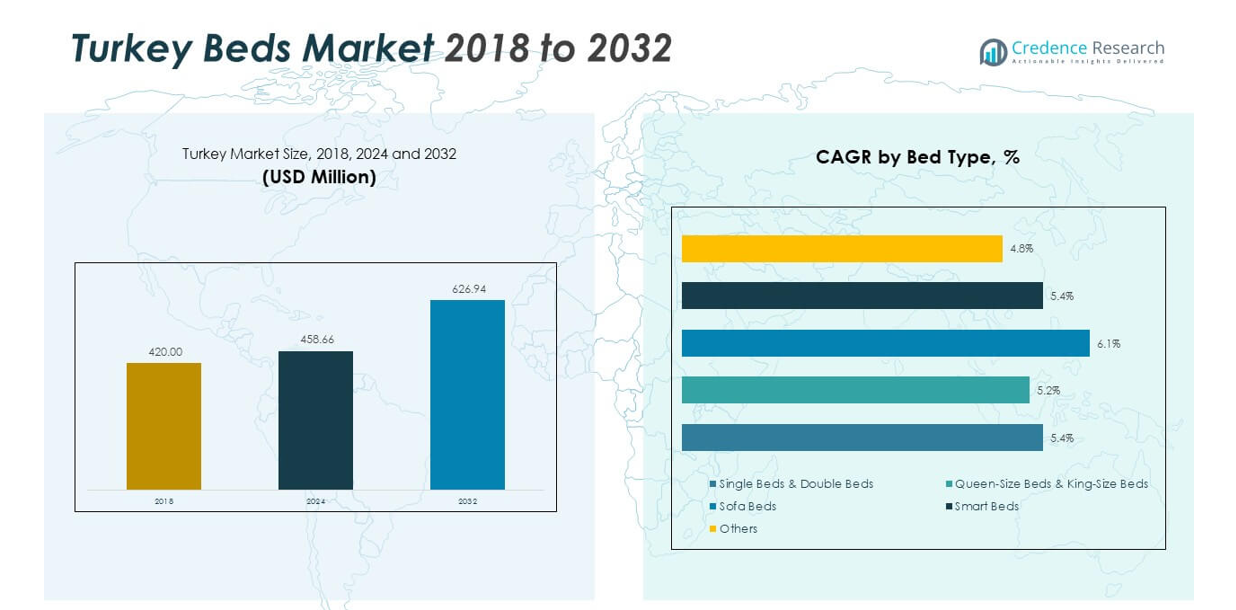
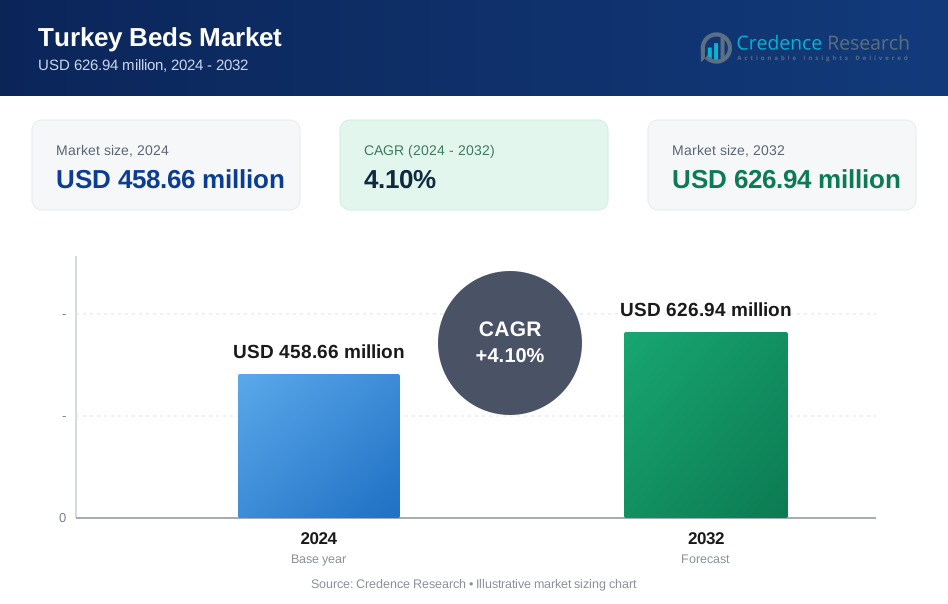
The Turkey Beds Market size was valued at USD 420.00 million in 2018, reached USD 458.66 million in 2024, and is anticipated to reach USD 626.94 million by 2032, at a CAGR of 4.10% during the forecast period.
| REPORT ATTRIBUTE | DETAILS |
|---|---|
| Historical Period | 2020-2023 |
| Base Year | 2024 |
| Forecast Period | 2025-2032 |
| Turkey Beds Market Size 2024 | USD 458.66 million |
| Turkey Beds Market, CAGR | 4.10% |
| Turkey Beds Market Size 2032 | USD 626.94 million |
Demand rises as consumers prioritize better sleep quality, ergonomic support, and durable materials. Manufacturers introduce improved mattress technologies that enhance breathability and long-term comfort. Hospitality projects stimulate new orders and support steady replacement cycles. Retailers expand both online and offline channels to offer wider selections. Growth also comes from rising awareness of health benefits linked to supportive bedding systems. Tourism-driven accommodation upgrades add further momentum across major cities.
Regional growth reflects strong adoption in urban centers where consumers shift toward premium bedding. Coastal regions lead due to higher hospitality density and frequent refurbishment cycles. Interior provinces show emerging momentum as home renovation activity rises. Market penetration expands as retailers strengthen distribution in semi-urban areas. Better logistics networks help reach distant regions more effectively. Diverse economic profiles across districts create varied demand patterns, supporting long-term growth.
Market Insights:
- The Turkey Beds Market grew from USD 420.00 million in 2018 to USD 458.66 million in 2024 and is projected to reach USD 626.94 million by 2032, reflecting a 10% CAGR driven by demand for premium, functional, and smart bedding solutions.
- Urban centers hold the largest regional share at 45%, supported by higher purchasing power and dense residential development. Coastal regions follow with 30%, influenced by tourism-driven hotel upgrades. Interior and eastern provinces contribute 25%, driven by rising household income and expanding retail penetration.
- The fastest-growing region is the coastal belt, holding 30% share, with growth supported by strong hospitality investment, frequent refurbishment cycles, and seasonal demand from tourism hubs.
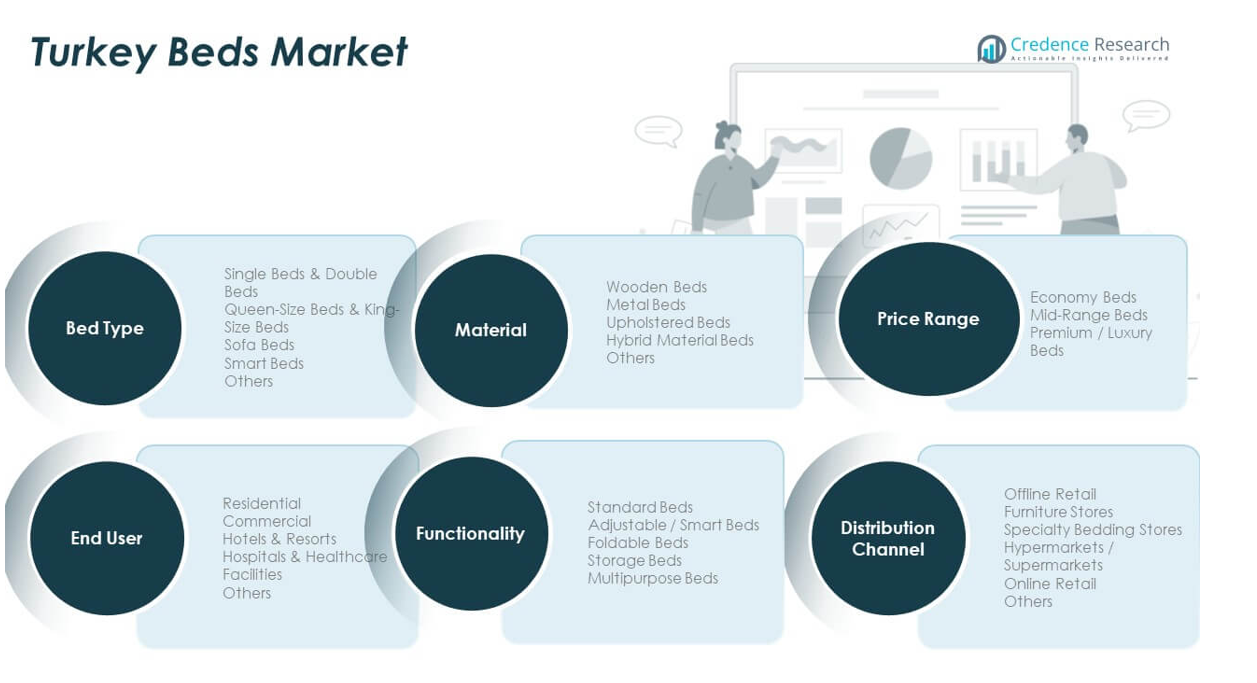
- Based on the chart, furniture stores command roughly 35% of the distribution channel share due to wide product availability and showroom-driven buying patterns.
- Specialty bedding stores and hypermarkets together account for about 45%, reflecting higher preference for guided purchases, branded options, and value-focused retail formats.
Market Drivers:
Strong Shift Toward Comfort-Focused Bedding Design And Premium Sleep Solutions
The Turkey Beds Market grows due to rising interest in comfort-driven products. Consumers seek better support features that reduce strain during long rest hours. Brands promote premium materials that enhance airflow and improve sleep quality. The market benefits from buyers who link comfort with long-term wellness. Manufacturers launch hybrid models that combine foam layers with spring structures. Retailers highlight ergonomic benefits that appeal to young households and new families. Hotels upgrade room setups to match global comfort standards. Tourism expansion encourages fresh procurement of advanced bedding solutions. Urban renovation projects keep replacement demand active.
- For instance, Tempur Sealy's TEMPUR-Adapt material is widely recognized for its superior pressure-relieving qualities compared to conventional foam, a characteristic supported by its use in medical settings where clinical trials have proven its ability to relieve pressure points. The material supports the body by distributing weight evenly, helping to relieve pressure on the spine and sensitive joints.
Rising Preference For Customizable Bed Structures And Modern Interior Compatibility
The Turkey Beds Market gains traction through demand for personalized designs. Buyers search for beds that match unique home layouts. Adjustable frames attract users who prefer flexible posture settings. Space-saving structures help smaller apartments manage limited room sizes. Designers work with brands to launch pieces that fit modern interiors. Hotels choose customizable units to maintain uniform appearance across properties. Retailers promote modular choices that support easy movement. Consumers compare style options before purchasing upgraded models. Online platforms highlight visual tools that help buyers plan room setups.
- For instance, IKEA’s BRIMNES storage bed integrates four built-in drawers and is sold in over 50 countries, supporting compact-space users.
Growing Influence Of Health Awareness And Demand For Orthopedic Support Systems
The Turkey Beds Market advances due to higher awareness of posture care. Orthopedic mattresses draw interest from adults who face back or neck strain. Doctors recommend firmer support structures for long-term health. Older adults look for beds that reduce pressure points. Wellness trends encourage households to choose supportive materials. Production teams focus on technologies that maintain spine alignment. Retailers highlight medical-grade benefits during product promotions. Hotels install supportive beds to attract health-conscious travelers. Awareness campaigns increase confidence in advanced bedding formats.
Expansion Of Hospitality Infrastructure And Faster Replacement Cycles Across Properties
The Turkey Beds Market moves forward through hotel and resort expansions. Rooms need new bedding during each upgrade cycle. Tourism growth pushes operators to invest in higher comfort levels. International visitors expect beds that meet global standards. Refurbishment schedules accelerate replacement of worn structures. Suppliers secure volume orders during peak travel seasons. New properties prefer durable models that reduce maintenance time. Developers include premium bedding in project plans to improve guest ratings. Retail chains benefit from continuous flow of commercial orders.
Market Trends:
Rapid Growth Of Online Bedding Sales And Wider Adoption Of Digital Room Planning Tools
The Turkey Beds Market observes strong growth in online channels. E-commerce platforms display wide product ranges with clear specifications. Buyers compare features before choosing premium or budget models. Digital room planning tools help users visualize bed placement. Retailers use virtual demos to highlight material and texture details. Mobile apps simplify the buying journey for young households. Brands introduce fast-delivery options that improve convenience. Online reviews influence final purchasing decisions. Digital campaigns help brands reach distant regions.
- For instance, Wayfair offers an AR-based visualization feature called "View in Room" that helps customers align and place furniture in their homes before purchase.
Increasing Popularity Of Eco-Friendly Materials And Sustainable Production Practices
The Turkey Beds Market reflects rising demand for greener materials. Households favor beds made from responsibly sourced wood. Brands replace chemical-based foams with cleaner alternatives. Manufacturers invest in low-emission production lines. Eco-certified products attract buyers who value environmental care. Hotels adopt sustainable models to support green tourism goals. Packaging teams redesign boxes to reduce waste volume. Retailers promote long-life units that minimize disposal needs. Awareness of sustainable living strengthens long-term adoption.
- For instance, Emma Sleep uses CertiPUR-US certified foams and reports reducing packaging material consumption by 21% across its European operations.
Growing Attraction Toward Smart Bed Features And Technology-Enhanced Sleep Experiences
The Turkey Beds Market shows interest in connected sleep systems. Smart beds track movement patterns during rest hours. Sensors help users understand posture habits. Mobile apps sync with bed functions to adjust firmness. Hotels test technology-led units in premium rooms. Young consumers explore new features that improve personal comfort. Brands market adjustable lighting zones integrated into bed frames. Innovation programs expand smart feature availability. Technology partnerships support product diversification.
Shift Toward Minimalist Aesthetic Designs And Multi-Functional Room Layout Integration
The Turkey Beds Market aligns with rising demand for minimalist interiors. Clean lines and neutral tones attract design-conscious buyers. Smaller homes choose beds that blend with compact layouts. Storage-integrated bases help organize limited floor space. Designers include multipurpose furniture themes in new projects. Retailers promote simple styles that fit wide décor choices. Hotels adopt streamlined models that support easy cleaning. Display rooms highlight combinations that suit modern homes. Minimalist trends influence future product planning.
Market Challenges Analysis:
Intense Price Sensitivity Across Consumer Groups And Rising Competition Among Regional Brands
The Turkey Beds Market faces challenges linked to strong price pressure. Buyers compare many models before making final decisions. Local brands compete aggressively with low-cost designs. Premium brands struggle to justify higher pricing in some regions. Retailers must balance stock across varying demand cycles. Logistics disruptions affect material availability for manufacturers. Supply gaps delay product launches during seasonal peaks. Marketing teams face difficulty promoting differentiated features. The challenge slows upgrade cycles across budget-focused households.
Rising Raw Material Costs And Complex Manufacturing Requirements Linked To Advanced Bedding Formats
The Turkey Beds Market experiences cost burdens from volatile input materials. Foam and fabric prices fluctuate due to global supply shifts. Manufacturers face complexity when producing hybrid structures. Skilled labor shortages slow fabrication of premium models. Hotels delay procurement when costs rise sharply. Import procedures affect access to specialized components. Retailers manage tight margins during economic uncertainty. Brands must invest more to maintain quality standards. Production delays affect delivery timelines across many cities.
Market Opportunities:
Expansion Potential In Untapped Semi-Urban Locations And Rising Interest In Organized Retail Networks
The Turkey Beds Market holds strong opportunities in developing districts. Semi-urban buyers show growing interest in branded bedding. Retail chains expand outlets to reach new customer clusters. Logistics networks improve access to remote neighborhoods. Consumers seek quality products with consistent after-sales support. Hotels in emerging towns begin upgrading room interiors. Brands highlight durability to attract first-time buyers. Wider exposure improves long-term adoption across mid-income groups.
Growing Demand For Premium Hospitality Projects And Increasing Focus On Long-Term Sleep Wellness
The Turkey Beds Market benefits from future hospitality development. New resorts require large volumes of durable bedding. Wellness-focused travelers prefer supportive structures that improve comfort. Brands promote ergonomic features to match global sleep trends. Hotels introduce themed room concepts that need suitable bed designs. Developers choose high-quality units to boost guest ratings. Training programs help staff manage product care. Wellness awareness supports steady interest in premium bedding formats.
Market Segmentation Analysis:
Bed Type Insights
The Turkey Beds Market expands through strong demand across several bed categories. Single and double beds remain essential choices for small households and rental properties. Queen-size and king-size beds gain traction among families seeking more comfort. Sofa beds attract buyers who prioritize space efficiency in compact homes. Smart beds create interest due to features that improve posture and rest quality. Premium models strengthen visibility in urban regions with higher lifestyle spending. The segment mix supports steady revenue growth for brands.
- For instance, Sleep Number has an engaged user base of nearly three million smart sleepersand has gathered over 14 billion hours of sleep data. The smart beds are supported by biometric sensing (including heart and breathing rates) and automated adjustments that learn the individual's sleep needs to optimize rest.
Material and End-user Insights
Material preferences shape purchasing patterns across many regions. Wooden beds dominate due to their durability and aesthetic appeal in long-term home setups. Metal beds maintain demand among budget-conscious buyers who value sturdy frames. Upholstered and hybrid material beds attract consumers who prefer modern designs. End-user demand increases within residential spaces where renovation activity is high. Hotels and resorts procure premium beds to improve guest comfort. Hospitals and healthcare facilities prefer functional models suited for frequent use. Commercial spaces maintain steady orders for standard formats.
- For instance, Hilton standardizes its hotels with Serenity Beds manufactured under licensed Serta designs, installed in more than 600,000 rooms globally.
Price Range, Functionality, and Distribution Insights
Price segmentation influences how the Turkey Beds Market distributes buying power. Economy beds appeal to cost-sensitive shoppers, while mid-range beds deliver balanced value and design. Premium or luxury beds gain interest from buyers who prioritize longevity. Functional divisions include standard beds that lead in overall volume. Adjustable, foldable, storage, and multipurpose beds support changing lifestyle needs. Offline retail and furniture stores remain key distribution channels. Online retail grows quickly due to wider product visibility and easier comparison tools.
Segmentation:
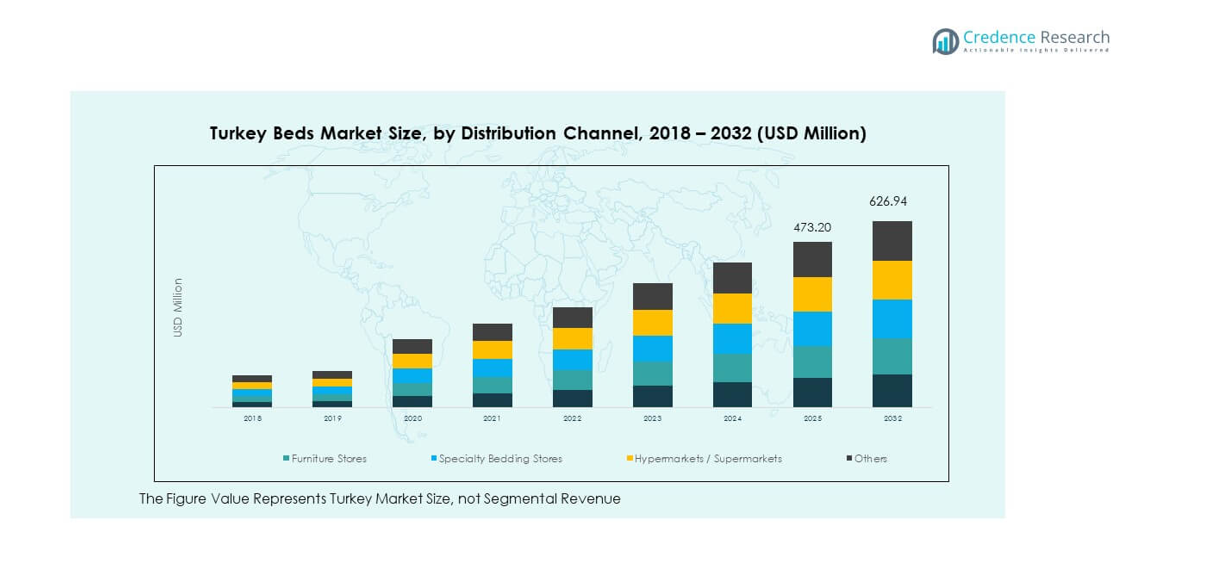
By Bed Type
- Single Beds
- Double Beds
- Queen-Size Beds
- King-Size Beds
- Sofa Beds
- Smart Beds
- Others
By Material
- Wooden Beds
- Metal Beds
- Upholstered Beds
- Hybrid Material Beds
- Others
By End-user
- Residential
- Commercial
- Hotels & Resorts
- Hospitals & Healthcare Facilities
- Others
By Price Range
- Economy Beds
- Mid-Range Beds
- Premium / Luxury Beds
By Functionality
- Standard Beds
- Adjustable / Smart Beds
- Foldable Beds
- Storage Beds
- Multipurpose Beds
By Distribution Channel
- Offline Retail
- Furniture Stores
- Specialty Bedding Stores
- Hypermarkets / Supermarkets
- Online Retail
- Others
Regional Analysis:
Urban Centers Leading Market Expansion
The Turkey Beds Market records strong dominance from major urban centers, which hold nearly 45% of the overall share. Istanbul drives demand due to dense residential construction and higher adoption of premium beds. Ankara and Izmir also contribute steady growth through active renovation cycles and rising household spending. Urban buyers prefer modern designs and functional beds that support compact layouts. Hotels in key cities maintain regular procurement schedules that strengthen commercial demand. Retail networks expand across leading metropolitan districts to meet rising customer expectations. The region continues to influence national trends due to rapid lifestyle upgrades.
Emerging Demand Across Coastal Regions
Coastal regions account for close to 30% of the Turkey Beds Market, driven by strong hospitality activity. Resorts along Antalya, Bodrum, and Marmaris require durable and stylish beds that support frequent guest turnover. Tourism-driven refurbishment cycles stimulate recurring orders from hotel groups. Residential buyers near coastal areas show interest in wooden and upholstered designs that match contemporary décor themes. Retailers in these regions broaden product ranges to capture both local and seasonal demand. Construction of new holiday homes encourages higher purchases of mid-range and premium beds. The region maintains stable momentum supported by tourism-linked investments.
Growing Adoption in Interior and Eastern Provinces
Interior and eastern provinces collectively represent around 25% of the Turkey Beds Market, supported by rising awareness of quality bedding. Households in these regions upgrade home interiors with standard and economy bed options. Growing urban migration increases demand for functional and affordable designs. Retailers expand distribution to semi-urban clusters to improve product reach. Hospitals and educational institutions in developing districts contribute to steady commercial orders. Buyers in emerging towns show interest in metal and hybrid material beds due to durability and maintenance ease. The region gains long-term potential through improving logistics and rising household income levels.
Key Player Analysis:
- Yataş Group / Enza Home
- İstikbal Furniture S.A.
- Alfemo
- Meta Mobel
- Seher Mobilya
- IKEA Turkey
Competitive Analysis:
The Turkey Beds Market reflects strong competition among national furniture manufacturers, regional brands, and international retailers that operate extensive product portfolios. Leading players focus on premium designs, ergonomic structures, and durable materials to strengthen visibility across residential and commercial segments. Companies improve supply chains to manage demand from hotels, resorts, and health facilities. Online platforms intensify competition by offering wide product catalogs with faster delivery options. Traditional retailers maintain share through personalized service and showroom experiences. Firms expand smart bed features to appeal to health-focused buyers. The market evolves through product upgrades that match changing lifestyle patterns and interior trends.
Recent Developments:
- In 2025, Yataş Group's Enza Home, one of Turkey's leading furniture and lifestyle brands, launched the “Summer Homes 2025” collection. This latest range features a blend of tactile fabrics and subdued color palettes, making a statement in understated sophistication. The collection was introduced in their flagship international stores and is designed to elevate summer living experiences with comfort and refined visual aesthetics.
- In July 2025, İstikbal Furniture S.A., a prominent Turkish beds and furniture brand, saw a pivotal development as Turkey’s government fund moved to sell the company following its prior seizure. This move is set to create new opportunities and potentially bring in fresh investments or new ownership, likely affecting its market strategy and partnerships in Turkey’s dynamic beds and furniture sector.
Report Coverage:
The research report offers an in-depth analysis based on bed type, material, end user, price range, distribution channel, and functionality. It details leading market players, providing an overview of their business, product offerings, investments, revenue streams, and key applications. Additionally, the report includes insights into the competitive environment, SWOT analysis, current market trends, as well as the primary drivers and constraints. Furthermore, it discusses various factors that have driven market expansion in recent years. The report also explores market dynamics, regulatory scenarios, and technological advancements that are shaping the industry. It assesses the impact of external factors and global economic changes on market growth. Lastly, it provides strategic recommendations for new entrants and established companies to navigate the complexities of the market.
Future Outlook:
- Demand for premium beds is expected to rise with growing lifestyle upgrades across cities.
- Smart bed adoption will grow as consumers show interest in health-supportive sleep technologies.
- Residential purchases will increase due to renovation cycles and expanding urban housing.
- Hotels and resorts will continue to drive commercial demand through frequent refurbishment.
- Wooden and upholstered beds will keep leading material preferences across key regions.
- Online retail penetration will expand due to better product visibility and delivery services.
- Storage and multipurpose beds will gain traction in compact homes seeking functional designs.
- Brands will differentiate through ergonomic innovation and improved durability standards.
- Regional manufacturers will strengthen competitiveness by offering value-driven product lines.
- Long-term growth will be supported by interior design trends that favor minimal and modern sleeping solutions.
Request a Free Sample
Fill in your details and we'll send you a free sample report.
- Sample data tables & charts
- Research methodology
Need a Custom Version of This Report?
Tailor the scope, geography, or segments to your exact requirements.
- Custom geography or segment scope
- Direct access to our analyst team
Frequently Asked Questions
What is the current market size for the Turkey Beds Market, and what is its projected size in 2032?
At what Compound Annual Growth Rate is the Turkey Beds Market projected to grow between 2024 and 2032?
Which Turkey Beds Market segment held the largest share in 2024?
What are the primary factors fueling the growth of the Turkey Beds Market?
Who are the leading companies in the Turkey Beds Market?
Table of Content
Chapter 1. Report Introduction
- 1.1 Report Description & Purpose
- 1.1.1 Report Title & Market Definition
- 1.1.2 Unique Selling Propositions (USP) & Key Differentiators
- 1.1.3 Value Proposition for Stakeholders
- 1.2 Research Objectives
- 1.2.1 Market Sizing Objectives (Volume & Revenue)
- 1.2.2 Segmentation Objectives
- 1.2.3 Competitive Intelligence Objectives
- 1.2.4 Forecast & Scenario Objectives
- 1.3 Report Scope
- 1.3.1 Turkey Beds Scope – Types & Subtypes Covered
- 1.3.2 Geographic Scope – Regions & Countries Covered
- 1.3.3 Historical Period, Base Year & Forecast Period (2024; forecast to 2032)
- 1.3.4 Inclusions & Exclusions
- 1.4 HS Code & Classification Framework
- 1.5 Currency, Units & Pricing Basis
- 1.6 Target Stakeholders
- 1.7 Limitations & Assumptions
Chapter 2. Executive Summary
- 2.1 Global Turkey Beds Market Snapshot
- 2.1.1 Market Size – Historical (2024) & Forecast (2024-2032) (2024: USD 458.66 million → 2032: USD 626.94 million)
- 2.1.2 Volume & Revenue – Global Totals
- 2.1.3 Key Market Highlights – Top Five Facts
- 2.2 Turkey Beds Market Segmentation Snapshot
- 2.2.1 Market Split by Region – 2024 vs. 2032
- 2.3 Competitive Snapshot
- 2.3.1 Top 10 Players by Revenue Share – 2024
- 2.3.2 Top 10 Players by Volume Share – 2024
- 2.3.3 Recent Strategic Developments (18-Month Summary)
- 2.4 Key Investment Highlights & Strategic Conclusions
Chapter 3. Turkey Beds Market Dynamics & Industry Analysis
- 3.1 Market Overview & Context
- 3.1.1 Turkey Beds Market Position in the Broader Automotive Value Chain
- 3.1.2 OEM vs. Replacement Market Dynamics
- 3.1.3 Market Maturity & Development Stage by Region
- 3.2 Turkey Beds Market Drivers
- 3.3 Turkey Beds Market Restraints & Challenges
- 3.4 Turkey Beds Market Opportunities
- 3.5 Porter's Five Forces Analysis
- 3.5.1 Threat of New Entrants
- 3.5.2 Bargaining Power of Suppliers
- 3.5.3 Bargaining Power of Buyers
- 3.5.4 Threat of Substitutes
- 3.5.5 Competitive Rivalry – Intensity Assessment
- 3.6 Turkey Beds Value Chain Analysis
- 3.6.1 Upstream – Raw Material/Input Suppliers
- 3.6.1.1 Raw Material/Input 1
- 3.6.1.2 Raw Material/Input 2
- 3.6.1.3 Raw Material/Input 3
- 3.6.2 Midstream – Production/Manufacturing/Service Delivery
- 3.6.2.1 Production/Process Overview
- 3.6.2.2 Key Facility Locations & Capacity by Manufacturer
- 3.6.3 Downstream – Distribution & End Consumer
- 3.6.3.1 Primary Channel – B2B/OEM
- 3.6.3.2 Secondary Channels – Dealer, Retail, Online, Direct
- 3.6.4 Value Chain Profitability Analysis
- 3.6.1 Upstream – Raw Material/Input Suppliers
- 3.7 PESTEL Analysis
- 3.7.1 Political Factors
- 3.7.2 Economic Factors
- 3.7.3 Social Factors
- 3.7.4 Technological Factors
- 3.7.5 Environmental Factors
- 3.7.6 Legal Factors
- 3.8 Turkey Beds Supply Chain Analysis
- 3.8.1 Raw Material/Input Supply Risk Assessment
- 3.8.2 Manufacturing Concentration Risk (Geographic Exposure)
- 3.8.3 Trade Disruption Impact Analysis
- 3.9 Regulatory & Policy Landscape
Note: The regulatory and policy landscape section covers regulations based on their applicability to the market, Turkey Beds category, geography, and scope of the study. Only regulatory frameworks with a material impact on operations, compliance, trade, sustainability, or market access are analyzed in detail.
Chapter 4. Key Investment Pockets & Opportunity Analysis
- 4.1 Turkey Beds Market Attractiveness Analysis
- 4.1.1 By Region – Investment Attractiveness Matrix (Volume × CAGR)
- 4.2 Absolute Revenue Growth Opportunity
- 4.2.1 By Region – Absolute USD Growth Through 2032
- 4.3 Incremental Volume Opportunity
- 4.3.1 By Region – Incremental Volume Through 2032
- 4.3.2 Segment – Incremental Volume
- 4.4 Emerging Submarket Opportunity Deep Dive (Subject to Applicability)
- 4.5 Emerging Market Opportunity Scorecards
- 4.5.1 United States
- 4.5.2 Europe
- 4.5.3 Asia
- 4.5.4 Middle East & Africa
Note: Emerging Market Opportunity Scorecards will be included based on relevance and strategic importance. Regions listed are indicative and may vary depending on data availability and market dynamics.
Chapter 5. Turkey Beds Import-Export Analysis & Trade Flows
- 5.1 Global Trade Overview
- 5.1.1 Global Export Value by Country (2024)
- 5.1.2 Global Export Volume by Country (2024)
- 5.1.3 Global Import Value by Country (2024)
- 5.1.4 Global Import Volume by Country (2024)
- 5.1.5 Net Trade Balance by Country (2024)
- 5.2 Export Analysis – Segment
- 5.2.1 Type 1 (HS Code)
- 5.2.2 Type 2 (HS Code)
- 5.2.3 Type 3 (HS Code)
- 5.2.4 Type 4 (HS Code)
- 5.2.5 Type 5 (HS Code)
- 5.3 Import Analysis – Segment
- 5.3.1 Type 1 (HS Code)
- 5.3.2 Type 2 (HS Code)
- 5.3.3 Type 3 (HS Code)
- 5.3.4 Type 4 (HS Code)
- 5.3.5 Type 5 (HS Code)
- 5.4 Average Unit Trade Prices
- 5.4.1 Average Export Price – Segment & Country
- 5.4.2 Average Import Price – Segment & Source Country
- 5.4.3 Price Trends (2024)
- 5.5 Key Trade Route Analysis
- 5.5.1 Trade Route 1
- 5.5.2 Trade Route 2
- 5.5.3 Trade Route 3
- 5.5.4 Trade Route 4
- 5.5.5 Trade Route 5
- 5.6 Trade Policy Impact Assessment
- 5.6.1 US Anti-Dumping & Section 301 Tariffs
- 5.6.2 EU Customs Union Impact
- 5.6.3 Major Free Trade Agreements
- 5.6.4 USMCA Rules of Origin
Note: Trade policy analysis will be included only where relevant to the Turkey Beds market.
Chapter 6. Competitive Landscape & Company Benchmarking
- 6.1 Turkey Beds Market Concentration & Structure
- 6.1.1 Herfindahl-Hirschman Index (HHI) – vs. 2024
- 6.1.2 Tier 1, Tier 2 & Tier 3 Market Structure
- 6.1.3 Global, Regional & Local Player Dynamics
- 6.2 Turkey Beds Market Share Analysis – 2024
- 6.2.1 Global Revenue Share by Company
- 6.2.2 Global Volume Share by Company
- 6.2.3 Regional Revenue Share
- 6.2.4 Market Share Evolution ( vs. 2024)
- 6.2.5 OEM Segment Share by Company
- 6.2.6 Replacement Segment Share by Company
- 6.3 Production/Delivery Capacity & Facility Analysis
- 6.3.1 Global Installed Capacity
- 6.3.2 Capacity Utilization Rates
- 6.3.3 Production/Output Volume
- 6.3.4 Facility Locations & Capacity Map
- 6.3.5 Planned Capacity Additions
- 6.4 Turkey Beds Competitive Benchmarking Matrix
- 6.4.1 Revenue, Volume, CAGR & Profitability Comparison
- 6.4.2 Channel Revenue Mix
- 6.4.3 Geographic Revenue Exposure
- 6.4.4 R&D Intensity
- 6.4.5 Sustainability Maturity
- 6.5 Strategic Developments in Turkey Beds (Last 24 Months)
- 6.5.1 Mergers, Acquisitions & Divestments
- 6.5.2 New Turkey Beds Launches
- 6.5.3 Facility Expansions
- 6.5.4 Strategic Alliances, Joint Ventures & Partnerships
- 6.5.5 Distribution Expansion & Market Entry
- 6.5.6 Sustainability & ESG Initiatives
- 6.6 Competitive Strategy Mapping
- 6.6.1 Leader, Challenger, Follower & Niche Classification
- 6.6.2 Pricing Strategy Comparison
- 6.6.3 Channel Strategy Matrix
Note: Strategic developments are included based on their materiality and the availability of reliable information.
Chapter 7. Global Turkey Beds Market – By Distribution Channel
- 7.1 Segment Overview
- 7.1.1 Volume & Revenue Split by Channel (2024 & 2032)
- 7.1.2 Channel Mix Evolution (2024-2032)
Chapter 8. Regional Market Analysis – Global Overview
- 8.1 Global Regional Overview
- 8.1.1 Regional Volume Share
- 8.1.2 Regional Revenue Share
- 8.1.3 Regional Volume by Region
- 8.1.4 Regional Revenue by Region
- 8.1.5 Regional Forecast Through 2032
- 8.2 Cross-Regional Segment Analysis
- 8.2.1 By Distribution Channel
- 8.2.2 By Brand/Price Tier
Chapter 9. North America Turkey Beds Market
- 9.1 United States
- 9.2 Canada
- 9.3 Mexico
Chapter 10. Europe Turkey Beds Market
- 10.1 Germany
- 10.2 France
- 10.3 Italy
- 10.4 United Kingdom
- 10.5 Spain
- 10.6 Poland
- 10.7 Russia
- 10.8 Netherlands
- 10.9 Belgium
- 10.10 Sweden
- 10.11 Denmark
- 10.12 Norway
- 10.13 Rest of Europe
Chapter 11. Asia Pacific Turkey Beds Market
- 11.1 China
- 11.2 India
- 11.3 Japan
- 11.4 South Korea
- 11.5 Thailand
- 11.6 Indonesia
- 11.7 Vietnam
- 11.8 Malaysia
- 11.9 Australia
- 11.10 Rest of Asia Pacific
Chapter 12. Latin America Turkey Beds Market
- 12.1 Brazil
- 12.2 Argentina
- 12.3 Colombia
- 12.4 Chile
- 12.5 Rest of Latin America
Chapter 13. Middle East Turkey Beds Market
- 13.1 Saudi Arabia
- 13.2 United Arab Emirates
- 13.3 Turkey
- 13.4 Israel
- 13.5 Iran
- 13.6 Rest of the Middle East
Chapter 14. Africa Turkey Beds Market
- 14.1 South Africa
- 14.2 Egypt
- 14.3 Nigeria
- 14.4 Morocco
- 14.5 Rest of Africa
Chapter 15. Turkey Beds Company Profiles
- 15.1 [Company 01]
- 15.1.1 Company Overview
- 15.1.2 Key Management Personnel
- 15.1.3 Products & Services Portfolio
- 15.1.4 Financial Performance
- 15.1.5 Key Market Focus & Geographic Presence
- 15.1.6 Recent Developments & Strategic Initiatives
Note: The company profile list is preliminary and may change based on research findings, market developments, data availability, and client requirements.
Chapter 16. Appendices
- Appendix A – List of Abbreviations & Acronyms
- Appendix B – Industry Classification Code Reference – Full Series
- Appendix C – Production & Capacity Data Tables
- Appendix D – End-Use & Demand Base Tables
- Appendix E – Consumption & Replacement Rate Assumptions
- Appendix F – ASP Reference Tables
- Appendix G – Manufacturing & Facility Database
- Appendix H – Import-Export Data Tables
- Appendix I – Regulatory Summary Tables
- Appendix J – Primary Research Participant List (Anonymized)
- Appendix K – Primary Research Questionnaire Framework
- Appendix L – Data Sources & Bibliography
- Appendix M – Market Size Divergence & Source Comparison
Chapter 17. Research Methodology
- 17.1 Research Framework & Philosophy
- 17.2 Secondary Research – Sources, Hierarchy & Data Extraction
- 17.3 Data Modeling – Bottom-Up & Top-Down Market Sizing
- 17.4 Primary Research – Stakeholder Framework, LOI & Sample Sizes
- 17.5 Forecast Methodology – Regression, Scenario & Sensitivity Analysis
- 17.6 Quality Control – Four-Layer Validation Framework
- 17.7 Limitations & Standard Assumptions
- 17.8 Disclaimer
