
Market Overview:
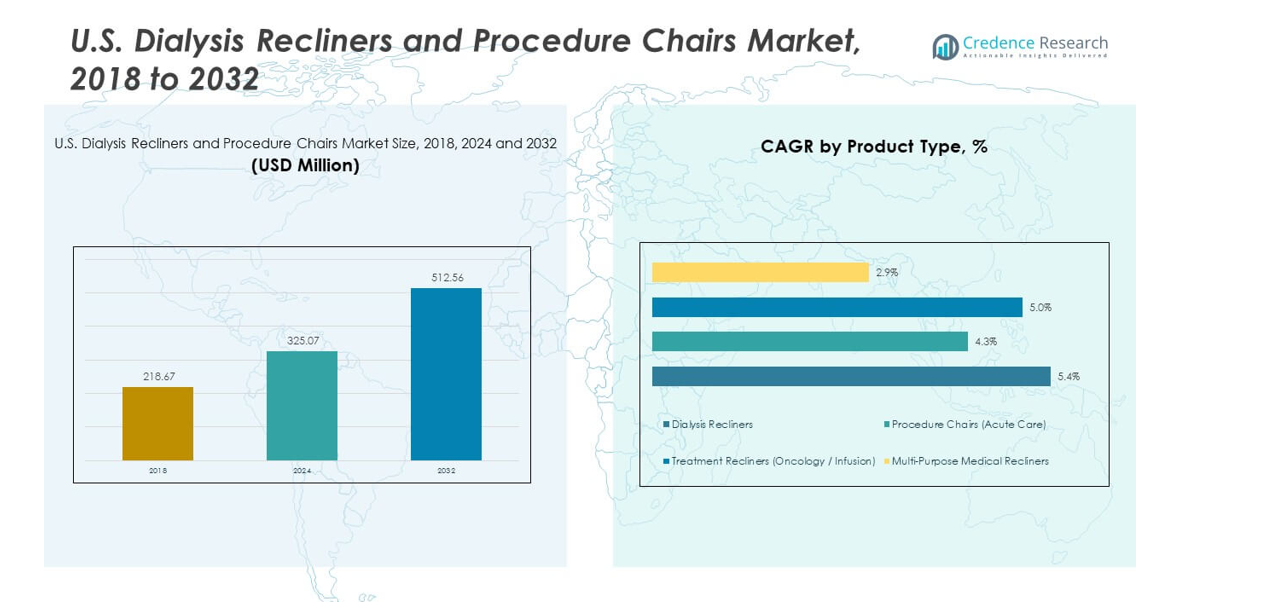
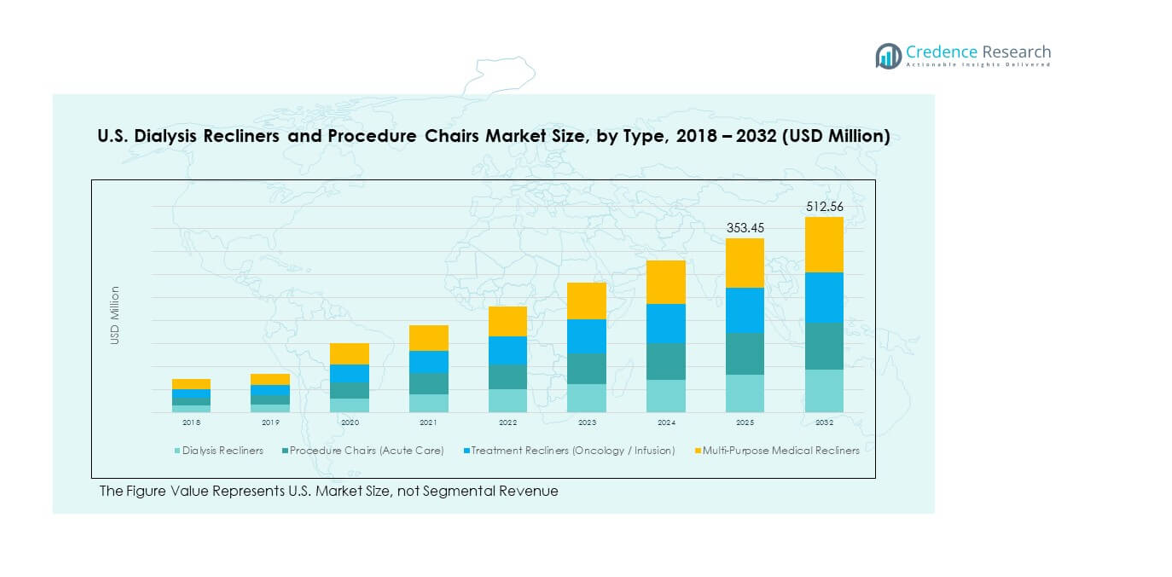
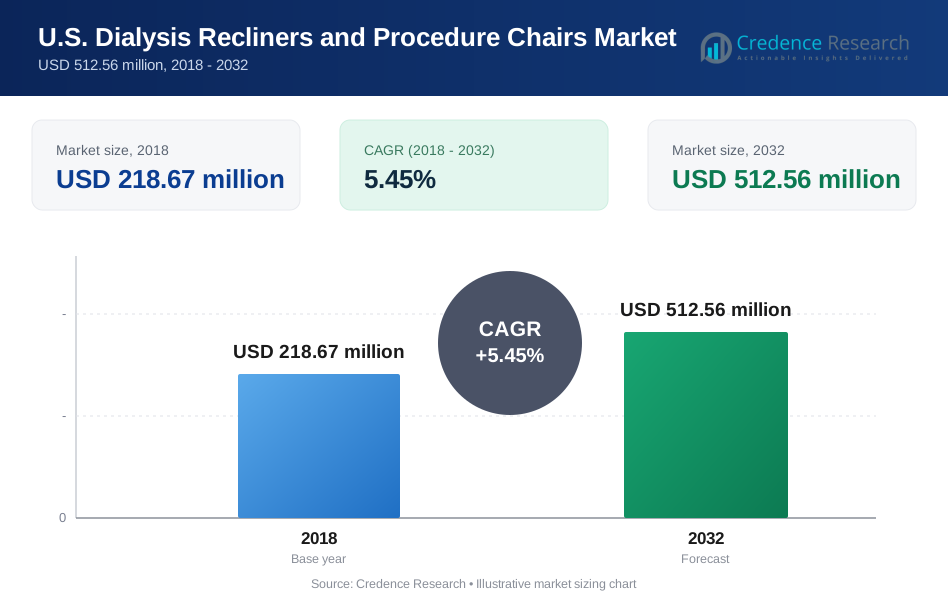
The U.S. Dialysis Recliners and Procedure Chairs Market size was valued at USD 218.67 million in 2018 to USD 325.07 million in 2024 and is anticipated to reach USD 512.56 million by 2032, at a CAGR of 5.45% during the forecast period.
| REPORT ATTRIBUTE | DETAILS |
|---|---|
| Historical Period | 2020-2023 |
| Base Year | 2024 |
| Forecast Period | 2025-2032 |
| U.S. Dialysis Recliners and Procedure Chairs Market Size 2024 | USD 325.07 million |
| U.S. Dialysis Recliners and Procedure Chairs Market, CAGR | 5.45% |
| U.S. Dialysis Recliners and Procedure Chairs Market Size 2032 | USD 512.56 million |
The growth of the U.S. Dialysis Recliners and Procedure Chairs Market is primarily driven by the increasing prevalence of chronic kidney disease (CKD) and end-stage renal disease (ESRD), which leads to more patients requiring dialysis. Advances in medical chair design, offering enhanced comfort and functionality, also boost demand. Healthcare institutions are investing in specialized recliners to improve patient experience and operational efficiency. These chairs, with ergonomic features and adjustability, are gaining popularity in both outpatient clinics and hospitals.
The U.S. remains the dominant region in this market, supported by its large and well-established healthcare infrastructure. The high incidence of renal diseases and the growing adoption of dialysis in various healthcare settings are key factors driving market growth. While North America leads, emerging markets like parts of Europe and Asia are witnessing steady increases in demand due to rising healthcare access and awareness of kidney diseases.
Market Insights:
- The U.S. Dialysis Recliners and Procedure Chairs Market was valued at USD 67 million in 2018, and is expected to grow to USD 512.56 million by 2032, at a CAGR of 5.45% during the forecast period.
- North America holds the largest share of the U.S. market, accounting for 70% due to its established healthcare infrastructure and high prevalence of CKD and ESRD. Europe follows with 15% share, driven by healthcare advancements and increasing renal care demands.
- The fastest-growing region is Asia-Pacific, with an expected share of 5% due to rising healthcare investments, improving healthcare access, and increasing chronic kidney disease cases in countries like China and India.
- In terms of segment distribution, Dialysis Recliners account for the largest share in the U.S. market, while Multi-Purpose Medical Recliners are projected to grow significantly, reflecting increased demand for versatile, multi-functional chairs across different treatment settings.
- The Procedure Chairs (Acute Care) segment holds a significant share, focusing on critical care needs, while Treatment Recliners (Oncology/Infusion) contribute substantially due to the growing use of recliners in oncology treatments.
Market Drivers:
Increasing Prevalence of Chronic Kidney Disease (CKD) and End-Stage Renal Disease (ESRD)
The U.S. Dialysis Recliners and Procedure Chairs Market benefits from the rising incidence of CKD and ESRD, which increases demand for dialysis treatments. As more people are diagnosed with kidney-related diseases, the need for more dialysis sessions grows. This directly impacts the demand for dialysis recliners and procedure chairs, as they are essential for the comfort and safety of patients during treatment. With CKD becoming more prevalent, healthcare facilities must invest in specialized seating to cater to this increasing patient population.
- For instance, major dialysis chains such as DaVita Inc. operate over 2,600 outpatient dialysis centers and serve more than 200,000 patients. The chairs and recliners support long treatment sessions, enhance patient comfort and safety, and fit the treatment models of increasing patient populations.
Technological Advancements in Dialysis Chairs
Technological innovations in dialysis recliners are a significant market driver. The U.S. Dialysis Recliners and Procedure Chairs Market sees continuous improvements in chair designs, offering enhanced comfort, durability, and functionality. Manufacturers are incorporating advanced features such as electronic adjustments, ergonomic designs, and easy-to-clean materials. These technological advancements contribute to greater patient satisfaction and operational efficiency for dialysis centers. The chairs' ability to meet specific patient needs, such as posture control and comfort, helps healthcare providers ensure the best possible patient experience during treatment.
- For instance, LINAK offers multi‑adjustable electric actuator systems that adjust height, backrest and leg‑rest positions to support both patients and caregivers.
Government Support for Renal Care Infrastructure
Government initiatives to improve healthcare facilities in the U.S. also support the market's growth. Federal funding and policies that promote better treatment options for CKD and ESRD patients are driving the expansion of dialysis centers across the country. Many healthcare providers are receiving grants to upgrade their infrastructure, which includes purchasing specialized equipment such as dialysis recliners and procedure chairs. With federal and state-level funding, healthcare providers are encouraged to offer high-quality care to meet the growing demand for kidney disease management.
Focus on Patient Comfort and Quality of Care
A key factor driving growth in the U.S. Dialysis Recliners and Procedure Chairs Market is the increasing focus on patient comfort and quality of care. Dialysis treatments often require long sessions, and ensuring patients' comfort during these times is critical to improving their overall experience. Healthcare providers are prioritizing patient-centered designs that provide support, comfort, and safety during treatments. This shift towards comfort-oriented solutions in dialysis clinics and hospitals leads to increased adoption of specialized recliners, driving market demand.
Market Trends:
Shift Toward Ergonomic and Adjustable Dialysis Recliners
A growing trend in the U.S. Dialysis Recliners and Procedure Chairs Market is the shift towards ergonomic, adjustable recliners. As the duration of dialysis treatments continues to increase, healthcare providers are investing in chairs that enhance patient comfort. Adjustable features, such as reclining positions and customizable armrests, are becoming standard in dialysis chairs. These innovations allow patients to maintain a comfortable position during extended sessions, reducing discomfort and improving the overall treatment experience.
- For instance, Digiterm Ltd.’s DiaCare‑3 treatment chair for dialysis and infusion therapy features a motorized height adjustment from 55 to 77 cm, leg‑rest tilt down by 30°, and integrates a Trendelenburg function for emergency use.
Rise in Home Dialysis Treatments
Another emerging trend is the rise of home dialysis treatments. As patients seek more convenient treatment options, many are opting for home dialysis, which requires specialized reclining chairs and equipment. The growing preference for home-based dialysis is influencing the U.S. Dialysis Recliners and Procedure Chairs Market, as these chairs are now being designed for home use. Companies are focusing on creating compact, portable, and easy-to-maintain chairs suitable for home environments, enabling patients to receive dialysis comfortably at home.
- For instance, data show that patients with ESKD who were initially wait‑listed for a transplant received home dialysis in 2021. Manufacturers now design compact, portable recliners tailored for home use with motorized adjustments and user‑friendly controls.
Integration of Smart Technology into Dialysis Chairs
Smart technology integration is another key trend shaping the U.S. Dialysis Recliners and Procedure Chairs Market. Manufacturers are incorporating digital features like built-in monitoring systems to track patient vital signs during dialysis sessions. These smart recliners can connect to healthcare networks, providing real-time data on patient comfort and health metrics. This technology offers healthcare providers enhanced insights into patient care, improving treatment outcomes and enhancing patient safety during long dialysis sessions.
Focus on Sustainable and Eco-friendly Materials
Sustainability is becoming a growing focus in the U.S. Dialysis Recliners and Procedure Chairs Market. Healthcare providers are increasingly prioritizing the use of eco-friendly materials in their equipment. Companies are working to develop chairs with recyclable components and sustainable production processes. The emphasis on sustainability aligns with broader trends in healthcare, where reducing environmental impact is a key goal. As patients and healthcare providers become more eco-conscious, the demand for sustainable dialysis recliners is expected to rise.
Market Challenges Analysis:
High Initial Cost of Dialysis Recliners and Procedure Chairs
One of the primary challenges in the U.S. Dialysis Recliners and Procedure Chairs Market is the high initial cost of specialized chairs. Dialysis recliners with advanced features, ergonomic designs, and smart technology often come at a premium price. Many healthcare providers, especially small dialysis centers, may find it challenging to invest in high-end equipment due to budget constraints. This cost barrier can limit the widespread adoption of these chairs, especially in regions with limited funding for healthcare infrastructure.
Regulatory Compliance and Quality Standards
Another challenge faced by the U.S. Dialysis Recliners and Procedure Chairs Market is ensuring compliance with strict regulatory and quality standards. Dialysis equipment must meet safety and quality requirements set by regulatory bodies such as the U.S. Food and Drug Administration (FDA). Healthcare providers and manufacturers must navigate complex regulatory processes to ensure that their products comply with medical device standards. This adds to the time and costs associated with bringing new dialysis recliners to market, creating additional challenges for companies in the industry.
Market Opportunities:
Expansion of Dialysis Centers in Underserved Regions
There is a significant market opportunity in the expansion of dialysis centers in underserved regions across the U.S. Many rural and low-income areas are lacking adequate access to dialysis treatment facilities. By increasing the availability of dialysis services in these regions, healthcare providers will require more dialysis recliners and procedure chairs. This market expansion presents a significant growth opportunity for manufacturers to supply these essential medical products to regions that need them most.
Rising Demand for Home Dialysis Solutions
The increasing demand for home dialysis solutions presents another major opportunity for the U.S. Dialysis Recliners and Procedure Chairs Market. As more patients opt for home-based dialysis, there is a growing need for specialized equipment designed for home use. Manufacturers can capitalize on this trend by developing lightweight, portable, and user-friendly dialysis recliners that cater to the needs of home dialysis patients. This segment holds potential for future growth as patients seek more personalized and flexible dialysis treatment options.
Market Segmentation Analysis:
By Product Type
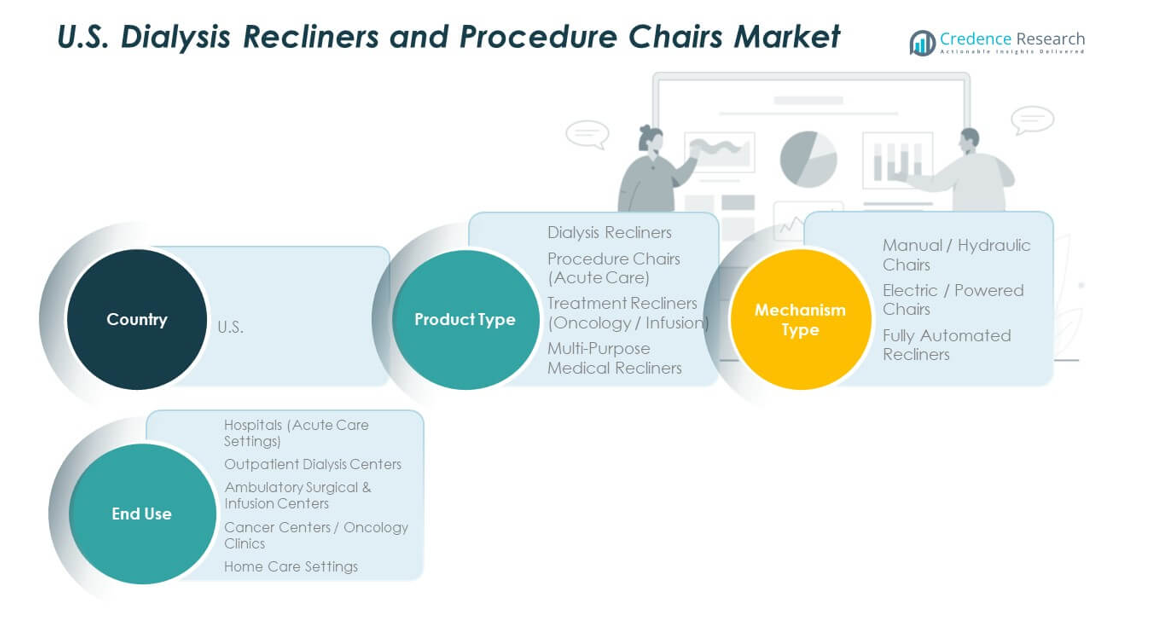
The U.S. Dialysis Recliners and Procedure Chairs Market is segmented into four key product types. Dialysis recliners are designed specifically for patient comfort during dialysis treatments, offering adjustable features and ergonomic support. Procedure chairs (acute care) are used in a variety of medical settings, providing stability and ease of access during treatments. Treatment recliners for oncology and infusion therapies cater to patients undergoing long treatment sessions, offering comfort and functionality. Multi-purpose medical recliners serve a broader range of treatments and healthcare settings, adapting to various patient needs.
- For instance, For instance, most clinical recliners include features like swing-away arms and heavy-duty construction, which are necessary for high-traffic clinical environments. Treatment recliners used for oncology and infusion therapies are specifically designed to cater to patients undergoing long treatment sessions, offering enhanced comfort, durability, and functionality through features like adjustable positioning and sanitizable upholstery.
By Mechanism Type
The market is further segmented by mechanism type, including manual/hydraulic chairs, electric/powered chairs, and fully automated recliners. Manual/hydraulic chairs are often preferred for their simplicity and cost-effectiveness, while electric/powered chairs offer ease of use and advanced adjustability. Fully automated recliners are becoming more common in healthcare settings, featuring advanced technology for optimal patient positioning, comfort, and monitoring, increasing their adoption in dialysis and other long-term treatment facilities.
- For instance, an electric dialysis chair model supports remote hand‑control adjustments and a load capacity of 200 kg with a motorised tilt and Trendelenburg function. Fully automated recliners are becoming more common in healthcare settings, featuring advanced technology for optimal patient positioning, comfort and monitoring, increasing their adoption in dialysis and other long‑term treatment facilities.
By End Use
In terms of end-use, the U.S. Dialysis Recliners and Procedure Chairs Market includes hospitals (acute care settings), outpatient dialysis centers, ambulatory surgical & infusion centers, cancer centers, and home care settings. Hospitals and outpatient dialysis centers dominate the market, driven by high patient volumes. Ambulatory surgical and cancer centers require specialized recliners for their patients, while the growing trend of home care settings presents emerging opportunities for portable, user-friendly recliners tailored to at-home dialysis treatments.
Segmentation:
By Product Type:- Dialysis Recliners
- Procedure Chairs (Acute Care)
- Treatment Recliners (Oncology / Infusion)
- Multi-Purpose Medical Recliners
- Manual / Hydraulic Chairs
- Electric / Powered Chairs
- Fully Automated Recliners
- Hospitals (Acute Care Settings)
- Outpatient Dialysis Centers
- Ambulatory Surgical & Infusion Centers
- Cancer Centers / Oncology Clinics
- Home Care Settings
Regional Analysis:
U.S. Regional Overview
The U.S. Dialysis Recliners and Procedure Chairs Market leads in North America, accounting for the largest share. The market is driven by the high prevalence of chronic kidney disease (CKD) and end-stage renal disease (ESRD), with dialysis becoming a critical treatment. Healthcare infrastructure in the U.S. is advanced, and the increasing adoption of specialized recliners and procedure chairs in hospitals, outpatient dialysis centers, and home care settings further supports market growth. The U.S. dominates due to its significant healthcare expenditure, large number of dialysis patients, and continuous investment in medical equipment upgrades. It holds more than 70% of the regional market share.
Canada Regional Overview
In Canada, the Dialysis Recliners and Procedure Chairs Market is experiencing steady growth, with demand increasing in line with the rising cases of CKD and ESRD. Although Canada has a smaller market share compared to the U.S., it benefits from a robust healthcare system and rising healthcare investments. The expansion of dialysis centers in urban and rural areas further drives demand for specialized reclining chairs. Canada accounts for about 15% of the North American market share, with strong potential for future growth, especially in remote and underserved regions where dialysis care is expanding.
Mexico Regional Overview
Mexico, as part of the Latin American region, is witnessing gradual growth in its dialysis recliner and procedure chair market. While its share in the North American market is relatively small, the increasing awareness of renal care and improved healthcare infrastructure provide an opportunity for expansion. As the number of dialysis patients rises, particularly in major cities, there is a growing need for advanced patient care furniture. Mexico holds approximately 5% of the North American market share but is poised for growth driven by an expanding healthcare sector and rising demand for medical equipment.
Key Player Analysis:
- Champion Manufacturing Inc.
- Stryker Corporation
- IOA Healthcare Furniture (IOA, Inc.)
- Graham-Field Health Products, Inc.
- Fresenius Medical Care
- Winco Mfg., LLC
- Medline Industries, LP
Competitive Analysis:
The U.S. Dialysis Recliners and Procedure Chairs Market is highly competitive, with key players focusing on innovation and patient comfort. Leading companies in this market include Champion Manufacturing, Stryker Corporation, IOA Healthcare Furniture, and Fresenius Medical Care. These players differentiate themselves through product advancements such as ergonomic designs, smart technology integration, and enhanced patient comfort features. Competitive strategies include expanding product portfolios, increasing manufacturing capabilities, and strengthening distribution channels. It also sees new entrants pushing innovation and offering cost-effective solutions. Companies are focusing on acquiring smaller firms to expand market share and diversify their offerings, enhancing their presence in North America.
Recent Developments:
- In October 2025, Medline Industries, LP announced it has entered into a new Prime Vendor agreement with Concerto Renal Services, a dialysis provider focused on serving nursing home residents within the comfort of their nursing home facilities. Medline and Concerto Renal Services signed the agreement in July 2025. As part of the agreement, Concerto uses Medline's extensive portfolio of medical products and supply chain infrastructure to support its network of facilities throughout 18 states. Concerto leverages Medline's Supply Chain Optimization capabilities to help streamline ordering, optimize inventory, and receive more timely, reliable delivery of medical supplies for their dialysis operations in nursing homehome settings.
- In May 2025, Fresenius Medical Care received FDA 510(k) clearance for the updated version of its 5008X CAREsystem with additional features. This additional clearance enabled the company to begin broader U.S. commercialization, deploying the machine to a first wave of Fresenius Kidney Care clinics for the remainder of 2025 and continuing broadly across the U.S. in 2026 and beyond. The updated 5008X CAREsystem includes the Fresenius Clinical Data Exchange® (CDX), a unique technology built into the 5008X that enables one-touch access to providers' medical information systems directly at chairside without the need for additional computer stations. In the U.S., there is an estimated installed base of around 160,000 in-center hemodialysis machines across all service providers that could be replaced to adapt this new standard of care.
- In January 2025, Stryker Corporation announced a definitive agreement to acquire Inari Medical, Inc. for approximately $4.8 billion. Under the terms of the offer, Stryker commenced a tender offer for all outstanding shares of common stock for $80 per share in cash. Inari Medical builds minimally invasive, novel, and catheter-based mechanical thrombectomy devices and accessories for specific diseases in the United States. This acquisition is expected to be accretive to Stryker's Neurovascular business and expands Stryker's portfolio to provide life-saving solutions to patients who suffer from peripheral vascular diseases.
Report Coverage:
The research report offers an in-depth analysis based on product type, mechanism type, and end-use. It details leading market players, providing an overview of their business, product offerings, investments, revenue streams, and key applications. Additionally, the report includes insights into the competitive environment, SWOT analysis, current market trends, as well as the primary drivers and constraints. Furthermore, it discusses various factors that have driven market expansion in recent years. The report also explores market dynamics, regulatory scenarios, and technological advancements that are shaping the industry. It assesses the impact of external factors and global economic changes on market growth. Lastly, it provides strategic recommendations for new entrants and established companies to navigate the complexities of the market.
Future Outlook:
- The U.S. Dialysis Recliners and Procedure Chairs Market is poised for steady growth driven by rising chronic kidney disease cases.
- Increasing healthcare infrastructure investments will support the demand for advanced dialysis equipment.
- Manufacturers are focusing on ergonomic, patient-friendly designs to improve comfort during long dialysis sessions.
- The market is witnessing a shift toward electric-powered and fully automated recliners for enhanced patient positioning.
- Home dialysis treatments will drive demand for compact and portable dialysis recliners in residential settings.
- Technological advancements such as smart recliners with built-in monitoring systems are expected to gain traction.
- The increasing number of outpatient dialysis centers and clinics will expand market opportunities.
- Government initiatives to expand healthcare services in underserved areas will boost market growth.
- Competitive pressure will encourage innovation in product features, including adjustable, multi-purpose chairs.
- The growing awareness of kidney health will foster demand for high-quality, specialized dialysis chairs.
Request a Free Sample
Fill in your details and we'll send you a free sample report.
- Sample data tables & charts
- Research methodology
Need a Custom Version of This Report?
Tailor the scope, geography, or segments to your exact requirements.
- Custom geography or segment scope
- Direct access to our analyst team
Frequently Asked Questions
What is the current market size for the U.S. Dialysis Recliners and Procedure Chairs Market, and what is its projected size in 2032?
At what Compound Annual Growth Rate is the U.S. Dialysis Recliners and Procedure Chairs Market projected to grow between 2024 and 2032?
Which U.S. Dialysis Recliners and Procedure Chairs Market segment held the largest share in 2024?
What are the primary factors fueling the growth of the U.S. Dialysis Recliners and Procedure Chairs Market?
Who are the leading companies in the U.S. Dialysis Recliners and Procedure Chairs Market?
Which region commanded the largest share of the U.S. Dialysis Recliners and Procedure Chairs Market in 2024?
Table of Content
Chapter 1. Report Introduction
- 1.1 Report Description & Purpose
- 1.1.1 Report Title & Market Definition
- 1.1.2 Unique Selling Propositions (USP) & Key Differentiators
- 1.1.3 Value Proposition for Stakeholders
- 1.2 Research Objectives
- 1.2.1 Market Sizing Objectives (Volume & Revenue)
- 1.2.2 Segmentation Objectives
- 1.2.3 Competitive Intelligence Objectives
- 1.2.4 Forecast & Scenario Objectives
- 1.3 Report Scope
- 1.3.1 U.S. Dialysis Recliners and Procedure Chairs Scope – Types & Subtypes Covered
- 1.3.2 Geographic Scope – Regions & Countries Covered
- 1.3.3 Historical Period, Base Year & Forecast Period (2018; forecast to 2032)
- 1.3.4 Inclusions & Exclusions
- 1.4 HS Code & Classification Framework
- 1.5 Currency, Units & Pricing Basis
- 1.6 Target Stakeholders
- 1.7 Limitations & Assumptions
Chapter 2. Executive Summary
- 2.1 Global U.S. Dialysis Recliners and Procedure Chairs Market Snapshot
- 2.1.1 Market Size – Historical (2018) & Forecast (2018-2032) (2018: USD 218.67 million → 2032: USD 512.56 million)
- 2.1.2 Volume & Revenue – Global Totals
- 2.1.3 Key Market Highlights – Top Five Facts
- 2.2 U.S. Dialysis Recliners and Procedure Chairs Market Segmentation Snapshot
- 2.2.1 Market Split by Region – 2018 vs. 2032
- 2.3 Competitive Snapshot
- 2.3.1 Top 10 Players by Revenue Share – 2018
- 2.3.2 Top 10 Players by Volume Share – 2018
- 2.3.3 Recent Strategic Developments (18-Month Summary)
- 2.4 Key Investment Highlights & Strategic Conclusions
Chapter 3. U.S. Dialysis Recliners and Procedure Chairs Market Dynamics & Industry Analysis
- 3.1 Market Overview & Context
- 3.1.1 U.S. Dialysis Recliners and Procedure Chairs Market Position in the Broader Automotive Value Chain
- 3.1.2 OEM vs. Replacement Market Dynamics
- 3.1.3 Market Maturity & Development Stage by Region
- 3.2 U.S. Dialysis Recliners and Procedure Chairs Market Drivers
- 3.3 U.S. Dialysis Recliners and Procedure Chairs Market Restraints & Challenges
- 3.4 U.S. Dialysis Recliners and Procedure Chairs Market Opportunities
- 3.5 Porter's Five Forces Analysis
- 3.5.1 Threat of New Entrants
- 3.5.2 Bargaining Power of Suppliers
- 3.5.3 Bargaining Power of Buyers
- 3.5.4 Threat of Substitutes
- 3.5.5 Competitive Rivalry – Intensity Assessment
- 3.6 U.S. Dialysis Recliners and Procedure Chairs Value Chain Analysis
- 3.6.1 Upstream – Raw Material/Input Suppliers
- 3.6.1.1 Raw Material/Input 1
- 3.6.1.2 Raw Material/Input 2
- 3.6.1.3 Raw Material/Input 3
- 3.6.2 Midstream – Production/Manufacturing/Service Delivery
- 3.6.2.1 Production/Process Overview
- 3.6.2.2 Key Facility Locations & Capacity by Manufacturer
- 3.6.3 Downstream – Distribution & End Consumer
- 3.6.3.1 Primary Channel – B2B/OEM
- 3.6.3.2 Secondary Channels – Dealer, Retail, Online, Direct
- 3.6.4 Value Chain Profitability Analysis
- 3.6.1 Upstream – Raw Material/Input Suppliers
- 3.7 PESTEL Analysis
- 3.7.1 Political Factors
- 3.7.2 Economic Factors
- 3.7.3 Social Factors
- 3.7.4 Technological Factors
- 3.7.5 Environmental Factors
- 3.7.6 Legal Factors
- 3.8 U.S. Dialysis Recliners and Procedure Chairs Supply Chain Analysis
- 3.8.1 Raw Material/Input Supply Risk Assessment
- 3.8.2 Manufacturing Concentration Risk (Geographic Exposure)
- 3.8.3 Trade Disruption Impact Analysis
- 3.9 Regulatory & Policy Landscape
Note: The regulatory and policy landscape section covers regulations based on their applicability to the market, U.S. Dialysis Recliners and Procedure Chairs category, geography, and scope of the study. Only regulatory frameworks with a material impact on operations, compliance, trade, sustainability, or market access are analyzed in detail.
Chapter 4. Key Investment Pockets & Opportunity Analysis
- 4.1 U.S. Dialysis Recliners and Procedure Chairs Market Attractiveness Analysis
- 4.1.1 By Region – Investment Attractiveness Matrix (Volume × CAGR)
- 4.2 Absolute Revenue Growth Opportunity
- 4.2.1 By Region – Absolute USD Growth Through 2032
- 4.3 Incremental Volume Opportunity
- 4.3.1 By Region – Incremental Volume Through 2032
- 4.3.2 Segment – Incremental Volume
- 4.4 Emerging Submarket Opportunity Deep Dive (Subject to Applicability)
- 4.5 Emerging Market Opportunity Scorecards
- 4.5.1 United States
- 4.5.2 Europe
- 4.5.3 Asia
- 4.5.4 Middle East & Africa
Note: Emerging Market Opportunity Scorecards will be included based on relevance and strategic importance. Regions listed are indicative and may vary depending on data availability and market dynamics.
Chapter 5. U.S. Dialysis Recliners and Procedure Chairs Import-Export Analysis & Trade Flows
- 5.1 Global Trade Overview
- 5.1.1 Global Export Value by Country (2018)
- 5.1.2 Global Export Volume by Country (2018)
- 5.1.3 Global Import Value by Country (2018)
- 5.1.4 Global Import Volume by Country (2018)
- 5.1.5 Net Trade Balance by Country (2018)
- 5.2 Export Analysis – Segment
- 5.2.1 Type 1 (HS Code)
- 5.2.2 Type 2 (HS Code)
- 5.2.3 Type 3 (HS Code)
- 5.2.4 Type 4 (HS Code)
- 5.2.5 Type 5 (HS Code)
- 5.3 Import Analysis – Segment
- 5.3.1 Type 1 (HS Code)
- 5.3.2 Type 2 (HS Code)
- 5.3.3 Type 3 (HS Code)
- 5.3.4 Type 4 (HS Code)
- 5.3.5 Type 5 (HS Code)
- 5.4 Average Unit Trade Prices
- 5.4.1 Average Export Price – Segment & Country
- 5.4.2 Average Import Price – Segment & Source Country
- 5.4.3 Price Trends (2018)
- 5.5 Key Trade Route Analysis
- 5.5.1 Trade Route 1
- 5.5.2 Trade Route 2
- 5.5.3 Trade Route 3
- 5.5.4 Trade Route 4
- 5.5.5 Trade Route 5
- 5.6 Trade Policy Impact Assessment
- 5.6.1 US Anti-Dumping & Section 301 Tariffs
- 5.6.2 EU Customs Union Impact
- 5.6.3 Major Free Trade Agreements
- 5.6.4 USMCA Rules of Origin
Note: Trade policy analysis will be included only where relevant to the U.S. Dialysis Recliners and Procedure Chairs market.
Chapter 6. Competitive Landscape & Company Benchmarking
- 6.1 U.S. Dialysis Recliners and Procedure Chairs Market Concentration & Structure
- 6.1.1 Herfindahl-Hirschman Index (HHI) – vs. 2018
- 6.1.2 Tier 1, Tier 2 & Tier 3 Market Structure
- 6.1.3 Global, Regional & Local Player Dynamics
- 6.2 U.S. Dialysis Recliners and Procedure Chairs Market Share Analysis – 2018
- 6.2.1 Global Revenue Share by Company
- 6.2.2 Global Volume Share by Company
- 6.2.3 Regional Revenue Share
- 6.2.4 Market Share Evolution ( vs. 2018)
- 6.2.5 OEM Segment Share by Company
- 6.2.6 Replacement Segment Share by Company
- 6.3 Production/Delivery Capacity & Facility Analysis
- 6.3.1 Global Installed Capacity
- 6.3.2 Capacity Utilization Rates
- 6.3.3 Production/Output Volume
- 6.3.4 Facility Locations & Capacity Map
- 6.3.5 Planned Capacity Additions
- 6.4 U.S. Dialysis Recliners and Procedure Chairs Competitive Benchmarking Matrix
- 6.4.1 Revenue, Volume, CAGR & Profitability Comparison
- 6.4.2 Channel Revenue Mix
- 6.4.3 Geographic Revenue Exposure
- 6.4.4 R&D Intensity
- 6.4.5 Sustainability Maturity
- 6.5 Strategic Developments in U.S. Dialysis Recliners and Procedure Chairs (Last 24 Months)
- 6.5.1 Mergers, Acquisitions & Divestments
- 6.5.2 New U.S. Dialysis Recliners and Procedure Chairs Launches
- 6.5.3 Facility Expansions
- 6.5.4 Strategic Alliances, Joint Ventures & Partnerships
- 6.5.5 Distribution Expansion & Market Entry
- 6.5.6 Sustainability & ESG Initiatives
- 6.6 Competitive Strategy Mapping
- 6.6.1 Leader, Challenger, Follower & Niche Classification
- 6.6.2 Pricing Strategy Comparison
- 6.6.3 Channel Strategy Matrix
Note: Strategic developments are included based on their materiality and the availability of reliable information.
Chapter 7. Global U.S. Dialysis Recliners and Procedure Chairs Market – By Distribution Channel
- 7.1 Segment Overview
- 7.1.1 Volume & Revenue Split by Channel (2018 & 2032)
- 7.1.2 Channel Mix Evolution (2018-2032)
Chapter 8. Regional Market Analysis – Global Overview
- 8.1 Global Regional Overview
- 8.1.1 Regional Volume Share
- 8.1.2 Regional Revenue Share
- 8.1.3 Regional Volume by Region
- 8.1.4 Regional Revenue by Region
- 8.1.5 Regional Forecast Through 2032
- 8.2 Cross-Regional Segment Analysis
- 8.2.1 By Distribution Channel
- 8.2.2 By Brand/Price Tier
Chapter 9. North America U.S. Dialysis Recliners and Procedure Chairs Market
- 9.1 United States
- 9.2 Canada
- 9.3 Mexico
Chapter 10. Europe U.S. Dialysis Recliners and Procedure Chairs Market
- 10.1 Germany
- 10.2 France
- 10.3 Italy
- 10.4 United Kingdom
- 10.5 Spain
- 10.6 Poland
- 10.7 Russia
- 10.8 Netherlands
- 10.9 Belgium
- 10.10 Sweden
- 10.11 Denmark
- 10.12 Norway
- 10.13 Rest of Europe
Chapter 11. Asia Pacific U.S. Dialysis Recliners and Procedure Chairs Market
- 11.1 China
- 11.2 India
- 11.3 Japan
- 11.4 South Korea
- 11.5 Thailand
- 11.6 Indonesia
- 11.7 Vietnam
- 11.8 Malaysia
- 11.9 Australia
- 11.10 Rest of Asia Pacific
Chapter 12. Latin America U.S. Dialysis Recliners and Procedure Chairs Market
- 12.1 Brazil
- 12.2 Argentina
- 12.3 Colombia
- 12.4 Chile
- 12.5 Rest of Latin America
Chapter 13. Middle East U.S. Dialysis Recliners and Procedure Chairs Market
- 13.1 Saudi Arabia
- 13.2 United Arab Emirates
- 13.3 Turkey
- 13.4 Israel
- 13.5 Iran
- 13.6 Rest of the Middle East
Chapter 14. Africa U.S. Dialysis Recliners and Procedure Chairs Market
- 14.1 South Africa
- 14.2 Egypt
- 14.3 Nigeria
- 14.4 Morocco
- 14.5 Rest of Africa
Chapter 15. U.S. Dialysis Recliners and Procedure Chairs Company Profiles
- 15.1 [Company 01]
- 15.1.1 Company Overview
- 15.1.2 Key Management Personnel
- 15.1.3 Products & Services Portfolio
- 15.1.4 Financial Performance
- 15.1.5 Key Market Focus & Geographic Presence
- 15.1.6 Recent Developments & Strategic Initiatives
Note: The company profile list is preliminary and may change based on research findings, market developments, data availability, and client requirements.
Chapter 16. Appendices
- Appendix A – List of Abbreviations & Acronyms
- Appendix B – Industry Classification Code Reference – Full Series
- Appendix C – Production & Capacity Data Tables
- Appendix D – End-Use & Demand Base Tables
- Appendix E – Consumption & Replacement Rate Assumptions
- Appendix F – ASP Reference Tables
- Appendix G – Manufacturing & Facility Database
- Appendix H – Import-Export Data Tables
- Appendix I – Regulatory Summary Tables
- Appendix J – Primary Research Participant List (Anonymized)
- Appendix K – Primary Research Questionnaire Framework
- Appendix L – Data Sources & Bibliography
- Appendix M – Market Size Divergence & Source Comparison
Chapter 17. Research Methodology
- 17.1 Research Framework & Philosophy
- 17.2 Secondary Research – Sources, Hierarchy & Data Extraction
- 17.3 Data Modeling – Bottom-Up & Top-Down Market Sizing
- 17.4 Primary Research – Stakeholder Framework, LOI & Sample Sizes
- 17.5 Forecast Methodology – Regression, Scenario & Sensitivity Analysis
- 17.6 Quality Control – Four-Layer Validation Framework
- 17.7 Limitations & Standard Assumptions
- 17.8 Disclaimer
