
Market Overview:
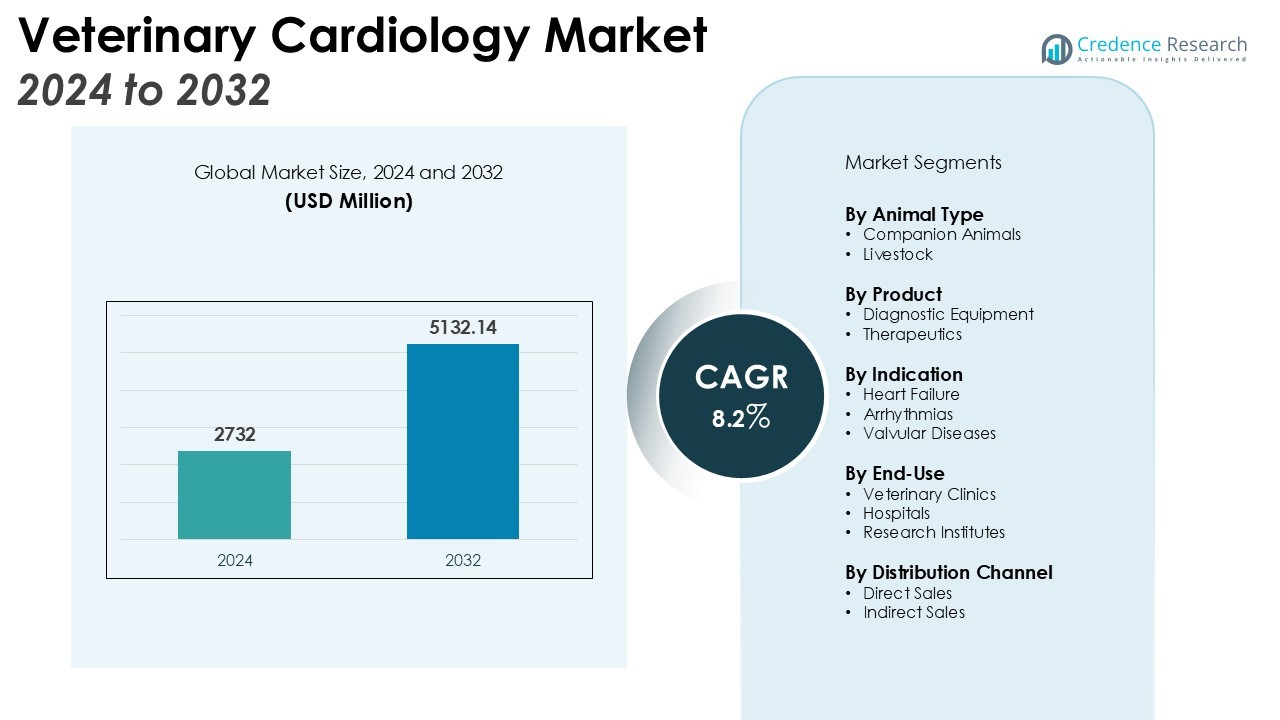
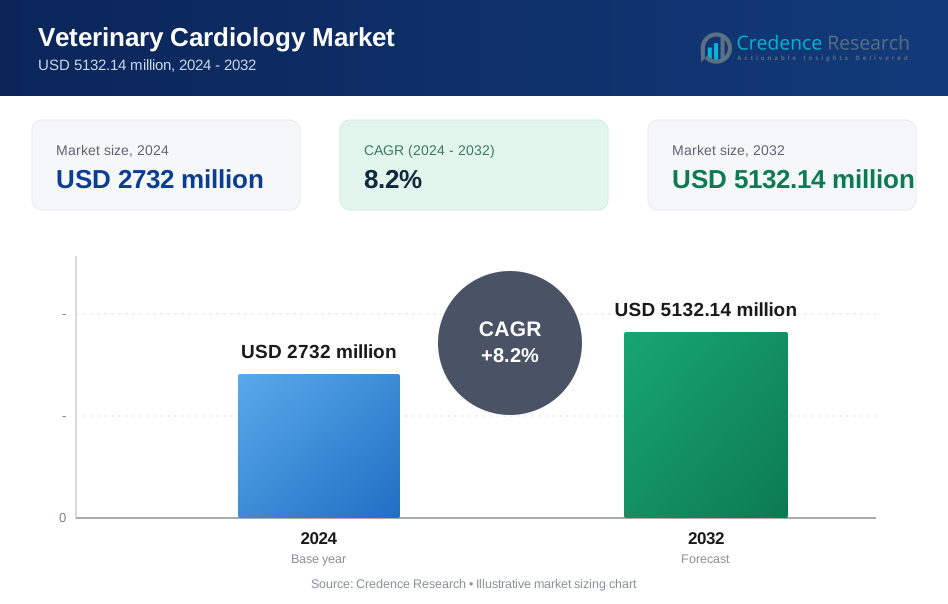
The Veterinary Cardiology Market size was valued at USD 2732 million in 2024 and is anticipated to reach USD 5132.14 million by 2032, at a CAGR of 8.2% during the forecast period (2024-2032).
| REPORT ATTRIBUTE | DETAILS |
|---|---|
| Historical Period | 2020-2024 |
| Base Year | 2024 |
| Forecast Period | 2025-2032 |
| Veterinary Cardiology Market Size 2024 | USD 2732 Million |
| Veterinary Cardiology Market, CAGR | 8.2% |
| Veterinary Cardiology Market Size 2032 | USD 5132.14 Million |
Key drivers of the market include the rising adoption of pets, particularly in developed countries, and the growing demand for advanced veterinary cardiology treatments and diagnostic tools. Moreover, the increasing availability of specialized veterinary cardiology services, such as echocardiography and electrocardiogram (ECG) diagnostics, is further accelerating market growth. Additionally, advancements in veterinary cardiac therapeutics, including new drug formulations and minimally invasive surgical procedures, are enhancing the effectiveness of treatments and boosting the market's expansion. The growing focus on preventive care for pets and increasing pet healthcare expenditure are also contributing significantly to market growth.
Regionally, North America holds the largest market share, supported by a strong veterinary healthcare infrastructure and high pet ownership rates. Europe follows closely, with a growing demand for veterinary cardiology services driven by the increasing incidence of heart diseases in companion animals. The Asia-Pacific region is expected to witness the highest growth rate, fueled by improving veterinary care standards, rising disposable incomes, and growing pet adoption in countries like China and India. Additionally, the increasing penetration of veterinary cardiology centers in emerging markets is further boosting regional market growth.
Market Insights:
- The Veterinary Cardiology Market size is valued at USD 2732 million in 2024 and is expected to reach USD 5132.14 million by 2032, growing at a CAGR of 8.2%, driven by rising pet adoption and advancements in diagnostics and treatments.
- Increased pet adoption, especially in developed countries, is driving demand for specialized veterinary cardiology services, particularly for aging pets at higher risk for cardiovascular diseases.
- Advancements in veterinary diagnostic tools like echocardiograms and ECGs enable early detection and effective monitoring of heart conditions, boosting demand for cardiology services.
- Continuous development in veterinary cardiac therapeutics, including new drugs and minimally invasive procedures, enhances treatment effectiveness and improves pets' quality of life.
- Growing emphasis on preventive healthcare is encouraging regular heart screenings, leading to higher demand for veterinary cardiology services among proactive pet owners.
- The high cost of advanced diagnostic tools and treatments limits access to veterinary cardiology services for smaller clinics and pet owners in lower-income regions.
- The shortage of skilled veterinary cardiologists affects market growth, leading to longer wait times for appointments and limiting accessibility to specialized care.
Market Drivers:
Rising Pet Adoption and Increasing Demand for Specialized Care
The Veterinary Cardiology Market is benefiting from the rising adoption of pets globally, particularly in developed countries. More households are welcoming pets, resulting in a larger pet population that requires comprehensive veterinary care, including cardiology services. As pets age, the likelihood of cardiovascular diseases increases, driving the demand for specialized diagnostics and treatments. This trend is amplifying the need for veterinary cardiologists and advanced heart care solutions for animals.
- For instance, in 2024, approximately 4.1 million cats and dogs found new homes through adoption from U.S. animal shelters, creating a significant population of pets that will require ongoing veterinary services.
Advancements in Veterinary Cardiological Diagnostic Tools
Technological advancements in veterinary cardiology diagnostics are significantly contributing to the market's growth. The availability of advanced tools, such as echocardiography, electrocardiograms (ECGs), and Holter monitoring, has improved the ability to diagnose heart conditions early. Veterinary Cardiology Market growth is also supported by the increasing adoption of non-invasive procedures that enable better detection and monitoring of cardiac conditions in pets, resulting in more effective treatments and better long-term health outcomes.
- For instance, the EPIC study, a major clinical trial in veterinary cardiology involving 36 centers, demonstrated the benefits of early intervention for canine heart disease.
Developments in Veterinary Cardiac Therapeutics
The market is further expanding due to the continuous development of innovative veterinary cardiac therapeutics. New drug formulations and treatments specifically designed for animals with heart disease are gaining popularity. Minimally invasive surgical techniques, such as catheter-based interventions, have also enhanced treatment effectiveness while reducing recovery time for pets. These advancements improve the quality of life for pets with cardiac conditions, driving increased demand for veterinary cardiology services.
Growing Focus on Preventive Pet Healthcare
An increasing focus on preventive care within the pet healthcare industry is another important driver of the Veterinary Cardiology Market. Pet owners are becoming more proactive about managing their pets' health, particularly heart health, through regular screenings and check-ups. This growing awareness and prioritization of preventive measures are stimulating greater demand for veterinary cardiology services, ensuring that cardiac issues are detected and treated at an earlier stage.
Market Trends:
Increasing Adoption of Advanced Cardiac Monitoring Technology
A key trend in the Veterinary Cardiology Market is the growing use of advanced cardiac monitoring technology. The demand for cutting-edge diagnostic tools such as echocardiography, ECGs, and portable monitoring devices is increasing as pet owners and veterinary professionals focus on early detection and continuous monitoring of heart conditions. These technologies allow for more accurate, real-time data, enhancing treatment plans and improving patient outcomes. Veterinary practices are increasingly adopting these high-tech solutions, making them more accessible and efficient. This shift toward sophisticated cardiac care tools is fueling market growth and encouraging veterinary practices to stay ahead of technological advancements in the field.
- For instance, the Vetcorder-Pro by MAI Animal Health is a handheld, multi-parameter monitor that can track ECG and vital signs continuously, this device has a battery life of up to 12 hours, which allows veterinary staff to monitor several patients from intake through recovery before needing to recharge it.
Expansion of Veterinary Cardiology Services in Emerging Markets
Another notable trend is the expansion of veterinary cardiology services in emerging markets. As pet ownership rises in developing regions, particularly in Asia-Pacific and Latin America, the demand for specialized veterinary care is growing. These markets are seeing the establishment of more veterinary cardiology clinics and specialized centers to cater to the increasing number of pets requiring heart care. The availability of more skilled cardiologists and advanced diagnostic equipment in these regions is enhancing the quality of care and promoting market expansion. This trend is expected to continue as the global pet population increases and awareness of animal health improves.
- For instance, Veterinary Cardiologists Australia (VCA) announced the upcoming opening of Australia's first dedicated veterinary cardiology hospital in early 2025.
Market Challenges Analysis:
High Cost of Advanced Cardiology Equipment and Treatments
A significant challenge in the Veterinary Cardiology Market is the high cost of advanced cardiology equipment and treatments. High-tech diagnostic tools, such as echocardiograms, ECGs, and specialized surgical instruments, can be prohibitively expensive for smaller veterinary practices, limiting access to these services. These costs often translate into higher treatment fees, making it difficult for some pet owners to afford comprehensive heart care for their pets. The financial burden on both veterinary clinics and pet owners can hinder market growth, particularly in regions with lower income levels.
Shortage of Skilled Veterinary Cardiologists
Another challenge facing the Veterinary Cardiology Market is the shortage of skilled veterinary cardiologists. The specialized nature of the field requires extensive training and expertise, which is in limited supply. As demand for veterinary cardiology services increases, there is a growing gap in the availability of qualified professionals to meet the needs of a growing pet population. This shortage can lead to longer wait times for appointments and limited access to expert care, affecting market expansion. Addressing this gap in workforce capacity is crucial for the continued development of the market.
Market Opportunities:
Expansion of Preventive Healthcare for Pets
The increasing focus on preventive healthcare presents a significant opportunity for the Veterinary Cardiology Market. Pet owners are becoming more proactive in managing their pets’ health, driving demand for regular cardiac screenings and early intervention. This shift in attitude towards preventive care opens up new avenues for veterinary clinics to offer diagnostic services, promoting long-term heart health. As pet owners become more aware of the importance of early detection, the market for veterinary cardiology services will likely see sustained growth, especially with innovations in affordable diagnostic tools and services tailored for routine check-ups.
Growth in Emerging Markets and Veterinary Cardiology Training
Another key opportunity lies in the expansion of veterinary cardiology services in emerging markets. As pet ownership continues to rise in regions such as Asia-Pacific and Latin America, the demand for specialized heart care for pets is increasing. This creates a market opportunity for veterinary practices to introduce cardiology services and tap into these developing markets. Furthermore, there is an opportunity to invest in training and education programs for veterinary cardiologists, addressing the shortage of skilled professionals. Expanding educational infrastructure and enhancing expertise in veterinary cardiology will support long-term market growth, ensuring a well-trained workforce to meet growing demand.
Market Segmentation Analysis:
By Animal Type
The Veterinary Cardiology Market is primarily segmented by animal type into companion animals and livestock. Companion animals, particularly dogs and cats, hold the largest market share due to their increased adoption in households and the rising demand for specialized heart care services. These animals are more prone to cardiovascular diseases due to aging, making them the primary focus of veterinary cardiology services. Livestock animals, while a smaller segment, also contribute to the market, especially in regions with extensive farming practices where heart diseases are diagnosed and treated to maintain herd health and productivity.
- For instance, the University of Florida's cardiology service initiated a first-of-its-kind pilot study to treat dilated cardiomyopathy (DCM) in 15 Doberman Pinschers, a breed with a high mortality rate from the disease, using adult stem cells.
By Product
The market is also segmented by product into diagnostic equipment and therapeutics. Diagnostic tools, such as echocardiograms, electrocardiograms (ECGs), and Holter monitors, dominate the market due to their critical role in early heart disease detection and ongoing monitoring. Therapeutic products, including medications for heart failure and arrhythmia, represent a growing segment, driven by advances in veterinary cardiac drug formulations and minimally invasive surgical techniques. The demand for both diagnostic and therapeutic products continues to rise as veterinary cardiology becomes more sophisticated.
- For instance, in a key laboratory study for Zoetis's ProHeart® 12 injectable, all treated dogs were found to have 0 adult heartworms, demonstrating a complete prevention of the disease for a full 12 months after a single dose.
By Indication
The Veterinary Cardiology Market is segmented by indication into heart failure, arrhythmias, and valvular diseases. Heart failure accounts for the largest share of the market, driven by the prevalence of this condition in aging pets. Arrhythmias and valvular diseases are also significant contributors, with growing treatment options and specialized services improving the prognosis and quality of life for affected animals.
Segmentations:
By Animal Type
- Companion Animals
- Livestock
By Product
- Diagnostic Equipment
- Therapeutics
By Indication
- Heart Failure
- Arrhythmias
- Valvular Diseases
By End-Use
- Veterinary Clinics
- Hospitals
- Research Institutes
By Distribution Channel
- Direct Sales
- Indirect Sales
By Region
- North America
- U.S.
- Canada
- Mexico
- Europe
- Germany
- France
- U.K.
- Italy
- Spain
- Rest of Europe
- Asia Pacific
- China
- Japan
- India
- South Korea
- South-east Asia
- Rest of Asia Pacific
- Latin America
- Brazil
- Argentina
- Rest of Latin America
- Middle East & Africa
- GCC Countries
- South Africa
- Rest of the Middle East and Africa
Regional Analysis:
North America: Leading in Veterinary Cardiology
North America holds 40% of the global Veterinary Cardiology Market share, driven by a strong veterinary healthcare infrastructure and high pet ownership rates. The region’s well-established pet care industry, particularly in the United States, has led to greater awareness about pet health, including cardiovascular conditions. This awareness, coupled with access to advanced diagnostic tools and treatments, contributes significantly to the region’s market dominance. The increasing adoption of advanced veterinary cardiology services, such as echocardiography and minimally invasive surgeries, is expected to further fuel market growth in North America.
Europe: Steady Growth with Advanced Cardiology Solutions
Europe holds 30% of the global market share, with key contributions from countries like the UK, Germany, and France. The demand for veterinary cardiology services in Europe is increasing, driven by the rising incidence of cardiovascular diseases in companion animals. European countries have robust veterinary care systems, with veterinary cardiology practices gaining popularity. The growth of advanced diagnostic and therapeutic solutions, such as digital ECGs and telemedicine services, is expanding access to specialized heart care. These trends suggest that Europe will continue to see steady growth in the Veterinary Cardiology Market.
Asia-Pacific: Emerging Market with High Growth Potential
The Asia-Pacific region holds 20% of the global Veterinary Cardiology Market share and is expected to witness the highest growth rate. With increasing pet adoption rates and improving veterinary care standards, countries like China, India, and Japan are seeing rising demand for specialized veterinary cardiology services. The growing middle class and increasing disposable incomes in these countries have led to higher spending on pet healthcare. As pet owners become more aware of the importance of heart health, the market for veterinary cardiology services in the region is poised for rapid expansion. The rise in veterinary cardiology training and infrastructure development further supports this growth.
Key Player Analysis:
- FUJIFILM Holdings America Corporation
- ESAOTE SPA
- Boehringer Ingelheim International GmbH
- Jurox Pty Limited
- General Electric Company
- Merck & Co., Inc.
- IDEXX
- Ceva
- SOUND
- Apex Bio Medical
Competitive Analysis:
The Veterinary Cardiology Market is highly competitive, with key players striving to enhance their product portfolios and expand market presence. Major companies focus on the development of advanced diagnostic tools, such as echocardiograms, ECGs, and Holter monitors, while also improving therapeutic solutions for heart failure, arrhythmias, and valvular diseases. Leading players, such as IDEXX Laboratories, Hill's Pet Nutrition, and Vetology, invest significantly in research and development to offer innovative solutions that cater to the growing demand for specialized veterinary cardiology services. Partnerships with veterinary clinics and hospitals further strengthen their market positions. The increasing availability of non-invasive procedures and the adoption of telemedicine in veterinary cardiology are also reshaping the competitive landscape. With growing pet ownership and rising awareness of pet health, competition in the market is expected to intensify as companies continue to innovate and expand their global reach.
Recent Developments:
- In July 2025, Fujifilm launched the FDR Go iS, a portable digital radiography system for hospitals and ambulatory surgery centers.
- In July 2025, Esaote presented the Vet-MR Grande ELITE, its next-generation veterinary MRI, at the European College of Veterinary Surgeons (ECVS) 2025 meeting.
- In March 2025, GE Aerospace announced an investment of nearly $1 billion into its U.S. manufacturing and supply chain throughout 2025.
Market Concentration & Characteristics:
The Veterinary Cardiology Market is characterized by moderate concentration, with several key players dominating the industry. Leading companies, including IDEXX Laboratories, Zoetis, and Hill's Pet Nutrition, hold significant market shares due to their established product portfolios and strong distribution networks. The market features a mix of large multinational corporations and smaller specialized firms that focus on developing advanced diagnostic and therapeutic solutions for veterinary cardiology. It is marked by ongoing innovation, particularly in non-invasive diagnostic technologies and specialized cardiac therapeutics. While major players maintain a competitive edge, smaller companies are also emerging with niche offerings and tailored services, contributing to market diversity. The increasing adoption of telemedicine and digital diagnostic tools is further reshaping the market landscape, driving both collaboration and competition among industry participants.
Report Coverage:
The research report offers an in-depth analysis based on Animal Type, Product, Indication, End-Use, Distribution Channel and Region. It details leading market players, providing an overview of their business, product offerings, investments, revenue streams, and key applications. Additionally, the report includes insights into the competitive environment, SWOT analysis, current market trends, as well as the primary drivers and constraints. Furthermore, it discusses various factors that have driven market expansion in recent years. The report also explores market dynamics, regulatory scenarios, and technological advancements that are shaping the industry. It assesses the impact of external factors and global economic changes on market growth. Lastly, it provides strategic recommendations for new entrants and established companies to navigate the complexities of the market.
Future Outlook:
- The Veterinary Cardiology Market will continue to benefit from the rising pet ownership and increasing awareness of cardiovascular health in animals.
- Advanced diagnostic technologies, such as echocardiograms, ECGs, and Holter monitors, will see wider adoption across veterinary practices.
- Non-invasive diagnostic tools will play a pivotal role in expanding access to early detection and treatment of heart conditions in pets.
- Growth in veterinary cardiology services will be driven by the increasing focus on preventive care and regular screenings for aging pets.
- Expanding veterinary care infrastructure in emerging markets, particularly in Asia-Pacific and Latin America, will fuel market growth.
- The introduction of innovative cardiac therapeutics, including new drug formulations and minimally invasive surgical procedures, will enhance treatment options.
- Increased investment in veterinary cardiology research will drive breakthroughs in treatments for heart failure, arrhythmias, and valvular diseases.
- Telemedicine and remote monitoring solutions will become more integrated into veterinary cardiology services, offering greater convenience and access.
- Smaller veterinary practices will increasingly adopt advanced cardiology tools as costs decrease and availability increases.
- Collaboration between veterinary cardiology professionals, pharmaceutical companies, and diagnostic device manufacturers will foster innovation and drive future market expansion.
Request a Free Sample
Fill in your details and we'll send you a free sample report.
- Sample data tables & charts
- Research methodology
Need a Custom Version of This Report?
Tailor the scope, geography, or segments to your exact requirements.
- Custom geography or segment scope
- Direct access to our analyst team
Frequently Asked Questions
What is the current market size for Veterinary Cardiology, and what is its projected size in 2032?
At what Compound Annual Growth Rate is the Veterinary Cardiology market projected to grow between 2024 and 2032?
Which Veterinary Cardiology market segment held the largest share in 2024?
What are the primary factors fueling the growth of the Veterinary Cardiology market?
Who are the leading companies in the Veterinary Cardiology market?
Which region commanded the largest share of the Veterinary Cardiology market in 2024?
Table of Content
Chapter 1. Report Introduction
- 1.1 Report Description & Purpose
- 1.1.1 Report Title & Market Definition
- 1.1.2 Unique Selling Propositions (USP) & Key Differentiators
- 1.1.3 Value Proposition for Stakeholders
- 1.2 Research Objectives
- 1.2.1 Market Sizing Objectives (Volume & Revenue)
- 1.2.2 Segmentation Objectives
- 1.2.3 Competitive Intelligence Objectives
- 1.2.4 Forecast & Scenario Objectives
- 1.3 Report Scope
- 1.3.1 Veterinary Cardiology Scope – Types & Subtypes Covered
- 1.3.2 Geographic Scope – Regions & Countries Covered
- 1.3.3 Historical Period, Base Year & Forecast Period (2024; forecast to 2032)
- 1.3.4 Inclusions & Exclusions
- 1.4 HS Code & Classification Framework
- 1.5 Currency, Units & Pricing Basis
- 1.6 Target Stakeholders
- 1.7 Limitations & Assumptions
Chapter 2. Executive Summary
- 2.1 Global Veterinary Cardiology Market Snapshot
- 2.1.1 Market Size – Historical (2024) & Forecast (2024-2032) (2024: USD 2732 million → 2032: USD 5132.14 million)
- 2.1.2 Volume & Revenue – Global Totals
- 2.1.3 Key Market Highlights – Top Five Facts
- 2.2 Veterinary Cardiology Market Segmentation Snapshot
- 2.2.1 Market Split by Region – 2024 vs. 2032
- 2.3 Competitive Snapshot
- 2.3.1 Top 10 Players by Revenue Share – 2024
- 2.3.2 Top 10 Players by Volume Share – 2024
- 2.3.3 Recent Strategic Developments (18-Month Summary)
- 2.4 Key Investment Highlights & Strategic Conclusions
Chapter 3. Veterinary Cardiology Market Dynamics & Industry Analysis
- 3.1 Market Overview & Context
- 3.1.1 Veterinary Cardiology Market Position in the Broader Automotive Value Chain
- 3.1.2 OEM vs. Replacement Market Dynamics
- 3.1.3 Market Maturity & Development Stage by Region
- 3.2 Veterinary Cardiology Market Drivers
- 3.3 Veterinary Cardiology Market Restraints & Challenges
- 3.4 Veterinary Cardiology Market Opportunities
- 3.5 Porter's Five Forces Analysis
- 3.5.1 Threat of New Entrants
- 3.5.2 Bargaining Power of Suppliers
- 3.5.3 Bargaining Power of Buyers
- 3.5.4 Threat of Substitutes
- 3.5.5 Competitive Rivalry – Intensity Assessment
- 3.6 Veterinary Cardiology Value Chain Analysis
- 3.6.1 Upstream – Raw Material/Input Suppliers
- 3.6.1.1 Raw Material/Input 1
- 3.6.1.2 Raw Material/Input 2
- 3.6.1.3 Raw Material/Input 3
- 3.6.2 Midstream – Production/Manufacturing/Service Delivery
- 3.6.2.1 Production/Process Overview
- 3.6.2.2 Key Facility Locations & Capacity by Manufacturer
- 3.6.3 Downstream – Distribution & End Consumer
- 3.6.3.1 Primary Channel – B2B/OEM
- 3.6.3.2 Secondary Channels – Dealer, Retail, Online, Direct
- 3.6.4 Value Chain Profitability Analysis
- 3.6.1 Upstream – Raw Material/Input Suppliers
- 3.7 PESTEL Analysis
- 3.7.1 Political Factors
- 3.7.2 Economic Factors
- 3.7.3 Social Factors
- 3.7.4 Technological Factors
- 3.7.5 Environmental Factors
- 3.7.6 Legal Factors
- 3.8 Veterinary Cardiology Supply Chain Analysis
- 3.8.1 Raw Material/Input Supply Risk Assessment
- 3.8.2 Manufacturing Concentration Risk (Geographic Exposure)
- 3.8.3 Trade Disruption Impact Analysis
- 3.9 Regulatory & Policy Landscape
Note: The regulatory and policy landscape section covers regulations based on their applicability to the market, Veterinary Cardiology category, geography, and scope of the study. Only regulatory frameworks with a material impact on operations, compliance, trade, sustainability, or market access are analyzed in detail.
Chapter 4. Key Investment Pockets & Opportunity Analysis
- 4.1 Veterinary Cardiology Market Attractiveness Analysis
- 4.1.1 By Region – Investment Attractiveness Matrix (Volume × CAGR)
- 4.2 Absolute Revenue Growth Opportunity
- 4.2.1 By Region – Absolute USD Growth Through 2032
- 4.3 Incremental Volume Opportunity
- 4.3.1 By Region – Incremental Volume Through 2032
- 4.3.2 Segment – Incremental Volume
- 4.4 Emerging Submarket Opportunity Deep Dive (Subject to Applicability)
- 4.5 Emerging Market Opportunity Scorecards
- 4.5.1 United States
- 4.5.2 Europe
- 4.5.3 Asia
- 4.5.4 Middle East & Africa
Note: Emerging Market Opportunity Scorecards will be included based on relevance and strategic importance. Regions listed are indicative and may vary depending on data availability and market dynamics.
Chapter 5. Veterinary Cardiology Import-Export Analysis & Trade Flows
- 5.1 Global Trade Overview
- 5.1.1 Global Export Value by Country (2024)
- 5.1.2 Global Export Volume by Country (2024)
- 5.1.3 Global Import Value by Country (2024)
- 5.1.4 Global Import Volume by Country (2024)
- 5.1.5 Net Trade Balance by Country (2024)
- 5.2 Export Analysis – Segment
- 5.2.1 Type 1 (HS Code)
- 5.2.2 Type 2 (HS Code)
- 5.2.3 Type 3 (HS Code)
- 5.2.4 Type 4 (HS Code)
- 5.2.5 Type 5 (HS Code)
- 5.3 Import Analysis – Segment
- 5.3.1 Type 1 (HS Code)
- 5.3.2 Type 2 (HS Code)
- 5.3.3 Type 3 (HS Code)
- 5.3.4 Type 4 (HS Code)
- 5.3.5 Type 5 (HS Code)
- 5.4 Average Unit Trade Prices
- 5.4.1 Average Export Price – Segment & Country
- 5.4.2 Average Import Price – Segment & Source Country
- 5.4.3 Price Trends (2024)
- 5.5 Key Trade Route Analysis
- 5.5.1 Trade Route 1
- 5.5.2 Trade Route 2
- 5.5.3 Trade Route 3
- 5.5.4 Trade Route 4
- 5.5.5 Trade Route 5
- 5.6 Trade Policy Impact Assessment
- 5.6.1 US Anti-Dumping & Section 301 Tariffs
- 5.6.2 EU Customs Union Impact
- 5.6.3 Major Free Trade Agreements
- 5.6.4 USMCA Rules of Origin
Note: Trade policy analysis will be included only where relevant to the Veterinary Cardiology market.
Chapter 6. Competitive Landscape & Company Benchmarking
- 6.1 Veterinary Cardiology Market Concentration & Structure
- 6.1.1 Herfindahl-Hirschman Index (HHI) – vs. 2024
- 6.1.2 Tier 1, Tier 2 & Tier 3 Market Structure
- 6.1.3 Global, Regional & Local Player Dynamics
- 6.2 Veterinary Cardiology Market Share Analysis – 2024
- 6.2.1 Global Revenue Share by Company
- 6.2.2 Global Volume Share by Company
- 6.2.3 Regional Revenue Share
- 6.2.4 Market Share Evolution ( vs. 2024)
- 6.2.5 OEM Segment Share by Company
- 6.2.6 Replacement Segment Share by Company
- 6.3 Production/Delivery Capacity & Facility Analysis
- 6.3.1 Global Installed Capacity
- 6.3.2 Capacity Utilization Rates
- 6.3.3 Production/Output Volume
- 6.3.4 Facility Locations & Capacity Map
- 6.3.5 Planned Capacity Additions
- 6.4 Veterinary Cardiology Competitive Benchmarking Matrix
- 6.4.1 Revenue, Volume, CAGR & Profitability Comparison
- 6.4.2 Channel Revenue Mix
- 6.4.3 Geographic Revenue Exposure
- 6.4.4 R&D Intensity
- 6.4.5 Sustainability Maturity
- 6.5 Strategic Developments in Veterinary Cardiology (Last 24 Months)
- 6.5.1 Mergers, Acquisitions & Divestments
- 6.5.2 New Veterinary Cardiology Launches
- 6.5.3 Facility Expansions
- 6.5.4 Strategic Alliances, Joint Ventures & Partnerships
- 6.5.5 Distribution Expansion & Market Entry
- 6.5.6 Sustainability & ESG Initiatives
- 6.6 Competitive Strategy Mapping
- 6.6.1 Leader, Challenger, Follower & Niche Classification
- 6.6.2 Pricing Strategy Comparison
- 6.6.3 Channel Strategy Matrix
Note: Strategic developments are included based on their materiality and the availability of reliable information.
Chapter 7. Global Veterinary Cardiology Market – By Distribution Channel
- 7.1 Segment Overview
- 7.1.1 Volume & Revenue Split by Channel (2024 & 2032)
- 7.1.2 Channel Mix Evolution (2024-2032)
Chapter 8. Regional Market Analysis – Global Overview
- 8.1 Global Regional Overview
- 8.1.1 Regional Volume Share
- 8.1.2 Regional Revenue Share
- 8.1.3 Regional Volume by Region
- 8.1.4 Regional Revenue by Region
- 8.1.5 Regional Forecast Through 2032
- 8.2 Cross-Regional Segment Analysis
- 8.2.1 By Distribution Channel
- 8.2.2 By Brand/Price Tier
Chapter 9. North America Veterinary Cardiology Market
- 9.1 United States
- 9.2 Canada
- 9.3 Mexico
Chapter 10. Europe Veterinary Cardiology Market
- 10.1 Germany
- 10.2 France
- 10.3 Italy
- 10.4 United Kingdom
- 10.5 Spain
- 10.6 Poland
- 10.7 Russia
- 10.8 Netherlands
- 10.9 Belgium
- 10.10 Sweden
- 10.11 Denmark
- 10.12 Norway
- 10.13 Rest of Europe
Chapter 11. Asia Pacific Veterinary Cardiology Market
- 11.1 China
- 11.2 India
- 11.3 Japan
- 11.4 South Korea
- 11.5 Thailand
- 11.6 Indonesia
- 11.7 Vietnam
- 11.8 Malaysia
- 11.9 Australia
- 11.10 Rest of Asia Pacific
Chapter 12. Latin America Veterinary Cardiology Market
- 12.1 Brazil
- 12.2 Argentina
- 12.3 Colombia
- 12.4 Chile
- 12.5 Rest of Latin America
Chapter 13. Middle East Veterinary Cardiology Market
- 13.1 Saudi Arabia
- 13.2 United Arab Emirates
- 13.3 Turkey
- 13.4 Israel
- 13.5 Iran
- 13.6 Rest of the Middle East
Chapter 14. Africa Veterinary Cardiology Market
- 14.1 South Africa
- 14.2 Egypt
- 14.3 Nigeria
- 14.4 Morocco
- 14.5 Rest of Africa
Chapter 15. Veterinary Cardiology Company Profiles
- 15.1 [Company 01]
- 15.1.1 Company Overview
- 15.1.2 Key Management Personnel
- 15.1.3 Products & Services Portfolio
- 15.1.4 Financial Performance
- 15.1.5 Key Market Focus & Geographic Presence
- 15.1.6 Recent Developments & Strategic Initiatives
Note: The company profile list is preliminary and may change based on research findings, market developments, data availability, and client requirements.
Chapter 16. Appendices
- Appendix A – List of Abbreviations & Acronyms
- Appendix B – Industry Classification Code Reference – Full Series
- Appendix C – Production & Capacity Data Tables
- Appendix D – End-Use & Demand Base Tables
- Appendix E – Consumption & Replacement Rate Assumptions
- Appendix F – ASP Reference Tables
- Appendix G – Manufacturing & Facility Database
- Appendix H – Import-Export Data Tables
- Appendix I – Regulatory Summary Tables
- Appendix J – Primary Research Participant List (Anonymized)
- Appendix K – Primary Research Questionnaire Framework
- Appendix L – Data Sources & Bibliography
- Appendix M – Market Size Divergence & Source Comparison
Chapter 17. Research Methodology
- 17.1 Research Framework & Philosophy
- 17.2 Secondary Research – Sources, Hierarchy & Data Extraction
- 17.3 Data Modeling – Bottom-Up & Top-Down Market Sizing
- 17.4 Primary Research – Stakeholder Framework, LOI & Sample Sizes
- 17.5 Forecast Methodology – Regression, Scenario & Sensitivity Analysis
- 17.6 Quality Control – Four-Layer Validation Framework
- 17.7 Limitations & Standard Assumptions
- 17.8 Disclaimer
