
Water as a Fuel Market Overview:
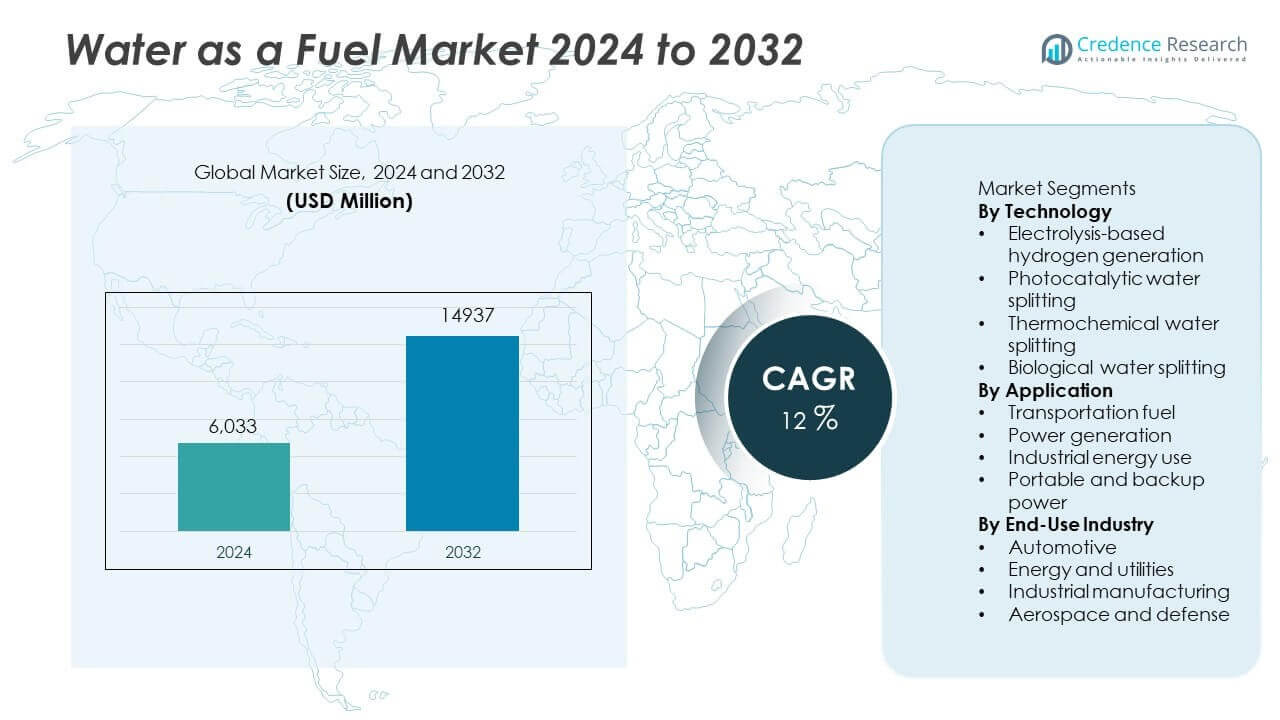
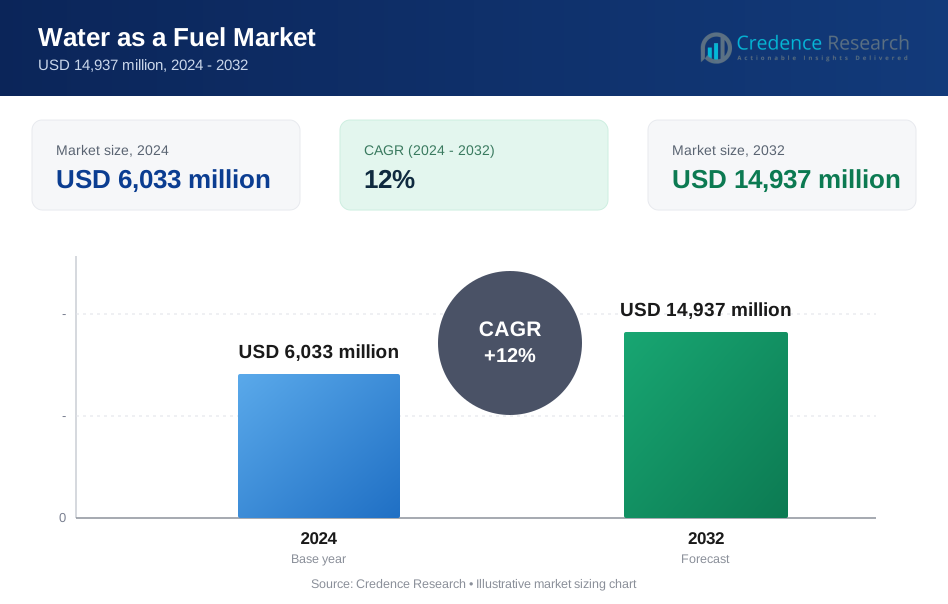
The Water as a Fuel market was valued at USD 6,033 million in 2024 and is expected to reach USD 14,937 million by 2032, growing at a CAGR of 12% during the forecast period.
| REPORT ATTRIBUTE | DETAILS |
|---|---|
| Historical Period | 2020-2023 |
| Base Year | 2024 |
| Forecast Period | 2025-2032 |
| Water as a Fuel Market Size 2024 | USD 6,033 million |
| Water as a Fuel Market, CAGR | 12% |
| Water as a Fuel Market Size 2032 | USD 14,937 million |
Water as a Fuel Market Insights
- Market growth is driven by clean energy policies, rising hydrogen demand, and expansion of renewable-powered electrolysis, with electrolysis-based hydrogen generation leading technology with a 57.6% segment share.
- Key market trends include strong adoption in transportation fuel applications, which hold a 41.8% segment share, supported by hydrogen mobility programs and fuel cell vehicle deployment.
- Competitive dynamics show moderate consolidation, with leading players focusing on electrolyzer scale-up, efficiency improvement, and long-term contracts amid high capital and infrastructure costs.
- Regionally, Asia Pacific leads with a 31.2% market share, followed by North America at 28.4% and Europe at 26.7%, driven by national hydrogen strategies and large-scale clean energy investments.
Water as a Fuel Market Segmentation Analysis:
By Technology
By technology, electrolysis-based hydrogen generation dominates the Water as a Fuel market with a market share of 57.6%. This leadership reflects its commercial readiness and scalability. Governments and private players invest heavily in electrolyzer deployment. Renewable-powered electrolysis supports low-carbon hydrogen production. Cost reductions in electrolyzer systems improve adoption. Industrial users prefer proven and reliable technologies. Infrastructure compatibility further strengthens demand. Photocatalytic and thermochemical methods remain in development stages. Biological water splitting shows limited commercial use. Electrolysis remains dominant due to maturity, policy support, and integration with renewable energy systems.
- For instance, ITM Power deployed a PEM electrolyzer at the REFHYNE project to produce green hydrogen annually.
By Application
By application, transportation fuel leads the market with a market share of 41.8%. Rising adoption of hydrogen-powered vehicles drives demand. Fuel cell vehicles gain traction in passenger and commercial segments. Government incentives support hydrogen mobility projects. Public transport fleets increasingly adopt hydrogen fuel. Refueling infrastructure expansion supports application growth. Transportation use benefits from zero-emission targets. Power generation and industrial energy use follow with steady adoption. However, transportation remains dominant due to policy focus and decarbonization of mobility.
- For instance, Hyundai Motor Company operates XCIENT trucks with 180 kW stacks across logistics pilots.
By End-Use Industry
By end-use industry, energy and utilities hold the largest share at 36.9%. Utilities adopt hydrogen for grid balancing and energy storage. Renewable integration increases hydrogen demand. Utilities invest in large-scale hydrogen projects. Power-to-gas initiatives support adoption. Long-term energy transition strategies favor hydrogen use. Industrial manufacturing follows due to process energy needs. Automotive demand grows steadily but remains smaller. Aerospace and defense contribute niche demand. Energy and utilities lead due to large-scale deployment and infrastructure readiness.
Key Growth Drivers
Strong Government Support for Clean Hydrogen Initiatives
Government policies strongly drive the Water as a Fuel market. National hydrogen strategies promote water-based fuel adoption. Subsidies support electrolyzer deployment and infrastructure buildout. Net-zero targets accelerate clean fuel investments. Public funding reduces project risk for developers. Regulatory frameworks encourage renewable hydrogen use. Cross-border hydrogen projects gain support. Energy security goals strengthen policy backing. Long-term roadmaps improve investor confidence. This driver creates stable demand for water-derived fuel solutions.
- For instance, ENGIE secured public funding for the Masshylia project with a 40 MW electrolyzer.
Rising Demand for Zero-Emission Energy Solutions
Industries seek zero-emission energy alternatives to cut carbon output. Water-based hydrogen offers clean combustion benefits. Transportation and power sectors face strict emission norms. Hydrogen fuel supports decarbonization without energy loss. Renewable integration increases hydrogen relevance. Corporates commit to sustainability targets. Clean energy procurement grows across sectors. Water as a fuel aligns with circular energy goals. This driver accelerates adoption across multiple end uses.
- For instance, Bloom Energy Corporation deployed solid oxide systems generating 300 kW per module for clean power.
Expansion of Renewable Energy Capacity
Renewable energy growth supports water-based fuel production. Excess solar and wind power enables electrolysis. Energy storage challenges increase hydrogen use. Power-to-hydrogen projects gain traction. Grid stability improves with hydrogen storage. Renewable curtailment issues drive demand. Integrated energy systems expand deployment. Utilities invest in green hydrogen hubs. This driver links renewable growth with fuel diversification.
Key Trends & Opportunities
Scaling of Green Hydrogen Infrastructure
Green hydrogen infrastructure expansion creates strong opportunities. Electrolyzer capacity scales rapidly. Hydrogen hubs emerge near renewable clusters. Pipeline and storage projects expand. Refueling networks grow steadily. Public-private partnerships support rollout. Standardization improves project efficiency. Cost decline improves competitiveness. This trend strengthens long-term market viability.
- For instance, Linde plc operates a PEM electrolyzer producing 24,000 kilograms of hydrogen per day at Leuna.
Growing Interest from Heavy Transport and Industry
Heavy transport shows rising interest in water-based fuel. Long-haul trucks adopt hydrogen fuel cells. Shipping explores hydrogen derivatives. Industrial heat applications gain focus. Steel and chemicals test hydrogen integration. High energy density supports heavy-duty use. Pilot projects expand to commercial scale. This opportunity broadens market reach beyond power.
- For instance, SSAB produced fossil-free steel using hydrogen-based direct reduction at pilot scale.
Key Challenges
High Production and Infrastructure Costs
High costs remain a major challenge for the market. Electrolyzer systems require large capital investment. Hydrogen storage adds expense. Distribution infrastructure remains limited. Cost parity with fossil fuels is pending. Financing risks slow deployment. Smaller players face entry barriers. This challenge delays large-scale commercialization.
Technology Efficiency and Energy Loss Concerns
Efficiency limitations affect water-based fuel adoption. Energy losses occur during conversion. Storage and transport reduce net efficiency. Technology optimization remains ongoing. System integration adds complexity. Reliability concerns affect industrial users. Performance consistency needs improvement. This challenge requires continued research and innovation.
Regional Analysis
North America
North America holds a market share of 28.4% in the Water as a Fuel market, supported by strong government funding and private investment in clean hydrogen projects. The United States leads regional adoption through national hydrogen strategies and large-scale electrolyzer deployments. Transportation and power generation remain key application areas. Utilities invest in hydrogen for grid balancing and energy storage. Strong research infrastructure accelerates technology development. Public–private partnerships support infrastructure rollout. Industrial decarbonization goals further strengthen demand. The region benefits from advanced renewable capacity and favorable policy frameworks supporting long-term hydrogen adoption.
Europe
Europe accounts for a market share of 26.7%, driven by aggressive decarbonization targets and energy transition policies. Countries such as Germany, France, and the Netherlands lead hydrogen deployment. Strong emphasis on green hydrogen supports water-based fuel adoption. Industrial energy use and power generation drive demand. Cross-border hydrogen corridors strengthen regional integration. Utilities invest in power-to-hydrogen projects. Funding from climate initiatives supports scale-up. Regulatory clarity improves investor confidence. Europe maintains steady growth due to strong climate commitments and coordinated regional hydrogen strategies.
Asia Pacific
Asia Pacific leads the Water as a Fuel market with a market share of 31.2%. Rapid industrialization and rising energy demand drive adoption across China, Japan, and South Korea. Governments actively promote hydrogen economies. Transportation fuel applications gain strong traction. Large renewable energy capacity supports electrolysis-based production. Industrial manufacturing adopts hydrogen for clean energy use. Infrastructure investments accelerate deployment. Domestic technology development improves cost efficiency. Asia Pacific remains the largest market due to scale, policy support, and strong energy demand growth.
Latin America
Latin America holds a market share of 7.1%, supported by growing interest in renewable-powered hydrogen production. Countries such as Chile and Brazil invest in green hydrogen projects. Abundant solar and wind resources support cost-effective water-based fuel generation. Export-oriented hydrogen initiatives gain momentum. Industrial and power applications drive early adoption. Infrastructure development remains gradual. Policy frameworks continue to evolve. International partnerships support project financing. The region shows emerging growth potential driven by renewable availability and export opportunities.
Middle East & Africa
The Middle East & Africa region accounts for a market share of 6.6%, driven by strategic diversification into clean energy. Gulf countries invest in large-scale hydrogen projects. Abundant solar resources support water-based fuel production. Energy export strategies encourage hydrogen adoption. Industrial energy use drives early demand. Infrastructure projects gain government backing. Africa contributes smaller volumes due to limited infrastructure. Long-term energy transition plans support gradual growth. The region shows steady progress through large-scale investments and renewable integration.
Water as a Fuel Market Segmentations:
By Technology
- Electrolysis-based hydrogen generation
- Photocatalytic water splitting
- Thermochemical water splitting
- Biological water splitting
By Application
- Transportation fuel
- Power generation
- Industrial energy use
- Portable and backup power
By End-Use Industry
- Automotive
- Energy and utilities
- Industrial manufacturing
- Aerospace and defense
By Geography
- North America
- U.S.
- Canada
- Mexico
- Europe
- Germany
- France
- U.K.
- Italy
- Spain
- Rest of Europe
- Asia Pacific
- China
- Japan
- India
- South Korea
- South-east Asia
- Rest of Asia Pacific
- Latin America
- Brazil
- Argentina
- Rest of Latin America
- Middle East & Africa
- GCC Countries
- South Africa
- Rest of the Middle East and Africa
Competitive Landscape
Competitive landscape analysis of the Water as a Fuel market highlights the presence of key players including Nel ASA, Plug Power Inc., ITM Power plc, Siemens Energy AG, and Air Liquide S.A.. The market remains moderately consolidated, with competition centered on technology efficiency, project scale, and system integration capabilities. Leading players focus on expanding electrolyzer capacity and improving hydrogen production efficiency. Strategic partnerships with utilities and governments strengthen market positioning. Large players benefit from strong balance sheets and global project pipelines. Regional players compete through localized deployment and cost optimization. Continuous investment in research supports performance improvements. Overall competition emphasizes scalability, long-term contracts, and alignment with national hydrogen strategies.
Key Player Analysis
- Nel ASA
- Plug Power Inc.
- ITM Power plc
- Siemens Energy AG
- Air Liquide S.A.
- Linde plc
- Ballard Power Systems Inc.
- Bloom Energy Corporation
- Cummins Inc.
- ENGIE
Recent Developments
- In December 2025, ITM Power plc signed a contract for 12.5 MW NEPTUNE V systems.
- In November 2025, Plug Power Inc. reported total hydrogen production capacity of 40 tons/day.
- In October 2025, Nel ASA received an order for one 2.5 MW MC500 PEM electrolyser.
Report Coverage
The research report offers an in-depth analysis based on Technology, Application, End-Use Industry and Geography. It details leading market players, providing an overview of their business, product offerings, investments, revenue streams, and key applications. Additionally, the report includes insights into the competitive environment, SWOT analysis, current market trends, as well as the primary drivers and constraints. Furthermore, it discusses various factors that have driven market expansion in recent years. The report also explores market dynamics, regulatory scenarios, and technological advancements that are shaping the industry. It assesses the impact of external factors and global economic changes on market growth. Lastly, it provides strategic recommendations for new entrants and established companies to navigate the complexities of the market.
Request a Free Sample
Fill in your details and we'll send you a free sample report.
- Sample data tables & charts
- Research methodology
Need a Custom Version of This Report?
Tailor the scope, geography, or segments to your exact requirements.
- Custom geography or segment scope
- Direct access to our analyst team
Frequently Asked Questions
What is the current market size for Water as a Fuel market, and what is its projected size in 2032?
At what Compound Annual Growth Rate is the Water as a Fuel market projected to grow between 2024 and 2032?
Which Water as a Fuel market segment held the largest share in 2024?
What are the primary factors fueling the growth of the Water as a Fuel market?
Who are the leading companies in the Water as a Fuel market?
Which region commanded the largest share of the Water as a Fuel market in 2024?
Table of Content
Chapter 1. Report Introduction
- 1.1 Report Description & Purpose
- 1.1.1 Report Title & Market Definition
- 1.1.2 Unique Selling Propositions (USP) & Key Differentiators
- 1.1.3 Value Proposition for Stakeholders
- 1.2 Research Objectives
- 1.2.1 Market Sizing Objectives (Volume & Revenue)
- 1.2.2 Segmentation Objectives
- 1.2.3 Competitive Intelligence Objectives
- 1.2.4 Forecast & Scenario Objectives
- 1.3 Report Scope
- 1.3.1 Water as a Fuel Scope – Types & Subtypes Covered
- 1.3.2 Geographic Scope – Regions & Countries Covered
- 1.3.3 Historical Period, Base Year & Forecast Period (2024; forecast to 2032)
- 1.3.4 Inclusions & Exclusions
- 1.4 HS Code & Classification Framework
- 1.5 Currency, Units & Pricing Basis
- 1.6 Target Stakeholders
- 1.7 Limitations & Assumptions
Chapter 2. Executive Summary
- 2.1 Global Water as a Fuel Market Snapshot
- 2.1.1 Market Size – Historical (2024) & Forecast (2024-2032) (2024: USD 6,033 million → 2032: USD 14,937 million)
- 2.1.2 Volume & Revenue – Global Totals
- 2.1.3 Key Market Highlights – Top Five Facts
- 2.2 Water as a Fuel Market Segmentation Snapshot
- 2.2.1 Market Split by Region – 2024 vs. 2032
- 2.3 Competitive Snapshot
- 2.3.1 Top 10 Players by Revenue Share – 2024
- 2.3.2 Top 10 Players by Volume Share – 2024
- 2.3.3 Recent Strategic Developments (18-Month Summary)
- 2.4 Key Investment Highlights & Strategic Conclusions
Chapter 3. Water as a Fuel Market Dynamics & Industry Analysis
- 3.1 Market Overview & Context
- 3.1.1 Water as a Fuel Market Position in the Broader Automotive Value Chain
- 3.1.2 OEM vs. Replacement Market Dynamics
- 3.1.3 Market Maturity & Development Stage by Region
- 3.2 Water as a Fuel Market Drivers
- 3.3 Water as a Fuel Market Restraints & Challenges
- 3.4 Water as a Fuel Market Opportunities
- 3.5 Porter's Five Forces Analysis
- 3.5.1 Threat of New Entrants
- 3.5.2 Bargaining Power of Suppliers
- 3.5.3 Bargaining Power of Buyers
- 3.5.4 Threat of Substitutes
- 3.5.5 Competitive Rivalry – Intensity Assessment
- 3.6 Water as a Fuel Value Chain Analysis
- 3.6.1 Upstream – Raw Material/Input Suppliers
- 3.6.1.1 Raw Material/Input 1
- 3.6.1.2 Raw Material/Input 2
- 3.6.1.3 Raw Material/Input 3
- 3.6.2 Midstream – Production/Manufacturing/Service Delivery
- 3.6.2.1 Production/Process Overview
- 3.6.2.2 Key Facility Locations & Capacity by Manufacturer
- 3.6.3 Downstream – Distribution & End Consumer
- 3.6.3.1 Primary Channel – B2B/OEM
- 3.6.3.2 Secondary Channels – Dealer, Retail, Online, Direct
- 3.6.4 Value Chain Profitability Analysis
- 3.6.1 Upstream – Raw Material/Input Suppliers
- 3.7 PESTEL Analysis
- 3.7.1 Political Factors
- 3.7.2 Economic Factors
- 3.7.3 Social Factors
- 3.7.4 Technological Factors
- 3.7.5 Environmental Factors
- 3.7.6 Legal Factors
- 3.8 Water as a Fuel Supply Chain Analysis
- 3.8.1 Raw Material/Input Supply Risk Assessment
- 3.8.2 Manufacturing Concentration Risk (Geographic Exposure)
- 3.8.3 Trade Disruption Impact Analysis
- 3.9 Regulatory & Policy Landscape
Note: The regulatory and policy landscape section covers regulations based on their applicability to the market, Water as a Fuel category, geography, and scope of the study. Only regulatory frameworks with a material impact on operations, compliance, trade, sustainability, or market access are analyzed in detail.
Chapter 4. Key Investment Pockets & Opportunity Analysis
- 4.1 Water as a Fuel Market Attractiveness Analysis
- 4.1.1 By Region – Investment Attractiveness Matrix (Volume × CAGR)
- 4.2 Absolute Revenue Growth Opportunity
- 4.2.1 By Region – Absolute USD Growth Through 2032
- 4.3 Incremental Volume Opportunity
- 4.3.1 By Region – Incremental Volume Through 2032
- 4.3.2 Segment – Incremental Volume
- 4.4 Emerging Submarket Opportunity Deep Dive (Subject to Applicability)
- 4.5 Emerging Market Opportunity Scorecards
- 4.5.1 United States
- 4.5.2 Europe
- 4.5.3 Asia
- 4.5.4 Middle East & Africa
Note: Emerging Market Opportunity Scorecards will be included based on relevance and strategic importance. Regions listed are indicative and may vary depending on data availability and market dynamics.
Chapter 5. Water as a Fuel Import-Export Analysis & Trade Flows
- 5.1 Global Trade Overview
- 5.1.1 Global Export Value by Country (2024)
- 5.1.2 Global Export Volume by Country (2024)
- 5.1.3 Global Import Value by Country (2024)
- 5.1.4 Global Import Volume by Country (2024)
- 5.1.5 Net Trade Balance by Country (2024)
- 5.2 Export Analysis – Segment
- 5.2.1 Type 1 (HS Code)
- 5.2.2 Type 2 (HS Code)
- 5.2.3 Type 3 (HS Code)
- 5.2.4 Type 4 (HS Code)
- 5.2.5 Type 5 (HS Code)
- 5.3 Import Analysis – Segment
- 5.3.1 Type 1 (HS Code)
- 5.3.2 Type 2 (HS Code)
- 5.3.3 Type 3 (HS Code)
- 5.3.4 Type 4 (HS Code)
- 5.3.5 Type 5 (HS Code)
- 5.4 Average Unit Trade Prices
- 5.4.1 Average Export Price – Segment & Country
- 5.4.2 Average Import Price – Segment & Source Country
- 5.4.3 Price Trends (2024)
- 5.5 Key Trade Route Analysis
- 5.5.1 Trade Route 1
- 5.5.2 Trade Route 2
- 5.5.3 Trade Route 3
- 5.5.4 Trade Route 4
- 5.5.5 Trade Route 5
- 5.6 Trade Policy Impact Assessment
- 5.6.1 US Anti-Dumping & Section 301 Tariffs
- 5.6.2 EU Customs Union Impact
- 5.6.3 Major Free Trade Agreements
- 5.6.4 USMCA Rules of Origin
Note: Trade policy analysis will be included only where relevant to the Water as a Fuel market.
Chapter 6. Competitive Landscape & Company Benchmarking
- 6.1 Water as a Fuel Market Concentration & Structure
- 6.1.1 Herfindahl-Hirschman Index (HHI) – vs. 2024
- 6.1.2 Tier 1, Tier 2 & Tier 3 Market Structure
- 6.1.3 Global, Regional & Local Player Dynamics
- 6.2 Water as a Fuel Market Share Analysis – 2024
- 6.2.1 Global Revenue Share by Company
- 6.2.2 Global Volume Share by Company
- 6.2.3 Regional Revenue Share
- 6.2.4 Market Share Evolution ( vs. 2024)
- 6.2.5 OEM Segment Share by Company
- 6.2.6 Replacement Segment Share by Company
- 6.3 Production/Delivery Capacity & Facility Analysis
- 6.3.1 Global Installed Capacity
- 6.3.2 Capacity Utilization Rates
- 6.3.3 Production/Output Volume
- 6.3.4 Facility Locations & Capacity Map
- 6.3.5 Planned Capacity Additions
- 6.4 Water as a Fuel Competitive Benchmarking Matrix
- 6.4.1 Revenue, Volume, CAGR & Profitability Comparison
- 6.4.2 Channel Revenue Mix
- 6.4.3 Geographic Revenue Exposure
- 6.4.4 R&D Intensity
- 6.4.5 Sustainability Maturity
- 6.5 Strategic Developments in Water as a Fuel (Last 24 Months)
- 6.5.1 Mergers, Acquisitions & Divestments
- 6.5.2 New Water as a Fuel Launches
- 6.5.3 Facility Expansions
- 6.5.4 Strategic Alliances, Joint Ventures & Partnerships
- 6.5.5 Distribution Expansion & Market Entry
- 6.5.6 Sustainability & ESG Initiatives
- 6.6 Competitive Strategy Mapping
- 6.6.1 Leader, Challenger, Follower & Niche Classification
- 6.6.2 Pricing Strategy Comparison
- 6.6.3 Channel Strategy Matrix
Note: Strategic developments are included based on their materiality and the availability of reliable information.
Chapter 7. Global Water as a Fuel Market – By Distribution Channel
- 7.1 Segment Overview
- 7.1.1 Volume & Revenue Split by Channel (2024 & 2032)
- 7.1.2 Channel Mix Evolution (2024-2032)
Chapter 8. Regional Market Analysis – Global Overview
- 8.1 Global Regional Overview
- 8.1.1 Regional Volume Share
- 8.1.2 Regional Revenue Share
- 8.1.3 Regional Volume by Region
- 8.1.4 Regional Revenue by Region
- 8.1.5 Regional Forecast Through 2032
- 8.2 Cross-Regional Segment Analysis
- 8.2.1 By Distribution Channel
- 8.2.2 By Brand/Price Tier
Chapter 9. North America Water as a Fuel Market
- 9.1 United States
- 9.2 Canada
- 9.3 Mexico
Chapter 10. Europe Water as a Fuel Market
- 10.1 Germany
- 10.2 France
- 10.3 Italy
- 10.4 United Kingdom
- 10.5 Spain
- 10.6 Poland
- 10.7 Russia
- 10.8 Netherlands
- 10.9 Belgium
- 10.10 Sweden
- 10.11 Denmark
- 10.12 Norway
- 10.13 Rest of Europe
Chapter 11. Asia Pacific Water as a Fuel Market
- 11.1 China
- 11.2 India
- 11.3 Japan
- 11.4 South Korea
- 11.5 Thailand
- 11.6 Indonesia
- 11.7 Vietnam
- 11.8 Malaysia
- 11.9 Australia
- 11.10 Rest of Asia Pacific
Chapter 12. Latin America Water as a Fuel Market
- 12.1 Brazil
- 12.2 Argentina
- 12.3 Colombia
- 12.4 Chile
- 12.5 Rest of Latin America
Chapter 13. Middle East Water as a Fuel Market
- 13.1 Saudi Arabia
- 13.2 United Arab Emirates
- 13.3 Turkey
- 13.4 Israel
- 13.5 Iran
- 13.6 Rest of the Middle East
Chapter 14. Africa Water as a Fuel Market
- 14.1 South Africa
- 14.2 Egypt
- 14.3 Nigeria
- 14.4 Morocco
- 14.5 Rest of Africa
Chapter 15. Water as a Fuel Company Profiles
- 15.1 [Company 01]
- 15.1.1 Company Overview
- 15.1.2 Key Management Personnel
- 15.1.3 Products & Services Portfolio
- 15.1.4 Financial Performance
- 15.1.5 Key Market Focus & Geographic Presence
- 15.1.6 Recent Developments & Strategic Initiatives
Note: The company profile list is preliminary and may change based on research findings, market developments, data availability, and client requirements.
Chapter 16. Appendices
- Appendix A – List of Abbreviations & Acronyms
- Appendix B – Industry Classification Code Reference – Full Series
- Appendix C – Production & Capacity Data Tables
- Appendix D – End-Use & Demand Base Tables
- Appendix E – Consumption & Replacement Rate Assumptions
- Appendix F – ASP Reference Tables
- Appendix G – Manufacturing & Facility Database
- Appendix H – Import-Export Data Tables
- Appendix I – Regulatory Summary Tables
- Appendix J – Primary Research Participant List (Anonymized)
- Appendix K – Primary Research Questionnaire Framework
- Appendix L – Data Sources & Bibliography
- Appendix M – Market Size Divergence & Source Comparison
Chapter 17. Research Methodology
- 17.1 Research Framework & Philosophy
- 17.2 Secondary Research – Sources, Hierarchy & Data Extraction
- 17.3 Data Modeling – Bottom-Up & Top-Down Market Sizing
- 17.4 Primary Research – Stakeholder Framework, LOI & Sample Sizes
- 17.5 Forecast Methodology – Regression, Scenario & Sensitivity Analysis
- 17.6 Quality Control – Four-Layer Validation Framework
- 17.7 Limitations & Standard Assumptions
- 17.8 Disclaimer
