
| REPORT ATTRIBUTE | DETAILS |
|---|---|
| Historical Period | 2019-2022 |
| Base Year | 2023 |
| Forecast Period | 2024-2032 |
| Water Desalination Equipment Market Size 2024 | USD 9,949.10 Million |
| Water Desalination Equipment Market, CAGR | 9% |
| Water Desalination Equipment Market Size 2032 | USD 19824.2 Million |
Market Overview:
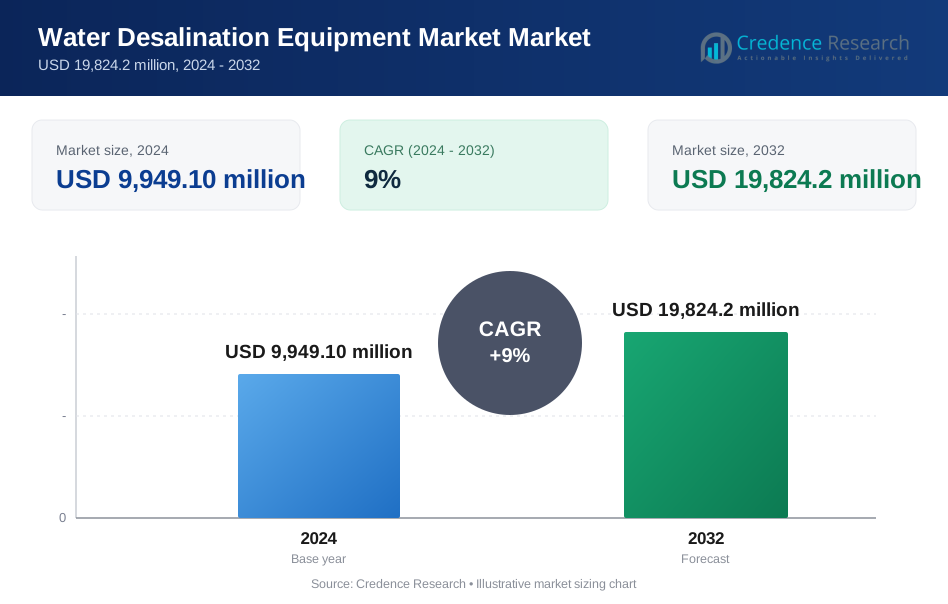
The Water Desalination Equipment Market is projected to grow from USD 9,949.10 million in 2024 to an estimated USD 19824.2 million by 2032, with a compound annual growth rate (CAGR) of 9% from 2024 to 2032.
Key drivers of the water desalination equipment market include the increasing water scarcity concerns due to rapid urbanization, industrialization, and climate change. The demand for clean drinking water, especially in regions with limited access to natural freshwater sources, has become a critical factor driving the adoption of desalination technologies. Moreover, advancements in reverse osmosis and electrodialysis technologies are improving desalination efficiency and reducing operational costs, making desalinated water more accessible and affordable. Increased awareness about water conservation and the need for reliable water sources are also contributing to market growth.
Regionally, the water desalination equipment market is witnessing a high demand in regions such as the Middle East, Asia Pacific, and North America. The Middle East remains the largest market due to the region’s arid climate and reliance on desalinated water to meet its water needs. In Asia Pacific, countries like India and China are increasingly adopting desalination solutions to address water scarcity concerns. North America, particularly the United States, is also investing heavily in desalination infrastructure to support growing water demands, further fueling market growth in the region. In addition, the increasing involvement of private-sector players, along with government-backed initiatives, is expected to improve the affordability and accessibility of desalinated water across developing regions. In countries where freshwater resources are limited or polluted, desalination provides a much-needed solution to improve the quality of life for millions of people. As urbanization and industrial growth continue to place additional strain on existing water resources, the desalination market is poised to experience sustained growth, ensuring that countries can meet their water needs without compromising their environmental or economic stability.
Market Drivers:
Increasing Water Scarcity
Water scarcity is a primary driver of the global water desalination equipment market. For instance, Veolia Water Technologies has built more than 1,950 Reverse Osmosis desalination plants in 85 countries, producing over 6.75 million m³/day of fresh water. Rapid urbanization, industrialization, and population growth are placing immense pressure on existing freshwater resources, especially in arid and semi-arid regions. With natural freshwater supplies dwindling, desalination has become a crucial solution to provide a sustainable and reliable source of potable water. The increasing frequency of droughts, exacerbated by climate change, is also contributing to the heightened demand for desalinated water, making desalination technologies an essential resource for many regions.
Technological Advancements
Technological innovations in desalination technologies, particularly reverse osmosis (RO) and electrodialysis, are driving market growth. For example, companies has developed innovative, chemical-free, biological-based pre-treatment processes that reduce environmental hazards and improve consumer safety. These advancements have significantly improved the efficiency and energy consumption of desalination processes, reduced operational costs and made desalinated water more affordable. Furthermore, ongoing research and development in desalination technologies, such as the integration of renewable energy sources like solar and wind power, are further enhancing the environmental sustainability of desalination plants, making them more attractive to governments and private investors.
Government Support and Investment
Government support and investment play a pivotal role in driving the growth of the water desalination equipment market. Many countries facing water scarcity challenges have implemented favorable policies and funding programs to promote desalination infrastructure development. Public-private partnerships and governmental incentives are encouraging the establishment of desalination plants, particularly in regions like the Middle East, North Africa, and Asia Pacific. For example, SUEZ SA implemented a large-scale seawater desalination project utilizing reverse osmosis technology to provide potable water to coastal communities facing water scarcity. Such investments are essential for meeting the growing demand for clean water, improving water security, and mitigating the effects of water shortages on both urban and rural populations.
Rising Public Awareness
The increasing awareness of water conservation and sustainable water use is also fueling market growth. Governments, environmental organizations, and the general public are recognizing the need to protect and manage water resources effectively. For example, the United Nations has launched the Water Action Decade (2018-2028) to support efforts to conserve and sustainably manage water resources. As a result, there is greater demand for alternative water sources, such as desalination, which can provide a continuous and reliable supply of water. The growing emphasis on sustainable water management practices is driving investment in desalination technologies, further enhancing their adoption worldwide.
Market Trends:
Integration of Renewable Energy
A significant trend in the water desalination equipment market is the growing integration of renewable energy sources, particularly solar and wind power, into desalination plants. For instance, the International Renewable Energy Agency (IRENA) reports that renewable energy can play an important role in desalination, with solar photovoltaics (PV) and wind energy being particularly suited for this purpose. As the demand for desalinated water increases, the need for energy-efficient solutions has become a priority. Renewable energy offers a sustainable, cost-effective alternative to conventional power sources, helping to reduce the carbon footprint of desalination processes. Many countries with abundant solar or wind resources are increasingly adopting these energy sources to power desalination plants, contributing to a greener and more sustainable approach to water production.
Development of Energy-Efficient Technologies
There is a clear trend toward the development and adoption of energy-efficient desalination technologies. For example, Danfoss, a leading supplier of desalination technologies, combines high-pressure pumps, drives, energy-recovery devices, and pressure and fluid control devices to provide superior and energy-efficient desalination solutions. Reverse osmosis (RO) systems, which currently dominate the market, are evolving to incorporate energy recovery devices and improved membrane technologies, reducing the overall energy consumption. Additionally, innovations such as pressure-retarded osmosis (PRO) and forward osmosis (FO) are gaining traction due to their lower energy requirements compared to traditional methods. These advancements not only reduce operational costs but also enhance the economic feasibility of desalination, especially in regions with high energy costs.
Modular and Scalable Desalination Systems
Another growing trend is the shift towards modular and scalable desalination systems. For instance, Newterra offers the SeaMega Desalination System, a modular, packaged solution that utilizes seawater reverse osmosis (SWRO) to convert brackish or seawater into potable water. These systems are increasingly favored for their flexibility and ease of installation. They allow for the gradual expansion of desalination capacity based on changing water demands, making them ideal for both small and large-scale applications. Modular systems are particularly useful in remote or off-grid locations, where the deployment of large, centralized desalination plants may not be feasible. This trend is driving innovation in the design and production of smaller, more adaptable desalination equipment.
Focus on Water Recycling and Reuse
The water desalination market is also seeing a rise in the focus on water recycling and reuse. In areas where water resources are scarce, integrating desalination systems with wastewater treatment facilities is becoming increasingly common. For instance, the Orange County Water District in California has implemented the Groundwater Replenishment System (GWRS), which recycles wastewater to produce high-quality water suitable for groundwater recharge and indirect potable reuse. This integration enables the recycling of water for non-potable uses, such as irrigation and industrial processes, while ensuring that potable water is produced through desalination for human consumption. This trend is enhancing the sustainability and efficiency of water management practices, reducing the pressure on freshwater resources.
Market Challenges Analysis:
High Operational and Energy Costs
One of the primary challenges facing the water desalination equipment market is the high operational and energy costs associated with desalination processes. Traditional methods, particularly reverse osmosis (RO), require significant amounts of energy to separate salt and other impurities from seawater. This high energy demand makes desalination expensive, especially in regions with limited access to affordable energy sources. Although advancements in energy-efficient technologies are helping to mitigate these costs, the ongoing need for affordable, sustainable energy solutions remains a significant barrier to the widespread adoption of desalination technologies. Desalination processes can have notable environmental impacts, which pose a challenge to the market. One of the main concerns is the brine disposal associated with desalination plants. The concentrated brine, which contains high levels of salt and chemicals, is often discharged back into the ocean, potentially harming marine ecosystems. While there are efforts to manage brine disposal through advanced treatment methods, the environmental impact of this byproduct remains a significant challenge. Furthermore, desalination plants can have adverse effects on local ecosystems, including the intake of marine life, which requires careful regulation and sustainable practices.
Limited Freshwater Market Integration
Despite the growing adoption of desalination technologies, integrating desalinated water into existing freshwater infrastructure remains a challenge. Many regions with desalination facilities still rely heavily on traditional water sources, and integrating desalinated water into municipal supply systems requires significant investment in infrastructure and distribution networks. The process of aligning desalinated water with local water management policies and standards can be complex and time-consuming, which slows down the expansion of desalination capacity in some areas. Regulatory and policy uncertainties also present challenges for the desalination market. Governments in many regions have yet to establish clear policies or provide sufficient incentives for the development and expansion of desalination infrastructure. In some countries, desalination remains a costly and unregulated process, which can hinder investments and delay the implementation of necessary projects. The lack of consistent regulatory frameworks can create uncertainty, making it difficult for businesses and governments to plan and implement long-term desalination strategies.
Market Segmentation Analysis:
By Technology, the market is primarily divided into reverse osmosis (RO), multi-stage flash distillation (MSF), multi-effect distillation (MED), and electrodialysis (ED). Among these, reverse osmosis dominates the market due to its energy efficiency, lower operational costs, and adaptability across a range of applications. Reverse osmosis membranes are particularly favored in desalination plants, municipal water systems, and industrial processes. Multi-stage flash distillation and multi-effect distillation are also significant, especially in areas with high demand for large-scale desalination. Electrodialysis, although niche, is increasingly used for brackish water desalination due to its lower energy consumption in specific applications.
By Application, the market is categorized into municipal, industrial, and agricultural segments. The municipal segment holds the largest share, driven by the growing need for potable water in arid regions and urban areas with insufficient freshwater resources. In the industrial sector, water desalination is crucial for various processes such as power generation, oil and gas, and chemical manufacturing, where high-quality water is necessary. The agricultural segment, while smaller, is gaining traction, especially in regions where irrigation water scarcity is becoming more pronounced, making desalination a viable solution for sustaining crop production.
Segmentations:
By Technology:
- Reverse Osmosis (RO)
- Multi-stage Flash Distillation (MSF)
- Multi-effect Distillation (MED)
- Electrodialysis (ED)
By Application:
- Municipal
- Industrial
- Agricultural
By Region:
- North America
- U.S.
- Canada
- Mexico
- Europe
- Germany
- France
- U.K.
- Italy
- Spain
- Rest of Europe
- Asia Pacific
- China
- Japan
- India
- South Korea
- South-east Asia
- Rest of Asia Pacific
- Latin America
- Brazil
- Argentina
- Rest of Latin America
- Middle East & Africa
- GCC Countries
- South Africa
- Rest of the Middle East and Africa
Regional Analysis:
North America
North America holds a substantial share of the water desalination equipment market, exceeding 20%. The demand for desalination solutions is driven by water scarcity in regions like the southwestern United States. Technological advancements, particularly in reverse osmosis (RO), are central to the market's growth. The United States is a leader in desalination infrastructure, with both large-scale and small-scale systems expanding to meet water security needs. Additionally, government initiatives supporting water infrastructure further strengthen the market in this region.
Europe
Europe accounts for 25% of the global market. The region's focus on sustainability, climate change adaptation, and efficient water management has spurred the adoption of desalination technologies. Spain, Italy, and Cyprus are key players, with substantial desalination facilities to cater to urban populations and agricultural needs. Technological investments in reverse osmosis (RO) and multi-effect distillation (MED) have contributed to the market's growth. Furthermore, stringent regulatory frameworks that encourage water reuse and environmental sustainability continue to drive market expansion.
Asia Pacific
Asia Pacific is the largest market, holding over 30% of the global share. The region's rapid urbanization, population growth, and increasing water demand have made desalination a critical solution. Key countries like China, India, and the UAE are investing heavily in desalination technologies. The Middle East, especially Saudi Arabia and the UAE, is a major contributor due to its reliance on desalinated water for both municipal and industrial purposes. Reverse osmosis, multi-stage flash distillation (MSF), and multi-effect distillation (MED) are widely used to meet large-scale demands. The growing focus on water security and new desalination plants in the region are key growth drivers.
Middle East & Africa
Middle East & Africa holds over 15% of the market, driven by the region’s dependence on desalinated water due to limited freshwater resources. Saudi Arabia, the UAE, and Kuwait have heavily invested in desalination infrastructure, making the region a global leader. The growing demand for desalinated water in municipalities, industries, and agriculture further fuels the market. Technologies like reverse osmosis and multi-stage flash distillation dominate in the region.
Latin America
Latin America represents 10% of the market. Countries such as Chile, Mexico, and Brazil face challenges with freshwater availability, especially in coastal and arid areas. As a result, desalination is becoming an increasingly important solution for meeting municipal and agricultural water needs. Reverse osmosis remains the dominant technology, with growing interest in multi-effect distillation (MED) and electrodialysis.
Key Player Analysis:
- Acciona SA
- Webuild SpA
- Veolia Environnement SA
- Doosan Enerbility Co Ltd
- Koch Separation Solutions
- Biwater
- IDE Technologies
- SUEZ SA
- Abengoa
- Ferrovial
Competitive Analysis:
The water desalination equipment market is highly competitive, with key players striving to innovate and enhance operational efficiency. Prominent companies such as Veolia North America, SUEZ, and IDE Technologies dominate the market, leveraging advanced technologies like reverse osmosis (RO), multi-stage flash distillation (MSF), and multi-effect distillation (MED) to meet growing demand. For instance, Veolia North America has implemented large-scale seawater desalination projects using RO technology. These companies focus on providing end-to-end solutions, including design, installation, and maintenance of desalination plants. Strategic mergers and acquisitions, along with investments in research and development, are key tactics to strengthen market positions and expand technological capabilities. Additionally, companies are increasingly integrating sustainable practices, optimizing energy consumption, and enhancing water recovery rates to cater to environmental and regulatory standards. The market also sees new entrants, especially in regions like Asia Pacific and Latin America, where growing water scarcity demands affordable and efficient desalination technologies. Competition remains fierce as market players strive to meet diverse regional needs and customer requirements.
Recent Developments:
- In March 2024, Abengoa completed final tests for the Taweelah desalination plant in Abu Dhabi, which is now operational with a capacity of over 909,000 m³/day. This facility is notable for integrating renewable energy generation into its operations.
- In March 2024, Webuild's subsidiary, Fisia Italimpianti, commenced construction of the Zuluf Water Treatment Plant in Saudi Arabia. This facility will treat up to 185,000 m³/day of water as part of a broader oil production enhancement project for Saudi Aramco, marking a significant entry into the Oil & Gas sector for the company.
- In October 2023, engineers at MIT introduced a compact, cost-effective desalination device designed to help regions facing water shortages obtain potable water. The device converts seawater into drinking water by harnessing solar energy.
- In March 2023, a seawater desalination plant in Qingdao underwent an assessment to ensure equipment safety and optimize productivity. The establishment of a large-scale desalination facility, along with the integration of desalinated water into the city’s municipal pipeline network, has significantly enhanced the city’s water resources.
Market Concentration & Characteristics:
The water desalination equipment market is moderately concentrated, with a few large players holding a significant share, such as Veolia North America, SUEZ, and IDE Technologies, which dominate the global landscape. These companies possess advanced technological capabilities, substantial financial resources, and extensive experience, allowing them to secure major projects and cater to large-scale desalination needs. The market is characterized by high capital investments, a focus on energy efficiency, and continuous technological innovation. While major players control a significant portion of the market, the rise of regional and smaller companies is notable, particularly in emerging markets where water scarcity is a growing concern. These players often focus on providing more cost-effective and localized solutions. Additionally, the increasing demand for sustainable and energy-efficient desalination technologies drives competition, with key market players continually developing more advanced, environmentally friendly systems to meet both regulatory requirements and consumer preferences.
Report Coverage:
The research report offers an in-depth analysis based on technology, application and region. It details leading market players, providing an overview of their business, product offerings, investments, revenue streams, and key applications. Additionally, the report includes insights into the competitive environment, SWOT analysis, current market trends, as well as the primary drivers and constraints. Furthermore, it discusses various factors that have driven market expansion in recent years. The report also explores market dynamics, regulatory scenarios, and technological advancements that are shaping the industry. It assesses the impact of external factors and global economic changes on market growth. Lastly, it provides strategic recommendations for new entrants and established companies to navigate the complexities of the market.
Future Outlook:
- The demand for water desalination equipment will continue to rise due to growing water scarcity, particularly in arid regions.
- Technological advancements in reverse osmosis (RO) and membrane filtration systems will drive efficiency and cost reduction in desalination processes.
- Increased focus on sustainability will lead to innovations in energy-efficient desalination technologies, reducing environmental impact.
- Governments and municipalities are expected to expand investment in desalination infrastructure to secure reliable fresh water sources.
- Integration of desalination with renewable energy sources, such as solar and wind, will enhance the overall sustainability of desalination plants.
- The industrial sector’s need for high-quality water in sectors like oil and gas, pharmaceuticals, and food processing will contribute to market growth.
- Desalination solutions will become increasingly modular and scalable, making them suitable for small-scale and off-grid applications.
- Rising global population and urbanization will intensify the demand for desalinated water in both developed and developing regions.
- Strategic partnerships between private companies and public organizations will stimulate innovation and expedite market growth.
- As awareness of water conservation grows, desalination will become a vital component of comprehensive water management strategies worldwide.
Request a Free Sample
Fill in your details and we'll send you a free sample report.
- Sample data tables & charts
- Research methodology
Need a Custom Version of This Report?
Tailor the scope, geography, or segments to your exact requirements.
- Custom geography or segment scope
- Direct access to our analyst team
Frequently Asked Questions
What is the projected growth of the water desalination equipment market?
What are the main drivers of the water desalination equipment market?
Which regions are seeing high demand for desalination equipment?
How are technological advancements influencing the market?
Why is desalination becoming more important?
Table of Content
Chapter 1. Report Introduction
- 1.1 Report Description & Purpose
- 1.1.1 Report Title & Market Definition
- 1.1.2 Unique Selling Propositions (USP) & Key Differentiators
- 1.1.3 Value Proposition for Stakeholders
- 1.2 Research Objectives
- 1.2.1 Market Sizing Objectives (Volume & Revenue)
- 1.2.2 Segmentation Objectives
- 1.2.3 Competitive Intelligence Objectives
- 1.2.4 Forecast & Scenario Objectives
- 1.3 Report Scope
- 1.3.1 Water Desalination Equipment Market Scope – Types & Subtypes Covered
- 1.3.2 Geographic Scope – Regions & Countries Covered
- 1.3.3 Historical Period, Base Year & Forecast Period (2024; forecast to 2032)
- 1.3.4 Inclusions & Exclusions
- 1.4 HS Code & Classification Framework
- 1.5 Currency, Units & Pricing Basis
- 1.6 Target Stakeholders
- 1.7 Limitations & Assumptions
Chapter 2. Executive Summary
- 2.1 Global Water Desalination Equipment Market Market Snapshot
- 2.1.1 Market Size – Historical (2024) & Forecast (2024-2032) (2024: USD 9,949.10 million → 2032: USD 19,824.2 million)
- 2.1.2 Volume & Revenue – Global Totals
- 2.1.3 Key Market Highlights – Top Five Facts
- 2.2 Water Desalination Equipment Market Market Segmentation Snapshot
- 2.2.1 Market Split by Region – 2024 vs. 2032
- 2.3 Competitive Snapshot
- 2.3.1 Top 10 Players by Revenue Share – 2024
- 2.3.2 Top 10 Players by Volume Share – 2024
- 2.3.3 Recent Strategic Developments (18-Month Summary)
- 2.4 Key Investment Highlights & Strategic Conclusions
Chapter 3. Water Desalination Equipment Market Market Dynamics & Industry Analysis
- 3.1 Market Overview & Context
- 3.1.1 Water Desalination Equipment Market Market Position in the Broader Automotive Value Chain
- 3.1.2 OEM vs. Replacement Market Dynamics
- 3.1.3 Market Maturity & Development Stage by Region
- 3.2 Water Desalination Equipment Market Market Drivers
- 3.3 Water Desalination Equipment Market Market Restraints & Challenges
- 3.4 Water Desalination Equipment Market Market Opportunities
- 3.5 Porter's Five Forces Analysis
- 3.5.1 Threat of New Entrants
- 3.5.2 Bargaining Power of Suppliers
- 3.5.3 Bargaining Power of Buyers
- 3.5.4 Threat of Substitutes
- 3.5.5 Competitive Rivalry – Intensity Assessment
- 3.6 Water Desalination Equipment Market Value Chain Analysis
- 3.6.1 Upstream – Raw Material/Input Suppliers
- 3.6.1.1 Raw Material/Input 1
- 3.6.1.2 Raw Material/Input 2
- 3.6.1.3 Raw Material/Input 3
- 3.6.2 Midstream – Production/Manufacturing/Service Delivery
- 3.6.2.1 Production/Process Overview
- 3.6.2.2 Key Facility Locations & Capacity by Manufacturer
- 3.6.3 Downstream – Distribution & End Consumer
- 3.6.3.1 Primary Channel – B2B/OEM
- 3.6.3.2 Secondary Channels – Dealer, Retail, Online, Direct
- 3.6.4 Value Chain Profitability Analysis
- 3.6.1 Upstream – Raw Material/Input Suppliers
- 3.7 PESTEL Analysis
- 3.7.1 Political Factors
- 3.7.2 Economic Factors
- 3.7.3 Social Factors
- 3.7.4 Technological Factors
- 3.7.5 Environmental Factors
- 3.7.6 Legal Factors
- 3.8 Water Desalination Equipment Market Supply Chain Analysis
- 3.8.1 Raw Material/Input Supply Risk Assessment
- 3.8.2 Manufacturing Concentration Risk (Geographic Exposure)
- 3.8.3 Trade Disruption Impact Analysis
- 3.9 Regulatory & Policy Landscape
Note: The regulatory and policy landscape section covers regulations based on their applicability to the market, Water Desalination Equipment Market category, geography, and scope of the study. Only regulatory frameworks with a material impact on operations, compliance, trade, sustainability, or market access are analyzed in detail.
Chapter 4. Key Investment Pockets & Opportunity Analysis
- 4.1 Water Desalination Equipment Market Market Attractiveness Analysis
- 4.1.1 By Region – Investment Attractiveness Matrix (Volume × CAGR)
- 4.2 Absolute Revenue Growth Opportunity
- 4.2.1 By Region – Absolute USD Growth Through 2032
- 4.3 Incremental Volume Opportunity
- 4.3.1 By Region – Incremental Volume Through 2032
- 4.3.2 Segment – Incremental Volume
- 4.4 Emerging Submarket Opportunity Deep Dive (Subject to Applicability)
- 4.5 Emerging Market Opportunity Scorecards
- 4.5.1 United States
- 4.5.2 Europe
- 4.5.3 Asia
- 4.5.4 Middle East & Africa
Note: Emerging Market Opportunity Scorecards will be included based on relevance and strategic importance. Regions listed are indicative and may vary depending on data availability and market dynamics.
Chapter 5. Water Desalination Equipment Market Import-Export Analysis & Trade Flows
- 5.1 Global Trade Overview
- 5.1.1 Global Export Value by Country (2024)
- 5.1.2 Global Export Volume by Country (2024)
- 5.1.3 Global Import Value by Country (2024)
- 5.1.4 Global Import Volume by Country (2024)
- 5.1.5 Net Trade Balance by Country (2024)
- 5.2 Export Analysis – Segment
- 5.2.1 Type 1 (HS Code)
- 5.2.2 Type 2 (HS Code)
- 5.2.3 Type 3 (HS Code)
- 5.2.4 Type 4 (HS Code)
- 5.2.5 Type 5 (HS Code)
- 5.3 Import Analysis – Segment
- 5.3.1 Type 1 (HS Code)
- 5.3.2 Type 2 (HS Code)
- 5.3.3 Type 3 (HS Code)
- 5.3.4 Type 4 (HS Code)
- 5.3.5 Type 5 (HS Code)
- 5.4 Average Unit Trade Prices
- 5.4.1 Average Export Price – Segment & Country
- 5.4.2 Average Import Price – Segment & Source Country
- 5.4.3 Price Trends (2024)
- 5.5 Key Trade Route Analysis
- 5.5.1 Trade Route 1
- 5.5.2 Trade Route 2
- 5.5.3 Trade Route 3
- 5.5.4 Trade Route 4
- 5.5.5 Trade Route 5
- 5.6 Trade Policy Impact Assessment
- 5.6.1 US Anti-Dumping & Section 301 Tariffs
- 5.6.2 EU Customs Union Impact
- 5.6.3 Major Free Trade Agreements
- 5.6.4 USMCA Rules of Origin
Note: Trade policy analysis will be included only where relevant to the Water Desalination Equipment Market market.
Chapter 6. Competitive Landscape & Company Benchmarking
- 6.1 Water Desalination Equipment Market Market Concentration & Structure
- 6.1.1 Herfindahl-Hirschman Index (HHI) – vs. 2024
- 6.1.2 Tier 1, Tier 2 & Tier 3 Market Structure
- 6.1.3 Global, Regional & Local Player Dynamics
- 6.2 Water Desalination Equipment Market Market Share Analysis – 2024
- 6.2.1 Global Revenue Share by Company
- 6.2.2 Global Volume Share by Company
- 6.2.3 Regional Revenue Share
- 6.2.4 Market Share Evolution ( vs. 2024)
- 6.2.5 OEM Segment Share by Company
- 6.2.6 Replacement Segment Share by Company
- 6.3 Production/Delivery Capacity & Facility Analysis
- 6.3.1 Global Installed Capacity
- 6.3.2 Capacity Utilization Rates
- 6.3.3 Production/Output Volume
- 6.3.4 Facility Locations & Capacity Map
- 6.3.5 Planned Capacity Additions
- 6.4 Water Desalination Equipment Market Competitive Benchmarking Matrix
- 6.4.1 Revenue, Volume, CAGR & Profitability Comparison
- 6.4.2 Channel Revenue Mix
- 6.4.3 Geographic Revenue Exposure
- 6.4.4 R&D Intensity
- 6.4.5 Sustainability Maturity
- 6.5 Strategic Developments in Water Desalination Equipment Market (Last 24 Months)
- 6.5.1 Mergers, Acquisitions & Divestments
- 6.5.2 New Water Desalination Equipment Market Launches
- 6.5.3 Facility Expansions
- 6.5.4 Strategic Alliances, Joint Ventures & Partnerships
- 6.5.5 Distribution Expansion & Market Entry
- 6.5.6 Sustainability & ESG Initiatives
- 6.6 Competitive Strategy Mapping
- 6.6.1 Leader, Challenger, Follower & Niche Classification
- 6.6.2 Pricing Strategy Comparison
- 6.6.3 Channel Strategy Matrix
Note: Strategic developments are included based on their materiality and the availability of reliable information.
Chapter 7. Global Water Desalination Equipment Market Market – By Distribution Channel
- 7.1 Segment Overview
- 7.1.1 Volume & Revenue Split by Channel (2024 & 2032)
- 7.1.2 Channel Mix Evolution (2024-2032)
Chapter 8. Regional Market Analysis – Global Overview
- 8.1 Global Regional Overview
- 8.1.1 Regional Volume Share
- 8.1.2 Regional Revenue Share
- 8.1.3 Regional Volume by Region
- 8.1.4 Regional Revenue by Region
- 8.1.5 Regional Forecast Through 2032
- 8.2 Cross-Regional Segment Analysis
- 8.2.1 By Distribution Channel
- 8.2.2 By Brand/Price Tier
Chapter 9. North America Water Desalination Equipment Market Market
- 9.1 United States
- 9.2 Canada
- 9.3 Mexico
Chapter 10. Europe Water Desalination Equipment Market Market
- 10.1 Germany
- 10.2 France
- 10.3 Italy
- 10.4 United Kingdom
- 10.5 Spain
- 10.6 Poland
- 10.7 Russia
- 10.8 Netherlands
- 10.9 Belgium
- 10.10 Sweden
- 10.11 Denmark
- 10.12 Norway
- 10.13 Rest of Europe
Chapter 11. Asia Pacific Water Desalination Equipment Market Market
- 11.1 China
- 11.2 India
- 11.3 Japan
- 11.4 South Korea
- 11.5 Thailand
- 11.6 Indonesia
- 11.7 Vietnam
- 11.8 Malaysia
- 11.9 Australia
- 11.10 Rest of Asia Pacific
Chapter 12. Latin America Water Desalination Equipment Market Market
- 12.1 Brazil
- 12.2 Argentina
- 12.3 Colombia
- 12.4 Chile
- 12.5 Rest of Latin America
Chapter 13. Middle East Water Desalination Equipment Market Market
- 13.1 Saudi Arabia
- 13.2 United Arab Emirates
- 13.3 Turkey
- 13.4 Israel
- 13.5 Iran
- 13.6 Rest of the Middle East
Chapter 14. Africa Water Desalination Equipment Market Market
- 14.1 South Africa
- 14.2 Egypt
- 14.3 Nigeria
- 14.4 Morocco
- 14.5 Rest of Africa
Chapter 15. Water Desalination Equipment Market Company Profiles
- 15.1 [Company 01]
- 15.1.1 Company Overview
- 15.1.2 Key Management Personnel
- 15.1.3 Products & Services Portfolio
- 15.1.4 Financial Performance
- 15.1.5 Key Market Focus & Geographic Presence
- 15.1.6 Recent Developments & Strategic Initiatives
Note: The company profile list is preliminary and may change based on research findings, market developments, data availability, and client requirements.
Chapter 16. Appendices
- Appendix A – List of Abbreviations & Acronyms
- Appendix B – Industry Classification Code Reference – Full Series
- Appendix C – Production & Capacity Data Tables
- Appendix D – End-Use & Demand Base Tables
- Appendix E – Consumption & Replacement Rate Assumptions
- Appendix F – ASP Reference Tables
- Appendix G – Manufacturing & Facility Database
- Appendix H – Import-Export Data Tables
- Appendix I – Regulatory Summary Tables
- Appendix J – Primary Research Participant List (Anonymized)
- Appendix K – Primary Research Questionnaire Framework
- Appendix L – Data Sources & Bibliography
- Appendix M – Market Size Divergence & Source Comparison
Chapter 17. Research Methodology
- 17.1 Research Framework & Philosophy
- 17.2 Secondary Research – Sources, Hierarchy & Data Extraction
- 17.3 Data Modeling – Bottom-Up & Top-Down Market Sizing
- 17.4 Primary Research – Stakeholder Framework, LOI & Sample Sizes
- 17.5 Forecast Methodology – Regression, Scenario & Sensitivity Analysis
- 17.6 Quality Control – Four-Layer Validation Framework
- 17.7 Limitations & Standard Assumptions
- 17.8 Disclaimer
