
Market Overview:
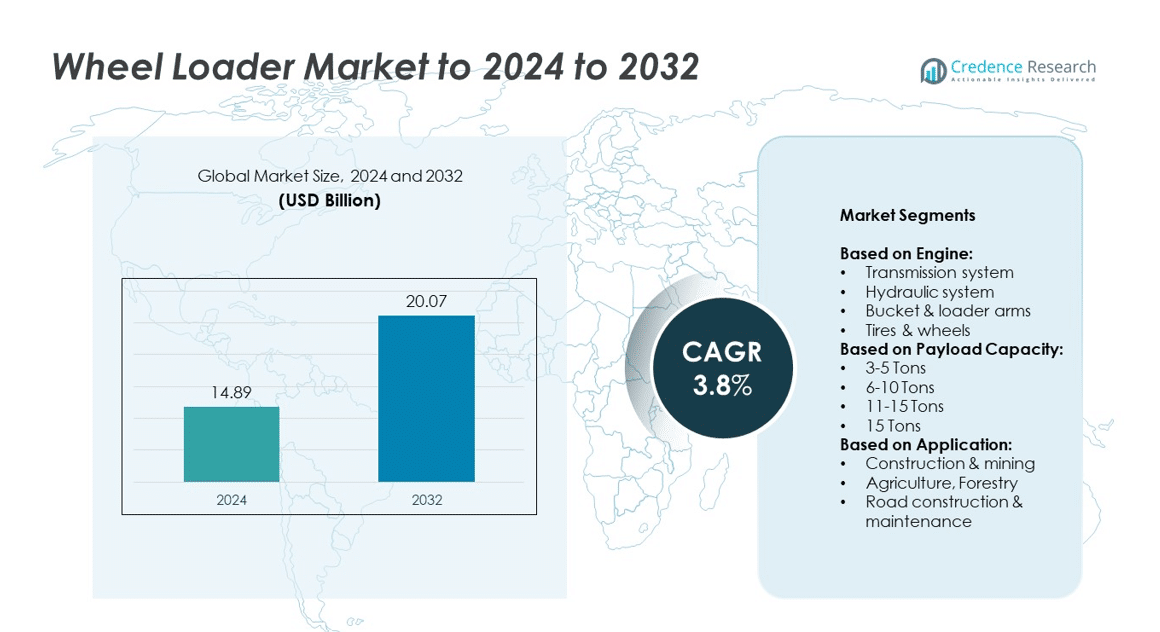
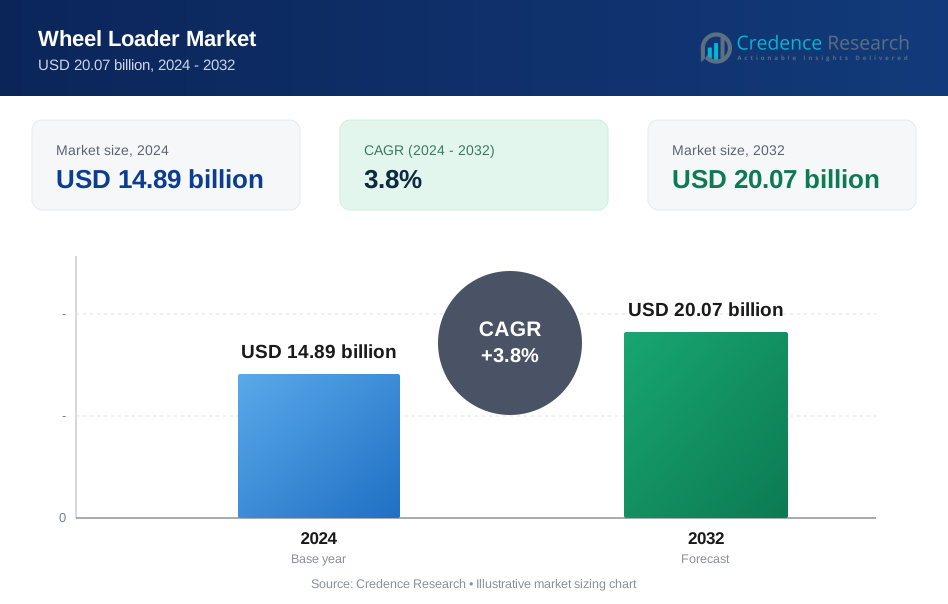
Wheel Loader Market size was valued at USD 14.89 Billion in 2024 and is anticipated to reach USD 20.07 Billion by 2032, at a CAGR of 3.8% during the forecast period.
| REPORT ATTRIBUTE | DETAILS |
|---|---|
| Historical Period | 2020-2023 |
| Base Year | 2024 |
| Forecast Period | 2025-2032 |
| Wheel Loader Market Size 2024 | USD 14.89 Billion |
| Wheel Loader Market, CAGR | 3.8% |
| Wheel Loader Market Size 2032 | USD 20.07 Billion |
The wheel loader market is driven by leading players such as Hyundai Construction Equipment, Caterpillar Inc., Liebherr Group, Komatsu Ltd., Sany Global, John Deere, JCB, Volvo Construction Equipment, Larsen & Toubro, and Hitachi Construction Machinery. These companies focus on expanding their product portfolios with electric and hybrid loaders, integrating telematics, and improving fuel efficiency to meet global emission norms. Asia Pacific remained the dominant region, capturing over 40 percent of the market share in 2024, supported by rapid infrastructure development in China and India. North America followed, driven by government-funded construction projects and a strong rental equipment ecosystem, while Europe showed growing demand for low-emission loaders aligned with carbon neutrality goals.
Market Insights
- The wheel loader market was valued at USD 14.89 billion in 2024 and is projected to reach USD 20.07 billion by 2032, growing at a CAGR of 3.8 % from 2025 to 2032.
- Market growth is driven by infrastructure development, smart city projects, and rising urbanization, creating demand for medium and large loaders as well as compact models for confined construction spaces.
- Key trends include the adoption of electric and hybrid wheel loaders, integration of telematics, and automation systems that improve fuel efficiency and productivity across construction and mining applications.
- The market is highly competitive with global players focusing on R&D, product launches, and partnerships with rental service providers to expand market presence and offer cost-effective solutions.
- Asia Pacific held over 40 % share in 2024, followed by North America at 28 % and Europe at 22%, while the 6-10 tons payload capacity segment dominated globally with around 40 % share.
Market Segmentation Analysis:
By Engine
The wheel loader market by engine components is segmented into transmission system, hydraulic system, bucket and loader arms, and tires and wheels. Hydraulic systems held the largest share of over 35 % in 2024, driven by their essential role in lifting, steering, and operating attachments efficiently. Demand is supported by advancements in energy-efficient hydraulic pumps and load-sensing technology, which improve fuel economy and performance. Bucket and loader arms also account for a significant portion as they directly affect payload handling, with manufacturers focusing on durable, lightweight materials to enhance efficiency.
- For instance, Bobcat’s L65 compact wheel loader features a 55 hp engine and delivers 19.9 gpm auxiliary hydraulic flow, enabling precise control for attachments in construction applications.
By Payload Capacity
The payload capacity segment includes 3-5 tons, 6-10 tons, 11-15 tons, and above 15 tons. The 6-10 ton loaders led the market with nearly 40 % share in 2024 due to their balance of size, maneuverability, and lifting capacity. They are widely used in construction, quarrying, and industrial operations where medium-duty equipment is preferred. The 3-5 ton category is growing steadily with demand from compact job sites, while loaders above 15 tons maintain steady adoption in mining and heavy earthmoving projects.
- For instance, Komatsu’s L-2350 loader offers an 80-short-ton operating payload (≈72,500 kg) with a bucket capacity of up to 40.5 m³, making it suitable for ultra-heavy mining operations.
By Application
Applications include construction and mining, agriculture and forestry, and road construction and maintenance. Construction and mining accounted for more than 55 % of the market share in 2024, supported by infrastructure development, mineral extraction, and urban expansion projects. These loaders are crucial for material loading, grading, and transport, keeping demand consistent. Agriculture and forestry are seeing steady growth as mechanization increases, while road construction benefits from rising investments in highway upgrades and transportation network expansion worldwide.
Market Overview
Infrastructure Development and Urbanization
Rapid infrastructure development and urban expansion are primary growth drivers for the wheel loader market. Governments worldwide are investing heavily in roads, bridges, and smart city projects, creating strong demand for efficient earthmoving equipment. Medium and large wheel loaders are preferred for construction and mining operations due to their high productivity and versatility. Urbanization also drives compact wheel loader adoption for projects with space constraints. These combined factors boost equipment sales and rental demand, supporting consistent market growth throughout the forecast period.
- For instance, Volvo Construction Equipment’s L150H achieved 35% higher fuel efficiency, 28% lower diesel consumption, 20% higher productivity, and 4% shorter cycle times in short-cycle loading tests compared to a competitor.
Technological Advancements and Automation
Integration of telematics, GPS, and IoT-enabled systems has enhanced wheel loader performance, increasing efficiency and reducing downtime. Smart monitoring systems provide real-time data on fuel consumption, maintenance needs, and machine health, helping operators improve productivity and reduce operating costs. Advanced automation features such as load-sensing hydraulics, auto-lubrication, and operator-assist systems reduce fatigue and shorten cycle times. These innovations make wheel loaders more appealing to contractors seeking higher efficiency and long-term cost optimization.
- For instance, Caterpillar’s 950 GC wheel loader has a tipping load (full turn, rigid tires) of 11,737 kg and an operating weight of 18,849 kg.
Sustainability and Emission Regulations
Stringent global emission norms and sustainability targets are encouraging manufacturers to introduce cleaner, fuel-efficient, and battery-electric wheel loaders. Electric models offer zero-emission operations, making them ideal for urban construction and indoor applications. Government incentives, subsidies, and ESG-focused procurement programs are accelerating adoption of eco-friendly equipment. This transition is driving innovation in battery technology, energy management systems, and hybrid powertrains, creating a clear growth pathway for sustainable machinery in the coming years.
Key Trends and Opportunities
Rise of Electric and Hybrid Loaders
Electric and hybrid wheel loaders are becoming a key trend as construction companies adopt greener equipment to meet sustainability goals. These machines reduce emissions, lower noise levels, and provide fuel savings, which is especially valuable in urban and regulated work environments. Major OEMs are investing in next-generation battery packs, fast-charging infrastructure, and longer duty cycles to make electric loaders practical for high-utilization fleets. This shift creates opportunities for equipment suppliers, rental providers, and technology firms to capitalize on the growing preference for low-emission machinery.
- For instance, JCB’s 403E electric compact wheel loader uses a 20 kWh lithium-ion battery, rapid charges from 0-100% in 2 hours, and delivers over 4 hours run time in mixed-use operations.
Growth of Equipment Rental Services
The rental model is gaining strong momentum as construction contractors prioritize flexibility and cost efficiency. Renting wheel loaders allows access to the latest technology without large upfront investments and includes service and maintenance support. This model helps companies adjust fleets based on project demand, reducing idle equipment time. Rental growth is also expanding market penetration in developing economies, where limited capital budgets make leasing equipment a preferred option for small and mid-sized contractors.
- For instance, Case CL36EV compact wheel loader has a 23 kWh battery, an operating weight of 8,911 lb, and dump height of 7 ft 7 in.
Key Challenges
High Operating and Maintenance Costs
Wheel loaders have high operating expenses, including fuel consumption, periodic maintenance, and replacement of wear parts such as hydraulic components and tires. These costs can weigh heavily on smaller contractors and deter direct purchases. Rising fuel prices further increase the total cost of ownership, encouraging many users to shift toward used machines or rental solutions. This trend, while positive for rental growth, can slow new equipment sales and impact OEM revenues in price-sensitive markets.
Supply Chain Disruptions and Raw Material Costs
Fluctuating raw material prices, particularly for steel and rubber, affect production costs and profitability for manufacturers. Global supply chain disruptions, including shipping delays and component shortages, create production backlogs and impact timely delivery of equipment to end users. These challenges can delay project execution, increase procurement costs, and force contractors to retain aging equipment for longer periods, which may limit the pace of new wheel loader adoption during economic volatility.
Regional Analysis
North America
North America accounted for nearly 28 % of the wheel loader market share in 2024, driven by robust demand from construction, road building, and mining projects. The U.S. Infrastructure Investment and Jobs Act continues to boost equipment purchases and fleet upgrades. Rental penetration is high, with contractors preferring flexible access to advanced models featuring telematics and fuel-efficient engines. The region also shows growing interest in hybrid and electric wheel loaders to meet emission norms and sustainability targets. Strong presence of global OEMs and dealer networks supports steady market growth in this region through the forecast period.
Europe
Europe held around 22 % share of the wheel loader market in 2024, supported by significant investments in infrastructure modernization and strict emission regulations. Demand is fueled by the adoption of electric and hybrid models to meet EU carbon reduction goals. Countries such as Germany, France, and the UK lead in deploying advanced, automated wheel loaders for construction and material handling. Growth is steady as the region emphasizes sustainability and efficiency, encouraging fleet renewal with low-emission equipment. Increased focus on digital technologies, telematics, and predictive maintenance is improving productivity across Europe’s construction and industrial sectors.
Asia Pacific
Asia Pacific led the global wheel loader market with more than 40 % share in 2024, driven by rapid urbanization, large-scale infrastructure projects, and high mining activity. China remains the largest market, supported by government spending on transportation and real estate development. India is witnessing strong demand growth as smart city projects and industrial expansion drive equipment needs. Local manufacturing and cost-effective models boost accessibility, while global OEMs are expanding production capacity in the region. Demand for mid-size loaders dominates, though electric models are slowly gaining traction in countries targeting emissions reduction and sustainable construction practices.
Latin America
Latin America represented close to 6 % of the wheel loader market share in 2024, with Brazil and Mexico being key contributors. The market is supported by ongoing mining activities, agricultural mechanization, and public infrastructure projects. Economic recovery and foreign investment in construction sectors are gradually boosting equipment demand. However, currency fluctuations and political instability can affect procurement cycles. Rental services are gaining traction as contractors seek cost-effective solutions. Adoption of advanced loaders is slower compared to developed regions, but modernization of fleets is expected to increase as local governments focus on infrastructure growth initiatives.
Middle East and Africa
Middle East and Africa accounted for nearly 4 % of the market share in 2024, driven by infrastructure development, oil and gas projects, and mining activities. The Gulf Cooperation Council countries are investing in mega construction projects, including smart cities and industrial hubs, which support wheel loader demand. Africa is seeing gradual growth as mining and road development projects expand, particularly in South Africa and Nigeria. High demand for durable, heavy-duty loaders suited for harsh environments is shaping equipment preferences. Market growth is steady but relies on government spending and private sector investments to sustain momentum.
Market Segmentations:
By Engine:
- Transmission system
- Hydraulic system
- Bucket & loader arms
- Tires & wheels
By Payload Capacity:
- 3-5 Tons
- 6-10 Tons
- 11-15 Tons
- 15 Tons
By Application:
- Construction & mining
- Agriculture, Forestry
- Road construction & maintenance
By Geography:
- North America
- U.S.
- Canada
- Mexico
- Europe
- UK
- France
- Germany
- Italy
- Spain
- Russia
- Belgium
- Netherlands
- Austria
- Sweden
- Poland
- Denmark
- Switzerland
- Rest of Europe
- Asia Pacific
- China
- Japan
- South Korea
- India
- Australia
- Thailand
- Indonesia
- Vietnam
- Malaysia
- Philippines
- Taiwan
- Rest of Asia Pacific
- Latin America
- Brazil
- Argentina
- Peru
- Chile
- Colombia
- Rest of Latin America
- Middle East
- UAE
- KSA
- Israel
- Turkey
- Iran
- Rest of Middle East
- Africa
- Egypt
- Nigeria
- Algeria
- Morocco
- Rest of Africa
Competitive Landscape
The wheel loader market is led by key players such as Hyundai Construction Equipment, Caterpillar Inc., Liebherr Group, Komatsu Ltd., Sany Global, John Deere, JCB, Volvo Construction Equipment, Larsen & Toubro, and Hitachi Construction Machinery. These companies focus on product innovation, expanding their electric and hybrid loader portfolios to meet emission regulations and sustainability targets. They are investing in telematics, automation, and IoT-based solutions to enhance machine efficiency and reduce downtime for end users. Strategic partnerships with rental companies and distributors are helping strengthen their market presence across emerging regions. Many players are also increasing production capacities and adopting modular designs to cater to a wider range of applications, from construction to mining. Continuous R&D efforts and focus on cost-competitive manufacturing are enabling them to remain competitive while addressing the growing demand for fuel-efficient, durable, and technologically advanced wheel loaders.
Key Player Analysis
- Hyundai Construction Equipment
- Caterpillar Inc.
- Liebherr Group
- Komatsu Ltd.
- Sany Global
- John Deere
- JCB
- Volvo Construction Equipment
- Larsen & Toubro
- Hitachi Construction Machinery
Recent Developments
- In 2025, Komatsu Ltd. introduced Komatsu WA170M-11, this compact and versatile 10-tonne wheel loader was designed for a wide range of jobs in tight spaces.
- In 2025, Volvo CE unveiled the first wave of a new generation of wheel loaders (L150, L180, L200 High Lift, L220, and L260), featuring faster cycle times and improved fuel consumption.
- In 2023, Caterpillar unveiled the new 950 and 962 Next-Generation Wheel Loaders.
Report Coverage
The research report offers an in-depth analysis based on Engine, Payload Capacity, Application and Geography. It details leading market players, providing an overview of their business, product offerings, investments, revenue streams, and key applications. Additionally, the report includes insights into the competitive environment, SWOT analysis, current market trends, as well as the primary drivers and constraints. Furthermore, it discusses various factors that have driven market expansion in recent years. The report also explores market dynamics, regulatory scenarios, and technological advancements that are shaping the industry. It assesses the impact of external factors and global economic changes on market growth. Lastly, it provides strategic recommendations for new entrants and established companies to navigate the complexities of the market.
Future Outlook
- Demand for medium and large wheel loaders will grow with rising infrastructure and mining projects.
- Adoption of electric and hybrid wheel loaders will accelerate due to stricter emission regulations.
- Telematics and IoT integration will become standard, enabling predictive maintenance and fleet optimization.
- Compact wheel loaders will see higher demand in urban construction and landscaping applications.
- Rental services will expand as contractors seek cost-effective and flexible equipment access.
- Manufacturers will focus on fuel-efficient engines and automation to lower operating costs.
- Asia Pacific will remain the dominant region, driven by government-led infrastructure spending.
- Europe will lead in electric loader adoption, influenced by carbon neutrality initiatives.
- Aftermarket services and parts replacement will gain importance for long-term equipment lifecycle management.
- Strategic collaborations and mergers will increase to strengthen distribution and technology capabilities.
Request a Free Sample
Fill in your details and we'll send you a free sample report.
- Sample data tables & charts
- Research methodology
Need a Custom Version of This Report?
Tailor the scope, geography, or segments to your exact requirements.
- Custom geography or segment scope
- Direct access to our analyst team
Frequently Asked Questions
What is the current market size for Wheel Loader Market, and what is its projected size in 2032?
At what Compound Annual Growth Rate is the Wheel Loader Market projected to grow between 2025 and 2032?
Which Wheel Loader Market segment held the largest share in 2024?
What are the primary factors fueling the growth of the Wheel Loader Market?
Who are the leading companies in the Wheel Loader Market?
Table of Content
Chapter 1. Report Introduction
- 1.1 Report Description & Purpose
- 1.1.1 Report Title & Market Definition
- 1.1.2 Unique Selling Propositions (USP) & Key Differentiators
- 1.1.3 Value Proposition for Stakeholders
- 1.2 Research Objectives
- 1.2.1 Market Sizing Objectives (Volume & Revenue)
- 1.2.2 Segmentation Objectives
- 1.2.3 Competitive Intelligence Objectives
- 1.2.4 Forecast & Scenario Objectives
- 1.3 Report Scope
- 1.3.1 Wheel Loader Scope – Types & Subtypes Covered
- 1.3.2 Geographic Scope – Regions & Countries Covered
- 1.3.3 Historical Period, Base Year & Forecast Period (2024; forecast to 2032)
- 1.3.4 Inclusions & Exclusions
- 1.4 HS Code & Classification Framework
- 1.5 Currency, Units & Pricing Basis
- 1.6 Target Stakeholders
- 1.7 Limitations & Assumptions
Chapter 2. Executive Summary
- 2.1 Global Wheel Loader Market Snapshot
- 2.1.1 Market Size – Historical (2024) & Forecast (2024-2032) (2024: USD 14.89 billion → 2032: USD 20.07 billion)
- 2.1.2 Volume & Revenue – Global Totals
- 2.1.3 Key Market Highlights – Top Five Facts
- 2.2 Wheel Loader Market Segmentation Snapshot
- 2.2.1 Market Split by Region – 2024 vs. 2032
- 2.3 Competitive Snapshot
- 2.3.1 Top 10 Players by Revenue Share – 2024
- 2.3.2 Top 10 Players by Volume Share – 2024
- 2.3.3 Recent Strategic Developments (18-Month Summary)
- 2.4 Key Investment Highlights & Strategic Conclusions
Chapter 3. Wheel Loader Market Dynamics & Industry Analysis
- 3.1 Market Overview & Context
- 3.1.1 Wheel Loader Market Position in the Broader Automotive Value Chain
- 3.1.2 OEM vs. Replacement Market Dynamics
- 3.1.3 Market Maturity & Development Stage by Region
- 3.2 Wheel Loader Market Drivers
- 3.3 Wheel Loader Market Restraints & Challenges
- 3.4 Wheel Loader Market Opportunities
- 3.5 Porter's Five Forces Analysis
- 3.5.1 Threat of New Entrants
- 3.5.2 Bargaining Power of Suppliers
- 3.5.3 Bargaining Power of Buyers
- 3.5.4 Threat of Substitutes
- 3.5.5 Competitive Rivalry – Intensity Assessment
- 3.6 Wheel Loader Value Chain Analysis
- 3.6.1 Upstream – Raw Material/Input Suppliers
- 3.6.1.1 Raw Material/Input 1
- 3.6.1.2 Raw Material/Input 2
- 3.6.1.3 Raw Material/Input 3
- 3.6.2 Midstream – Production/Manufacturing/Service Delivery
- 3.6.2.1 Production/Process Overview
- 3.6.2.2 Key Facility Locations & Capacity by Manufacturer
- 3.6.3 Downstream – Distribution & End Consumer
- 3.6.3.1 Primary Channel – B2B/OEM
- 3.6.3.2 Secondary Channels – Dealer, Retail, Online, Direct
- 3.6.4 Value Chain Profitability Analysis
- 3.6.1 Upstream – Raw Material/Input Suppliers
- 3.7 PESTEL Analysis
- 3.7.1 Political Factors
- 3.7.2 Economic Factors
- 3.7.3 Social Factors
- 3.7.4 Technological Factors
- 3.7.5 Environmental Factors
- 3.7.6 Legal Factors
- 3.8 Wheel Loader Supply Chain Analysis
- 3.8.1 Raw Material/Input Supply Risk Assessment
- 3.8.2 Manufacturing Concentration Risk (Geographic Exposure)
- 3.8.3 Trade Disruption Impact Analysis
- 3.9 Regulatory & Policy Landscape
Note: The regulatory and policy landscape section covers regulations based on their applicability to the market, Wheel Loader category, geography, and scope of the study. Only regulatory frameworks with a material impact on operations, compliance, trade, sustainability, or market access are analyzed in detail.
Chapter 4. Key Investment Pockets & Opportunity Analysis
- 4.1 Wheel Loader Market Attractiveness Analysis
- 4.1.1 By Region – Investment Attractiveness Matrix (Volume × CAGR)
- 4.2 Absolute Revenue Growth Opportunity
- 4.2.1 By Region – Absolute USD Growth Through 2032
- 4.3 Incremental Volume Opportunity
- 4.3.1 By Region – Incremental Volume Through 2032
- 4.3.2 Segment – Incremental Volume
- 4.4 Emerging Submarket Opportunity Deep Dive (Subject to Applicability)
- 4.5 Emerging Market Opportunity Scorecards
- 4.5.1 United States
- 4.5.2 Europe
- 4.5.3 Asia
- 4.5.4 Middle East & Africa
Note: Emerging Market Opportunity Scorecards will be included based on relevance and strategic importance. Regions listed are indicative and may vary depending on data availability and market dynamics.
Chapter 5. Wheel Loader Import-Export Analysis & Trade Flows
- 5.1 Global Trade Overview
- 5.1.1 Global Export Value by Country (2024)
- 5.1.2 Global Export Volume by Country (2024)
- 5.1.3 Global Import Value by Country (2024)
- 5.1.4 Global Import Volume by Country (2024)
- 5.1.5 Net Trade Balance by Country (2024)
- 5.2 Export Analysis – Segment
- 5.2.1 Type 1 (HS Code)
- 5.2.2 Type 2 (HS Code)
- 5.2.3 Type 3 (HS Code)
- 5.2.4 Type 4 (HS Code)
- 5.2.5 Type 5 (HS Code)
- 5.3 Import Analysis – Segment
- 5.3.1 Type 1 (HS Code)
- 5.3.2 Type 2 (HS Code)
- 5.3.3 Type 3 (HS Code)
- 5.3.4 Type 4 (HS Code)
- 5.3.5 Type 5 (HS Code)
- 5.4 Average Unit Trade Prices
- 5.4.1 Average Export Price – Segment & Country
- 5.4.2 Average Import Price – Segment & Source Country
- 5.4.3 Price Trends (2024)
- 5.5 Key Trade Route Analysis
- 5.5.1 Trade Route 1
- 5.5.2 Trade Route 2
- 5.5.3 Trade Route 3
- 5.5.4 Trade Route 4
- 5.5.5 Trade Route 5
- 5.6 Trade Policy Impact Assessment
- 5.6.1 US Anti-Dumping & Section 301 Tariffs
- 5.6.2 EU Customs Union Impact
- 5.6.3 Major Free Trade Agreements
- 5.6.4 USMCA Rules of Origin
Note: Trade policy analysis will be included only where relevant to the Wheel Loader market.
Chapter 6. Competitive Landscape & Company Benchmarking
- 6.1 Wheel Loader Market Concentration & Structure
- 6.1.1 Herfindahl-Hirschman Index (HHI) – vs. 2024
- 6.1.2 Tier 1, Tier 2 & Tier 3 Market Structure
- 6.1.3 Global, Regional & Local Player Dynamics
- 6.2 Wheel Loader Market Share Analysis – 2024
- 6.2.1 Global Revenue Share by Company
- 6.2.2 Global Volume Share by Company
- 6.2.3 Regional Revenue Share
- 6.2.4 Market Share Evolution ( vs. 2024)
- 6.2.5 OEM Segment Share by Company
- 6.2.6 Replacement Segment Share by Company
- 6.3 Production/Delivery Capacity & Facility Analysis
- 6.3.1 Global Installed Capacity
- 6.3.2 Capacity Utilization Rates
- 6.3.3 Production/Output Volume
- 6.3.4 Facility Locations & Capacity Map
- 6.3.5 Planned Capacity Additions
- 6.4 Wheel Loader Competitive Benchmarking Matrix
- 6.4.1 Revenue, Volume, CAGR & Profitability Comparison
- 6.4.2 Channel Revenue Mix
- 6.4.3 Geographic Revenue Exposure
- 6.4.4 R&D Intensity
- 6.4.5 Sustainability Maturity
- 6.5 Strategic Developments in Wheel Loader (Last 24 Months)
- 6.5.1 Mergers, Acquisitions & Divestments
- 6.5.2 New Wheel Loader Launches
- 6.5.3 Facility Expansions
- 6.5.4 Strategic Alliances, Joint Ventures & Partnerships
- 6.5.5 Distribution Expansion & Market Entry
- 6.5.6 Sustainability & ESG Initiatives
- 6.6 Competitive Strategy Mapping
- 6.6.1 Leader, Challenger, Follower & Niche Classification
- 6.6.2 Pricing Strategy Comparison
- 6.6.3 Channel Strategy Matrix
Note: Strategic developments are included based on their materiality and the availability of reliable information.
Chapter 7. Global Wheel Loader Market – By Distribution Channel
- 7.1 Segment Overview
- 7.1.1 Volume & Revenue Split by Channel (2024 & 2032)
- 7.1.2 Channel Mix Evolution (2024-2032)
Chapter 8. Regional Market Analysis – Global Overview
- 8.1 Global Regional Overview
- 8.1.1 Regional Volume Share
- 8.1.2 Regional Revenue Share
- 8.1.3 Regional Volume by Region
- 8.1.4 Regional Revenue by Region
- 8.1.5 Regional Forecast Through 2032
- 8.2 Cross-Regional Segment Analysis
- 8.2.1 By Distribution Channel
- 8.2.2 By Brand/Price Tier
Chapter 9. North America Wheel Loader Market
- 9.1 United States
- 9.2 Canada
- 9.3 Mexico
Chapter 10. Europe Wheel Loader Market
- 10.1 Germany
- 10.2 France
- 10.3 Italy
- 10.4 United Kingdom
- 10.5 Spain
- 10.6 Poland
- 10.7 Russia
- 10.8 Netherlands
- 10.9 Belgium
- 10.10 Sweden
- 10.11 Denmark
- 10.12 Norway
- 10.13 Rest of Europe
Chapter 11. Asia Pacific Wheel Loader Market
- 11.1 China
- 11.2 India
- 11.3 Japan
- 11.4 South Korea
- 11.5 Thailand
- 11.6 Indonesia
- 11.7 Vietnam
- 11.8 Malaysia
- 11.9 Australia
- 11.10 Rest of Asia Pacific
Chapter 12. Latin America Wheel Loader Market
- 12.1 Brazil
- 12.2 Argentina
- 12.3 Colombia
- 12.4 Chile
- 12.5 Rest of Latin America
Chapter 13. Middle East Wheel Loader Market
- 13.1 Saudi Arabia
- 13.2 United Arab Emirates
- 13.3 Turkey
- 13.4 Israel
- 13.5 Iran
- 13.6 Rest of the Middle East
Chapter 14. Africa Wheel Loader Market
- 14.1 South Africa
- 14.2 Egypt
- 14.3 Nigeria
- 14.4 Morocco
- 14.5 Rest of Africa
Chapter 15. Wheel Loader Company Profiles
- 15.1 [Company 01]
- 15.1.1 Company Overview
- 15.1.2 Key Management Personnel
- 15.1.3 Products & Services Portfolio
- 15.1.4 Financial Performance
- 15.1.5 Key Market Focus & Geographic Presence
- 15.1.6 Recent Developments & Strategic Initiatives
Note: The company profile list is preliminary and may change based on research findings, market developments, data availability, and client requirements.
Chapter 16. Appendices
- Appendix A – List of Abbreviations & Acronyms
- Appendix B – Industry Classification Code Reference – Full Series
- Appendix C – Production & Capacity Data Tables
- Appendix D – End-Use & Demand Base Tables
- Appendix E – Consumption & Replacement Rate Assumptions
- Appendix F – ASP Reference Tables
- Appendix G – Manufacturing & Facility Database
- Appendix H – Import-Export Data Tables
- Appendix I – Regulatory Summary Tables
- Appendix J – Primary Research Participant List (Anonymized)
- Appendix K – Primary Research Questionnaire Framework
- Appendix L – Data Sources & Bibliography
- Appendix M – Market Size Divergence & Source Comparison
Chapter 17. Research Methodology
- 17.1 Research Framework & Philosophy
- 17.2 Secondary Research – Sources, Hierarchy & Data Extraction
- 17.3 Data Modeling – Bottom-Up & Top-Down Market Sizing
- 17.4 Primary Research – Stakeholder Framework, LOI & Sample Sizes
- 17.5 Forecast Methodology – Regression, Scenario & Sensitivity Analysis
- 17.6 Quality Control – Four-Layer Validation Framework
- 17.7 Limitations & Standard Assumptions
- 17.8 Disclaimer
