
| REPORT ATTRIBUTE | DETAILS |
|---|---|
| Historical Period | 2020-2023 |
| Base Year | 2024 |
| Forecast Period | 2025-2032 |
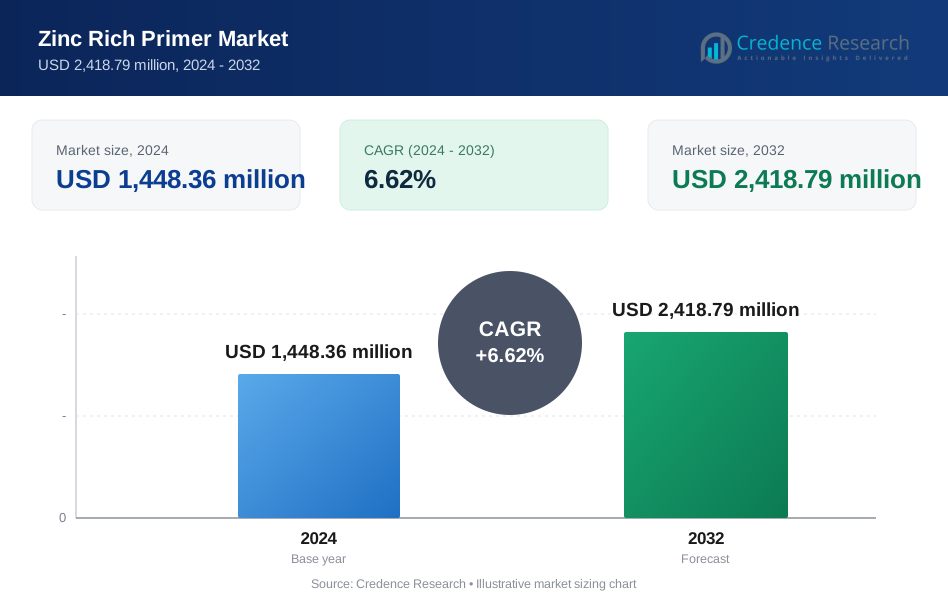
| Zinc Rich Primer Market Size 2024 | USD 1,448.36 million |
| Zinc Rich Primer Market, CAGR | 6.62% |
| Zinc Rich Primer Market Size 2032 | USD 2,418.79 million |
Market overview
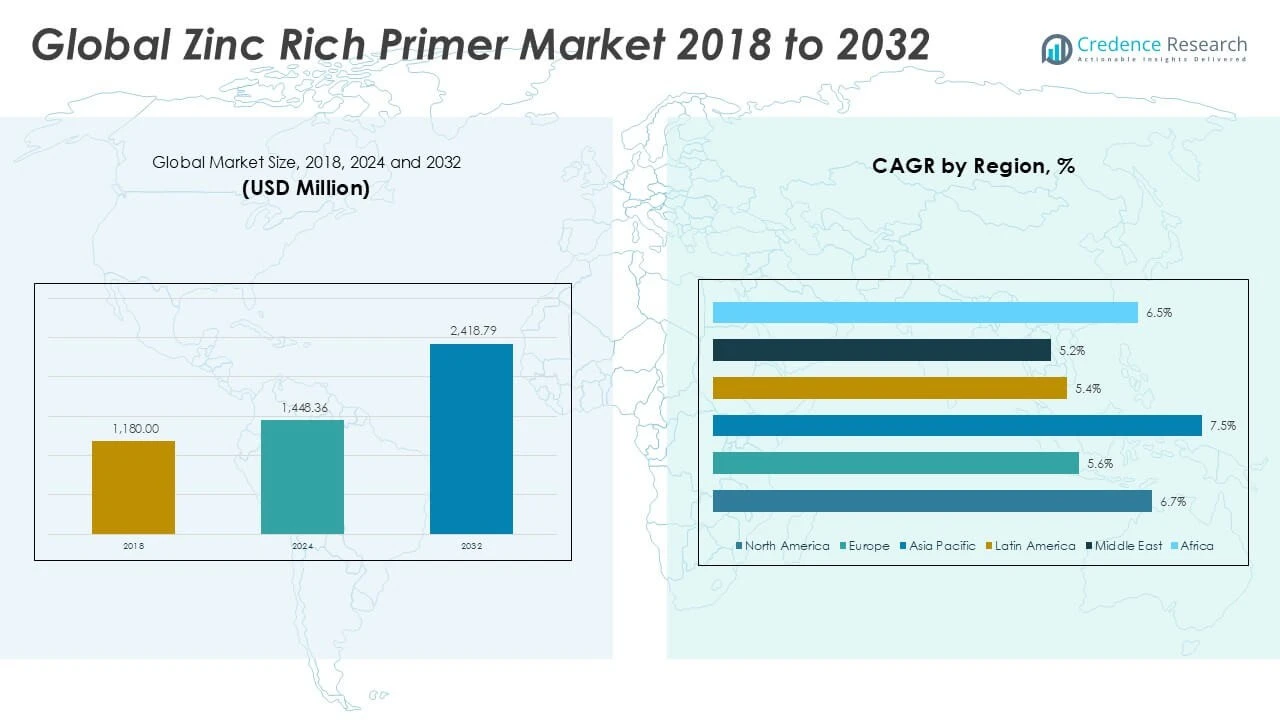
The Global Zinc Rich Primer Market is projected to grow from USD 1,448.36 million in 2024 to an estimated USD 2,418.79 million by 2032, with a compound annual growth rate (CAGR) of 6.62% from 2025 to 2032.
Key drivers propelling the zinc rich primer market include growing industrialization and stringent government regulations on corrosion control and environmental safety. Manufacturers increasingly adopt zinc rich primers due to their superior protective properties and compliance with eco-friendly standards. Technological advancements have improved primer formulations, enhancing performance while minimizing harmful emissions. Trends such as the rising use of solvent-free and water-based primers and growing awareness about sustainable coatings further stimulate market expansion. Additionally, increasing investments in infrastructure and renewable energy sectors create substantial opportunities for zinc rich primer applications.
Regionally, Asia Pacific dominates the zinc rich primer market, driven by rapid industrial growth and infrastructural development in countries like China, India, and Southeast Asian nations. The region’s expanding automotive and construction industries fuel demand for corrosion-resistant coatings. North America and Europe also hold significant shares, supported by advanced manufacturing and stringent environmental policies. Key players operating in the market include AkzoNobel, PPG Industries, Sherwin-Williams, Jotun, and Asian Paints, who focus on product innovation and strategic partnerships to strengthen their market presence globally.
Market Insights
- The Global Zinc Rich Primer Market is projected to grow from USD 1,448.36 million in 2024 to USD 2,418.79 million by 2032, with a CAGR of 6.62%, driven by rising demand for corrosion protection across industries.
- Expanding industrialization and infrastructure development globally increase the need for durable zinc rich primers, especially in automotive, marine, and construction sectors.
- Stringent environmental regulations promoting low-VOC and eco-friendly coatings accelerate market adoption and drive manufacturers to innovate sustainable primer formulations.
- High raw material costs and regulatory compliance pose challenges, impacting production expenses and market growth pace.
- Asia Pacific dominates the market due to rapid industrial growth, urbanization, and infrastructure investments in countries such as China, India, and Southeast Asia.
- North America and Europe hold significant market shares, supported by advanced manufacturing capabilities and strong environmental policies.
- Emerging markets in Latin America, the Middle East, and Africa offer growth opportunities driven by expanding industrial bases and infrastructure projects.
Market Drivers
Key Drivers Shaping the Growth of the Global Zinc Rich Primer Market Include Expanding Industrialization and Infrastructure Development
The Global Zinc Rich Primer Market benefits significantly from the ongoing industrialization and rapid infrastructure expansion worldwide. Increasing construction activities in emerging economies drive the demand for corrosion-resistant coatings to protect steel structures from environmental degradation. It supports extended service life and reduces maintenance costs in sectors such as bridges, buildings, and pipelines. Industrial growth in automotive, marine, and oil & gas industries further propels market demand. The rising need for durable protective coatings in harsh environments accelerates zinc rich primer adoption. Government initiatives aimed at infrastructure modernization also contribute to sustained market growth.
- For instance, in 2024, over 2,300 commercial vessels were produced in shipyards across South Korea, China, and Japan, each requiring multiple coatings of zinc-rich primers for hulls and decks
Strict Environmental Regulations and Rising Focus on Sustainable Corrosion Protection Propel Market Demand
It responds directly to tightening environmental regulations that restrict the use of hazardous materials in coatings. Zinc rich primers offer an eco-friendly alternative by reducing volatile organic compound (VOC) emissions compared to traditional primers. Regulatory frameworks in North America, Europe, and Asia Pacific encourage the use of sustainable coatings, boosting product acceptance. Manufacturers prioritize the development of solvent-free and water-based zinc rich primers to meet compliance standards. This shift aligns with global efforts to minimize environmental impact while maintaining effective corrosion protection. It supports market expansion by addressing both performance and sustainability criteria.
- For instance, in 2023, the U.S. Environmental Protection Agency (EPA) reported that protective coatings, including zinc-rich primers, significantly reduced environmental impact in construction and maintenance activities, supporting sustainability goals
Technological Advancements Enhancing Product Performance Drive Market Penetration
The Global Zinc Rich Primer Market grows with continuous innovations in formulation technologies. Improved primer compositions enhance adhesion, corrosion resistance, and application efficiency. Innovations in nanoparticle zinc formulations and hybrid coatings provide superior protective properties under diverse conditions. It facilitates easier application and faster drying times, improving operational productivity. Development of primers compatible with various substrates broadens market reach across industries. Such advancements position zinc rich primers as preferred solutions in demanding environments. Manufacturers leverage technology to differentiate offerings and capture greater market share.
Growing Demand from End-User Industries Strengthens Market Expansion Opportunities
Increasing activities in the automotive, marine, and heavy machinery sectors create consistent demand for zinc rich primers. It plays a vital role in protecting vehicles, ships, and industrial equipment from corrosion, thereby extending asset longevity. Rising investments in renewable energy infrastructure, including wind and solar power, further boost zinc rich primer requirements. These industries prioritize coatings that ensure reliability and reduce lifecycle costs. It encourages the adoption of advanced corrosion protection solutions. End-user demand dynamics remain pivotal to driving sustained growth in the zinc rich primer market.
Market Trends
Increasing Adoption of Eco-Friendly and Low-VOC Zinc Rich Primers Drives Market Trends
The Global Zinc Rich Primer Market shows a clear shift toward environmentally friendly formulations that reduce volatile organic compound (VOC) emissions. It meets stricter regulations and growing consumer preference for sustainable products. Water-based and solvent-free zinc rich primers gain traction due to their reduced environmental impact and compliance with global standards. Manufacturers invest in developing these greener alternatives without compromising corrosion protection performance. This trend aligns with broader industry movements toward sustainability and corporate social responsibility. It encourages wider acceptance across various end-use sectors focused on eco-conscious practices.
- For instance, the Global Organic Zinc Rich Primer Market had 103 industry report pages and was extensively analyzed across 5 major application sectors, including shipbuilding, offshore structures, and industrial machinery.
Integration of Advanced Nanotechnology Enhances Product Efficiency and Durability
Nanotechnology integration represents a significant trend in the Global Zinc Rich Primer Market. It improves zinc particle dispersion and adhesion, enhancing corrosion resistance and coating longevity. Nanoparticles in primer formulations offer better surface coverage and faster drying times, increasing application efficiency. Such innovations allow primers to perform effectively under extreme environmental conditions, including marine and industrial exposures. It supports manufacturers in differentiating their products with superior technical capabilities. This trend drives higher demand for next-generation zinc rich primers that meet evolving industry requirements.
- For instance, the Global Nanotechnology Market had 100 industry report pages and covered 58% of revenue from nanodevices, which are widely used in coatings for enhanced corrosion resistance.
Rising Preference for Multi-Functional Coatings Boosts Market Innovation
The Global Zinc Rich Primer Market witnesses growing interest in primers that combine corrosion protection with additional properties such as abrasion resistance and chemical stability. It addresses the need for versatile coatings that reduce the number of layers required, cutting application time and costs. Formulations that integrate anti-fungal and anti-microbial features respond to specific industry demands like infrastructure and marine applications. This trend reflects the market’s focus on delivering enhanced value through innovation. It encourages continuous product development to meet complex customer needs and performance standards.
Expansion of Application Scope Across Diverse End-Use Industries Supports Market Growth
The Global Zinc Rich Primer Market expands its reach beyond traditional sectors such as construction and automotive. It gains adoption in emerging fields like renewable energy, aerospace, and heavy machinery manufacturing. These industries demand advanced corrosion protection to ensure reliability and operational efficiency. Growth in offshore wind farms and solar power installations stimulates primer consumption due to the need for durable coatings in harsh environments. It also benefits from increased infrastructure investments globally. Expanding application areas drive innovation and market penetration across new geographic and industrial segments.
Market Challenges
High Raw Material Costs and Supply Chain Disruptions Pose Significant Challenges for the Global Zinc Rich Primer Market
The Global Zinc Rich Primer Market faces pressure from fluctuating zinc prices and volatile raw material costs, which impact overall production expenses. It forces manufacturers to manage tight profit margins while maintaining competitive pricing. Supply chain disruptions, including transportation delays and limited availability of quality zinc, further complicate procurement processes. These challenges can lead to production slowdowns and affect timely delivery to end-users. Manufacturers must adopt efficient sourcing strategies and explore alternative materials to mitigate risks. Such cost pressures restrict the ability to scale operations and invest in research and development, hindering market growth potential.
- For instance, over 1,200 industrial projects worldwide faced delays in zinc primer procurement due to supply chain disruptions between 2023 and 2025
Strict Regulatory Compliance and Health Concerns Limit Market Expansion Opportunities
It contends with stringent environmental regulations governing the use of heavy metals and volatile organic compounds (VOCs) in coating products. Compliance requirements demand continuous reformulation efforts to reduce hazardous substances without compromising product effectiveness. Health concerns related to zinc dust inhalation and chemical exposure during application create safety challenges for workers. These issues increase operational costs due to necessary protective measures and training. The regulatory burden may slow product approvals and market entry, especially in highly regulated regions. Companies face difficulties balancing performance, safety, and regulatory adherence, which can limit rapid expansion and adoption of zinc rich primers.
Market Opportunities
Growing Infrastructure Investments and Renewable Energy Projects Create Expansion Opportunities for the Global Zinc Rich Primer Market
The Global Zinc Rich Primer Market benefits from rising infrastructure spending in emerging economies, which drives demand for durable corrosion protection solutions. It finds increased application in bridges, highways, and industrial facilities where long-term metal protection is critical. Expansion in renewable energy sectors, including wind and solar power, opens new avenues for zinc rich primers due to their effectiveness in harsh environments. Governments’ focus on sustainable infrastructure development further stimulates demand. These factors create opportunities for market players to introduce specialized primers tailored to renewable energy installations. It supports sustained growth through diversification into high-potential end-use segments.
Advancements in Eco-Friendly Technologies and Product Innovation Offer Strategic Growth Potential
It can leverage advancements in green chemistry and formulation technologies to develop environmentally compliant zinc rich primers. Water-based and low-VOC products attract customers focused on regulatory compliance and sustainability. Innovative multi-functional primers that combine corrosion resistance with abrasion and chemical protection appeal to diverse industries. Strategic collaborations between coating manufacturers and end-users facilitate customized solutions that meet specific operational needs. This approach enables market players to differentiate themselves and capture niche markets. The increasing emphasis on eco-conscious industrial practices ensures ongoing demand for advanced zinc rich primer technologies, creating long-term growth prospects.
Market Segmentation Analysis
By Type
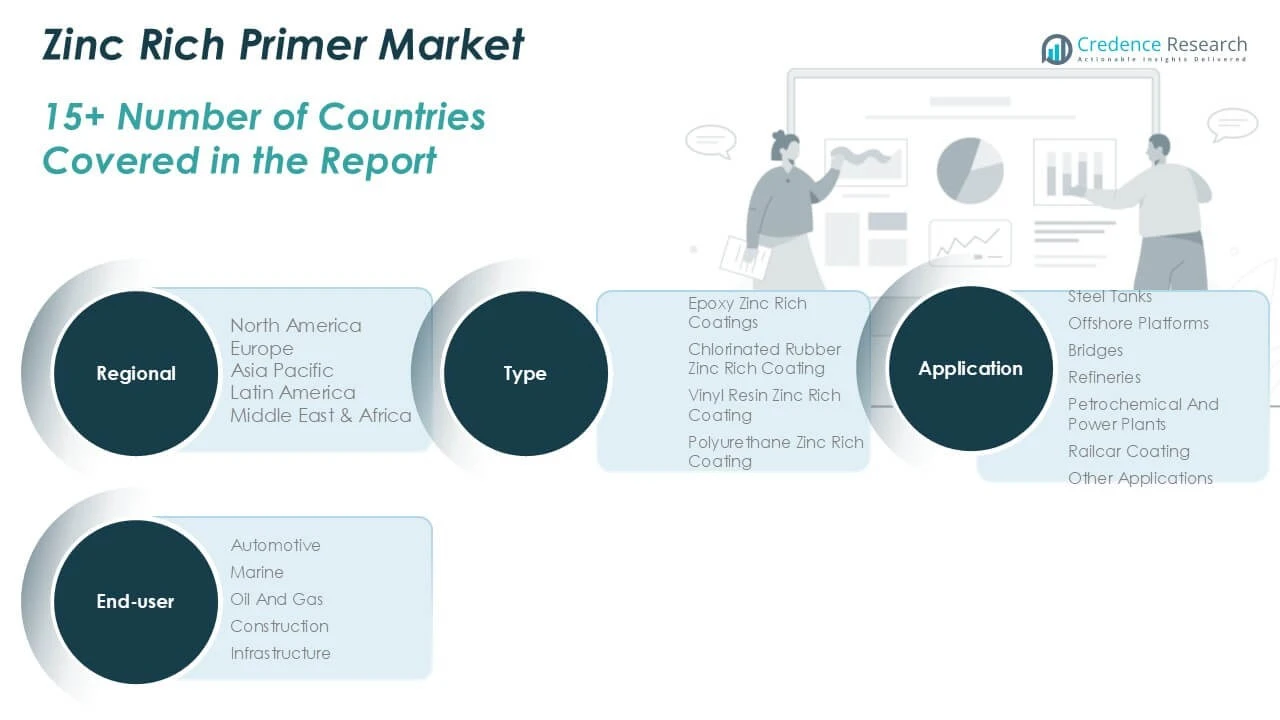
The Global Zinc Rich Primer Market divides into key product types including epoxy zinc rich coatings, chlorinated rubber zinc rich coatings, vinyl resin zinc rich coatings, and polyurethane zinc rich coatings. Epoxy zinc rich coatings dominate due to their excellent adhesion, corrosion resistance, and durability across harsh environments. It serves widely in industrial and marine applications where robust protection is critical. Chlorinated rubber and vinyl resin coatings find niche applications with specific chemical resistance requirements. Polyurethane zinc rich coatings gain traction for their superior flexibility and weather resistance. This segmentation reflects varied end-user needs and environmental conditions influencing product choice.
By Application
Applications of zinc rich primers encompass steel tanks, offshore platforms, bridges, refineries, petrochemical and power plants, railcar coatings, and other specialized uses. Steel tanks and offshore platforms constitute significant revenue contributors due to their exposure to corrosive environments demanding reliable protective coatings. Bridges and infrastructure benefit from zinc rich primers that extend structural lifespan and reduce maintenance frequency. The petrochemical and power sectors utilize these primers to ensure operational safety under aggressive chemical exposures. Railcar coatings and other applications continue to grow with increasing industrial transportation and infrastructure development, driving broader market adoption.
By End-User
The end-user segmentation includes automotive, marine, oil and gas, construction, and infrastructure sectors. The automotive industry leverages zinc rich primers for corrosion protection on vehicle chassis and components, promoting longevity and safety. Marine applications require primers capable of withstanding saltwater corrosion and mechanical wear. Oil and gas industries prioritize zinc rich primers to protect pipelines and equipment exposed to extreme conditions. Construction and infrastructure sectors drive demand for primers used on steel frameworks, bridges, and industrial structures. This diverse end-user base sustains market growth by addressing varied protection needs across sectors.
Segments
Based on Type
- Epoxy Zinc Rich Coatings
- Chlorinated Rubber Zinc Rich Coating
- Vinyl Resin Zinc Rich Coating
- Polyurethane Zinc Rich Coating
Based on Application
- Steel Tanks
- Offshore Platforms
- Bridges
- Refineries
- Petrochemical And Power Plants
- Railcar Coating
- Other Applications
Based on End-user
- Automotive
- Marine
- Oil And Gas
- Construction
- Infrastructure
Based on Region
- North America
- U.S.
- Canada
- Mexico
- Europe
- UK
- France
- Germany
- Italy
- Spain
- Russia
- Belgium
- Netherlands
- Austria
- Sweden
- Poland
- Denmark
- Switzerland
- Rest of Europe
- Asia Pacific
- China
- Japan
- South Korea
- India
- Australia
- Thailand
- Indonesia
- Vietnam
- Malaysia
- Philippines
- Taiwan
- Rest of Asia Pacific
- Latin America
- Brazil
- Argentina
- Peru
- Chile
- Colombia
- Rest of Latin America
- Middle East
- UAE
- KSA
- Israel
- Turkey
- Iran
- Rest of Middle East
- Africa
- Egypt
- Nigeria
- Algeria
- Morocco
- Rest of Africa
Regional Analysis
North America Zinc Rich Primer Market
The North America zinc rich primer market holds a significant share, valued at USD 432.08 million in 2024 and projected to reach USD 726.01 million by 2032. It commands approximately 29.8% of the global market in 2024, reflecting strong demand from industrial sectors including automotive, oil and gas, and construction. The region’s CAGR stands at 6.7%, driven by stringent environmental regulations promoting the adoption of sustainable corrosion protection solutions. The U.S. leads regional growth with ongoing infrastructure investments and advanced manufacturing capabilities. Canada and Mexico contribute through expanding industrial activities and government initiatives supporting protective coatings.
Europe Zinc Rich Primer Market
Europe accounts for around 21.5% of the global zinc rich primer market with a valuation of USD 311.07 million in 2024, expected to grow to USD 480.79 million by 2032 at a CAGR of 5.6%. It experiences steady growth due to stringent environmental policies and rising demand in automotive and marine sectors. Germany, France, and the UK drive market expansion through industrial modernization and infrastructure refurbishment projects. The region prioritizes low-VOC and eco-friendly primer formulations, boosting adoption. It supports product innovation and compliance with evolving regulatory standards, sustaining market momentum.
Asia Pacific Zinc Rich Primer Market
The Asia Pacific market commands the largest regional share, valued at USD 515.39 million in 2024, which is approximately 35.5% of the global market. It is forecast to reach USD 919.26 million by 2032, registering the highest CAGR at 7.5%. Rapid industrialization, urban infrastructure development, and growing automotive production fuel demand in China, India, Japan, and Southeast Asian countries. Government investments in renewable energy and construction sectors further accelerate zinc rich primer usage. It benefits from expanding manufacturing bases and increasing awareness of corrosion protection solutions in emerging economies.
Latin America Zinc Rich Primer Market
Latin America holds about 6.1% of the global zinc rich primer market with a market size of USD 89.06 million in 2024, growing to USD 135.77 million by 2032 at a CAGR of 5.4%. Brazil, Mexico, and Argentina drive growth through expanding infrastructure projects and industrial maintenance requirements. The demand for corrosion-resistant coatings in oil and gas and marine applications supports steady market development. It faces challenges from economic fluctuations but benefits from increasing urbanization and government infrastructure initiatives.
Middle East Zinc Rich Primer Market
The Middle East zinc rich primer market represents roughly 3.9% of the global market, valued at USD 55.90 million in 2024 and expected to reach USD 83.67 million by 2032 with a CAGR of 5.2%. Its growth aligns with oil and gas sector investments and infrastructure expansion in countries such as Saudi Arabia, UAE, and Qatar. It requires high-performance coatings to withstand harsh environmental conditions, driving zinc rich primer adoption. The region’s emphasis on infrastructure diversification into renewable energy projects also supports market potential.
Africa Zinc Rich Primer Market
Africa accounts for approximately 3.1% of the global zinc rich primer market, with a market value of USD 44.86 million in 2024 and projected to reach USD 73.29 million by 2032 at a CAGR of 6.5%. South Africa, Nigeria, and Egypt lead demand through mining, construction, and oil & gas activities. It benefits from increasing industrialization and infrastructure investments across the continent. Market players focus on expanding distribution networks and introducing cost-effective corrosion protection solutions to capture growth opportunities.
Key players
- The Sherwin-Williams Company
- PPG Industries Inc
- Akzo Nobel N.V.
- Sika AG
- Axalta Coating Systems
- Kansai Paint America Inc
- Hempel A/S
- MBCC Group
- Berger Paints Nigeria Plc
- Tnemec Company Inc
- Nippon Paint Holdings Co Ltd
- Dulux Protective Coatings
- Altex Coatings Ltd
- Promain
Competitive Analysis
The Global Zinc Rich Primer Market features intense competition among leading multinational coatings manufacturers and specialized regional players. It benefits from continuous product innovation, extensive distribution networks, and strategic collaborations that strengthen market presence. Major companies invest heavily in research and development to enhance primer performance, focusing on eco-friendly formulations and compliance with regulatory standards. It faces pressure to balance cost competitiveness with advanced technology adoption to meet diverse customer requirements. Market players differentiate through customized solutions targeting key end-user industries such as automotive, marine, and construction. Emerging players leverage niche applications and regional expertise to capture market share. This competitive landscape drives overall market growth while pushing innovation and efficiency improvements across the sector.
Recent Developments
- In January 2025, Sika AG launched Sikagard P 8100 AP Plus, an enhanced version of its one-component epoxy primer, providing superior protection for reinforcing steel in corrosive environments.
- In February 2025, Tnemec Company Inc introduced Tneme-Zinc Ultra, a next-generation, moisture-cured, zinc-rich primer offering exceptional performance and rapid curing for industrial applications.
- In March 2025, Axalta Coating Systems launched Ganicin 3.0, a state-of-the-art zinc-rich primer providing unparalleled corrosion protection for industrial applications.
- In April 2025, Nippon Paint Holdings Co Ltd introduced Zinky-24 Epoxy Zinc Rich Primer, a two-pack epoxy zinc-rich primer offering enhanced performance for steel surfaces in demanding environments.
- In May 2025, Hempel A/S launched Zinc Primer 16500, a high-performance, one-component, quick-drying, phenoxy coating with a high content of zinc, suitable for use in severely corrosive environments.
Market Concentration and Characteristics
The Global Zinc Rich Primer Market exhibits a moderately concentrated structure with a few dominant players holding substantial market shares alongside numerous regional and niche manufacturers. It features high entry barriers due to stringent regulatory requirements and the need for advanced technological capabilities in formulation and production. Market leaders focus on innovation, sustainability, and broad product portfolios to maintain competitive advantage. It experiences steady demand driven by industrial growth and infrastructure development across key regions. The market characteristics include a strong emphasis on environmental compliance, performance consistency, and tailored solutions for diverse end-user industries. Emerging players contribute by targeting specialized applications and offering cost-effective alternatives. This dynamic fosters a competitive environment that encourages continuous improvement and adaptation to evolving industry standards.
Report Coverage
The research report offers an in-depth analysis based on Type, Application, End-user and Region. It details leading market players, providing an overview of their business, product offerings, investments, revenue streams, and key applications. Additionally, the report includes insights into the competitive environment, SWOT analysis, current market trends, as well as the primary drivers and constraints. Furthermore, it discusses various factors that have driven market expansion in recent years. The report also explores market dynamics, regulatory scenarios, and technological advancements that are shaping the industry. It assesses the impact of external factors and global economic changes on market growth. Lastly, it provides strategic recommendations for new entrants and established companies to navigate the complexities of the market.
Future Outlook
- The Global Zinc Rich Primer Market will continue expanding due to rising industrialization and infrastructure development worldwide. Demand for durable corrosion protection in automotive, marine, and construction sectors will drive growth.
- Increasing regulatory focus on environmental sustainability will accelerate the adoption of low-VOC and water-based zinc rich primers. Manufacturers will prioritize eco-friendly formulations to comply with global standards.
- Technological advancements in nanotechnology and hybrid coatings will enhance primer performance and application efficiency. These innovations will broaden the market reach across challenging environments.
- Growing investments in renewable energy infrastructure, including wind and solar power projects, will create new opportunities for zinc rich primer applications. Coatings capable of withstanding harsh conditions will see higher demand.
- Emerging economies in Asia Pacific, Latin America, and Africa will witness faster market growth due to expanding manufacturing bases and urbanization. Increasing awareness of corrosion protection will support market penetration.
- Strategic collaborations and partnerships between coating manufacturers and end-users will enable customized solutions, fostering deeper market engagement. Tailored products will improve operational efficiency and asset longevity.
- The market will see increased competition with rising entries of regional players offering cost-effective and specialized primers. This will intensify innovation and pricing strategies.
- Digital transformation in supply chain management and production processes will optimize efficiency and reduce operational costs. It will facilitate faster product delivery and enhanced customer service.
- Challenges related to raw material price volatility and regulatory compliance will require manufacturers to invest in sustainable sourcing and continuous product reformulation. Managing these factors will be critical for maintaining profitability.
- Overall, the Global Zinc Rich Primer Market will demonstrate steady, long-term growth driven by evolving industry needs, technological progress, and global efforts toward sustainable infrastructure development. It will remain vital for protecting metal assets across diverse sectors.
Request a Free Sample
Fill in your details and we'll send you a free sample report.
- Sample data tables & charts
- Research methodology
Need a Custom Version of This Report?
Tailor the scope, geography, or segments to your exact requirements.
- Custom geography or segment scope
- Direct access to our analyst team
Frequently Asked Questions
What was the market size of the Global Zinc Rich Primer Market in 2023 and what is the forecast for 2032?
What factors are driving the growth of the zinc rich primer market?
Which regions dominate the Global Zinc Rich Primer Market?
Who are the key players in the zinc rich primer industry?
Who are the major players in this market?
Table of Content
Chapter 1. Report Introduction
- 1.1 Report Description & Purpose
- 1.1.1 Report Title & Market Definition
- 1.1.2 Unique Selling Propositions (USP) & Key Differentiators
- 1.1.3 Value Proposition for Stakeholders
- 1.2 Research Objectives
- 1.2.1 Market Sizing Objectives (Volume & Revenue)
- 1.2.2 Segmentation Objectives
- 1.2.3 Competitive Intelligence Objectives
- 1.2.4 Forecast & Scenario Objectives
- 1.3 Report Scope
- 1.3.1 Zinc Rich Primer Scope – Types & Subtypes Covered
- 1.3.2 Geographic Scope – Regions & Countries Covered
- 1.3.3 Historical Period, Base Year & Forecast Period (2024; forecast to 2032)
- 1.3.4 Inclusions & Exclusions
- 1.4 HS Code & Classification Framework
- 1.5 Currency, Units & Pricing Basis
- 1.6 Target Stakeholders
- 1.7 Limitations & Assumptions
Chapter 2. Executive Summary
- 2.1 Global Zinc Rich Primer Market Snapshot
- 2.1.1 Market Size – Historical (2024) & Forecast (2024-2032) (2024: USD 1,448.36 million → 2032: USD 2,418.79 million)
- 2.1.2 Volume & Revenue – Global Totals
- 2.1.3 Key Market Highlights – Top Five Facts
- 2.2 Zinc Rich Primer Market Segmentation Snapshot
- 2.2.1 Market Split by Region – 2024 vs. 2032
- 2.3 Competitive Snapshot
- 2.3.1 Top 10 Players by Revenue Share – 2024
- 2.3.2 Top 10 Players by Volume Share – 2024
- 2.3.3 Recent Strategic Developments (18-Month Summary)
- 2.4 Key Investment Highlights & Strategic Conclusions
Chapter 3. Zinc Rich Primer Market Dynamics & Industry Analysis
- 3.1 Market Overview & Context
- 3.1.1 Zinc Rich Primer Market Position in the Broader Automotive Value Chain
- 3.1.2 OEM vs. Replacement Market Dynamics
- 3.1.3 Market Maturity & Development Stage by Region
- 3.2 Zinc Rich Primer Market Drivers
- 3.3 Zinc Rich Primer Market Restraints & Challenges
- 3.4 Zinc Rich Primer Market Opportunities
- 3.5 Porter's Five Forces Analysis
- 3.5.1 Threat of New Entrants
- 3.5.2 Bargaining Power of Suppliers
- 3.5.3 Bargaining Power of Buyers
- 3.5.4 Threat of Substitutes
- 3.5.5 Competitive Rivalry – Intensity Assessment
- 3.6 Zinc Rich Primer Value Chain Analysis
- 3.6.1 Upstream – Raw Material/Input Suppliers
- 3.6.1.1 Raw Material/Input 1
- 3.6.1.2 Raw Material/Input 2
- 3.6.1.3 Raw Material/Input 3
- 3.6.2 Midstream – Production/Manufacturing/Service Delivery
- 3.6.2.1 Production/Process Overview
- 3.6.2.2 Key Facility Locations & Capacity by Manufacturer
- 3.6.3 Downstream – Distribution & End Consumer
- 3.6.3.1 Primary Channel – B2B/OEM
- 3.6.3.2 Secondary Channels – Dealer, Retail, Online, Direct
- 3.6.4 Value Chain Profitability Analysis
- 3.6.1 Upstream – Raw Material/Input Suppliers
- 3.7 PESTEL Analysis
- 3.7.1 Political Factors
- 3.7.2 Economic Factors
- 3.7.3 Social Factors
- 3.7.4 Technological Factors
- 3.7.5 Environmental Factors
- 3.7.6 Legal Factors
- 3.8 Zinc Rich Primer Supply Chain Analysis
- 3.8.1 Raw Material/Input Supply Risk Assessment
- 3.8.2 Manufacturing Concentration Risk (Geographic Exposure)
- 3.8.3 Trade Disruption Impact Analysis
- 3.9 Regulatory & Policy Landscape
Note: The regulatory and policy landscape section covers regulations based on their applicability to the market, Zinc Rich Primer category, geography, and scope of the study. Only regulatory frameworks with a material impact on operations, compliance, trade, sustainability, or market access are analyzed in detail.
Chapter 4. Key Investment Pockets & Opportunity Analysis
- 4.1 Zinc Rich Primer Market Attractiveness Analysis
- 4.1.1 By Region – Investment Attractiveness Matrix (Volume × CAGR)
- 4.2 Absolute Revenue Growth Opportunity
- 4.2.1 By Region – Absolute USD Growth Through 2032
- 4.3 Incremental Volume Opportunity
- 4.3.1 By Region – Incremental Volume Through 2032
- 4.3.2 Segment – Incremental Volume
- 4.4 Emerging Submarket Opportunity Deep Dive (Subject to Applicability)
- 4.5 Emerging Market Opportunity Scorecards
- 4.5.1 United States
- 4.5.2 Europe
- 4.5.3 Asia
- 4.5.4 Middle East & Africa
Note: Emerging Market Opportunity Scorecards will be included based on relevance and strategic importance. Regions listed are indicative and may vary depending on data availability and market dynamics.
Chapter 5. Zinc Rich Primer Import-Export Analysis & Trade Flows
- 5.1 Global Trade Overview
- 5.1.1 Global Export Value by Country (2024)
- 5.1.2 Global Export Volume by Country (2024)
- 5.1.3 Global Import Value by Country (2024)
- 5.1.4 Global Import Volume by Country (2024)
- 5.1.5 Net Trade Balance by Country (2024)
- 5.2 Export Analysis – Segment
- 5.2.1 Type 1 (HS Code)
- 5.2.2 Type 2 (HS Code)
- 5.2.3 Type 3 (HS Code)
- 5.2.4 Type 4 (HS Code)
- 5.2.5 Type 5 (HS Code)
- 5.3 Import Analysis – Segment
- 5.3.1 Type 1 (HS Code)
- 5.3.2 Type 2 (HS Code)
- 5.3.3 Type 3 (HS Code)
- 5.3.4 Type 4 (HS Code)
- 5.3.5 Type 5 (HS Code)
- 5.4 Average Unit Trade Prices
- 5.4.1 Average Export Price – Segment & Country
- 5.4.2 Average Import Price – Segment & Source Country
- 5.4.3 Price Trends (2024)
- 5.5 Key Trade Route Analysis
- 5.5.1 Trade Route 1
- 5.5.2 Trade Route 2
- 5.5.3 Trade Route 3
- 5.5.4 Trade Route 4
- 5.5.5 Trade Route 5
- 5.6 Trade Policy Impact Assessment
- 5.6.1 US Anti-Dumping & Section 301 Tariffs
- 5.6.2 EU Customs Union Impact
- 5.6.3 Major Free Trade Agreements
- 5.6.4 USMCA Rules of Origin
Note: Trade policy analysis will be included only where relevant to the Zinc Rich Primer market.
Chapter 6. Competitive Landscape & Company Benchmarking
- 6.1 Zinc Rich Primer Market Concentration & Structure
- 6.1.1 Herfindahl-Hirschman Index (HHI) – vs. 2024
- 6.1.2 Tier 1, Tier 2 & Tier 3 Market Structure
- 6.1.3 Global, Regional & Local Player Dynamics
- 6.2 Zinc Rich Primer Market Share Analysis – 2024
- 6.2.1 Global Revenue Share by Company
- 6.2.2 Global Volume Share by Company
- 6.2.3 Regional Revenue Share
- 6.2.4 Market Share Evolution ( vs. 2024)
- 6.2.5 OEM Segment Share by Company
- 6.2.6 Replacement Segment Share by Company
- 6.3 Production/Delivery Capacity & Facility Analysis
- 6.3.1 Global Installed Capacity
- 6.3.2 Capacity Utilization Rates
- 6.3.3 Production/Output Volume
- 6.3.4 Facility Locations & Capacity Map
- 6.3.5 Planned Capacity Additions
- 6.4 Zinc Rich Primer Competitive Benchmarking Matrix
- 6.4.1 Revenue, Volume, CAGR & Profitability Comparison
- 6.4.2 Channel Revenue Mix
- 6.4.3 Geographic Revenue Exposure
- 6.4.4 R&D Intensity
- 6.4.5 Sustainability Maturity
- 6.5 Strategic Developments in Zinc Rich Primer (Last 24 Months)
- 6.5.1 Mergers, Acquisitions & Divestments
- 6.5.2 New Zinc Rich Primer Launches
- 6.5.3 Facility Expansions
- 6.5.4 Strategic Alliances, Joint Ventures & Partnerships
- 6.5.5 Distribution Expansion & Market Entry
- 6.5.6 Sustainability & ESG Initiatives
- 6.6 Competitive Strategy Mapping
- 6.6.1 Leader, Challenger, Follower & Niche Classification
- 6.6.2 Pricing Strategy Comparison
- 6.6.3 Channel Strategy Matrix
Note: Strategic developments are included based on their materiality and the availability of reliable information.
Chapter 7. Global Zinc Rich Primer Market – By Distribution Channel
- 7.1 Segment Overview
- 7.1.1 Volume & Revenue Split by Channel (2024 & 2032)
- 7.1.2 Channel Mix Evolution (2024-2032)
Chapter 8. Regional Market Analysis – Global Overview
- 8.1 Global Regional Overview
- 8.1.1 Regional Volume Share
- 8.1.2 Regional Revenue Share
- 8.1.3 Regional Volume by Region
- 8.1.4 Regional Revenue by Region
- 8.1.5 Regional Forecast Through 2032
- 8.2 Cross-Regional Segment Analysis
- 8.2.1 By Distribution Channel
- 8.2.2 By Brand/Price Tier
Chapter 9. North America Zinc Rich Primer Market
- 9.1 United States
- 9.2 Canada
- 9.3 Mexico
Chapter 10. Europe Zinc Rich Primer Market
- 10.1 Germany
- 10.2 France
- 10.3 Italy
- 10.4 United Kingdom
- 10.5 Spain
- 10.6 Poland
- 10.7 Russia
- 10.8 Netherlands
- 10.9 Belgium
- 10.10 Sweden
- 10.11 Denmark
- 10.12 Norway
- 10.13 Rest of Europe
Chapter 11. Asia Pacific Zinc Rich Primer Market
- 11.1 China
- 11.2 India
- 11.3 Japan
- 11.4 South Korea
- 11.5 Thailand
- 11.6 Indonesia
- 11.7 Vietnam
- 11.8 Malaysia
- 11.9 Australia
- 11.10 Rest of Asia Pacific
Chapter 12. Latin America Zinc Rich Primer Market
- 12.1 Brazil
- 12.2 Argentina
- 12.3 Colombia
- 12.4 Chile
- 12.5 Rest of Latin America
Chapter 13. Middle East Zinc Rich Primer Market
- 13.1 Saudi Arabia
- 13.2 United Arab Emirates
- 13.3 Turkey
- 13.4 Israel
- 13.5 Iran
- 13.6 Rest of the Middle East
Chapter 14. Africa Zinc Rich Primer Market
- 14.1 South Africa
- 14.2 Egypt
- 14.3 Nigeria
- 14.4 Morocco
- 14.5 Rest of Africa
Chapter 15. Zinc Rich Primer Company Profiles
- 15.1 [Company 01]
- 15.1.1 Company Overview
- 15.1.2 Key Management Personnel
- 15.1.3 Products & Services Portfolio
- 15.1.4 Financial Performance
- 15.1.5 Key Market Focus & Geographic Presence
- 15.1.6 Recent Developments & Strategic Initiatives
Note: The company profile list is preliminary and may change based on research findings, market developments, data availability, and client requirements.
Chapter 16. Appendices
- Appendix A – List of Abbreviations & Acronyms
- Appendix B – Industry Classification Code Reference – Full Series
- Appendix C – Production & Capacity Data Tables
- Appendix D – End-Use & Demand Base Tables
- Appendix E – Consumption & Replacement Rate Assumptions
- Appendix F – ASP Reference Tables
- Appendix G – Manufacturing & Facility Database
- Appendix H – Import-Export Data Tables
- Appendix I – Regulatory Summary Tables
- Appendix J – Primary Research Participant List (Anonymized)
- Appendix K – Primary Research Questionnaire Framework
- Appendix L – Data Sources & Bibliography
- Appendix M – Market Size Divergence & Source Comparison
Chapter 17. Research Methodology
- 17.1 Research Framework & Philosophy
- 17.2 Secondary Research – Sources, Hierarchy & Data Extraction
- 17.3 Data Modeling – Bottom-Up & Top-Down Market Sizing
- 17.4 Primary Research – Stakeholder Framework, LOI & Sample Sizes
- 17.5 Forecast Methodology – Regression, Scenario & Sensitivity Analysis
- 17.6 Quality Control – Four-Layer Validation Framework
- 17.7 Limitations & Standard Assumptions
- 17.8 Disclaimer
