
| REPORT ATTRIBUTE | DETAILS |
|---|---|
| Historical Period | 2019-2022 |
| Base Year | 2023 |
| Forecast Period | 2024-2032 |
| Geomembrane Market Size 2023 | USD 2845.8 Million |
| Geomembrane Market, CAGR | 7.90% |
| Geomembrane Market Size 2032 | USD 5641.53 Million |
Market Insights
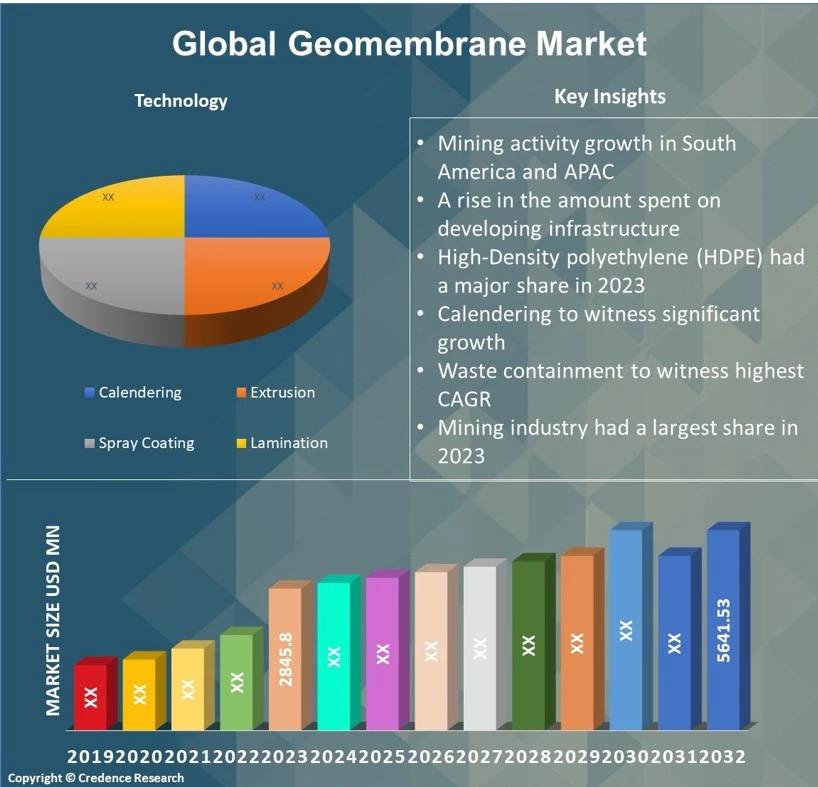
- The global demand for geomembrane was valued at USD 2845.8 Million in 2023 and is expected to reach USD 5641.53 Million in 2032, growing at a CAGR of 7.90% between 2024 and 2032.
- The largest material type section is high-density polyethylene (HDPE). On the other hand, low-density polyethylene (LDPE) is expected to grow at a strong CAGR.
- The leading technology segment is calendering.
- The CAGR for waste containment is expected to be the highest during the projection period.
- Throughout the prediction period, the medium geomembranes (0.75 mm to 2 mm) are probably going to have the highest CAGR.
- Black geomembranes are estimated to have the greatest CAGR during the forecast period.
- The mining industry segment will likely have the highest CAGR during the prediction period.
- During the forecasting period, extrusion welding will probably be the segment with the highest CAGR.
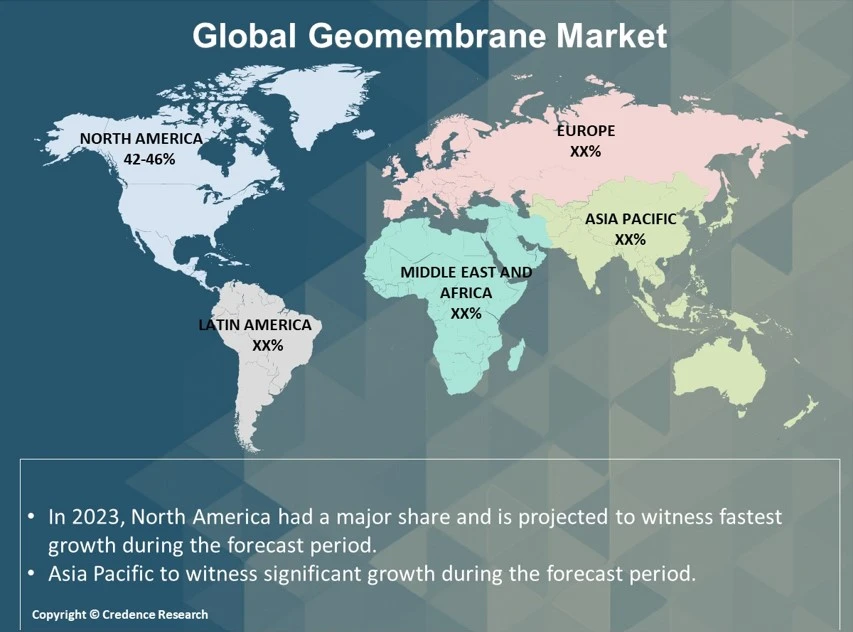
- North America dominated the geomembrane market.
- Regarding geomembrane market share, Europe is expected to come second.
- In the geomembrane market, Asia Pacific is anticipated to grow fastest.
- The main factors driving market expansion are strict waste management rules and a growing focus on appropriate waste containment.
- The growing number of infrastructure projects and the use of geomembranes in water storage plants present numerous opportunities for the geomembrane sector.
Executive Summary
Market Definition
A geomembrane is a synthetic membrane liner or barrier in geotechnical engineering and environmental containment applications. In various civil and environmental engineering projects, it is intended to regulate the flow of fluids, including gases and liquids. Geomembranes are composed of a variety of materials including ethylene propylene diene monomer, polypropylene, polyvinyl chloride, high-density polyethylene, and low-density polyethylene.
Market Overview
With consistent growth in recent years, the global geomembrane market is predicted to expand at a compound annual growth rate (CAGR) of 7.90% between 2024 and 2032. The market was valued at USD 2845.8 million in 2023 and is expected to reach USD 5641.53 million in 2032.
The market for geomembranes is being driven by the rising level of environmental consciousness. At a reasonable cost, geomembranes can effectively stop leaking toxic liquids, hazardous gases, and other pollutants, minimizing environmental harm. Because of its stability and safety when utilized on landfill sites, it is extensively used in a variety of waste sites across the globe. For almost 20 years, geomembranes-particularly HDPE geomembranes-have been utilized as bottom liners in landfills.
Additionally, it is utilized as caps and floating covers for leachate ponds. While a geomembrane cover traps landfill gas and keeps precipitation from turning into leachate, a geomembrane liner shields groundwater. Potable water is shielded from odor emissions, evaporation, and contamination by a floating cover. Demand for freshwater resources and appropriate waste management projects is rising due to population growth and rapid industrialization in many economies. This would also raise demand for geomembranes.
Segmentation by Material Type
- High-density polyethylene (HDPE) is the market leader by material type. In the packaging industry, HDPE is widely used to create bottles, containers, and other materials for packaging. The development of consumer goods, pharmaceuticals, and food and beverage products all affect this industry's requirement for HDPE.
- The low-density polyethylene (LDPE) category is anticipated to exhibit a sizable CAGR during the projected period. In agriculture, LDPE films are used for silage bags, mulching, and greenhouse films. Modern farming techniques and the deployment of technologies to increase crop output impact the demand for LDPE in the agricultural sector.
- The need for geomembrane is additionally supported by other material types, including polyvinyl chloride, polypropylene, ethylene propylene diene monomer, and others.
Segmentation by Technology
- The main technology is calendering. The manufacturing method known as "geomembrane calendering" yields thin-sheet geomembranes with a flat surface. In the mechanical process of calendering, the material is passed through several rollers to obtain the required thickness, physical characteristics, and surface quality.
- The extrusion category will likely register a significant CAGR during forecasting. Geomembrane sheets can be produced seamlessly through extrusion, reducing the possibility of leaks at joins or seams.
- Other technologies, such as spray coating and lamination, also contribute to the demand for geomembrane.
Segmentation by Application
- It is projected that over the projection period, the category of waste containment will grow at the fastest rate. Geomembranes are utilized to line lagoons and storage ponds that hold liquid waste in waste treatment plants and industrial sites. Ensuring compliance with environmental rules stops pollutants from leaking into the soil and groundwater.
- Other applications, such as water containment, mining, construction, and transportation infrastructure, also contribute to the demand for geomembrane.
Segmentation by Thickness
- The medium geomembranes (0.75 mm to 2 mm) category will likely have the highest CAGR during the projection period. Medium-sized geomembranes are frequently used as landfill liners. By acting as a barrier, they lessen the amount of environmental contamination by keeping leachate, or liquid waste, from getting into the groundwater and soil.
- Other thicknesses, such as thin geomembranes (Below 0.75 mm) and thick geomembranes (Above 2 mm), also contribute to the demand for geomembranes.
Segmentation by Color
- Black geomembrane will be expected to have the foremost CAGR during the prediction period. Water reservoir covers made of black geomembranes can lower evaporation and stop light penetration. The requirement for effective water storage technologies affects demand.
- Other colors, such as white and others, also contribute to the demand for geomembrane.
Segmentation by End-User Industry
- Throughout the forecast duration, the category for the mining industry is anticipated to have the greatest CAGR. In-situ, often known as solution mining, is the process of using a solution to recover minerals from underground deposits. The extraction and recovery wells are lined with geomembranes that inhibit solution migration and safeguard the surrounding area.
- Other end-user industries, such as agriculture, water management and treatment, construction, oil and gas, and others, also contribute to the demand for geomembrane.
Segmentation by Seaming Technology
- Throughout the forecast period, extrusion welding is anticipated to have the highest CAGR. For big plastic structures, extrusion welding is used because it can provide continuous, leak-proof seams. It is often used to build plastic tanks, pipes, geomembrane liners, and other applications where a solid, impenetrable bond is necessary.
- Other seaming technologies, such as hot wedge welding, chemical fusion, radio frequency (RF) welding, and dual track hot air welding, also contribute to the demand for geomembrane.
Segmentation by Region
- North America leads the geomembrane industry. This results from more strict regulations being implemented in North America for waste and water management in several industries, including construction and oil and gas.
- Europe is estimated to rank second in market size for geomembrane.
- Asia Pacific will witness the most rapid growth of the geomembrane market.
- World regions including Africa, the Middle East, and Latin America meet the remaining demand for geomembranes.
The primary drivers of the geomembrane industry include increased building activity, technological developments, and the use of geomembranes for secondary containment in the oil and gas sector.
Regarding forecasting, North America is likely to dominate the geomembrane market. The United States is expected to be North America's most significant geomembrane market. This market in North America is primarily driven by the widespread use of geomembranes for leachate collection, waste, and unsafe chemical containment. The rising application of geomembranes in aquaculture and as floating covers for irrigation ditches, ponds, and lakes is predicted to drive a strong growth rate in the demand for these materials in North America.
Throughout the forecast, the Asia Pacific region is anticipated to increase at the quickest rate. This can be associated with the increasing industrialization of developing nations like China and India and the increasing recognition of the advantages of polymer-based geomembrane in the mining and construction sectors.
Geomembranes are frequently utilized in mining applications like heap leach pads and tailings ponds because Australia has a sizable mining industry. The mining industry may see increased demand for geomembranes as mining operations expand. Geomembranes find application in a range of renewable energy projects, including the building and upkeep of biogas storage facilities. Australia may have chances in this industry as it invests in renewable energy.
Key Highlights of the Report
The global geomembrane market is segmented by material type, technology, application, thickness, color, end-user industry, seaming technology, and region. As far as the material type is concerned, high-density polyethylene (HDPE) is the market spearhead. Calendering is the top technology segment. The waste containment category is anticipated to increase at the highest CAGR throughout the course of the projection period. The mining industry will experience the highest CAGR during the forecast period. Geomembrane is expanding mostly in North America.
New and economical solutions are created due to ongoing research and development into geomembrane materials, production procedures, and installation methods. The market may expand as a result of geomembrane technological advancements. Geomembranes are being used increasingly for climate resilience measures like protecting against soil erosion and floods as people become more conscious of the effects of climate change and how they may affect infrastructure and the environment.
However, according to forecasts, North America will hold the largest market share for geomembrane globally. The geomembrane market in North America is expanding due to government projects that encourage sustainable practices, environmental preservation, and infrastructure development. The market is further driven by funding initiatives for public infrastructure projects. The Asia Pacific region is also assumed to have the market's sharpest growth. Applications for geomembranes in the oil and gas sector, such as liners for oil and gas exploration sites, chemical secondary containment, and oil storage, are favorable for the Asia Pacific geomembrane sector.
Which Key Factors Are Driving The Global Geomembrane Market?
The necessity for waste management, the effects of climate change, and the trends in urbanization are all elements driving the development of the geomembrane industry.
What Are The Key Challenges In The Global Market For Geomembrane?
The geomembrane sector is facing several challenges to growth, including the dynamic and complex regulatory landscape, the difficulty of installing geomembranes, and the scarcity of adequate land for landfill projects.
What Market Opportunities Exist For Geomembrane Globally?
Geomembranes are becoming increasingly popular because they are used in government funding and projects, renewable energy projects, and raising public awareness of environmental issues.
Market Drivers
Multiple factors propel the geomembrane industry across the globe. The primary factors propelling the global geomembrane market are as follows:
Mining Activity Growth in South America and APAC
Expanding urbanisation and industrialization in major countries like China and India have raised popularity for metals and minerals in recent years. Furthermore, Australia, New Zealand, Japan, South Korea, Singapore, Mongolia, and Indonesia are among the other APAC nations that have drawn sizable mining investments. One of the regions where the mining sector is expanding is South America. Large international mining firms now favor it as a place to invest in mining. Prominent nations like Brazil, Peru, and Chile possess substantial mining resources and have experienced a surge in foreign company investments in the last five years. One of the biggest users of geomembranes is the mining sector. The hazardous chemicals that are used in solutions to treat ponds and secondary containment applications can be captured and recycled with the use of geomembranes. The geomembranes market is anticipated to be driven by this throughout the projected period.
Market Restraints
There are several obstacles that the global geomembrane market must overcome to continue growing. Among them are the following:
Variations in the Cost of Raw Materials Due to Changes in the Price of Crude Oil
Crude oil price volatility is one of the main factors impeding the production of geomembranes. Most raw materials used in the production of geomembranes are derived from petroleum and are subject to sharp changes in the price of crude oil. The cost of the raw materials needed to make geomembranes is directly impacted by changes in crude oil prices. Leading manufacturers' profit margins are lowered due to dealing with high and unstable raw material costs. This has created a situation where market participants must increase the productivity and efficiency of their business operations to maintain growth and market share.
Opportunities
There are plenty of potential prospects in the global geomembrane industry. Among these are the following:
Rise in the Amount Spent on Developing Infrastructure
Increasing infrastructure construction, including roads, tunnels, bridges, airports, water treatment and supply facilities, telecommunication networks, schools, and hospitals. The output for residential and non-residential (including commercial, industrial, and other) infrastructures is expected to increase by 85% in volume by 2030, reaching USD 15.5 trillion, according to the Confederation of International Contractors' Associations (CICA). Geomembranes have a wide range of uses in the construction industry. Geomembranes' excellent mechanical and physical qualities, combined with their long shelf life, will benefit the market. Therefore, throughout the projected period, expanding infrastructure initiatives are anticipated to generate growth prospects for the geomembranes market.
Competitive Landscape
Key Players
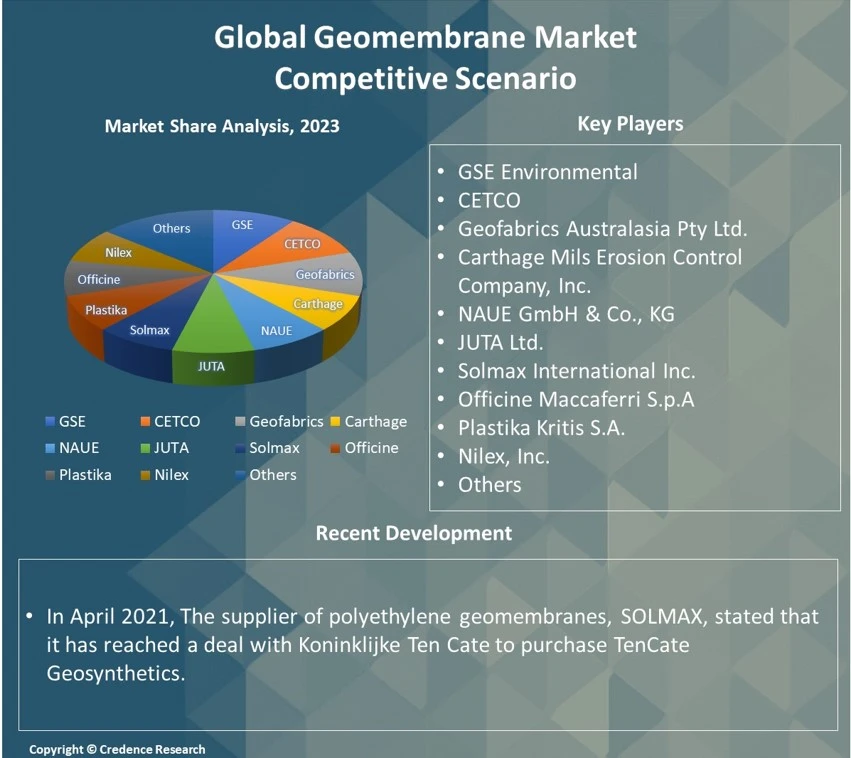
There are several major competitors in the fiercely competitive global geomembrane market. The followings are a few of the leading market participants and their market shares:
- GSE Environmental
- CETCO
- Geofabrics Australasia Pty Ltd.
- Carthage Mils Erosion Control Company, Inc.
- NAUE GmbH & Co., KG
- JUTA Ltd.
- Solmax International Inc.
- Officine Maccaferri S.p.A
- Plastika Kritis S.A.
- Nilex, Inc.
- Bridgestone America
- Carlisle SynTec Systems
- Anhui Huifeng New Synthetic Materials Co., Ltd.
- Others
To remain competitive, these companies prioritize product innovation, distribution channel expansion, and mergers and acquisitions.
The major global geomembrane market players always try to remain ahead of the competition by introducing innovations and products.
- In July 2023, To collect rainfall for agricultural purposes, geomembrane tanks were constructed in the coastal regions of Karnataka. The 1.5-crore-liter geomembrane tank in Moodbidri, which was built on 1.5 acres of land, is reportedly the largest one to be built for agricultural use in the coastal region.
- In January 2022, AGRO America Inc. and HK Solutions Group announced unveiled Monoform PLUS, which is a comprehensive mahole rehabilitation product package offering streamlined installation without impacting the local traffic. It provides customers a better option for the protection against corrosion through the integrated chip liner.
- In December 2022, terrafix acquired Nilex, Inc., a manufacturer of geosynthetics for environmental and civil projects. This acquisition will allow terrafix to increase its customer base and help consumers by offering innovative solutions.
- In December 2021, Seaman Corporation, announced that the company has developed a high-performance XR-FR fire proof geo-membrane, that expand its product line of XR Geo-membranes. The newly developed product is highly suitable for for combustible liquid tanks, that complies with the ULC S668.
- In February 2021, About the 7-layer barrier extruded line and the most recent polished-edge technology, Raven Industries, Inc. announced its Engineered Films department produces 23′ wide textured sheet geomembranes. The most recent smooth-edge extrusion method creates a top-notch, smooth surface edge on the rough side goods on both the top and bottom. The newest technology aids in increasing the surface area for thermal fusion welding. To provide more stability on steep slopes, increased worksite safety, and stabilization of primary and secondary geosynthetics, the Raven HydraLineTM HDT- and LLT-Series are designed with a textured surface.
- In April 2021, SOLMAX, a manufacturer of polyethylene geomembranes, has announced that the company has signed an agreement with Koninklijke Ten Cate to acquire TenCate Geosynthetics.
- In June 2021, Solmax declared that it had successfully finished purchasing Propex, a renowned North American geosynthetics producer with a solid background in the transportation, building, flood protection, and automotive sectors. Solmax solidifies its status as a top supplier of geosynthetics solutions with the completion of this deal.
Summary of Key Findings
- Geomembranes with improved resistance to environmental variables, durability, and flexibility are being developed due to advancements in material science.
- The market is segmented by material type, technology, application, thickness, color, end-user industry, seaming technology, and region.
- The most popular type of material type in the market is high-density polyethylene.
- Calendering is the foremost technology category.
- Regarding CAGR, medium geomembranes (0.75 mm to 2 mm) are expected to grow fastest during the forecast period.
- The category for extrusion welding will likely see the highest CAGR during the anticipated time frame.
- North America is leading market development; the market is highly competitive with key players including GSE Environmental, CETCO, Geofabrics Australasia Pty Ltd., Carthage Mils Erosion Control Company, Inc., NAUE GmbH & Co., KG, JUTA Ltd., Solmax International Inc., Officine Maccaferri S.p.A, Plastika Kritis S.A., Nilex, Inc., Bridgestone America, Carlisle SynTec Systems, Anhui Huifeng New Synthetic Materials Co., Ltd., and Others.
Future Outlook
- The geomembrane industry is expected to increase significantly in North America and has a positive outlook worldwide.
- The use of geomembranes in infrastructure projects is supported by cooperation between the public and commercial sectors.
- During the projected period, one of the main factors anticipated to restrain the geomembrane market's growth is its reliance on raw materials.
- To stay ahead of the competition, key enterprises must develop new products, expand their market reach, and keep their prices competitive.
How CXOs Can Benefit from the Credence Research Geomembrane Market Report
The Credence Research Geomembrane Market Report provides CXOs with a comprehensive overview of the market, including:
- Market size and growth forecast: The report provides detailed estimates of the global geomembrane market size, segmented by material type, technology, application, thickness, color, end-user industry, seaming technology, and region. It also includes forecasts for the market through 2032 based on key trends and drivers.
- Market segmentation: The report segments the geomembrane market by material type, technology, application, thickness, color, end-user industry, seaming technology, and region. This segmentation provides CXOs with a granular understanding of the market and the opportunities in each segment.
- Competitive landscape: The report profiles the key players in the geomembrane market and provides insights into their strategies, product offerings, and financial performance. This information can help CXOs to identify and assess their competition.
- Key trends and drivers: The report identifies and analyzes the key trends and drivers shaping the geomembrane market. This information can help CXOs to make informed decisions about their investments and strategies.
CXOs can use the insights from the Credence Research Geomembrane Market Report to:
- Identify growth opportunities: The report can help CXOs identify new growth opportunities in the geomembrane market. For example, the report identifies the growing demand for geomembrane from the mining industry as a key opportunity.
- Make informed investment decisions: The report can help CXOs make informed investment decisions about geomembrane. For example, the report provides insights into the key factors to consider when evaluating geomembrane providers and selecting geomembrane solutions.
- Develop competitive strategies: The report can help CXOs develop competitive strategies for their geomembrane businesses. For example, the report identifies the key strategies that geomembrane providers are using to differentiate themselves from their competitors.
- Track market developments: The report can help CXOs track market developments and stay ahead of the curve. For example, the report provides insights into the latest trends and innovations in the geomembrane market.
Overall, the Credence Research Geomembrane Market Report is a valuable resource for CXOs who are looking to gain a deeper understanding of the market and identify growth opportunities.
Segmentation
- By Material Type
- High-Density Polyethylene (HDPE)
- Low-Density Polyethylene (LDPE)
- Polyvinyl Chloride (PVC)
- Ethylene Propylene Diene Monomer (EPDM)
- Polypropylene (PP)
- Other Materials
- By Technology
- Calendering
- Extrusion
- Spray Coating
- Lamination
- By Application
- Waste Containment
- Water Containment
- Mining
- Construction
- Transportation Infrastructure
- By Thickness
- Thin Geomembranes (Below 0.75 mm)
- Medium Geomembranes (0.75 mm to 2 mm)
- Thick Geomembranes (Above 2 mm)
- By Color
- Black
- White
- Other Colors
- By End-User Industry
- Mining Industry
- Agriculture Industry
- Water Management and Treatment
- Construction Industry
- Oil and Gas Industry
- Others
- By Seaming Technology
- Extrusion Welding
- Hot Wedge Welding
- Chemical Fusion
- Radio Frequency (RF) Welding
- Dual Track Hot Air Welding
- By Region
- North America
- The U.S.
- Canada
- Mexico
- Europe
- Germany
- France
- The U.K.
- Italy
- Spain
- Rest of Europe
- Asia Pacific
- China
- Japan
- India
- South Korea
- South-east Asia
- Rest of Asia Pacific
- Latin America
- Brazil
- Argentina
- Rest of Latin America
- Middle East & Africa
- GCC Countries
- South Africa
- Rest of Middle East and Africa
- North America

Request a Free Sample
Fill in your details and we'll send you a free sample report.
- Sample data tables & charts
- Research methodology
Market Dynamics
Stringent Waste Management Regulations
Governments worldwide are enforcing stricter environmental regulations for waste containment and landfill management, driving the adoption of geomembranes as reliable barriers to prevent soil and groundwater contamination.
Growth in Mining and Industrial Activities
Expanding mining operations, especially in Asia Pacific and South America, require geomembranes for tailings ponds, heap leach pads, and containment of hazardous materials, significantly boosting market demand.
Infrastructure Development and Urbanization
Rapid urbanization and increased infrastructure projects, such as water reservoirs, tunnels, and transportation networks, are fueling the need for geomembranes for fluid containment and environmental protection.
Technological Advancements in Geomembrane Materials
Ongoing R&D has led to the development of more durable, flexible, and chemically resistant geomembranes, expanding their applicability and improving performance in challenging environments.
Rising Focus on Water Conservation and Management
With growing concerns over water scarcity and the need for efficient water storage and treatment, geomembranes are increasingly used in reservoirs, canals, and water treatment plants to minimize losses and contamination.
Need a Custom Version of This Report?
Tailor the scope, geography, or segments to your exact requirements.
- Custom geography or segment scope
- Direct access to our analyst team
Frequently Asked Questions
How big is the global geomembrane market right now?
What is the projected growth rate of the geomembrane market between 2024 and 2032?
Which market category is in the lead in material type?
Which application segment is estimated to have the highest CAGR throughout the forecast period?
Who are the key participants in the global market for geomembrane?
Table of Content
Chapter 1 Market Segmentation
- 1.1 Segmentation Framework
- 1.1.1 Product and Service Classification
- 1.1.2 Application and End-Use Classification
- 1.1.3 Technology and Solution Classification
- 1.1.4 Customer and Distribution Channel Classification
- 1.1.5 Geographic Segmentation
- 1.1.6 Market Segment Definitions and Boundaries
- 1.2 By Technology
- 1.2.1 Calendering
- 1.2.2 Extrusion
- 1.2.3 Spray Coating
- 1.2.4 Lamination
- 1.3 By Application
- 1.3.1 Waste Containment
- 1.3.2 Water Containment
- 1.3.3 Mining
- 1.3.4 Construction
- 1.3.5 Transportation Infrastructure
- 1.4 By Material Type
- 1.4.1 High-Density Polyethylene (HDPE)
- 1.4.2 Low-Density Polyethylene (LDPE)
- 1.4.3 Polyvinyl Chloride (PVC)
- 1.4.4 Ethylene Propylene Diene Monomer (EPDM)
- 1.4.5 Polypropylene (PP)
- 1.4.6 Other Materials
Chapter 2 Introduction
- 2.1 Report Objectives and Scope
- 2.2 Product Definition and Industry Terminology
- 2.3 Market Inclusions and Exclusions
- 2.4 Research Process
- 2.4.1 Primary Research and Expert Interviews
- 2.4.2 Secondary Research and Source Review
- 2.4.3 Top-Down and Bottom-Up Estimation
- 2.4.4 Data Triangulation and Verification
- 2.5 Market Size Measurement Basis
- 2.5.1 2023: USD 2,845.8 Million → 2032: USD 5,641.53 Million
- 2.6 Historical and Forecast Reference Periods
- 2.6.1 Base Year: 2023
- 2.6.2 Forecast Period: 2023-2032
- 2.7 Research Assumptions and Limitations
Chapter 3 Executive Summary
- 3.1 Market Snapshot and Key Findings
- 3.2 Base-Year Market Size, 2023
- 3.3 Forecast Market Size, 2032
- 3.4 Revenue and Volume Growth Outlook
- 3.5 Key Demand and Supply Indicators
- 3.6 Leading Market Segments
- 3.7 Fastest-Growing Market Opportunities
- 3.8 Regional Performance Highlights
- 3.9 Technology and Industry Transformation
- 3.10 Competitive Landscape Summary
- 3.11 Analyst View and Strategic Implications
Chapter 4 Global Geomembrane Market Trends and Developments
- 4.1 Historical Industry Development
- 4.2 Recent Market Trends and Developments
- 4.3 Demand and Customer Behavior Trends
- 4.4 Technology and Product Innovation
- 4.5 Artificial Intelligence, Automation and Digitalization
- 4.6 Local Manufacturing and Supply Chain Realignment
- 4.7 Industry Partnerships, Mergers and Acquisitions
- 4.8 Sustainability and Circular Economy Developments
- 4.9 Government and Private Sector Investment Trends
- 4.10 Emerging Business Models and Commercialization
- 4.11 Industry Developments and Announcements
Chapter 5 Global Geomembrane Market Production, Supply and Demand Analysis
- 5.1 Demand Trend and Consumption Analysis
- 5.2 Demand Forecast, 2023-2032
- 5.3 Production and Output Trend
- 5.4 Production and Output Forecast, 2023-2032
- 5.5 Installed Capacity and Capacity Utilization
- 5.6 Company-Wise Production Plants and Statistics
- 5.6.1 Installed Production Capacity
- 5.6.2 Actual Production
- 5.6.3 Planned Capacity and Expansion Targets
- 5.7 Supply Chain Structure and Procurement Trends
- 5.8 Supply-Demand Gap and Bottlenecks
- 5.9 Import Dependence and Sourcing Structure
- 5.10 Contract Manufacturing and Outsourcing
- 5.11 Regional Supply and Demand Concentration
Chapter 6 Global Geomembrane Market Pricing Analysis
- 6.1 Pricing Structure and Measurement
- 6.2 Historical Pricing Trends
- 6.3 Pricing Outlook, 2023-2032
- 6.4 Average Selling Price and Unit Economics
- 6.5 Pricing by Product and Market Segment
- 6.6 Geographic Pricing Differences
- 6.7 Key Input, Energy, Labor and Logistics Costs
- 6.8 Contract Pricing and Purchasing Models
- 6.9 Pricing Sensitivity and Competitive Positioning
- 6.10 Price, Margin and Profitability Implications
Chapter 7 Global Geomembrane Market Dynamics
- 7.1 Market Growth Drivers
- 7.1.1 Demand-Side Drivers
- 7.1.2 Technology and Innovation Drivers
- 7.1.3 Infrastructure and Investment Drivers
- 7.1.4 Regulatory and Policy Drivers
- 7.2 Market Restraints
- 7.2.1 Cost and Affordability Constraints
- 7.2.2 Technology and Adoption Barriers
- 7.2.3 Supply Chain and Operational Constraints
- 7.3 Market Challenges
- 7.3.1 Competitive Pressure and Margin Erosion
- 7.3.2 Skills, Infrastructure and Implementation Gaps
- 7.4 Emerging Market Opportunities
- 7.5 Market Dynamics Impact and Time-Horizon Assessment
Chapter 8 Global Geomembrane Value Chain Analysis
- 8.1 Industry Value Chain Overview
- 8.2 Upstream Suppliers and Critical Inputs
- 8.3 Technology and Component Providers
- 8.4 Manufacturing or Service Delivery
- 8.5 Distribution, Channel Partners and Integrators
- 8.6 Downstream Applications and End Users
- 8.7 Value Addition and Profit Pools
- 8.8 Vertical Integration and Outsourcing
- 8.9 Supplier Concentration and Risk
- 8.10 Supply Chain Localization and Resilience
Chapter 9 Global Geomembrane Market Regulations and Policies
- 9.1 Relevant Laws, Standards and Compliance Frameworks
- 9.2 Product, Service, Safety and Quality Requirements
- 9.3 Government Policies, Incentives and Subsidies
- 9.4 Imports, Exports and Trade Barriers
- 9.5 Public Procurement and Local Content Requirements
- 9.6 Environmental and Sustainability Compliance
- 9.7 Upcoming Policy Changes and Market Implications
Chapter 10 Global Geomembrane Market Hotspots and Opportunities
- 10.1 Market Opportunity Mapping and Growth Hotspots
- 10.2 High-Growth Applications and Customer Groups
- 10.3 Underserved Markets and White-Space Opportunities
- 10.4 Emerging Technology and Product Opportunities
- 10.5 New Capacity and Investment Hotspots
- 10.6 Market Entry and Expansion Opportunities
- 10.7 Distribution and Partnership Opportunities
- 10.8 Near-Term and Long-Term Commercial Potential
- 10.9 Opportunity Attractiveness and Execution Risks
Chapter 11 Global Geomembrane Market Outlook, 2023-2032
- 11.1 Market Size and Analysis
- 11.1.1 Revenue (Market Measurement: 2023: USD 2,845.8 Million → 2032: USD 5,641.53 Million)
- 11.1.2 Market Volume and Quantity Sold
- 11.1.3 Historical Market Size
- 11.1.4 Base-Year Market Size, 2023
- 11.2 Market Forecast, 2023-2032
- 11.2.1 Revenue Forecast to 2032
- 11.2.2 Volume Forecast to 2032
- 11.2.3 CAGR and Year-on-Year Growth
- 11.2.4 Incremental Revenue Opportunity
- 11.3 Forecast Assumptions and Scenario Analysis
- 11.3.1 Base-Case Forecast
- 11.3.2 Optimistic and Conservative Scenarios
- 11.3.3 Technology, Pricing and Policy Sensitivities
- 11.4 Market Attractiveness and Growth Outlook
Chapter 12 Global Geomembrane Market Segmentation and Outlook
- 12.1 Segmentation Summary and Market Shares, 2023
- 12.2 Largest and Fastest-Growing Segments
- 12.3 By Technology - Market Size and Forecast, 2023-2032
- 12.3.1 Segment Definition and Scope
- 12.3.2 Historical Market Size
- 12.3.3 Revenue Forecast, 2023-2032
- 12.3.4 Volume Forecast, 2023-2032
- 12.3.5 Base-Year Market Share, 2023
- 12.3.6 Segment CAGR and Growth Drivers
- 12.3.7 Subsegment Market Size and Forecast
- 12.3.7.1 Calendering
- 12.3.7.2 Extrusion
- 12.3.7.3 Spray Coating
- 12.3.7.4 Lamination
- 12.3.8 Subsegment Pricing and Adoption Trends
- 12.3.9 Leading Suppliers and Competition
- 12.3.10 Regional Demand and Opportunities
- 12.4 By Application - Market Size and Forecast, 2023-2032
- 12.4.1 Segment Definition and Scope
- 12.4.2 Historical Market Size
- 12.4.3 Revenue Forecast, 2023-2032
- 12.4.4 Volume Forecast, 2023-2032
- 12.4.5 Base-Year Market Share, 2023
- 12.4.6 Segment CAGR and Growth Drivers
- 12.4.7 Subsegment Market Size and Forecast
- 12.4.7.1 Waste Containment
- 12.4.7.2 Water Containment
- 12.4.7.3 Mining
- 12.4.7.4 Construction
- 12.4.7.5 Transportation Infrastructure
- 12.4.8 Subsegment Pricing and Adoption Trends
- 12.4.9 Leading Suppliers and Competition
- 12.4.10 Regional Demand and Opportunities
- 12.5 By Material Type - Market Size and Forecast, 2023-2032
- 12.5.1 Segment Definition and Scope
- 12.5.2 Historical Market Size
- 12.5.3 Revenue Forecast, 2023-2032
- 12.5.4 Volume Forecast, 2023-2032
- 12.5.5 Base-Year Market Share, 2023
- 12.5.6 Segment CAGR and Growth Drivers
- 12.5.7 Subsegment Market Size and Forecast
- 12.5.7.1 High-Density Polyethylene (HDPE)
- 12.5.7.2 Low-Density Polyethylene (LDPE)
- 12.5.7.3 Polyvinyl Chloride (PVC)
- 12.5.7.4 Ethylene Propylene Diene Monomer (EPDM)
- 12.5.7.5 Polypropylene (PP)
- 12.5.7.6 Other Materials
- 12.5.8 Subsegment Pricing and Adoption Trends
- 12.5.9 Leading Suppliers and Competition
- 12.5.10 Regional Demand and Opportunities
- 12.6 Segment Growth Comparison
- 12.7 Segment Attractiveness and Priority Matrix
Chapter 13 Global Geomembrane End-Use and Application Market Outlook
- 13.1 End-Use Industry and Customer Demand Structure
- 13.2 Leading Applications and Customer Groups
- 13.3 End-Use Market Size, Share and Forecast
- 13.4 Major End-Use Industry Deep Dives
- 13.4.1 Customer Requirements and Use Cases
- 13.4.2 Demand and Replacement Cycles
- 13.4.3 Technical and Regulatory Considerations
- 13.4.4 Purchasing and Procurement Models
- 13.4.5 Leading Vendors and Distribution Channels
- 13.4.6 Forecast and Commercial Opportunities
- 13.5 Emerging Applications and Cross-Segment Demand
- 13.6 End-Use Industry Investment Priorities
Chapter 14 Global Geomembrane Geographic Market Outlook, 2023-2032
- 14.1 Regional Market Size and Share, 2023
- 14.2 Regional Market Forecast, 2023-2032
- 14.3 Regional Pricing, Production and Demand Differences
- 14.4 North America
- 14.4.1 United States
- 14.4.2 Canada
- 14.4.3 Mexico
- 14.5 Europe
- 14.5.1 Germany
- 14.5.2 France
- 14.5.3 Italy
- 14.5.4 United Kingdom
- 14.5.5 Spain
- 14.5.6 Poland
- 14.5.7 Russia
- 14.5.8 Netherlands
- 14.5.9 Belgium
- 14.5.10 Sweden
- 14.5.11 Denmark
- 14.5.12 Norway
- 14.5.13 Rest of Europe
- 14.6 Asia Pacific
- 14.6.1 China
- 14.6.2 India
- 14.6.3 Japan
- 14.6.4 South Korea
- 14.6.5 Thailand
- 14.6.6 Indonesia
- 14.6.7 Vietnam
- 14.6.8 Malaysia
- 14.6.9 Australia
- 14.6.10 Rest of Asia Pacific
- 14.7 Latin America
- 14.7.1 Brazil
- 14.7.2 Argentina
- 14.7.3 Colombia
- 14.7.4 Chile
- 14.7.5 Rest of Latin America
- 14.8 Middle East
- 14.8.1 Saudi Arabia
- 14.8.2 United Arab Emirates
- 14.8.3 Turkey
- 14.8.4 Israel
- 14.8.5 Iran
- 14.8.6 Rest of the Middle East
- 14.9 Africa
- 14.9.1 South Africa
- 14.9.2 Egypt
- 14.9.3 Nigeria
- 14.9.4 Morocco
- 14.9.5 Rest of Africa
- 14.10 Regional Investment, Policy and Supply Chain Differences
- 14.11 Regional Competitive Landscape
- 14.12 Geographic Growth Hotspots
Chapter 15 Global Geomembrane Technology, Innovation and Sustainability Outlook
- 15.1 Technology Landscape and Maturity
- 15.2 Product, Process and Service Innovation
- 15.3 AI, Automation and Digital Tools in the Industry
- 15.4 Technology Adoption and Performance Benchmarking
- 15.5 Innovation Pipeline and R&D Investment
- 15.6 Patent and Intellectual Property Trends
- 15.7 Energy Efficiency and Resource Management
- 15.8 Sustainability, Recycling and Circularity
- 15.9 Technology Roadmap, 2023-2032
- 15.10 Risks of Obsolescence and Technology Substitution
Chapter 16 Global Geomembrane Market Key Strategic Imperatives
- 16.1 Growth and Market Entry Priorities
- 16.2 High-Return Products and Segments
- 16.3 Pricing, Profitability and Cost Optimization
- 16.4 Technology Investment and Product Differentiation
- 16.5 Supply Chain Localization and Resilience
- 16.6 Distribution and Customer Acquisition
- 16.7 Partnership, Acquisition and Capacity Strategy
- 16.8 Regional Expansion Priorities
- 16.9 Short-, Medium- and Long-Term Actions
Chapter 17 Competition Outlook
- 17.1 Industry Competition Characteristics
- 17.2 Market Structure and Concentration
- 17.3 Market Share and Competitive Positioning, 2023
- 17.4 Company-Wise Revenue and Product Benchmarking
- 17.5 Production and Service Capacity Benchmarking
- 17.6 Technology, Pricing and Differentiation
- 17.7 Regional Footprint and Distribution Strength
- 17.8 Mergers, Acquisitions and Strategic Alliances
- 17.9 New Entrants and Competitive Threats
- 17.10 Porter's Five Forces and Industry Attractiveness
- 17.11 Competitive Outlook, 2023-2032
Chapter 18 Company Profiles
- 18.1 Company Coverage and Selection Criteria
- 18.2 GSE Environmental
- 18.2.1 Business Description
- 18.2.2 Company Ownership and Geographic Presence
- 18.2.3 Product and Service Portfolio
- 18.2.4 Manufacturing and Operating Footprint
- 18.2.5 Production Capacity and Expansion Plans
- 18.2.6 Financial Performance and Investment
- 18.2.7 Market Share and Competitive Position
- 18.2.8 Technology and Innovation Capabilities
- 18.2.9 Strategic Alliances or Partnerships
- 18.2.10 Recent Developments
- 18.2.11 Growth Strategy and Outlook
- 18.3 Solmax International Inc.
- 18.4 NAUE GmbH & Co. KG
- 18.5 CETCO
- 18.6 Geofabrics Australasia Pty Ltd.
- 18.7 JUTA Ltd.
- 18.8 Officine Maccaferri S.p.A
- 18.9 Plastika Kritis S.A.
- 18.10 Carlisle SynTec Systems
- 18.11 Bridgestone America
- 18.12 Other Relevant Market Participants
Note: Every listed company is profiled on the structure shown under the first company. The company list is preliminary and may change based on research findings, market developments, data availability and client requirements.
Chapter 19 Disclaimer
- 19.1 Research and Forecast Disclaimer
- 19.2 Data Source and Estimation Limitations
Note: The depth of individual sections depends on data availability for this market. Volume, capacity, trade and other unit-based metrics are included where applicable.

