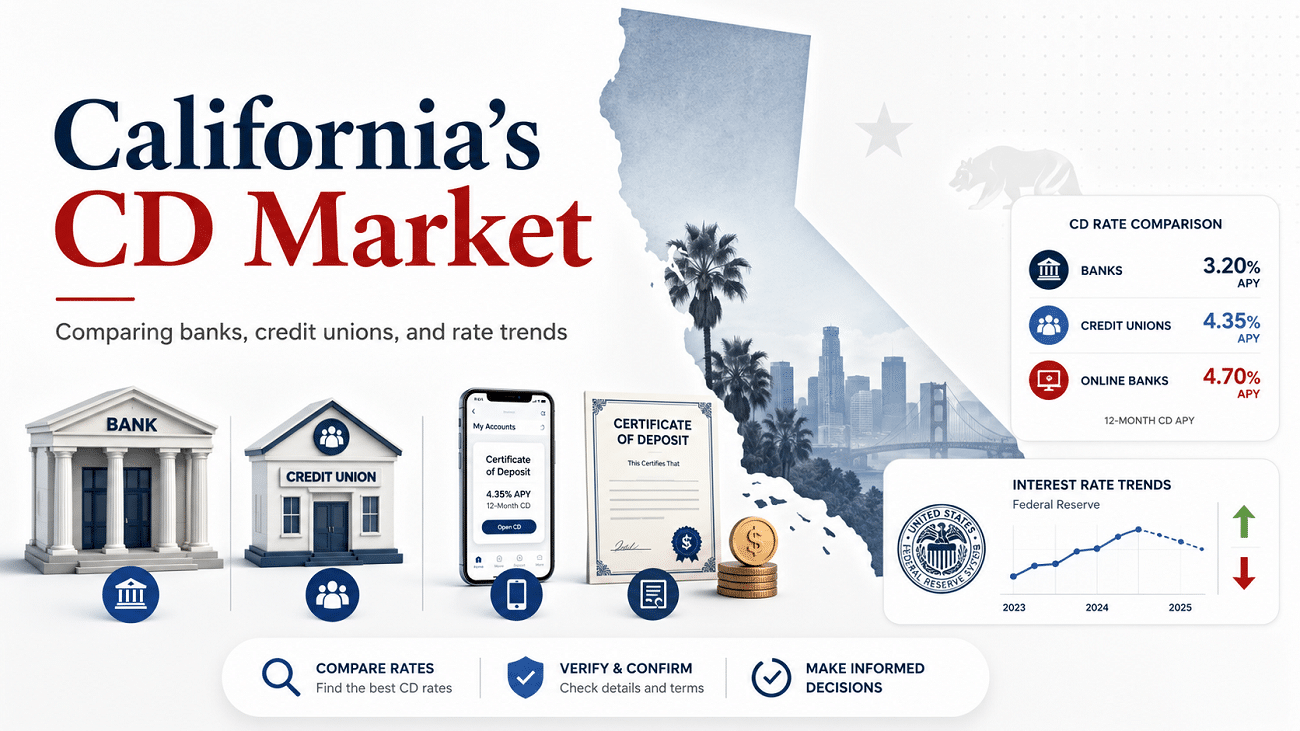
California's certificate of deposit (CD) market reflects the state's size, diversity, and economic influence. Savers can choose from large national banks, regional institutions, community banks, online banks, and hundreds of credit unions competing for deposits.
This competition often creates attractive CD yields, but it can also make comparisons more difficult. Rates may change quickly, eligibility requirements can vary, and advertised offers are not always available when consumers begin the account-opening process.
At the same time, uncertainty surrounding Federal Reserve policy has led many savers to question whether now is the right time to lock in a CD. Understanding how banks and credit unions position their products, how rate trends are evolving, and why rate verification matters can help California savers make more informed decisions when evaluating CD opportunities.
How Federal Reserve Policy Shapes California CD Rates
CD rates are closely connected to the broader interest rate environment. When the Federal Reserve raises benchmark rates, financial institutions often increase CD yields to attract deposits. When policymakers signal potential rate cuts, institutions may begin adjusting deposit rates downward.
California's highly competitive banking environment tends to amplify these changes. Banks and credit unions frequently respond to shifts in funding needs and market conditions by updating rates across multiple CD terms.
Recent years have produced some of the strongest CD yields seen in more than a decade. Higher interest rates encouraged institutions to compete more aggressively for deposits, creating opportunities for savers seeking predictable returns.
Although future rate movements remain uncertain, institutions continue monitoring Federal Reserve decisions closely. This means CD rates may continue to fluctuate as economic conditions evolve. For savers, understanding the relationship between Fed policy and deposit yields provides important context when comparing available options.
Current CD Rate Trends in California
California's CD market remains competitive because institutions are still trying to attract deposits in a changing rate environment. Even when rates are no longer rising sharply, banks and credit unions may continue offering strong yields on selected terms to meet internal funding goals.
Rate trends can vary by maturity. Short-term CDs may react more quickly to Federal Reserve expectations, while longer-term CDs may reflect broader assumptions about where rates are headed over the next year or more. This can create differences between six-month, one-year, and multi-year CD offers.
Regional competition also affects pricing. A credit union in San Diego may price CDs differently from a Bay Area institution, while online banks may compete nationally with fewer geographic limits.
For California savers, this means the current CD rate environment is not uniform. Comparing institutions, terms, and regions can reveal meaningful differences, especially when rates are verified before funds are deposited.
Credit Union and Bank Strategies for Attracting Deposits
Banks and credit unions often compete for the same customers, but they may approach deposit gathering differently. Large banks frequently emphasize convenience, digital tools, branch access, and broad product offerings. Customers who prefer managing multiple financial products within one institution may find these features appealing.
Credit unions typically focus on member relationships and competitive pricing. Because they operate as member-owned institutions, they may structure products differently than shareholder-owned banks.
Neither model consistently produces the highest CD yields. Instead, rates often depend on an institution's funding objectives, market conditions, and competitive environment.
For California savers, comparing both types of institutions can expand the number of available opportunities. A credit union may offer a strong rate in one maturity range, while a bank may be more competitive in another. Looking beyond institution type and focusing on verified rate information can help consumers identify products that align with their savings goals.
Should Savers Lock in a CD Now or Wait?
Many savers are asking whether they should buy a CD now or wait to see how rates move. The answer depends on financial goals, liquidity needs, and expectations about future rate movements.
Trying to predict the exact peak in CD rates is difficult. Inflation data, employment trends, Federal Reserve decisions, and bank funding needs can all affect future yields.
If rates decline, locking in a CD now may help preserve today's yield for the full term. If rates rise, waiting could lead to better opportunities. That uncertainty is why some savers avoid putting all funds into one CD at one time.
CD laddering can help manage this risk. By spreading deposits across different maturities, savers can maintain access to funds while still participating in the current rate environment.
Local and Nationwide Competition Across California
Technology has expanded access to CD products well beyond local branch networks. California consumers can compare offers from local banks, regional credit unions, online institutions, and nationwide providers without visiting a branch.
This broader marketplace has increased competition for deposits. Financial institutions frequently adjust CD yields to attract savers, creating opportunities across a wide range of terms and regions.
Local markets remain important, particularly in major metropolitan areas such as San Diego, Los Angeles, Sacramento, and the Bay Area. Savers often compare nearby institutions alongside national providers to determine whether local opportunities remain competitive.
Many consumers researching regional opportunities use resources such as
San Diego CD rates on CD Valet to compare local offers with broader statewide and nationwide rate trends. This type of verification matters because one of the biggest frustrations with CD comparison sites is discovering that an advertised rate is no longer available when it comes time to open an account.
That can happen when sites update information infrequently, rely on automated scraping, or display promotional rates with eligibility requirements that are not immediately clear. CD Valet is a CD marketplace that provides verified CD rates and comparison tools, helping savers explore higher-yield CD options from federally insured banks and credit unions. Its team of Rate Watchers conducts daily audits of more than 38,000 CD offers, helping ensure displayed rates are current and accurate.
For California savers comparing banks and credit unions, that added verification step can reduce the risk of pursuing outdated offers before depositing funds.
Navigating California's CD Market With Better Rate Context
California savers have access to a broad and competitive CD market, with banks, credit unions, and online providers competing across regions and terms. The strongest choice depends on more than the highest advertised APY. Fed policy, rate trends, timing, eligibility rules, and local versus nationwide competition all matter. By comparing verified rates and understanding how institutions position their CD products, savers can make more informed decisions before committing funds.