
Key Highlights of the report
How are the major segments performing in the U.S. 503b compounding pharmacies market?
- In 2022, the phenylephrine segment accounted for the largest market share as it is widely used to relieve nasal discomfort.
- In 2022, the prefilled syringes segment was anticipated to hold a prominent share in the U.S. 503b compounding pharmacies market. Increasing demands for efficient, easy-to-use drug delivery devices and healthcare professionals' efforts to reduce hospital errors.
What is the Market Size of U.S. 503b Compounding Pharmacies regarding value?
The U.S. 503b compounding pharmacies market is anticipated to grow at a substantial CAGR of 7.80% in the upcoming years. The U.S. 503b compounding pharmacies industry was estimated to be worth USD 1.1 billion in 2022 and was expected to be worth USD 1.9 billion by 2030.
How is US Market Performing in the 503b Compounding Pharmacies market?
In 2022, compounding pharmacies in the U.S. are seeing increased demand for pain management drugs. According to the National Health Interview Survey, in 2019, 50.2 million Americans (20.5%) reported chronic pain on most days. Knees, backs, feet, and hips are the most common areas of pain. Compounded medications are also a good method of relieving pain. Creams from compounded medications provide instant relief when applied directly to the affected area. Further, compounding pharmacies collaborate with healthcare providers to create customized pain management treatment options and dosages. Such scenarios are expected to drive market growth in the next few years.
How is the economy impacting the U.S. 503b Compounding Pharmacies growth?
Pharmacy staff is struggling to fill the demand for medicines during times of covid-19 pandemic. Because of this, 503B outsourcing facilities are invaluable partners for hospitals and health systems in addressing drug scarcity and its impact on patients during this pandemic. According to the Drug Quality and Security Act, passed in 2013, 503B outsourcing facilities could compound nonsterile and sterile drug products in advance of their providers' needs if they met certain standards established by the federal government. With the surge in demand for critical care medicines caused by the pandemic, 503B facilities can supply hospitals when commercial manufacturers cannot supply.
What is the competitive environment of the U.S. 503b Compounding Pharmacies market?
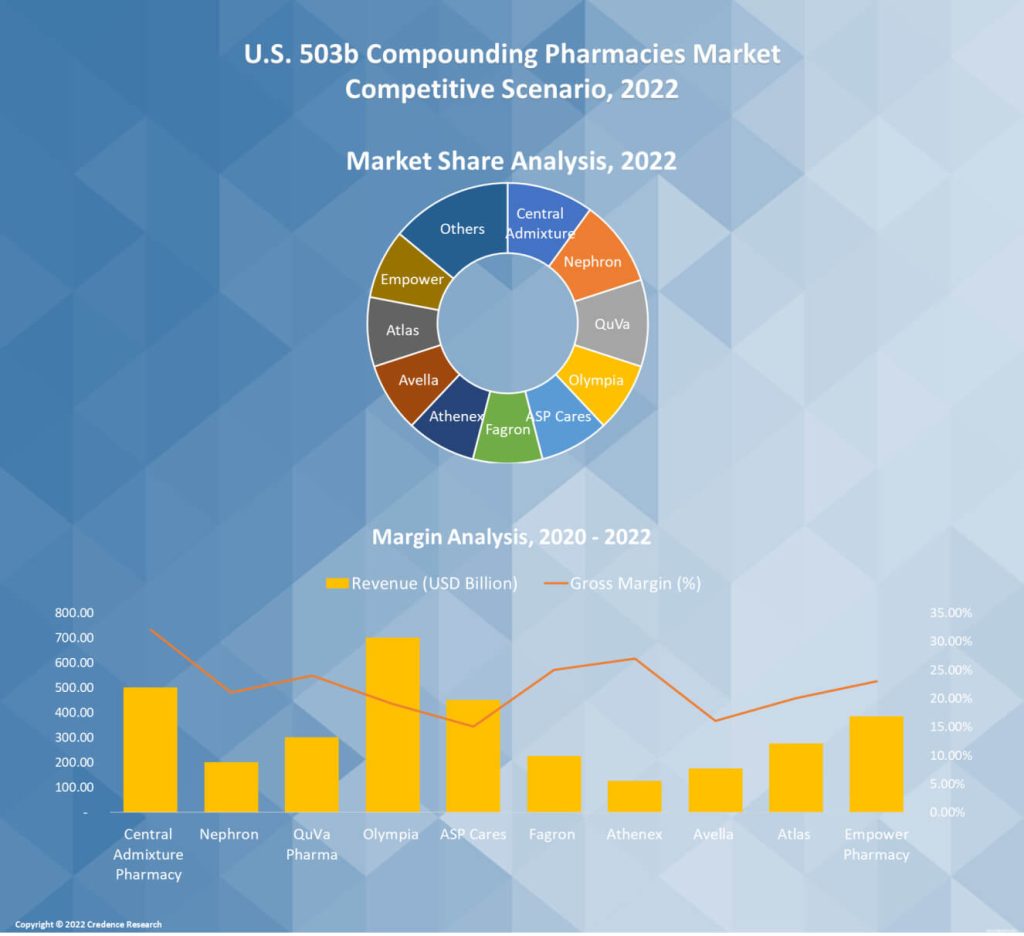
The U.S. 503b compounding pharmacies industry's competitive environment provides information on the entire economic profit made by suppliers and businesses, the sales and revenues created in this sector, the U.S. 503b compounding pharmacies market share, the business organization summary, the introduction of new products, and the opportunities for the industrial U.S. 503b compounding pharmacies market. For instance, in January 2022, in the Nephron 503B Outsourcing Facility operation, Nephron Pharmaceuticals Corporation launched a new syringe presentation, the Cyclic Olefin Copolymer Syringe (COC). In addition to 8.4% sodium bicarbonate injection, the company will also introduce a COC syringe for this product. By pursuing this strategy, the company will be able to grow its product portfolio in compounding pharmacies. Furthermore, in May 2022, A 503B outsourcing facility and a state-licensed pharmacy were acquired by Edgewood Pharmacy through Zoo, Wildlife Specializations. This strategy increased the company's product portfolio, accelerating its market growth.
Executive Summary
What are the key trends in the U.S. 503b Compounding Pharmacies market?
- Over the forecast period, the U.S. 503B Compounding Pharmacies market is expected to grow due to an increased drug shortage. For example, the Drug Shortages Task Force of the U.S. Food and Drug Administration 2019 report titled 'Drug Shortages: Root Causes and Potential Solutions' explains that drug shortages are caused by a lack of incentives to produce less profitable drugs and logistical and regulatory obstacles. As stated in the report, hospitals must pay more for branded and alternative drugs when there is a shortage of low-cost generic drugs or obtain medications from compounding facilities. Therefore, such instances could contribute to the market's growth in the near future.
How are Pharma Manufacturers Teaming Up with Stakeholders in U.S. 503b Compounding Pharmacies Market?
As geriatric patients suffering from chronic diseases demand more pain management therapies, the market is expected to grow over the forecast period. Chronic pain is a major concern among older adults suffering from chronic diseases, according to Progress in Neuro-Psychopharmacology and Biological Psychiatry Journal: 2019. CDC (The Centers for Disease Control and Prevention) reports that in 2018, the population aged 60 years and older had the highest number of pain management therapies prescribed. The market is projected to grow during the forecast period due to increasing product approvals and launches. For instance, in November 2020, Fagron Compounding Pharmacies launched new intravenous bags (IV bags) containing Fentanyl Hydromorphone and Midazolam. Furthermore, the company plans to add hormones, chemicals, and norepinephrine to its IV bag offerings. According to a the U.S. Food and Drug Administration (FDA), the U.S. has been suffering from a drug shortage for several years, and the outbreak of COVID-19 has made it worse. In addition to supply chain disruptions, manufacturing process delays and discontinuities, quality issues, and difficulties obtaining raw materials, shortages are often caused by supply chain disruptions. As a result of drug shortages, compounding pharmacies in the U.S. have gained additional opportunities. In addition, FDA has issued temporary guidance to federal facilities and state-licensed pharmacies, including hospital pharmacies and compounding pharmacies, that are not registered as outsourcing facilities with FDA. As a result of a shortage of drugs required for patient treatment, compounding certain medications for hospitalized patients was required during the public health emergency.
Which are the key investments by the U.S. 503b Compounding Pharmacies market players?
Leading players operating in the U.S. 503b compounding pharmacies market focus on expanding 503b compounding. Apart from this, players are concentrating on strategic mergers and acquisitions, collaborations and creating awareness among pharmacies via different associations formed to promote smart practices to serve more end users in the domestic market to gain a competitive edge. For instance, in May 2020, Wedgwood Pharmacy acquired Zoo, Wildlife Specializations to acquire 503B outsourcing facilities and a state-licensed pharmacy to enhance the company's market position.
Some major players in the U.S. 503b compounding pharmacies market are Central Admixture Pharmacy Services, Inc., Avella Specialty Pharmacy, Atlas Pharmaceuticals, Empower Pharmacy, Carie Boyd’S Prescription Shop, Edge Pharma, Imprimis NJOF, Nephron Pharmaceuticals Corporation, QuVa Pharma, Olympia Pharmacy, ASP Cares, Fagron Compounding Pharmacies, Athenex, Inc., IntegraDose Compounding services, Wells Pharma of Houston, LLC, US Compounding Inc., and SCA Pharma.
What are the Major Driving Factors for the U.S. 503b Compounding Pharmacies Market?
Increasing investments by the key market players in research and development will boost the growth of the US compounding pharmacy market as they innovate and customize formulations to treat various diseases effectively. Market growth is significantly accelerated by the rising prevalence of cancer among the US population. In addition, the growing acceptance of compounding pharmacies in the US is fueled by favorable government reimbursement policies. In addition, the growth of effective compounding pharmacies is being driven by technological advancements. Combined with the strong healthcare infrastructure in the US, the US compounding pharmacy market is growing due to the presence of leading market players.
What are the Major Risks for the U.S. 503b Compounding Pharmacies Market?
As a result of increasing product recalls, the U.S. 503B compounding pharmacy market is expected to slow down. For example, in August 2019, the U.S. Food and Drug Administration requested a recall of sterile compounded drug products produced by Pacifico National Inc. This Melbourne-based outsourcing facility operates as AmEx Pharmacy. Because of significant quality and sterility concerns, compounded ophthalmic and other drug products pose unnecessary risks.
Which is the key packaging in the U.S. 503b Compounding Pharmacies market?
The prefilled syringes segment is expected to hold a prominent share of the U.S. 503b compounding pharmacies market during the forecast period. The pharmaceutical industry seeks new and more convenient ways to deliver drugs, which has led to the rapid growth of prefilled syringes as a unit-dose medication option. In its article published in June 2022 on self-care interventions, the World Health Organization noted that self-injectable contraception could reduce unintended pregnancy rates. Increasing efforts of healthcare professionals to reduce hospital errors and growing demand for easy-to-use drug delivery devices are driving the market.
What is the regulatory landscape for the U.S. 503b Compounding Pharmacies market?
The FDA authorizes 503A pharmacies to provide sterile medicines under patient-specific conditions to fill each patient's unique prescription. They are also approved for use at home by the FDA. The FDA does not require 503A pharmacies to register with the FDA, nor do they need to follow current good manufacturing practices (cGMP). These regulatory relaxations will boost the demand for 503A compounding pharmacies.
What are the major players planning for the future of the U.S. 503b Compounding Pharmacies market?
Growing regional existence and investment in downstream applications are anticipated to deliver a competitive edge in the market. It was announced in January 2022 that Athenex would manufacture its 503B products at its Dunkirk facility under a preliminary agreement with ImmunityBio, Inc. Through this partnership, the company will gain a competitive advantage and expand its product line.
| REPORT ATTRIBUTE | DETAILS |
|---|---|
| U.S. 503b Compounding Pharmacies Market by Value | Yes |
| U.S. 503b Compounding Pharmacies Market, Tornado Analysis | Yes |
| U.S. 503b Compounding Pharmacies Market, STAR Analysis | Yes |
| U.S. 503b Compounding Pharmacies Market, SRC Analysis | Yes |
| U.S. 503b Compounding Pharmacies Market Pricing Analysis | Yes (On Demand) |
| U.S. 503b Compounding Pharmacies Market Segment Analysis | By Molecule (Esmolol, Vancomycin, Epinephrine, Fentanyl/ Bupivacaine, Adenocaine, Morphine, Amiodarone, Bupivacaine, Lidocaine, Heparin, Ketamine, Dextrose, Hydromorphone, BKK (Bupivacaine, ketorolac, Ketamine), RKK (Ropivacaine, Ketorolac, Ketamine), RCK (Ropivacaine, Clonidine, Ketorolac), and Other Molecules) By Packaging (Vials, Prefilled Syringes, Ampoules, Syringes, and Others) |
| U.S. 503b Compounding Pharmacies Market Key Companies | Central Admixture Pharmacy Services, Inc., Nephron Pharmaceuticals Corporation, QuVa Pharma, Olympia Pharmacy, ASP Cares, Fagron Compounding Pharmacies, Athenex, Inc., Avella Specialty Pharmacy, Atlas Pharmaceuticals, Empower Pharmacy, Carie Boyd’S Prescription Shop, Edge Pharma, Imprimis NJOF, IntegraDose Compounding services, Wells Pharma of Houston, LLC, US Compounding Inc., and SCA Pharma. |
| U.S. 503b Compounding Pharmacies Market Competitive Landscape | Market Share Analysis Competitive Benchmarking Key Players Market Positioning Geographical Presence Analysis Major Strategies Adopted |
Segmentation of U.S. 503b Compounding Pharmacies Market-
U.S. 503b Compounding Pharmacies Market – By Molecule
- Acetaminophen
- Phenylephrine
- Midazolam
- Esmolol
- Vancomycin
- Epinephrine
- Adenocaine
- Fentanyl/ Bupivacaine
- Morphine
- Amiodarone
- Heparin
- Ketamine
- Dextrose
- Hydromorphone
- Bupivacaine
- Lidocaine
- BKK (Bupivacaine, ketorolac, Ketamine)
- RCK (Ropivacaine, Clonidine, Ketorolac)
- RKK (Ropivacaine, Ketorolac, Ketamine)
- Other Molecules
U.S. 503b Compounding Pharmacies Market – By Packaging
- Vials
- Prefilled Syringes
- Ampoules
- Syringes
- Others

Request a Free Sample
Fill in your details and we'll send you a free sample report.
- Sample data tables & charts
- Research methodology
Market Dynamics
Drug Shortages and Supply Chain Disruptions
Persistent shortages of critical medications in the U.S., exacerbated by supply chain issues and manufacturing delays, have increased reliance on 503b compounding pharmacies to fill gaps and ensure continuity of care for hospitals and clinics.
Rising Prevalence of Chronic Pain and Geriatric Population
A growing number of Americans, especially older adults, suffer from chronic pain and require customized pain management therapies, driving demand for compounded medications tailored to individual patient needs.
Technological Advancements and Product Innovation
Investments in research and development have led to the introduction of advanced drug delivery formats such as prefilled syringes and IV bags, improving safety, convenience, and reducing medication errors in clinical settings.
Favorable Regulatory Environment and Emergency Guidance
Regulatory provisions, such as the Drug Quality and Security Act and temporary FDA guidance during public health emergencies, have enabled 503b outsourcing facilities to compound and supply medications more flexibly, supporting market growth.
Need a Custom Version of This Report?
Tailor the scope, geography, or segments to your exact requirements.
- Custom geography or segment scope
- Direct access to our analyst team
Frequently Asked Questions
How does COVID-19 Impact the U.S. 503b Compounding Pharmacies market?
What are the key drivers for the growth of the U.S. 503b Compounding Pharmacies market?
Which is the major segment in the U.S. 503b Compounding Pharmacies market by molecule?
Which is the major segment in the U.S. 503b Compounding Pharmacies market by packaging?
Table of Content
Chapter 1 Market Segmentation
- 1.1 Segmentation Framework
- 1.1.1 Product and Service Classification
- 1.1.2 Application and End-Use Classification
- 1.1.3 Technology and Solution Classification
- 1.1.4 Customer and Distribution Channel Classification
- 1.1.5 Geographic Segmentation
- 1.1.6 Market Segment Definitions and Boundaries
- 1.2 By End User
- 1.2.1 Hospitals
- 1.2.2 Ambulatory Surgical Centers
- 1.2.3 Specialty Clinics
- 1.2.4 Other Healthcare Facilities
- 1.3 By Molecule
- 1.3.1 Phenylephrine
- 1.3.2 Esmolol
- 1.3.3 Vancomycin
- 1.3.4 Epinephrine
- 1.3.5 Fentanyl/Bupivacaine
- 1.3.6 Midazolam
- 1.3.7 Morphine
- 1.3.8 Heparin
- 1.3.9 Ketamine
- 1.3.10 Other Molecules
- 1.4 By Packaging
- 1.4.1 Prefilled Syringes
- 1.4.2 Vials
- 1.4.3 Ampoules
- 1.4.4 Syringes
- 1.4.5 Others
- 1.5 By Application
- 1.5.1 Pain Management
- 1.5.2 Critical Care
- 1.5.3 Anesthesia
- 1.5.4 Infectious Diseases
Chapter 2 Introduction
- 2.1 Report Objectives and Scope
- 2.2 Product Definition and Industry Terminology
- 2.3 Market Inclusions and Exclusions
- 2.4 Research Process
- 2.4.1 Primary Research and Expert Interviews
- 2.4.2 Secondary Research and Source Review
- 2.4.3 Top-Down and Bottom-Up Estimation
- 2.4.4 Data Triangulation and Verification
- 2.5 Research Assumptions and Limitations
Chapter 3 Executive Summary
- 3.1 Market Snapshot and Key Findings
- 3.2 Base-Year Market Size
- 3.3 Forecast Market Size
- 3.4 Revenue and Volume Growth Outlook
- 3.5 Key Demand and Supply Indicators
- 3.6 Leading Market Segments
- 3.7 Fastest-Growing Market Opportunities
- 3.8 Regional Performance Highlights
- 3.9 Technology and Industry Transformation
- 3.10 Competitive Landscape Summary
- 3.11 Analyst View and Strategic Implications
Chapter 4 U.S. 503b Compounding Pharmacies Market Trends and Developments
- 4.1 Historical Industry Development
- 4.2 Recent Market Trends and Developments
- 4.3 Demand and Customer Behavior Trends
- 4.4 Technology and Product Innovation
- 4.5 Artificial Intelligence, Automation and Digitalization
- 4.6 Local Manufacturing and Supply Chain Realignment
- 4.7 Industry Partnerships, Mergers and Acquisitions
- 4.8 Sustainability and Circular Economy Developments
- 4.9 Government and Private Sector Investment Trends
- 4.10 Emerging Business Models and Commercialization
- 4.11 Industry Developments and Announcements
Chapter 5 U.S. 503b Compounding Pharmacies Market Production, Supply and Demand Analysis
- 5.1 Demand Trend and Consumption Analysis
- 5.2 Demand Forecast
- 5.3 Production and Output Trend
- 5.4 Production and Output Forecast
- 5.5 Installed Capacity and Capacity Utilization
- 5.6 Company-Wise Production Plants and Statistics
- 5.6.1 Installed Production Capacity
- 5.6.2 Actual Production
- 5.6.3 Planned Capacity and Expansion Targets
- 5.7 Supply Chain Structure and Procurement Trends
- 5.8 Supply-Demand Gap and Bottlenecks
- 5.9 Import Dependence and Sourcing Structure
- 5.10 Contract Manufacturing and Outsourcing
- 5.11 Regional Supply and Demand Concentration
Chapter 6 U.S. 503b Compounding Pharmacies Market Pricing Analysis
- 6.1 Pricing Structure and Measurement
- 6.2 Historical Pricing Trends
- 6.3 Pricing Outlook
- 6.4 Average Selling Price and Unit Economics
- 6.5 Pricing by Product and Market Segment
- 6.6 Geographic Pricing Differences
- 6.7 Key Input, Energy, Labor and Logistics Costs
- 6.8 Contract Pricing and Purchasing Models
- 6.9 Pricing Sensitivity and Competitive Positioning
- 6.10 Price, Margin and Profitability Implications
Chapter 7 U.S. 503b Compounding Pharmacies Market Dynamics
- 7.1 Market Growth Drivers
- 7.1.1 Demand-Side Drivers
- 7.1.2 Technology and Innovation Drivers
- 7.1.3 Infrastructure and Investment Drivers
- 7.1.4 Regulatory and Policy Drivers
- 7.2 Market Restraints
- 7.2.1 Cost and Affordability Constraints
- 7.2.2 Technology and Adoption Barriers
- 7.2.3 Supply Chain and Operational Constraints
- 7.3 Market Challenges
- 7.3.1 Competitive Pressure and Margin Erosion
- 7.3.2 Skills, Infrastructure and Implementation Gaps
- 7.4 Emerging Market Opportunities
- 7.5 Market Dynamics Impact and Time-Horizon Assessment
Chapter 8 U.S. 503b Compounding Pharmacies Value Chain Analysis
- 8.1 Industry Value Chain Overview
- 8.2 Upstream Suppliers and Critical Inputs
- 8.3 Technology and Component Providers
- 8.4 Manufacturing or Service Delivery
- 8.5 Distribution, Channel Partners and Integrators
- 8.6 Downstream Applications and End Users
- 8.7 Value Addition and Profit Pools
- 8.8 Vertical Integration and Outsourcing
- 8.9 Supplier Concentration and Risk
- 8.10 Supply Chain Localization and Resilience
Chapter 9 U.S. 503b Compounding Pharmacies Market Regulations and Policies
- 9.1 Relevant Laws, Standards and Compliance Frameworks
- 9.2 Product, Service, Safety and Quality Requirements
- 9.3 Government Policies, Incentives and Subsidies
- 9.4 Imports, Exports and Trade Barriers
- 9.5 Public Procurement and Local Content Requirements
- 9.6 Environmental and Sustainability Compliance
- 9.7 Upcoming Policy Changes and Market Implications
Chapter 10 U.S. 503b Compounding Pharmacies Market Hotspots and Opportunities
- 10.1 Market Opportunity Mapping and Growth Hotspots
- 10.2 High-Growth Applications and Customer Groups
- 10.3 Underserved Markets and White-Space Opportunities
- 10.4 Emerging Technology and Product Opportunities
- 10.5 New Capacity and Investment Hotspots
- 10.6 Market Entry and Expansion Opportunities
- 10.7 Distribution and Partnership Opportunities
- 10.8 Near-Term and Long-Term Commercial Potential
- 10.9 Opportunity Attractiveness and Execution Risks
Chapter 11 U.S. 503b Compounding Pharmacies Market Outlook
- 11.1 Market Size and Analysis
- 11.1.1 Revenue
- 11.1.2 Market Volume and Quantity Sold
- 11.1.3 Historical Market Size
- 11.1.4 Base-Year Market Size
- 11.2 Market Forecast
- 11.2.1 Revenue Forecast
- 11.2.2 Volume Forecast
- 11.2.3 CAGR and Year-on-Year Growth
- 11.2.4 Incremental Revenue Opportunity
- 11.3 Forecast Assumptions and Scenario Analysis
- 11.3.1 Base-Case Forecast
- 11.3.2 Optimistic and Conservative Scenarios
- 11.3.3 Technology, Pricing and Policy Sensitivities
- 11.4 Market Attractiveness and Growth Outlook
Chapter 12 U.S. 503b Compounding Pharmacies Market Segmentation and Outlook
- 12.1 Segmentation Summary and Market Shares
- 12.2 Largest and Fastest-Growing Segments
- 12.3 By End User - Market Size and Forecast
- 12.3.1 Segment Definition and Scope
- 12.3.2 Historical Market Size
- 12.3.3 Revenue Forecast
- 12.3.4 Volume Forecast
- 12.3.5 Base-Year Market Share
- 12.3.6 Segment CAGR and Growth Drivers
- 12.3.7 Subsegment Market Size and Forecast
- 12.3.7.1 Hospitals
- 12.3.7.2 Ambulatory Surgical Centers
- 12.3.7.3 Specialty Clinics
- 12.3.7.4 Other Healthcare Facilities
- 12.3.8 Subsegment Pricing and Adoption Trends
- 12.3.9 Leading Suppliers and Competition
- 12.3.10 Regional Demand and Opportunities
- 12.4 By Molecule - Market Size and Forecast
- 12.4.1 Segment Definition and Scope
- 12.4.2 Historical Market Size
- 12.4.3 Revenue Forecast
- 12.4.4 Volume Forecast
- 12.4.5 Base-Year Market Share
- 12.4.6 Segment CAGR and Growth Drivers
- 12.4.7 Subsegment Market Size and Forecast
- 12.4.7.1 Phenylephrine
- 12.4.7.2 Esmolol
- 12.4.7.3 Vancomycin
- 12.4.7.4 Epinephrine
- 12.4.7.5 Fentanyl/Bupivacaine
- 12.4.7.6 Midazolam
- 12.4.7.7 Morphine
- 12.4.7.8 Heparin
- 12.4.7.9 Ketamine
- 12.4.7.10 Other Molecules
- 12.4.8 Subsegment Pricing and Adoption Trends
- 12.4.9 Leading Suppliers and Competition
- 12.4.10 Regional Demand and Opportunities
- 12.5 By Packaging - Market Size and Forecast
- 12.5.1 Segment Definition and Scope
- 12.5.2 Historical Market Size
- 12.5.3 Revenue Forecast
- 12.5.4 Volume Forecast
- 12.5.5 Base-Year Market Share
- 12.5.6 Segment CAGR and Growth Drivers
- 12.5.7 Subsegment Market Size and Forecast
- 12.5.7.1 Prefilled Syringes
- 12.5.7.2 Vials
- 12.5.7.3 Ampoules
- 12.5.7.4 Syringes
- 12.5.7.5 Others
- 12.5.8 Subsegment Pricing and Adoption Trends
- 12.5.9 Leading Suppliers and Competition
- 12.5.10 Regional Demand and Opportunities
- 12.6 By Application - Market Size and Forecast
- 12.6.1 Segment Definition and Scope
- 12.6.2 Historical Market Size
- 12.6.3 Revenue Forecast
- 12.6.4 Volume Forecast
- 12.6.5 Base-Year Market Share
- 12.6.6 Segment CAGR and Growth Drivers
- 12.6.7 Subsegment Market Size and Forecast
- 12.6.7.1 Pain Management
- 12.6.7.2 Critical Care
- 12.6.7.3 Anesthesia
- 12.6.7.4 Infectious Diseases
- 12.6.8 Subsegment Pricing and Adoption Trends
- 12.6.9 Leading Suppliers and Competition
- 12.6.10 Regional Demand and Opportunities
- 12.7 Segment Growth Comparison
- 12.8 Segment Attractiveness and Priority Matrix
Chapter 13 U.S. 503b Compounding Pharmacies End-Use and Application Market Outlook
- 13.1 End-Use Industry and Customer Demand Structure
- 13.2 Leading Applications and Customer Groups
- 13.3 End-Use Market Size, Share and Forecast
- 13.4 Major End-Use Industry Deep Dives
- 13.4.1 Customer Requirements and Use Cases
- 13.4.2 Demand and Replacement Cycles
- 13.4.3 Technical and Regulatory Considerations
- 13.4.4 Purchasing and Procurement Models
- 13.4.5 Leading Vendors and Distribution Channels
- 13.4.6 Forecast and Commercial Opportunities
- 13.5 Emerging Applications and Cross-Segment Demand
- 13.6 End-Use Industry Investment Priorities
Chapter 14 U.S. 503b Compounding Pharmacies Geographic Market Outlook
- 14.1 Domestic Market Distribution and Demand Clusters
- 14.2 State- or Province-Wise Market Size and Forecast
- 14.3 City and Metropolitan Market Outlook
- 14.4 Industrial, Manufacturing and Commercial Clusters
- 14.5 Geographic Concentration of Key End Users
- 14.6 Local Pricing and Purchasing Differences
- 14.7 Domestic Production Facilities and Capacity Map
- 14.8 Local Infrastructure and Project Pipeline
- 14.9 State-Level Policy and Incentive Differences
- 14.10 Subnational Investment Hotspots and Opportunities
- 14.11 Distribution and Logistics Networks
- 14.12 Domestic Competitive Footprint
Chapter 15 U.S. 503b Compounding Pharmacies Technology, Innovation and Sustainability Outlook
- 15.1 Technology Landscape and Maturity
- 15.2 Product, Process and Service Innovation
- 15.3 AI, Automation and Digital Tools in the Industry
- 15.4 Technology Adoption and Performance Benchmarking
- 15.5 Innovation Pipeline and R&D Investment
- 15.6 Patent and Intellectual Property Trends
- 15.7 Energy Efficiency and Resource Management
- 15.8 Sustainability, Recycling and Circularity
- 15.9 Technology Roadmap
- 15.10 Risks of Obsolescence and Technology Substitution
Chapter 16 U.S. 503b Compounding Pharmacies Market Key Strategic Imperatives
- 16.1 Growth and Market Entry Priorities
- 16.2 High-Return Products and Segments
- 16.3 Pricing, Profitability and Cost Optimization
- 16.4 Technology Investment and Product Differentiation
- 16.5 Supply Chain Localization and Resilience
- 16.6 Distribution and Customer Acquisition
- 16.7 Partnership, Acquisition and Capacity Strategy
- 16.8 Regional Expansion Priorities
- 16.9 Short-, Medium- and Long-Term Actions
Chapter 17 Competition Outlook
- 17.1 Industry Competition Characteristics
- 17.2 Market Structure and Concentration
- 17.3 Market Share and Competitive Positioning
- 17.4 Company-Wise Revenue and Product Benchmarking
- 17.5 Production and Service Capacity Benchmarking
- 17.6 Technology, Pricing and Differentiation
- 17.7 Regional Footprint and Distribution Strength
- 17.8 Mergers, Acquisitions and Strategic Alliances
- 17.9 New Entrants and Competitive Threats
- 17.10 Porter's Five Forces and Industry Attractiveness
- 17.11 Competitive Outlook
Chapter 18 Company Profiles
- 18.1 Company Coverage and Selection Criteria
- 18.2 Central Admixture Pharmacy Services, Inc.
- 18.2.1 Business Description
- 18.2.2 Company Ownership and Geographic Presence
- 18.2.3 Product and Service Portfolio
- 18.2.4 Manufacturing and Operating Footprint
- 18.2.5 Production Capacity and Expansion Plans
- 18.2.6 Financial Performance and Investment
- 18.2.7 Market Share and Competitive Position
- 18.2.8 Technology and Innovation Capabilities
- 18.2.9 Strategic Alliances or Partnerships
- 18.2.10 Recent Developments
- 18.2.11 Growth Strategy and Outlook
- 18.3 Nephron Pharmaceuticals Corporation
- 18.4 QuVa Pharma
- 18.5 Olympia Pharmacy
- 18.6 ASP Cares
- 18.7 Fagron Compounding Pharmacies
- 18.8 Athenex, Inc.
- 18.9 Empower Pharmacy
- 18.10 Edge Pharma
- 18.11 SCA Pharma
- 18.12 Other Relevant Market Participants
Note: Every listed company is profiled on the structure shown under the first company. The company list is preliminary and may change based on research findings, market developments, data availability and client requirements.
Chapter 19 Disclaimer
- 19.1 Research and Forecast Disclaimer
- 19.2 Data Source and Estimation Limitations
Note: The depth of individual sections depends on data availability for this market. Volume, capacity, trade and other unit-based metrics are included where applicable.

