
Endoscopy Cameras Market to Reach USD 6,236.96 Million Driven by Minimally Invasive Surgery Adoption
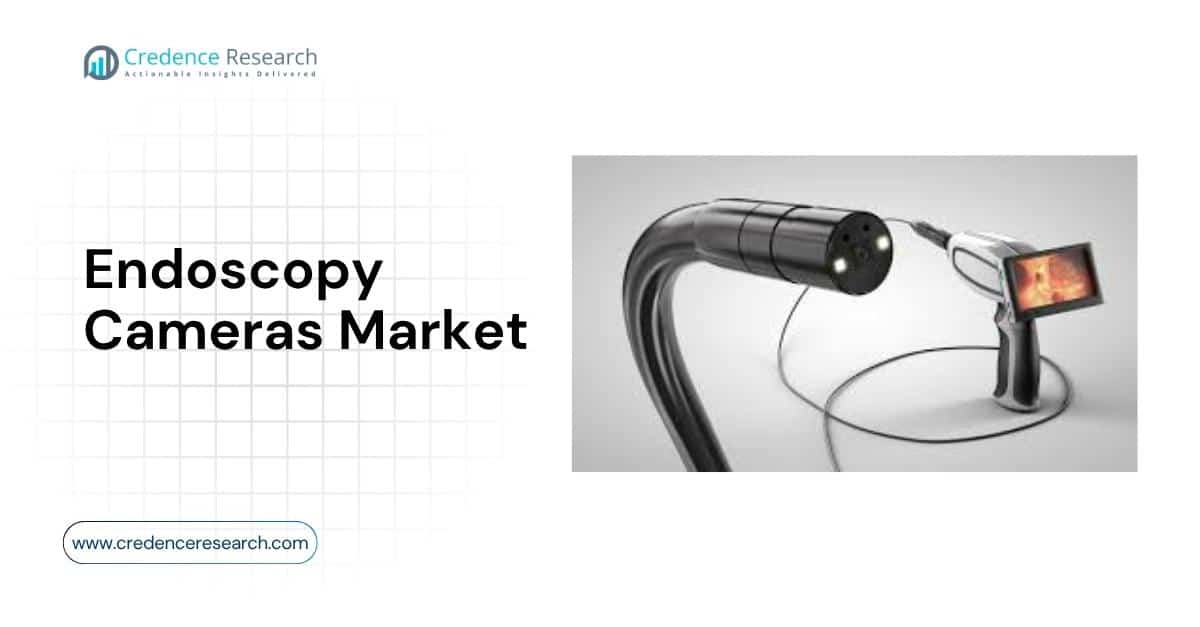
Credence Research has published a new research report titled “Endoscopy Cameras Market Size, Share, Growth, Opportunities, and Competitive Analysis, 2025–2032.” According to the study, the Endoscopy Cameras Market was valued at USD 3,107 million in 2024 and is projected to reach USD 6,236.96 million by 2032, expanding at a CAGR of 9.1% during the forecast period. Market growth is strongly supported by increasing adoption of minimally invasive surgeries, where high-definition and ultra-high-definition endoscopy cameras improve visualization accuracy, procedural efficiency, and clinical outcomes across gastroenterology, urology, gynecology, orthopedics, ENT, and general surgery.
The Endoscopy Cameras Market is expanding as hospitals and ambulatory surgical centers upgrade visualization platforms to support accurate diagnosis, precise tissue identification, and better surgical navigation. Modern endoscopy cameras integrate advanced CMOS sensors, low-light imaging, digital signal processing, and compatibility with visualization systems to deliver sharper images and improved real-time performance. Demand is also rising as healthcare providers shift toward procedures that reduce incision size, shorten hospital stays, lower complication risks, and improve patient recovery. HD and UHD camera systems remain central to this transition due to their strong clinical preference and broad procedural use.
Rising Adoption of Minimally Invasive Surgeries
The growing preference for minimally invasive procedures is a major driver of the Endoscopy Cameras Market. These procedures require high-quality imaging to help surgeons and physicians perform accurate diagnosis, tissue assessment, and surgical intervention through small incisions or natural body openings. Endoscopy cameras improve visualization of internal organs, reduce procedural uncertainty, and support better clinical decision-making. As hospitals expand minimally invasive capabilities across multiple specialties, demand for reliable and advanced endoscopy camera systems continues to rise.
Strong Demand for HD and UHD Visualization
HD and UHD endoscopy cameras are gaining strong adoption because they provide sharper images, improved color reproduction, and better depth perception during procedures. These systems collectively hold over 60% segment share, reflecting widespread clinical preference for enhanced visualization. Better image quality helps physicians identify lesions, bleeding points, anatomical structures, and abnormal tissues more accurately. This supports improved procedural confidence, patient outcomes, and operating room efficiency.
Demand for AI-Ready Surgical Visualization in Minimally Invasive Procedures
The Endoscopy Cameras Market is being driven by the shift from basic visualization tools to AI-ready, high-resolution imaging platforms that support precision diagnosis, surgical navigation, and real-time decision-making. Endoscopy is already central to minimally invasive diagnosis and treatment, as it allows physicians to view internal organs using a camera-equipped scope and, in many cases, perform procedures such as biopsy, bleeding control, polyp removal, and dilation without open surgery.
Growth of Ultra-High-Definition Imaging Systems
Ultra-high-definition imaging is becoming a key trend as clinicians seek better anatomical detail and more accurate visualization. UHD systems support improved detection, precise navigation, and better differentiation of tissues during procedures. This trend is expected to strengthen as hospitals upgrade older visualization systems and prioritize advanced imaging quality.
Enhanced Low-Light Imaging Capabilities
Low-light imaging performance is becoming increasingly important in endoscopic procedures where visibility can be limited by anatomy, fluid, bleeding, or narrow working spaces. Cameras with improved sensitivity and image enhancement allow physicians to maintain image clarity under challenging conditions. This creates opportunities for manufacturers offering advanced sensors and optimized optical systems.
High Capital Cost of Advanced Imaging Systems
Advanced HD and UHD endoscopy camera systems require significant capital investment, which can limit adoption in smaller hospitals and cost-sensitive healthcare markets. Facilities must also invest in compatible monitors, light sources, processors, scopes, and service support. High upfront cost can slow replacement cycles, especially in emerging regions.
Need for Skilled Operation and Maintenance
Endoscopy camera systems require proper handling, calibration, cleaning, maintenance, and integration with other surgical equipment. Inadequate training or poor maintenance can affect image quality, equipment life, and procedural efficiency. Healthcare providers must invest in staff training and service support to ensure consistent performance.
Endoscopy Cameras Market Regional Analysis
North America leads the Endoscopy Cameras Market with an exact 38% market share, supported by strong healthcare infrastructure, high capital spending, advanced hospital systems, and broad adoption of minimally invasive procedures. The United States remains the leading contributor due to high procedural volumes, early technology adoption, and strong demand for HD and UHD visualization systems in hospitals and ambulatory surgical centers.
Europe holds a significant market share due to established healthcare systems, strong demand for minimally invasive procedures, and continuous investment in surgical imaging technologies. Germany, France, the U.K., Italy, Spain, and the Nordic countries are key contributors, supported by hospital modernization programs and growing demand for gastrointestinal and laparoscopic procedures.
Asia-Pacific is expected to record the fastest expansion, driven by improving hospital capacity, rising healthcare expenditure, and increasing adoption of endoscopic procedures. China, India, Japan, South Korea, and Southeast Asian countries are investing in surgical infrastructure and advanced diagnostic capabilities. Growing patient volumes and expanding private healthcare networks further support regional demand.
Competitive Landscape
The Endoscopy Cameras Market has a concentrated competitive landscape, with key players including SIGMA CORPORATION, Panasonic Corporation, Leica Camera AG, Canon Inc., RICOH IMAGING COMPANY, LTD., FUJIFILM Holdings Corporation, OM Digital Solutions Corporation, Nikon Corporation, Eastman Kodak Company, and Olympus Corporation. These companies compete through optical innovation, advanced imaging performance, system interoperability, robust after-sales support, and long-term partnerships with hospitals and ambulatory surgical centers. Competitive differentiation increasingly depends on image clarity, sensor performance, low-light capability, platform compatibility, and service reliability.
ATTRIBUTE DETAILS
| ATTRIBUTE | DETAILS |
|---|---|
| Research Period | 2020–2032 |
| Base Year | 2024 |
| Forecast Period | 2025–2032 |
| Historical Year | 2020–2023 |
| Unit | USD Million |
| By Product (2020–2032; USD Million) | Visualization Systems; Endoscopic Ultrasound |
| By Application (2020–2032; USD Million) | Gastroscopy; Colonoscopy |
| By End User (2020–2032; USD Million) | Hospitals; Ambulatory Surgical Centers |
| By Geography (2020–2032; USD Million) | North America; Europe; Asia-Pacific; Latin America; Middle East & Africa |
About the Author

Healthcare & Biotech Analyst