
| REPORT ATTRIBUTE | DETAILS |
|---|---|
| Historical Period | 2019-2022 |
| Base Year | 2023 |
| Forecast Period | 2024-2032 |
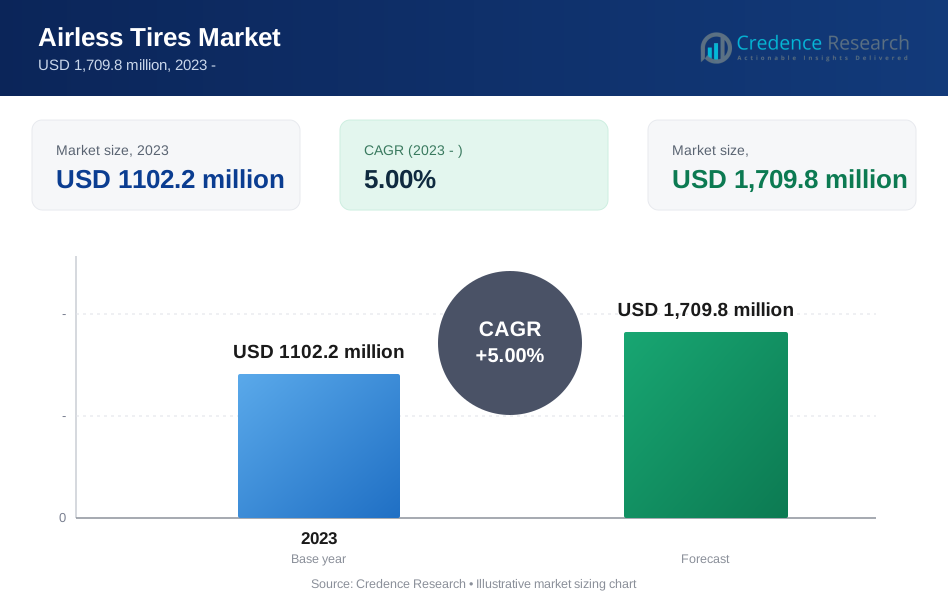
| Airless Tires Market Size 2023 | USD 1102.2 Million |
| Airless Tires Market, CAGR | 5.00% |
| Airless Tires Market Size 2032 | USD 1709.8 Million |
Market Insights
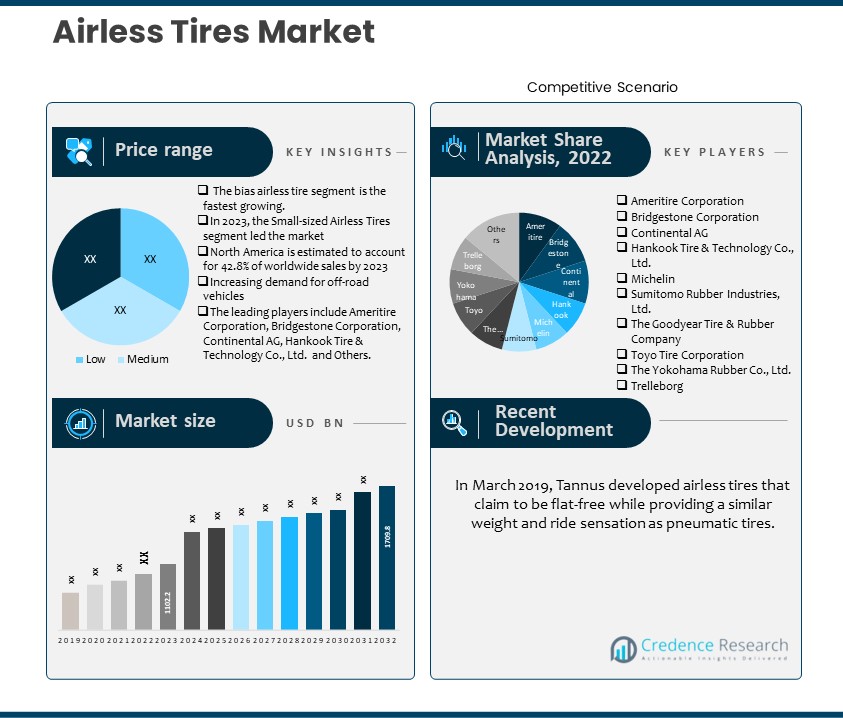
- The global demand for Airless Tires was valued at USD 1102.2 million in 2023 and is expected to reach USD 1709.8 million in 2032, growing at a CAGR of 5.00% between 2024 and 2032.
- In 2023, the rubber-based airless tire sector led the market, with plastic-based airless tires being the most opportunistic segment.
- Radial tires held the largest market share in the Airless Tires Market in 2023, while the bias airless tire segment is the fastest growing.
- Commercial and Industrial Vehicles are the fastest developing segment, while another key market sector is Military vehicles.
- Off-road Airless Tires have a significant market share, and the All-terrain Airless Tires sector adds to the market.
- In 2023, the Small-sized Airless Tires segment led the market. Another prominent category is Large-sized Airless Tires.
- The construction industry is the most dominating segment, and another prominent market is the agricultural sector.
- North America is predicted to account for 42.8% of global sales by 2023, while Asia Pacific is expected to have the greatest CAGR of 7.7% over the projection period.
- E-commerce-driven demand boosts airless tire market growth
- High cost of airless tires
Executive Summary
Market Definition
The development of airless tires, designed to run without air pressure, is causing a dramatic shift in the Airless Tires Market. These unique tires, known for their multiple benefits and ability to replace standard pneumatic tires, have received a lot of attention in a variety of applications. Airless tires, which are already used in bicycles, military vehicles, and a variety of commercial and utility vehicles, are poised to make their way into passenger vehicles, emerging as the next generation of automobile tires. Michelin, Bridgestone Corporation, Hankook Tire and Technology, Yokohama Rubber Co., Ltd., and Sumitomo Rubber Industries, Ltd. are among the leading companies in the Non-pneumatic Tire (NPT) or flat-free tire market. Airless tires are especially beneficial for electric vehicles since they have a lower rolling resistance, resulting in better battery power conservation. It is worth noting that, while these tires are suitable for a variety of vehicle types, they are not suggested for high-speed vehicles in the Airless Tires Industry.
Market Overview
The global Airless Tires Market has witnessed steady growth in recent years and is expected to grow at a CAGR of 5.00% between 2024 and 2032. The market was valued at USD 1102.2 million in 2023 and is expected to reach USD 1709.8 million in 2032.
Airless tires are solid, non-pneumatic tires that do not require air pressure to function. They are often composed of plastic or rubber, but 3D printing is becoming increasingly popular. These tires reduce accidents caused by flat tires and blowouts, while also maintaining passenger safety. Also, as a result of globalization and urbanization, the number of heavy commercial vehicles, such as heavy construction equipment and heavy-duty trucks, is expected to expand, driving the airless tire market.
The rising demand for all-terrain and military vehicles, ongoing technological advancements to reduce tire vibration and noise, the presence of technology suppliers in the market, and the expanding automotive sector are some of the primary factors driving the airless tires market growth during the forecast period.
However, the significant capital investment necessary to develop new manufacturing facilities, together with the unpredictability of raw material pricing, may limit the airless tire market's growth. The solid tire performance in terms of suspension and friction, as well as heat dissipation issues, may limit the growth of the airless tire industry. The aftermarket demand for solid tires from passenger vehicles, as well as technological advancements incorporating new materials, are expected to provide considerable market prospects.
Segmentation by Material Composition
- In 2023, the rubber-based airless tires segment dominated the market, accounting for around 62% of the total. A rubber tire is made by wrapping a rubber ring around the rim of an automobile wheel. Rubber is widely used in automobiles because to its high tensile strength, durability, and resistance to tears and abrasions.
- Plastic-based Airless Tires are expected to be the most opportunistic segment over the projection period. Manufacturers use plastic materials for airless tire production because they are recyclable. The market will grow as the usage of recyclable plastic in the production of two-wheeler tires with plastic spokes grows.
Segmentation by Type of Airless Tires
- Radial tires accounted for the greatest market share in the Airless Tires Market in 2023. This is due to its outstanding performance characteristics, including high strength, superb flexibility, enhanced shock absorption, and superior flexibility. Other factors, such as lower fuel consumption and industry players' strong preference for making radial tires, are projected to increase product demand over the forecast period.
- On the other hand, the bias airless tire segment is the fastest growing. Bias airless tires are gaining popularity because to their increased use in off-road vehicles and heavy-duty applications.
Segmentation By Application
- Commercial and Industrial Vehicles are the fastest expanding segment. Commercial vehicles, including trucks, buses, and vans, are seeing an increase in the use of airless tires due to the benefits they provide, such as increased durability, lower maintenance costs, and higher stability.
- Another major market sector is Military vehicles. Military vehicles have emerged as a large consumer of airless tires, accounting for nearly 11,825,000 in 2023 alone. Because of the difficult off-road conditions in which these vehicles operate, the defense industry has a high demand for airless tires that require little maintenance and repair..
Segmentation by Terrain Type
- The Off-road Airless Tires segment has a substantial market share. These tires are intended for heavy-duty vehicles, such as construction equipment and agricultural gear, where durability and dependability are critical.
- On the other hand, the All-terrain Airless Tires sector contributes to the market by catering to vehicles that operate in varied terrains, providing a balance of on-road and off-road characteristics.
Segmentation by Wheel Size
- In 2023, the Small-sized Airless Tires segment dominated the market, accounting for approximately 55% of the total. Broader tire sizes are recommended because they give greater stability and cover a larger area.
- Another significant section is Large-sized Airless Tires.
Segmentation by End-Use Industry
- The construction industry is the most dominant segment. Construction vehicles require tough tires that can handle difficult terrain and big loads.
- Another prominent market is the agricultural industry, where airless tires provide dependability and reduce the risk of punctures in farm equipment, ensuring smooth operations in the fields.
Segmentation by Region
- North America is estimated to account for 42.8% of worldwide sales by 2023.
- Asia Pacific is expected to have the highest CAGR of 7.7% during the projection period.
- The rest of the world, including Latin America, the Middle East, and Africa, supplies the remaining demand for Airless Tires.
North America has the greatest market for airless tires. North America has a large market share due to a variety of factors contributing to its dominance. The region is home to various major market participants, technical developments, and a thriving automobile industry. The presence of major producers and suppliers of airless tires in North America fuels market expansion. Additionally, severe safety standards and a strong emphasis on vehicle performance and durability drive up demand for airless tires in the region. Furthermore, the growing popularity of electric vehicles in North America helps to the market's growth, as airless tires are well-suited to these vehicles' specific needs.
Moreover, The Asia-Pacific Airless Tires Market is estimated to expand at the quickest CAGR between 2023 and 2032. This is owing to an increase in demand for airless tires in the region, which may be attributed to factors such as increased construction activity, the need for fuel-efficient technology, and industrial growth. Furthermore, China's Airless Tires Market accounted for the greatest market share, while India's Airless Tires Market was the fastest expanding market in Asia Pacific.
Key Highlights of the Report
The global Airless Tires Market is segmented based on Material Composition, Type of Airless Tires, Application, Terrain Type, Wheel Size, End-Use Industry, and Region. Commercial and industrial vehicles are the segment with the quickest rate of expansion. In 2023, the rubber-based airless tire segment dominated the market. In addition, the market share of the Off-road Airless Tires segment is considerable, and the Large-sized Airless Tires section is also noteworthy North America is driving market expansion.
The important market drivers are rising demand for off-road vehicles, a growing focus on lowering maintenance costs, and an increase in the usage of airless tires for commercial vehicles. Furthermore, limited availability of airless tire options for various vehicle types, initial high prices associated with airless tires, and resistance from traditional tire producers are the main limitations of the market.
North America has the largest market for airless tires. The region has a significant market share due to several factors, including several important market participants, technological advancements, and a strong automobile sector. Furthermore, the Asia-Pacific Airless Tires Market is expected to grow at the fastest CAGR between 2023 and 2032.
What Are The Main Drivers Of The Global Airless Tires Market?
The Airless Tires Market is primarily driven by the growing demand for off-road vehicles, which require tough and dependable tires to cross harsh terrain. In addition, there is a rising emphasis on lowering maintenance costs, and airless tires provide a longer lifespan and require less care than typical pneumatic tires. Also, the increasing adoption of airless tires for commercial vehicles, such as construction equipment and industrial machines, is driving market expansion.
What Are The Major Challenges Faced By The Global Airless Tires Market?
Despite market expansion, the Airless Tires Market faces constraints such as a scarcity of airless tire options for various vehicle types, which may impede wider adoption. Moreover, the initial high costs of airless tires may discourage some consumers from investing in this technology. Additionally, traditional tire producers who are hesitant to transition from pneumatic to airless tires provide an obstacle to market expansion.
What Are The Growth Opportunities In The Global Airless Tires Market?
The Airless tire market offers prospects for growth due to technological breakthroughs in airless tire design and manufacturing, which result in enhanced performance and cost-efficiency. Also, airless tire applications have the potential to expand to other industries other than off-road and commercial vehicles, such as personal transportation and recreational vehicles.
Market Drivers
Several factors drive the global Airless Tires Market. The following are the key drivers of the global Airless Tires Market:
E-commerce-Driven Demand
The expanding e-commerce sector is likely to drive future growth in the airless tire market. The e-commerce sector refers to the electronic commerce industry, which involves the purchase and sale of goods and services via the internet. With the growing e-commerce landscape, delivery fleets seek increased reliability and cost-effective maintenance, making airless tires, which are known for their puncture resistance and durability, a valuable solution that improves overall operational efficiency and meets the changing needs of the e-commerce sector.
For instance, according to a research issued in October 2021 by the International Trade Administration, a US-based body, e-commerce for consumer goods is predicted to account for around 22% of all retail sales worldwide, expanding at an average rate of more than 1% by 2024. Retail e-commerce sales indicate a continuous, long-term increase of 8% in total worldwide retail e-commerce sales through 2024. As a result, the growing e-commerce sector is fueling the expansion of the airless tire market.
Market Restraints
The global Airless Tires Market faces some challenges that may hinder its growth. These include the following:
High Cost of Airless Tires
These tires come with a higher price tag compared to traditional ones due to their innovative technology and durable materials. This increased cost can make it challenging for some individuals and businesses to make the switch to airless tires, especially in industries where budget constraints are a concern. Despite the upfront expense, airless tires offer long-term advantages like reduced maintenance needs and extended lifespan, which can ultimately lead to cost savings over time. While the initial investment may be a barrier, the benefits of durability and reliability make airless tires a valuable choice for those looking for long-lasting and dependable tire solutions.
Opportunities
The global Gasket and seal market offers significant growth opportunities. These include the following:
Innovative Technologies Drive Advancements
Integration of technology is a growing trend in the airless tire business. Major airless tire producers are integrating their technology into car tests to shape the future of mobility and maintain their market position. For instance, in November 2021, Goodyear Tire & Rubber firm, a US-based tire manufacturing firm, introduced their airless tire, which is currently being utilized (prototype airless tires) on a Tesla Model 3. The company's non-pneumatic tires have reached speeds of up to 55 mph on a Tesla test vehicle. A network of spokes keeps the wheel rigid enough to drive on, rather than air pressure keeping the tire taut and ready. The mechanism is incredible to watch in action; unlike traditional tires, the wheels bend strangely.
Competitive Landscape
Key Players
The global Airless Tires Market is highly competitive, with several key players. Some of the major players in the market and their market share are as follows:
- Ameritire Corporation
- Bridgestone Corporation
- Continental AG
- Hankook Tire & Technology Co., Ltd.
- Michelin
- Sumitomo Rubber Industries, Ltd.
- The Goodyear Tire & Rubber Company
- Toyo Tire Corporation
- The Yokohama Rubber Co., Ltd.
- Trelleborg
These organizations prioritize product innovation, Service Provider expansion, and mergers and acquisitions to stay competitive.
The global Airless Tires Market's key players continually seek to stay ahead by offering new products and developments.
In February 2020, Bridgestone presented a prototype version of an air-free commercial truck tire at the American Trucking Associations' Technology and Maintenance (TMC) council's annual conference in Atlanta.
In January 2020, Bridgestone has created and plans to manufacture large airless tires that can handle 5,000 pounds of weight, particularly for commercial truck owners.
Summary of Key Findings
- Innovative technologies are driving developments in the airless tire market
- The market is segmented by Material Composition, Type of Airless Tires, Application, Terrain Type, Wheel Size, End-Use Industry, and Region.
- In 2023, Small-sized Airless Tires dominated the market
- The bias airless tire segment is the fastest growing..
- North America is leading market growth. The market is highly competitive, with key players including Ameritire Corporation, Bridgestone Corporation, Continental AG, Hankook Tire & Technology Co., Ltd. and Others.
Future Outlook
- Increasing demand for off-road vehicles.
- Growing emphasis on lowering maintenance expenses.
- Increased usage of airless tires for commercial vehicles.
- Technological advances in tire manufacture.
- Environmental Advantages of Airless Tires
How CXOs Can Benefit from the Credence Research Airless Tires Market Report
The Credence Research Airless Tires Market Report provides CXOs with a comprehensive overview of the market, including:
- Market Size and Growth Forecast: The report provides detailed estimates of the global Airless Tires Market segmented by Material Composition, Type of Airless Tires, Application, Terrain Type, Wheel Size, End-Use Industry, and Region. It also includes forecasts for the market through 2032 based on key trends and drivers.
- Market segmentation: The report segments the Airless Tires Market by Material Composition, Type of Airless Tires, Application, Terrain Type, Wheel Size, End-Use Industry, and Region. This segmentation provides CXOs with a granular understanding of the market and the opportunities in each segment.
- Competitive Landscape: The report profiles the key players in the Airless Tires Market and provides insights into their strategies, product offerings, and financial performance. This information can help CXOs to identify and assess their competition.
- Key trends and drivers: The report identifies and analyzes the key trends and drivers shaping the Airless Tires Market. This information can help CXOs make informed decisions about their investments and strategies.
CXOs can use the insights from the Credence Research Airless Tires Market Report to:
- Identify growth opportunities: The report can help CXOs identify new growth opportunities in the Airless Tires Market. It provides valuable insights and analysis that can assist them in making informed decisions and strategic plans for their businesses.
- Make in Informed investment decisions: The report can help CXOs to make informed investment decisions about Airless Tires. For example, it provides valuable market insights such as growth trends, market size, and competitive analysis. CXOs can use this information to assess the potential profitability and growth opportunities in the Airless Tires Market.
- Develop competitive strategies: The report can help CXOs develop competitive strategies for their Airless Tires businesses. It provides insights into market trends, customer preferences, and competitive landscape analysis.
- Track market developments: The report can help CXOs track market developments and stay ahead of the curve. For example, It provides valuable insights and analysis that can inform strategic decision-making and help them stay ahead of the competition.
Overall, the Credence Research Airless Tires Market Report is a valuable resource for CXOs who are looking to gain a deeper understanding of the market and identify opportunities for growth.
Segmentation
By Material Composition:
- Rubber-based Airless Tires
- Polyurethane-based Airless Tires
- Plastic-based Airless Tires
- Composite-based Airless Tires
- Others
By Type of Airless Tires:
- Radial Airless Tires
- Bias Airless Tires
- Belted Airless Tires
- Non-Belted Airless Tires
By Application:
- Military and Defense Vehicles
- Off-road Vehicles (e.g., ATVs, UTVs, golf carts)
- Commercial and Industrial Vehicles (e.g., forklifts, skid steers, construction equipment)
- Lawn and Garden Equipment (e.g., lawn mowers, tractors, wheelbarrows)
- Bicycles and Electric Scooters
- Wheelchairs and Mobility Aids
- Others
By Terrain Type:
- On-road Airless Tires
- Off-road Airless Tires
- All-terrain Airless Tires
By Wheel Size:
- Small-sized Airless Tires (e.g., for bicycles, wheelchairs)
- Medium-sized Airless Tires (e.g., for lawn mowers, golf carts)
- Large-sized Airless Tires (e.g., for commercial vehicles, military vehicles)
By End-Use Industry:
- Automotive Industry
- Aerospace and Defense Industry
- Construction Industry
- Agriculture Industry
- Landscaping and Groundskeeping Industry
- Transportation and Logistics Industry
- Personal Mobility Industry
- Others
By Region
- North America
- The U.S.
- Canada
- Mexico
- Europe
- Germany
- France
- The U.K.
- Italy
- Spain
- Rest of Europe
- Asia Pacific
- China
- Japan
- India
- South Korea
- South-east Asia
- Rest of Asia Pacific
- Latin America
- Brazil
- Argentina
- Rest of Latin America
- Middle East & Africa
- GCC Countries
- South Africa
- Rest of the Middle East and Africa
Request a Free Sample
Fill in your details and we'll send you a free sample report.
- Sample data tables & charts
- Research methodology
Need a Custom Version of This Report?
Tailor the scope, geography, or segments to your exact requirements.
- Custom geography or segment scope
- Direct access to our analyst team
Frequently Asked Questions
What is the current Material Composition of the global Airless Tires Market?
What is the expected growth rate of the Airless Tires Market between 2024 and 2032?
Which segment is leading the market share in terms of Material Composition?
Which Wheel Size segment governs the demand for rapid pharmaceutical microbiology testing in the world?
Who are the major players in the global Airless Tires Market?
Table of Content
Chapter 1. Report Introduction
- 1.1 Report Description & Purpose
- 1.1.1 Report Title & Market Definition
- 1.1.2 Unique Selling Propositions (USP) & Key Differentiators
- 1.1.3 Value Proposition for Stakeholders
- 1.2 Research Objectives
- 1.2.1 Market Sizing Objectives (Volume & Revenue)
- 1.2.2 Segmentation Objectives
- 1.2.3 Competitive Intelligence Objectives
- 1.2.4 Forecast & Scenario Objectives
- 1.3 Report Scope
- 1.3.1 Airless Tires Scope – Types & Subtypes Covered
- 1.3.2 Geographic Scope – Regions & Countries Covered
- 1.3.3 Historical Period, Base Year & Forecast Period (2023; forecast to the forecast period)
- 1.3.4 Inclusions & Exclusions
- 1.4 HS Code & Classification Framework
- 1.5 Currency, Units & Pricing Basis
- 1.6 Target Stakeholders
- 1.7 Limitations & Assumptions
Chapter 2. Executive Summary
- 2.1 Global Airless Tires Market Snapshot
- 2.1.1 Market Size – Historical (2023) & Forecast (the forecast period) (2023: USD 1102.2 million → forecast year: USD 1,709.8 million)
- 2.1.2 Volume & Revenue – Global Totals
- 2.1.3 Key Market Highlights – Top Five Facts
- 2.2 Airless Tires Market Segmentation Snapshot
- 2.2.1 Market Split by Region – 2023 vs.
- 2.3 Competitive Snapshot
- 2.3.1 Top 10 Players by Revenue Share – 2023
- 2.3.2 Top 10 Players by Volume Share – 2023
- 2.3.3 Recent Strategic Developments (18-Month Summary)
- 2.4 Key Investment Highlights & Strategic Conclusions
Chapter 3. Airless Tires Market Dynamics & Industry Analysis
- 3.1 Market Overview & Context
- 3.1.1 Airless Tires Market Position in the Broader Automotive Value Chain
- 3.1.2 OEM vs. Replacement Market Dynamics
- 3.1.3 Market Maturity & Development Stage by Region
- 3.2 Airless Tires Market Drivers
- 3.3 Airless Tires Market Restraints & Challenges
- 3.4 Airless Tires Market Opportunities
- 3.5 Porter's Five Forces Analysis
- 3.5.1 Threat of New Entrants
- 3.5.2 Bargaining Power of Suppliers
- 3.5.3 Bargaining Power of Buyers
- 3.5.4 Threat of Substitutes
- 3.5.5 Competitive Rivalry – Intensity Assessment
- 3.6 Airless Tires Value Chain Analysis
- 3.6.1 Upstream – Raw Material/Input Suppliers
- 3.6.1.1 Raw Material/Input 1
- 3.6.1.2 Raw Material/Input 2
- 3.6.1.3 Raw Material/Input 3
- 3.6.2 Midstream – Production/Manufacturing/Service Delivery
- 3.6.2.1 Production/Process Overview
- 3.6.2.2 Key Facility Locations & Capacity by Manufacturer
- 3.6.3 Downstream – Distribution & End Consumer
- 3.6.3.1 Primary Channel – B2B/OEM
- 3.6.3.2 Secondary Channels – Dealer, Retail, Online, Direct
- 3.6.4 Value Chain Profitability Analysis
- 3.6.1 Upstream – Raw Material/Input Suppliers
- 3.7 PESTEL Analysis
- 3.7.1 Political Factors
- 3.7.2 Economic Factors
- 3.7.3 Social Factors
- 3.7.4 Technological Factors
- 3.7.5 Environmental Factors
- 3.7.6 Legal Factors
- 3.8 Airless Tires Supply Chain Analysis
- 3.8.1 Raw Material/Input Supply Risk Assessment
- 3.8.2 Manufacturing Concentration Risk (Geographic Exposure)
- 3.8.3 Trade Disruption Impact Analysis
- 3.9 Regulatory & Policy Landscape
Note: The regulatory and policy landscape section covers regulations based on their applicability to the market, Airless Tires category, geography, and scope of the study. Only regulatory frameworks with a material impact on operations, compliance, trade, sustainability, or market access are analyzed in detail.
Chapter 4. Key Investment Pockets & Opportunity Analysis
- 4.1 Airless Tires Market Attractiveness Analysis
- 4.1.1 By Region – Investment Attractiveness Matrix (Volume × CAGR)
- 4.2 Absolute Revenue Growth Opportunity
- 4.2.1 By Region – Absolute USD Growth Through the forecast period
- 4.3 Incremental Volume Opportunity
- 4.3.1 By Region – Incremental Volume Through the forecast period
- 4.3.2 Segment – Incremental Volume
- 4.4 Emerging Submarket Opportunity Deep Dive (Subject to Applicability)
- 4.5 Emerging Market Opportunity Scorecards
- 4.5.1 United States
- 4.5.2 Europe
- 4.5.3 Asia
- 4.5.4 Middle East & Africa
Note: Emerging Market Opportunity Scorecards will be included based on relevance and strategic importance. Regions listed are indicative and may vary depending on data availability and market dynamics.
Chapter 5. Airless Tires Import-Export Analysis & Trade Flows
- 5.1 Global Trade Overview
- 5.1.1 Global Export Value by Country (2023)
- 5.1.2 Global Export Volume by Country (2023)
- 5.1.3 Global Import Value by Country (2023)
- 5.1.4 Global Import Volume by Country (2023)
- 5.1.5 Net Trade Balance by Country (2023)
- 5.2 Export Analysis – Segment
- 5.2.1 Type 1 (HS Code)
- 5.2.2 Type 2 (HS Code)
- 5.2.3 Type 3 (HS Code)
- 5.2.4 Type 4 (HS Code)
- 5.2.5 Type 5 (HS Code)
- 5.3 Import Analysis – Segment
- 5.3.1 Type 1 (HS Code)
- 5.3.2 Type 2 (HS Code)
- 5.3.3 Type 3 (HS Code)
- 5.3.4 Type 4 (HS Code)
- 5.3.5 Type 5 (HS Code)
- 5.4 Average Unit Trade Prices
- 5.4.1 Average Export Price – Segment & Country
- 5.4.2 Average Import Price – Segment & Source Country
- 5.4.3 Price Trends (2023)
- 5.5 Key Trade Route Analysis
- 5.5.1 Trade Route 1
- 5.5.2 Trade Route 2
- 5.5.3 Trade Route 3
- 5.5.4 Trade Route 4
- 5.5.5 Trade Route 5
- 5.6 Trade Policy Impact Assessment
- 5.6.1 US Anti-Dumping & Section 301 Tariffs
- 5.6.2 EU Customs Union Impact
- 5.6.3 Major Free Trade Agreements
- 5.6.4 USMCA Rules of Origin
Note: Trade policy analysis will be included only where relevant to the Airless Tires market.
Chapter 6. Competitive Landscape & Company Benchmarking
- 6.1 Airless Tires Market Concentration & Structure
- 6.1.1 Herfindahl-Hirschman Index (HHI) – vs. 2023
- 6.1.2 Tier 1, Tier 2 & Tier 3 Market Structure
- 6.1.3 Global, Regional & Local Player Dynamics
- 6.2 Airless Tires Market Share Analysis – 2023
- 6.2.1 Global Revenue Share by Company
- 6.2.2 Global Volume Share by Company
- 6.2.3 Regional Revenue Share
- 6.2.4 Market Share Evolution ( vs. 2023)
- 6.2.5 OEM Segment Share by Company
- 6.2.6 Replacement Segment Share by Company
- 6.3 Production/Delivery Capacity & Facility Analysis
- 6.3.1 Global Installed Capacity
- 6.3.2 Capacity Utilization Rates
- 6.3.3 Production/Output Volume
- 6.3.4 Facility Locations & Capacity Map
- 6.3.5 Planned Capacity Additions
- 6.4 Airless Tires Competitive Benchmarking Matrix
- 6.4.1 Revenue, Volume, CAGR & Profitability Comparison
- 6.4.2 Channel Revenue Mix
- 6.4.3 Geographic Revenue Exposure
- 6.4.4 R&D Intensity
- 6.4.5 Sustainability Maturity
- 6.5 Strategic Developments in Airless Tires (Last 24 Months)
- 6.5.1 Mergers, Acquisitions & Divestments
- 6.5.2 New Airless Tires Launches
- 6.5.3 Facility Expansions
- 6.5.4 Strategic Alliances, Joint Ventures & Partnerships
- 6.5.5 Distribution Expansion & Market Entry
- 6.5.6 Sustainability & ESG Initiatives
- 6.6 Competitive Strategy Mapping
- 6.6.1 Leader, Challenger, Follower & Niche Classification
- 6.6.2 Pricing Strategy Comparison
- 6.6.3 Channel Strategy Matrix
Note: Strategic developments are included based on their materiality and the availability of reliable information.
Chapter 7. Global Airless Tires Market – By Distribution Channel
- 7.1 Segment Overview
- 7.1.1 Volume & Revenue Split by Channel (2023 & )
- 7.1.2 Channel Mix Evolution (the forecast period)
Chapter 8. Regional Market Analysis – Global Overview
- 8.1 Global Regional Overview
- 8.1.1 Regional Volume Share
- 8.1.2 Regional Revenue Share
- 8.1.3 Regional Volume by Region
- 8.1.4 Regional Revenue by Region
- 8.1.5 Regional Forecast Through the forecast period
- 8.2 Cross-Regional Segment Analysis
- 8.2.1 By Distribution Channel
- 8.2.2 By Brand/Price Tier
Chapter 9. North America Airless Tires Market
- 9.1 United States
- 9.2 Canada
- 9.3 Mexico
Chapter 10. Europe Airless Tires Market
- 10.1 Germany
- 10.2 France
- 10.3 Italy
- 10.4 United Kingdom
- 10.5 Spain
- 10.6 Poland
- 10.7 Russia
- 10.8 Netherlands
- 10.9 Belgium
- 10.10 Sweden
- 10.11 Denmark
- 10.12 Norway
- 10.13 Rest of Europe
Chapter 11. Asia Pacific Airless Tires Market
- 11.1 China
- 11.2 India
- 11.3 Japan
- 11.4 South Korea
- 11.5 Thailand
- 11.6 Indonesia
- 11.7 Vietnam
- 11.8 Malaysia
- 11.9 Australia
- 11.10 Rest of Asia Pacific
Chapter 12. Latin America Airless Tires Market
- 12.1 Brazil
- 12.2 Argentina
- 12.3 Colombia
- 12.4 Chile
- 12.5 Rest of Latin America
Chapter 13. Middle East Airless Tires Market
- 13.1 Saudi Arabia
- 13.2 United Arab Emirates
- 13.3 Turkey
- 13.4 Israel
- 13.5 Iran
- 13.6 Rest of the Middle East
Chapter 14. Africa Airless Tires Market
- 14.1 South Africa
- 14.2 Egypt
- 14.3 Nigeria
- 14.4 Morocco
- 14.5 Rest of Africa
Chapter 15. Airless Tires Company Profiles
- 15.1 [Company 01]
- 15.1.1 Company Overview
- 15.1.2 Key Management Personnel
- 15.1.3 Products & Services Portfolio
- 15.1.4 Financial Performance
- 15.1.5 Key Market Focus & Geographic Presence
- 15.1.6 Recent Developments & Strategic Initiatives
Note: The company profile list is preliminary and may change based on research findings, market developments, data availability, and client requirements.
Chapter 16. Appendices
- Appendix A – List of Abbreviations & Acronyms
- Appendix B – Industry Classification Code Reference – Full Series
- Appendix C – Production & Capacity Data Tables
- Appendix D – End-Use & Demand Base Tables
- Appendix E – Consumption & Replacement Rate Assumptions
- Appendix F – ASP Reference Tables
- Appendix G – Manufacturing & Facility Database
- Appendix H – Import-Export Data Tables
- Appendix I – Regulatory Summary Tables
- Appendix J – Primary Research Participant List (Anonymized)
- Appendix K – Primary Research Questionnaire Framework
- Appendix L – Data Sources & Bibliography
- Appendix M – Market Size Divergence & Source Comparison
Chapter 17. Research Methodology
- 17.1 Research Framework & Philosophy
- 17.2 Secondary Research – Sources, Hierarchy & Data Extraction
- 17.3 Data Modeling – Bottom-Up & Top-Down Market Sizing
- 17.4 Primary Research – Stakeholder Framework, LOI & Sample Sizes
- 17.5 Forecast Methodology – Regression, Scenario & Sensitivity Analysis
- 17.6 Quality Control – Four-Layer Validation Framework
- 17.7 Limitations & Standard Assumptions
- 17.8 Disclaimer
