
| REPORT ATTRIBUTE | DETAILS |
|---|---|
| Historical Period | 2019-2022 |
| Base Year | 2023 |
| Forecast Period | 2024-2032 |
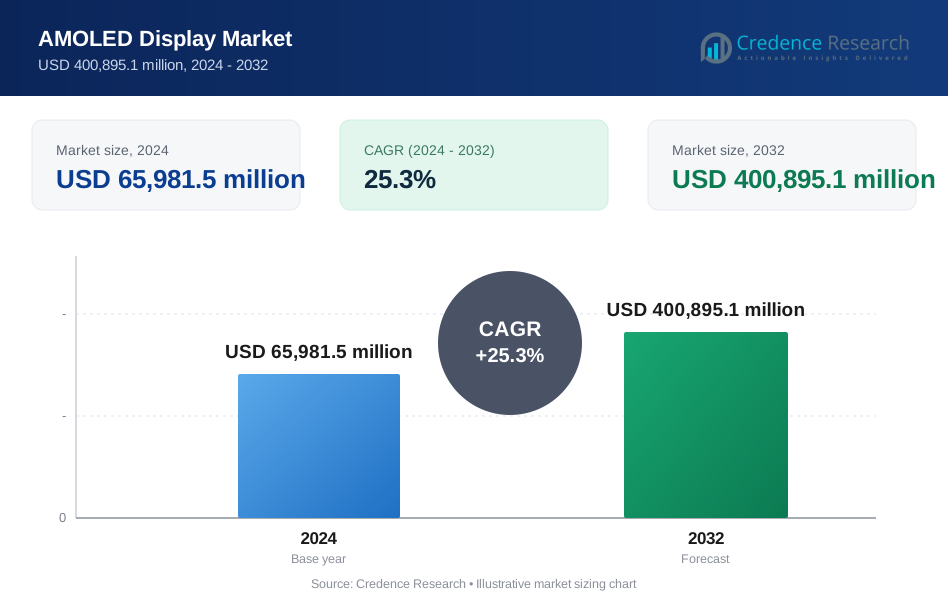
| AMOLED Display Market Size 2024 | USD 65,981.5 Million |
| AMOLED Display Market, CAGR | 25.3% |
| AMOLED Display Market Size 2032 | USD 400,895.1 Million |
Market Overview
The AMOLED Display Market is projected to grow from USD 65,981.5 million in 2024 to USD 400,895.1 million by 2032, registering a robust CAGR of 25.3% during the forecast period.
The AMOLED display market is driven by increasing demand for high-resolution, energy-efficient displays in consumer electronics, including smartphones, wearables, and televisions. Advancements in flexible and foldable display technologies are boosting adoption, particularly in premium devices. The rise of smart devices and growing investments in OLED technology for automotive and healthcare applications further fuel market growth. Additionally, consumers' preference for superior image quality, vibrant colors, and thinner display panels is accelerating innovation. Industry players are focusing on expanding production capacities and developing cost-effective solutions to meet escalating demand, positioning AMOLED displays as a key component in next-generation display technologies.
The AMOLED display market exhibits robust growth across key regions, with Asia Pacific leading due to its strong manufacturing base in countries like China, South Korea, and Japan, alongside rising consumer demand for advanced electronics. North America follows, driven by technological innovation and adoption in sectors like automotive and consumer electronics. Prominent players driving the market include Samsung Display, LG Display, BOE Technology Group, Japan Display Inc., and AU Optronics. These companies focus on product innovation, flexible displays, and energy-efficient technologies, ensuring continued market expansion across diverse applications such as smartphones, wearables, automotive systems, and high-resolution televisions.
Market Drivers
Superior Display Quality
AMOLED displays are celebrated for their exceptional visual performance, offering high contrast ratios with deeper blacks and vibrant colors due to their self-emissive nature. This technology ensures stunning visuals, making it ideal for immersive experiences. For instance, a survey by the Consumer Technology Association highlighted that users rated AMOLED screens higher in color accuracy and brightness consistency compared to other display types. Wide viewing angles allow consistent color accuracy and brightness even from extreme perspectives, enhancing user experience across various devices. Additionally, fast response times eliminate motion blur, ensuring smooth playback for gaming and video content. These features collectively position AMOLED displays as the gold standard in modern display technology, catering to the increasing demand for superior image quality in consumer and professional applications.
Energy Efficiency
The self-emissive pixels in AMOLED displays provide significant energy savings by illuminating only the pixels actively displaying content. This feature drastically reduces power consumption compared to traditional LCD displays, making them more eco-friendly and practical. For instance, according to a report by the International Energy Agency, devices with AMOLED screens showed a marked improvement in battery life, with smartphones and smartwatches benefiting the most. As a result, devices such as smartphones, smartwatches, and wearables benefit from extended battery life, a critical factor in today's fast-paced, on-the-go lifestyle. The energy efficiency of AMOLED technology supports the growing demand for sustainable and power-optimized electronic devices, strengthening its adoption across diverse markets.
Thin and Flexible Form Factors
The unique self-emissive structure of AMOLED displays allows for thinner and lighter designs, enabling manufacturers to create sleek and highly portable devices. This technology has paved the way for innovative designs, including foldable smartphones and rollable TVs, which are redefining the consumer electronics landscape. For instance, a study by the National Institute of Standards and Technology found that AMOLED displays' flexibility and durability are key attributes driving their use in next-generation devices. With flexibility and durability as key attributes, AMOLED displays are central to the development of next-generation devices, offering unparalleled design possibilities and functionality to meet evolving consumer preferences.
Growing Adoption in Consumer Electronics
AMOLED displays are increasingly becoming the standard in high-end consumer electronics, especially in smartphones, where superior image quality and energy efficiency are critical. In wearables, the compact size and low power consumption of AMOLED technology make it a preferred choice for smartwatches and fitness trackers. Additionally, AMOLED televisions are gaining popularity due to their exceptional picture quality and wide viewing angles, meeting the demand for premium home entertainment solutions. This widespread adoption highlights AMOLED displays' versatility and relevance across diverse electronic applications.
Market Trends
Expanding Applications Across Consumer Electronics
The AMOLED display market is witnessing rapid adoption across diverse consumer electronics, driven by its superior performance and versatility. In smartphones, AMOLED displays have become the standard for high-end devices due to their superior image quality, energy efficiency, and sleek form factors. This trend is also penetrating mid-range segments, making AMOLED technology accessible to a broader consumer base. For instance, according to a report by the International Data Corporation, the adoption of AMOLED displays in wearables has increased significantly, with major brands incorporating this technology into their latest models. The wearable device segment is another key growth area, with smartwatches and fitness trackers leveraging AMOLED’s vibrant colors, deep blacks, and low power consumption to deliver exceptional user experiences. Additionally, the growing demand for foldable and flexible displays is reshaping the consumer electronics landscape. AMOLED technology enables foldable smartphones, rollable TVs, and other flexible devices, allowing for innovative designs that cater to evolving consumer preferences.
Technological Advancements and Emerging Markets
Advancements in AMOLED display technology are further fueling its market growth. Manufacturers are consistently pushing the boundaries of resolution and color accuracy, offering sharper, more detailed images and vibrant, true-to-life colors. Innovations in power-saving technologies are also enhancing energy efficiency, extending battery life, and aligning with sustainable practices. Beyond consumer electronics, the automotive sector is emerging as a promising market for AMOLED displays, particularly in instrument clusters, infotainment systems, and head-up displays, where high-quality visuals are essential. The competitive landscape remains dynamic, with established players like Samsung, LG Display, and BOE Technology Group leading innovation while new entrants, especially from China, challenge their dominance. These trends underscore the expanding applications and technological progress driving the AMOLED display market forward.
Market Challenges Analysis
High Costs and Technical Limitations
AMOLED displays face challenges associated with high production costs and technical limitations, which impact their adoption across price-sensitive markets. The manufacturing process for AMOLED panels is inherently complex and more expensive than traditional LCD displays, leading to elevated production costs. For instance, a report by Display Supply Chain Consultants highlights that the production cost of a 5-inch 1080p AMOLED display is approximately $14.30, compared to $14.60 for a similar LCD panel. Additionally, the organic materials used in these displays are relatively costly, further contributing to their premium pricing. Another technical hurdle is the risk of burn-in and image retention, where static images like icons or notifications can leave faint residual marks on the screen over time. While manufacturers are implementing mitigation strategies such as pixel shifting and adaptive brightness controls, these solutions add complexity and do not entirely eliminate the issue. Furthermore, the organic materials in AMOLED displays are prone to degradation, reducing brightness and color accuracy over time. This limited lifespan, which varies based on usage patterns and environmental conditions, poses a challenge for applications requiring long-term reliability, such as automotive displays and industrial panels.
Supply Chain Constraints and Emerging Competition
Supply chain constraints and competition from emerging technologies further challenge the AMOLED display market. The availability of critical materials, such as organic light-emitting diodes (OLEDs), remains limited, which can disrupt production and escalate costs. Geopolitical tensions and trade disputes exacerbate these supply chain issues, adding uncertainty to material sourcing and pricing. Additionally, competition from newer display technologies like Micro-LED and quantum dot displays presents a significant threat. Micro-LED displays offer similar benefits to AMOLED, including high contrast ratios and wide viewing angles, while addressing challenges like burn-in and lifespan limitations. Quantum dot displays, on the other hand, provide improved brightness and color accuracy, positioning them as viable alternatives in applications demanding superior performance. These emerging technologies are intensifying competition and pressuring AMOLED manufacturers to innovate and reduce costs to maintain market relevance.
Market Segmentation Analysis:
By Type:
The AMOLED display market is segmented by type into conventional, flexible, transparent, and 3D displays, each serving distinct applications and driving market growth. Conventional AMOLED displays remain widely used due to their established manufacturing processes and cost-effectiveness, catering to applications like smartphones and televisions. Flexible AMOLED displays are gaining momentum, particularly in foldable and curved devices, due to their ability to enable innovative designs and enhanced portability. Transparent AMOLED displays are carving a niche in applications like automotive heads-up displays, retail, and augmented reality, where see-through functionality adds value. 3D AMOLED displays, though still emerging, are finding applications in gaming and virtual reality due to their immersive viewing experience. The diverse capabilities of these types underscore their growing adoption across various industries, driven by consumer demand for advanced and versatile display technologies.
By Material
The market is also segmented by material into polymer, glass, and glass substrates, each influencing the performance and design of AMOLED displays. Polymer-based AMOLEDs offer flexibility and durability, making them ideal for foldable devices and wearables. Glass, known for its rigidity and optical clarity, remains the primary material for conventional AMOLED displays used in smartphones and televisions. Glass substrates, a specialized material, are crucial in high-resolution displays, ensuring precise pixel alignment and superior image quality. Manufacturers are continually innovating with these materials to enhance performance, reduce production costs, and expand application areas. The evolution of material technology is pivotal in meeting the growing demand for lightweight, durable, and high-performing AMOLED displays, further strengthening their position in the global market.
Segments:
Based on Type
- Conventional
- Flexible
- Transparent
- 3D
By Material
- Polymer
- Glass
- Glass Substrate
By Application
- Consumer Electronics
- Automotive
- Healthcare
- Others
Based on the Geography
- North America
- U.S.
- Canada
- Mexico
- Europe
- Germany
- France
- U.K.
- Italy
- Spain
- Rest of Europe
- Asia Pacific
- China
- Japan
- India
- South Korea
- South-east Asia
- Rest of Asia Pacific
- Latin America
- Brazil
- Argentina
- Rest of Latin America
- Middle East & Africa
- GCC Countries
- South Africa
- Rest of the Middle East and Africa
Regional Analysis
North America
North America holds a significant share in the global AMOLED display market, accounting for approximately 30%. The region's dominance is driven by the strong presence of leading consumer electronics manufacturers and high demand for premium smartphones, wearables, and televisions. Rapid technological advancements and early adoption of innovative display technologies further bolster the market in this region. The increasing use of AMOLED displays in automotive applications, such as advanced infotainment systems and heads-up displays, also contributes to regional growth. North America's robust research and development ecosystem, coupled with growing investments in next-generation display technologies, ensures steady expansion. Additionally, the rising popularity of flexible and foldable displays among consumers, alongside their incorporation into luxury and professional-grade devices, continues to enhance the region's market prospects.
Asia Pacific
Asia Pacific dominates the AMOLED display market, capturing a remarkable 50% of the market share, making it the largest regional market. This growth is fueled by the presence of major AMOLED display manufacturers in countries like China, South Korea, and Japan. These nations serve as global hubs for display production and innovation, driven by extensive manufacturing capacities and advancements in OLED technology. High consumer demand for smartphones, wearables, and home entertainment devices in fast-growing economies such as India and China further accelerates market growth. Additionally, the region benefits from favorable government initiatives aimed at promoting domestic production and exports of advanced electronic components. The rising adoption of AMOLED displays in automotive and healthcare applications, coupled with increasing investments in flexible and transparent display technologies, underscores the region’s leadership in the global market. Asia Pacific’s ability to deliver cost-efficient manufacturing, combined with its vast consumer base, cements its pivotal role in the growth of AMOLED displays worldwide.
Key Player Analysis
- AU Optronics (Taiwan)
- Beijing Opto-Electronics (China)
- BOE Technology Group Co. Ltd.
- Chimei Innolux Corp. (Taiwan)
- Dresden Microdisplay (Germany)
- Innolux Corporation
- Japan Display Inc. (Japan)
- LG Display Co. Ltd. (Korea)
- Novaled GmbH (Samsung SDI Co. Ltd.)
- Panasonic Corporation (Japan)
- Samsung Display (Korea)
- Sharp Corp. (Japan)
- Sony Corporation (Japan)
- Universal Display Corporation
Competitive Analysis
The AMOLED display market is highly competitive, with leading players such as Samsung Display, LG Display, BOE Technology Group, Japan Display Inc., AU Optronics, and Panasonic Corporation driving innovation and market growth. Industry leaders focus on developing flexible, foldable, and high-resolution displays to meet the growing demand for innovative consumer electronics, including smartphones, wearables, and televisions. Manufacturers are also prioritizing energy-efficient technologies and improving the longevity of AMOLED displays, addressing challenges like burn-in and limited lifespan. Additionally, the market is witnessing a surge in applications beyond traditional consumer electronics, including automotive systems and healthcare devices. Companies are leveraging technological advancements and expanding their manufacturing capabilities to cater to these new demands. The race for dominance is driven by the continuous improvement of display quality, enhanced power-saving features, and the development of new form factors that enable next-generation devices. As the market evolves, companies must stay at the forefront of innovation to meet consumer expectations and industry standards.
Recent Developments
- In 2023, Samsung Electronics took the top position in the global OLED monitor market by capturing 34.7% of the market share based on total revenue and the top position in market share based on sales volume with 28.3% of OLED monitors sold in 2023.
- In October 18, 2023, eMagin Corporation (eMagin or the Company), a U.S.-based leader in the development, design, and manufacture of Active-Matrix OLED microdisplays for high-resolution, AR/VR and other near-eye imaging products, announced the completion of its acquisition by Samsung Display Co., Ltd. (“Samsung Display”), a subsidiary of Samsung Electronics Co., Ltd. and manufacturer and distributor of display products, for $2.08 per share in an all-cash transaction valued at approximately $218 million.
Market Concentration & Characteristics
The AMOLED display market exhibits moderate to high concentration, with a few key players dominating the industry. These companies hold substantial market share due to their technological expertise, large-scale production capacities, and strong brand recognition. The market is characterized by rapid innovation, with companies investing heavily in research and development to improve display quality, energy efficiency, and flexibility. As AMOLED technology evolves, there is a growing focus on new form factors such as flexible, foldable, and transparent displays, which cater to a broader range of applications beyond smartphones, including automotive, wearables, and healthcare devices. The competitive landscape is shaped by continuous advancements in manufacturing processes, cost reduction strategies, and differentiation through product features like resolution, color accuracy, and energy savings. With increasing demand for high-quality, energy-efficient displays, market players must continue to innovate and adapt to shifting consumer preferences and emerging trends.
Report Coverage
The research report offers an in-depth analysis based on Type, Material, Application and Geography. It details leading market players, providing an overview of their business, product offerings, investments, revenue streams, and key applications. Additionally, the report includes insights into the competitive environment, SWOT analysis, current market trends, as well as the primary drivers and constraints. Furthermore, it discusses various factors that have driven market expansion in recent years. The report also explores market dynamics, regulatory scenarios, and technological advancements that are shaping the industry. It assesses the impact of external factors and global economic changes on market growth. Lastly, it provides strategic recommendations for new entrants and established companies to navigate the complexities of the market.
Future Outlook
- AMOLED displays are expected to see continued growth driven by rising demand in smartphones and wearables.
- Flexible and foldable AMOLED displays will become more mainstream in consumer electronics.
- The adoption of AMOLED technology in automotive applications is anticipated to increase, particularly in infotainment systems and heads-up displays.
- Energy efficiency improvements will be a key focus to extend battery life in portable devices.
- Advances in display resolution and color accuracy will enhance the overall visual experience.
- Transparent AMOLED displays are likely to expand in applications such as retail, automotive, and augmented reality.
- The rise of 5G technology will drive higher demand for AMOLED displays in smartphones and other connected devices.
- Competitive pricing and advancements in manufacturing processes will make AMOLED displays more accessible to mid-range markets.
- The healthcare sector will adopt AMOLED displays for medical devices, offering clear visuals with low power consumption.
- New materials and production techniques will further improve the durability and lifespan of AMOLED displays, addressing challenges like burn-in.
Request a Free Sample
Fill in your details and we'll send you a free sample report.
- Sample data tables & charts
- Research methodology
Need a Custom Version of This Report?
Tailor the scope, geography, or segments to your exact requirements.
- Custom geography or segment scope
- Direct access to our analyst team
Frequently Asked Questions
What is the current size of the AMOLED Display market?
What factors are driving the growth of the AMOLED Display market?
What are the key segments within the AMOLED Display market?
What are some challenges faced by the AMOLED Display market?
Who are the major players in the AMOLED Display market?
Table of Content
Chapter 1. Report Introduction
- 1.1 Report Description & Purpose
- 1.1.1 Report Title & Market Definition
- 1.1.2 Unique Selling Propositions (USP) & Key Differentiators
- 1.1.3 Value Proposition for Stakeholders
- 1.2 Research Objectives
- 1.2.1 Market Sizing Objectives (Volume & Revenue) (Volume Where Applicable)
- 1.2.2 Segmentation Objectives
- 1.2.3 Competitive Intelligence Objectives
- 1.2.4 Forecast & Scenario Objectives
- 1.3 Report Scope
- 1.3.1 AMOLED Display Scope – Segments & Subsegments Covered
- 1.3.2 Geographic Scope – Regions & Countries Covered
- 1.3.3 Historical Period, Base Year & Forecast Period (2024; forecast to 2032)
- 1.3.4 Inclusions & Exclusions
- 1.4 Industry Classification & Applicable Codes
- 1.5 Currency, Measurement Units & Valuation Basis
- 1.6 Target Stakeholders
- 1.7 Limitations & Assumptions
Chapter 2. Executive Summary
- 2.1 Global AMOLED Display Market Snapshot
- 2.1.1 Market Size – Historical (2024) & Forecast (2024-2032) (2024: USD 65,981.5 million → 2032: USD 400,895.1 million)
- 2.1.2 Volume & Revenue – Global Totals (Volume Where Applicable)
- 2.1.3 Key Market Highlights – Top Five Facts
- 2.2 AMOLED Display Market Segmentation Snapshot
- 2.2.1 Market Split by Region – 2024 vs. 2032
- 2.3 Competitive Snapshot
- 2.3.1 Top 10 Players by Revenue Share – 2024
- 2.3.2 Top 10 Players by Volume Share – 2024 (Volume Where Applicable)
- 2.3.3 Recent Strategic Developments (18-Month Summary)
- 2.4 Key Investment Highlights & Strategic Conclusions
Chapter 3. AMOLED Display Market Dynamics & Industry Analysis
- 3.1 Market Overview & Context
- 3.1.1 AMOLED Display Market Position in the Broader Industry Value Chain
- 3.1.2 Demand Structure & Purchasing Dynamics
- 3.1.3 Market Maturity & Development Stage by Region
- 3.2 AMOLED Display Market Drivers
- 3.3 AMOLED Display Market Restraints & Challenges
- 3.4 AMOLED Display Market Opportunities
- 3.5 Porter's Five Forces Analysis
- 3.5.1 Threat of New Entrants
- 3.5.2 Bargaining Power of Suppliers
- 3.5.3 Bargaining Power of Buyers
- 3.5.4 Threat of Substitutes
- 3.5.5 Competitive Rivalry – Intensity Assessment
- 3.6 AMOLED Display Value Chain Analysis
- 3.6.1 Upstream – Key Inputs, Resources & Suppliers
- 3.6.1.1 Key Input/Resource 1
- 3.6.1.2 Key Input/Resource 2
- 3.6.1.3 Key Input/Resource 3
- 3.6.2 Midstream – Core Operations & Value Creation
- 3.6.2.1 Operating Model & Process Overview
- 3.6.2.2 Key Operating Locations & Capabilities by Company
- 3.6.3 Downstream – Market Channels & End Users
- 3.6.3.1 Direct Sales & Customer Engagement Channels
- 3.6.3.2 Indirect Sales, Intermediaries & Partner Channels
- 3.6.4 Value Chain Profitability Analysis
- 3.6.1 Upstream – Key Inputs, Resources & Suppliers
- 3.7 PESTEL Analysis
- 3.7.1 Political Factors
- 3.7.2 Economic Factors
- 3.7.3 Social Factors
- 3.7.4 Technological Factors
- 3.7.5 Environmental Factors
- 3.7.6 Legal Factors
- 3.8 AMOLED Display Supply Chain Analysis
- 3.8.1 Critical Input & Resource Availability Risk Assessment
- 3.8.2 Supplier & Operational Concentration Risk (Geographic Exposure)
- 3.8.3 Supply & Service Disruption Impact Analysis
- 3.9 Regulatory & Policy Landscape
Note: The regulatory and policy landscape section covers regulations based on their applicability to the market, AMOLED Display category, geography, and scope of the study. Only regulatory frameworks with a material impact on operations, compliance, trade, sustainability, or market access are analyzed in detail.
Chapter 4. Key Investment Pockets & Opportunity Analysis
- 4.1 AMOLED Display Market Attractiveness Analysis
- 4.1.1 By Region – Investment Attractiveness Matrix (Market Size × CAGR)
- 4.2 Absolute Revenue Growth Opportunity
- 4.2.1 By Region – Absolute Revenue Growth Through 2032
- 4.3 Incremental Demand Opportunity
- 4.3.1 By Region – Incremental Demand Through 2032
- 4.3.2 Segment – Incremental Demand
- 4.4 Emerging Submarket Opportunity Deep Dive (Subject to Applicability)
- 4.5 Priority Market Opportunity Scorecards
- 4.5.1 United States
- 4.5.2 Europe
- 4.5.3 Asia
- 4.5.4 Middle East & Africa
Note: Priority market opportunity scorecards reflect the geographic scope and strategic relevance of the study. Listed markets are indicative and may be adapted to the industry.
Chapter 5. AMOLED Display Cross-Border Trade & Market Access Analysis
- 5.1 International Trade & Cross-Border Activity Overview
- 5.1.1 Global Export Value by Country (2024)
- 5.1.2 Global Export Volume by Country (2024) (Volume Where Applicable)
- 5.1.3 Global Import Value by Country (2024)
- 5.1.4 Global Import Volume by Country (2024) (Volume Where Applicable)
- 5.1.5 Net Trade Balance by Country (2024)
- 5.2 Export Analysis – Segment
- 5.2.1 Category 1 (Applicable Classification Code)
- 5.2.2 Category 2 (Applicable Classification Code)
- 5.2.3 Category 3 (Applicable Classification Code)
- 5.2.4 Category 4 (Applicable Classification Code)
- 5.2.5 Category 5 (Applicable Classification Code)
- 5.3 Import Analysis – Segment
- 5.3.1 Category 1 (Applicable Classification Code)
- 5.3.2 Category 2 (Applicable Classification Code)
- 5.3.3 Category 3 (Applicable Classification Code)
- 5.3.4 Category 4 (Applicable Classification Code)
- 5.3.5 Category 5 (Applicable Classification Code)
- 5.4 Cross-Border Pricing & Transaction Benchmarks
- 5.4.1 Export Pricing – Segment & Country
- 5.4.2 Import Pricing – Segment & Source Country
- 5.4.3 Price Trends (2024)
- 5.5 Key Cross-Border Trade & Delivery Routes
- 5.5.1 Cross-Border Trade/Delivery Route 1
- 5.5.2 Cross-Border Trade/Delivery Route 2
- 5.5.3 Cross-Border Trade/Delivery Route 3
- 5.5.4 Cross-Border Trade/Delivery Route 4
- 5.5.5 Cross-Border Trade/Delivery Route 5
- 5.6 Trade Policy & Market Access Impact Assessment
- 5.6.1 Tariff & Non-Tariff Barriers
- 5.6.2 Regional Trade & Economic Integration Frameworks
- 5.6.3 Bilateral & Multilateral Trade Agreements
- 5.6.4 Cross-Border Operating, Licensing & Localization Requirements
Note: This chapter applies where cross-border trade or delivery is relevant to AMOLED Display. Goods, services, and digital offerings are assessed using applicable classifications and transaction measures. Import-export volumes, trade balances, and route analyses are included only where meaningful to the market.
Chapter 6. Competitive Landscape & Company Benchmarking
- 6.1 AMOLED Display Market Concentration & Structure
- 6.1.1 Herfindahl-Hirschman Index (HHI) – vs. 2024
- 6.1.2 Leading, Mid-Sized & Emerging Player Structure
- 6.1.3 Global, Regional & Local Player Dynamics
- 6.2 AMOLED Display Market Share Analysis – 2024
- 6.2.1 Global Revenue Share by Company
- 6.2.2 Global Volume Share by Company (Volume Where Applicable)
- 6.2.3 Regional Revenue Share
- 6.2.4 Market Share Evolution ( vs. 2024)
- 6.2.5 Company Market Share by Key Segment
- 6.2.6 Company Market Share by Customer Group
- 6.3 Operating Scale, Capacity & Infrastructure Analysis
- 6.3.1 Global Operating Scale & Supply Capacity
- 6.3.2 Resource Utilization & Operating Efficiency
- 6.3.3 Output, Service Delivery & Activity Metrics
- 6.3.4 Operating Footprint & Infrastructure Map
- 6.3.5 Planned Operational & Capacity Expansion
- 6.4 AMOLED Display Competitive Benchmarking Matrix
- 6.4.1 Revenue, Growth, Profitability & Operating Metric Comparison
- 6.4.2 Channel Revenue Mix
- 6.4.3 Geographic Revenue Exposure
- 6.4.4 R&D Intensity
- 6.4.5 Sustainability Maturity
- 6.5 Strategic Developments in AMOLED Display (Last 24 Months)
- 6.5.1 Mergers, Acquisitions & Divestments
- 6.5.2 New Products, Services & Solutions in AMOLED Display
- 6.5.3 Operational & Infrastructure Expansions
- 6.5.4 Strategic Alliances, Joint Ventures & Partnerships
- 6.5.5 Distribution Expansion & Market Entry
- 6.5.6 Sustainability & ESG Initiatives
- 6.6 Competitive Strategy Mapping
- 6.6.1 Leader, Challenger, Follower & Niche Classification
- 6.6.2 Pricing Strategy Comparison
- 6.6.3 Channel Strategy Matrix
Note: Strategic developments are included based on their materiality and the availability of reliable information.
Chapter 7. Global AMOLED Display Market – By Sales & Delivery Channel
- 7.1 Segment Overview
- 7.1.1 Volume & Revenue Split by Channel (2024 & 2032) (Volume Where Applicable)
- 7.1.2 Channel Mix Evolution (2024-2032)
Chapter 8. Regional Market Analysis – Global Overview
- 8.1 Global Regional Overview
- 8.1.1 Regional Volume Share (Volume Where Applicable)
- 8.1.2 Regional Revenue Share
- 8.1.3 Regional Volume by Region (Volume Where Applicable)
- 8.1.4 Regional Revenue by Region
- 8.1.5 Regional Forecast Through 2032
- 8.2 Cross-Regional Segment Analysis
- 8.2.1 By Sales & Delivery Channel
- 8.2.2 By Competitive Positioning & Price Tier
Chapter 9. North America AMOLED Display Market
- 9.1 United States
- 9.2 Canada
- 9.3 Mexico
Chapter 10. Europe AMOLED Display Market
- 10.1 Germany
- 10.2 France
- 10.3 Italy
- 10.4 United Kingdom
- 10.5 Spain
- 10.6 Poland
- 10.7 Russia
- 10.8 Netherlands
- 10.9 Belgium
- 10.10 Sweden
- 10.11 Denmark
- 10.12 Norway
- 10.13 Rest of Europe
Chapter 11. Asia Pacific AMOLED Display Market
- 11.1 China
- 11.2 India
- 11.3 Japan
- 11.4 South Korea
- 11.5 Thailand
- 11.6 Indonesia
- 11.7 Vietnam
- 11.8 Malaysia
- 11.9 Australia
- 11.10 Rest of Asia Pacific
Chapter 12. Latin America AMOLED Display Market
- 12.1 Brazil
- 12.2 Argentina
- 12.3 Colombia
- 12.4 Chile
- 12.5 Rest of Latin America
Chapter 13. Middle East AMOLED Display Market
- 13.1 Saudi Arabia
- 13.2 United Arab Emirates
- 13.3 Turkey
- 13.4 Israel
- 13.5 Iran
- 13.6 Rest of the Middle East
Chapter 14. Africa AMOLED Display Market
- 14.1 South Africa
- 14.2 Egypt
- 14.3 Nigeria
- 14.4 Morocco
- 14.5 Rest of Africa
Chapter 15. AMOLED Display Company Profiles
- 15.1 [Company 01]
- 15.1.1 Company Overview
- 15.1.2 Key Management Personnel
- 15.1.3 Products & Services Portfolio
- 15.1.4 Financial Performance
- 15.1.5 Key Market Focus & Geographic Presence
- 15.1.6 Recent Developments & Strategic Initiatives
Note: The company profile list is preliminary and may change based on research findings, market developments, data availability, and client requirements.
Chapter 16. Appendices
- Appendix A – List of Abbreviations & Acronyms
- Appendix B – Industry Classification Code Reference – Full Series
- Appendix C – Supply, Output & Operating Capacity Data Tables
- Appendix D – End-Use & Demand Base Tables
- Appendix E – Demand, Adoption & Usage Assumptions
- Appendix F – Pricing & Revenue Metric Reference Tables
- Appendix G – Company Operations & Infrastructure Database
- Appendix H – Cross-Border Trade & Activity Data Tables (Where Applicable)
- Appendix I – Regulatory Summary Tables
- Appendix J – Primary Research Participant List (Anonymized)
- Appendix K – Primary Research Questionnaire Framework
- Appendix L – Data Sources & Bibliography
- Appendix M – Market Size Divergence & Source Comparison
Chapter 17. Research Methodology
- 17.1 Research Framework & Philosophy
- 17.2 Secondary Research – Sources, Hierarchy & Data Extraction
- 17.3 Data Modeling – Bottom-Up & Top-Down Market Sizing
- 17.4 Primary Research – Stakeholder Framework, LOI & Sample Sizes
- 17.5 Forecast Methodology – Regression, Scenario & Sensitivity Analysis
- 17.6 Quality Control – Four-Layer Validation Framework
- 17.7 Limitations & Standard Assumptions
- 17.8 Disclaimer
