Home » Healthcare » Pharmaceuticals » Antitussives Market

Antitussives Market By Drug Class (Narcotic [Dextromethorphan, Codeine, Hydrocodone, Methadone, Noscapine, Butorphanol], Non-Narcotic [Benzonatate, Pipazethate, Transpulmin]); By Sales Channel (Retail Pharmacies, Online Pharmacies, Hospital Pharmacies) – Growth, Share, Opportunities & Competitive Analysis, 2024 – 2032

Report ID: 1532 | Report Format : Excel, PDF

Market Overview

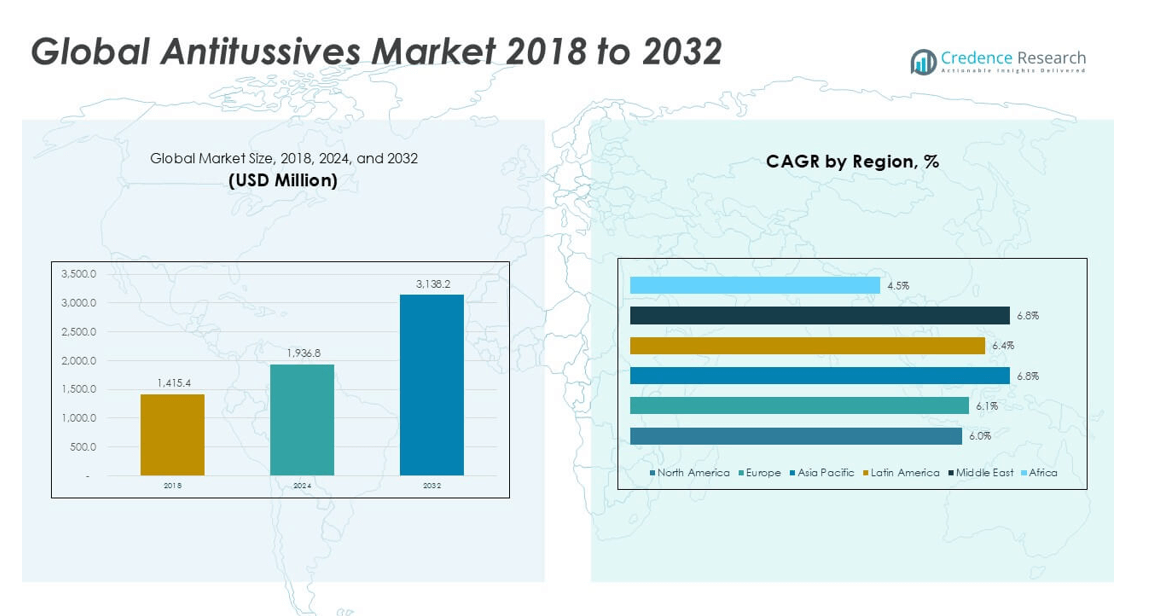
Global Antitussives market size was valued at USD 1,415.4 million in 2018 to USD 1,936.8 million in 2024 and is anticipated to reach USD 3,138.2 million by 2032, at a CAGR of 6.29% during the forecast period.

REPORT ATTRIBUTE DETAILS
Historical Period 2020-2023
Base Year 2024
Forecast Period 2025-2032
Antitussives Market Size 2024 USD 1,936.8 million
Antitussives Market , CAGR 6.29%
Antitussives Market Size 2032  USD 3,138.2 million


The Global Antitussives market is led by major pharmaceutical companies with strong brand portfolios. Johnson & Johnson, Pfizer, Novartis, AstraZeneca, and Merck & Co. hold strong positions through OTC and prescription products. Cipla, Alkem Laboratories, Glenmark Pharmaceuticals, Zydus Cadila, and Biophar Lifesciences strengthen competition in cost-sensitive markets. North America leads the market with an exact share of 34.1%, supported by high OTC usage and retail pharmacy reach. Europe follows with a 26.7% share, driven by strong healthcare systems. Asia Pacific accounts for 23.2% share, supported by population scale and rising access. These regions shape global revenue leadership.

Antitussives Market size

Market Insights

  • Global Antitussives market reached USD 1,936.8 million in 2024 and is projected to grow at a CAGR of 6.29% through 2032, supported by steady cough treatment demand across OTC and prescription channels.
  • Rising respiratory infections, pollution exposure, smoking habits, and chronic conditions drive sustained antitussive use, with OTC products supporting self-medication and faster symptom relief across adult and pediatric populations.
  • Non-narcotic drugs gain traction due to safety preference, while dextromethorphan remains the leading segment by share, supported by wide OTC availability and strong consumer familiarity.
  • Competition remains intense, led by Johnson & Johnson, Pfizer, Novartis, and AstraZeneca, while Cipla, Alkem, Glenmark, and Zydus Cadila strengthen presence in generic and emerging markets.
  • North America leads with about 34.1% share, followed by Europe at 26.7% and Asia Pacific at 23.2%, supported by retail pharmacy dominance and expanding healthcare access.

Access crucial information at unmatched prices!

Request your sample report today & start making informed decisions powered by Credence Research Inc.!

Download Sample

Market Segmentation Analysis:

By Drug Class

The Global Antitussives market shows clear dominance of the narcotic drug class. Narcotic antitussives hold the largest market share, driven by strong cough suppression efficacy. Dextromethorphan leads this segment, accounting for the highest share due to wide OTC use. Codeine and hydrocodone maintain demand in prescription settings for severe cough. Noscapine gains traction in markets favoring non-opioid narcotics. Non-narcotic drugs show steady growth, led by benzonatate. Demand rises from safety concerns, regulatory scrutiny on opioids, and preference for lower abuse potential therapies.

  • For instance, the U.S. FDA approves dextromethorphan for OTC use at single doses up to 30 mg, while benzonatate capsules are prescribed at 100 mg or 200 mg per dose for cough suppression.

By Sales Channel

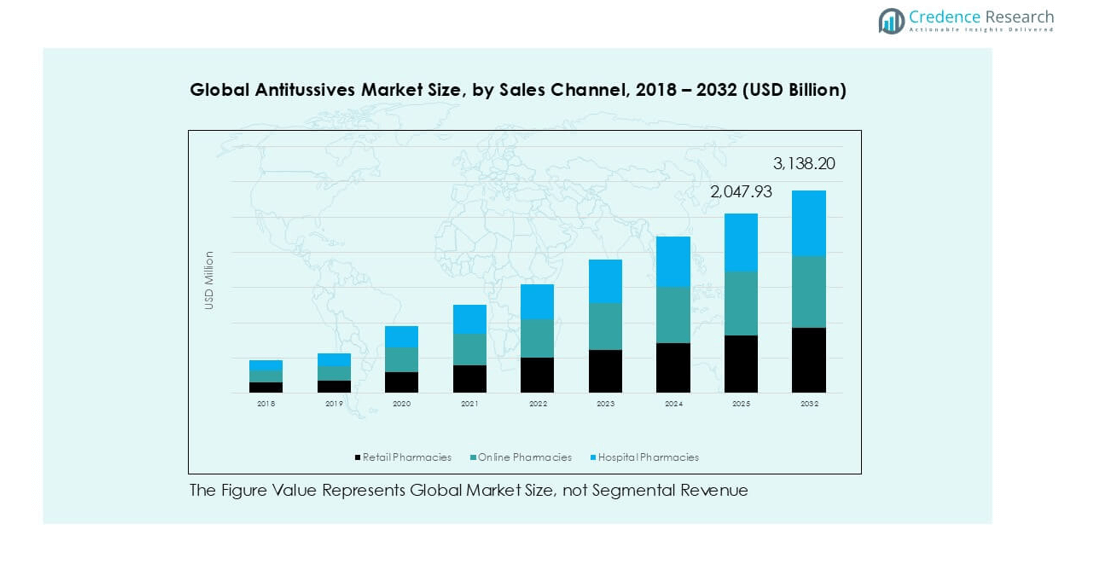
Retail pharmacies dominate the Global Antitussives market by sales channel, holding the largest revenue share. Easy access, pharmacist guidance, and strong OTC availability drive this dominance. High consumer footfall supports repeat purchases during seasonal cough outbreaks. Online pharmacies show rapid growth due to home delivery and price discounts. Digital prescriptions also support online sales. Hospital pharmacies serve acute and prescription-heavy treatments, including narcotic antitussives. Growth drivers include rising respiratory infections, self-medication trends, expanding pharmacy networks, and improved distribution efficiency across urban and semi-urban regions.

  • For instance, Walgreens operates approximately 8,500 retail pharmacy locations in the United States, stocking multiple over-the-counter (OTC) antitussive brands. Similarly, CVS Health operates over 9,000 pharmacy outlets, dispensing a full range of medications, including both OTC antitussives and prescription-strength, and sometimes narcotic, antitussives.

Key Growth Drivers

Rising Prevalence of Respiratory Infections and Chronic Cough Conditions

Respiratory infections remain common across all age groups worldwide. Seasonal flu, colds, and bronchitis increase cough incidence. Urban pollution worsens airway irritation and cough frequency. Smoking and passive smoke exposure add long-term respiratory stress. Chronic diseases such as asthma and COPD raise persistent cough cases. Aging populations show higher vulnerability to respiratory illnesses. The Global Antitussives market benefits from this sustained clinical need. Physicians prescribe antitussives to improve patient comfort and sleep quality. OTC antitussives support early symptom control. Public awareness of cough management continues to rise. Healthcare visits for respiratory symptoms remain high. This driver supports stable demand across acute and chronic care settings.

  • For instance, the World Health Organization reports around 262 million people living with asthma globally, while chronic obstructive pulmonary disease affects over 300 million patients, both conditions often requiring cough management therapies.

Strong Demand for Over-the-Counter Cough Medications

Consumers prefer quick relief for mild to moderate cough symptoms. OTC antitussives enable self-care without physician visits. Retail pharmacies promote easy access to cough syrups and tablets. Brand familiarity influences repeat purchases. Pediatric and adult formulations expand consumer choice. The Global Antitussives market gains from high-volume OTC sales. Dextromethorphan-based products dominate shelves globally. Non-prescription availability improves treatment adherence. Busy lifestyles support self-medication trends. Packaging innovation improves dosing accuracy. Marketing campaigns educate consumers on symptom relief. This driver strengthens steady sales across urban and rural markets.

  • For instance, Johnson & Johnson’s Benylin and GSK’s Robitussin product lines distribute millions of cough syrup bottles annually across global retail markets, with standard pack sizes ranging from 100 mL to 250 mL to support short-term home treatment needs.

Expansion of Healthcare Access and Pharmacy Networks

Healthcare infrastructure continues to expand in emerging economies. Governments invest in primary care and retail pharmacy coverage. Rural access improves through chain pharmacies and digital platforms. Hospital networks increase outpatient treatment capacity. The Global Antitussives market benefits from broader drug availability. Prescription fulfillment rates improve across regions. Pharmacist-led counseling supports appropriate product selection. Supply chain efficiency reduces stock shortages. Insurance coverage increases access to prescription antitussives. This driver supports consistent volume growth. Improved distribution channels enhance market penetration. Healthcare modernization sustains long-term demand stability.

Antitussives Market share

Key Trends & Opportunities

Shift Toward Non-Narcotic and Safer Cough Therapies

Safety concerns influence antitussive prescribing behavior. Regulators tighten controls on opioid-based cough medicines. Physicians prefer non-narcotic alternatives for routine treatment. Benzonatate and pipazethate gain clinical acceptance. The Global Antitussives market reflects this safety-driven shift. Parents favor non-opioid products for pediatric use. Abuse risk awareness affects prescribing decisions. Manufacturers invest in reformulation and safety labeling. This trend creates opportunities for safer drug development. Non-narcotic portfolios support long-term growth. Regulatory alignment improves market confidence.

  • For instance, benzonatate is prescribed in capsule strengths of 100 mg and 200 mg, while the U.S. FDA mandates boxed warnings for codeine cough products, restricting use in children under 18 years.

Growth of Online Pharmacies and Digital Health Platforms

Digital health adoption reshapes medicine purchasing behavior. Online pharmacies expand rapidly across developed and emerging markets. Home delivery improves convenience for cough treatment. The Global Antitussives market benefits from digital sales channels. E-prescriptions support compliant narcotic dispensing online. Price transparency attracts cost-sensitive consumers. Subscription models encourage repeat purchases. Telemedicine increases early cough diagnosis. This trend opens new revenue channels. Data analytics improve inventory planning. Digital platforms strengthen patient engagement and access.

Key Challenges

Regulatory Restrictions on Narcotic Antitussives

Strict regulations limit opioid-based cough drug usage. Authorities impose tighter prescription controls. Compliance costs increase for manufacturers. The Global Antitussives market faces reduced narcotic volumes. Physician hesitation affects prescribing rates. Monitoring requirements raise operational complexity. Some markets restrict pediatric use completely. This challenge pressures traditional product portfolios. Companies must adapt with safer alternatives. Regulatory delays impact product launches. Market players face uneven regional policies.

Risk of Misuse and Public Safety Concerns

Misuse of cough syrups raises public health concerns. Recreational abuse attracts regulatory attention. Public campaigns warn against improper consumption. The Global Antitussives market faces reputational risks. Retailers enforce stricter sales monitoring. Prescription verification becomes mandatory in many regions. Youth misuse concerns affect brand perception. Manufacturers invest in abuse-deterrent formulations. This challenge increases development costs. Balancing access and control remains complex. Long-term trust depends on responsible market practices.

Regional Analysis

North America

North America held the largest share of the Global Antitussives market in 2018. The region accounted for about 34.1% market share, valued at USD 482.95 million. High respiratory infection incidence supports demand. Strong OTC product penetration drives volume sales. Retail pharmacy dominance improves accessibility. Physicians widely prescribe antitussives for chronic cough. In 2024, the market reached USD 649.72 million. It is projected to reach USD 1,028.70 million by 2032. The region is expected to grow at a CAGR of 6.0%. Product innovation and brand loyalty support sustained growth.

Europe

Europe represented around 26.7% of the Global Antitussives market in 2018. Market size reached USD 378.35 million during that year. Strong public healthcare systems support treatment access. High awareness of cough management sustains steady demand. Non-narcotic antitussives gain preference due to safety focus. In 2024, the market expanded to USD 512.48 million. It is forecast to reach USD 819.07 million by 2032. Europe is projected to grow at a CAGR of 6.1%. Aging populations and seasonal respiratory infections remain key growth drivers across major countries.

Asia Pacific

Asia Pacific accounted for nearly 23.2% market share in 2018. The regional market was valued at USD 328.67 million. Large population bases drive high cough incidence volumes. Rapid urbanization increases pollution-related respiratory conditions. OTC drug usage remains strong in developing economies. The market reached USD 464.50 million in 2024. It is expected to reach USD 784.55 million by 2032. Asia Pacific shows a CAGR of 6.8%, the highest among regions. Expanding pharmacy networks and rising healthcare spending continue to support long-term growth momentum.

Latin America

Latin America held about 10.2% of the Global Antitussives market in 2018. The market size stood at USD 144.38 million. Respiratory infections remain common across urban centers. Retail pharmacies act as primary distribution points. Self-medication trends support OTC antitussive demand. In 2024, the market reached USD 198.72 million. It is projected to grow to USD 324.49 million by 2032. The region is expected to record a CAGR of 6.4%. Improving healthcare access and rising awareness support steady regional expansion.

Middle East

The Middle East accounted for roughly 4.3% market share in 2018. Market size reached USD 61.43 million during that year. Hot climate conditions increase respiratory irritation cases. Urban pollution supports cough treatment demand. Hospital pharmacies play a key distribution role. The market expanded to USD 86.80 million in 2024. It is forecast to reach USD 146.55 million by 2032. The region is projected to grow at a CAGR of 6.8%. Healthcare infrastructure investments and pharmacy expansion support consistent market development.

Africa

Africa held a smaller share of the Global Antitussives market in 2018. The region accounted for around 1.4% market share, valued at USD 19.67 million. Limited healthcare access restricts treatment penetration. Respiratory infections remain underdiagnosed in rural areas. OTC products dominate urban demand. The market reached USD 24.60 million in 2024. It is expected to reach USD 34.83 million by 2032. Africa is projected to grow at a CAGR of 4.5%. Public health programs and pharmacy expansion gradually support market growth.

Antitussives Market segmentation

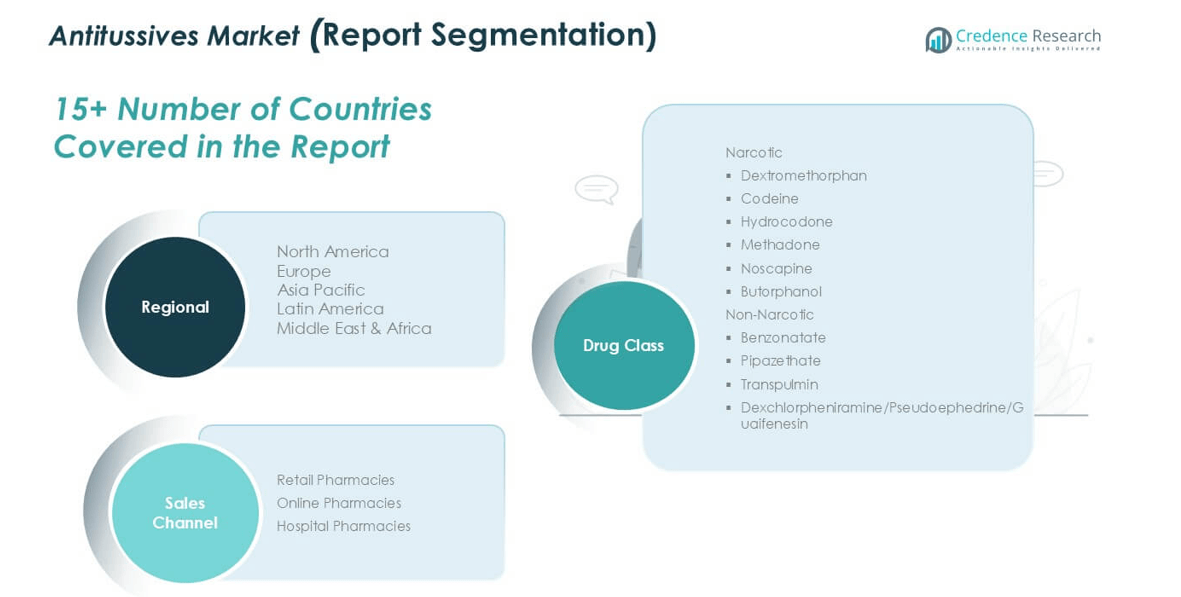
Market Segmentations:

By Drug Class

  • Narcotic
    • Dextromethorphan
    • Codeine
    • Hydrocodone
    • Methadone
    • Noscapine
    • Butorphanol
  • Non-Narcotic
    • Benzonatate
    • Pipazethate
    • Transpulmin

By Sales Channel

  • Retail Pharmacies
  • Online Pharmacies
  • Hospital Pharmacies

By Geography

  • North America
    • U.S.
    • Canada
    • Mexico
  • Europe
    • Germany
    • France
    • U.K.
    • Italy
    • Spain
    • Rest of Europe
  • Asia Pacific
    • China
    • Japan
    • India
    • South Korea
    • South-east Asia
    • Rest of Asia Pacific
  • Latin America
    • Brazil
    • Argentina
    • Rest of Latin America
  • Middle East & Africa
    • GCC Countries
    • South Africa
    • Rest of the Middle East and Africa

Competitive Landscape

The Global Antitussives market features strong competition among multinational and regional pharmaceutical companies. Leading players focus on broad OTC and prescription portfolios. Companies such as Johnson & Johnson, Pfizer, Novartis, and AstraZeneca leverage strong brand recognition. These firms maintain wide retail and hospital distribution networks. Generic manufacturers such as Cipla, Alkem Laboratories, Glenmark Pharmaceuticals, and Zydus Cadila compete on cost efficiency. Product differentiation centers on formulation safety and taste. Non-narcotic antitussives gain higher focus due to regulatory pressure. Companies invest in pediatric-friendly syrups and dosage formats. Strategic partnerships support market expansion. Mergers and licensing agreements strengthen regional presence. Continuous product launches improve shelf visibility. Competitive intensity remains high due to price sensitivity. Regulatory compliance and supply reliability shape long-term positioning.

Shape Your Report to Specific Countries or Regions & Enjoy 30% Off!

Key Player Analysis

  • Biophar Lifesciences
  • AstraZeneca
  • Alkem Laboratories
  • Cipla Ltd
  • Glenmark Pharmaceuticals
  • Johnson & Johnson Services Inc.
  • Merck & Co.
  • Novartis AG
  • Pfizer, Inc.
  • Zydus Cadila

Recent Developments

  • In November 2024, Pfizer Inc. entered a strategic collaboration with Zai Lab for the novel antibacterial drug XACDURO® (sulbactam-durlobactam) in mainland China, where Pfizer’s affiliates gained exclusive rights to commercialization activities through November 2028, aiming to accelerate patient access using Pfizer’s anti-infective infrastructure.
  • In May 2023, the Indian government initiated a new rule to ensure that cough syrups exported from the country are safe for consumption. The new rule that has been set in since 1st June 2023 required cough syrup manufacturers to undergo product testing at specific government laboratories before they receive permits for exporting the products.
  • In 2023, GlaxoSmithKline plc (GSK) acquired Bellus Health for $2 billion to gain camlipixant, a Phase 3 P2X3 inhibitor for chronic cough as an antitussive rival to Merck’s gefapixant, with data expected in 2024-2025 and potential launch in 2026 offering better efficacy and tolerability

Report Coverage

The research report offers an in-depth analysis based on Drug Class, Sales Channel and Geography. It details leading market players, providing an overview of their business, product offerings, investments, revenue streams, and key applications. Additionally, the report includes insights into the competitive environment, SWOT analysis, current market trends, as well as the primary drivers and constraints. Furthermore, it discusses various factors that have driven market expansion in recent years. The report also explores market dynamics, regulatory scenarios, and technological advancements that are shaping the industry. It assesses the impact of external factors and global economic changes on market growth. Lastly, it provides strategic recommendations for new entrants and established companies to navigate the complexities of the market.

Future Outlook

  1. Demand will remain steady due to recurring respiratory infections and seasonal cough conditions.
  2. Non-narcotic antitussives will gain wider acceptance due to safety and regulatory preference.
  3. OTC products will continue to dominate volume sales across retail pharmacies.
  4. Online pharmacy channels will expand through digital prescriptions and home delivery.
  5. Pediatric-friendly formulations will support long-term consumer adoption.
  6. Emerging markets will show faster growth due to healthcare access expansion.
  7. Product reformulation will focus on taste, dosing accuracy, and safety profiles.
  8. Regulatory oversight will shape portfolio strategies for narcotic drugs.
  9. Brand trust and pharmacist recommendations will influence purchase decisions.
  10. Competitive intensity will remain high due to generic competition and pricing pressure.

CHAPTER NO. 1 : GENESIS OF THE MARKET    

1.1 Market Prelude – Introduction & Scope

1.2 The Big Picture – Objectives & Vision

1.3 Strategic Edge – Unique Value Proposition

1.4 Stakeholder Compass – Key Beneficiaries

CHAPTER NO. 2 : EXECUTIVE LENS

2.1 Pulse of the Industry – Market Snapshot

2.2 Growth Arc – Revenue Projections (USD Million)

2.3. Premium Insights – Based on Primary Interviews

CHAPTER NO. 3 : ANTITUSSIVES MARKET FORCES & INDUSTRY PULSE   

3.1 Foundations of Change – Market Overview
3.2 Catalysts of Expansion – Key Market Drivers
3.2.1 Momentum Boosters – Growth Triggers
3.2.2 Innovation Fuel – Disruptive Technologies
3.3 Headwinds & Crosswinds – Market Restraints
3.3.1 Regulatory Tides – Compliance Challenges
3.3.2 Economic Frictions – Inflationary Pressures
3.4 Untapped Horizons – Growth Potential & Opportunities
3.5 Strategic Navigation – Industry Frameworks
3.5.1 Market Equilibrium – Porter’s Five Forces
3.5.2 Ecosystem Dynamics – Value Chain Analysis
3.5.3 Macro Forces – PESTEL Breakdown

CHAPTER NO. 4 :      KEY INVESTMENT EPICENTER    

4.1 Regional Goldmines – High-Growth Geographies

4.2 Product Frontiers – Lucrative Drug Class Categories

4.3 Sales Channel Sweet Spots – Emerging Demand Segments

CHAPTER NO. 5: REVENUE TRAJECTORY & WEALTH MAPPING

5.1 Momentum Metrics – Forecast & Growth Curves

5.2 Regional Revenue Footprint – Market Share Insights

5.3 Segmental Wealth Flow – Drug Class & Sales Channel Revenue

CHAPTER NO. 6 : TRADE & COMMERCE ANALYSIS    

6.1.      Import Analysis By Region

6.1.1.    Global Antitussives Market Import Revenue By Region

6.2.      Export Analysis By Region

6.2.1.    Global Antitussives Market Export Revenue By Region

CHAPTER NO. 7 : COMPETITION ANALYSIS      

7.1.      Company Market Share Analysis

7.1.1.    Global Antitussives Market: Company Market Share

7.2.      Global Antitussives Market Company Revenue Market Share

7.3.      Strategic Developments

7.3.1.    Acquisitions & Mergers

7.3.2.    New Product Launch

7.3.3.    Regional Expansion

7.4.      Competitive Dashboard

7.5.      Company Assessment Metrics, 2024

CHAPTER NO. 8 : ANTITUSSIVES MARKET – BY DRUG CLASS SEGMENT ANALYSIS

8.1.      Antitussives Market Overview By Drug Class Segment

8.1.1.    Antitussives Market Revenue Share By Drug Class

8.2.      Narcotic

8.2.1.   Dextromethorphan

8.2.2.   Codeine

8.2.3.   Hydrocodone

8.2.4.   Methadone

8.2.5.   Noscapine

8.2.6.   Butorphanol

8.3.      Non-Narcotic

8.3.1.  Benzonatate

8.3.2.  Pipazethate

8.3.3.  Transpulmin

CHAPTER NO. 9 : ANTITUSSIVES MARKET – BY SALES CHANNEL SEGMENT ANALYSIS

9.1.      Antitussives Market Overview By Sales Channel Segment

9.1.1.    Antitussives Market Revenue Share By Sales Channel

9.2.      Retail Pharmacies

9.3.      Online Pharmacies

9.4.      Hospital Pharmacies

CHAPTER NO. 10 : ANTITUSSIVES MARKET – REGIONAL ANALYSIS           

10.1.     Antitussives Market Overview By Region Segment

10.1.1.  Global Antitussives Market Revenue Share By Region

10.1.2.  Regions

10.1.3.  Global Antitussives Market Revenue By Region

10.1.4.  Drug Class

10.1.5.  Global Antitussives Market Revenue By Drug Class

10.1.6.  Sales Channel

10.1.7. Global Antitussives Market Revenue By Sales Channel

CHAPTER NO. 11 : NORTH AMERICA ANTITUSSIVES MARKET – COUNTRY ANALYSIS

11.1.     North America Antitussives Market Overview By Country Segment

11.1.1.  North America Antitussives Market Revenue Share By Region

11.2.     North America

11.2.1.  North America Antitussives Market Revenue By Country

11.2.2.  Drug Class

11.2.3.  North America Antitussives Market Revenue By Drug Class

11.2.4.  Sales Channel

11.2.5.  North America Antitussives Market Revenue By Sales Channel

11.3.     U.S.

11.4.     Canada

11.5.     Mexico

CHAPTER NO. 12 : EUROPE ANTITUSSIVES MARKET – COUNTRY ANALYSIS

12.1.     Europe Antitussives Market Overview By Country Segment

12.1.1.  Europe Antitussives Market Revenue Share By Region

12.2.     Europe

12.2.1.  Europe Antitussives Market Revenue By Country

12.2.2.  Drug Class

12.2.3.  Europe Antitussives Market Revenue By Drug Class

12.2.4.  Sales Channel

12.2.5.  Europe Antitussives Market Revenue By Sales Channel

12.3.     UK

12.4.     France

12.5.     Germany

12.6.     Italy

12.7.     Spain

12.8.     Russia

12.9.   Rest of Europe

CHAPTER NO. 13 : ASIA PACIFIC ANTITUSSIVES MARKET – COUNTRY ANALYSIS

13.1.     Asia Pacific Antitussives Market Overview By Country Segment

13.1.1.  Asia Pacific Antitussives Market Revenue Share By Region

13.2.     Asia Pacific

13.2.1.  Asia Pacific Antitussives Market Revenue By Country

13.2.2.  Drug Class

13.2.3.  Asia Pacific Antitussives Market Revenue By Drug Class

13.2.4.  Sales Channel

13.2.5.  Asia Pacific Antitussives Market Revenue By Sales Channel

13.3.     China

13.4.     Japan

13.5.     South Korea

13.6.     India

13.7.     Australia

13.8.     Southeast Asia

13.9.     Rest of Asia Pacific

CHAPTER NO. 14 : LATIN AMERICA ANTITUSSIVES MARKET – COUNTRY ANALYSIS

14.1.     Latin America Antitussives Market Overview By Country Segment

14.1.1.  Latin America Antitussives Market Revenue Share By Region

14.2.     Latin America

14.2.1.  Latin America Antitussives Market Revenue By Country

14.2.2.  Drug Class

14.2.3.  Latin America Antitussives Market Revenue By Drug Class

14.2.4.  Sales Channel

14.2.5.  Latin America Antitussives Market Revenue By Sales Channel

14.3.     Brazil

14.4.     Argentina

14.5.     Rest of Latin America

CHAPTER NO. 15 : MIDDLE EAST ANTITUSSIVES MARKET – COUNTRY ANALYSIS

15.1.     Middle East Antitussives Market Overview By Country Segment

15.1.1.  Middle East Antitussives Market Revenue Share By Region

15.2.     Middle East

15.2.1.  Middle East Antitussives Market Revenue By Country

15.2.2.  Drug Class

15.2.3.  Middle East Antitussives Market Revenue By Drug Class

15.2.4.  Sales Channel

15.2.5.  Middle East Antitussives Market Revenue By Sales Channel

15.3.     GCC Countries

15.4.     Israel

15.5.     Turkey

15.6.     Rest of Middle East

CHAPTER NO. 16 : AFRICA ANTITUSSIVES MARKET – COUNTRY ANALYSIS

16.1.     Africa Antitussives Market Overview By Country Segment

16.1.1.  Africa Antitussives Market Revenue Share By Region

16.2.     Africa

16.2.1.  Africa Antitussives Market Revenue By Country

16.2.2.  Drug Class

16.2.3.  Africa Antitussives Market Revenue By Drug Class

16.2.4.  Sales Channel

16.2.5.  Africa Antitussives Market Revenue By Sales Channel

16.3.     South Africa

16.4.     Egypt

16.5.     Rest of Africa

CHAPTER NO. 17 : COMPANY PROFILES

17.1.     Biophar Lifesciences

17.1.2.  Product Portfolio

17.1.3.  Financial Overview

17.1.4.  Recent Developments

17.1.5.  Growth Strategy

17.1.6.  SWOT Analysis

17.2.    AstraZeneca

17.3.    Alkem Laboratories

17.4.    Cipla Ltd

17.5.    Glenmark Pharmaceuticals

17.6.    Johnson & Johnson Services Inc.

17.7.    Merck & Co.

17.8.    Novartis AG

17.9.    Pfizer, Inc.

17.10.  Zydus Cadila

17.11.  Other Key Players

Request Free Sample

We prioritize the confidentiality and security of your data. Our promise: your information remains private.

Ready to Transform Data into Decisions?

Request Your Sample Report and Start Your Journey of Informed Choices


Providing the strategic compass for industry titans.

cr-clients-logos

Frequently Asked Question:

What is the current market size for the Antitussives Market, and what is its projected size in 2032?

The market was valued at USD 1,936.8 million in 2024 and is projected to reach USD 3,138.2 million by 2032.

At what Compound Annual Growth Rate is the Antitussives Market projected to grow between 2025 and 2032?

The market is projected to grow at a CAGR of 6.29% during the forecast period.

Which Antitussives Market segment held the largest share in 2024?

The OTC segment held the largest share due to strong availability and high consumer preference for quick, accessible cough relief. Syrups also gained wide traction among pediatric and adult users. Rising awareness and retail reach supported stronger adoption across core markets.

Who are the leading companies in the Antitussives Market?

Key players include major pharmaceutical companies with strong global distribution. Their focus on advanced formulations and broader retail penetration supports demand. These firms expand production to meet rising respiratory burdens across urban clusters.

Who are the major players in this market?

AstraZeneca, Alkem Laboratories, Cipla, Glenmark Pharmaceuticals, Johnson & Johnson, Merck & Co., Novartis AG, Pfizer, Inc., Toray Industries. are some of the major players in the global market.

About Author

Shweta Bisht

Shweta Bisht

Healthcare & Biotech Analyst

Shweta is a healthcare and biotech researcher with strong analytical skills in chemical and agri domains.

View Profile


Related Reports

Ophthalmic Combination Product Market

The Ophthalmic combination product market is projected to grow from USD 12,893 million in 2024 to USD 22,152.2 million by 2032. The market is expected to expand at a CAGR of 7% from 2024 to 2032.

Immune Checkpoint Inhibitors Market

The Immune Checkpoint Inhibitors Market is projected to grow from USD 49,490 million in 2024 to USD 143,166.7 million by 2032. The market will expand at a CAGR of 14.2% from 2024 to 2032.

Pharmaceutical Contract Packaging Market

The Global Pharmaceutical Contract Packaging Market size was valued at USD 23,220.90 million in 2018 to USD 32,946.20 million in 2024 and is anticipated to reach USD 52,165.40 million by 2032, at a CAGR of 5.92% during the forecast period.

Gastric Motility Disorder Drugs Market

Gastric Motility Disorder Drugs Market size was valued at USD 57,750 Million in 2024 and is anticipated to reach USD 87,957.59 Million by 2032, at a CAGR of 5.4% during the forecast period.

Clostridium Difficile Infection (CDI) Treatment Market

Clostridium Difficile Infection (CDI) Treatment market size was valued at USD 1,230 million in 2024 and is anticipated to reach USD 1,944.9 million by 2032, expanding at a CAGR of 5.9% during the forecast period.

Glioblastoma Multiforme Market

The Glioblastoma Multiforme Market shows steady growth driven by unmet medical needs. The market stands at USD 2,770 million in 2024. It is projected to reach USD 5,518.4 million by 2032, growing at a CAGR of 9% during the forecast period.

Tracheitis Treatment Market

Tracheitis Treatment Market size was valued USD 5,736 million in 2024 and is anticipated to reach USD 7,552.67 million by 2032, at a CAGR of 3.5% during the forecast period.

Tamoxifen Market

Tamoxifen Market size was valued at USD 659 Million in 2024 and is anticipated to reach USD 713.06 Million by 2032, at a CAGR of 1% during the forecast period.

Sphingosine-1-Receptor Modulators Drugs Market

Sphingosine-1-Receptor Modulators Drugs Market size was valued at USD 5,650 million in 2024 and is anticipated to reach USD 11,011.52 million by 2032, growing at a CAGR of 8.7% during the forecast period.

Naloxone Market

The global naloxone market was valued at USD 1,020.32 million in 2024 and is projected to reach USD 2,334.48 million by 2032, reflecting a compound annual growth rate (CAGR) of 10.9% over the forecast period.

Neuromyelitis Optica Therapy Market

Neuromyelitis Optica Therapy Market size was valued USD 549 million in 2024 and is anticipated to reach USD 1291.75 million by 2032, at a CAGR of 11.3% during the forecast period.

North America Iron Supplements Market

North America Iron Supplements Market size was valued USD 912 million in 2024 and is anticipated to reach USD 1482.17 million by 2032, at a CAGR of 6.26% during the forecast period.

Licence Option

The report comes as a view-only PDF document, optimized for individual clients. This version is recommended for personal digital use and does not allow printing. Use restricted to one purchaser only.
$4999

To meet the needs of modern corporate teams, our report comes in two formats: a printable PDF and a data-rich Excel sheet. This package is optimized for internal analysis. Unlimited users allowed within one corporate location (e.g., regional office).
$6999

The report will be delivered in printable PDF format along with the report’s data Excel sheet. This license offers 100 Free Analyst hours where the client can utilize Credence Research Inc. research team. Permitted for unlimited global use by all users within the purchasing corporation, such as all employees of a single company.
$12999

Report delivery within 24 to 48 hours

Europe

North America

Email

Smallform of Sample request
User Review

Thank you for the data! The numbers are exactly what we asked for and what we need to build our business case.

Materials Scientist
(privacy requested)

User Review

The report was an excellent overview of the Industrial Burners market. This report does a great job of breaking everything down into manageable chunks.

Imre Hof
Management Assistant, Bekaert

cr-clients-logos

Request Sample