
| REPORT ATTRIBUTE | DETAILS |
|---|---|
| Historical Period | 2019-2022 |
| Base Year | 2023 |
| Forecast Period | 2024-2032 |
| Brilliant Blue FCF Colors Market Size 2024 | USD 93.8 million |
| Brilliant Blue FCF Colors Market, CAGR | 5.1% |
| Brilliant Blue FCF Colors Market Size 2032 | USD 139.64 million |
Market Overview:
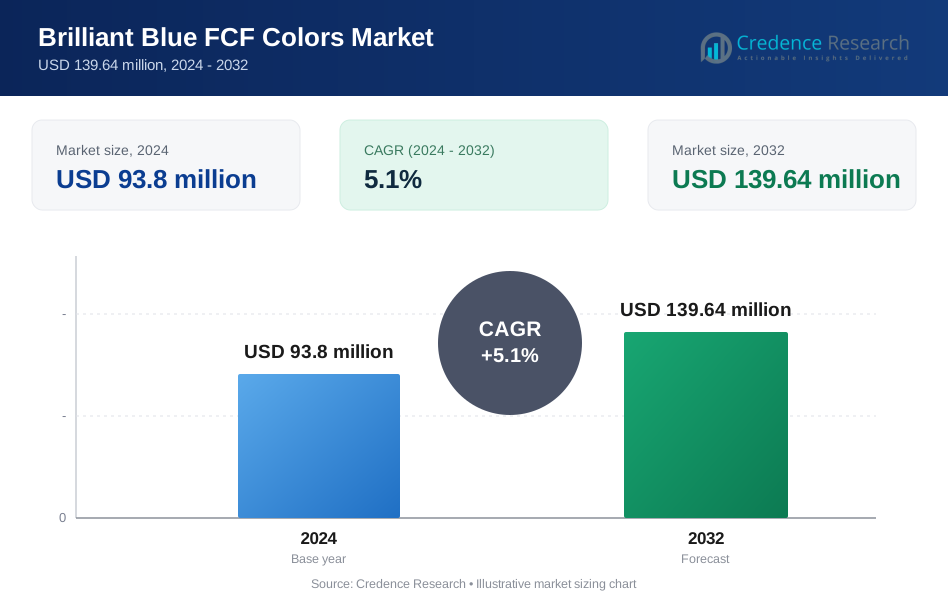
The Brilliant Blue FCF Colors Market size was valued at USD 93.8 million in 2024 and is anticipated to reach USD 139.64 million by 2032, at a CAGR of 5.1% during the forecast period (2024-2032).
The market growth is primarily driven by expanding applications in food and beverage products, including confectionery, dairy, beverages, and processed foods. The increasing consumption of packaged and ready-to-eat foods is further boosting demand. Moreover, the pharmaceutical and personal care industries are leveraging Brilliant Blue FCF for its stability and aesthetic appeal in formulations. Regulatory bodies such as the FDA and EFSA have approved its usage within permissible limits, ensuring market sustainability. Additionally, rising disposable income and urbanization are contributing to increased demand for processed foods with enhanced visual appeal. The ongoing shift toward plant-based and alternative food products has also resulted in growing demand for synthetic colorants to maintain product attractiveness. However, concerns regarding synthetic dyes and a rising inclination toward natural alternatives may pose challenges to market growth.
Regionally, North America and Europe hold a substantial share due to established food and pharmaceutical industries and stringent regulatory compliance regarding food additives. The Asia-Pacific region is expected to witness the fastest growth, attributed to the rising food processing sector, increasing urbanization, and changing dietary habits in countries such as China, India, and Japan. Additionally, Latin America and the Middle East and Africa are experiencing steady market penetration due to expanding food manufacturing and increasing awareness of food quality standards. The increasing presence of multinational food and beverage companies in emerging economies is driving regional demand. Government initiatives supporting the growth of the food and pharmaceutical industries in developing countries are further fueling market expansion. Furthermore, improvements in supply chain logistics and e-commerce platforms are enhancing product availability across different regions.
Market Insights:
- The Brilliant Blue FCF Colors Market was valued at USD 93.8 million in 2024 and is projected to reach USD 139.64 million by 2032, growing at a CAGR of 5.1% during the forecast period.
- The market is driven by its expanding applications in food and beverages, especially in confectionery, dairy, beverages, and processed foods, as demand for packaged and ready-to-eat products continues to rise.
- The pharmaceutical and personal care industries are witnessing increased usage of Brilliant Blue FCF due to its stability, solubility, and aesthetic appeal, making it a preferred choice in tablets, liquid medications, shampoos, and skincare products.
- Regulatory bodies such as the FDA and EFSA have approved its use within permissible limits, ensuring its continued adoption in global markets while maintaining strict safety standards.
- North America and Europe dominate the market, accounting for a combined 55% share, while Asia-Pacific leads in growth due to increasing food processing activities and rising urbanization.
- Challenges such as regulatory restrictions and the shift toward natural alternatives are pushing manufacturers to develop high-purity formulations and hybrid solutions to meet consumer preferences.
- E-commerce expansion and supply chain advancements are improving market accessibility, allowing manufacturers to reach a broader customer base and drive regional market penetration.
Market Drivers:
Growing Demand in the Food and Beverage Industry:
The increasing use of Brilliant Blue FCF in food and beverage products is a major driver of market growth. Manufacturers are incorporating synthetic colorants to enhance the visual appeal of confectionery, dairy, beverages, and processed foods. For instance, a survey conducted by the Food Safety and Standards Authority of India (FSSAI) found that Brilliant Blue FCF is widely used in products such as cotton candy, ice cream, and bottled food colorings. The rising consumption of packaged and convenience foods, along with changing consumer preferences for vibrant and visually appealing products, is accelerating demand. Advancements in food processing technologies are further ensuring the stability and consistency of synthetic color integration.
Regulatory Approvals and Industry Compliance:
Regulatory approvals from organizations such as the FDA and EFSA are reinforcing the credibility of Brilliant Blue FCF in the market. Compliance with stringent food safety and quality regulations ensures continued usage in multiple applications. For instance, the European Food Safety Authority (EFSA) has established an Acceptable Daily Intake (ADI) for Brilliant Blue FCF, providing guidelines for its safe use in food products. Increasing scrutiny of synthetic additives has led to the development of high-purity formulations, improving safety and consumer confidence. Additionally, global standardization of synthetic color usage is streamlining trade and expanding market opportunities.
Expansion in the Pharmaceutical and Cosmetics Sectors:
Brilliant Blue FCF is widely used in pharmaceutical and personal care applications due to its stability and aesthetic appeal. The pharmaceutical industry incorporates it in tablet coatings, capsules, and liquid medications for product differentiation and patient compliance. For instance, a study published in the Journal of Pharmaceutical Sciences by researchers at Pfizer found that Brilliant Blue FCF significantly improved the visual identification of their pediatric antibiotic formulations, leading to better patient adherence. The cosmetics sector also utilizes synthetic colors in shampoos, soaps, and skincare products to enhance visual appeal. Increasing investments in product innovation across these industries are further supporting market expansion.
Increasing Urbanization and Consumer Preferences:
Rapid urbanization and evolving consumer lifestyles are driving the demand for processed and ready-to-eat foods. The foodservice industry, including quick-service restaurants and online food delivery platforms, is contributing to the increasing use of synthetic colorants. For instance, a study conducted by the National Restaurant Association of India (NRAI) revealed that urban consumers show a strong preference for visually appealing food items, often enhanced with food colorants like Brilliant Blue FCF. Growing disposable income levels in developing economies are also enabling consumers to opt for premium food products, boosting the adoption of Brilliant Blue FCF across various markets.
Market Trends:
Increasing Preference for Synthetic Food Colorants:
The demand for synthetic food colorants, including Brilliant Blue FCF, continues to rise due to their stability, cost-effectiveness, and vibrant color properties. Food and beverage manufacturers prefer synthetic alternatives over natural colorants as they provide consistent color quality and improved shelf life. For instance, according to the National Bureau of Statistics of China, in July 2023, 18.9 million metric tons of soft drinks were produced, highlighting the massive scale of industries requiring food coloring. The expansion of the processed food industry, particularly in developing economies, is further contributing to the increasing adoption of synthetic food dyes in a wide range of applications.
Growing Adoption in Pharmaceuticals and Personal Care:
Pharmaceutical and personal care industries are incorporating Brilliant Blue FCF in various formulations, including tablets, capsules, syrups, and cosmetic products. The colorant enhances product identification and visual appeal, which plays a crucial role in consumer purchasing decisions. For instance, BASF, Clariant, and Sensient Cosmetic Technologies are major players in the USA Brilliant Blue FCF colors market, utilizing the latest production technologies and efficient distribution networks. The rising focus on product differentiation in the pharmaceutical and cosmetics sectors is driving demand for synthetic colors, with companies investing in innovative formulations to enhance aesthetics and brand identity.
Expansion in Emerging Markets:
Emerging economies in Asia-Pacific, Latin America, and the Middle East are witnessing a surge in demand for Brilliant Blue FCF, driven by rapid urbanization and changing consumer preferences. The increasing consumption of packaged foods, beverages, and confectionery in these regions is fueling market growth. For instance, according to DEFRA data from 2021, the average purchase per person per week of cakes, buns, and pastries in the United Kingdom was 165 grams, an increase compared to the previous year at 158 grams. Additionally, multinational companies are expanding their presence in these markets, contributing to higher adoption rates of synthetic colorants.
Regulatory Developments and Quality Standards:
Regulatory bodies worldwide are continuously updating guidelines on synthetic food colorants, impacting market dynamics. While approvals from agencies such as the FDA and EFSA ensure market stability, ongoing research on synthetic dyes is leading to stricter quality control measures. For instance, the European Food Safety Authority (EFSA) has established an Acceptable Daily Intake (ADI) for Brilliant Blue FCF, providing guidelines for its safe use in food products. Companies are investing in high-purity formulations to comply with evolving regulations, ensuring safe usage while maintaining product appeal across various industries.
Market Challenges Analysis:
Regulatory Restrictions and Compliance Issues:
Stringent regulatory restrictions on synthetic food colorants pose a significant challenge to the Brilliant Blue FCF market. While agencies such as the FDA and EFSA have approved its usage within specific limits, ongoing scientific research on synthetic dyes has led to stricter regulations in some regions. Certain countries have imposed restrictions or additional labeling requirements, creating compliance hurdles for manufacturers. The growing focus on food safety and consumer health has intensified regulatory scrutiny, leading to higher testing standards and quality control measures. Adapting to evolving regulations while ensuring product consistency increases production costs and may impact market expansion. Additionally, frequent regulatory updates require continuous monitoring and reformulation efforts, adding complexity to market operations. Companies must invest in compliance strategies and advanced testing methods to meet global safety standards. The lack of uniform international regulations further complicates market entry, making it challenging for businesses to expand across multiple regions.
Shift Towards Natural Alternatives:
The rising consumer preference for natural and clean-label food products is challenging the demand for synthetic colorants, including Brilliant Blue FCF. Health-conscious consumers are increasingly opting for food and beverage products with plant-based or naturally derived colorants due to concerns over synthetic additives. The growing awareness of potential health risks associated with artificial dyes has prompted manufacturers to explore natural alternatives such as spirulina extract and butterfly pea flower. However, natural colorants often lack the stability and cost-effectiveness of synthetic dyes, making it difficult for companies to transition completely. The rising trend of organic and minimally processed foods is further pushing companies to reduce synthetic ingredient usage. As a result, manufacturers are focusing on research and innovation to develop hybrid formulations that balance cost, performance, and regulatory compliance. The challenge of maintaining product vibrancy and shelf life with natural alternatives continues to hinder a full transition, leading to a gradual rather than immediate market shift.
Market Opportunities:
The Brilliant Blue FCF colors market presents significant opportunities, particularly in the expanding food and beverage industry. The rising demand for processed and packaged foods, especially in emerging markets, is driving the need for synthetic colorants that offer stability and consistency. As consumer preferences shift toward visually appealing products, manufacturers are increasingly incorporating Brilliant Blue FCF in confectionery, beverages, dairy products, and snacks. The rapid growth of quick-service restaurants, online food delivery platforms, and bakery chains further supports market expansion. Additionally, advancements in formulation technologies are enhancing the solubility and heat resistance of synthetic colorants, enabling their use in a wider range of food applications. The expansion of retail chains and supermarkets in developing regions is also increasing the accessibility of colored food products, further fueling demand.
Beyond the food industry, Brilliant Blue FCF is witnessing growing adoption in pharmaceuticals and personal care products. Pharmaceutical companies are using synthetic colorants to enhance product differentiation and improve patient compliance in tablets, capsules, and liquid formulations. Similarly, the cosmetics and personal care sector is leveraging Brilliant Blue FCF in skincare, haircare, and hygiene products to enhance visual appeal. The increasing popularity of color cosmetics and premium skincare brands is creating additional growth opportunities. Moreover, ongoing research and development efforts are leading to the introduction of high-purity formulations that meet regulatory standards while maintaining performance. The expansion of the e-commerce sector is also enabling greater product reach, allowing manufacturers to tap into a broader consumer base and strengthen market presence.
Market Segmentation Analysis:
By Form
The Brilliant Blue FCF market is segmented based on form into powder, liquid, and gel. Powdered form is widely preferred due to its long shelf life, ease of handling, and stability in various applications. Liquid form is gaining traction in the food and beverage industry, particularly in beverages and dairy products, where quick solubility is essential. The gel form is primarily used in bakery, confectionery, and cosmetic applications, providing uniform color dispersion and enhanced visual appeal.
By Solubility
Based on solubility, the market is categorized into water-soluble and fat-soluble variants. Water-soluble Brilliant Blue FCF is the dominant segment, extensively used in beverages, pharmaceuticals, and processed foods due to its easy blending properties. Fat-soluble variants, though less common, are utilized in specific applications such as chocolate coatings and oil-based formulations where water solubility is not required. Increasing research efforts are focused on improving the solubility of synthetic colorants to expand their usability across different product categories.
By Application
The market finds applications across food and beverages, pharmaceuticals, and personal care industries. The food and beverage sector accounts for the largest share, with strong demand in confectionery, dairy, and packaged foods. Pharmaceuticals use Brilliant Blue FCF for tablet coatings and liquid medications to enhance product differentiation. In personal care, it is widely used in shampoos, soaps, and skincare products, contributing to product aesthetics and consumer appeal.
Segmentations:
By Form:
- Solid
- Powder
- Granulated
By Solubility:
- Lakes
- Dyes
By Application:
- Beverage
- Bakery, Snacks, and Cereals
- Meat, Poultry, Fish, and Eggs
- Potatoes, Pasta, and Rice
- Candy/Confectionery
- Dairy
- Fruit Preparations/ Fillings
- Sauces, Soups, and Dressings
- Seasonings
- Pet Food
- Others
By Region:
- North America
- U.S.
- Canada
- Mexico
- Europe
- Germany
- France
- U.K.
- Italy
- Spain
- Rest of Europe
- Asia Pacific
- China
- Japan
- India
- South Korea
- South-east Asia
- Rest of Asia Pacific
- Latin America
- Brazil
- Argentina
- Rest of Latin America
- Middle East & Africa
- GCC Countries
- South Africa
- Rest of the Middle East and Africa
Regional Analysis:
North America
North America holds a market share of 30%, driven by the strong presence of the food and beverage, pharmaceutical, and personal care industries. The demand for Brilliant Blue FCF in the region is supported by the widespread consumption of processed and packaged foods, where synthetic colorants play a crucial role in enhancing visual appeal. Regulatory approvals from agencies such as the FDA ensure the continued use of synthetic food dyes within permissible limits, providing stability to the market. The pharmaceutical sector in the United States and Canada extensively utilizes Brilliant Blue FCF in tablet coatings and liquid formulations to improve product differentiation. Additionally, the region's highly developed personal care industry, with a focus on innovative skincare and haircare products, further fuels market demand. The growing consumer preference for visually appealing and branded food products is expected to drive steady growth in the North American market.
Europe
Europe accounts for 25% of the Brilliant Blue FCF market, with demand driven by the well-established food processing and pharmaceutical industries. The European Food Safety Authority (EFSA) regulates the use of synthetic colorants, ensuring compliance with stringent safety standards. The region's high consumption of confectionery, bakery, and dairy products contributes significantly to the demand for Brilliant Blue FCF in food applications. Countries such as Germany, France, and the United Kingdom are major contributors to market growth, with increasing consumer awareness of product aesthetics influencing purchasing decisions. The pharmaceutical sector in Europe also utilizes synthetic colorants to enhance the identification and branding of medicines. However, the rising trend toward clean-label products and natural alternatives poses a challenge, prompting manufacturers to develop advanced formulations that maintain stability while meeting evolving consumer preferences.
Asia-Pacific
Asia-Pacific holds the largest market share at 35%, driven by rapid industrialization, urbanization, and changing dietary habits. The expanding food and beverage sector in countries such as China, India, and Japan is a key factor propelling market growth. Increasing disposable income and a shift toward convenience foods are fueling the demand for synthetic food colorants, including Brilliant Blue FCF, in processed and packaged food products. The pharmaceutical industry in Asia-Pacific is also witnessing significant expansion, with growing demand for colored tablets and liquid medications for product differentiation. The personal care sector is experiencing strong growth, with multinational brands expanding their presence in the region to cater to a rising consumer base. Government initiatives supporting the food processing and pharmaceutical industries are further contributing to the expansion of the Brilliant Blue FCF market in Asia-Pacific.
Key Player Analysis:
- Sensient Cosmetic Technologies
- Spectra Colors
- Koel Colors
- Clariant
- BASF
- MIFAR
- Neelikon Food Dyes and Chemicals
- Symrise
- Sun Chemical (DIC)
- Daito Kasei Kogyo
Competitive Analysis:
The Brilliant Blue FCF colors market is characterized by the presence of several key players competing based on product quality, regulatory compliance, and distribution networks. Leading manufacturers focus on expanding their product portfolios by improving formulation stability and purity to meet evolving industry standards. For instance, the Food Safety and Standards Authority of India (FSSAI) approves the use of Brilliant Blue FCF in products, but within specified limits to ensure safety for human consumption. Companies invest in research and development to enhance solubility and compatibility across various applications, including food, pharmaceuticals, and personal care. Strategic partnerships, mergers, and acquisitions are common as companies seek to strengthen their market position and expand geographically. Regulatory compliance plays a crucial role, with manufacturers ensuring adherence to safety standards set by agencies such as the FDA and EFSA. Additionally, expanding e-commerce platforms and digital marketing strategies are helping companies reach a broader consumer base. Increasing competition is driving innovation, leading to the development of high-performance synthetic colorants that offer enhanced stability and visual appeal across industries.
Recent Developments:
- February 2025: BASF expanded its production capacity for medium-molecular-weight polyisobutenes (OPPANOL® B) by 25% at its Ludwigshafen, Germany facility. This expansion aims to meet the rising global demand across various industries, including food and beverages, and is expected to be completed by the first half of 2025.
- January 2025: Clariant made significant progress in sustainability transparency by making Product Carbon Footprint (PCF) data available for a large part of its Care Chemicals products. The company plans to have PCFs for most of its portfolio available by the end of 2025.
Market Concentration & Characteristics:
The Brilliant Blue FCF colors market exhibits a moderately concentrated structure, with a mix of global and regional players competing based on product quality, regulatory compliance, and distribution reach. Leading manufacturers dominate the market through extensive R&D investments, ensuring product stability, improved solubility, and adherence to international safety standards. The market is characterized by high regulatory oversight, with agencies such as the FDA and EFSA setting strict guidelines for synthetic food colorants. Companies focus on product differentiation, offering various formulations such as powder, liquid, and gel to cater to diverse applications in food, pharmaceuticals, and personal care. The industry also experiences steady demand growth, driven by the increasing consumption of processed foods and expanding pharmaceutical applications. With the rise of clean-label trends, companies are also innovating hybrid solutions that balance synthetic and natural alternatives, ensuring long-term market sustainability amidst evolving consumer preferences.
Report Coverage:
The research report offers an in-depth analysis based on Form, Solubility, Application and Region. It details leading market players, providing an overview of their business, product offerings, investments, revenue streams, and key applications. Additionally, the report includes insights into the competitive environment, SWOT analysis, current market trends, as well as the primary drivers and constraints. Furthermore, it discusses various factors that have driven market expansion in recent years. The report also explores market dynamics, regulatory scenarios, and technological advancements that are shaping the industry. It assesses the impact of external factors and global economic changes on market growth. Lastly, it provides strategic recommendations for new entrants and established companies to navigate the complexities of the market.
Future Outlook:
- Demand for Brilliant Blue FCF is expected to grow due to increasing applications in the food and beverage industry, particularly in processed foods, confectionery, and beverages.
- The pharmaceutical sector will continue to drive market expansion as companies increasingly use synthetic colorants for tablet coatings, capsules, and liquid formulations to enhance product identification.
- Rising urbanization and changing consumer lifestyles will fuel the consumption of packaged and convenience foods, boosting the demand for synthetic colorants.
- Regulatory developments will shape market dynamics, with manufacturers focusing on compliance with evolving food safety standards set by agencies such as the FDA and EFSA.
- Companies will invest in research and development to improve formulation stability, solubility, and compatibility with various food and pharmaceutical applications.
- The personal care and cosmetics industry will witness increased adoption of Brilliant Blue FCF in skincare, haircare, and hygiene products to enhance visual appeal.
- Emerging markets in Asia-Pacific, Latin America, and the Middle East will present significant growth opportunities due to expanding food processing and pharmaceutical industries.
- Consumer preference for clean-label products will encourage manufacturers to develop hybrid solutions that balance synthetic and natural colorants while maintaining performance.
- The expansion of e-commerce and digital marketing strategies will enable companies to reach a broader consumer base and enhance brand visibility.
- Strategic partnerships, mergers, and acquisitions will continue as key players strengthen their market presence and expand their global distribution networks.
Request a Free Sample
Fill in your details and we'll send you a free sample report.
- Sample data tables & charts
- Research methodology
Need a Custom Version of This Report?
Tailor the scope, geography, or segments to your exact requirements.
- Custom geography or segment scope
- Direct access to our analyst team
Frequently Asked Questions
What is the market size of the Brilliant Blue FCF Colors Market?
What factors are driving the market growth?
Which regions hold the largest market share?
What are the key challenges in the market?
Table of Content
Chapter 1. Report Introduction
- 1.1 Report Description & Purpose
- 1.1.1 Report Title & Market Definition
- 1.1.2 Unique Selling Propositions (USP) & Key Differentiators
- 1.1.3 Value Proposition for Stakeholders
- 1.2 Research Objectives
- 1.2.1 Market Sizing Objectives (Volume & Revenue)
- 1.2.2 Segmentation Objectives
- 1.2.3 Competitive Intelligence Objectives
- 1.2.4 Forecast & Scenario Objectives
- 1.3 Report Scope
- 1.3.1 Brilliant Blue FCF Colors Scope – Types & Subtypes Covered
- 1.3.2 Geographic Scope – Regions & Countries Covered
- 1.3.3 Historical Period, Base Year & Forecast Period (2024; forecast to 2032)
- 1.3.4 Inclusions & Exclusions
- 1.4 HS Code & Classification Framework
- 1.5 Currency, Units & Pricing Basis
- 1.6 Target Stakeholders
- 1.7 Limitations & Assumptions
Chapter 2. Executive Summary
- 2.1 Global Brilliant Blue FCF Colors Market Snapshot
- 2.1.1 Market Size – Historical (2024) & Forecast (2024-2032) (2024: USD 93.8 million → 2032: USD 139.64 million)
- 2.1.2 Volume & Revenue – Global Totals
- 2.1.3 Key Market Highlights – Top Five Facts
- 2.2 Brilliant Blue FCF Colors Market Segmentation Snapshot
- 2.2.1 Market Split by Region – 2024 vs. 2032
- 2.3 Competitive Snapshot
- 2.3.1 Top 10 Players by Revenue Share – 2024
- 2.3.2 Top 10 Players by Volume Share – 2024
- 2.3.3 Recent Strategic Developments (18-Month Summary)
- 2.4 Key Investment Highlights & Strategic Conclusions
Chapter 3. Brilliant Blue FCF Colors Market Dynamics & Industry Analysis
- 3.1 Market Overview & Context
- 3.1.1 Brilliant Blue FCF Colors Market Position in the Broader Automotive Value Chain
- 3.1.2 OEM vs. Replacement Market Dynamics
- 3.1.3 Market Maturity & Development Stage by Region
- 3.2 Brilliant Blue FCF Colors Market Drivers
- 3.3 Brilliant Blue FCF Colors Market Restraints & Challenges
- 3.4 Brilliant Blue FCF Colors Market Opportunities
- 3.5 Porter's Five Forces Analysis
- 3.5.1 Threat of New Entrants
- 3.5.2 Bargaining Power of Suppliers
- 3.5.3 Bargaining Power of Buyers
- 3.5.4 Threat of Substitutes
- 3.5.5 Competitive Rivalry – Intensity Assessment
- 3.6 Brilliant Blue FCF Colors Value Chain Analysis
- 3.6.1 Upstream – Raw Material/Input Suppliers
- 3.6.1.1 Raw Material/Input 1
- 3.6.1.2 Raw Material/Input 2
- 3.6.1.3 Raw Material/Input 3
- 3.6.2 Midstream – Production/Manufacturing/Service Delivery
- 3.6.2.1 Production/Process Overview
- 3.6.2.2 Key Facility Locations & Capacity by Manufacturer
- 3.6.3 Downstream – Distribution & End Consumer
- 3.6.3.1 Primary Channel – B2B/OEM
- 3.6.3.2 Secondary Channels – Dealer, Retail, Online, Direct
- 3.6.4 Value Chain Profitability Analysis
- 3.6.1 Upstream – Raw Material/Input Suppliers
- 3.7 PESTEL Analysis
- 3.7.1 Political Factors
- 3.7.2 Economic Factors
- 3.7.3 Social Factors
- 3.7.4 Technological Factors
- 3.7.5 Environmental Factors
- 3.7.6 Legal Factors
- 3.8 Brilliant Blue FCF Colors Supply Chain Analysis
- 3.8.1 Raw Material/Input Supply Risk Assessment
- 3.8.2 Manufacturing Concentration Risk (Geographic Exposure)
- 3.8.3 Trade Disruption Impact Analysis
- 3.9 Regulatory & Policy Landscape
Note: The regulatory and policy landscape section covers regulations based on their applicability to the market, Brilliant Blue FCF Colors category, geography, and scope of the study. Only regulatory frameworks with a material impact on operations, compliance, trade, sustainability, or market access are analyzed in detail.
Chapter 4. Key Investment Pockets & Opportunity Analysis
- 4.1 Brilliant Blue FCF Colors Market Attractiveness Analysis
- 4.1.1 By Region – Investment Attractiveness Matrix (Volume × CAGR)
- 4.2 Absolute Revenue Growth Opportunity
- 4.2.1 By Region – Absolute USD Growth Through 2032
- 4.3 Incremental Volume Opportunity
- 4.3.1 By Region – Incremental Volume Through 2032
- 4.3.2 Segment – Incremental Volume
- 4.4 Emerging Submarket Opportunity Deep Dive (Subject to Applicability)
- 4.5 Emerging Market Opportunity Scorecards
- 4.5.1 United States
- 4.5.2 Europe
- 4.5.3 Asia
- 4.5.4 Middle East & Africa
Note: Emerging Market Opportunity Scorecards will be included based on relevance and strategic importance. Regions listed are indicative and may vary depending on data availability and market dynamics.
Chapter 5. Brilliant Blue FCF Colors Import-Export Analysis & Trade Flows
- 5.1 Global Trade Overview
- 5.1.1 Global Export Value by Country (2024)
- 5.1.2 Global Export Volume by Country (2024)
- 5.1.3 Global Import Value by Country (2024)
- 5.1.4 Global Import Volume by Country (2024)
- 5.1.5 Net Trade Balance by Country (2024)
- 5.2 Export Analysis – Segment
- 5.2.1 Type 1 (HS Code)
- 5.2.2 Type 2 (HS Code)
- 5.2.3 Type 3 (HS Code)
- 5.2.4 Type 4 (HS Code)
- 5.2.5 Type 5 (HS Code)
- 5.3 Import Analysis – Segment
- 5.3.1 Type 1 (HS Code)
- 5.3.2 Type 2 (HS Code)
- 5.3.3 Type 3 (HS Code)
- 5.3.4 Type 4 (HS Code)
- 5.3.5 Type 5 (HS Code)
- 5.4 Average Unit Trade Prices
- 5.4.1 Average Export Price – Segment & Country
- 5.4.2 Average Import Price – Segment & Source Country
- 5.4.3 Price Trends (2024)
- 5.5 Key Trade Route Analysis
- 5.5.1 Trade Route 1
- 5.5.2 Trade Route 2
- 5.5.3 Trade Route 3
- 5.5.4 Trade Route 4
- 5.5.5 Trade Route 5
- 5.6 Trade Policy Impact Assessment
- 5.6.1 US Anti-Dumping & Section 301 Tariffs
- 5.6.2 EU Customs Union Impact
- 5.6.3 Major Free Trade Agreements
- 5.6.4 USMCA Rules of Origin
Note: Trade policy analysis will be included only where relevant to the Brilliant Blue FCF Colors market.
Chapter 6. Competitive Landscape & Company Benchmarking
- 6.1 Brilliant Blue FCF Colors Market Concentration & Structure
- 6.1.1 Herfindahl-Hirschman Index (HHI) – vs. 2024
- 6.1.2 Tier 1, Tier 2 & Tier 3 Market Structure
- 6.1.3 Global, Regional & Local Player Dynamics
- 6.2 Brilliant Blue FCF Colors Market Share Analysis – 2024
- 6.2.1 Global Revenue Share by Company
- 6.2.2 Global Volume Share by Company
- 6.2.3 Regional Revenue Share
- 6.2.4 Market Share Evolution ( vs. 2024)
- 6.2.5 OEM Segment Share by Company
- 6.2.6 Replacement Segment Share by Company
- 6.3 Production/Delivery Capacity & Facility Analysis
- 6.3.1 Global Installed Capacity
- 6.3.2 Capacity Utilization Rates
- 6.3.3 Production/Output Volume
- 6.3.4 Facility Locations & Capacity Map
- 6.3.5 Planned Capacity Additions
- 6.4 Brilliant Blue FCF Colors Competitive Benchmarking Matrix
- 6.4.1 Revenue, Volume, CAGR & Profitability Comparison
- 6.4.2 Channel Revenue Mix
- 6.4.3 Geographic Revenue Exposure
- 6.4.4 R&D Intensity
- 6.4.5 Sustainability Maturity
- 6.5 Strategic Developments in Brilliant Blue FCF Colors (Last 24 Months)
- 6.5.1 Mergers, Acquisitions & Divestments
- 6.5.2 New Brilliant Blue FCF Colors Launches
- 6.5.3 Facility Expansions
- 6.5.4 Strategic Alliances, Joint Ventures & Partnerships
- 6.5.5 Distribution Expansion & Market Entry
- 6.5.6 Sustainability & ESG Initiatives
- 6.6 Competitive Strategy Mapping
- 6.6.1 Leader, Challenger, Follower & Niche Classification
- 6.6.2 Pricing Strategy Comparison
- 6.6.3 Channel Strategy Matrix
Note: Strategic developments are included based on their materiality and the availability of reliable information.
Chapter 7. Global Brilliant Blue FCF Colors Market – By Distribution Channel
- 7.1 Segment Overview
- 7.1.1 Volume & Revenue Split by Channel (2024 & 2032)
- 7.1.2 Channel Mix Evolution (2024-2032)
Chapter 8. Regional Market Analysis – Global Overview
- 8.1 Global Regional Overview
- 8.1.1 Regional Volume Share
- 8.1.2 Regional Revenue Share
- 8.1.3 Regional Volume by Region
- 8.1.4 Regional Revenue by Region
- 8.1.5 Regional Forecast Through 2032
- 8.2 Cross-Regional Segment Analysis
- 8.2.1 By Distribution Channel
- 8.2.2 By Brand/Price Tier
Chapter 9. North America Brilliant Blue FCF Colors Market
- 9.1 United States
- 9.2 Canada
- 9.3 Mexico
Chapter 10. Europe Brilliant Blue FCF Colors Market
- 10.1 Germany
- 10.2 France
- 10.3 Italy
- 10.4 United Kingdom
- 10.5 Spain
- 10.6 Poland
- 10.7 Russia
- 10.8 Netherlands
- 10.9 Belgium
- 10.10 Sweden
- 10.11 Denmark
- 10.12 Norway
- 10.13 Rest of Europe
Chapter 11. Asia Pacific Brilliant Blue FCF Colors Market
- 11.1 China
- 11.2 India
- 11.3 Japan
- 11.4 South Korea
- 11.5 Thailand
- 11.6 Indonesia
- 11.7 Vietnam
- 11.8 Malaysia
- 11.9 Australia
- 11.10 Rest of Asia Pacific
Chapter 12. Latin America Brilliant Blue FCF Colors Market
- 12.1 Brazil
- 12.2 Argentina
- 12.3 Colombia
- 12.4 Chile
- 12.5 Rest of Latin America
Chapter 13. Middle East Brilliant Blue FCF Colors Market
- 13.1 Saudi Arabia
- 13.2 United Arab Emirates
- 13.3 Turkey
- 13.4 Israel
- 13.5 Iran
- 13.6 Rest of the Middle East
Chapter 14. Africa Brilliant Blue FCF Colors Market
- 14.1 South Africa
- 14.2 Egypt
- 14.3 Nigeria
- 14.4 Morocco
- 14.5 Rest of Africa
Chapter 15. Brilliant Blue FCF Colors Company Profiles
- 15.1 [Company 01]
- 15.1.1 Company Overview
- 15.1.2 Key Management Personnel
- 15.1.3 Products & Services Portfolio
- 15.1.4 Financial Performance
- 15.1.5 Key Market Focus & Geographic Presence
- 15.1.6 Recent Developments & Strategic Initiatives
Note: The company profile list is preliminary and may change based on research findings, market developments, data availability, and client requirements.
Chapter 16. Appendices
- Appendix A – List of Abbreviations & Acronyms
- Appendix B – Industry Classification Code Reference – Full Series
- Appendix C – Production & Capacity Data Tables
- Appendix D – End-Use & Demand Base Tables
- Appendix E – Consumption & Replacement Rate Assumptions
- Appendix F – ASP Reference Tables
- Appendix G – Manufacturing & Facility Database
- Appendix H – Import-Export Data Tables
- Appendix I – Regulatory Summary Tables
- Appendix J – Primary Research Participant List (Anonymized)
- Appendix K – Primary Research Questionnaire Framework
- Appendix L – Data Sources & Bibliography
- Appendix M – Market Size Divergence & Source Comparison
Chapter 17. Research Methodology
- 17.1 Research Framework & Philosophy
- 17.2 Secondary Research – Sources, Hierarchy & Data Extraction
- 17.3 Data Modeling – Bottom-Up & Top-Down Market Sizing
- 17.4 Primary Research – Stakeholder Framework, LOI & Sample Sizes
- 17.5 Forecast Methodology – Regression, Scenario & Sensitivity Analysis
- 17.6 Quality Control – Four-Layer Validation Framework
- 17.7 Limitations & Standard Assumptions
- 17.8 Disclaimer
