
Market Overview
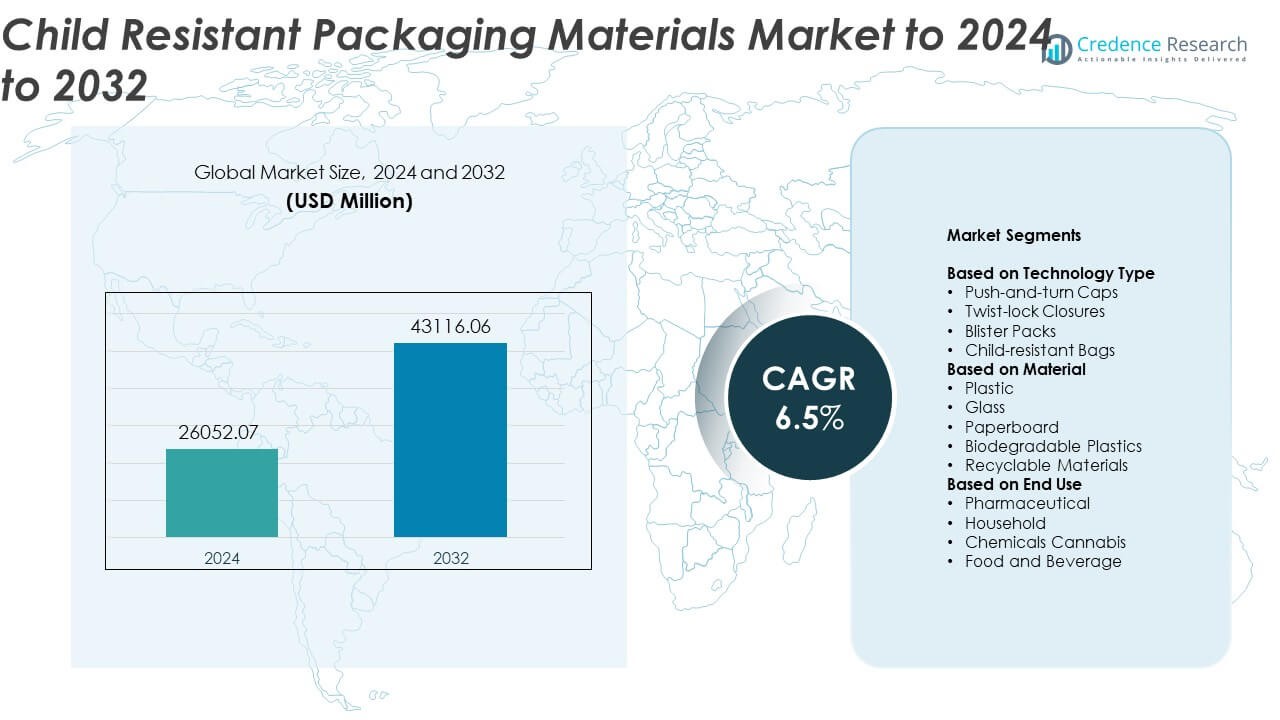
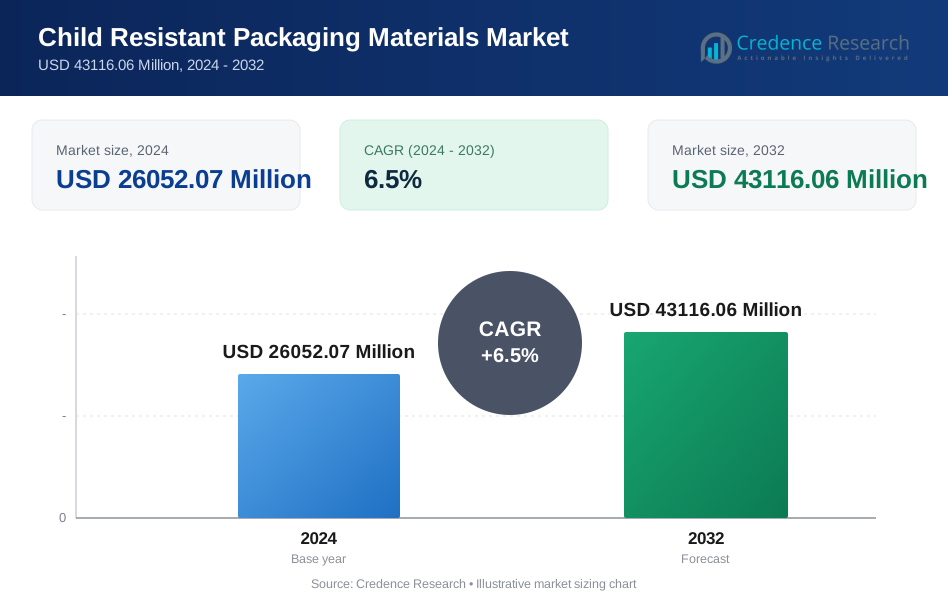
Child Resistant Packaging Materials Market size was valued at USD 26052.07 Million in 2024 and is anticipated to reach USD 43116.06 Million by 2032, at a CAGR of 6.5% during the forecast period.
| REPORT ATTRIBUTE | DETAILS |
|---|---|
| Historical Period | 2020-2023 |
| Base Year | 2024 |
| Forecast Period | 2025-2032 |
| Child Resistant Packaging Materials Market Size 2024 | USD 26052.07 Million |
| Child Resistant Packaging Materials Market, CAGR | 6.5% |
| Child Resistant Packaging Materials Market Size 2032 | USD 43116.06 Million |
The child resistant packaging materials market is led by major players such as Amcor plc, Berry Global Inc., Gerresheimer AG, WestRock Company, AptarGroup, Inc., and Mondi Group, alongside emerging competitors like Stora Enso Oyj and Klockner Pentaplast. These companies focus on developing innovative, compliant, and sustainable packaging materials that meet global safety regulations. North America leads the market with approximately 37% share in 2024, driven by stringent safety standards and high pharmaceutical consumption. Europe follows with around 28% share, supported by strong regulatory frameworks and sustainability initiatives, while Asia Pacific rapidly expands with nearly 23% share due to rising healthcare and industrial packaging demand.
Market Insights
- The child resistant packaging materials market was valued at USD 26052.07 Million in 2024 and is projected to reach USD 43116.06 Million by 2032, growing at a CAGR of 6.5%.
- Increasing regulatory requirements for child safety in pharmaceuticals and household chemicals are key drivers enhancing adoption across industries.
- Rising sustainability trends are pushing manufacturers toward biodegradable plastics and recyclable materials, improving product appeal and compliance.
- The market is highly competitive, with major players investing in smart closure technologies, eco-friendly materials, and global expansion to maintain leadership.
- North America holds 37% share due to strict safety regulations, followed by Europe with 28%, while Asia Pacific grows fastest at 23%, supported by expanding pharmaceutical and packaging manufacturing bases.
Market Segmentation Analysis:
By Technology Type
The push-and-turn caps segment dominates the child resistant packaging materials market, accounting for nearly 41% share in 2024. Their widespread use in pharmaceutical and household chemical packaging is driven by reliability and cost efficiency. These closures provide an effective balance between child safety and user convenience. Increasing regulatory focus on child safety standards and the high adaptability of push-and-turn designs across container types support market growth. Blister packs and child-resistant bags are gaining traction due to expanding applications in over-the-counter medicines and cannabis products.
- For instance, Gwalia Healthcare lists over 7 push-and-turn CRC sizes (20–45 mm) certified to BS EN ISO 8317:2015, offering a full range of closures within this standard.
By Material
Plastic leads the market with around 52% share in 2024, driven by its durability, flexibility, and lightweight properties. It enables complex designs for closures and blister packs that meet strict safety standards. Rising use of polypropylene and polyethylene in packaging pharmaceuticals and household products enhances market expansion. However, growing environmental concerns are pushing manufacturers toward recyclable and biodegradable plastics. Glass and paperboard are also gaining moderate growth due to their sustainability appeal and compliance with eco-friendly packaging trends.
- For instance, Gerresheimer offers Duma® Twist-Off in 18 sizes from 15–600 ml, with optional child-resistant closures.
By End Use
The pharmaceutical segment holds the largest share of approximately 48% in 2024. Strict global regulations for child-resistant packaging in prescription and over-the-counter medicines drive its dominance. Increasing medication use and safety awareness among parents further boost adoption. Household and chemical applications follow, supported by demand for safe packaging for cleaning agents and pesticides. Meanwhile, the food and beverage and cannabis industries are rapidly adopting child-resistant materials to comply with safety laws and enhance product credibility.
Key Growth Drivers
Stringent Regulatory Mandates
Stringent global regulations mandating child-resistant packaging for pharmaceuticals, chemicals, and cannabis products remain a primary growth driver. Authorities such as the U.S. Consumer Product Safety Commission and the European Medicines Agency enforce strict safety standards to reduce accidental poisoning incidents. Manufacturers are investing in compliant packaging designs that balance safety with user convenience. The growing enforcement of these standards across developing economies further strengthens market expansion and pushes companies to innovate in materials and closure mechanisms.
- For instance, Berry Global’s PET bottle with PP28 Medi-Loc® cap is certified to ISO 8317 and 16 CFR 1700.20, covering five bottle sizes and four liner types.
Rising Pharmaceutical Consumption
The surge in prescription and over-the-counter drug use globally is fueling demand for child-resistant packaging materials. The rise in chronic diseases, coupled with expanding geriatric and pediatric populations, increases the need for safe and accessible medication containers. Pharmaceutical firms prefer push-and-turn caps and blister packs to meet regulatory and safety requirements. Continuous innovations in packaging formats that enhance both safety and usability are boosting adoption across pharmaceutical supply chains and distribution networks.
- For instance, WestRock reports Shellpak® users were 11–23% more likely to achieve PDC ≥ 80% versus vials.
Sustainability-Focused Packaging Innovations
Growing environmental awareness is driving the shift toward recyclable and biodegradable child-resistant materials. Manufacturers are increasingly adopting eco-friendly plastics, paperboard, and bio-based polymers to meet sustainability goals without compromising safety performance. The use of recycled content in closures and containers is expanding, supported by green manufacturing incentives. This move toward sustainable packaging solutions attracts environmentally conscious consumers and aligns with corporate social responsibility initiatives, creating new market opportunities.
Key Trends & Opportunities
Integration of Smart Packaging Solutions
Smart child-resistant packaging is emerging as a key trend, integrating digital authentication and tracking features. Technologies such as NFC tags and QR codes enhance product safety, traceability, and consumer engagement. These solutions are gaining popularity in pharmaceuticals and cannabis packaging, where counterfeiting and compliance are critical. Companies are leveraging connected packaging to monitor usage and improve supply chain transparency, driving innovation in both materials and functionality.
- For instance, Avery Dennison (atma.io) manages item-level digital IDs for over 30 billion products.
Expansion of Cannabis Packaging Regulations
Legalization of medical and recreational cannabis in several regions has created new opportunities for child-resistant packaging materials. Regulations require tamper-evident, odor-proof, and secure packaging for cannabis products to ensure child safety and product integrity. This has led to growing demand for specialized child-resistant pouches and closures tailored for the cannabis industry. The segment’s rapid growth is encouraging manufacturers to design cost-effective and sustainable packaging compliant with evolving standards.
- For instance, KushCo Holdings has sold over 1 billion packaging units, including child-resistant formats, across the Americas and Europe.
Key Challenges
High Manufacturing and Compliance Costs
Developing child-resistant packaging that meets safety and environmental standards involves high production costs. Testing, certification, and design validation add further expenses, making it challenging for smaller manufacturers to compete. Balancing functionality, sustainability, and affordability remains complex, particularly as material costs rise. Companies face pressure to deliver innovative yet cost-efficient packaging without compromising regulatory compliance or safety performance.
Balancing Ease of Use with Child Safety
Achieving the right balance between child resistance and user accessibility is a key design challenge. Packaging must prevent accidental access by children while remaining easy for adults and elderly users to open. Overly complex mechanisms can lead to usability issues and consumer dissatisfaction. Manufacturers continue to refine closure technologies and ergonomic designs to maintain safety compliance while improving user experience.
Regional Analysis
North America
North America dominates the child resistant packaging materials market with around 37% share in 2024. The region’s leadership is driven by stringent regulatory requirements set by agencies such as the U.S. Consumer Product Safety Commission and Health Canada. High pharmaceutical consumption, strong demand for household chemical safety packaging, and growth in the legalized cannabis market further support expansion. The United States leads regional demand, while Canada is witnessing steady growth due to sustainability-focused packaging initiatives and increasing adoption of eco-friendly child-resistant materials.
Europe
Europe holds approximately 28% share of the global market in 2024, supported by strict packaging safety standards under EU regulations. Rising consumption of prescription drugs and the growing emphasis on recyclable and biodegradable materials are key growth factors. Germany, France, and the United Kingdom are major contributors, with strong pharmaceutical manufacturing bases. The adoption of sustainable plastic alternatives and innovative closure systems is accelerating across European countries, driven by environmental goals and compliance with the Packaging and Packaging Waste Directive.
Asia Pacific
Asia Pacific accounts for about 23% share in 2024 and is the fastest-growing regional market. Expanding pharmaceutical production in China, India, and Japan is a key driver, alongside rising health awareness and regulatory enforcement for child safety. Rapid industrialization, urbanization, and growing disposable incomes contribute to increasing demand for safe packaging in household and chemical products. The regional shift toward biodegradable plastics and localized manufacturing investments further enhances market penetration across emerging economies.
Latin America
Latin America represents around 7% share of the child resistant packaging materials market in 2024. Growth is supported by expanding pharmaceutical and chemical industries, particularly in Brazil and Mexico. Increasing government focus on child safety and regulatory adoption similar to North American standards drive gradual market advancement. The region also shows rising interest in recyclable and cost-effective packaging solutions. Local manufacturers are strengthening capabilities through partnerships with global packaging companies to improve compliance and technology integration.
Middle East & Africa
The Middle East & Africa holds a smaller but growing share of nearly 5% in 2024. Demand is driven by the expanding pharmaceutical and healthcare sectors, along with growing awareness of child safety standards. Countries such as South Africa, Saudi Arabia, and the UAE are leading adopters of advanced packaging materials. The gradual shift toward sustainable materials and regional investments in packaging infrastructure are boosting market development. Increasing import of child-resistant containers and closures from global suppliers supports steady growth in the region.
Market Segmentations:
By Technology Type
- Push-and-turn Caps
- Twist-lock Closures
- Blister Packs
- Child-resistant Bags
By Material
- Plastic
- Glass
- Paperboard
- Biodegradable Plastics
- Recyclable Materials
By End Use
- Pharmaceutical
- Household
- Chemicals Cannabis
- Food and Beverage
By Geography
- North America
- U.S.
- Canada
- Mexico
- Europe
- Germany
- France
- U.K.
- Italy
- Spain
- Rest of Europe
- Asia Pacific
- China
- Japan
- India
- South Korea
- South-east Asia
- Rest of Asia Pacific
- Latin America
- Brazil
- Argentina
- Rest of Latin America
- Middle East & Africa
- GCC Countries
- South Africa
- Rest of the Middle East and Africa
Competitive Landscape
Amcor plc, Berry Global Inc., Gerresheimer AG, WestRock Company, AptarGroup, Inc., Stora Enso Oyj, Klockner Pentaplast, Mondi Group, SGD Pharma, Comar, LLC, Bilcare Limited, Reynolds Group Holdings, Global Closures Systems, Origin Pharma Packaging, and Pretium Packaging are key players shaping the competitive landscape of the child resistant packaging materials market. The market is characterized by strong competition, driven by regulatory compliance, sustainability initiatives, and innovation in design. Leading companies focus on advanced material development, smart closure technologies, and eco-friendly solutions to meet global safety standards. Strategic mergers, acquisitions, and partnerships strengthen their global presence and production capacity. Manufacturers are expanding portfolios with recyclable and biodegradable materials to align with environmental policies. Growing investment in R&D, automation, and digital printing technologies enhances efficiency and product differentiation. The competition remains intense, as companies continuously innovate to balance child safety, usability, and environmental responsibility across diverse end-use sectors.
Key Player Analysis
- Amcor plc
- Berry Global Inc.
- Gerresheimer AG
- WestRock Company
- AptarGroup, Inc.
- Stora Enso Oyj
- Klockner Pentaplast
- Mondi Group
- SGD Pharma
- Comar, LLC
- Bilcare Limited
- Reynolds Group Holdings
- Global Closures Systems
- Origin Pharma Packaging
- Pretium Packaging
Recent Developments
- In 2025, Amcor launched the Hector Child Resistant Closure (CRC), a lightweight polypropylene closure designed for household products with enhanced sustainability and user-friendly squeeze-and-turn safety features.
- In 2025, Aptar Beauty launched the TSP (Trigger Spray Pump), an all-plastic and highly recyclable trigger spray pump for the home care industry, which includes an optional child-resistant (CRC) feature for added product security.
- In 2023, Berry Global Group introduced a new line of child-resistant packaging solutions, including ASTM-certified closures and PCR (Post-Consumer Recycled) CRP containers to support circular packaging in healthcare and chemical sectors.
Report Coverage
The research report offers an in-depth analysis based on Technology Type, Material, End-Use and Geography. It details leading market players, providing an overview of their business, product offerings, investments, revenue streams, and key applications. Additionally, the report includes insights into the competitive environment, SWOT analysis, current market trends, as well as the primary drivers and constraints. Furthermore, it discusses various factors that have driven market expansion in recent years. The report also explores market dynamics, regulatory scenarios, and technological advancements that are shaping the industry. It assesses the impact of external factors and global economic changes on market growth. Lastly, it provides strategic recommendations for new entrants and established companies to navigate the complexities of the market.
Future Outlook
- Rising demand for eco-friendly and recyclable child-resistant materials will shape product development.
- Integration of smart packaging technologies will enhance safety, traceability, and consumer engagement.
- Expanding pharmaceutical and healthcare sectors will continue driving large-scale adoption.
- Legalization of cannabis in new markets will create fresh opportunities for compliant packaging.
- Manufacturers will invest more in biodegradable plastics to align with sustainability goals.
- Increasing regulatory harmonization across regions will standardize safety and labeling requirements.
- Automation and digital printing advancements will improve packaging precision and efficiency.
- Partnerships between material suppliers and packaging firms will foster innovation and cost optimization.
- Growing consumer preference for user-friendly yet secure packaging will guide design strategies.
- Emerging markets in Asia and Latin America will experience accelerated adoption through regulatory reforms.
Request a Free Sample
Fill in your details and we'll send you a free sample report.
- Sample data tables & charts
- Research methodology
Need a Custom Version of This Report?
Tailor the scope, geography, or segments to your exact requirements.
- Custom geography or segment scope
- Direct access to our analyst team
Frequently Asked Questions
What is the current market size for Child Resistant Packaging Materials Market, and what is its projected size in 2032?
At what Compound Annual Growth Rate is the Child Resistant Packaging Materials Market projected to grow between 2025 and 2032?
Which Child Resistant Packaging Materials Market segment held the largest share in 2024?
What are the primary factors fueling the growth of the Child Resistant Packaging Materials Market?
Who are the leading companies in the Child Resistant Packaging Materials Market?
Which region commanded the largest share of the Child Resistant Packaging Materials Market in 2024?
Table of Content
Chapter 1. Report Introduction
- 1.1 Report Description & Purpose
- 1.1.1 Report Title & Market Definition
- 1.1.2 Unique Selling Propositions (USP) & Key Differentiators
- 1.1.3 Value Proposition for Stakeholders
- 1.2 Research Objectives
- 1.2.1 Market Sizing Objectives (Volume & Revenue)
- 1.2.2 Segmentation Objectives
- 1.2.3 Competitive Intelligence Objectives
- 1.2.4 Forecast & Scenario Objectives
- 1.3 Report Scope
- 1.3.1 Child Resistant Packaging Materials Scope – Types & Subtypes Covered
- 1.3.2 Geographic Scope – Regions & Countries Covered
- 1.3.3 Historical Period, Base Year & Forecast Period (2024; forecast to 2032)
- 1.3.4 Inclusions & Exclusions
- 1.4 HS Code & Classification Framework
- 1.5 Currency, Units & Pricing Basis
- 1.6 Target Stakeholders
- 1.7 Limitations & Assumptions
Chapter 2. Executive Summary
- 2.1 Global Child Resistant Packaging Materials Market Snapshot
- 2.1.1 Market Size – Historical (2024) & Forecast (2024-2032) (2024: USD 26052.07 Million → 2032: USD 43116.06 Million)
- 2.1.2 Volume & Revenue – Global Totals
- 2.1.3 Key Market Highlights – Top Five Facts
- 2.2 Child Resistant Packaging Materials Market Segmentation Snapshot
- 2.2.1 Market Split by Region – 2024 vs. 2032
- 2.3 Competitive Snapshot
- 2.3.1 Top 10 Players by Revenue Share – 2024
- 2.3.2 Top 10 Players by Volume Share – 2024
- 2.3.3 Recent Strategic Developments (18-Month Summary)
- 2.4 Key Investment Highlights & Strategic Conclusions
Chapter 3. Child Resistant Packaging Materials Market Dynamics & Industry Analysis
- 3.1 Market Overview & Context
- 3.1.1 Child Resistant Packaging Materials Market Position in the Broader Automotive Value Chain
- 3.1.2 OEM vs. Replacement Market Dynamics
- 3.1.3 Market Maturity & Development Stage by Region
- 3.2 Child Resistant Packaging Materials Market Drivers
- 3.3 Child Resistant Packaging Materials Market Restraints & Challenges
- 3.4 Child Resistant Packaging Materials Market Opportunities
- 3.5 Porter's Five Forces Analysis
- 3.5.1 Threat of New Entrants
- 3.5.2 Bargaining Power of Suppliers
- 3.5.3 Bargaining Power of Buyers
- 3.5.4 Threat of Substitutes
- 3.5.5 Competitive Rivalry – Intensity Assessment
- 3.6 Child Resistant Packaging Materials Value Chain Analysis
- 3.6.1 Upstream – Raw Material/Input Suppliers
- 3.6.1.1 Raw Material/Input 1
- 3.6.1.2 Raw Material/Input 2
- 3.6.1.3 Raw Material/Input 3
- 3.6.2 Midstream – Production/Manufacturing/Service Delivery
- 3.6.2.1 Production/Process Overview
- 3.6.2.2 Key Facility Locations & Capacity by Manufacturer
- 3.6.3 Downstream – Distribution & End Consumer
- 3.6.3.1 Primary Channel – B2B/OEM
- 3.6.3.2 Secondary Channels – Dealer, Retail, Online, Direct
- 3.6.4 Value Chain Profitability Analysis
- 3.6.1 Upstream – Raw Material/Input Suppliers
- 3.7 PESTEL Analysis
- 3.7.1 Political Factors
- 3.7.2 Economic Factors
- 3.7.3 Social Factors
- 3.7.4 Technological Factors
- 3.7.5 Environmental Factors
- 3.7.6 Legal Factors
- 3.8 Child Resistant Packaging Materials Supply Chain Analysis
- 3.8.1 Raw Material/Input Supply Risk Assessment
- 3.8.2 Manufacturing Concentration Risk (Geographic Exposure)
- 3.8.3 Trade Disruption Impact Analysis
- 3.9 Regulatory & Policy Landscape
Note: The regulatory and policy landscape section covers regulations based on their applicability to the market, Child Resistant Packaging Materials category, geography, and scope of the study. Only regulatory frameworks with a material impact on operations, compliance, trade, sustainability, or market access are analyzed in detail.
Chapter 4. Key Investment Pockets & Opportunity Analysis
- 4.1 Child Resistant Packaging Materials Market Attractiveness Analysis
- 4.1.1 By Region – Investment Attractiveness Matrix (Volume × CAGR)
- 4.2 Absolute Revenue Growth Opportunity
- 4.2.1 By Region – Absolute USD Growth Through 2032
- 4.3 Incremental Volume Opportunity
- 4.3.1 By Region – Incremental Volume Through 2032
- 4.3.2 Segment – Incremental Volume
- 4.4 Emerging Submarket Opportunity Deep Dive (Subject to Applicability)
- 4.5 Emerging Market Opportunity Scorecards
- 4.5.1 United States
- 4.5.2 Europe
- 4.5.3 Asia
- 4.5.4 Middle East & Africa
Note: Emerging Market Opportunity Scorecards will be included based on relevance and strategic importance. Regions listed are indicative and may vary depending on data availability and market dynamics.
Chapter 5. Child Resistant Packaging Materials Import-Export Analysis & Trade Flows
- 5.1 Global Trade Overview
- 5.1.1 Global Export Value by Country (2024)
- 5.1.2 Global Export Volume by Country (2024)
- 5.1.3 Global Import Value by Country (2024)
- 5.1.4 Global Import Volume by Country (2024)
- 5.1.5 Net Trade Balance by Country (2024)
- 5.2 Export Analysis – Segment
- 5.2.1 Type 1 (HS Code)
- 5.2.2 Type 2 (HS Code)
- 5.2.3 Type 3 (HS Code)
- 5.2.4 Type 4 (HS Code)
- 5.2.5 Type 5 (HS Code)
- 5.3 Import Analysis – Segment
- 5.3.1 Type 1 (HS Code)
- 5.3.2 Type 2 (HS Code)
- 5.3.3 Type 3 (HS Code)
- 5.3.4 Type 4 (HS Code)
- 5.3.5 Type 5 (HS Code)
- 5.4 Average Unit Trade Prices
- 5.4.1 Average Export Price – Segment & Country
- 5.4.2 Average Import Price – Segment & Source Country
- 5.4.3 Price Trends (2024)
- 5.5 Key Trade Route Analysis
- 5.5.1 Trade Route 1
- 5.5.2 Trade Route 2
- 5.5.3 Trade Route 3
- 5.5.4 Trade Route 4
- 5.5.5 Trade Route 5
- 5.6 Trade Policy Impact Assessment
- 5.6.1 US Anti-Dumping & Section 301 Tariffs
- 5.6.2 EU Customs Union Impact
- 5.6.3 Major Free Trade Agreements
- 5.6.4 USMCA Rules of Origin
Note: Trade policy analysis will be included only where relevant to the Child Resistant Packaging Materials market.
Chapter 6. Competitive Landscape & Company Benchmarking
- 6.1 Child Resistant Packaging Materials Market Concentration & Structure
- 6.1.1 Herfindahl-Hirschman Index (HHI) – vs. 2024
- 6.1.2 Tier 1, Tier 2 & Tier 3 Market Structure
- 6.1.3 Global, Regional & Local Player Dynamics
- 6.2 Child Resistant Packaging Materials Market Share Analysis – 2024
- 6.2.1 Global Revenue Share by Company
- 6.2.2 Global Volume Share by Company
- 6.2.3 Regional Revenue Share
- 6.2.4 Market Share Evolution ( vs. 2024)
- 6.2.5 OEM Segment Share by Company
- 6.2.6 Replacement Segment Share by Company
- 6.3 Production/Delivery Capacity & Facility Analysis
- 6.3.1 Global Installed Capacity
- 6.3.2 Capacity Utilization Rates
- 6.3.3 Production/Output Volume
- 6.3.4 Facility Locations & Capacity Map
- 6.3.5 Planned Capacity Additions
- 6.4 Child Resistant Packaging Materials Competitive Benchmarking Matrix
- 6.4.1 Revenue, Volume, CAGR & Profitability Comparison
- 6.4.2 Channel Revenue Mix
- 6.4.3 Geographic Revenue Exposure
- 6.4.4 R&D Intensity
- 6.4.5 Sustainability Maturity
- 6.5 Strategic Developments in Child Resistant Packaging Materials (Last 24 Months)
- 6.5.1 Mergers, Acquisitions & Divestments
- 6.5.2 New Child Resistant Packaging Materials Launches
- 6.5.3 Facility Expansions
- 6.5.4 Strategic Alliances, Joint Ventures & Partnerships
- 6.5.5 Distribution Expansion & Market Entry
- 6.5.6 Sustainability & ESG Initiatives
- 6.6 Competitive Strategy Mapping
- 6.6.1 Leader, Challenger, Follower & Niche Classification
- 6.6.2 Pricing Strategy Comparison
- 6.6.3 Channel Strategy Matrix
Note: Strategic developments are included based on their materiality and the availability of reliable information.
Chapter 7. Global Child Resistant Packaging Materials Market – By Distribution Channel
- 7.1 Segment Overview
- 7.1.1 Volume & Revenue Split by Channel (2024 & 2032)
- 7.1.2 Channel Mix Evolution (2024-2032)
Chapter 8. Regional Market Analysis – Global Overview
- 8.1 Global Regional Overview
- 8.1.1 Regional Volume Share
- 8.1.2 Regional Revenue Share
- 8.1.3 Regional Volume by Region
- 8.1.4 Regional Revenue by Region
- 8.1.5 Regional Forecast Through 2032
- 8.2 Cross-Regional Segment Analysis
- 8.2.1 By Distribution Channel
- 8.2.2 By Brand/Price Tier
Chapter 9. North America Child Resistant Packaging Materials Market
- 9.1 United States
- 9.2 Canada
- 9.3 Mexico
Chapter 10. Europe Child Resistant Packaging Materials Market
- 10.1 Germany
- 10.2 France
- 10.3 Italy
- 10.4 United Kingdom
- 10.5 Spain
- 10.6 Poland
- 10.7 Russia
- 10.8 Netherlands
- 10.9 Belgium
- 10.10 Sweden
- 10.11 Denmark
- 10.12 Norway
- 10.13 Rest of Europe
Chapter 11. Asia Pacific Child Resistant Packaging Materials Market
- 11.1 China
- 11.2 India
- 11.3 Japan
- 11.4 South Korea
- 11.5 Thailand
- 11.6 Indonesia
- 11.7 Vietnam
- 11.8 Malaysia
- 11.9 Australia
- 11.10 Rest of Asia Pacific
Chapter 12. Latin America Child Resistant Packaging Materials Market
- 12.1 Brazil
- 12.2 Argentina
- 12.3 Colombia
- 12.4 Chile
- 12.5 Rest of Latin America
Chapter 13. Middle East Child Resistant Packaging Materials Market
- 13.1 Saudi Arabia
- 13.2 United Arab Emirates
- 13.3 Turkey
- 13.4 Israel
- 13.5 Iran
- 13.6 Rest of the Middle East
Chapter 14. Africa Child Resistant Packaging Materials Market
- 14.1 South Africa
- 14.2 Egypt
- 14.3 Nigeria
- 14.4 Morocco
- 14.5 Rest of Africa
Chapter 15. Child Resistant Packaging Materials Company Profiles
- 15.1 [Company 01]
- 15.1.1 Company Overview
- 15.1.2 Key Management Personnel
- 15.1.3 Products & Services Portfolio
- 15.1.4 Financial Performance
- 15.1.5 Key Market Focus & Geographic Presence
- 15.1.6 Recent Developments & Strategic Initiatives
Note: The company profile list is preliminary and may change based on research findings, market developments, data availability, and client requirements.
Chapter 16. Appendices
- Appendix A – List of Abbreviations & Acronyms
- Appendix B – Industry Classification Code Reference – Full Series
- Appendix C – Production & Capacity Data Tables
- Appendix D – End-Use & Demand Base Tables
- Appendix E – Consumption & Replacement Rate Assumptions
- Appendix F – ASP Reference Tables
- Appendix G – Manufacturing & Facility Database
- Appendix H – Import-Export Data Tables
- Appendix I – Regulatory Summary Tables
- Appendix J – Primary Research Participant List (Anonymized)
- Appendix K – Primary Research Questionnaire Framework
- Appendix L – Data Sources & Bibliography
- Appendix M – Market Size Divergence & Source Comparison
Chapter 17. Research Methodology
- 17.1 Research Framework & Philosophy
- 17.2 Secondary Research – Sources, Hierarchy & Data Extraction
- 17.3 Data Modeling – Bottom-Up & Top-Down Market Sizing
- 17.4 Primary Research – Stakeholder Framework, LOI & Sample Sizes
- 17.5 Forecast Methodology – Regression, Scenario & Sensitivity Analysis
- 17.6 Quality Control – Four-Layer Validation Framework
- 17.7 Limitations & Standard Assumptions
- 17.8 Disclaimer
