Market Overview:
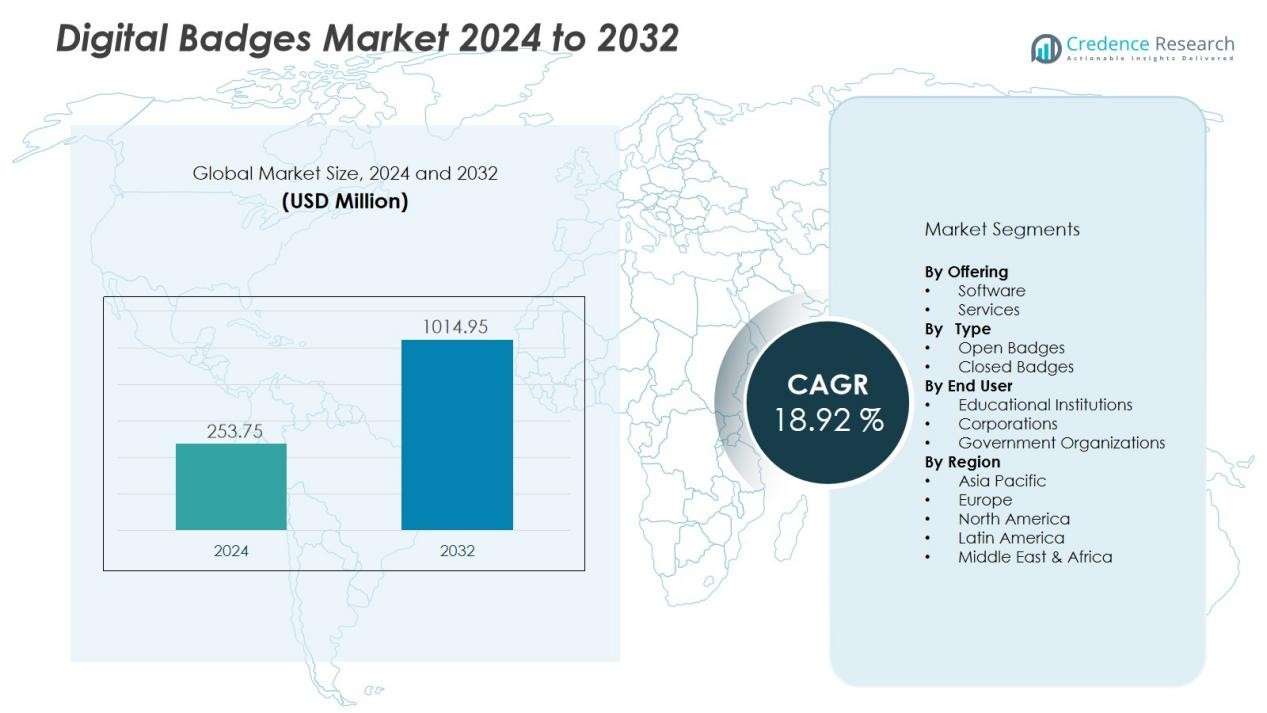
The Digital Badges Market size was valued at USD 253.75 million in 2024 and is anticipated to reach USD 1014.95 million by 2032, at a CAGR of 18.92 % during the forecast period.
| REPORT ATTRIBUTE |
DETAILS |
| Historical Period |
2020-2023 |
| Base Year |
2024 |
| Forecast Period |
2025-2032 |
| Digital Badges Market Size 2024 |
USD 253.75 Million |
| Digital Badges Market, CAGR |
18.92% |
| Digital Badges Market Size 2032 |
USD 1014.95 Million |
Key drivers of the Digital Badges Market include the growing shift towards e-learning platforms, which utilize digital badges as a tool for validating and motivating learners. Furthermore, the increasing need for secure and verifiable credentials in corporate training and professional development programs is fueling the adoption of digital badges. The ability to track competencies and achievements in a non-traditional, gamified manner also enhances their appeal to younger generations seeking to stand out in competitive job markets.
Regionally, North America holds the largest market share, driven by widespread adoption in the education sector and corporate training programs. Europe follows closely, with an increasing emphasis on digital learning tools and credentialing. Meanwhile, the Asia-Pacific region is expected to witness the fastest growth, attributed to rising educational and technological developments in countries such as India and China.
Access crucial information at unmatched prices!
Request your sample report today & start making informed decisions powered by Credence Research Inc.!
Download Sample
Market Insights:
- The Digital Badges Market was valued at USD 253.75 million in 2024 and is anticipated to reach USD 1014.95 million by 2032, growing at a CAGR of 18.92% during the forecast period.
- North America holds the largest market share, accounting for 40%, driven by the widespread adoption of digital credentialing systems in education and corporate sectors, alongside strong technological infrastructure.
- Europe holds a 30% market share, with growing demand from educational institutions and government bodies that recognize the importance of digital badges for tracking academic and professional competencies.
- The Asia-Pacific region is the fastest-growing market, with a 20% share, fueled by expanding digital infrastructure, the emphasis on skill-based learning, and increasing educational and technological developments in countries like China and India.
- In terms of segment share, the software offering leads with the largest share, while open badges dominate the type segment due to their global recognition and interoperability.
Market Drivers:
Growing Adoption of E-Learning Platforms
The rise of e-learning platforms has significantly contributed to the expansion of the Digital Badges Market. Educational institutions are increasingly using digital badges as a way to recognize student achievements in online courses. It enables learners to showcase specific skills and competencies earned through digital learning environments, providing a more efficient and tangible way of measuring success. This shift aligns with the growing trend of remote learning and offers institutions an innovative way to engage and motivate students.
- For instance, IBM has issued 10 million digital badges since 2016 through its IBM SkillsBuild and IBM Skills Gateway platform, validating employee and learner competencies across foundational, intermediate, and advanced technical skills, with a commitment to providing 30 million people with new skills by 2030.
Need for Verified Credentials in Corporate Training
Corporations are increasingly recognizing the importance of verifiable and secure credentials in employee training programs, which has driven the growth of the Digital Badges Market. Employers seek an efficient method to assess and verify the skills and qualifications of employees or candidates. Digital badges provide a secure, easily shareable credentialing system that allows companies to track employee development. This trend is expected to continue as companies prioritize skills over traditional qualifications, enhancing the demand for such digital solutions.
- For instance, IBM has made extensive use of verifiable digital credentials in corporate training programs. This is highlighted by a significant 40% year-over-year increase in digital credentials earned between January and April 2020 during the initial surge of the pandemic.
Integration of Gamification in Learning Systems
The integration of gamification into educational and corporate training systems has become a key factor in the Digital Badges Market’s growth. Gamification makes learning more engaging and fun, and digital badges serve as a natural extension of this strategy. Learners are more motivated when they receive recognition for completing specific challenges or tasks, which can lead to increased participation and improved learning outcomes. It also enhances user experience, making it a valuable tool for educators and organizations.
Rising Demand for Flexible and Scalable Learning Solutions
The demand for flexible and scalable learning solutions has been a crucial driver for the Digital Badges Market. Educational and professional organizations are looking for ways to scale learning programs while maintaining a level of recognition and validation. Digital badges offer a customizable and easily scalable option for recognizing individual achievements across a wide range of learning environments. This flexibility makes it an attractive solution for various industries, from education to corporate training.
Market Trends:
Increasing Integration with Blockchain Technology
A notable trend in the Digital Badges Market is the integration of blockchain technology to ensure the security and verifiability of digital credentials. Blockchain provides a decentralized and immutable ledger that ensures badges cannot be tampered with, offering greater trust to employers, institutions, and learners. This integration addresses concerns related to counterfeit badges and enhances the transparency of credential verification. As organizations and educational institutions seek more secure and transparent systems, blockchain technology is becoming a vital component in the digital credentialing ecosystem. The rise of blockchain is expected to drive further growth in the Digital Badges Market by establishing more robust credentialing frameworks.
Expansion Across Corporate and Non-Formal Education Sectors
The Digital Badges Market is seeing significant growth in both corporate training and non-formal education sectors. Companies are increasingly leveraging digital badges to recognize employee skills and achievements in areas such as leadership, technical proficiency, and customer service. This trend is expanding beyond traditional educational settings into professional development programs, where badges serve as proof of competency. Additionally, non-formal education, such as online certifications and short-term courses, is gaining popularity, and digital badges are playing an essential role in validating these alternative learning pathways. This trend reflects the growing recognition of non-traditional learning models and the increasing demand for flexible, accessible, and verifiable credentialing systems.
Market Challenges Analysis:
Lack of Standardization and Industry Adoption
One of the key challenges facing the Digital Badges Market is the lack of standardization across platforms and industries. With numerous providers and systems in place, digital badges can vary in their design, issuance, and verification processes. This fragmentation makes it difficult for employers, educators, and learners to universally recognize the value of certain badges. Without a universally accepted standard, the market may face slow adoption rates, as organizations hesitate to invest in a system that may not be widely accepted or recognized. Establishing industry-wide standards is critical to increasing the credibility and value of digital badges.
Resistance to Change in Traditional Credentialing Systems
Despite the growing interest in digital credentials, many industries and educational institutions remain resistant to change from traditional credentialing methods. Paper-based certifications and diplomas are still widely accepted, and transitioning to digital badges can be seen as a complex and costly shift. Institutions and organizations may be wary of adopting a new system due to concerns about implementation, security, or the potential disruption of existing processes. This resistance to change poses a significant hurdle for the Digital Badges Market, delaying its full integration into traditional education and corporate sectors.
Market Opportunities:
Expansion of Micro‑Credentials and Lifelong Learning Initiatives
The growth of micro‑credential programs presents a significant opportunity in the Digital Badges Market. Educational institutions and corporate entities increasingly adopt short‑form credentials that target specific skills or competencies. Organizations now seek robust digital badge systems that can validate those credentials and integrate with existing learning platforms. It enables learners to build personalized credential portfolios reflecting continuous professional development. Employers favour digital badges when they align directly with recognized skills frameworks and job roles. This trend supports a shift from traditional degree‑based assessment towards competency‑based recognition.
Greater Adoption in Emerging Markets and Cross‑Sector Applications
Emerging regions offer considerable opportunities for the Digital Badges Market expansion. In countries with large youth populations and expanding digital infrastructure, educational and workforce development programs can deploy badge systems to bridge skills gaps. Governments may partner with training providers and technology vendors to implement scalable credentialing platforms. It creates pathways for non‑formal learning and alternative skill verification outside traditional credentialing methods. Sectors like healthcare, manufacturing and public services may leverage badges to certify short‑term upskilling initiatives and regulatory compliance training. This diversification across geography and industry verticals can drive broader market growth and innovation.
Market Segmentation Analysis:
By Offering
The Digital Badges Market is primarily segmented by offering into software and services. The software segment holds the largest share, driven by the growing demand for digital credentialing systems in educational and corporate environments. These software solutions are increasingly integrated with learning management systems and talent management platforms, providing efficient ways to issue, track, and verify digital badges. The service segment includes consulting, implementation, and maintenance services, which support organizations in adopting digital badge systems. As more institutions and enterprises seek customized solutions, the demand for these services is expected to rise.
- For instance, Salesforce’s Trailhead platform demonstrates the software segment’s effectiveness, having reached 5 million badges earned by community members in just three years, corresponding to more than 22 million challenges completed as learners acquired in-demand Salesforce administrator and developer skills.
By Type
The Digital Badges Market is divided into two main types: open and closed badges. Open badges, being globally recognized and interoperable, are leading the market. They are issued by various organizations and can be shared across platforms, offering greater flexibility for learners. Closed badges are more restricted, typically issued within specific institutions or organizations, and are primarily used for internal recognition. Open badges’ growing recognition across educational and professional sectors contributes significantly to their market share.
- For instance, Credly, a top open badges provider, has enabled over 100 million verified digital credentials to be issued globally, with more than 48 million unique individuals having earned badges on the platform as of early 2025.
By End User
The Digital Badges Market caters to various end-users, including educational institutions, corporations, and government organizations. Educational institutions are the largest segment, leveraging digital badges for tracking student achievements and competencies. Corporations utilize badges for employee training, skill development, and certifications. Government organizations also implement badge systems for vocational training and compliance certifications. As the market matures, demand from corporations and governments is expected to rise, driven by the need for secure, verifiable credentials.
Segmentations:
By Offering
By Type
- Open Badges
- Closed Badges
By End User
- Educational Institutions
- Corporations
- Government Organizations
By Regions
- North America
- Europe
- Germany
- France
- U.K.
- Italy
- Spain
- Rest of Europe
- Asia Pacific
- China
- Japan
- India
- South Korea
- South-east Asia
- Rest of Asia Pacific
- Latin America
- Brazil
- Argentina
- Rest of Latin America
- Middle East & Africa
- GCC Countries
- South Africa
- Rest of the Middle East and Africa
Regional Analysis:
North America
North America holds the largest market share in the Digital Badges Market, accounting for 40% of the global demand. The region’s dominance is primarily driven by the widespread adoption of digital credentialing systems in both education and corporate sectors. Educational institutions in the U.S. and Canada have been early adopters of digital badges to track student achievements and competencies. Corporate organizations use digital badges to certify employee skills and professional development. The region’s strong technology infrastructure and the growing trend of online learning contribute to its continued leadership in the market. Increased demand for secure and verifiable credentials also bolsters the market’s expansion in this region.
Europe
Europe holds a significant share of the Digital Badges Market, contributing 30% to the global revenue. The region’s demand for digital badges is driven by educational institutions and government bodies that utilize badges for tracking skills, certifications, and achievements. In countries like the U.K., Germany, and France, digital badges are widely used to recognize academic, vocational, and professional competencies. Government programs supporting digital learning and skill development also encourage the adoption of digital badges. As the European workforce continues to prioritize lifelong learning and skill development, the market for digital badges is expected to grow further.
Asia-Pacific
The Asia-Pacific region is the fastest-growing market for digital badges, with a market share of 20%. Rapid digitalization and expanding educational infrastructure in countries like China, India, and Japan are major contributors to this growth. The demand for digital badges is increasing as educational institutions and corporations recognize the benefits of digital credentialing systems. These systems allow for efficient verification of skills and competencies, which are crucial for the growing workforce in the region. The increasing emphasis on skill-based learning and vocational education further drives the demand for digital badges in the Asia-Pacific region.
Key Player Analysis:
- Credly, Inc.
- Accredible
- Nocti Business Solutions
- RedCritter Corp.
- Accreditrust Technologies LLC
- Concentric Sky Inc.
- Forall Systems Inc.
- Blackboard Inc.
- Badgecraft
- LearningTimes LLC
Competitive Analysis:
The competitive landscape in the Digital Badges Market features key players deploying distinct strategies to gain market traction. Leaders such as Accredible, Nocti Business Solutions, RedCritter Corp. and Accreditrust Technologies LLC focus on expanding functionality, broadening regional reach and enhancing integration capabilities. Accredible offers a comprehensive platform that supports badge issuance, verification and analytics, and it positions itself around brand customization and security features. Nocti Business Solutions emphasizes digital badging systems within workforce development and testing services, targeting technical certification and skills recognition. RedCritter Corp. delivers badging tools tailored for corporate learning ecosystems, and Accreditrust Technologies LLC targets niche credentialing needs in specialized sectors. These companies invest in partnerships, platform enhancements and global scale‑up to strengthen their market positions. They strive to meet evolving issuer and learner demands and drive adoption across education and corporate training. It remains critical for any vendor to demonstrate interoperability, security, and measurable impact to succeed in this competitive market environment.
Shape Your Report to Specific Countries or Regions & Enjoy 30% Off!
Recent Developments:
- In January 2025, Credly announced it had issued 100 million digital credentials since its acquisition by Pearson, reinforcing its role in workforce upskilling and credentialing in the AI era.
- In April 2024, Nocti Business Solutions supported career and technical education credentials through its ongoing partnership with G-W and the Home Builders Institute (HBI).
Report Coverage:
The research report offers an in-depth analysis based on Offering, Type, End User and Regions. It details leading Market players, providing an overview of their business, product offerings, investments, revenue streams, and key applications. Additionally, the report includes insights into the competitive environment, SWOT analysis, current Market trends, as well as the primary drivers and constraints. Furthermore, it discusses various factors that have driven Market expansion in recent years. The report also explores Market dynamics, regulatory scenarios, and technological advancements that are shaping the industry. It assesses the impact of external factors and global economic changes on Market growth. Lastly, it provides strategic recommendations for new entrants and established companies to navigate the complexities of the Market.
Future Outlook:
- Increased adoption of digital badges in educational institutions to track student achievements and competencies.
- Growing use of digital badges in corporate training programs to certify employee skills and professional development.
- Rising demand for blockchain integration to enhance the security and verifiability of digital credentials.
- Expansion of digital badges into non-formal education and micro-credentialing sectors, offering alternative learning pathways.
- Enhanced focus on interoperability across platforms to ensure digital badges are universally recognized and easily shared.
- Broader acceptance of digital badges as a reliable method of skill validation by employers globally.
- Development of gamification features within digital badge systems to increase learner engagement and motivation.
- Increased government investment in digital credentials for vocational training, workforce development, and certification programs.
- Growth in the Asia-Pacific region, driven by rising digital education initiatives and expanding workforce development.
- Advancements in artificial intelligence and analytics to track, assess, and improve the value of digital badges in various sectors.



