
Market Overview
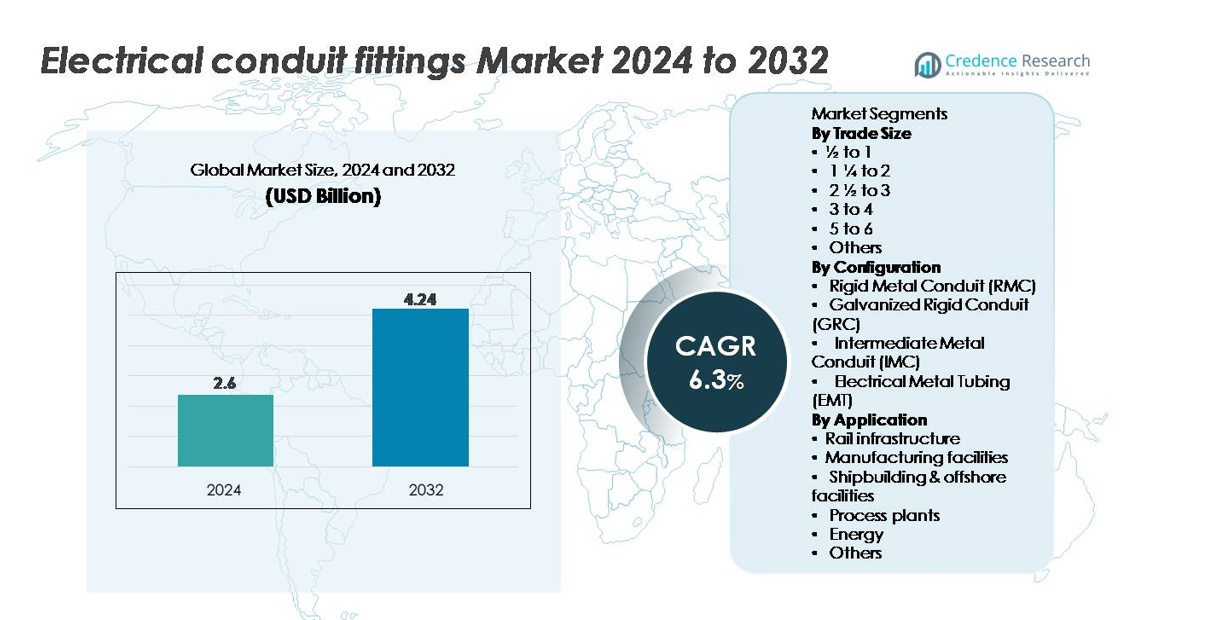
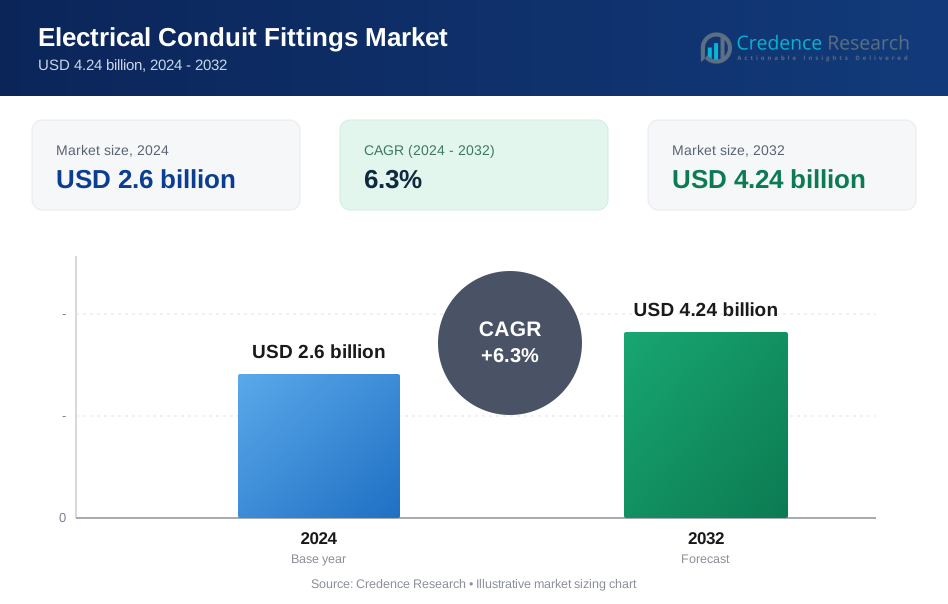
The electrical conduit fitting market was valued at USD 2.6 billion in 2024 and is projected to reach USD 4.24 billion by 2032, expanding at a CAGR of 6.3% during the forecast period (2025–2032).
| REPORT ATTRIBUTE | DETAILS |
|---|---|
| Historical Period | 2020-2023 |
| Base Year | 2024 |
| Forecast Period | 2025-2032 |
| Electrical Conduit Fittings Market Size 2024 | USD 2.6 billion |
| Electrical Conduit Fittings Market, CAGR | 6.3% |
| Electrical Conduit Fittings Market Size 2032 | USD 4.24 billion |
The electrical conduit fitting market is shaped by strong competition among global manufacturers such as Techno Flex, Gibson Stainless & Specialty, Nucor Tubular Products, Legrand, American Conduit, HellermannTyton, Schneider Electric, Flexa, Anamet Electrical, and Atkore, each leveraging material innovation, corrosion-resistant designs, and extensive distribution networks to strengthen market penetration. Asia-Pacific leads the global market with a 36% share, driven by rapid industrialization, large-scale construction, and expanding power infrastructure. North America and Europe follow, supported by stringent electrical safety standards and modernization of commercial and industrial facilities. Companies continue to compete through advanced manufacturing, certification compliance, and engineered fittings tailored for high-performance applications across diverse installation environments
Market Insights
- The electrical conduit fitting market was valued at USD 2.6 billion in 2024 and is projected to reach USD 4.24 billion by 2032, registering a CAGR of 6.3% during the forecast period.
- Strong demand is driven by rapid commercial construction, industrial electrification, and stringent safety regulations that accelerate adoption of EMT, IMC, GRC, and RMC-compatible fittings across diverse wiring systems.
- Key trends include rising preference for corrosion-resistant stainless steel and coated fittings, expansion of modular and tool-less connector designs, and increasing use of digital planning tools like BIM for accurate conduit routing.
- Competition intensifies among major players such as Techno Flex, Gibson Stainless & Specialty, Nucor Tubular Products, Legrand, American Conduit, HellermannTyton, Schneider Electric, Flexa, Anamet Electrical, and Atkore, each strengthening portfolios and distribution networks.
- Asia-Pacific leads with 36% share, followed by North America at 32% and Europe at 24%, while EMT remains the dominant configuration segment and ½ to 1 inch trade size accounts for the highest installation volume.
Market Segmentation Analysis:
By Trade Size
Trade sizes ½ to 1 inch form the dominant sub-segment in the electrical conduit fitting market, driven by their extensive use in residential and light-commercial wiring projects where compact circuits and branch connections are common. Their high throughput in renovation and small-scale construction ensures continuous demand, while compatibility with EMT and IMC systems strengthens adoption across contractors. Larger trade sizes such as 1¼ to 2 inches and 2½ to 3 inches support industrial cabling but remain secondary due to lower installation frequency. Sizes above 3 inches primarily serve specialized heavy-duty applications.
- For instance, Atkore produces EMT and IMC steel conduit that meets UL-797 and UL-1242 standards across its U.S. manufacturing network. The company operates over 60 manufacturing and distribution sites globally, supporting consistent quality and high-volume conduit supply.
By Configuration
Electrical Metal Tubing (EMT) emerges as the leading configuration, supported by its lightweight design, fast installation characteristics, and strong preference in commercial buildings and industrial fit-outs. EMT's bendability and lower material cost compared to rigid metal conduits make it the first choice for large electrical contractors seeking installation efficiency. Rigid Metal Conduit (RMC) and Galvanized Rigid Conduit (GRC) dominate in harsh and hazardous environments, offering superior corrosion protection, while Intermediate Metal Conduit (IMC) provides a balanced option for weight-sensitive industrial installations.
- For instance, Gibson Stainless & Specialty produces 316 stainless-steel conduit fittings with a typical tensile strength of 515 MPa and a 205 MPa yield rating. These mechanical properties support reliable performance in harsh petrochemical and offshore environments where corrosion resistance is critical.
By Application
Manufacturing facilities represent the dominant application segment, driven by continuous expansion of automated production lines, extensive machinery wiring, and stringent safety requirements for enclosed electrical systems. High power-load distribution, equipment interconnections, and control room cabling significantly increase demand for heavy-duty conduit fittings. Rail infrastructure and process plants follow, supported by large-scale electrification upgrades and stringent compliance norms. Shipbuilding and offshore facilities require corrosion-resistant conduit solutions, while the energy sector particularly substations and renewable energy assets utilizes robust configurations to support long-distance, high-reliability cabling networks.
Key Growth Drivers
Expansion of Commercial, Industrial, and Infrastructure Construction
Rising global investment in commercial, industrial, and public infrastructure development serves as a major growth catalyst for electrical conduit fittings. Rapid construction of commercial complexes, logistics hubs, data centers, and healthcare facilities drives higher consumption of secure wiring systems. Industrial expansions involving manufacturing lines, automation equipment, and high-load electrical networks further strengthen demand for conduit fittings capable of supporting heavy mechanical stress, corrosive exposure, and long cable runs. Urban infrastructure upgrades such as smart transportation systems, metro rail corridors, and utility modernization programs continue to adopt structured conduit-based wiring to meet compliance and safety norms. Renovation and retrofitting activities in aging facilities also increase replacement demand for connectors, couplings, elbows, and compression fittings. The cumulative effect of ongoing construction activity and rising regulatory pressure for safe, enclosed wiring significantly supports long-term market expansion.
- For instance, Legrand reports a global portfolio of over 300,000 product references supported by manufacturing operations across nearly 90 countries. This network enables steady supply of wiring devices, cable-management systems, and conduit accessories for commercial and industrial projects.
Increasing Focus on Electrical Safety and Regulatory Compliance
Growing emphasis on electrical safety across commercial, industrial, and high-risk environments continues to push adoption of conduit fittings designed to protect wiring integrity. Regulatory bodies such as the NEC, IEC, and regional authorities enforce strict standards related to mechanical protection, grounding continuity, corrosion resistance, and fire safety. Industries involving high temperatures, vibration, chemicals, or explosion-prone atmospheres increasingly require rigid metallic conduit systems and reinforced fittings. Insurance-driven compliance audits further accelerate replacement of outdated wiring accessories. As organizations strengthen EHS (Environment, Health, and Safety) programs, they prioritize conduit fittings that minimize risk of arc faults, short circuits, moisture ingress, and cable degradation. The necessity for code-compliant installations in warehouses, plants, public buildings, and transportation sectors positions safety regulations as a key market driver.
- For instance, Schneider Electric operates globally in electrical distribution and energy-management systems. Its product range covers low-voltage distribution gear, switches, sockets, switchboards and related components used in residential, commercial and industrial settings.
Electrification of Industrial Processes and Rise of Automation
The growing shift toward electrification of industrial processes and adoption of Industry 4.0 technologies significantly increases the need for robust conduit infrastructure. Automated production lines, robotics, CNC machinery, and high-density control wiring require secure routing solutions capable of protecting sensitive cables from abrasion, vibration, and EMI exposure. Electrification of pumping systems, HVAC units, mining equipment, and power-distribution assets also expands heavy-duty conduit fitting usage. The integration of sensing devices, IoT nodes, and monitoring systems in factory environments results in more cabling density, prompting demand for precise junction fittings, expansion couplings, and grounding accessories. As industries transition toward smart, digitally enabled operations, the need for reliable, organized, and scalable wiring frameworks strengthens the adoption of advanced conduit fittings.
Key Trends and Opportunities
Growth of Corrosion-Resistant and Specialty Material Fittings
A key market trend revolves around increasing demand for corrosion-resistant fittings made from stainless steel, hot-dip galvanized steel, PVC-coated metals, and advanced polymer composites. Industries such as shipbuilding, offshore energy, petrochemicals, and wastewater treatment require fittings capable of withstanding saltwater exposure, chemical splash, and high humidity. The rise of cleanrooms, pharmaceuticals, and food processing facilities also boosts adoption of hygienic, easy-to-clean conduit systems. Manufacturers are expanding portfolios to include fittings with enhanced sealing mechanisms, improved thread integrity, and high-grade coatings. This trend creates strong opportunities for suppliers developing specialized material technologies to meet environmental, thermal, and mechanical performance requirements across harsh operating conditions.
Digitization of Electrical Planning and Rise of Pre-Engineered Installation Systems
An emerging opportunity lies in the adoption of digital construction tools such as BIM-based electrical routing, 3D layout optimization, and automated bill-of-material generation which increases demand for standardized, precision-engineered conduit fittings. Pre-engineered fitting kits, modular assemblies, and quick-connect accessories accelerate installation speed, reduce labor cost, and enhance consistency across large building projects. Contractors increasingly prefer fittings compatible with automated bending tools, robotic installation systems, and smart tagging for asset tracking. As construction firms digitalize workflows and adopt prefabrication practices, suppliers offering integrated, installation-ready conduit fitting systems stand to gain a competitive edge.
- For instance, Atkore offers Revit-compatible BIM files for more than 2,000 conduit, strut, and cable-management products through its official BIM library, enabling accurate digital electrical-routing and automated bill-of-material generation in large construction projects.
Rising Investments in Renewable Energy and Power Infrastructure
The global shift toward renewable energy including solar farms, wind plants, hydrogen facilities, and battery-energy storage projects creates substantial opportunities for electrical conduit fittings tailored for outdoor, high-voltage, and vibration-intensive settings. Renewable installations require extensive cabling networks for inverters, substations, transformers, and monitoring devices, driving demand for robust conduit fittings that withstand UV, moisture, and thermal cycles. Grid modernization initiatives, including substation upgrades and underground cabling programs, further support adoption. As energy transition accelerates, conduit fittings used in power-distribution architecture experience sustained long-term growth.
- For instance, ABB’s Elastimold™ solid-dielectric underground distribution system includes 15 kV, 25 kV, and 35 kV rated components tested to IEEE 386 standards, which are deployed in solar and wind substations that require conduit-compatible terminations capable of withstanding outdoor thermal cycling and high-voltage stress.
Key Challenges
Fluctuating Raw Material Prices and Supply Chain Constraints
The conduit fitting market faces significant challenges stemming from volatile steel, aluminum, and polymer prices, which directly impact manufacturing costs and pricing stability. Supply chain disruptions from geopolitical instability, freight constraints, or shortages of galvanized steel further strain production cycles and delivery timelines. Manufacturers face rising expenses related to coatings, threading processes, and precision machining. These fluctuations limit profit margins, complicate long-term contracting, and pressure suppliers to diversify sourcing. Smaller manufacturers struggle to maintain competitiveness against large players with vertically integrated supply chains, magnifying raw material dependency as a major industry challenge.
Labor Shortages and Installation Skill Gaps in Electrical Contracting
A persistent shortage of trained electricians and skilled installers poses operational challenges, particularly in industrial and large-scale commercial projects that rely heavily on conduit-based wiring. Inadequate skill levels result in installation errors, longer project timelines, and higher rework costs, reducing overall productivity. Complex conduit layouts especially involving rigid metal systems, hazardous-area compliance, and precision bending require technicians with specialized expertise. As construction demand grows faster than workforce availability, contractors increasingly face delays and capacity constraints. This shortage pressures manufacturers to offer simplified, modular, and tool-less fitting designs to mitigate installation complexity.
Regional Analysis
North America
North America holds around 32% of the electrical conduit fitting market, driven by robust commercial construction, modernization of utility grids, and strong adherence to NEC regulatory standards. The U.S. leads regional demand due to extensive investments in data centers, logistics infrastructure, and industrial automation. Large-scale renovation of aging electrical systems in manufacturing, transportation, and institutional facilities further accelerates replacement demand for conduit fittings. High adoption of EMT and rigid metal conduits, combined with rising spending on renewable power installations, strengthens long-term market growth across the region.
Europe
Europe captures an estimated 24% share, fueled by strict electrical safety regulations, continuous industrial modernization, and rapid expansion of rail, renewable energy, and public infrastructure projects. Countries such as Germany, the UK, France, and the Nordics drive demand for corrosion-resistant and fire-rated conduit fittings used across advanced manufacturing, process industries, and smart building networks. Ongoing retrofitting of old commercial structures and renewed investments in offshore wind projects support uptake of metallic and specialty-coated fittings. Emphasis on sustainability, energy efficiency, and EN/IEC compliance reinforces Europe's position as a technically mature market.
Asia-Pacific
Asia-Pacific leads the global market with approximately 36% share, supported by large-scale urbanization, expanding industrial corridors, and high public spending on transportation, rail, and energy infrastructure. China, India, Japan, and Southeast Asia exhibit strong demand for EMT, IMC, and GRC systems across factories, commercial buildings, and utility networks. The region’s booming manufacturing sector especially electronics, automotive, and chemicals drives extensive use of conduit-based wiring for high-density electrical installations. Government-led smart city programs and rapid growth in renewable energy assets further amplify the need for durable, scalable conduit fittings.
Latin America
Latin America accounts for roughly 5% of global demand, shaped by expanding industrial activities, mining operations, and infrastructure upgrades across Brazil, Mexico, Chile, and Colombia. Increasing investments in oil & gas, hydroelectric power, and transportation networks support greater usage of rugged conduit fittings suitable for high-vibration and corrosive environments. Urban expansion and modernization of commercial buildings also contribute to steady adoption. However, economic fluctuations and slower construction cycles limit broader market penetration. As regional safety codes strengthen and private-sector industrialization grows, demand for standardized conduit systems is expected to rise.
Middle East & Africa
The Middle East & Africa region holds close to 3% share, driven by ongoing construction megaprojects, oil & gas facility development, and utility expansion programs. GCC countries including Saudi Arabia, the UAE, and Qatar boost demand for heavy-duty, corrosion-resistant conduit fittings used in high-temperature and hazardous industrial environments. Africa’s growing power distribution and mining sectors drive incremental adoption, though infrastructure gaps constrain rapid scaling. Increasing investments in commercial real estate, renewable energy, and industrial zones support moderate long-term growth, especially for galvanized and rigid metal conduit systems capable of withstanding harsh climatic conditions.
Market Segmentations:
By Trade Size
- ½ to 1
- 1 ¼ to 2
- 2 ½ to 3
- 3 to 4
- 5 to 6
- Others
By Configuration
- Rigid Metal Conduit (RMC)
- Galvanized Rigid Conduit (GRC)
- Intermediate Metal Conduit (IMC)
- Electrical Metal Tubing (EMT)
By Application
- Rail infrastructure
- Manufacturing facilities
- Shipbuilding & offshore facilities
- Process plants
- Energy
- Others
By Geography
- North America
- U.S.
- Canada
- Mexico
- Europe
- Germany
- France
- U.K.
- Italy
- Spain
- Rest of Europe
- Asia Pacific
- China
- Japan
- India
- South Korea
- South-east Asia
- Rest of Asia Pacific
- Latin America
- Brazil
- Argentina
- Rest of Latin America
- Middle East & Africa
- GCC Countries
- South Africa
- Rest of the Middle East and Africa
Competitive Landscape
The competitive landscape of the electrical conduit fitting market is characterized by a mix of global manufacturers and regional specialists competing through product quality, material innovation, and compliance-driven engineering. Leading players focus on expanding portfolios of EMT, IMC, GRC, and RMC-compatible fittings while integrating corrosion-resistant coatings, high-strength alloys, and precision threading technologies to meet stringent installation standards. Companies strengthen market presence through strategic distribution networks, contractor partnerships, and training programs that support efficient field installation. Competition intensifies as manufacturers introduce modular, quick-connect, and tool-less fittings that reduce labor time and improve alignment accuracy in large commercial and industrial projects. Firms also invest in digital catalogues, BIM-compatible product libraries, and automated manufacturing systems to enhance consistency and supply reliability. With rising infrastructure demand and tightening electrical safety regulations, companies with strong technical credibility, certification compliance, and robust after-sales support maintain a clear competitive advantage across global markets.
Key Player Analysis
- Techno Flex
- Gibson Stainless & Specialty
- Nucor Tubular Products
- Legrand
- American Conduit
- HellermannTyton
- Schneider Electric
- Flexa
- Anamet Electrical
- Atkore
Recent Developments
- In August 2025, Techno Flex expanded its manufacturing footprint with a new, state-of-the-art facility in the SEZ at Pithampur, Madhya Pradesh. This expansion is aimed at increasing capacity for conduit pipes and fittings and supporting both domestic and export markets.
- In July 9, 2025, Gibson Stainless & Specialty, Inc. announced product-line enhancements targeting the food & beverage sector shifting from paper labels to laser marking and extending female ports to fully enclose male threads for hygienic, debris-free conduit fittings.
- In May 2024, Atkore issued Environmental Product Declarations (EPDs) for its stainless steel, galvanized steel, and PVC conduits and fittings. Verified by an independent third party, the EPDs outlined the environmental impacts throughout the product lifecycle, including greenhouse gas emissions and energy consumption. This initiative highlights Atkore's commitment to sustainability, helping customers make informed decisions and support green building certifications.
Report Coverage
The research report offers an in-depth analysis based on Trade size, Configruation, Application and Geography. It details leading market players, providing an overview of their business, product offerings, investments, revenue streams, and key applications. Additionally, the report includes insights into the competitive environment, SWOT analysis, current market trends, as well as the primary drivers and constraints. Furthermore, it discusses various factors that have driven market expansion in recent years. The report also explores market dynamics, regulatory scenarios, and technological advancements that are shaping the industry. It assesses the impact of external factors and global economic changes on market growth. Lastly, it provides strategic recommendations for new entrants and established companies to navigate the complexities of the market.
Future Outlook
- The market will experience steady demand as large commercial, industrial, and infrastructure projects continue adopting enclosed wiring systems for enhanced safety and durability.
- Rising automation and electrification in manufacturing facilities will increase the need for high-performance conduit fittings supporting dense, vibration-prone electrical networks.
- Adoption of corrosion-resistant and specialty material fittings will accelerate as offshore, marine, and process industries expand and tighten compliance requirements.
- Digital construction tools such as BIM and prefabrication workflows will drive demand for standardized, installation-ready conduit fitting solutions.
- Smart buildings and advanced HVAC, security, and energy-management systems will boost uptake of adaptable conduit fittings for integrated electrical routing.
- Growth in renewable energy solar, wind, hydrogen, and storage assets will expand applications requiring outdoor-grade, UV-resistant, and heavy-duty fittings.
- Manufacturers will increasingly invest in modular, quick-connect, and tool-less designs to reduce labor time amid persistent electrical workforce shortages.
- Sustainability initiatives will encourage development of recyclable materials, low-emission coatings, and longer-life conduit systems.
- Strengthening regulatory standards across global markets will accelerate replacement of outdated wiring hardware with code-compliant fittings.
- Expanding distribution networks and e-commerce channels will improve product availability and accelerate adoption across small contractors and regional construction markets.
Request a Free Sample
Fill in your details and we'll send you a free sample report.
- Sample data tables & charts
- Research methodology
Market Dynamics
Expansion of Commercial, Industrial, and Infrastructure Construction
Rapid growth in commercial complexes, industrial facilities, and public infrastructure projects is increasing the need for secure, code-compliant wiring systems, directly boosting demand for electrical conduit fittings across new builds and renovations.
Increasing Focus on Electrical Safety and Regulatory Compliance
Stricter enforcement of electrical safety standards by regulatory bodies such as NEC and IEC is driving the adoption of advanced conduit fittings that ensure mechanical protection, grounding, and fire resistance in diverse environments.
Electrification and Automation of Industrial Processes
The shift toward electrified and automated manufacturing, including robotics and high-density control wiring, is fueling demand for robust conduit fittings that can protect sensitive cables from mechanical and environmental hazards.
Growth of Corrosion-Resistant and Specialty Material Fittings
Industries such as offshore energy, petrochemicals, and food processing require corrosion-resistant and hygienic conduit fittings, leading manufacturers to innovate with stainless steel, coated metals, and specialty polymers to meet these needs.
Digitization of Construction and Prefabrication Workflows
The adoption of digital planning tools like BIM and modular, installation-ready fitting systems is streamlining electrical installation processes, increasing demand for standardized and precision-engineered conduit fittings.
Need a Custom Version of This Report?
Tailor the scope, geography, or segments to your exact requirements.
- Custom geography or segment scope
- Direct access to our analyst team
Frequently Asked Questions
What is the current market size for the Electrical Conduit Fittings market, and what is its projected size in 2032?
At what Compound Annual Growth Rate is the Electrical Conduit Fittings market projected to grow between 2024 and 2032?
Who are the major players in this Market?
What are the primary factors fueling the growth of the Electrical Conduit Fittings market?
Who are the leading companies in the Electrical Conduit Fittings market?
Table of Content
Chapter 1 Market Segmentation
- 1.1 Segmentation Framework
- 1.1.1 Product and Service Classification
- 1.1.2 Application and End-Use Classification
- 1.1.3 Technology and Solution Classification
- 1.1.4 Customer and Distribution Channel Classification
- 1.1.5 Geographic Segmentation
- 1.1.6 Market Segment Definitions and Boundaries
- 1.2 By Trade Size
- 1.2.1 ½ to 1
- 1.2.2 1 ¼ to 2
- 1.2.3 2 ½ to 3
- 1.2.4 3 to 4
- 1.2.5 5 to 6
- 1.2.6 Others
- 1.3 By Application
- 1.3.1 Manufacturing facilities
- 1.3.2 Rail infrastructure
- 1.3.3 Shipbuilding & offshore facilities
- 1.3.4 Process plants
- 1.3.5 Energy
- 1.3.6 Others
- 1.4 By Configuration
- 1.4.1 Rigid Metal Conduit (RMC)
- 1.4.2 Galvanized Rigid Conduit (GRC)
- 1.4.3 Intermediate Metal Conduit (IMC)
- 1.4.4 Electrical Metal Tubing (EMT)
Chapter 2 Introduction
- 2.1 Report Objectives and Scope
- 2.2 Product Definition and Industry Terminology
- 2.3 Market Inclusions and Exclusions
- 2.4 Research Process
- 2.4.1 Primary Research and Expert Interviews
- 2.4.2 Secondary Research and Source Review
- 2.4.3 Top-Down and Bottom-Up Estimation
- 2.4.4 Data Triangulation and Verification
- 2.5 Market Size Measurement Basis
- 2.5.1 2024: USD 2.6 billion → 2032: USD 4.24 billion
- 2.6 Historical and Forecast Reference Periods
- 2.6.1 Base Year: 2024
- 2.6.2 Forecast Period: 2024-2032
- 2.7 Research Assumptions and Limitations
Chapter 3 Executive Summary
- 3.1 Market Snapshot and Key Findings
- 3.2 Base-Year Market Size, 2024
- 3.3 Forecast Market Size, 2032
- 3.4 Revenue and Volume Growth Outlook
- 3.5 Key Demand and Supply Indicators
- 3.6 Leading Market Segments
- 3.7 Fastest-Growing Market Opportunities
- 3.8 Regional Performance Highlights
- 3.9 Technology and Industry Transformation
- 3.10 Competitive Landscape Summary
- 3.11 Analyst View and Strategic Implications
Chapter 4 Global Electrical Conduit Fittings Market Trends and Developments
- 4.1 Historical Industry Development
- 4.2 Recent Market Trends and Developments
- 4.3 Demand and Customer Behavior Trends
- 4.4 Technology and Product Innovation
- 4.5 Artificial Intelligence, Automation and Digitalization
- 4.6 Local Manufacturing and Supply Chain Realignment
- 4.7 Industry Partnerships, Mergers and Acquisitions
- 4.8 Sustainability and Circular Economy Developments
- 4.9 Government and Private Sector Investment Trends
- 4.10 Emerging Business Models and Commercialization
- 4.11 Industry Developments and Announcements
Chapter 5 Global Electrical Conduit Fittings Market Production, Supply and Demand Analysis
- 5.1 Demand Trend and Consumption Analysis
- 5.2 Demand Forecast, 2024-2032
- 5.3 Production and Output Trend
- 5.4 Production and Output Forecast, 2024-2032
- 5.5 Installed Capacity and Capacity Utilization
- 5.6 Company-Wise Production Plants and Statistics
- 5.6.1 Installed Production Capacity
- 5.6.2 Actual Production
- 5.6.3 Planned Capacity and Expansion Targets
- 5.7 Supply Chain Structure and Procurement Trends
- 5.8 Supply-Demand Gap and Bottlenecks
- 5.9 Import Dependence and Sourcing Structure
- 5.10 Contract Manufacturing and Outsourcing
- 5.11 Regional Supply and Demand Concentration
Chapter 6 Global Electrical Conduit Fittings Market Pricing Analysis
- 6.1 Pricing Structure and Measurement
- 6.2 Historical Pricing Trends
- 6.3 Pricing Outlook, 2024-2032
- 6.4 Average Selling Price and Unit Economics
- 6.5 Pricing by Product and Market Segment
- 6.6 Geographic Pricing Differences
- 6.7 Key Input, Energy, Labor and Logistics Costs
- 6.8 Contract Pricing and Purchasing Models
- 6.9 Pricing Sensitivity and Competitive Positioning
- 6.10 Price, Margin and Profitability Implications
Chapter 7 Global Electrical Conduit Fittings Market Dynamics
- 7.1 Market Growth Drivers
- 7.1.1 Demand-Side Drivers
- 7.1.2 Technology and Innovation Drivers
- 7.1.3 Infrastructure and Investment Drivers
- 7.1.4 Regulatory and Policy Drivers
- 7.2 Market Restraints
- 7.2.1 Cost and Affordability Constraints
- 7.2.2 Technology and Adoption Barriers
- 7.2.3 Supply Chain and Operational Constraints
- 7.3 Market Challenges
- 7.3.1 Competitive Pressure and Margin Erosion
- 7.3.2 Skills, Infrastructure and Implementation Gaps
- 7.4 Emerging Market Opportunities
- 7.5 Market Dynamics Impact and Time-Horizon Assessment
Chapter 8 Global Electrical Conduit Fittings Value Chain Analysis
- 8.1 Industry Value Chain Overview
- 8.2 Upstream Suppliers and Critical Inputs
- 8.3 Technology and Component Providers
- 8.4 Manufacturing or Service Delivery
- 8.5 Distribution, Channel Partners and Integrators
- 8.6 Downstream Applications and End Users
- 8.7 Value Addition and Profit Pools
- 8.8 Vertical Integration and Outsourcing
- 8.9 Supplier Concentration and Risk
- 8.10 Supply Chain Localization and Resilience
Chapter 9 Global Electrical Conduit Fittings Market Regulations and Policies
- 9.1 Relevant Laws, Standards and Compliance Frameworks
- 9.2 Product, Service, Safety and Quality Requirements
- 9.3 Government Policies, Incentives and Subsidies
- 9.4 Imports, Exports and Trade Barriers
- 9.5 Public Procurement and Local Content Requirements
- 9.6 Environmental and Sustainability Compliance
- 9.7 Upcoming Policy Changes and Market Implications
Chapter 10 Global Electrical Conduit Fittings Market Hotspots and Opportunities
- 10.1 Market Opportunity Mapping and Growth Hotspots
- 10.2 High-Growth Applications and Customer Groups
- 10.3 Underserved Markets and White-Space Opportunities
- 10.4 Emerging Technology and Product Opportunities
- 10.5 New Capacity and Investment Hotspots
- 10.6 Market Entry and Expansion Opportunities
- 10.7 Distribution and Partnership Opportunities
- 10.8 Near-Term and Long-Term Commercial Potential
- 10.9 Opportunity Attractiveness and Execution Risks
Chapter 11 Global Electrical Conduit Fittings Market Outlook, 2024-2032
- 11.1 Market Size and Analysis
- 11.1.1 Revenue (Market Measurement: 2024: USD 2.6 billion → 2032: USD 4.24 billion)
- 11.1.2 Market Volume and Quantity Sold
- 11.1.3 Historical Market Size
- 11.1.4 Base-Year Market Size, 2024
- 11.2 Market Forecast, 2024-2032
- 11.2.1 Revenue Forecast to 2032
- 11.2.2 Volume Forecast to 2032
- 11.2.3 CAGR and Year-on-Year Growth
- 11.2.4 Incremental Revenue Opportunity
- 11.3 Forecast Assumptions and Scenario Analysis
- 11.3.1 Base-Case Forecast
- 11.3.2 Optimistic and Conservative Scenarios
- 11.3.3 Technology, Pricing and Policy Sensitivities
- 11.4 Market Attractiveness and Growth Outlook
Chapter 12 Global Electrical Conduit Fittings Market Segmentation and Outlook
- 12.1 Segmentation Summary and Market Shares, 2024
- 12.2 Largest and Fastest-Growing Segments
- 12.3 By Trade Size - Market Size and Forecast, 2024-2032
- 12.3.1 Segment Definition and Scope
- 12.3.2 Historical Market Size
- 12.3.3 Revenue Forecast, 2024-2032
- 12.3.4 Volume Forecast, 2024-2032
- 12.3.5 Base-Year Market Share, 2024
- 12.3.6 Segment CAGR and Growth Drivers
- 12.3.7 Subsegment Market Size and Forecast
- 12.3.7.1 ½ to 1
- 12.3.7.2 1 ¼ to 2
- 12.3.7.3 2 ½ to 3
- 12.3.7.4 3 to 4
- 12.3.7.5 5 to 6
- 12.3.7.6 Others
- 12.3.8 Subsegment Pricing and Adoption Trends
- 12.3.9 Leading Suppliers and Competition
- 12.3.10 Regional Demand and Opportunities
- 12.4 By Application - Market Size and Forecast, 2024-2032
- 12.4.1 Segment Definition and Scope
- 12.4.2 Historical Market Size
- 12.4.3 Revenue Forecast, 2024-2032
- 12.4.4 Volume Forecast, 2024-2032
- 12.4.5 Base-Year Market Share, 2024
- 12.4.6 Segment CAGR and Growth Drivers
- 12.4.7 Subsegment Market Size and Forecast
- 12.4.7.1 Manufacturing facilities
- 12.4.7.2 Rail infrastructure
- 12.4.7.3 Shipbuilding & offshore facilities
- 12.4.7.4 Process plants
- 12.4.7.5 Energy
- 12.4.7.6 Others
- 12.4.8 Subsegment Pricing and Adoption Trends
- 12.4.9 Leading Suppliers and Competition
- 12.4.10 Regional Demand and Opportunities
- 12.5 By Configuration - Market Size and Forecast, 2024-2032
- 12.5.1 Segment Definition and Scope
- 12.5.2 Historical Market Size
- 12.5.3 Revenue Forecast, 2024-2032
- 12.5.4 Volume Forecast, 2024-2032
- 12.5.5 Base-Year Market Share, 2024
- 12.5.6 Segment CAGR and Growth Drivers
- 12.5.7 Subsegment Market Size and Forecast
- 12.5.7.1 Rigid Metal Conduit (RMC)
- 12.5.7.2 Galvanized Rigid Conduit (GRC)
- 12.5.7.3 Intermediate Metal Conduit (IMC)
- 12.5.7.4 Electrical Metal Tubing (EMT)
- 12.5.8 Subsegment Pricing and Adoption Trends
- 12.5.9 Leading Suppliers and Competition
- 12.5.10 Regional Demand and Opportunities
- 12.6 Segment Growth Comparison
- 12.7 Segment Attractiveness and Priority Matrix
Chapter 13 Global Electrical Conduit Fittings End-Use and Application Market Outlook
- 13.1 End-Use Industry and Customer Demand Structure
- 13.2 Leading Applications and Customer Groups
- 13.3 End-Use Market Size, Share and Forecast
- 13.4 Major End-Use Industry Deep Dives
- 13.4.1 Customer Requirements and Use Cases
- 13.4.2 Demand and Replacement Cycles
- 13.4.3 Technical and Regulatory Considerations
- 13.4.4 Purchasing and Procurement Models
- 13.4.5 Leading Vendors and Distribution Channels
- 13.4.6 Forecast and Commercial Opportunities
- 13.5 Emerging Applications and Cross-Segment Demand
- 13.6 End-Use Industry Investment Priorities
Chapter 14 Global Electrical Conduit Fittings Geographic Market Outlook, 2024-2032
- 14.1 Regional Market Size and Share, 2024
- 14.2 Regional Market Forecast, 2024-2032
- 14.3 Regional Pricing, Production and Demand Differences
- 14.4 North America
- 14.4.1 United States
- 14.4.2 Canada
- 14.4.3 Mexico
- 14.5 Europe
- 14.5.1 Germany
- 14.5.2 France
- 14.5.3 Italy
- 14.5.4 United Kingdom
- 14.5.5 Spain
- 14.5.6 Poland
- 14.5.7 Russia
- 14.5.8 Netherlands
- 14.5.9 Belgium
- 14.5.10 Sweden
- 14.5.11 Denmark
- 14.5.12 Norway
- 14.5.13 Rest of Europe
- 14.6 Asia Pacific
- 14.6.1 China
- 14.6.2 India
- 14.6.3 Japan
- 14.6.4 South Korea
- 14.6.5 Thailand
- 14.6.6 Indonesia
- 14.6.7 Vietnam
- 14.6.8 Malaysia
- 14.6.9 Australia
- 14.6.10 Rest of Asia Pacific
- 14.7 Latin America
- 14.7.1 Brazil
- 14.7.2 Argentina
- 14.7.3 Colombia
- 14.7.4 Chile
- 14.7.5 Rest of Latin America
- 14.8 Middle East
- 14.8.1 Saudi Arabia
- 14.8.2 United Arab Emirates
- 14.8.3 Turkey
- 14.8.4 Israel
- 14.8.5 Iran
- 14.8.6 Rest of the Middle East
- 14.9 Africa
- 14.9.1 South Africa
- 14.9.2 Egypt
- 14.9.3 Nigeria
- 14.9.4 Morocco
- 14.9.5 Rest of Africa
- 14.10 Regional Investment, Policy and Supply Chain Differences
- 14.11 Regional Competitive Landscape
- 14.12 Geographic Growth Hotspots
Chapter 15 Global Electrical Conduit Fittings Technology, Innovation and Sustainability Outlook
- 15.1 Technology Landscape and Maturity
- 15.2 Product, Process and Service Innovation
- 15.3 AI, Automation and Digital Tools in the Industry
- 15.4 Technology Adoption and Performance Benchmarking
- 15.5 Innovation Pipeline and R&D Investment
- 15.6 Patent and Intellectual Property Trends
- 15.7 Energy Efficiency and Resource Management
- 15.8 Sustainability, Recycling and Circularity
- 15.9 Technology Roadmap, 2024-2032
- 15.10 Risks of Obsolescence and Technology Substitution
Chapter 16 Global Electrical Conduit Fittings Market Key Strategic Imperatives
- 16.1 Growth and Market Entry Priorities
- 16.2 High-Return Products and Segments
- 16.3 Pricing, Profitability and Cost Optimization
- 16.4 Technology Investment and Product Differentiation
- 16.5 Supply Chain Localization and Resilience
- 16.6 Distribution and Customer Acquisition
- 16.7 Partnership, Acquisition and Capacity Strategy
- 16.8 Regional Expansion Priorities
- 16.9 Short-, Medium- and Long-Term Actions
Chapter 17 Competition Outlook
- 17.1 Industry Competition Characteristics
- 17.2 Market Structure and Concentration
- 17.3 Market Share and Competitive Positioning, 2024
- 17.4 Company-Wise Revenue and Product Benchmarking
- 17.5 Production and Service Capacity Benchmarking
- 17.6 Technology, Pricing and Differentiation
- 17.7 Regional Footprint and Distribution Strength
- 17.8 Mergers, Acquisitions and Strategic Alliances
- 17.9 New Entrants and Competitive Threats
- 17.10 Porter's Five Forces and Industry Attractiveness
- 17.11 Competitive Outlook, 2024-2032
Chapter 18 Company Profiles
- 18.1 Company Coverage and Selection Criteria
- 18.2 Techno Flex
- 18.2.1 Business Description
- 18.2.2 Company Ownership and Geographic Presence
- 18.2.3 Product and Service Portfolio
- 18.2.4 Manufacturing and Operating Footprint
- 18.2.5 Production Capacity and Expansion Plans
- 18.2.6 Financial Performance and Investment
- 18.2.7 Market Share and Competitive Position
- 18.2.8 Technology and Innovation Capabilities
- 18.2.9 Strategic Alliances or Partnerships
- 18.2.10 Recent Developments
- 18.2.11 Growth Strategy and Outlook
- 18.3 Gibson Stainless & Specialty
- 18.4 Nucor Tubular Products
- 18.5 Legrand
- 18.6 American Conduit
- 18.7 HellermannTyton
- 18.8 Schneider Electric
- 18.9 Flexa
- 18.10 Anamet Electrical
- 18.11 Atkore
- 18.12 Other Relevant Market Participants
Note: Every listed company is profiled on the structure shown under the first company. The company list is preliminary and may change based on research findings, market developments, data availability and client requirements.
Chapter 19 Disclaimer
- 19.1 Research and Forecast Disclaimer
- 19.2 Data Source and Estimation Limitations
Note: The depth of individual sections depends on data availability for this market. Volume, capacity, trade and other unit-based metrics are included where applicable.

