
| REPORT ATTRIBUTE | DETAILS |
|---|---|
| Historical Period | 2019-2022 |
| Base Year | 2023 |
| Forecast Period | 2024-2032 |
| Advanced Polymer Composites Market Size 2024 | USD 11,132 Million |
| Advanced Polymer Composites Market, CAGR | 6.4% |
| Advanced Polymer Composites Market Size 2032 | USD 18,285.47 Million |
Market Overview
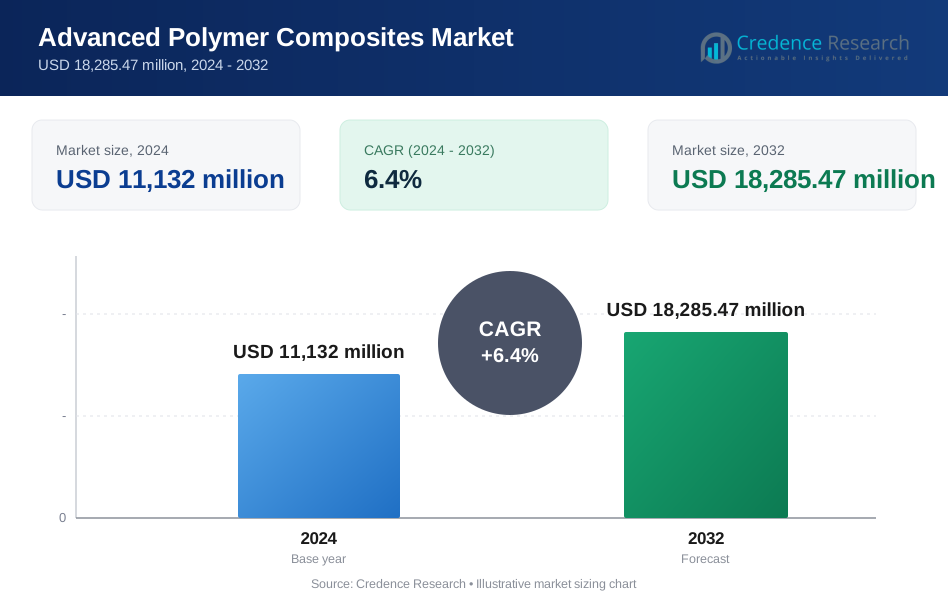
The Advanced Polymer Composites Market is projected to grow from USD 11,132 million in 2024 to USD 18,285.47 million by 2032, at a compound annual growth rate (CAGR) of 6.4%.
The Advanced Polymer Composites Market is driven by the increasing demand for lightweight, high-performance materials across industries such as aerospace, automotive, and construction. These materials offer superior strength, durability, and corrosion resistance, which contribute to their widespread adoption. The growing need for fuel efficiency in the automotive and aerospace sectors is accelerating the use of polymer composites in manufacturing, as they help reduce weight and improve energy efficiency. Additionally, the rise in infrastructure development and renewable energy projects is boosting market growth, with composites being used in wind turbine blades, pipes, and other critical components. Technological advancements, such as the development of new composite materials and improved manufacturing techniques, are also enhancing the performance and cost-effectiveness of these materials. Moreover, sustainability trends are prompting industries to adopt more eco-friendly solutions, driving further adoption of advanced polymer composites in various applications.
The Advanced Polymer Composites Market is experiencing significant growth across regions such as North America, Europe, and Asia Pacific, with each region contributing to the market’s expansion. North America holds a dominant position due to its strong aerospace and automotive sectors, while Europe is growing rapidly, driven by advancements in wind energy and automotive industries. Asia Pacific is also witnessing substantial growth, particularly in China, India, and Japan, with increasing investments in automotive, construction, and renewable energy. Key players such as BASF, SABIC, Hexcel, 3M, Momentive Performance Materials, and DuPont are leading the market, focusing on technological advancements and sustainability. These companies are actively expanding their presence across these regions to capitalize on emerging opportunities and to meet the rising demand for high-performance, lightweight materials.
Market Drivers
Increasing Demand for Lightweight Materials
One of the primary drivers of the Advanced Polymer Composites Market is the growing demand for lightweight materials across various industries. In aerospace, automotive, and transportation sectors, reducing weight is crucial for improving fuel efficiency and reducing emissions. For instance, the Boeing 787 Dreamliner utilizes advanced polymer composites for over 50% of its structure, including the fuselage and wings, significantly reducing the aircraft's weight and improving efficiency. Advanced polymer composites, with their high strength-to-weight ratio, offer an ideal solution. By replacing traditional materials like metals and alloys, these composites contribute to lighter and more fuel-efficient vehicles, planes, and machinery, meeting both environmental and performance standards.
Technological Advancements in Composite Materials
Technological innovations in polymer composites are another significant driver of market growth. The development of new, high-performance composite materials and improved manufacturing techniques has expanded the range of applications for these materials. An example is the development of carbon fiber reinforced polymers (CFRPs), used in high-performance sports equipment such as Formula 1 cars. Innovations in resin systems and fiber reinforcement have enhanced the strength, durability, and cost-effectiveness of polymer composites, revolutionizing performance capabilities and making them more accessible and competitive, enabling their use in industries that previously relied on conventional materials.
Growth of the Aerospace and Automotive Sectors
The aerospace and automotive sectors are two of the largest contributors to the demand for advanced polymer composites. In aerospace, there is a continuous need to reduce weight and improve fuel efficiency, making composites a preferred choice for components like fuselage structures, wings, and interior parts. For example, the BMW i3, which extensively uses polymer composites in its body panels and chassis, exemplifies the industry's shift towards lightweight, fuel-efficient vehicles. The push for electric vehicles, with a focus on enhancing energy efficiency, further accelerates this demand.
Sustainability and Environmental Considerations
Sustainability has become a key market driver for advanced polymer composites. As industries seek to reduce their carbon footprint and meet environmental regulations, polymer composites offer an eco-friendlier alternative to traditional materials. An example is the construction of wind turbine blades by companies like Vestas, who are developing recyclable composite materials that align with global sustainability goals, reducing the environmental impact of energy production. Their ability to improve energy efficiency and reduce material waste makes them an attractive choice. Furthermore, manufacturers are increasingly adopting recyclable composites to align with global sustainability goals, contributing to the overall growth of the market.
Market Trends
Adoption of Bio-based Composites
A significant trend in the Advanced Polymer Composites Market is the increasing adoption of bio-based composites. For instance, Companies such as BASF SE and DuPont are leading the way in turning to renewable and sustainable materials to replace traditional petroleum-based composites. Bio-based resins and natural fibers such as hemp, flax, and jute are gaining popularity due to their lower environmental impact and potential for recyclability. This trend is driven by growing demand for eco-friendly materials in industries such as automotive, construction, and aerospace.
Integration of Smart Technologies
Another notable trend is the integration of smart technologies into advanced polymer composites. For instance,Companies like Hexcel Corporation and Solvay are developing composites with embedded sensors and other smart capabilities to enhance the functionality of these materials. These composites can monitor structural health, detect damage, and communicate with external systems, providing real-time data that can improve performance and safety. This trend is particularly relevant in aerospace and automotive applications. Companies such as Boeing and General Motors are leveraging these technologies for enhanced safety and maintenance.
Increased Use in Electric Vehicles (EVs)
The growing shift toward electric vehicles (EVs) is driving the demand for advanced polymer composites. For instance, Toray Industries and Teijin Limited are essential for reducing the weight of EVs and improving their energy efficiency. Composites are increasingly being used in battery casings, structural components, and body panels to optimize the performance and range of electric vehicles. As the automotive industry focuses on enhancing sustainability and energy efficiency, the adoption of polymer composites by companies like Tesla and Nissan is a strategic move to boost vehicle performance.
Advanced Manufacturing Techniques
The adoption of advanced manufacturing techniques, such as 3D printing and automated fiber placement, is another key trend shaping the Advanced Polymer Composites Market. For example, Companies like Stratasys and Cincinnati Inc. are at the forefront of these technologies, enabling more precise, cost-effective production of complex composite components. The ability to produce customized and lightweight parts with reduced material waste is improving the efficiency and scalability of composite manufacturing. As these technologies evolve, they are likely to further drive the adoption of advanced polymer composites in various industries.
Market Challenges Analysis
High Production Costs
One of the key challenges faced by the Advanced Polymer Composites Market is the high production costs associated with these materials. The manufacturing processes for polymer composites, such as resin infusion, autoclave curing, and automated fiber placement, often require specialized equipment and expertise, which can significantly increase the overall production expenses. Moreover, the cost of raw materials, including high-quality fibers and resins, further contributes to the high price point of these composites. While these materials offer superior strength, durability, and performance, the initial investment required for production can be a barrier for widespread adoption, particularly in cost-sensitive industries such as automotive and construction. This challenge is exacerbated by the need for significant upfront capital to invest in advanced manufacturing facilities and technologies that can handle composite production efficiently. Although economies of scale can help reduce costs over time, the initial financial burden remains a significant obstacle for many companies.
Limited Recycling and Sustainability Options
Another significant challenge for the Advanced Polymer Composites Market is the limited recycling and sustainability options currently available for these materials. While polymer composites offer several advantages, such as enhanced performance and reduced weight, their disposal at the end of life remains problematic. Unlike metals or certain plastics, which can be recycled relatively easily, composites are more difficult to process and reuse. The lack of efficient and cost-effective recycling methods for polymer composites means that they are often sent to landfills, contributing to environmental waste. Additionally, the growing emphasis on sustainability within industries places pressure on manufacturers to find ways to make these materials more environmentally friendly. Although research is ongoing into developing recyclable composite materials, current options are limited, which hinders the ability of companies to fully meet sustainability targets.
Market Segmentation Analysis:
By Type
The Advanced Polymer Composites Market is segmented by type into continuous and discontinuous fibers. Continuous fiber composites are preferred in high-performance applications like aerospace and automotive, where strength and durability are paramount. Discontinuous fiber composites are more economical and commonly used in industries such as consumer goods and packaging.
By Application
In terms of application, the market is divided into aerospace, automotive, wind energy, construction, and others. Aerospace and automotive sectors lead in demand for lightweight, fuel-efficient materials, while wind energy is experiencing growth with composites used in turbine blades. These segments benefit from the strength, lightweight, and durability of polymer composites.
By Material
The key materials used in advanced polymer composites include carbon fiber, glass fiber, and aramid fiber. Carbon fiber composites, known for their strength-to-weight ratio, dominate high-performance industries. Glass fiber composites are cost-effective for automotive and construction applications, while aramid fibers offer durability and impact resistance, making them ideal for protective gear and defense applications.
Segments:
Based on Application
- Aerospace
- Automotive
- Construction
- Electronics
- Marine
Based on Type
- Thermosetting Polymer Composites
- Thermoplastic Polymer Composites
- Hybrid Polymer Composites
Based on Material
- Fiberglass
- Carbon Fiber
- Aramid Fiber
Based on the Geography:
- North America
- U.S.
- Canada
- Mexico
- Europe
- Germany
- France
- U.K.
- Italy
- Spain
- Rest of Europe
- Asia Pacific
- China
- Japan
- India
- South Korea
- South-east Asia
- Rest of Asia Pacific
- Latin America
- Brazil
- Argentina
- Rest of Latin America
- Middle East & Africa
- GCC Countries
- South Africa
- Rest of the Middle East and Africa
Regional Analysis
North America
North America is expected to hold a substantial share of the Advanced Polymer Composites Market in 2024, with an estimated market share of 40%. The region’s dominance is driven by its well-established aerospace and automotive industries, which rely heavily on lightweight, high-performance materials to enhance fuel efficiency and meet environmental standards. The United States, home to aerospace giants like Boeing and Lockheed Martin, significantly contributes to market demand, using advanced composites for aircraft production. Additionally, the automotive sector's shift towards electric vehicles and sustainable manufacturing practices further strengthens the region’s market position. The growing demand for energy-efficient solutions and the ongoing technological advancements in composite materials are anticipated to drive further growth, solidifying North America’s leadership in the market.
Europe
Europe is projected to account for 30% of the global Advanced Polymer Composites Market by 2024. This is largely due to the region’s significant investments in the aerospace, automotive, and renewable energy sectors, all of which are key drivers of polymer composite adoption. In aerospace, companies like Airbus are increasingly using composites for lightweight, fuel-efficient aircraft. The automotive industry’s focus on reducing emissions and producing energy-efficient vehicles is also boosting demand. Furthermore, Europe’s leadership in wind energy, particularly in turbine blade production, supports the growing need for high-performance polymer composites. Strict environmental regulations and sustainability goals across the European Union further propel the adoption of advanced composites, creating substantial growth opportunities for the region.
Asia Pacific
Asia Pacific is expected to experience rapid growth in the Advanced Polymer Composites Market, with a projected market share of 20% in 2024. The region’s strong industrialization, infrastructure development, and increasing focus on sustainability are key factors driving demand for polymer composites. Countries such as China, India, and Japan are heavily investing in sectors like automotive, construction, and renewable energy, which are expanding the adoption of advanced composites. In particular, China’s growth in wind energy infrastructure is boosting the demand for composites in turbine blades. The automotive industry in Asia is also undergoing a transformation, with rising production of electric vehicles that require lightweight materials for improved energy efficiency. These factors position Asia Pacific as a rapidly growing market with significant potential.
Key Player Analysis
- 3M
- Hexcel
- SABIC
- Momentive Performance Materials
- Teijin Limited
- BASF
- Owens Corning
- Cytec Solvay Group
- Arkema
- DuPont
Competitive Analysis
The Advanced Polymer Composites Market is highly competitive, with leading players like BASF, SABIC, Hexcel, 3M, Momentive Performance Materials, Cytec Solvay Group, Teijin Limited, DuPont, Arkema, and Owens Corning. These companies are continuously innovating and investing in research and development to strengthen their product portfolios and cater to the growing demand for high-performance, lightweight materials. Strategic partnerships, acquisitions, and regional expansions are key strategies employed by these players to maintain market dominance. They are also focusing on sustainable solutions and eco-friendly materials to meet environmental regulations and customer preferences. For instance, Hexcel and 3M are introducing advanced, cost-effective composites in response to these demands. The competitive landscape is further shaped by the increasing emphasis on renewable energy, automotive light weighting, and aerospace advancements, prompting these companies to introduce advanced, cost-effective composites. As the market evolves, innovation and sustainability will remain critical to staying ahead of the competition.
Recent Developments
- In September 2023, Teijin Ltd., has announced its intention to sell its whole investment in GH Craft Co. Ltd, an equity-method subsidiary of Teijin's composites business in Japan, to TIP Composite Co. Ltd (Tokyo) . The agreement will enable Teijin Ltd to expand its operations in other locations.
- In July 2023, The Gumi facility in Gyeongsangbuk-do, Korea, and the Spartanburg plant in South Carolina, both produce normal tow carbon fiber, according to a plan released by Toray Industries Inc. Beginning in 2025, the expenditures will contribute to a more than 20% increase in the company's yearly capacity to produce carbon fiber, reaching 35, 000 metric tons.
- In June 2023, Arkema expanded its high-performance polymer portfolio by acquiring a 54% controlling stake in PI Advanced Materials (PIAM), a leading global polyimide films manufacturer. The $803 million enterprise value deal enhances Arkema's position in consumer electronics and electric vehicles markets, with PIAM boasting over $215 million in sales, a 30% EBITDA margin, and top-notch manufacturing capabilities.
- In April 2023, Ulysse Nardin introduced the Diver Net Ops watch, incorporating Carbonium®, a sustainable carbon composite developed by Lavoisier Composites. This sustainable material reduces the environmental impact of manufacturing by using aerospace industry by-products, showcasing the growing trend of eco-friendly composites in consumer goods.
Market Concentration & Characteristics
The Advanced Polymer Composites Market exhibits a moderate to high level of market concentration, with key players dominating the industry, particularly in North America, Europe, and Asia Pacific. Large companies such as Toray Industries, Solvay, BASF, and Hexcel lead the market, leveraging their strong research and development capabilities, extensive distribution networks, and strategic partnerships. These companies are focused on innovation, product diversification, and enhancing manufacturing efficiency to cater to various applications across aerospace, automotive, and renewable energy sectors. The market is characterized by significant technological advancements, particularly in the development of sustainable, high-performance materials. Furthermore, the competitive landscape is shaped by the increasing demand for lightweight, fuel-efficient, and eco-friendly solutions, which drives continuous product development. The market is also seeing a shift toward advanced manufacturing methods such as 3D printing and automation, offering opportunities for smaller players to enter the market with innovative, cost-effective solutions.
Report Coverage
The research report offers an in-depth analysis based on Application, Material, Type, End-User and Geography. It details leading market players, providing an overview of their business, product offerings, investments, revenue streams, and key applications. Additionally, the report includes insights into the competitive environment, SWOT analysis, current market trends, as well as the primary drivers and constraints. Furthermore, it discusses various factors that have driven market expansion in recent years. The report also explores market dynamics, regulatory scenarios, and technological advancements that are shaping the industry. It assesses the impact of external factors and global economic changes on market growth. Lastly, it provides strategic recommendations for new entrants and established companies to navigate the complexities of the market.
Future Outlook
- The Advanced Polymer Composites Market is expected to experience steady growth due to increasing demand for lightweight, high-performance materials.
- Aerospace and automotive sectors will remain the primary drivers of market expansion, with a focus on fuel efficiency and emission reductions.
- The growing adoption of electric vehicles will continue to boost the demand for lightweight materials, especially in automotive manufacturing.
- Technological advancements in composite materials, including bio-based resins and fibers, will foster innovation and sustainability.
- Strong growth in renewable energy applications, especially wind turbine manufacturing, will further propel the market for polymer composites.
- Regional expansion, particularly in Asia Pacific, will increase market opportunities as industrialization and infrastructure development accelerate.
- Recycling and sustainability initiatives will become a central focus, with efforts to improve the end-of-life disposal of composites.
- The integration of smart technologies into polymer composites will open new applications in sectors like aerospace and automotive.
- Increased investment in R&D will lead to improved manufacturing processes and cost-effective composite production.
- Competitive pressures will intensify, prompting companies to adopt strategic partnerships, acquisitions, and mergers to strengthen market positions.
Request a Free Sample
Fill in your details and we'll send you a free sample report.
- Sample data tables & charts
- Research methodology
Need a Custom Version of This Report?
Tailor the scope, geography, or segments to your exact requirements.
- Custom geography or segment scope
- Direct access to our analyst team
Frequently Asked Questions
What is the current size of the Advanced Polymer Composites Market?
What factors are driving the growth of the Advanced Polymer Composites Market?
What are the key segments within the Advanced Polymer Composites Market?
What are some challenges faced by the Advanced Polymer Composites Market?
Who are the major players in the Advanced Polymer Composites Market?
Table of Content
Chapter 1. Report Introduction
- 1.1 Report Description & Purpose
- 1.1.1 Report Title & Market Definition
- 1.1.2 Unique Selling Propositions (USP) & Key Differentiators
- 1.1.3 Value Proposition for Stakeholders
- 1.2 Research Objectives
- 1.2.1 Market Sizing Objectives (Volume & Revenue)
- 1.2.2 Segmentation Objectives
- 1.2.3 Competitive Intelligence Objectives
- 1.2.4 Forecast & Scenario Objectives
- 1.3 Report Scope
- 1.3.1 Advanced Polymer Composites Scope – Types & Subtypes Covered
- 1.3.2 Geographic Scope – Regions & Countries Covered
- 1.3.3 Historical Period, Base Year & Forecast Period (2024; forecast to 2032)
- 1.3.4 Inclusions & Exclusions
- 1.4 HS Code & Classification Framework
- 1.5 Currency, Units & Pricing Basis
- 1.6 Target Stakeholders
- 1.7 Limitations & Assumptions
Chapter 2. Executive Summary
- 2.1 Global Advanced Polymer Composites Market Snapshot
- 2.1.1 Market Size – Historical (2024) & Forecast (2024-2032) (2024: USD 11,132 million → 2032: USD 18,285.47 million)
- 2.1.2 Volume & Revenue – Global Totals
- 2.1.3 Key Market Highlights – Top Five Facts
- 2.2 Advanced Polymer Composites Market Segmentation Snapshot
- 2.2.1 Market Split by Region – 2024 vs. 2032
- 2.3 Competitive Snapshot
- 2.3.1 Top 10 Players by Revenue Share – 2024
- 2.3.2 Top 10 Players by Volume Share – 2024
- 2.3.3 Recent Strategic Developments (18-Month Summary)
- 2.4 Key Investment Highlights & Strategic Conclusions
Chapter 3. Advanced Polymer Composites Market Dynamics & Industry Analysis
- 3.1 Market Overview & Context
- 3.1.1 Advanced Polymer Composites Market Position in the Broader Automotive Value Chain
- 3.1.2 OEM vs. Replacement Market Dynamics
- 3.1.3 Market Maturity & Development Stage by Region
- 3.2 Advanced Polymer Composites Market Drivers
- 3.3 Advanced Polymer Composites Market Restraints & Challenges
- 3.4 Advanced Polymer Composites Market Opportunities
- 3.5 Porter's Five Forces Analysis
- 3.5.1 Threat of New Entrants
- 3.5.2 Bargaining Power of Suppliers
- 3.5.3 Bargaining Power of Buyers
- 3.5.4 Threat of Substitutes
- 3.5.5 Competitive Rivalry – Intensity Assessment
- 3.6 Advanced Polymer Composites Value Chain Analysis
- 3.6.1 Upstream – Raw Material/Input Suppliers
- 3.6.1.1 Raw Material/Input 1
- 3.6.1.2 Raw Material/Input 2
- 3.6.1.3 Raw Material/Input 3
- 3.6.2 Midstream – Production/Manufacturing/Service Delivery
- 3.6.2.1 Production/Process Overview
- 3.6.2.2 Key Facility Locations & Capacity by Manufacturer
- 3.6.3 Downstream – Distribution & End Consumer
- 3.6.3.1 Primary Channel – B2B/OEM
- 3.6.3.2 Secondary Channels – Dealer, Retail, Online, Direct
- 3.6.4 Value Chain Profitability Analysis
- 3.6.1 Upstream – Raw Material/Input Suppliers
- 3.7 PESTEL Analysis
- 3.7.1 Political Factors
- 3.7.2 Economic Factors
- 3.7.3 Social Factors
- 3.7.4 Technological Factors
- 3.7.5 Environmental Factors
- 3.7.6 Legal Factors
- 3.8 Advanced Polymer Composites Supply Chain Analysis
- 3.8.1 Raw Material/Input Supply Risk Assessment
- 3.8.2 Manufacturing Concentration Risk (Geographic Exposure)
- 3.8.3 Trade Disruption Impact Analysis
- 3.9 Regulatory & Policy Landscape
Note: The regulatory and policy landscape section covers regulations based on their applicability to the market, Advanced Polymer Composites category, geography, and scope of the study. Only regulatory frameworks with a material impact on operations, compliance, trade, sustainability, or market access are analyzed in detail.
Chapter 4. Key Investment Pockets & Opportunity Analysis
- 4.1 Advanced Polymer Composites Market Attractiveness Analysis
- 4.1.1 By Region – Investment Attractiveness Matrix (Volume × CAGR)
- 4.2 Absolute Revenue Growth Opportunity
- 4.2.1 By Region – Absolute USD Growth Through 2032
- 4.3 Incremental Volume Opportunity
- 4.3.1 By Region – Incremental Volume Through 2032
- 4.3.2 Segment – Incremental Volume
- 4.4 Emerging Submarket Opportunity Deep Dive (Subject to Applicability)
- 4.5 Emerging Market Opportunity Scorecards
- 4.5.1 United States
- 4.5.2 Europe
- 4.5.3 Asia
- 4.5.4 Middle East & Africa
Note: Emerging Market Opportunity Scorecards will be included based on relevance and strategic importance. Regions listed are indicative and may vary depending on data availability and market dynamics.
Chapter 5. Advanced Polymer Composites Import-Export Analysis & Trade Flows
- 5.1 Global Trade Overview
- 5.1.1 Global Export Value by Country (2024)
- 5.1.2 Global Export Volume by Country (2024)
- 5.1.3 Global Import Value by Country (2024)
- 5.1.4 Global Import Volume by Country (2024)
- 5.1.5 Net Trade Balance by Country (2024)
- 5.2 Export Analysis – Segment
- 5.2.1 Type 1 (HS Code)
- 5.2.2 Type 2 (HS Code)
- 5.2.3 Type 3 (HS Code)
- 5.2.4 Type 4 (HS Code)
- 5.2.5 Type 5 (HS Code)
- 5.3 Import Analysis – Segment
- 5.3.1 Type 1 (HS Code)
- 5.3.2 Type 2 (HS Code)
- 5.3.3 Type 3 (HS Code)
- 5.3.4 Type 4 (HS Code)
- 5.3.5 Type 5 (HS Code)
- 5.4 Average Unit Trade Prices
- 5.4.1 Average Export Price – Segment & Country
- 5.4.2 Average Import Price – Segment & Source Country
- 5.4.3 Price Trends (2024)
- 5.5 Key Trade Route Analysis
- 5.5.1 Trade Route 1
- 5.5.2 Trade Route 2
- 5.5.3 Trade Route 3
- 5.5.4 Trade Route 4
- 5.5.5 Trade Route 5
- 5.6 Trade Policy Impact Assessment
- 5.6.1 US Anti-Dumping & Section 301 Tariffs
- 5.6.2 EU Customs Union Impact
- 5.6.3 Major Free Trade Agreements
- 5.6.4 USMCA Rules of Origin
Note: Trade policy analysis will be included only where relevant to the Advanced Polymer Composites market.
Chapter 6. Competitive Landscape & Company Benchmarking
- 6.1 Advanced Polymer Composites Market Concentration & Structure
- 6.1.1 Herfindahl-Hirschman Index (HHI) – vs. 2024
- 6.1.2 Tier 1, Tier 2 & Tier 3 Market Structure
- 6.1.3 Global, Regional & Local Player Dynamics
- 6.2 Advanced Polymer Composites Market Share Analysis – 2024
- 6.2.1 Global Revenue Share by Company
- 6.2.2 Global Volume Share by Company
- 6.2.3 Regional Revenue Share
- 6.2.4 Market Share Evolution ( vs. 2024)
- 6.2.5 OEM Segment Share by Company
- 6.2.6 Replacement Segment Share by Company
- 6.3 Production/Delivery Capacity & Facility Analysis
- 6.3.1 Global Installed Capacity
- 6.3.2 Capacity Utilization Rates
- 6.3.3 Production/Output Volume
- 6.3.4 Facility Locations & Capacity Map
- 6.3.5 Planned Capacity Additions
- 6.4 Advanced Polymer Composites Competitive Benchmarking Matrix
- 6.4.1 Revenue, Volume, CAGR & Profitability Comparison
- 6.4.2 Channel Revenue Mix
- 6.4.3 Geographic Revenue Exposure
- 6.4.4 R&D Intensity
- 6.4.5 Sustainability Maturity
- 6.5 Strategic Developments in Advanced Polymer Composites (Last 24 Months)
- 6.5.1 Mergers, Acquisitions & Divestments
- 6.5.2 New Advanced Polymer Composites Launches
- 6.5.3 Facility Expansions
- 6.5.4 Strategic Alliances, Joint Ventures & Partnerships
- 6.5.5 Distribution Expansion & Market Entry
- 6.5.6 Sustainability & ESG Initiatives
- 6.6 Competitive Strategy Mapping
- 6.6.1 Leader, Challenger, Follower & Niche Classification
- 6.6.2 Pricing Strategy Comparison
- 6.6.3 Channel Strategy Matrix
Note: Strategic developments are included based on their materiality and the availability of reliable information.
Chapter 7. Global Advanced Polymer Composites Market – By Distribution Channel
- 7.1 Segment Overview
- 7.1.1 Volume & Revenue Split by Channel (2024 & 2032)
- 7.1.2 Channel Mix Evolution (2024-2032)
Chapter 8. Regional Market Analysis – Global Overview
- 8.1 Global Regional Overview
- 8.1.1 Regional Volume Share
- 8.1.2 Regional Revenue Share
- 8.1.3 Regional Volume by Region
- 8.1.4 Regional Revenue by Region
- 8.1.5 Regional Forecast Through 2032
- 8.2 Cross-Regional Segment Analysis
- 8.2.1 By Distribution Channel
- 8.2.2 By Brand/Price Tier
Chapter 9. North America Advanced Polymer Composites Market
- 9.1 United States
- 9.2 Canada
- 9.3 Mexico
Chapter 10. Europe Advanced Polymer Composites Market
- 10.1 Germany
- 10.2 France
- 10.3 Italy
- 10.4 United Kingdom
- 10.5 Spain
- 10.6 Poland
- 10.7 Russia
- 10.8 Netherlands
- 10.9 Belgium
- 10.10 Sweden
- 10.11 Denmark
- 10.12 Norway
- 10.13 Rest of Europe
Chapter 11. Asia Pacific Advanced Polymer Composites Market
- 11.1 China
- 11.2 India
- 11.3 Japan
- 11.4 South Korea
- 11.5 Thailand
- 11.6 Indonesia
- 11.7 Vietnam
- 11.8 Malaysia
- 11.9 Australia
- 11.10 Rest of Asia Pacific
Chapter 12. Latin America Advanced Polymer Composites Market
- 12.1 Brazil
- 12.2 Argentina
- 12.3 Colombia
- 12.4 Chile
- 12.5 Rest of Latin America
Chapter 13. Middle East Advanced Polymer Composites Market
- 13.1 Saudi Arabia
- 13.2 United Arab Emirates
- 13.3 Turkey
- 13.4 Israel
- 13.5 Iran
- 13.6 Rest of the Middle East
Chapter 14. Africa Advanced Polymer Composites Market
- 14.1 South Africa
- 14.2 Egypt
- 14.3 Nigeria
- 14.4 Morocco
- 14.5 Rest of Africa
Chapter 15. Advanced Polymer Composites Company Profiles
- 15.1 [Company 01]
- 15.1.1 Company Overview
- 15.1.2 Key Management Personnel
- 15.1.3 Products & Services Portfolio
- 15.1.4 Financial Performance
- 15.1.5 Key Market Focus & Geographic Presence
- 15.1.6 Recent Developments & Strategic Initiatives
Note: The company profile list is preliminary and may change based on research findings, market developments, data availability, and client requirements.
Chapter 16. Appendices
- Appendix A – List of Abbreviations & Acronyms
- Appendix B – Industry Classification Code Reference – Full Series
- Appendix C – Production & Capacity Data Tables
- Appendix D – End-Use & Demand Base Tables
- Appendix E – Consumption & Replacement Rate Assumptions
- Appendix F – ASP Reference Tables
- Appendix G – Manufacturing & Facility Database
- Appendix H – Import-Export Data Tables
- Appendix I – Regulatory Summary Tables
- Appendix J – Primary Research Participant List (Anonymized)
- Appendix K – Primary Research Questionnaire Framework
- Appendix L – Data Sources & Bibliography
- Appendix M – Market Size Divergence & Source Comparison
Chapter 17. Research Methodology
- 17.1 Research Framework & Philosophy
- 17.2 Secondary Research – Sources, Hierarchy & Data Extraction
- 17.3 Data Modeling – Bottom-Up & Top-Down Market Sizing
- 17.4 Primary Research – Stakeholder Framework, LOI & Sample Sizes
- 17.5 Forecast Methodology – Regression, Scenario & Sensitivity Analysis
- 17.6 Quality Control – Four-Layer Validation Framework
- 17.7 Limitations & Standard Assumptions
- 17.8 Disclaimer
