
Market Overview:
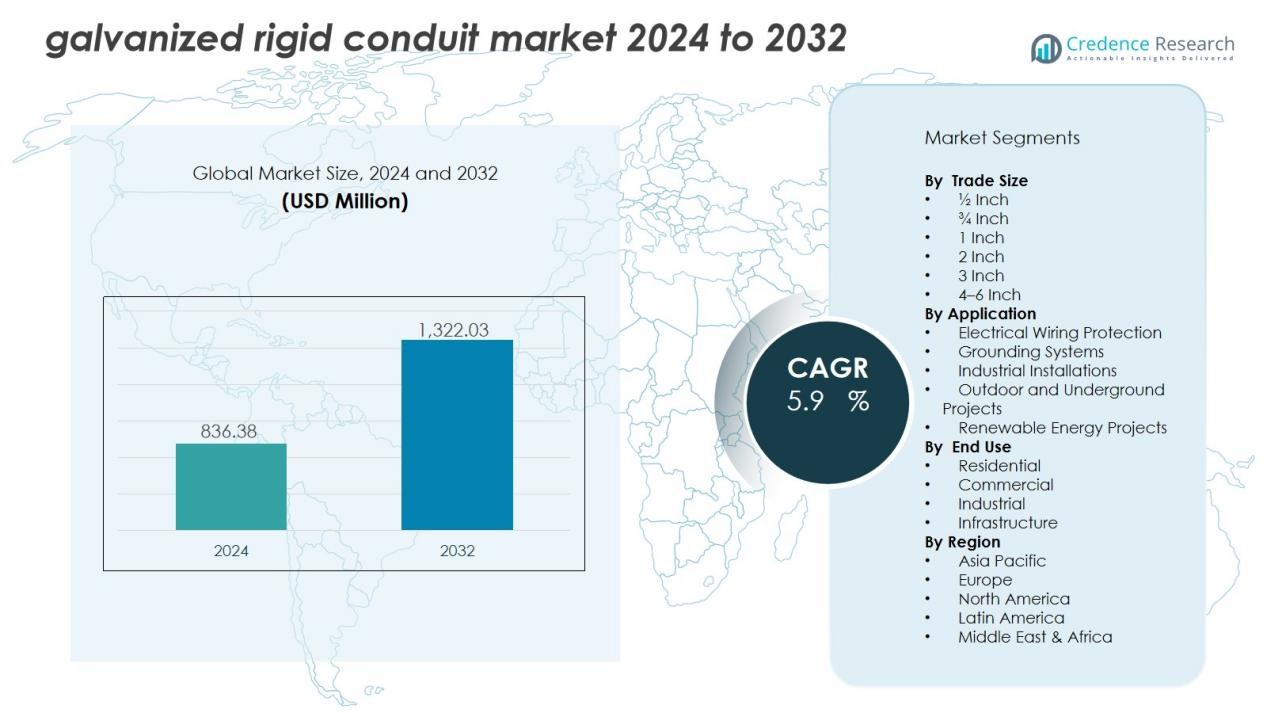
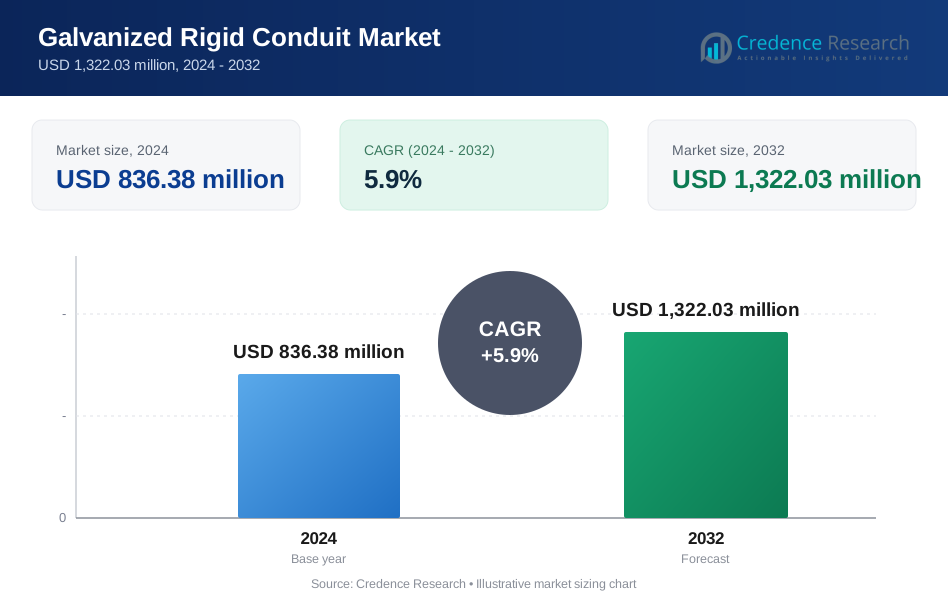
The galvanized rigid conduit market size was valued at USD 836.38 million in 2024 and is anticipated to reach USD 1,322.03 million by 2032, at a CAGR of 5.9% during the forecast period (2024-2032).
| REPORT ATTRIBUTE | DETAILS |
|---|---|
| Historical Period | 2020-2023 |
| Base Year | 2024 |
| Forecast Period | 2025-2032 |
| Galvanized Rigid Conduit Market Size 2024 | USD 836.38 Million |
| Galvanized Rigid Conduit Market, CAGR | 5.9% |
| Galvanized Rigid Conduit Market Size 2032 | USD 1,322.03 Million |
Growth is driven by stringent safety regulations, the need for durable wiring solutions, and rising urbanization. GRC offers superior strength, corrosion resistance, and grounding capabilities, making it the preferred choice for high-risk environments and outdoor applications. Technological innovations in coatings and material processing are further enhancing product life and reducing maintenance costs. Additionally, the push for energy-efficient buildings and smart infrastructure is creating new opportunities for conduit installations.
Regionally, North America leads due to advanced construction standards, strong regulatory frameworks, and large-scale infrastructure renewal. Europe follows with demand driven by modernization of old structures and emphasis on safety compliance. Asia-Pacific is projected to grow fastest, supported by rapid urbanization, industrialization, and government-led infrastructure initiatives in China, India, and Southeast Asia. Meanwhile, Latin America and the Middle East & Africa are gradually expanding markets, supported by growing construction activities and urban development projects.
Market Insights:
- The galvanized rigid conduit market was valued at USD 836.38 million in 2024 and is projected to reach USD 1,322.03 million by 2032 at a CAGR of 5.9%.
- Rising construction and infrastructure projects across residential, commercial, and industrial sectors continue to fuel demand.
- Strict safety regulations and compliance standards push contractors to adopt GRC for reliable electrical protection.
- Rapid industrialization and the growth of manufacturing facilities strengthen the need for heavy-duty conduit systems.
- Contractors favor GRC for its durability, corrosion resistance, and long-term cost-saving benefits in harsh environments.
- High installation costs and the presence of PVC or flexible alternatives remain key challenges.
- Asia-Pacific led with 41% share in 2024, followed by North America at 32% and Europe at 18%.
Market Drivers:
Rising Demand from Construction and Infrastructure Development:
The galvanized rigid conduit market benefits from continuous expansion in global construction and infrastructure projects. Residential, commercial, and industrial buildings require strong wiring protection systems to meet safety codes. GRC offers durability and resistance to mechanical stress, making it a standard choice for large projects. Growing investments in smart cities and transport infrastructure also enhance demand. The market continues to gain from stricter building standards in developed economies.
Increasing Emphasis on Safety and Compliance Standards:
Safety regulations in electrical installations strongly drive the galvanized rigid conduit market. GRC provides superior grounding and corrosion resistance, helping reduce risks of fire and electrical hazards. Governments and regulatory bodies enforce strict codes, pushing contractors to adopt compliant materials. It also assures long-term safety, reducing liability for builders and operators. Compliance pressure makes GRC a necessary product across high-voltage and industrial applications.
- For instance, Anamet Electrical’s Sealtite® 316 stainless steel conduit fittings showed no red rust after 672 hours of neutral salt spray testing per ASTM B117, meeting UL 514B requirements for corrosion resistance.
Rising Industrialization and Expansion of Manufacturing Facilities:
Rapid industrialization in emerging economies expands opportunities for the galvanized rigid conduit market. Manufacturing plants and industrial complexes need reliable conduit systems to support heavy-duty power distribution. It ensures protection against physical damage and chemical exposure in harsh environments. Growing investments in industrial corridors, oil refineries, and large-scale factories boost consumption. GRC’s strength and long service life make it ideal for industrial applications.
- For instance, Thomas & Betts COND1/2-G Ocal PVC-coated rigid conduit features a total wall thickness of 0.14 inches, which includes the galvanized steel and the 0.04-inch (40 mil) PVC coating
Growing Preference for Durable and Low-Maintenance Solutions:
Contractors and end-users favor materials that reduce replacement and maintenance costs. The galvanized rigid conduit market aligns with this demand by offering long-term durability. It resists rust and harsh weather, ensuring stable performance in outdoor and underground installations. Rising awareness about lifecycle cost savings encourages wider adoption. Infrastructure owners prefer GRC for its combination of reliability, strength, and cost efficiency.
Market Trends:
Growing Shift Toward Sustainable and Corrosion-Resistant Materials:
The galvanized rigid conduit market is witnessing a steady trend toward sustainability and advanced material solutions. Manufacturers focus on eco-friendly galvanization processes that minimize environmental impact while maintaining product strength. Demand for corrosion-resistant coatings continues to rise in regions with high humidity and harsh climates. It allows contractors to extend product life and reduce replacement frequency, improving overall cost efficiency. Increasing awareness of green construction practices further drives interest in recyclable and environmentally safe materials. Global players invest in research and development to deliver conduits that align with evolving sustainability standards and building codes.
- For Instance, Tata Steel’s Continuous Galvanizing Line-1 (CGL-1) at Kalinganagar is equipped with a third-generation air-knife system.
Integration with Smart Infrastructure and Advanced Construction Practices:
The galvanized rigid conduit market also benefits from trends in smart infrastructure and advanced building technologies. GRC plays a vital role in supporting reliable electrical pathways for modern buildings and industrial facilities. It ensures protection for integrated systems, including automation, IoT-enabled devices, and renewable energy connections. The growing adoption of prefabricated and modular construction methods increases the need for durable conduit solutions that can be installed quickly. Demand also rises in large-scale projects involving data centers, transportation hubs, and energy facilities. Contractors and developers view GRC as a long-term solution that supports safety and high-performance standards in advanced infrastructure projects.
- For Instance, The San Diego International Airport's Terminal 1 is undergoing a modernization that includes a 1.2 million square-foot terminal space. This new terminal features 19 gates that are scheduled to open in 2025
Market Challenges Analysis:
High Installation Costs and Availability of Alternatives:
The galvanized rigid conduit market faces challenges from high installation and material costs. Contractors often prefer flexible or lightweight alternatives that reduce labor expenses. It demands specialized tools and skilled labor, which raises overall project costs. Price-sensitive markets in developing regions often shift toward PVC or flexible conduits. These substitutes offer easier handling and faster installation, making them attractive despite lower durability. High upfront expenses limit GRC adoption in small-scale and budget-driven projects.
Supply Chain Disruptions and Raw Material Volatility:
The galvanized rigid conduit market also struggles with supply chain disruptions and steel price fluctuations. Volatile raw material costs directly impact production expenses and profit margins for manufacturers. It creates uncertainty for contractors planning long-term infrastructure investments. Global supply issues, including shipping delays and trade restrictions, further increase risks. Dependence on zinc and steel imports in certain regions adds pressure to balance costs. These challenges highlight the need for diversified sourcing and stronger supply chain resilience.
Market Opportunities:
Expansion of Smart Cities and Renewable Energy Projects:
The galvanized rigid conduit market holds strong opportunities in smart city and renewable energy projects. Governments invest heavily in urban infrastructure, transportation networks, and sustainable housing. It ensures reliable electrical protection in solar farms, wind energy plants, and EV charging stations. Rising adoption of renewable energy drives the need for robust conduit systems to handle high-capacity wiring. Demand also grows in large infrastructure projects requiring compliance with strict safety codes. Global initiatives promoting clean energy create long-term growth potential for GRC manufacturers.
Growing Demand in Emerging Economies and Industrial Corridors:
The galvanized rigid conduit market also benefits from rapid growth in emerging economies. Expanding industrial corridors in Asia-Pacific, Latin America, and Africa require durable electrical infrastructure. It offers strong advantages for factories, warehouses, and commercial complexes needing reliable power distribution. Rising foreign direct investments in manufacturing and construction projects support broader market penetration. Urbanization and government-led housing schemes further increase demand for GRC. These regions represent high-potential opportunities for global players seeking long-term expansion.
Market Segmentation Analysis:
By Trade Size:
The galvanized rigid conduit market is segmented into trade sizes ranging from half-inch to six inches. Demand is highest for one-inch and two-inch conduits, widely used in commercial and residential wiring projects. It provides strong mechanical protection for electrical systems, ensuring compliance with safety codes. Larger sizes serve industrial plants and infrastructure projects requiring heavy-duty wiring. Smaller trade sizes remain popular for low-voltage applications and space-constrained installations. Growing investments in urban housing and industrial corridors sustain demand across all trade sizes.
- For instance, Thomas & Betts COND1SS rigid metal conduit (trade size 1") features an exact inside diameter of 1.049 inches.
By Application:
Applications of GRC include electrical protection, grounding, and mechanical shielding in diverse settings. The galvanized rigid conduit market sees strong adoption in construction projects where durability is critical. It supports power distribution in data centers, renewable energy plants, and large commercial buildings. Industrial facilities use GRC to protect wiring against physical damage and chemical exposure. Outdoor and underground installations also prefer GRC due to its corrosion-resistant properties. Demand from renewable energy projects further strengthens application growth.
- For Instance, Thomas & Betts’ series 5302 is a sealing ring used with rigid and IMC conduits. Its purpose is to provide a liquid-tight and dust-tight seal for fittings at enclosures, ensuring a reliable barrier against environmental elements. It is not rated to carry ground-fault currents
By End Use:
End-use segments include residential, commercial, and industrial sectors. The galvanized rigid conduit market records strong uptake in commercial and industrial settings where safety standards are stringent. It plays a crucial role in factories, warehouses, and transportation infrastructure requiring reliable electrical distribution. Residential demand continues to grow with housing development projects in emerging economies. Contractors and developers rely on GRC for its durability, safety, and long-term cost efficiency. Its versatility ensures adoption across diverse end-use industries.
Segmentations:
By Trade Size:
- ½ Inch
- ¾ Inch
- 1 Inch
- 2 Inch
- 3 Inch
- 4–6 Inch
By Application:
- Electrical Wiring Protection
- Grounding Systems
- Industrial Installations
- Outdoor and Underground Projects
- Renewable Energy Projects
By End Use:
- Residential
- Commercial
- Industrial
- Infrastructure
By Region:
- North America
- U.S.
- Canada
- Mexico
- Europe
- Germany
- France
- U.K.
- Italy
- Spain
- Rest of Europe
- Asia Pacific
- China
- Japan
- India
- South Korea
- South-east Asia
- Rest of Asia Pacific
- Latin America
- Brazil
- Argentina
- Rest of Latin America
- Middle East & Africa
- GCC Countries
- South Africa
- Rest of the Middle East and Africa
Regional Analysis:
North America:
North America held 32% market share in 2024, supported by strict building codes and advanced infrastructure. The galvanized rigid conduit market in this region benefits from large-scale construction and retrofit projects. It is widely used in commercial complexes, industrial facilities, and government infrastructure upgrades. Rising demand for energy-efficient buildings further accelerates adoption across urban centers. Regulatory emphasis on electrical safety standards drives consistent replacement and installation of GRC. Strong participation of domestic manufacturers ensures reliable supply and steady growth.
Asia-Pacific:
Asia-Pacific accounted for 41% market share in 2024, making it the largest regional contributor. The galvanized rigid conduit market benefits from rapid urbanization, industrialization, and government-led infrastructure initiatives. It sees high usage in housing schemes, industrial corridors, and renewable energy projects. Rising investments in manufacturing facilities across China, India, and Southeast Asia enhance demand. Strong population growth and smart city projects add long-term expansion opportunities. Local producers and international suppliers actively compete, pushing innovation and cost efficiency.
Europe, Latin America, and Middle East & Africa:
Europe held 18% market share in 2024, driven by modernization of outdated infrastructure and strict safety regulations. The galvanized rigid conduit market in Latin America captured 5% share, supported by infrastructure expansion and rising industrial activities. It shows growth in Middle East & Africa with 4% share, aided by urban development and energy projects. Demand in these regions is reinforced by government policies promoting construction and foreign direct investment. The need for durable and low-maintenance conduits ensures steady adoption across key industries. Global players continue to strengthen regional networks to capture long-term opportunities.
Key Player Analysis:
- Anamet Electrical
- Atkore
- American Conduit
- Flexa
- Gibson Stainless & Specialty
- Legrand
- Nucor Tubular Products
- HellermannTyton
- Schneider Electric
- United Pipe & Steel
- Techno Flex
Competitive Analysis:
The galvanized rigid conduit market is highly competitive, shaped by global and regional manufacturers with strong product portfolios. Key players include Anamet Electrical, Atkore, American Conduit, Flexa, Gibson Stainless & Specialty, Legrand, Nucor Tubular Products, and HellermannTyton. These companies compete through product innovation, advanced coatings, and reliable distribution networks. It remains driven by the need for compliance with strict safety standards, pushing firms to improve performance and durability. Strategic mergers, acquisitions, and partnerships help players expand their market presence and address regional demand. Companies also focus on sustainability and cost efficiency to attract contractors and developers in both mature and emerging markets. The market’s competitive nature ensures continuous investment in technology and manufacturing capacity to support long-term growth.
Recent Developments:
- In August 2025, Atkore announced its third quarter 2025 financial results, reporting net sales of $735 million and maintaining a full-year adjusted EBITDA outlook midpoint of $400 million.
- In July 2025, Atkore’s Board of Directors approved a quarterly dividend payment of $0.33 per share of common stock, payable on August 29, 2025, to stockholders of record on August 19, 2025.
Report Coverage:
The research report offers an in-depth analysis based on Trade Size, Application, End Use and Region. It details leading Market players, providing an overview of their business, product offerings, investments, revenue streams, and key applications. Additionally, the report includes insights into the competitive environment, SWOT analysis, current Market trends, as well as the primary drivers and constraints. Furthermore, it discusses various factors that have driven Market expansion in recent years. The report also explores Market dynamics, regulatory scenarios, and technological advancements that are shaping the industry. It assesses the impact of external factors and global economic changes on Market growth. Lastly, it provides strategic recommendations for new entrants and established companies to navigate the complexities of the Market.
Future Outlook:
- Growing demand from infrastructure and commercial construction projects will strengthen long-term adoption of galvanized rigid conduit.
- Urbanization and housing development programs in emerging economies will boost installations across residential sectors.
- The focus on renewable energy projects, including solar and wind farms, will increase conduit usage.
- Smart city initiatives will create new opportunities for durable and safe electrical conduit systems.
- Industrial expansion in manufacturing hubs will drive higher consumption in heavy-duty applications.
- Regulatory standards for electrical safety and fire protection will continue to favor GRC adoption.
- Technological improvements in galvanization and coatings will enhance product durability and reduce lifecycle costs.
- Supply chain diversification by manufacturers will reduce risks linked to raw material volatility.
- Investments in prefabricated and modular construction will support greater reliance on rigid conduit systems.
- Rising awareness of long-term cost savings will make GRC a preferred choice for contractors and developers.
Request a Free Sample
Fill in your details and we'll send you a free sample report.
- Sample data tables & charts
- Research methodology
Need a Custom Version of This Report?
Tailor the scope, geography, or segments to your exact requirements.
- Custom geography or segment scope
- Direct access to our analyst team
Frequently Asked Questions
What is the current market size for the galvanized rigid conduit market, and what is its projected size in 2032?
At what Compound Annual Growth Rate is the galvanized rigid conduit market projected to grow between 2024 and 2032?
Which galvanized rigid conduit market segment held the largest share in 2024?
What are the primary factors fueling the growth of the galvanized rigid conduit market?
Who are the leading companies in the galvanized rigid conduit market?
Which region commanded the largest share of the galvanized rigid conduit market in 2024?
Table of Content
Chapter 1. Report Introduction
- 1.1 Report Description & Purpose
- 1.1.1 Report Title & Market Definition
- 1.1.2 Unique Selling Propositions (USP) & Key Differentiators
- 1.1.3 Value Proposition for Stakeholders
- 1.2 Research Objectives
- 1.2.1 Market Sizing Objectives (Volume & Revenue)
- 1.2.2 Segmentation Objectives
- 1.2.3 Competitive Intelligence Objectives
- 1.2.4 Forecast & Scenario Objectives
- 1.3 Report Scope
- 1.3.1 Galvanized Rigid Conduit Scope – Types & Subtypes Covered
- 1.3.2 Geographic Scope – Regions & Countries Covered
- 1.3.3 Historical Period, Base Year & Forecast Period (2024; forecast to 2032)
- 1.3.4 Inclusions & Exclusions
- 1.4 HS Code & Classification Framework
- 1.5 Currency, Units & Pricing Basis
- 1.6 Target Stakeholders
- 1.7 Limitations & Assumptions
Chapter 2. Executive Summary
- 2.1 Global Galvanized Rigid Conduit Market Snapshot
- 2.1.1 Market Size – Historical (2024) & Forecast (2024-2032) (2024: USD 836.38 million → 2032: USD 1,322.03 million)
- 2.1.2 Volume & Revenue – Global Totals
- 2.1.3 Key Market Highlights – Top Five Facts
- 2.2 Galvanized Rigid Conduit Market Segmentation Snapshot
- 2.2.1 Market Split by Region – 2024 vs. 2032
- 2.3 Competitive Snapshot
- 2.3.1 Top 10 Players by Revenue Share – 2024
- 2.3.2 Top 10 Players by Volume Share – 2024
- 2.3.3 Recent Strategic Developments (18-Month Summary)
- 2.4 Key Investment Highlights & Strategic Conclusions
Chapter 3. Galvanized Rigid Conduit Market Dynamics & Industry Analysis
- 3.1 Market Overview & Context
- 3.1.1 Galvanized Rigid Conduit Market Position in the Broader Automotive Value Chain
- 3.1.2 OEM vs. Replacement Market Dynamics
- 3.1.3 Market Maturity & Development Stage by Region
- 3.2 Galvanized Rigid Conduit Market Drivers
- 3.3 Galvanized Rigid Conduit Market Restraints & Challenges
- 3.4 Galvanized Rigid Conduit Market Opportunities
- 3.5 Porter's Five Forces Analysis
- 3.5.1 Threat of New Entrants
- 3.5.2 Bargaining Power of Suppliers
- 3.5.3 Bargaining Power of Buyers
- 3.5.4 Threat of Substitutes
- 3.5.5 Competitive Rivalry – Intensity Assessment
- 3.6 Galvanized Rigid Conduit Value Chain Analysis
- 3.6.1 Upstream – Raw Material/Input Suppliers
- 3.6.1.1 Raw Material/Input 1
- 3.6.1.2 Raw Material/Input 2
- 3.6.1.3 Raw Material/Input 3
- 3.6.2 Midstream – Production/Manufacturing/Service Delivery
- 3.6.2.1 Production/Process Overview
- 3.6.2.2 Key Facility Locations & Capacity by Manufacturer
- 3.6.3 Downstream – Distribution & End Consumer
- 3.6.3.1 Primary Channel – B2B/OEM
- 3.6.3.2 Secondary Channels – Dealer, Retail, Online, Direct
- 3.6.4 Value Chain Profitability Analysis
- 3.6.1 Upstream – Raw Material/Input Suppliers
- 3.7 PESTEL Analysis
- 3.7.1 Political Factors
- 3.7.2 Economic Factors
- 3.7.3 Social Factors
- 3.7.4 Technological Factors
- 3.7.5 Environmental Factors
- 3.7.6 Legal Factors
- 3.8 Galvanized Rigid Conduit Supply Chain Analysis
- 3.8.1 Raw Material/Input Supply Risk Assessment
- 3.8.2 Manufacturing Concentration Risk (Geographic Exposure)
- 3.8.3 Trade Disruption Impact Analysis
- 3.9 Regulatory & Policy Landscape
Note: The regulatory and policy landscape section covers regulations based on their applicability to the market, Galvanized Rigid Conduit category, geography, and scope of the study. Only regulatory frameworks with a material impact on operations, compliance, trade, sustainability, or market access are analyzed in detail.
Chapter 4. Key Investment Pockets & Opportunity Analysis
- 4.1 Galvanized Rigid Conduit Market Attractiveness Analysis
- 4.1.1 By Region – Investment Attractiveness Matrix (Volume × CAGR)
- 4.2 Absolute Revenue Growth Opportunity
- 4.2.1 By Region – Absolute USD Growth Through 2032
- 4.3 Incremental Volume Opportunity
- 4.3.1 By Region – Incremental Volume Through 2032
- 4.3.2 Segment – Incremental Volume
- 4.4 Emerging Submarket Opportunity Deep Dive (Subject to Applicability)
- 4.5 Emerging Market Opportunity Scorecards
- 4.5.1 United States
- 4.5.2 Europe
- 4.5.3 Asia
- 4.5.4 Middle East & Africa
Note: Emerging Market Opportunity Scorecards will be included based on relevance and strategic importance. Regions listed are indicative and may vary depending on data availability and market dynamics.
Chapter 5. Galvanized Rigid Conduit Import-Export Analysis & Trade Flows
- 5.1 Global Trade Overview
- 5.1.1 Global Export Value by Country (2024)
- 5.1.2 Global Export Volume by Country (2024)
- 5.1.3 Global Import Value by Country (2024)
- 5.1.4 Global Import Volume by Country (2024)
- 5.1.5 Net Trade Balance by Country (2024)
- 5.2 Export Analysis – Segment
- 5.2.1 Type 1 (HS Code)
- 5.2.2 Type 2 (HS Code)
- 5.2.3 Type 3 (HS Code)
- 5.2.4 Type 4 (HS Code)
- 5.2.5 Type 5 (HS Code)
- 5.3 Import Analysis – Segment
- 5.3.1 Type 1 (HS Code)
- 5.3.2 Type 2 (HS Code)
- 5.3.3 Type 3 (HS Code)
- 5.3.4 Type 4 (HS Code)
- 5.3.5 Type 5 (HS Code)
- 5.4 Average Unit Trade Prices
- 5.4.1 Average Export Price – Segment & Country
- 5.4.2 Average Import Price – Segment & Source Country
- 5.4.3 Price Trends (2024)
- 5.5 Key Trade Route Analysis
- 5.5.1 Trade Route 1
- 5.5.2 Trade Route 2
- 5.5.3 Trade Route 3
- 5.5.4 Trade Route 4
- 5.5.5 Trade Route 5
- 5.6 Trade Policy Impact Assessment
- 5.6.1 US Anti-Dumping & Section 301 Tariffs
- 5.6.2 EU Customs Union Impact
- 5.6.3 Major Free Trade Agreements
- 5.6.4 USMCA Rules of Origin
Note: Trade policy analysis will be included only where relevant to the Galvanized Rigid Conduit market.
Chapter 6. Competitive Landscape & Company Benchmarking
- 6.1 Galvanized Rigid Conduit Market Concentration & Structure
- 6.1.1 Herfindahl-Hirschman Index (HHI) – vs. 2024
- 6.1.2 Tier 1, Tier 2 & Tier 3 Market Structure
- 6.1.3 Global, Regional & Local Player Dynamics
- 6.2 Galvanized Rigid Conduit Market Share Analysis – 2024
- 6.2.1 Global Revenue Share by Company
- 6.2.2 Global Volume Share by Company
- 6.2.3 Regional Revenue Share
- 6.2.4 Market Share Evolution ( vs. 2024)
- 6.2.5 OEM Segment Share by Company
- 6.2.6 Replacement Segment Share by Company
- 6.3 Production/Delivery Capacity & Facility Analysis
- 6.3.1 Global Installed Capacity
- 6.3.2 Capacity Utilization Rates
- 6.3.3 Production/Output Volume
- 6.3.4 Facility Locations & Capacity Map
- 6.3.5 Planned Capacity Additions
- 6.4 Galvanized Rigid Conduit Competitive Benchmarking Matrix
- 6.4.1 Revenue, Volume, CAGR & Profitability Comparison
- 6.4.2 Channel Revenue Mix
- 6.4.3 Geographic Revenue Exposure
- 6.4.4 R&D Intensity
- 6.4.5 Sustainability Maturity
- 6.5 Strategic Developments in Galvanized Rigid Conduit (Last 24 Months)
- 6.5.1 Mergers, Acquisitions & Divestments
- 6.5.2 New Galvanized Rigid Conduit Launches
- 6.5.3 Facility Expansions
- 6.5.4 Strategic Alliances, Joint Ventures & Partnerships
- 6.5.5 Distribution Expansion & Market Entry
- 6.5.6 Sustainability & ESG Initiatives
- 6.6 Competitive Strategy Mapping
- 6.6.1 Leader, Challenger, Follower & Niche Classification
- 6.6.2 Pricing Strategy Comparison
- 6.6.3 Channel Strategy Matrix
Note: Strategic developments are included based on their materiality and the availability of reliable information.
Chapter 7. Global Galvanized Rigid Conduit Market – By Distribution Channel
- 7.1 Segment Overview
- 7.1.1 Volume & Revenue Split by Channel (2024 & 2032)
- 7.1.2 Channel Mix Evolution (2024-2032)
Chapter 8. Regional Market Analysis – Global Overview
- 8.1 Global Regional Overview
- 8.1.1 Regional Volume Share
- 8.1.2 Regional Revenue Share
- 8.1.3 Regional Volume by Region
- 8.1.4 Regional Revenue by Region
- 8.1.5 Regional Forecast Through 2032
- 8.2 Cross-Regional Segment Analysis
- 8.2.1 By Distribution Channel
- 8.2.2 By Brand/Price Tier
Chapter 9. North America Galvanized Rigid Conduit Market
- 9.1 United States
- 9.2 Canada
- 9.3 Mexico
Chapter 10. Europe Galvanized Rigid Conduit Market
- 10.1 Germany
- 10.2 France
- 10.3 Italy
- 10.4 United Kingdom
- 10.5 Spain
- 10.6 Poland
- 10.7 Russia
- 10.8 Netherlands
- 10.9 Belgium
- 10.10 Sweden
- 10.11 Denmark
- 10.12 Norway
- 10.13 Rest of Europe
Chapter 11. Asia Pacific Galvanized Rigid Conduit Market
- 11.1 China
- 11.2 India
- 11.3 Japan
- 11.4 South Korea
- 11.5 Thailand
- 11.6 Indonesia
- 11.7 Vietnam
- 11.8 Malaysia
- 11.9 Australia
- 11.10 Rest of Asia Pacific
Chapter 12. Latin America Galvanized Rigid Conduit Market
- 12.1 Brazil
- 12.2 Argentina
- 12.3 Colombia
- 12.4 Chile
- 12.5 Rest of Latin America
Chapter 13. Middle East Galvanized Rigid Conduit Market
- 13.1 Saudi Arabia
- 13.2 United Arab Emirates
- 13.3 Turkey
- 13.4 Israel
- 13.5 Iran
- 13.6 Rest of the Middle East
Chapter 14. Africa Galvanized Rigid Conduit Market
- 14.1 South Africa
- 14.2 Egypt
- 14.3 Nigeria
- 14.4 Morocco
- 14.5 Rest of Africa
Chapter 15. Galvanized Rigid Conduit Company Profiles
- 15.1 [Company 01]
- 15.1.1 Company Overview
- 15.1.2 Key Management Personnel
- 15.1.3 Products & Services Portfolio
- 15.1.4 Financial Performance
- 15.1.5 Key Market Focus & Geographic Presence
- 15.1.6 Recent Developments & Strategic Initiatives
Note: The company profile list is preliminary and may change based on research findings, market developments, data availability, and client requirements.
Chapter 16. Appendices
- Appendix A – List of Abbreviations & Acronyms
- Appendix B – Industry Classification Code Reference – Full Series
- Appendix C – Production & Capacity Data Tables
- Appendix D – End-Use & Demand Base Tables
- Appendix E – Consumption & Replacement Rate Assumptions
- Appendix F – ASP Reference Tables
- Appendix G – Manufacturing & Facility Database
- Appendix H – Import-Export Data Tables
- Appendix I – Regulatory Summary Tables
- Appendix J – Primary Research Participant List (Anonymized)
- Appendix K – Primary Research Questionnaire Framework
- Appendix L – Data Sources & Bibliography
- Appendix M – Market Size Divergence & Source Comparison
Chapter 17. Research Methodology
- 17.1 Research Framework & Philosophy
- 17.2 Secondary Research – Sources, Hierarchy & Data Extraction
- 17.3 Data Modeling – Bottom-Up & Top-Down Market Sizing
- 17.4 Primary Research – Stakeholder Framework, LOI & Sample Sizes
- 17.5 Forecast Methodology – Regression, Scenario & Sensitivity Analysis
- 17.6 Quality Control – Four-Layer Validation Framework
- 17.7 Limitations & Standard Assumptions
- 17.8 Disclaimer
