
Market Overview:
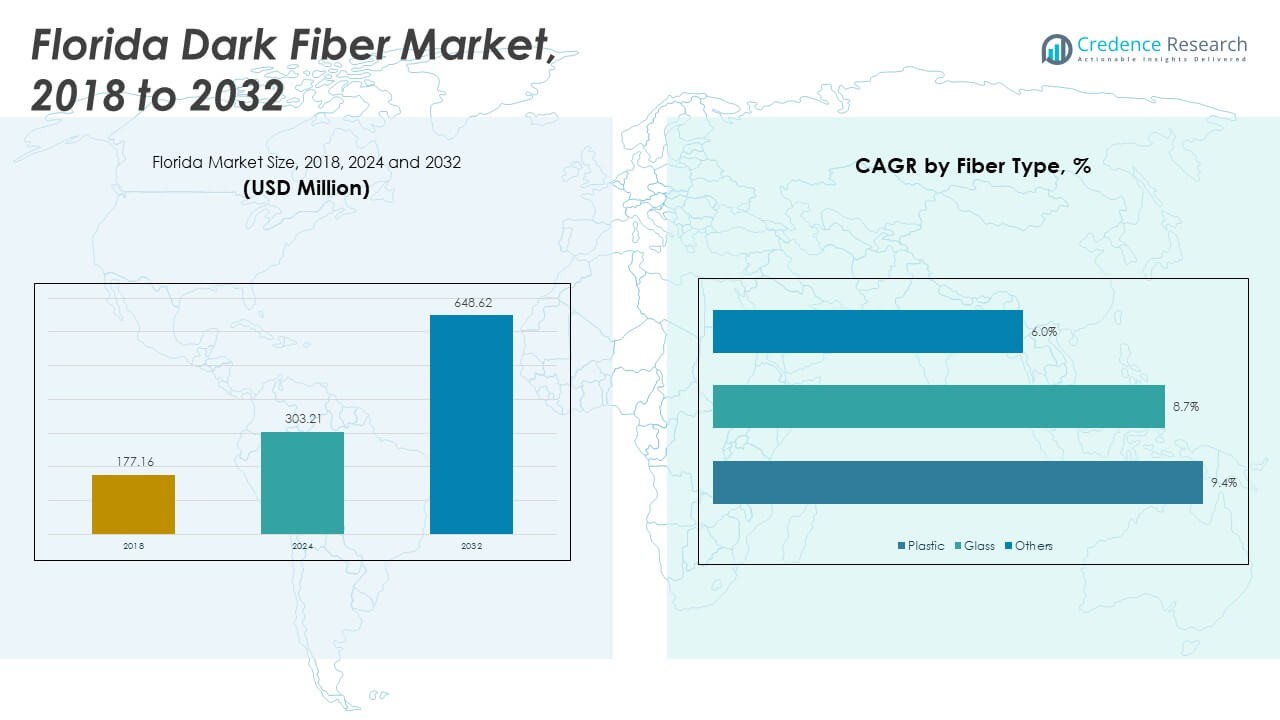
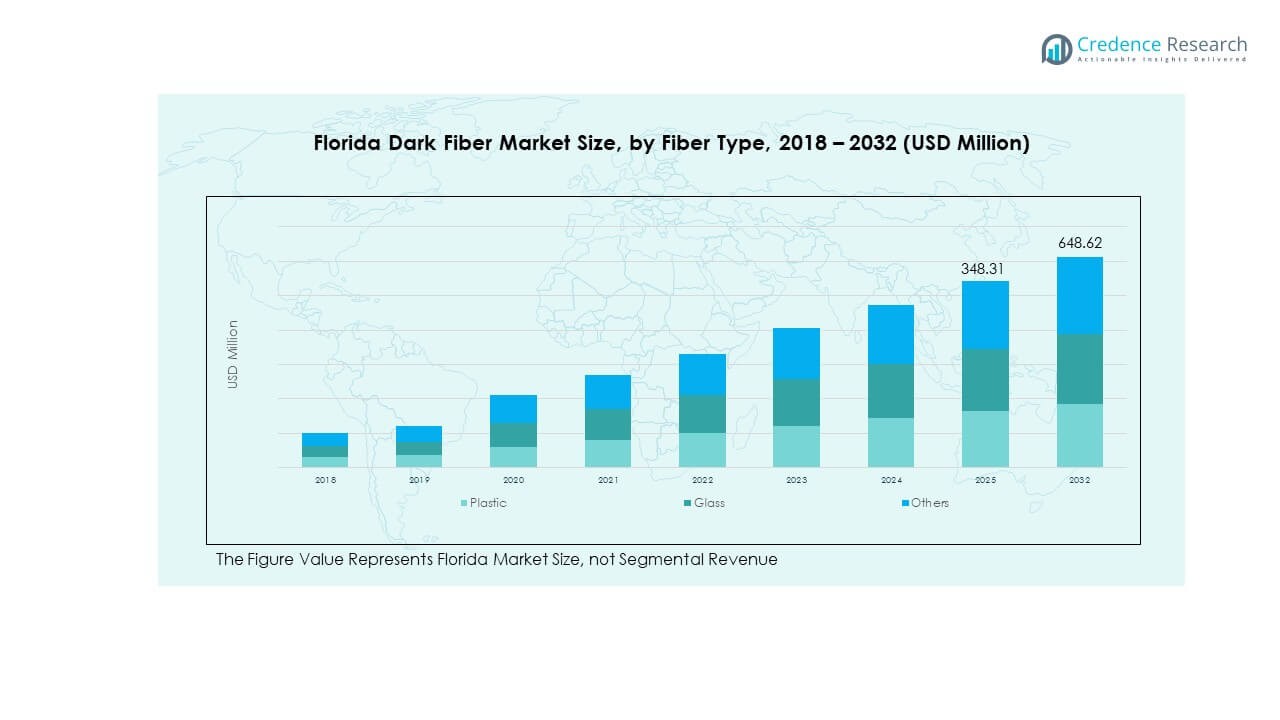
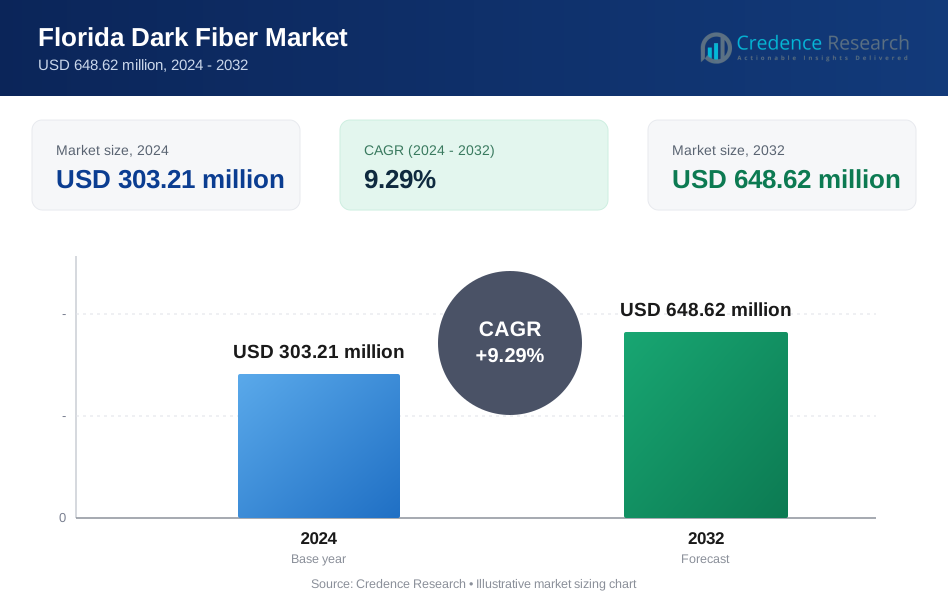
The Florida Dark Fiber Market size was valued at USD 177.16 million in 2018 to USD 303.21 million in 2024 and is anticipated to reach USD 648.62 million by 2032, at a CAGR of 9.29% during the forecast period.
| REPORT ATTRIBUTE | DETAILS |
|---|---|
| Historical Period | 2020-2023 |
| Base Year | 2024 |
| Forecast Period | 2025-2032 |
| Florida Dark Fiber Market Size 2024 | USD 303.21 Million |
| Florida Dark Fiber Market, CAGR | 9.29% |
| Florida Dark Fiber Market Size 2032 | USD 648.62 Million |
Strong demand for high-capacity networks drives growth across Florida. Enterprises deploy dark fiber to support cloud expansion, data-heavy workloads, and secure traffic movement. Hyperscale data center activity lifts long-term leasing, while telecom firms upgrade backbone routes to increase resilience. Public agencies adopt dark fiber to handle smart city plans and connected infrastructure. Rising bandwidth needs encourage utilities and transport networks to invest in scalable fiber routes. Digital service providers view dark fiber as a flexible way to meet rapid traffic spikes.
Geographically, South Florida leads due to dense commercial clusters and major data hubs. Central Florida gains traction as tech firms and logistics players expand network footprints. North Florida emerges as a growth pocket fueled by rising enterprise activity and new government connectivity projects. Coastal regions benefit from strong subsea landing points that enable faster global routes. Inland metros strengthen adoption through rising cloud migration and smart infrastructure investments.
Market Insights:
- The Florida Dark Fiber Market grew from USD 177.16 million in 2018 to USD 303.21 million in 2024 and is projected to reach USD 648.62 million by 2032, supported by a strong 29% CAGR driven by rising bandwidth demand and data-center expansion.
- South Florida (42%), Central Florida (34%), and North Florida (24%) hold the largest shares due to dense enterprise clusters, strong digital infrastructure, and active government and commercial deployments that continue to lift connectivity needs.
- North Florida emerges as the fastest-growing region with a 24% share, supported by expanding enterprise activity, improved corridor upgrades, and rising demand from government, education, and healthcare networks.
- Glass fiber dominates the segment mix at an estimated 60% share, reflecting its high-bandwidth performance and suitability for long-haul and metro applications across major corridors.
- Plastic and other fiber types jointly account for nearly 40%, driven by cost-efficient short-range links and niche deployments across local networks, utilities, and sector-specific applications.
 Market Drivers:
Rising Demand for High-Capacity Fiber Networks Across Enterprise and Government Sectors
Enterprise digital adoption pushes rapid network scaling across the Florida Dark Fiber Market. Firms invest in long-haul and metro routes to support cloud workloads. Government agencies deploy secure fiber strands to improve data flow. Smart city plans lift demand for high-bandwidth corridors. Edge computing spreads network density toward suburban zones. Carriers upgrade backbone rings to reduce latency across key metros. Healthcare networks expand fiber routes to support imaging and telehealth loads. It gains new traction from rising data protection needs. The driver strengthens long-term infrastructure planning.
- For instance, Lumen Technologies did significantly expand its high-speed network in 2023. In January of that year, the company announced it was kicking up its 400-Gbps offering across the U.S., connecting to more than 70 markets and 240 data centers.
Expansion of Data Centers, Colocation Facilities, and Interconnection Hubs Across the State
Florida’s data center buildouts push higher adoption of dedicated fiber routes. Hyperscale operators lease dark fiber to maintain traffic control. Colocation hubs expand cross-connect layers to reduce congestion. Cloud on-ramps lift dark fiber demand across tech corridors. New subsea landing points raise global network alignment. Metro markets attract carriers seeking scalable backbone capacity. Interconnection zones rely on dense fiber grids for redundancy. The Florida Dark Fiber Market gains support from strong hosting activity. It aligns with long-term data mobility needs.
- For instance, Equinix reported more than 425,000 cross-connects globally in 2023, including expansions in Miami (MI1 and MI3), reinforcing demand for high-capacity fiber interconnection.
Growing Dependence on Cloud Migration, AI Workloads, and Bandwidth-Intensive Applications
Cloud-first adoption lifts fiber installation across major industries. AI workloads demand predictable throughput across distributed nodes. Video traffic growth strains legacy networks and drives upgrades. Remote operations increased sensitivity to latency issues. Fiber routes deliver reliable pathways for mission-critical tasks. Enterprises select open-access dark fiber for flexibility. Managed service firms expand leased strands for client networks. The Florida Dark Fiber Market benefits from workload diversification. It supports stable traffic expansion across the state.
Rising Investments in Telecom Modernization and Fiber Backbone Reinforcement Projects
Telecom firms rebuild network cores to serve new digital demands. Long-haul reinforcements raise resilience across hurricane-prone regions. Metro expansions upgrade older copper corridors. Wholesale carriers deploy new strands for future channelization. Municipal networks invest in broader fiber footprints. Commercial clusters demand redundant rings for operational continuity. Infrastructure funds support multi-city fiber builds. The Florida Dark Fiber Market grows with strong modernization cycles. It gains momentum from resilience-led planning.
 Market Trends:
Shift Toward Open-Access Fiber Models and Neutral Host Infrastructure Expansion
Neutral host providers increase open-access availability across Florida metros. Carriers share dark fiber routes to lower deployment strain. Enterprises gain flexibility from multi-tenant fiber grids. Municipalities support open frameworks for public networks. Retail and wholesale players blend service layers for scale. Open-access models lift investment appetite for new routes. Data-driven sectors adopt flexible fiber models for uptime gains. The Florida Dark Fiber Market reflects clear movement toward shared network structures. It supports broader cooperation across operators.
- For instance, Zayo Group invested heavily in its independent fiber network in 2023, initiating the build of new long-haul dark fiber routes, such as Chicago to Columbus, and making significant progress on its 400G enablement. The company completed several long-haul construction projects in 2023, totaling nearly 3,000 new route miles, and launched 8 new "Waves on Demand" routes to enable faster provisioning of high-capacity services.
Increasing Integration of Edge Nodes and Distributed Compute Zones Along Fiber Corridors
Edge expansion increases metro fiber density. Distributed compute nodes reduce data travel distances. Logistics firms adopt edge points for real-time routing. Retail chains deploy compute layers for local processing. IoT-heavy sectors rely on fiber-fed micro data zones. Suburban markets gain traction for new nodes. Fiber corridors evolve into support grids for local compute. The Florida Dark Fiber Market benefits from this distributed footprint. It helps maintain stable network performance.
- For instance, EdgeConneX deployed edge facilities in more than 40 global markets, with individual sites designed for sub-10-millisecond latency delivery to support distributed compute loads.
Growing Preference for Long-Term Indefeasible Rights of Use (IRU) Contracts Across Key Enterprises
Enterprises secure long-term control of fiber assets through IRU models. Long tenures reduce bandwidth cost uncertainty. Carriers offer flexible IRU terms with scalability features. Large firms prefer ownership-like control for traffic planning. Data centers strengthen interconnect reliability through IRU adoption. Financial firms lock dedicated routes for secure operations. Education networks use IRUs to maintain multi-campus control. The Florida Dark Fiber Market gains steady commitments through these agreements. It supports predictable investment cycles.
Rising Focus on Disaster-Resilient Fiber Paths and Climate-Hard Infrastructure Planning
Climate risks elevate interest in resilient fiber builds. Providers bury cables deeper to avoid disruption. Coastal zones add redundant routes for protection. Carriers deploy ring topologies to maintain uptime. Enterprises demand hardened networks for business continuity. Infrastructure planners integrate climate mapping into route design. Disaster-resilient frameworks increase long-term reliability. The Florida Dark Fiber Market gains strength from risk-aware designs. It supports stable operations across vulnerable areas.
Challenges Analysis:
High Deployment Costs, Right-of-Way Barriers, and Infrastructure Complexity Across Urban and Coastal Zones
The Florida Dark Fiber Market faces cost strain from heavy construction needs. Dense metros create difficult trenching conditions. Right-of-way clearances increase project delays. Coastal geology adds complexity during installation. Carriers navigate fragmented approvals across counties. Older underground utilities slow rollout speed. Capital intensity limits small provider participation. It experiences timeline pressure during peak build cycles. Challenge severity increases with rising urban density.
Limited Skilled Workforce, Regulatory Variability, and Vulnerability to Severe Weather Disruptions
Fiber deployment needs skilled labor that remains scarce across the region. Training gaps reduce installation efficiency. Regulatory inconsistency increases uncertainty for builders. Severe storms threaten aerial fiber routes. Flood zones create restoration challenges for buried lines. Carriers invest heavily in maintenance cycles to reduce downtime. Labor shortages slow repair operations during peak outages. The Florida Dark Fiber Market manages these risks under tight operational standards. It maintains service continuity through careful planning.
Market Opportunities:
Expansion of Smart Infrastructure, Connected Public Systems, and Government Digitalization Programs
Government-led modernization opens new demand pockets across the Florida Dark Fiber Market. Smart lighting, traffic systems, and emergency grids need secure fiber. Public schools integrate high-bandwidth networks for digital learning. Healthcare networks expand telemedicine routes. Local agencies invest in secure data movement. Fiber enables scalable platforms for future city planning. It creates opportunities for multi-sector deployments. Opportunity strength grows with statewide digital momentum.
Growth Potential Across Edge Computing, AI Infrastructure, and Sector-Specific High-Bandwidth Use Cases
Edge nodes increase need for localized fiber density. AI-driven firms demand predictable capacity. Logistics and ports strengthen routing intelligence through fiber links. Media firms use dark strands for rapid content distribution. Financial hubs adopt low-latency fiber for trading security. Colocation centers grow interconnect layers for tenants. The Florida Dark Fiber Market gains new routes from sector-specific workloads. It benefits from sustained digital upgrading across industries.
Market Segmentation Analysis:
By Fiber Type
Plastic fiber supports shorter-range links where cost efficiency matters, while glass fiber holds a dominant role due to higher bandwidth and lower signal loss. Premium networks adopt glass strands for long-haul and metro routes. The Others category covers specialized materials used in niche deployments. The Florida Dark Fiber Market benefits from strong preference for glass fiber across major corridors. It gains support from rising digital workloads across enterprises.
- For instance, Corning’s SMF-28 Ultra Optical Fiber delivers attenuation as low as 0.17 dB/km at 1550 nm, making it a preferred choice for long-distance and metro applications across major U.S. networks.
By Technology
DWDM enables dense channel stacking for high-capacity transport across long distances. CWDM fits shorter routes where moderate bandwidth is required. The Others category covers legacy and hybrid systems. Telecom carriers pick DWDM for intercity expansion. Data-heavy zones adopt CWDM to stabilize metro networks. It supports flexible channel planning across regional traffic clusters.
- For instance, Ciena’s WaveLogic 5 Extreme platform supports up to 800-Gbps single-wave transmission, enabling dense channel provisioning across modern DWDM systems deployed by leading carriers.
By Service
Single-mode fiber leads deployments due to its long-range capability. Multimode fits campus and short metro layouts. Mobile backhaul strengthens 5G coverage through dedicated dark strands. Enterprises combine single-mode routes with local multimode grids. It supports traffic growth across hybrid work environments.
By Pricing Model
Price per strand-mile suits long-haul builds with predictable routes. Price per route-mile fits simple geographic layouts. Price per fiber-pair offers enterprises secure control. MRC and NRC structures provide flexible leasing options. It aligns with varied buyer needs across sectors.
By Customer Type & Route
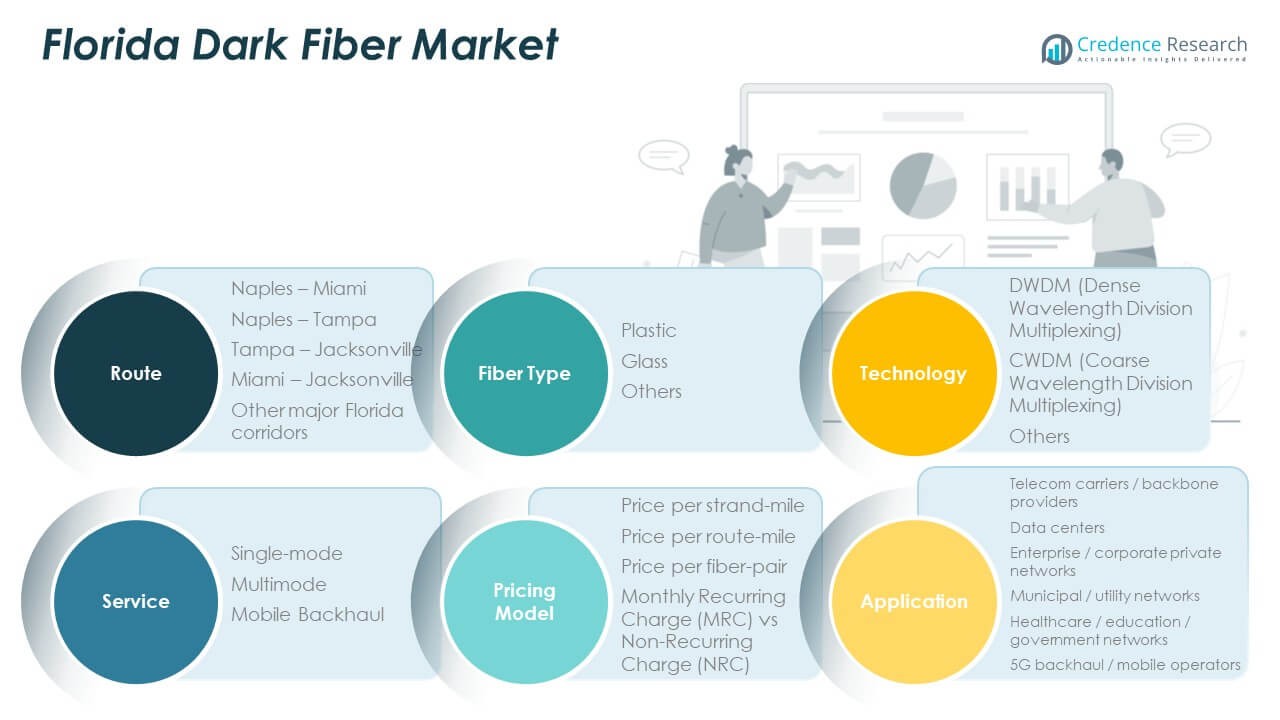
Telecom carriers, data centers, enterprises, municipal networks, and critical sectors expand dark fiber use. 5G operators lift demand across dense metros. Key routes such as Naples–Miami, Naples–Tampa, Tampa–Jacksonville, and Miami–Jacksonville anchor statewide connectivity. Other corridors support regional growth.
Segmentation:
By Fiber Type
- Plastic
- Glass
- Others
By Technology
- DWDM (Dense Wavelength Division Multiplexing)
- CWDM (Coarse Wavelength Division Multiplexing)
- Others
By Service
- Single-mode
- Multimode
- Mobile Backhaul
By Pricing Model
- Price per strand-mile
- Price per route-mile
- Price per fiber-pair
- Monthly Recurring Charge (MRC) vs Non-Recurring Charge (NRC)
By Customer Type
- Telecom carriers / backbone providers
- Data centers
- Enterprise / corporate private networks
- Municipal / utility networks
- Healthcare / education / government networks
- 5G backhaul / mobile operators
By Route
- Naples – Miami
- Naples – Tampa
- Tampa – Jacksonville
- Miami – Jacksonville
- Other major Florida corridors
 Regional Analysis:
South Florida
South Florida holds the leading position with an estimated 42% market share, driven by dense commercial zones and a strong base of data-intensive industries. Miami anchors demand due to its global connectivity role and concentration of financial, cloud, and media networks. The Florida Dark Fiber Market gains major traction here due to subsea landing points that feed high-capacity routes into the state. Carriers expand metro rings to support traffic growth across Miami, Fort Lauderdale, and West Palm Beach. Data centers and colocation facilities strengthen regional demand. It benefits from higher enterprise density and sustained digital expansion. Growth momentum stays firm due to strong investment pipelines.
Central Florida
Central Florida holds about 34% market share, supported by rapid expansion across Orlando, Lakeland, and surrounding metros. Technology firms, logistics hubs, and entertainment companies lift demand for scalable fiber routes. Regional operators deploy network upgrades to support cloud adoption and traffic resilience. Infrastructure programs encourage broader deployment across suburban corridors. It gains support from rising 5G backhaul activity and enterprise network upgrades. Public sector modernization raises demand for secure fiber links. Strong population inflow strengthens long-term digital needs.
North Florida
North Florida accounts for roughly 24% market share, driven by steady enterprise expansion across Jacksonville, Tallahassee, and Pensacola. Carriers invest in new corridors that link coastal and inland markets. Government institutions lift interest in secure fiber assets across administrative zones. Healthcare networks support demand through multi-facility connectivity. It gains momentum from industrial growth and upgraded transport corridors. Regional universities expand research networks, creating new bandwidth requirements. The area shows rising adoption due to improved infrastructure readiness.
Key Player Analysis:
- South Reach Networks (SRN)
- FPL FiberNet
- LLC
- Dark Fiber Systems, Inc.
- Southern Telecom, Inc. (STI)
Competitive Analysis:
The Florida Dark Fiber Market features strong competition among regional carriers, infrastructure operators, and specialized fiber providers. Companies focus on network expansion, route diversity, and long-haul resilience to secure enterprise demand. Data center connectivity shapes strategic placement of new fiber corridors. Providers invest in open-access models to attract multi-sector buyers. It gains competitive intensity from rising interest in IRU contracts and 5G backhaul routes. Firms strengthen partnerships with municipal networks to secure broader geographic reach. Market rivalry remains steady due to ongoing modernization cycles and steady digital adoption across industries.
Recent Developments:
- Beyond the acquisition announcement, South Reach Networks unveiled two major expansion initiatives in October 2025, introducing over 60 route miles of new underground fiber infrastructure across the Southeast and Northeast Florida regions. These expansion projects encompass new underground multi-conduit pathways with high-capacity, low-loss fiber installed within public rights-of-way to ensure long-term accessibility and scalability. The Southeast Florida expansion targets Boca Raton, Fort Lauderdale, and Miami areas, while the Northeast Florida project covers the corridor from Flagler Beach to Palm Coast. The South Florida project is expected to become operational by early 2026. These network expansions are strategically designed to enhance route diversity, improve network resilience, and broaden on-net connectivity to major carrier points of presence (PoPs), edge data centers, and subsea cable landing stations along Florida's eastern coast. The expansion facilitates on-net access to multiple data centers and cable stations, creating new growth opportunities and enabling seamless interconnections for CDNs, cloud providers, hyperscalers, FTT providers, and other telecom partners.
- Southern Telecom, Inc., a wholly owned subsidiary of Southern Company, announced a transformative strategic partnership in September 2025. On September 23, 2025, Southern Telecom and Seimitsu, a Savannah-based leader in broadband networking solutions, announced the formation of SouthernWaves, a strategic alliance poised to deliver state-of-the-art fiber-optic network services across the Southeast.
- In July 2025, South Reach Networks, a Florida-based fiber infrastructure provider, announced a major acquisition by Blue Owl Capital's Digital Infrastructure strategy. The acquisition, completed on July 15, 2025, marks a significant consolidation in the Florida dark fiber market. South Reach Networks, operating under the parent company Intermetro Fiber LLC, was acquired from Turning Rock Partners. SRN operates an extensive 370-mile dark and lit fiber network stretching from Jacksonville to Miami, with strategic interconnections to 40 data centers, colocation facilities, and cable landing stations. The company also owns five edge colocation facilities positioned along this crucial route. Blue Owl has committed substantial capital investment to expand SRN's footprint and accelerate new builds across Florida to meet the surging demand from hyperscale and enterprise customers.
Report Coverage:
The research report offers an in-depth analysis based on fiber type, technology, service, pricing model, customer type, and route segments. It details leading market players, providing an overview of their business, product offerings, investments, revenue streams, and key applications. Additionally, the report includes insights into the competitive environment, SWOT analysis, current market trends, as well as the primary drivers and constraints. Furthermore, it discusses various factors that have driven market expansion in recent years. The report also explores market dynamics, regulatory scenarios, and technological advancements that are shaping the industry. It assesses the impact of external factors and global economic changes on market growth. Lastly, it provides strategic recommendations for new entrants and established companies to navigate the complexities of the market.
Future Outlook:
- Market expansion will accelerate as enterprises scale cloud workloads and seek dedicated fiber routes.
- Investment in metro and long-haul corridors will rise to support high-density data movement.
- Data centers will strengthen demand for low-latency fiber paths tied to regional hosting growth.
- 5G backhaul needs will lift adoption of dark strands in urban and suburban zones.
- Municipal networks will increase deployment to support digital services and connected systems.
- Edge computing clusters will push new fiber routes into logistics and industrial zones.
- IRU adoption will grow among enterprises that require control over bandwidth provisioning.
- Disaster-resilient infrastructure will gain priority due to climate risks across coastal regions.
- Open-access models will shape competitive behavior across providers and route operators.
- Broader smart city initiatives will support long-term fiber penetration across Florida metros.
Request a Free Sample
Fill in your details and we'll send you a free sample report.
- Sample data tables & charts
- Research methodology
Need a Custom Version of This Report?
Tailor the scope, geography, or segments to your exact requirements.
- Custom geography or segment scope
- Direct access to our analyst team
Frequently Asked Questions
What is the current market size for the Florida Dark Fiber Market, and what is its projected size in 2032?
At what Compound Annual Growth Rate is the Florida Dark Fiber Market projected to grow between 2024 and 2032?
Which Florida Dark Fiber Market segment held the largest share in 2024?
What are the primary factors fueling the growth of the Florida Dark Fiber Market?
Who are the leading companies in the Florida Dark Fiber Market?
Which region commanded the largest share of the Florida Dark Fiber Market in 2024?
Table of Content
Chapter 1. Report Introduction
- 1.1 Report Description & Purpose
- 1.1.1 Report Title & Market Definition
- 1.1.2 Unique Selling Propositions (USP) & Key Differentiators
- 1.1.3 Value Proposition for Stakeholders
- 1.2 Research Objectives
- 1.2.1 Market Sizing Objectives (Volume & Revenue)
- 1.2.2 Segmentation Objectives
- 1.2.3 Competitive Intelligence Objectives
- 1.2.4 Forecast & Scenario Objectives
- 1.3 Report Scope
- 1.3.1 Florida Dark Fiber Scope – Types & Subtypes Covered
- 1.3.2 Geographic Scope – Regions & Countries Covered
- 1.3.3 Historical Period, Base Year & Forecast Period (2024; forecast to 2032)
- 1.3.4 Inclusions & Exclusions
- 1.4 HS Code & Classification Framework
- 1.5 Currency, Units & Pricing Basis
- 1.6 Target Stakeholders
- 1.7 Limitations & Assumptions
Chapter 2. Executive Summary
- 2.1 Global Florida Dark Fiber Market Snapshot
- 2.1.1 Market Size – Historical (2024) & Forecast (2024-2032) (2024: USD 303.21 million → 2032: USD 648.62 million)
- 2.1.2 Volume & Revenue – Global Totals
- 2.1.3 Key Market Highlights – Top Five Facts
- 2.2 Florida Dark Fiber Market Segmentation Snapshot
- 2.2.1 Market Split by Region – 2024 vs. 2032
- 2.3 Competitive Snapshot
- 2.3.1 Top 10 Players by Revenue Share – 2024
- 2.3.2 Top 10 Players by Volume Share – 2024
- 2.3.3 Recent Strategic Developments (18-Month Summary)
- 2.4 Key Investment Highlights & Strategic Conclusions
Chapter 3. Florida Dark Fiber Market Dynamics & Industry Analysis
- 3.1 Market Overview & Context
- 3.1.1 Florida Dark Fiber Market Position in the Broader Automotive Value Chain
- 3.1.2 OEM vs. Replacement Market Dynamics
- 3.1.3 Market Maturity & Development Stage by Region
- 3.2 Florida Dark Fiber Market Drivers
- 3.3 Florida Dark Fiber Market Restraints & Challenges
- 3.4 Florida Dark Fiber Market Opportunities
- 3.5 Porter's Five Forces Analysis
- 3.5.1 Threat of New Entrants
- 3.5.2 Bargaining Power of Suppliers
- 3.5.3 Bargaining Power of Buyers
- 3.5.4 Threat of Substitutes
- 3.5.5 Competitive Rivalry – Intensity Assessment
- 3.6 Florida Dark Fiber Value Chain Analysis
- 3.6.1 Upstream – Raw Material/Input Suppliers
- 3.6.1.1 Raw Material/Input 1
- 3.6.1.2 Raw Material/Input 2
- 3.6.1.3 Raw Material/Input 3
- 3.6.2 Midstream – Production/Manufacturing/Service Delivery
- 3.6.2.1 Production/Process Overview
- 3.6.2.2 Key Facility Locations & Capacity by Manufacturer
- 3.6.3 Downstream – Distribution & End Consumer
- 3.6.3.1 Primary Channel – B2B/OEM
- 3.6.3.2 Secondary Channels – Dealer, Retail, Online, Direct
- 3.6.4 Value Chain Profitability Analysis
- 3.6.1 Upstream – Raw Material/Input Suppliers
- 3.7 PESTEL Analysis
- 3.7.1 Political Factors
- 3.7.2 Economic Factors
- 3.7.3 Social Factors
- 3.7.4 Technological Factors
- 3.7.5 Environmental Factors
- 3.7.6 Legal Factors
- 3.8 Florida Dark Fiber Supply Chain Analysis
- 3.8.1 Raw Material/Input Supply Risk Assessment
- 3.8.2 Manufacturing Concentration Risk (Geographic Exposure)
- 3.8.3 Trade Disruption Impact Analysis
- 3.9 Regulatory & Policy Landscape
Note: The regulatory and policy landscape section covers regulations based on their applicability to the market, Florida Dark Fiber category, geography, and scope of the study. Only regulatory frameworks with a material impact on operations, compliance, trade, sustainability, or market access are analyzed in detail.
Chapter 4. Key Investment Pockets & Opportunity Analysis
- 4.1 Florida Dark Fiber Market Attractiveness Analysis
- 4.1.1 By Region – Investment Attractiveness Matrix (Volume × CAGR)
- 4.2 Absolute Revenue Growth Opportunity
- 4.2.1 By Region – Absolute USD Growth Through 2032
- 4.3 Incremental Volume Opportunity
- 4.3.1 By Region – Incremental Volume Through 2032
- 4.3.2 Segment – Incremental Volume
- 4.4 Emerging Submarket Opportunity Deep Dive (Subject to Applicability)
- 4.5 Emerging Market Opportunity Scorecards
- 4.5.1 United States
- 4.5.2 Europe
- 4.5.3 Asia
- 4.5.4 Middle East & Africa
Note: Emerging Market Opportunity Scorecards will be included based on relevance and strategic importance. Regions listed are indicative and may vary depending on data availability and market dynamics.
Chapter 5. Florida Dark Fiber Import-Export Analysis & Trade Flows
- 5.1 Global Trade Overview
- 5.1.1 Global Export Value by Country (2024)
- 5.1.2 Global Export Volume by Country (2024)
- 5.1.3 Global Import Value by Country (2024)
- 5.1.4 Global Import Volume by Country (2024)
- 5.1.5 Net Trade Balance by Country (2024)
- 5.2 Export Analysis – Segment
- 5.2.1 Type 1 (HS Code)
- 5.2.2 Type 2 (HS Code)
- 5.2.3 Type 3 (HS Code)
- 5.2.4 Type 4 (HS Code)
- 5.2.5 Type 5 (HS Code)
- 5.3 Import Analysis – Segment
- 5.3.1 Type 1 (HS Code)
- 5.3.2 Type 2 (HS Code)
- 5.3.3 Type 3 (HS Code)
- 5.3.4 Type 4 (HS Code)
- 5.3.5 Type 5 (HS Code)
- 5.4 Average Unit Trade Prices
- 5.4.1 Average Export Price – Segment & Country
- 5.4.2 Average Import Price – Segment & Source Country
- 5.4.3 Price Trends (2024)
- 5.5 Key Trade Route Analysis
- 5.5.1 Trade Route 1
- 5.5.2 Trade Route 2
- 5.5.3 Trade Route 3
- 5.5.4 Trade Route 4
- 5.5.5 Trade Route 5
- 5.6 Trade Policy Impact Assessment
- 5.6.1 US Anti-Dumping & Section 301 Tariffs
- 5.6.2 EU Customs Union Impact
- 5.6.3 Major Free Trade Agreements
- 5.6.4 USMCA Rules of Origin
Note: Trade policy analysis will be included only where relevant to the Florida Dark Fiber market.
Chapter 6. Competitive Landscape & Company Benchmarking
- 6.1 Florida Dark Fiber Market Concentration & Structure
- 6.1.1 Herfindahl-Hirschman Index (HHI) – vs. 2024
- 6.1.2 Tier 1, Tier 2 & Tier 3 Market Structure
- 6.1.3 Global, Regional & Local Player Dynamics
- 6.2 Florida Dark Fiber Market Share Analysis – 2024
- 6.2.1 Global Revenue Share by Company
- 6.2.2 Global Volume Share by Company
- 6.2.3 Regional Revenue Share
- 6.2.4 Market Share Evolution ( vs. 2024)
- 6.2.5 OEM Segment Share by Company
- 6.2.6 Replacement Segment Share by Company
- 6.3 Production/Delivery Capacity & Facility Analysis
- 6.3.1 Global Installed Capacity
- 6.3.2 Capacity Utilization Rates
- 6.3.3 Production/Output Volume
- 6.3.4 Facility Locations & Capacity Map
- 6.3.5 Planned Capacity Additions
- 6.4 Florida Dark Fiber Competitive Benchmarking Matrix
- 6.4.1 Revenue, Volume, CAGR & Profitability Comparison
- 6.4.2 Channel Revenue Mix
- 6.4.3 Geographic Revenue Exposure
- 6.4.4 R&D Intensity
- 6.4.5 Sustainability Maturity
- 6.5 Strategic Developments in Florida Dark Fiber (Last 24 Months)
- 6.5.1 Mergers, Acquisitions & Divestments
- 6.5.2 New Florida Dark Fiber Launches
- 6.5.3 Facility Expansions
- 6.5.4 Strategic Alliances, Joint Ventures & Partnerships
- 6.5.5 Distribution Expansion & Market Entry
- 6.5.6 Sustainability & ESG Initiatives
- 6.6 Competitive Strategy Mapping
- 6.6.1 Leader, Challenger, Follower & Niche Classification
- 6.6.2 Pricing Strategy Comparison
- 6.6.3 Channel Strategy Matrix
Note: Strategic developments are included based on their materiality and the availability of reliable information.
Chapter 7. Global Florida Dark Fiber Market – By Distribution Channel
- 7.1 Segment Overview
- 7.1.1 Volume & Revenue Split by Channel (2024 & 2032)
- 7.1.2 Channel Mix Evolution (2024-2032)
Chapter 8. Regional Market Analysis – Global Overview
- 8.1 Global Regional Overview
- 8.1.1 Regional Volume Share
- 8.1.2 Regional Revenue Share
- 8.1.3 Regional Volume by Region
- 8.1.4 Regional Revenue by Region
- 8.1.5 Regional Forecast Through 2032
- 8.2 Cross-Regional Segment Analysis
- 8.2.1 By Distribution Channel
- 8.2.2 By Brand/Price Tier
Chapter 9. North America Florida Dark Fiber Market
- 9.1 United States
- 9.2 Canada
- 9.3 Mexico
Chapter 10. Europe Florida Dark Fiber Market
- 10.1 Germany
- 10.2 France
- 10.3 Italy
- 10.4 United Kingdom
- 10.5 Spain
- 10.6 Poland
- 10.7 Russia
- 10.8 Netherlands
- 10.9 Belgium
- 10.10 Sweden
- 10.11 Denmark
- 10.12 Norway
- 10.13 Rest of Europe
Chapter 11. Asia Pacific Florida Dark Fiber Market
- 11.1 China
- 11.2 India
- 11.3 Japan
- 11.4 South Korea
- 11.5 Thailand
- 11.6 Indonesia
- 11.7 Vietnam
- 11.8 Malaysia
- 11.9 Australia
- 11.10 Rest of Asia Pacific
Chapter 12. Latin America Florida Dark Fiber Market
- 12.1 Brazil
- 12.2 Argentina
- 12.3 Colombia
- 12.4 Chile
- 12.5 Rest of Latin America
Chapter 13. Middle East Florida Dark Fiber Market
- 13.1 Saudi Arabia
- 13.2 United Arab Emirates
- 13.3 Turkey
- 13.4 Israel
- 13.5 Iran
- 13.6 Rest of the Middle East
Chapter 14. Africa Florida Dark Fiber Market
- 14.1 South Africa
- 14.2 Egypt
- 14.3 Nigeria
- 14.4 Morocco
- 14.5 Rest of Africa
Chapter 15. Florida Dark Fiber Company Profiles
- 15.1 [Company 01]
- 15.1.1 Company Overview
- 15.1.2 Key Management Personnel
- 15.1.3 Products & Services Portfolio
- 15.1.4 Financial Performance
- 15.1.5 Key Market Focus & Geographic Presence
- 15.1.6 Recent Developments & Strategic Initiatives
Note: The company profile list is preliminary and may change based on research findings, market developments, data availability, and client requirements.
Chapter 16. Appendices
- Appendix A – List of Abbreviations & Acronyms
- Appendix B – Industry Classification Code Reference – Full Series
- Appendix C – Production & Capacity Data Tables
- Appendix D – End-Use & Demand Base Tables
- Appendix E – Consumption & Replacement Rate Assumptions
- Appendix F – ASP Reference Tables
- Appendix G – Manufacturing & Facility Database
- Appendix H – Import-Export Data Tables
- Appendix I – Regulatory Summary Tables
- Appendix J – Primary Research Participant List (Anonymized)
- Appendix K – Primary Research Questionnaire Framework
- Appendix L – Data Sources & Bibliography
- Appendix M – Market Size Divergence & Source Comparison
Chapter 17. Research Methodology
- 17.1 Research Framework & Philosophy
- 17.2 Secondary Research – Sources, Hierarchy & Data Extraction
- 17.3 Data Modeling – Bottom-Up & Top-Down Market Sizing
- 17.4 Primary Research – Stakeholder Framework, LOI & Sample Sizes
- 17.5 Forecast Methodology – Regression, Scenario & Sensitivity Analysis
- 17.6 Quality Control – Four-Layer Validation Framework
- 17.7 Limitations & Standard Assumptions
- 17.8 Disclaimer
