
| REPORT ATTRIBUTE | DETAILS |
|---|---|
| Historical Period | 2019-2022 |
| Base Year | 2023 |
| Forecast Period | 2024-2032 |
| Frosting Toppings and Decorations Market Size 2024 | USD 10602.5 million |
| Frosting Toppings and Decorations Market, CAGR | 6.1% |
| Frosting Toppings and Decorations Market Size 2032 | USD 17026.73 million |
Market Overview:
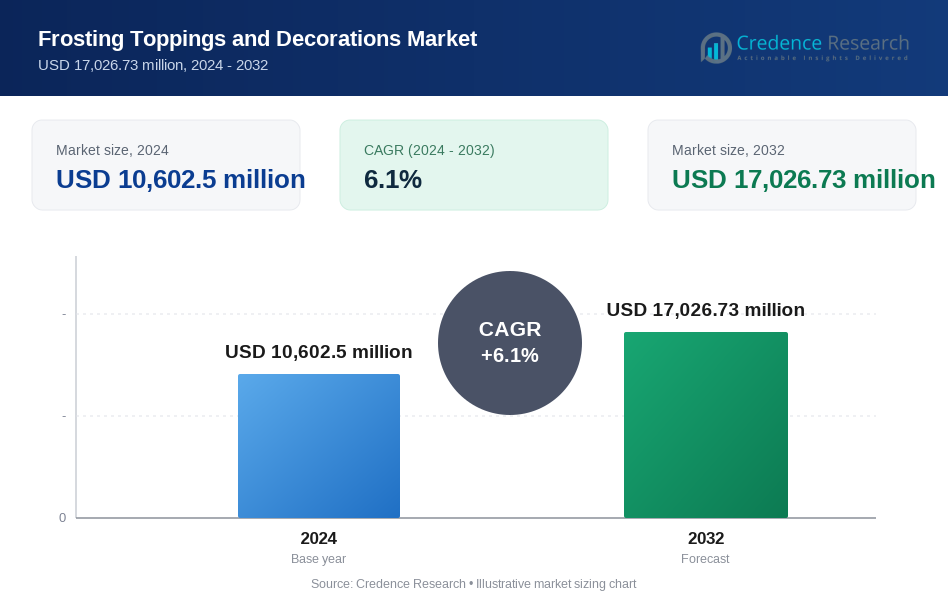
The Frosting Toppings and Decorations Market is projected to grow from USD 10602.5 million in 2024 to an estimated USD 17026.73 million by 2032, with a compound annual growth rate (CAGR) of 6.1% from 2024 to 2032.
The growth of the frosting, toppings, and decorations market is propelled by several factors. The booming bakery industry, influenced by growing urbanization and changing dietary preferences, has significantly increased the demand for visually appealing and flavorful bakery items. Consumers are increasingly seeking artisanal and personalized cakes, cupcakes, and pastries, creating opportunities for innovative decorations and premium toppings. The trend of home baking, amplified during the COVID-19 pandemic, continues to drive demand for DIY frosting and decoration kits. Additionally, advancements in product formulations, including sugar-free, vegan, and organic options, cater to health-conscious consumers, further expanding the market. Marketing through social media platforms, where visually striking baked goods gain traction, has also contributed to the heightened demand for decorative elements in the bakery segment.
North America and Europe dominate the frosting, toppings, and decorations market, accounting for a significant share due to the well-established bakery industries and high consumer spending on premium and customized bakery products. In North America, the U.S. leads the market, driven by a robust demand for innovative and themed decorations for celebrations and events. Europe, with its rich bakery tradition, sees substantial growth in artisanal decorations and sustainable product options. The Asia-Pacific region is the fastest-growing market, fueled by increasing urbanization, rising disposable incomes, and the growing influence of Western bakery trends in countries like China, India, and Japan. Latin America and the Middle East & Africa are emerging markets, with expanding bakery sectors and increasing consumer interest in decorative baked goods, creating lucrative opportunities for market players.
Market Insights:
- The market is projected to grow from USD 10,602.5 million in 2024 to USD 17,026.73 million by 2032, driven by a 6.1% CAGR, highlighting robust growth opportunities across regions.
- Home baking trends, spurred by the COVID-19 pandemic, continue to fuel demand for DIY frosting kits and decorative products, with a 20% rise in sales among home bakers in India.
- Health-conscious consumers are driving the adoption of sugar-free, vegan, and organic decorations, with 25% of premium bakery sales in Canada attributed to plant-based products.
- The Asia-Pacific region is the fastest-growing, with 15% annual growth in China’s decorated bakery segment, fueled by urbanization and Western bakery influences.
- Social media platforms like Instagram amplify demand for visually appealing baked goods, with over 70% of special occasion bakery purchases in the U.S. featuring custom decorations.
- Sustainability trends are pushing manufacturers to adopt biodegradable packaging and natural ingredients, with 35% of German bakery chains introducing clean-label decoration options.
- Emerging markets in Latin America and the Middle East & Africa show rising potential, as 40% of urban bakeries in Brazil incorporate decorative elements to meet growing demand for premium baked goods.
Market Drivers:
Increasing Demand for Customization and Personalization
The growing consumer preference for customized and personalized baked goods is a major driver of the frosting, toppings, and decorations market. Cakes, cupcakes, and pastries for celebrations such as birthdays, weddings, and corporate events increasingly require intricate decorations that reflect unique themes and individual preferences. This demand has encouraged bakeries and manufacturers to innovate with custom designs, edible decorations, and personalized toppings. For instance, Wilton Brands reported a increase in sales of their custom cake decorating kits in 2023, reflecting the growing demand for personalized baked goods. The ability to offer distinctive and eye-catching bakery items has become a competitive advantage, driving the adoption of advanced frosting and decoration techniques.
Rise in Home Baking and DIY Trends
The trend of home baking has surged in recent years, significantly influencing the demand for frosting, toppings, and decorations. The COVID-19 pandemic, in particular, saw a rise in at-home baking as consumers sought creative outlets and homemade treats. This trend has continued post-pandemic, with a growing number of consumers exploring DIY kits and pre-packaged decoration materials. For example, Betty Crocker saw a 40% increase in sales of their ready-to-use frosting and decoration kits during the pandemic, which has continued to remain popular. Products like ready-to-use frostings, edible glitter, and themed sprinkles appeal to home bakers looking to replicate professional designs, creating new opportunities for market players.
Expanding Health-Conscious Consumer Base
The rising awareness of health and wellness has shaped the product offerings in the frosting, toppings, and decorations market. Consumers are increasingly opting for healthier alternatives, including sugar-free, vegan, and organic options. Manufacturers are responding by reformulating their products to meet these demands without compromising on aesthetics or taste. Innovations in plant-based frostings, low-calorie decorations, and allergen-free toppings cater to a broader consumer base, particularly those with dietary restrictions. For instance, Schulstand Bakery Solutions offers low-sugar pastries made with natural sweeteners like honey and stevia, which have become popular among health-conscious consumers. This health-driven demand is expanding the market while fostering innovation.
Growth in the Bakery Industry and Online Retail Channels
The robust growth of the global bakery industry is another critical driver for the frosting, toppings, and decorations market. The rising popularity of premium bakery items and desserts across retail and foodservice channels has boosted the need for high-quality decorations. Additionally, the growth of online retail platforms has made decorative baking supplies more accessible, particularly to home bakers and small businesses. Social media platforms such as Instagram and Pinterest have amplified this trend, as visually appealing baked goods often gain popularity online, further increasing the demand for innovative and artistic decorations. For example, Pastreez, an online bakery specializing in French macarons, saw a significant increase in sales by leveraging social media and online retail channels to reach a wider audience.
Market Trends:
Rising Popularity of Sustainable and Eco-Friendly Products
The frosting, toppings, and decorations market is witnessing a growing demand for sustainable and eco-friendly products. Consumers are increasingly prioritizing brands that demonstrate a commitment to environmental responsibility, prompting manufacturers to adopt sustainable practices. Biodegradable packaging, natural food coloring, and organic decorations have gained traction in response to this trend. For instance, Natural buttercream frosting dyes using beet juice, grape juice concentrate, spinach juice, and carrot juice have demonstrated successful color achievements without artificial additives. This shift aligns with broader sustainability efforts across the food industry, appealing to environmentally conscious consumers.
Growth of Edible Innovations and Artistic Designs
Edible decorations are evolving beyond traditional sprinkles and frostings to include intricate and artistic designs. The rise of advanced technologies like edible printing has enabled the creation of highly detailed, customized decorations for cakes and pastries. Consumers are gravitating toward visually stunning designs, such as edible metallic finishes, 3D printed decorations, and sculpted fondant figures. These innovations cater to the growing demand for aesthetically unique baked goods, especially for special occasions like weddings and themed events, driving the creative possibilities in the market. For instance, Virtual Cake Studio's 3D visualization technology allows designers to experiment with different shapes, sizes, and decorations before actual production.
Increasing Adoption of Ethnic and Regional Flavors
The integration of ethnic and regional flavors into frosting, toppings, and decorations is a noteworthy trend. Consumers are seeking globally inspired desserts, leading to the incorporation of flavors like matcha, saffron, rosewater, and cardamom in decorative elements. This trend is especially prominent in multicultural markets, where bakeries aim to cater to diverse tastes. For instance, Cakenote's Designer platform has demonstrated success with their growing library of decorations, construction elements, and patterns, allowing bakers to create and price culturally diverse designs while automatically calculating costs. Their system enables easy adjustments to suit client budgets while maintaining design integrity. Regional ingredients, such as tropical fruits for frosting or floral essences for decorations, are expanding the flavor palette, providing unique offerings that appeal to adventurous consumers.
Integration of Technology in Retail and Consumer Engagement
Technology is reshaping the way consumers interact with frosting, toppings, and decoration products. Augmented reality (AR) applications allow customers to visualize cake designs before purchase, enhancing customization experiences. Online platforms offering tutorials, virtual baking classes, and interactive design tools are empowering consumers to create professional-quality baked goods at home. Social media platforms remain pivotal in showcasing trending decoration styles and inspiring consumers to experiment, further boosting demand for innovative decorative products. For instance, AR Cake Baker app enables virtual cake decoration with features including sprinkles, stickers, candies, and icings, allowing users to experiment with designs without material waste. The combination of technology-driven engagement and accessibility through e-commerce channels continues to transform the market landscape.
Market Challenges Analysis:
High Production Costs and Pricing Sensitivity
The production of high-quality frosting, toppings, and decorations often involves significant costs due to the use of premium ingredients, intricate designs, and advanced manufacturing processes. Organic and natural ingredients, biodegradable packaging, and specialized edible decorations further escalate production expenses. These costs are frequently passed on to consumers, limiting accessibility for price-sensitive markets. The challenge of balancing affordability with quality and innovation remains a significant hurdle for manufacturers aiming to expand their consumer base.
Regulatory Compliance and Food Safety Standards
The frosting, toppings, and decorations market is subject to stringent food safety and quality regulations across different regions. Compliance with these standards involves rigorous testing, certification processes, and adherence to labeling requirements, which can be both time-consuming and costly. Variations in regulatory frameworks across countries add complexity for manufacturers operating on a global scale. Any non-compliance can result in product recalls, legal penalties, and damage to brand reputation, posing a significant challenge to market growth.
Limited Awareness in Emerging Markets
In emerging economies, consumer awareness of premium frosting and decorative products is relatively low. The focus in these markets often leans toward basic baked goods, with less emphasis on visual appeal and customization. Additionally, limited access to innovative products and a lack of marketing efforts in rural or semi-urban areas hinder the adoption of advanced frosting and decoration solutions. Bridging this awareness gap is crucial for unlocking growth potential in these regions.
Sustainability Challenges and Ingredient Constraints
The rising demand for sustainable and natural ingredients presents challenges related to sourcing, production, and shelf-life stability. Natural colorants and flavors may lack the vibrancy or consistency of synthetic alternatives, impacting product quality. Additionally, incorporating biodegradable or eco-friendly packaging while maintaining cost efficiency poses significant difficulties for manufacturers. Addressing these constraints requires continuous innovation and investment in sustainable practices.
Market Opportunities:
The Frosting, Toppings, and Decorations Market presents substantial growth opportunities driven by evolving consumer preferences and expanding bakery industries globally. The increasing demand for personalized and aesthetically pleasing baked goods offers a lucrative avenue for manufacturers to innovate with custom designs, themed decorations, and edible art. The growing popularity of plant-based, organic, and health-conscious products is an additional catalyst, encouraging brands to develop natural and allergen-free alternatives. As consumer trends shift toward unique and premium products, there is significant potential for manufacturers to expand offerings with innovative and sustainable solutions that cater to diverse dietary and aesthetic preferences.
Emerging markets, particularly in the Asia-Pacific, Latin America, and Middle East & Africa regions, offer untapped potential due to rising urbanization, increasing disposable incomes, and the growing influence of Western bakery trends. The rapid growth of e-commerce platforms and social media marketing further amplifies these opportunities by broadening market access and enabling direct consumer engagement. Additionally, the integration of technology in the form of augmented reality tools for custom cake visualization and interactive baking tutorials can enhance customer experiences and boost product demand. Manufacturers that strategically invest in these opportunities, while addressing challenges like production costs and regulatory compliance, are well-positioned to capture significant market share and drive future growth.
Market Segmentation Analysis:
The Frosting, Toppings, and Decorations Market is segmented into product type, ingredient type, end-use application, distribution channel, and region, reflecting its diverse consumer base and applications.
By Product Type, categories such as fondants, creams, pastes & variegates, fruits & nuts, sprinkles, and decorative shapes dominate the market. Fondants and creams are popular for their versatility in professional and home baking, while fruits and nuts cater to health-conscious consumers seeking natural toppings.
By Ingredient Type, sugar-based products hold a significant share due to their traditional use in frostings and toppings. Cocoa-based options cater to chocolate enthusiasts, while fruit-based decorations and other innovative ingredients like edible glitter expand the market with healthier and visually appealing alternatives.
By End-Use Application, the market serves a variety of sectors. The bakery segment, encompassing cakes, breads, biscuits, and rolls, is the largest contributor. Applications in confectionery, fillings, and icings continue to grow, while the HoReCa (Hotels, Restaurants, and Catering) and household/retail sectors have surged in demand due to rising consumer interest in artisanal and personalized baked goods.
By Distribution Channel, supermarkets and hypermarkets dominate the market, offering a wide range of products. Specialty stores cater to niche and premium consumer demands, while online retail is rapidly growing, driven by convenience and access to unique products.
Segmentation:
By Product Type:
- Fondants
- Creams
- Pastes & Variegates
- Fruits & Nuts
- Sprinkles
- Shapes
By Ingredient Type
- Sugar-Based
- Cocoa-Based
- Fruit-Based
- Others:
By End-use Application:
- Food & Beverage Processing
- Bakery
- Breads and Rolls
- Biscuits, Cookies, and Crackers
- Batters
- Cake Mixes
- Cakes
- Fillings and Icing
- Shortenings
- Confectionery
- HoReCa
- Household/ Retail
By Distribution Channel:
- Supermarkets and Hypermarkets
- Convenience Stores
- Specialty Stores
- Online Retail
- Others
By Region
- North America
- U.S.
- Canada
- Mexico
- Europe
- Germany
- France
- U.K.
- Italy
- Spain
- Rest of Europe
- Asia Pacific
- China
- Japan
- India
- South Korea
- South-east Asia
- Rest of Asia Pacific
- Latin America
- Brazil
- Argentina
- Rest of Latin America
- Middle East & Africa
- GCC Countries
- South Africa
- Rest of the Middle East and Africa
Regional Analysis:
The Frosting, Toppings, and Decorations Market exhibits diverse regional dynamics, driven by varying consumer preferences, bakery traditions, and market maturity. North America leads the global market, accounting for approximately 35% of the overall share in 2023. In the United States, over 70% of bakery products purchased for special occasions feature custom decorations, reflecting a robust demand for personalized and themed goods. The thriving home baking trend, with 40% of households engaging in baking activities during the past year, has further driven demand for frosting and toppings. In Canada, the rising preference for organic and plant-based decorative products has contributed to a 25% increase in premium bakery sales over the last three years.
Europe holds the second-largest share, contributing around 30% of the global market. The region’s rich bakery heritage has fueled demand for artisanal decorations, with Germany, France, and the United Kingdom being key contributors. In Germany, 35% of bakery chains have introduced sustainable and clean-label decoration options to meet consumer demands for eco-friendly products. Similarly, France has reported that 20% of bakery product launches in 2023 featured organic or natural decorative elements. The United Kingdom is witnessing a surge in demand for ethnic flavors in decorative toppings, contributing to a 15% annual growth in multicultural bakery product sales.
The Asia-Pacific region is the fastest-growing market, holding approximately 25% of the global share. In China, the consumption of decorated bakery items has grown by 15% annually, supported by the increasing influence of Western bakery trends and the expanding middle-class population. India’s bakery sector has witnessed a 20% rise in demand for DIY frosting and decoration kits among home bakers, reflecting the growing interest in at-home customization. Japan, known for its innovation in bakery aesthetics, has reported a 30% increase in sales of edible decorations featuring unique designs and premium ingredients.
Latin America and the Middle East & Africa collectively account for the remaining 10% of the market. In Brazil, 40% of urban bakery chains have incorporated decorative elements into their product offerings to meet rising consumer demand for premium baked goods. In Mexico, the popularity of celebration cakes with elaborate decorations has driven a 25% increase in frosting and topping sales over the past five years. The Middle East & Africa region is seeing growth fueled by urbanization rates exceeding 50% and a rising preference for personalized baked goods in urban centers.
Key Player Analysis:
- Archer Daniels Midland Company
- Associated British Foods plc
- Barry Callebaut
- Cargill Inc
- Dawn Foods Inc.
- decorations market
- Dobla B.V.
- Dr. August Oetker KG
- ICAM S.p.a.
- Tate & Lyle Plc
- toppings
Competitive Analysis:
The Frosting, Toppings, and Decorations Market is characterized by intense competition, driven by a mix of global leaders and regional players. Key market participants such as Wilton Brands LLC, Cargill Incorporated, Dawn Foods, and Dr. Oetker dominate through their extensive product portfolios and global distribution networks. These players invest heavily in innovation, introducing unique products like vegan, organic, and plant-based decorations to cater to evolving consumer preferences. For instance, Dawn Foods launched the Exceptional Compound Yuzu, a concentrate liquid compound that adds a distinctive citrus flavor to various bakery applications, reflecting their commitment to innovation. Regional and local manufacturers focus on cost-effective solutions and culturally specific designs, appealing to niche markets. The market also sees frequent product launches, collaborations, and acquisitions, allowing players to expand their geographic footprint and diversify offerings. The rise of e-commerce and direct-to-consumer channels has intensified competition, enabling smaller players to reach broader audiences. As consumers increasingly prioritize quality, sustainability, and customization, companies are differentiating through innovative designs, sustainable practices, and personalized solutions, further shaping the competitive landscape.
Recent Developments:
- In September 2024, Dawn Foods Inc. integrated new ecommerce technologies combining Contentstack CMS and Salsify with commercetools platform, achieving triple-digit online sales growth and enhanced customer experience in bakery ingredients purchasing.
Market Concentration & Characteristics:
The Frosting, Toppings, and Decorations Market is moderately fragmented, featuring a mix of global corporations and regional players catering to diverse consumer demands. Established companies such as Wilton Brands LLC, Dawn Foods, and Dr. Oetker hold significant market shares, leveraging robust distribution networks, product innovation, and strong brand recognition. These leaders dominate the premium and professional bakery segments, introducing advanced and customizable decoration solutions. Regional and local manufacturers play a crucial role in addressing price-sensitive markets and specific cultural preferences, particularly in emerging regions. The market is characterized by high innovation, with players introducing products aligned with sustainability trends, such as biodegradable packaging and natural ingredients. Additionally, the increasing adoption of digital retail channels has enabled smaller players to expand their reach. This dynamic environment fosters intense competition while providing ample opportunities for differentiation through innovation, customization, and sustainable practices.
Report Coverage:
The research report offers an in-depth analysis based on By Product Type, By Ingredient Type, By End-use Application and By Distribution Channel. It details leading market players, providing an overview of their business, product offerings, investments, revenue streams, and key applications. Additionally, the report includes insights into the competitive environment, SWOT analysis, current market trends, as well as the primary drivers and constraints. Furthermore, it discusses various factors that have driven market expansion in recent years. The report also explores market dynamics, regulatory scenarios, and technological advancements that are shaping the industry. It assesses the impact of external factors and global economic changes on market growth. Lastly, it provides strategic recommendations for new entrants and established companies to navigate the complexities of the market.
Future Outlook:
- Demand for plant-based and organic decorations will rise as health-conscious consumers seek natural alternatives.
- Innovations in edible printing and 3D decoration technologies will redefine customization possibilities.
- The growing popularity of DIY baking kits will drive demand for user-friendly frosting and decoration products.
- Emerging markets in Asia-Pacific and Latin America will fuel growth, supported by urbanization and Western bakery trends.
- Sustainable packaging and eco-friendly ingredients will become essential for gaining consumer trust.
- Integration of regional flavors and ethnic designs will expand product diversity in multicultural markets.
- Social media platforms will continue to influence consumer preferences, promoting visually striking and themed decorations.
- E-commerce expansion will enhance accessibility for home bakers and small-scale businesses, driving market penetration.
- Technological advancements, such as augmented reality tools, will revolutionize customer engagement and product visualization.
- Strategic collaborations and acquisitions will shape market dynamics and encourage innovation among competitors.
Request a Free Sample
Fill in your details and we'll send you a free sample report.
- Sample data tables & charts
- Research methodology
Market Dynamics
Customization and Personalization Demand
Consumers increasingly seek unique, themed, and personalized baked goods for celebrations and special occasions, driving bakeries and manufacturers to innovate with custom designs and edible decorations, thus expanding the market for frosting, toppings, and decorations.
Home Baking and DIY Trends
The surge in home baking, especially post-pandemic, has led to higher demand for ready-to-use frosting kits and decorative products, as consumers look to replicate professional bakery aesthetics at home, fueling market growth.
Health-Conscious and Specialty Product Adoption
Rising awareness of health and wellness is pushing manufacturers to develop sugar-free, vegan, and organic frosting and decoration options, attracting a broader, health-focused consumer base and expanding the market.
Growth of Online Retail and Social Media Influence
The proliferation of e-commerce platforms and the visual nature of social media have made decorative baking supplies more accessible and desirable, with visually appealing baked goods trending online and boosting demand for innovative decorations.
Sustainability and Eco-Friendly Innovations
Consumer preference for sustainable products is prompting manufacturers to adopt biodegradable packaging and natural ingredients, which not only meets regulatory and ethical standards but also appeals to environmentally conscious buyers, supporting market expansion.
Need a Custom Version of This Report?
Tailor the scope, geography, or segments to your exact requirements.
- Custom geography or segment scope
- Direct access to our analyst team
Frequently Asked Questions
What is the projected growth of the frosting, toppings, and decorations market?
What factors are driving the growth of this market?
Which regions dominate the market?
What challenges does the market face?
Table of Content
Chapter 1 Market Segmentation
- 1.1 Segmentation Framework
- 1.1.1 Product and Service Classification
- 1.1.2 Application and End-Use Classification
- 1.1.3 Technology and Solution Classification
- 1.1.4 Customer and Distribution Channel Classification
- 1.1.5 Geographic Segmentation
- 1.1.6 Market Segment Definitions and Boundaries
- 1.2 By Product Type
- 1.2.1 Fondants
- 1.2.2 Creams
- 1.2.3 Pastes & Variegates
- 1.2.4 Fruits & Nuts
- 1.2.5 Sprinkles
- 1.2.6 Shapes
- 1.3 By Ingredient Type
- 1.3.1 Sugar-Based
- 1.3.2 Cocoa-Based
- 1.3.3 Fruit-Based
- 1.3.4 Others
- 1.4 By End-use Application
- 1.4.1 Bakery
- 1.4.2 Confectionery
- 1.4.3 HoReCa
- 1.4.4 Household/Retail
Chapter 2 Introduction
- 2.1 Report Objectives and Scope
- 2.2 Product Definition and Industry Terminology
- 2.3 Market Inclusions and Exclusions
- 2.4 Research Process
- 2.4.1 Primary Research and Expert Interviews
- 2.4.2 Secondary Research and Source Review
- 2.4.3 Top-Down and Bottom-Up Estimation
- 2.4.4 Data Triangulation and Verification
- 2.5 Market Size Measurement Basis
- 2.5.1 2024: USD 10,602.5 million → 2032: USD 17,026.73 million
- 2.6 Historical and Forecast Reference Periods
- 2.6.1 Base Year: 2024
- 2.6.2 Forecast Period: 2024-2032
- 2.7 Research Assumptions and Limitations
Chapter 3 Executive Summary
- 3.1 Market Snapshot and Key Findings
- 3.2 Base-Year Market Size, 2024
- 3.3 Forecast Market Size, 2032
- 3.4 Revenue and Volume Growth Outlook
- 3.5 Key Demand and Supply Indicators
- 3.6 Leading Market Segments
- 3.7 Fastest-Growing Market Opportunities
- 3.8 Regional Performance Highlights
- 3.9 Technology and Industry Transformation
- 3.10 Competitive Landscape Summary
- 3.11 Analyst View and Strategic Implications
Chapter 4 Global Frosting Toppings and Decorations Market Trends and Developments
- 4.1 Historical Industry Development
- 4.2 Recent Market Trends and Developments
- 4.3 Demand and Customer Behavior Trends
- 4.4 Technology and Product Innovation
- 4.5 Artificial Intelligence, Automation and Digitalization
- 4.6 Local Manufacturing and Supply Chain Realignment
- 4.7 Industry Partnerships, Mergers and Acquisitions
- 4.8 Sustainability and Circular Economy Developments
- 4.9 Government and Private Sector Investment Trends
- 4.10 Emerging Business Models and Commercialization
- 4.11 Industry Developments and Announcements
Chapter 5 Global Frosting Toppings and Decorations Market Production, Supply and Demand Analysis
- 5.1 Demand Trend and Consumption Analysis
- 5.2 Demand Forecast, 2024-2032
- 5.3 Production and Output Trend
- 5.4 Production and Output Forecast, 2024-2032
- 5.5 Installed Capacity and Capacity Utilization
- 5.6 Company-Wise Production Plants and Statistics
- 5.6.1 Installed Production Capacity
- 5.6.2 Actual Production
- 5.6.3 Planned Capacity and Expansion Targets
- 5.7 Supply Chain Structure and Procurement Trends
- 5.8 Supply-Demand Gap and Bottlenecks
- 5.9 Import Dependence and Sourcing Structure
- 5.10 Contract Manufacturing and Outsourcing
- 5.11 Regional Supply and Demand Concentration
Chapter 6 Global Frosting Toppings and Decorations Market Pricing Analysis
- 6.1 Pricing Structure and Measurement
- 6.2 Historical Pricing Trends
- 6.3 Pricing Outlook, 2024-2032
- 6.4 Average Selling Price and Unit Economics
- 6.5 Pricing by Product and Market Segment
- 6.6 Geographic Pricing Differences
- 6.7 Key Input, Energy, Labor and Logistics Costs
- 6.8 Contract Pricing and Purchasing Models
- 6.9 Pricing Sensitivity and Competitive Positioning
- 6.10 Price, Margin and Profitability Implications
Chapter 7 Global Frosting Toppings and Decorations Market Dynamics
- 7.1 Market Growth Drivers
- 7.1.1 Demand-Side Drivers
- 7.1.2 Technology and Innovation Drivers
- 7.1.3 Infrastructure and Investment Drivers
- 7.1.4 Regulatory and Policy Drivers
- 7.2 Market Restraints
- 7.2.1 Cost and Affordability Constraints
- 7.2.2 Technology and Adoption Barriers
- 7.2.3 Supply Chain and Operational Constraints
- 7.3 Market Challenges
- 7.3.1 Competitive Pressure and Margin Erosion
- 7.3.2 Skills, Infrastructure and Implementation Gaps
- 7.4 Emerging Market Opportunities
- 7.5 Market Dynamics Impact and Time-Horizon Assessment
Chapter 8 Global Frosting Toppings and Decorations Value Chain Analysis
- 8.1 Industry Value Chain Overview
- 8.2 Upstream Suppliers and Critical Inputs
- 8.3 Technology and Component Providers
- 8.4 Manufacturing or Service Delivery
- 8.5 Distribution, Channel Partners and Integrators
- 8.6 Downstream Applications and End Users
- 8.7 Value Addition and Profit Pools
- 8.8 Vertical Integration and Outsourcing
- 8.9 Supplier Concentration and Risk
- 8.10 Supply Chain Localization and Resilience
Chapter 9 Global Frosting Toppings and Decorations Market Regulations and Policies
- 9.1 Relevant Laws, Standards and Compliance Frameworks
- 9.2 Product, Service, Safety and Quality Requirements
- 9.3 Government Policies, Incentives and Subsidies
- 9.4 Imports, Exports and Trade Barriers
- 9.5 Public Procurement and Local Content Requirements
- 9.6 Environmental and Sustainability Compliance
- 9.7 Upcoming Policy Changes and Market Implications
Chapter 10 Global Frosting Toppings and Decorations Market Hotspots and Opportunities
- 10.1 Market Opportunity Mapping and Growth Hotspots
- 10.2 High-Growth Applications and Customer Groups
- 10.3 Underserved Markets and White-Space Opportunities
- 10.4 Emerging Technology and Product Opportunities
- 10.5 New Capacity and Investment Hotspots
- 10.6 Market Entry and Expansion Opportunities
- 10.7 Distribution and Partnership Opportunities
- 10.8 Near-Term and Long-Term Commercial Potential
- 10.9 Opportunity Attractiveness and Execution Risks
Chapter 11 Global Frosting Toppings and Decorations Market Outlook, 2024-2032
- 11.1 Market Size and Analysis
- 11.1.1 Revenue (Market Measurement: 2024: USD 10,602.5 million → 2032: USD 17,026.73 million)
- 11.1.2 Market Volume and Quantity Sold
- 11.1.3 Historical Market Size
- 11.1.4 Base-Year Market Size, 2024
- 11.2 Market Forecast, 2024-2032
- 11.2.1 Revenue Forecast to 2032
- 11.2.2 Volume Forecast to 2032
- 11.2.3 CAGR and Year-on-Year Growth
- 11.2.4 Incremental Revenue Opportunity
- 11.3 Forecast Assumptions and Scenario Analysis
- 11.3.1 Base-Case Forecast
- 11.3.2 Optimistic and Conservative Scenarios
- 11.3.3 Technology, Pricing and Policy Sensitivities
- 11.4 Market Attractiveness and Growth Outlook
Chapter 12 Global Frosting Toppings and Decorations Market Segmentation and Outlook
- 12.1 Segmentation Summary and Market Shares, 2024
- 12.2 Largest and Fastest-Growing Segments
- 12.3 By Product Type - Market Size and Forecast, 2024-2032
- 12.3.1 Segment Definition and Scope
- 12.3.2 Historical Market Size
- 12.3.3 Revenue Forecast, 2024-2032
- 12.3.4 Volume Forecast, 2024-2032
- 12.3.5 Base-Year Market Share, 2024
- 12.3.6 Segment CAGR and Growth Drivers
- 12.3.7 Subsegment Market Size and Forecast
- 12.3.7.1 Fondants
- 12.3.7.2 Creams
- 12.3.7.3 Pastes & Variegates
- 12.3.7.4 Fruits & Nuts
- 12.3.7.5 Sprinkles
- 12.3.7.6 Shapes
- 12.3.8 Subsegment Pricing and Adoption Trends
- 12.3.9 Leading Suppliers and Competition
- 12.3.10 Regional Demand and Opportunities
- 12.4 By Ingredient Type - Market Size and Forecast, 2024-2032
- 12.4.1 Segment Definition and Scope
- 12.4.2 Historical Market Size
- 12.4.3 Revenue Forecast, 2024-2032
- 12.4.4 Volume Forecast, 2024-2032
- 12.4.5 Base-Year Market Share, 2024
- 12.4.6 Segment CAGR and Growth Drivers
- 12.4.7 Subsegment Market Size and Forecast
- 12.4.7.1 Sugar-Based
- 12.4.7.2 Cocoa-Based
- 12.4.7.3 Fruit-Based
- 12.4.7.4 Others
- 12.4.8 Subsegment Pricing and Adoption Trends
- 12.4.9 Leading Suppliers and Competition
- 12.4.10 Regional Demand and Opportunities
- 12.5 By End-use Application - Market Size and Forecast, 2024-2032
- 12.5.1 Segment Definition and Scope
- 12.5.2 Historical Market Size
- 12.5.3 Revenue Forecast, 2024-2032
- 12.5.4 Volume Forecast, 2024-2032
- 12.5.5 Base-Year Market Share, 2024
- 12.5.6 Segment CAGR and Growth Drivers
- 12.5.7 Subsegment Market Size and Forecast
- 12.5.7.1 Bakery
- 12.5.7.2 Confectionery
- 12.5.7.3 HoReCa
- 12.5.7.4 Household/Retail
- 12.5.8 Subsegment Pricing and Adoption Trends
- 12.5.9 Leading Suppliers and Competition
- 12.5.10 Regional Demand and Opportunities
- 12.6 Segment Growth Comparison
- 12.7 Segment Attractiveness and Priority Matrix
Chapter 13 Global Frosting Toppings and Decorations End-Use and Application Market Outlook
- 13.1 End-Use Industry and Customer Demand Structure
- 13.2 Leading Applications and Customer Groups
- 13.3 End-Use Market Size, Share and Forecast
- 13.4 Major End-Use Industry Deep Dives
- 13.4.1 Customer Requirements and Use Cases
- 13.4.2 Demand and Replacement Cycles
- 13.4.3 Technical and Regulatory Considerations
- 13.4.4 Purchasing and Procurement Models
- 13.4.5 Leading Vendors and Distribution Channels
- 13.4.6 Forecast and Commercial Opportunities
- 13.5 Emerging Applications and Cross-Segment Demand
- 13.6 End-Use Industry Investment Priorities
Chapter 14 Global Frosting Toppings and Decorations Geographic Market Outlook, 2024-2032
- 14.1 Regional Market Size and Share, 2024
- 14.2 Regional Market Forecast, 2024-2032
- 14.3 Regional Pricing, Production and Demand Differences
- 14.4 North America
- 14.4.1 United States
- 14.4.2 Canada
- 14.4.3 Mexico
- 14.5 Europe
- 14.5.1 Germany
- 14.5.2 France
- 14.5.3 Italy
- 14.5.4 United Kingdom
- 14.5.5 Spain
- 14.5.6 Poland
- 14.5.7 Russia
- 14.5.8 Netherlands
- 14.5.9 Belgium
- 14.5.10 Sweden
- 14.5.11 Denmark
- 14.5.12 Norway
- 14.5.13 Rest of Europe
- 14.6 Asia Pacific
- 14.6.1 China
- 14.6.2 India
- 14.6.3 Japan
- 14.6.4 South Korea
- 14.6.5 Thailand
- 14.6.6 Indonesia
- 14.6.7 Vietnam
- 14.6.8 Malaysia
- 14.6.9 Australia
- 14.6.10 Rest of Asia Pacific
- 14.7 Latin America
- 14.7.1 Brazil
- 14.7.2 Argentina
- 14.7.3 Colombia
- 14.7.4 Chile
- 14.7.5 Rest of Latin America
- 14.8 Middle East
- 14.8.1 Saudi Arabia
- 14.8.2 United Arab Emirates
- 14.8.3 Turkey
- 14.8.4 Israel
- 14.8.5 Iran
- 14.8.6 Rest of the Middle East
- 14.9 Africa
- 14.9.1 South Africa
- 14.9.2 Egypt
- 14.9.3 Nigeria
- 14.9.4 Morocco
- 14.9.5 Rest of Africa
- 14.10 Regional Investment, Policy and Supply Chain Differences
- 14.11 Regional Competitive Landscape
- 14.12 Geographic Growth Hotspots
Chapter 15 Global Frosting Toppings and Decorations Technology, Innovation and Sustainability Outlook
- 15.1 Technology Landscape and Maturity
- 15.2 Product, Process and Service Innovation
- 15.3 AI, Automation and Digital Tools in the Industry
- 15.4 Technology Adoption and Performance Benchmarking
- 15.5 Innovation Pipeline and R&D Investment
- 15.6 Patent and Intellectual Property Trends
- 15.7 Energy Efficiency and Resource Management
- 15.8 Sustainability, Recycling and Circularity
- 15.9 Technology Roadmap, 2024-2032
- 15.10 Risks of Obsolescence and Technology Substitution
Chapter 16 Global Frosting Toppings and Decorations Market Key Strategic Imperatives
- 16.1 Growth and Market Entry Priorities
- 16.2 High-Return Products and Segments
- 16.3 Pricing, Profitability and Cost Optimization
- 16.4 Technology Investment and Product Differentiation
- 16.5 Supply Chain Localization and Resilience
- 16.6 Distribution and Customer Acquisition
- 16.7 Partnership, Acquisition and Capacity Strategy
- 16.8 Regional Expansion Priorities
- 16.9 Short-, Medium- and Long-Term Actions
Chapter 17 Competition Outlook
- 17.1 Industry Competition Characteristics
- 17.2 Market Structure and Concentration
- 17.3 Market Share and Competitive Positioning, 2024
- 17.4 Company-Wise Revenue and Product Benchmarking
- 17.5 Production and Service Capacity Benchmarking
- 17.6 Technology, Pricing and Differentiation
- 17.7 Regional Footprint and Distribution Strength
- 17.8 Mergers, Acquisitions and Strategic Alliances
- 17.9 New Entrants and Competitive Threats
- 17.10 Porter's Five Forces and Industry Attractiveness
- 17.11 Competitive Outlook, 2024-2032
Chapter 18 Company Profiles
- 18.1 Company Coverage and Selection Criteria
- 18.2 Wilton Brands LLC
- 18.2.1 Business Description
- 18.2.2 Company Ownership and Geographic Presence
- 18.2.3 Product and Service Portfolio
- 18.2.4 Manufacturing and Operating Footprint
- 18.2.5 Production Capacity and Expansion Plans
- 18.2.6 Financial Performance and Investment
- 18.2.7 Market Share and Competitive Position
- 18.2.8 Technology and Innovation Capabilities
- 18.2.9 Strategic Alliances or Partnerships
- 18.2.10 Recent Developments
- 18.2.11 Growth Strategy and Outlook
- 18.3 Dawn Foods Inc.
- 18.4 Dr. August Oetker KG
- 18.5 Cargill Inc.
- 18.6 Barry Callebaut
- 18.7 Archer Daniels Midland Company
- 18.8 Associated British Foods plc
- 18.9 Tate & Lyle Plc
- 18.10 Dobla B.V.
- 18.11 ICAM S.p.a.
- 18.12 Other Relevant Market Participants
Note: Every listed company is profiled on the structure shown under the first company. The company list is preliminary and may change based on research findings, market developments, data availability and client requirements.
Chapter 19 Disclaimer
- 19.1 Research and Forecast Disclaimer
- 19.2 Data Source and Estimation Limitations
Note: The depth of individual sections depends on data availability for this market. Volume, capacity, trade and other unit-based metrics are included where applicable.

