
Gasification Market Overview:
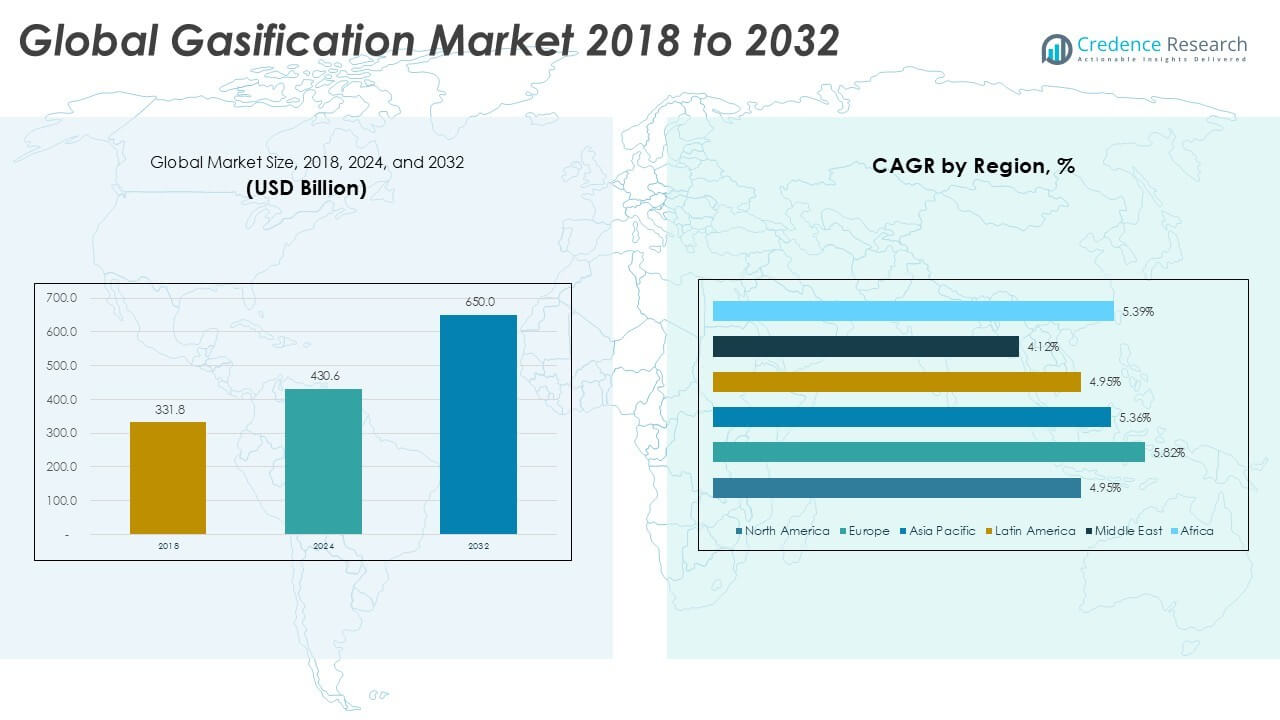
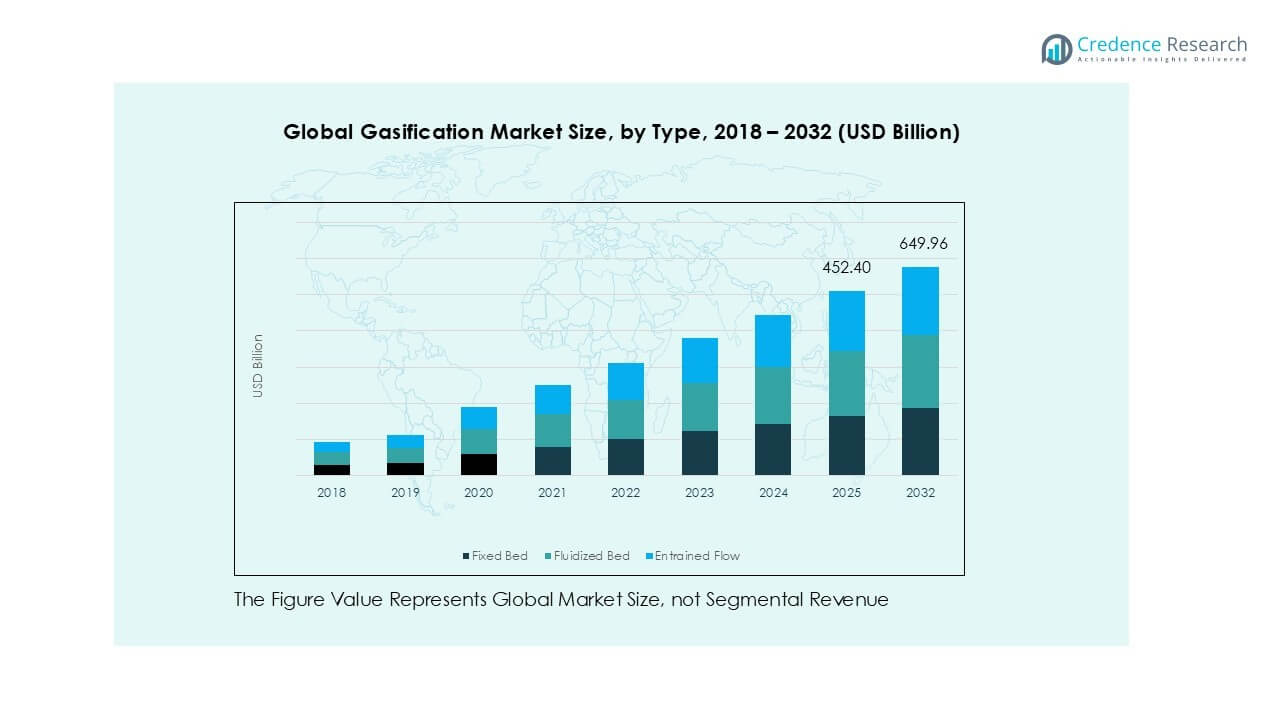
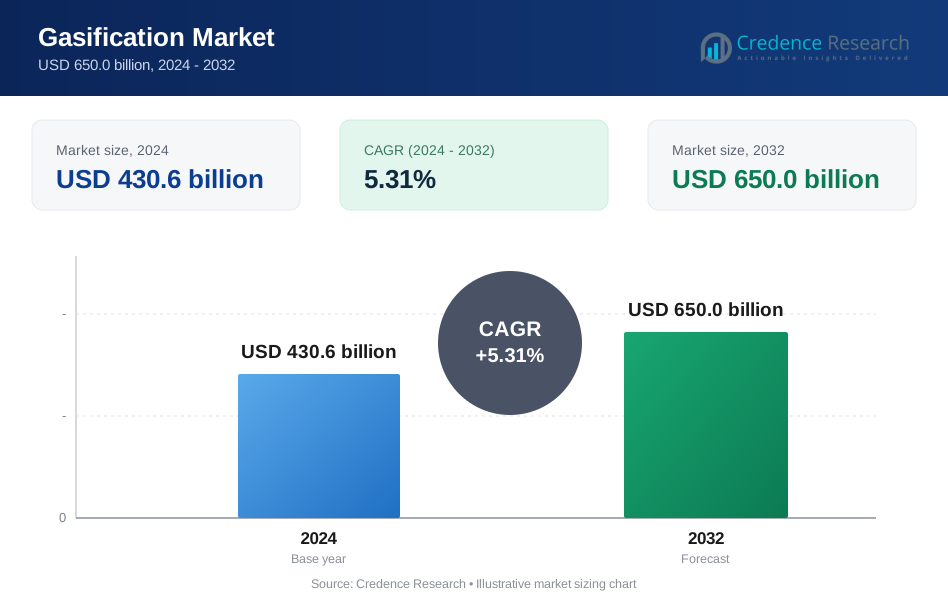
The Global Gasification Market size was valued at USD 331.8 billion in 2018, increased to USD 430.6 billion in 2024, and is anticipated to reach USD 650.0 billion by 2032, at a CAGR of 5.31% during the forecast period.
| REPORT ATTRIBUTE | DETAILS |
|---|---|
| Historical Period | 2020-2023 |
| Base Year | 2024 |
| Forecast Period | 2025-2032 |
| Gasification Market Size 2024 | USD 430.6 Billion |
| Gasification Market, CAGR | 5.31% |
| Gasification Market Size 2032 | USD 650.0 Billion |
Top players in the global gasification market include Shell Plc, Mitsubishi Heavy Industries, KBR Inc., General Electric, and Air Liquide, each offering proprietary gasifier technologies and end-to-end project solutions. These companies lead in industrial-scale deployments across power, chemicals, and hydrogen sectors. Shell and Mitsubishi dominate large coal and gas-based projects, while Air Liquide specializes in syngas processing and integration with industrial gases. Regionally, Asia Pacific holds the largest market share at 34.9% in 2024, driven by high coal availability, rapid industrialization, and government-backed coal-to-chemical initiatives, particularly in China and India. Europe and North America follow, supported by investments in waste-to-energy, clean hydrogen, and CCUS-linked projects.
Gasification Market Insights
- The global gasification market was valued at USD 430.6 billion in 2024 and is projected to reach USD 650.0 billion by 2032, growing at a CAGR of 5.31% during the forecast period.
- Rising demand for clean energy, hydrogen production, and syngas-based chemicals is driving the market, supported by abundant coal reserves and growing biomass feedstock adoption.
- Trends include growing investment in waste-to-energy and CCUS-integrated gasification systems, along with modular and feedstock-flexible gasifier designs to meet sustainability targets.
- Key players such as Shell, Mitsubishi Heavy Industries, KBR, and Air Liquide lead the market through strategic alliances, proprietary technology, and regional expansion, especially in Asia and Europe.
- Asia Pacific held the largest share at 34.9% in 2024, followed by Europe and North America; coal remained the dominant feedstock with over 45% share, while electricity generation led application segments with more than 40% of global revenue.
Gasification Market Segmentation Analysis:
By Feedstock
Coal dominated the global gasification market by feedstock, accounting for over 45% of the revenue share in 2024. Its abundance, high carbon content, and compatibility with large-scale industrial plants drive this dominance. Asia-Pacific countries, especially China and India, rely heavily on coal-based gasification for power and chemical production. While petroleum and gas are used in select refineries, their adoption is limited due to higher costs and lower carbon efficiency. Biomass and waste feedstocks are gaining momentum due to circular economy goals and renewable energy mandates, but they remain niche segments with limited scalability.
- For instance, China’s Shenhua Baotou Coal-to-Olefins project processes over 4 million tons of coal annually to produce syngas and 600,000 tons of olefins using coal gasification technology.
By Type
Entrained flow gasifiers led the market with a share exceeding 50% in 2024, driven by their capability to process a wide range of feedstocks, including coal and petcoke, at high efficiency and pressure. They offer higher throughput and cleaner syngas, making them ideal for large-scale chemical and fuel production. Fixed bed gasifiers hold a smaller share and serve localized applications due to lower capital costs and simple design. Fluidized bed systems are expanding in waste and biomass conversion projects, benefiting from uniform temperature distribution and suitability for low-grade feedstocks.
- For instance, Shell’s Pernis refinery in the Netherlands uses entrained flow gasification to convert residual oils and petcoke into synthesis gas for hydrogen and power generation.
By Application
Electricity generation remains the dominant application, contributing over 40% of global gasification revenue in 2024. Rising demand for decentralized power, particularly in developing economies, and support for cleaner coal conversion bolster this segment. Chemical production ranks second, with syngas used for methanol, ammonia, and hydrogen manufacturing. Fertilizers and liquid fuels follow, supported by integrated gasification combined cycle (IGCC) and Fischer-Tropsch projects. Synthetic Natural Gas (SNG) and hydrogen segments are witnessing faster growth, supported by green transition policies, decarbonization efforts, and investments in hydrogen economy infrastructure across North America and Europe.
Gasification Market Key Growth Drivers
Abundance of Coal and Diversification of Feedstocks
The global gasification market benefits from the abundant availability of coal and increasing diversification of feedstocks such as biomass, petcoke, and municipal waste. Coal continues to dominate due to its low cost and wide availability, especially in Asia-Pacific, where industrial-scale power and chemical plants drive demand. Meanwhile, countries are increasingly adopting biomass and waste-to-energy gasification to reduce landfill use and comply with circular economy regulations. This diversification enhances energy security, stabilizes supply chains, and supports long-term sustainability goals. Technological advancements also enable efficient handling of mixed feedstocks, improving plant economics and environmental performance. The shift toward alternative feedstocks is further accelerated by growing concerns around greenhouse gas emissions and carbon regulations. These factors collectively broaden the scope and adaptability of gasification across both developed and emerging markets, positioning it as a flexible and scalable clean energy solution.
- For instance, China’s new coal‑to‑chemicals project in Inner Mongolia is designed to produce around 70.59 million cubic meters of hydrogen annually from coal‑derived syngas, demonstrating how existing fossil feedstocks can be repurposed for cleaner outputs.
Rising Demand for Clean Energy and Hydrogen Production
Gasification is gaining momentum as a strategic solution for low-emission energy generation and clean hydrogen production. As countries target net-zero emissions, gasification systems offer a pathway to decarbonize electricity and industrial sectors using integrated carbon capture, utilization, and storage (CCUS). Hydrogen derived from syngas is increasingly being adopted across transportation, refining, and ammonia production sectors. With policy frameworks supporting blue hydrogen and clean fuel standards, several nations are investing in gasification-based hydrogen hubs. Moreover, the integration of gasification with renewable-powered electrolysis in hybrid systems is under exploration, enhancing its role in future hydrogen ecosystems. As global hydrogen demand surges projected to reach over 500 million tonnes annually by 2050 gasification stands as a key enabler of large-scale, cost-effective hydrogen output. This positions the technology as a core component in clean energy roadmaps of Europe, North America, and Asia.
- For example, global hydrogen production from all sources was about 94 million tonnes in 2021, with coal gasification representing a significant portion of this output.
Growth in Industrial Chemicals and Fertilizer Demand
Industrial sectors continue to drive gasification adoption for chemical and fertilizer production due to the high purity and reliability of syngas as a feedstock. Syngas is a key input for methanol, ammonia, and urea, which are widely used across multiple industries including agriculture, plastics, and textiles. Growing global population and food demand are pushing fertilizer production higher, particularly in Asia and Latin America. Meanwhile, methanol’s use in fuels and plastics further stimulates demand. Gasification enables consistent, high-output chemical production with better emission control than traditional combustion methods. It also allows industries to tap into locally available feedstocks especially coal and petcoke ensuring energy security and cost control. Countries like China, India, and Indonesia have expanded coal-to-chemical projects, reinforcing gasification’s role in driving vertical integration within industrial value chains. As demand for chemicals and fertilizers continues to rise, gasification provides a cost-competitive and scalable production route.
Gasification Market Key Trends & Opportunities
Expansion of Waste-to-Energy and Biomass Gasification Projects
The shift toward sustainable waste management and renewable energy has accelerated the deployment of waste-to-energy (WtE) and biomass-based gasification plants. Municipal solid waste, agricultural residues, and industrial biomass offer vast untapped potential for energy recovery, especially in densely populated and agro-based economies. Gasification enables cleaner and more efficient conversion of these feedstocks compared to incineration or landfilling. Governments across Europe, Southeast Asia, and parts of Africa are offering incentives for decentralized, grid-connected biomass gasification projects to address rural electrification and reduce methane emissions. Moreover, urban centers are deploying compact WtE gasifiers to manage waste volumes and generate electricity or district heating. These projects align with circular economy principles and climate action goals while creating employment and reducing import dependence on fossil fuels. Advancements in gasifier design and air filtration also make modern WtE plants more viable, opening new investment avenues globally.
- For example, Ankur Scientific Energy Technologies has installed hundreds of biomass gasifiers in countries such as India, Bangladesh, Uganda, and Madagascar for decentralized energy generation in rural and industrial settings.
Integration with Carbon Capture and Utilization Technologies
The integration of gasification with carbon capture, utilization, and storage (CCUS) presents a transformative opportunity for reducing the carbon footprint of syngas production. Gasification's concentrated CO₂ streams allow more efficient capture than other industrial processes, making it well-suited for carbon abatement strategies. Several commercial-scale projects, especially in North America and China, are demonstrating how gasification can deliver low-carbon hydrogen, synthetic fuels, and chemicals when combined with CCUS infrastructure. This synergy supports energy-intensive industries in meeting their emission targets while continuing operations. Additionally, captured CO₂ is increasingly being reused in enhanced oil recovery (EOR), building materials, and algae cultivation, creating new revenue streams. With global funding for carbon management technologies rising, gasification facilities with CCUS capabilities are expected to gain preference in licensing, financing, and policy support. This trend aligns with both corporate decarbonization goals and national energy transition strategies.
Gasification Market Key Challenges
High Capital Investment and Operational Complexity
One of the major challenges facing the global gasification market is the high upfront capital investment and operational complexity associated with large-scale facilities. Constructing integrated gasification combined cycle (IGCC) or coal-to-chemical plants requires significant financial commitments, often exceeding several hundred million dollars. These projects involve complex engineering, feedstock preprocessing systems, and stringent environmental controls. Moreover, fluctuations in feedstock quality, plant downtime risks, and high maintenance needs increase operating costs. In emerging economies, access to financing and skilled labor often becomes a hurdle, delaying project execution. Additionally, uncertainty in policy incentives and long permitting cycles further complicate project viability. This deters small and medium enterprises from entering the market and slows adoption in capital-constrained regions. Streamlining modular gasifier designs, improving feedstock flexibility, and strengthening public-private financing models will be essential to overcome these barriers and expand gasification deployment.
Environmental and Regulatory Concerns
Despite its clean energy potential, gasification faces scrutiny over environmental impacts, particularly when coal or petcoke is used as feedstock. Emissions of CO₂, particulate matter, and trace contaminants like mercury and sulfur can raise compliance issues under tightening environmental regulations. Water usage, especially in cooling and gas cleaning processes, is another point of concern in water-stressed regions. Public opposition to large-scale coal gasification projects has increased due to land use, air quality, and community health concerns. Moreover, stricter global climate policies and carbon pricing mechanisms could make fossil feedstock-based gasification economically less attractive without carbon mitigation technologies in place. Regulatory uncertainties in permitting and licensing also cause project delays and investor hesitation. To address these challenges, companies are investing in low-emission designs, closed-loop water systems, and CCUS integration, while governments must align policy frameworks to promote sustainable, feedstock-flexible gasification solutions.
Gasification Market Regional Analysis
North America
North America accounted for 18.8% of the global gasification market in 2024, reaching a value of USD 101.77 billion, up from USD 79.99 billion in 2018. The market is projected to grow to USD 149.49 billion by 2032, registering a CAGR of 4.95%. Growth is driven by increased investments in clean hydrogen, waste-to-energy systems, and advanced IGCC projects. The U.S. leads regional demand, supported by energy diversification policies and carbon capture integration. Rising industrial use of syngas in chemicals and refining, coupled with policy backing for low-emission technologies, reinforces the market’s long-term potential in this region.
Europe
Europe held a 22.5% share of the global gasification market in 2024, with a value of USD 119.77 billion, rising from USD 89.58 billion in 2018. The market is expected to reach USD 187.84 billion by 2032, growing at a CAGR of 5.82%, the highest among major developed markets. Demand is bolstered by strong waste management frameworks, biomass gasification adoption, and carbon reduction policies under the EU Green Deal. Germany, France, and the Netherlands lead investments in WtE and hydrogen-focused projects. The region also benefits from a mature regulatory environment and growing interest in decentralized energy solutions.
Asia Pacific
Asia Pacific led the global gasification market with a 34.9% share in 2024, reaching USD 150.17 billion, up from USD 115.39 billion in 2018. By 2032, the market is projected to hit USD 227.48 billion, growing at a CAGR of 5.36%. Rapid industrialization, coal-based syngas projects, and rising fertilizer and methanol demand support this leadership. China dominates the region’s market, followed by India and Indonesia. Expanding domestic feedstock availability and government-backed coal-to-chemical programs also drive adoption. The region’s emphasis on energy security, alongside a shift to biomass and waste-based gasifiers, continues to enhance growth momentum.
Latin America
Latin America represented 7.3% of the global gasification market in 2024, with a value of USD 31.43 billion, up from USD 24.72 billion in 2018. The market is expected to grow to USD 46.15 billion by 2032, posting a CAGR of 4.95%. Regional growth is driven by expanding fertilizer and ammonia demand and rising interest in biomass-based energy systems. Brazil and Argentina lead adoption, leveraging agricultural waste and forest residues for energy generation. Public-private partnerships are supporting decentralized energy models in rural and semi-urban areas. However, inconsistent policies and limited financing pose challenges to large-scale project development.
Middle East
The Middle East accounted for 3.7% of the global gasification market in 2024, reaching USD 19.33 billion, up from USD 15.86 billion in 2018. The market is projected to reach USD 26.65 billion by 2032, with a CAGR of 4.12%. Gasification adoption is supported by oil-to-chemical conversions and refinery-based hydrogen generation. Countries like Saudi Arabia and the UAE invest in IGCC and clean fuel projects to diversify energy portfolios. However, low natural gas prices and reliance on conventional fuels limit broader deployment. Future growth depends on regional strategies for blue hydrogen and emissions reduction commitments.
Africa
Africa contributed 1.5% to the global gasification market in 2024, with a value of USD 8.13 billion, up from USD 6.24 billion in 2018. The market is forecast to grow to USD 12.35 billion by 2032, registering a CAGR of 5.39%. Growth is driven by rural electrification needs and the availability of agricultural waste as a feedstock. Nigeria, South Africa, and Kenya are exploring decentralized biomass gasification systems to expand energy access. Government-backed mini-grid programs and donor-funded sustainability projects further support adoption. While infrastructure and financing gaps remain, Africa presents long-term potential for clean, community-based gasification initiatives.
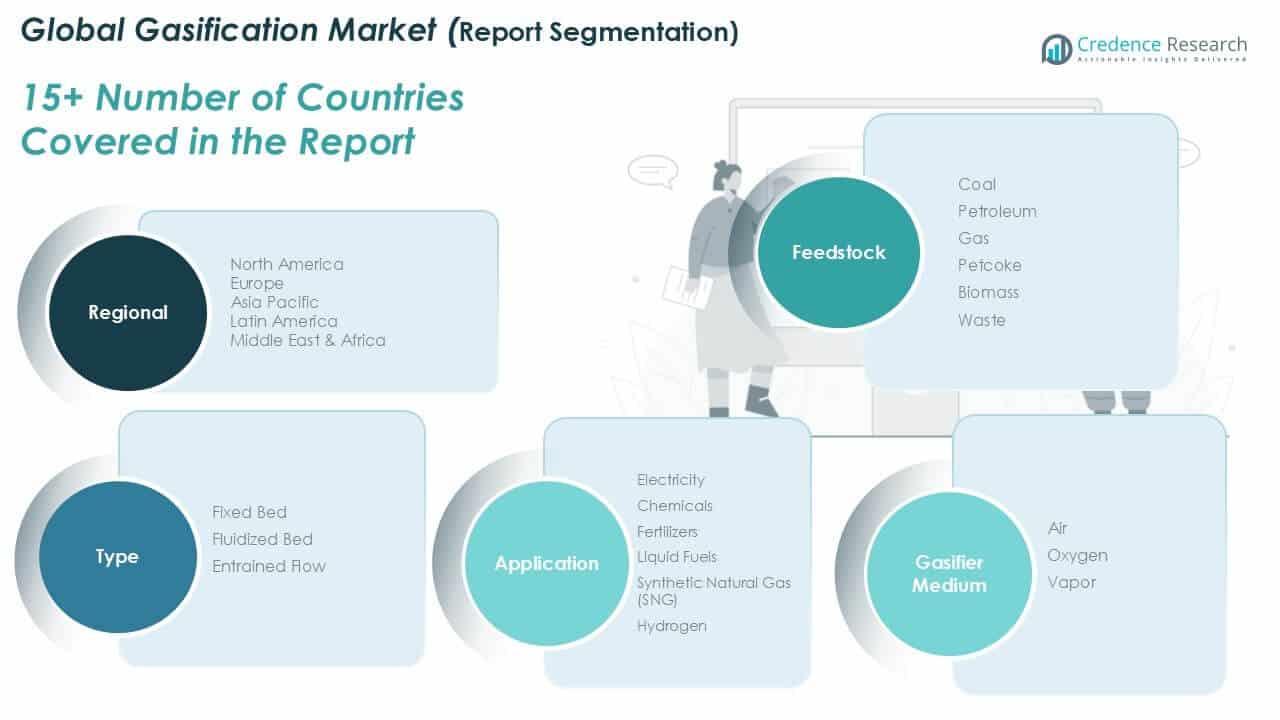
Gasification Market Segmentations:
By Feedstock
- Coal
- Petroleum
- Gas
- Petcoke
- Biomass
- Waste
By Type
- Fixed Bed
- Fluidized Bed
- Entrained Flow
By Application
- Electricity
- Chemicals
- Fertilizers
- Liquid Fuels
- Synthetic Natural Gas (SNG)
- Hydrogen
By Gasifier Medium
- Air
- Oxygen
- Vapor
By Geography
- North America
- U.S.
- Canada
- Mexico
- Europe
- Germany
- France
- U.K.
- Italy
- Spain
- Rest of Europe
- Asia Pacific
- China
- Japan
- India
- South Korea
- South-east Asia
- Rest of Asia Pacific
- Latin America
- Brazil
- Argentina
- Rest of Latin America
- Middle East & Africa
- GCC Countries
- South Africa
- Rest of the Middle East and Africa
Gasification Market Competitive Landscape
The global gasification market features a mix of established energy giants, industrial technology firms, and regional specialists competing across diverse applications. Shell Plc leads with advanced gasification technologies and hydrogen-focused investments, supported by strong financials and global project execution. SEDIN Engineering and Synthesis Energy Systems Inc. focus on customized syngas systems and niche markets, particularly in Asia. Mitsubishi Heavy Industries and KBR Inc. provide large-scale IGCC and chemical gasification solutions, leveraging engineering expertise. General Electric and Siemens integrate gasification with turbine and power systems, while Air Liquide strengthens its position through syngas purification and industrial gas applications. Companies are pursuing strategies such as feedstock-flexible systems, modular gasifiers, and CCUS integration to enhance competitiveness. Partnerships, technology licensing, and regional expansions are common, especially in high-growth areas like Asia Pacific and Europe. Competitive intensity is expected to increase as clean hydrogen demand, waste-to-energy mandates, and decarbonization policies shape future market dynamics.
Key Player Analysis
- Shell Plc
- SEDIN Engineering Company Limited
- Synthesis Energy Systems Inc.
- Mitsubishi Heavy Industries
- KBR Inc.
- General Electric
- Siemens
- Air Liquide
- Other Key Players
Recent Developments
- In December 2023, Air Liquide has announced that it will build, own, and operate a global carbon capture facility in the industrial area of Rotterdam, the Netherlands, using its proprietary Cryocap™ technology. The new unit will be installed at the group's hydrogen production plant in the port of Rotterdam and connected to Porthos, one of Europe's largest carbon capture and storage infrastructures, to reduce CO₂ emissions in this large industrial area significantly.
- In October 2023, Air Liquide announces the creation of a new platform in Bécancour, Québec, Canada, with an investment of more than 140 million euros, to deliver low-carbon industrial gases such as hydrogen, oxygen, nitrogen and argon. In addition to the 20 MW PEM electrolyser currently in use at the group, the infrastructure created by Air Liquide will include a new air separation unit producing renewable oxygen and nitrogen and liquid storage capacity, which will be connected to the local pipeline network.
Report Coverage
The research report offers an in-depth analysis based on Feedstock, Type, Application, Gasifier Medium and Geography. It details leading market players, providing an overview of their business, product offerings, investments, revenue streams, and key applications. Additionally, the report includes insights into the competitive environment, SWOT analysis, current market trends, as well as the primary drivers and constraints. Furthermore, it discusses various factors that have driven market expansion in recent years. The report also explores market dynamics, regulatory scenarios, and technological advancements that are shaping the industry. It assesses the impact of external factors and global economic changes on market growth. Lastly, it provides strategic recommendations for new entrants and established companies to navigate the complexities of the market.
Future Outlook
- Gasification adoption will increase as countries pursue long-term energy security strategies.
- Hydrogen production from syngas will gain stronger policy and industrial support.
- Waste-to-energy gasification will expand to address urban waste management challenges.
- Biomass gasification will grow with renewable energy and circular economy initiatives.
- Integration with carbon capture systems will improve environmental performance.
- Industrial demand for syngas-based chemicals will remain a key growth driver.
- Modular and flexible gasifier designs will support faster project deployment.
- Asia Pacific will continue to lead capacity additions and new investments.
- Regulations on emissions will push cleaner and more efficient gasification technologies.
- Strategic partnerships will accelerate technology development and market expansion.
Request a Free Sample
Fill in your details and we'll send you a free sample report.
- Sample data tables & charts
- Research methodology
Need a Custom Version of This Report?
Tailor the scope, geography, or segments to your exact requirements.
- Custom geography or segment scope
- Direct access to our analyst team
Frequently Asked Questions
What is the current market size for Global Gasification market, and what is its projected size in 2032?
At what Compound Annual Growth Rate is the Global Gasification market projected to grow between 2024 and 2032?
Which Global Gasification market segment held the largest share in 2024?
What are the primary factors fueling the growth of the Global Gasification market?
Who are the leading companies in the Global Gasification market?
Which region commanded the largest share of the Global Gasification market in 2024?
Table of Content
Chapter 1. Report Introduction
- 1.1 Report Description & Purpose
- 1.1.1 Report Title & Market Definition
- 1.1.2 Unique Selling Propositions (USP) & Key Differentiators
- 1.1.3 Value Proposition for Stakeholders
- 1.2 Research Objectives
- 1.2.1 Market Sizing Objectives (Volume & Revenue)
- 1.2.2 Segmentation Objectives
- 1.2.3 Competitive Intelligence Objectives
- 1.2.4 Forecast & Scenario Objectives
- 1.3 Report Scope
- 1.3.1 Gasification Scope – Types & Subtypes Covered
- 1.3.2 Geographic Scope – Regions & Countries Covered
- 1.3.3 Historical Period, Base Year & Forecast Period (2024; forecast to 2032)
- 1.3.4 Inclusions & Exclusions
- 1.4 HS Code & Classification Framework
- 1.5 Currency, Units & Pricing Basis
- 1.6 Target Stakeholders
- 1.7 Limitations & Assumptions
Chapter 2. Executive Summary
- 2.1 Global Gasification Market Snapshot
- 2.1.1 Market Size – Historical (2024) & Forecast (2024-2032) (2024: USD 430.6 billion → 2032: USD 650.0 billion)
- 2.1.2 Volume & Revenue – Global Totals
- 2.1.3 Key Market Highlights – Top Five Facts
- 2.2 Gasification Market Segmentation Snapshot
- 2.2.1 Market Split by Region – 2024 vs. 2032
- 2.3 Competitive Snapshot
- 2.3.1 Top 10 Players by Revenue Share – 2024
- 2.3.2 Top 10 Players by Volume Share – 2024
- 2.3.3 Recent Strategic Developments (18-Month Summary)
- 2.4 Key Investment Highlights & Strategic Conclusions
Chapter 3. Gasification Market Dynamics & Industry Analysis
- 3.1 Market Overview & Context
- 3.1.1 Gasification Market Position in the Broader Automotive Value Chain
- 3.1.2 OEM vs. Replacement Market Dynamics
- 3.1.3 Market Maturity & Development Stage by Region
- 3.2 Gasification Market Drivers
- 3.3 Gasification Market Restraints & Challenges
- 3.4 Gasification Market Opportunities
- 3.5 Porter's Five Forces Analysis
- 3.5.1 Threat of New Entrants
- 3.5.2 Bargaining Power of Suppliers
- 3.5.3 Bargaining Power of Buyers
- 3.5.4 Threat of Substitutes
- 3.5.5 Competitive Rivalry – Intensity Assessment
- 3.6 Gasification Value Chain Analysis
- 3.6.1 Upstream – Raw Material/Input Suppliers
- 3.6.1.1 Raw Material/Input 1
- 3.6.1.2 Raw Material/Input 2
- 3.6.1.3 Raw Material/Input 3
- 3.6.2 Midstream – Production/Manufacturing/Service Delivery
- 3.6.2.1 Production/Process Overview
- 3.6.2.2 Key Facility Locations & Capacity by Manufacturer
- 3.6.3 Downstream – Distribution & End Consumer
- 3.6.3.1 Primary Channel – B2B/OEM
- 3.6.3.2 Secondary Channels – Dealer, Retail, Online, Direct
- 3.6.4 Value Chain Profitability Analysis
- 3.6.1 Upstream – Raw Material/Input Suppliers
- 3.7 PESTEL Analysis
- 3.7.1 Political Factors
- 3.7.2 Economic Factors
- 3.7.3 Social Factors
- 3.7.4 Technological Factors
- 3.7.5 Environmental Factors
- 3.7.6 Legal Factors
- 3.8 Gasification Supply Chain Analysis
- 3.8.1 Raw Material/Input Supply Risk Assessment
- 3.8.2 Manufacturing Concentration Risk (Geographic Exposure)
- 3.8.3 Trade Disruption Impact Analysis
- 3.9 Regulatory & Policy Landscape
Note: The regulatory and policy landscape section covers regulations based on their applicability to the market, Gasification category, geography, and scope of the study. Only regulatory frameworks with a material impact on operations, compliance, trade, sustainability, or market access are analyzed in detail.
Chapter 4. Key Investment Pockets & Opportunity Analysis
- 4.1 Gasification Market Attractiveness Analysis
- 4.1.1 By Region – Investment Attractiveness Matrix (Volume × CAGR)
- 4.2 Absolute Revenue Growth Opportunity
- 4.2.1 By Region – Absolute USD Growth Through 2032
- 4.3 Incremental Volume Opportunity
- 4.3.1 By Region – Incremental Volume Through 2032
- 4.3.2 Segment – Incremental Volume
- 4.4 Emerging Submarket Opportunity Deep Dive (Subject to Applicability)
- 4.5 Emerging Market Opportunity Scorecards
- 4.5.1 United States
- 4.5.2 Europe
- 4.5.3 Asia
- 4.5.4 Middle East & Africa
Note: Emerging Market Opportunity Scorecards will be included based on relevance and strategic importance. Regions listed are indicative and may vary depending on data availability and market dynamics.
Chapter 5. Gasification Import-Export Analysis & Trade Flows
- 5.1 Global Trade Overview
- 5.1.1 Global Export Value by Country (2024)
- 5.1.2 Global Export Volume by Country (2024)
- 5.1.3 Global Import Value by Country (2024)
- 5.1.4 Global Import Volume by Country (2024)
- 5.1.5 Net Trade Balance by Country (2024)
- 5.2 Export Analysis – Segment
- 5.2.1 Type 1 (HS Code)
- 5.2.2 Type 2 (HS Code)
- 5.2.3 Type 3 (HS Code)
- 5.2.4 Type 4 (HS Code)
- 5.2.5 Type 5 (HS Code)
- 5.3 Import Analysis – Segment
- 5.3.1 Type 1 (HS Code)
- 5.3.2 Type 2 (HS Code)
- 5.3.3 Type 3 (HS Code)
- 5.3.4 Type 4 (HS Code)
- 5.3.5 Type 5 (HS Code)
- 5.4 Average Unit Trade Prices
- 5.4.1 Average Export Price – Segment & Country
- 5.4.2 Average Import Price – Segment & Source Country
- 5.4.3 Price Trends (2024)
- 5.5 Key Trade Route Analysis
- 5.5.1 Trade Route 1
- 5.5.2 Trade Route 2
- 5.5.3 Trade Route 3
- 5.5.4 Trade Route 4
- 5.5.5 Trade Route 5
- 5.6 Trade Policy Impact Assessment
- 5.6.1 US Anti-Dumping & Section 301 Tariffs
- 5.6.2 EU Customs Union Impact
- 5.6.3 Major Free Trade Agreements
- 5.6.4 USMCA Rules of Origin
Note: Trade policy analysis will be included only where relevant to the Gasification market.
Chapter 6. Competitive Landscape & Company Benchmarking
- 6.1 Gasification Market Concentration & Structure
- 6.1.1 Herfindahl-Hirschman Index (HHI) – vs. 2024
- 6.1.2 Tier 1, Tier 2 & Tier 3 Market Structure
- 6.1.3 Global, Regional & Local Player Dynamics
- 6.2 Gasification Market Share Analysis – 2024
- 6.2.1 Global Revenue Share by Company
- 6.2.2 Global Volume Share by Company
- 6.2.3 Regional Revenue Share
- 6.2.4 Market Share Evolution ( vs. 2024)
- 6.2.5 OEM Segment Share by Company
- 6.2.6 Replacement Segment Share by Company
- 6.3 Production/Delivery Capacity & Facility Analysis
- 6.3.1 Global Installed Capacity
- 6.3.2 Capacity Utilization Rates
- 6.3.3 Production/Output Volume
- 6.3.4 Facility Locations & Capacity Map
- 6.3.5 Planned Capacity Additions
- 6.4 Gasification Competitive Benchmarking Matrix
- 6.4.1 Revenue, Volume, CAGR & Profitability Comparison
- 6.4.2 Channel Revenue Mix
- 6.4.3 Geographic Revenue Exposure
- 6.4.4 R&D Intensity
- 6.4.5 Sustainability Maturity
- 6.5 Strategic Developments in Gasification (Last 24 Months)
- 6.5.1 Mergers, Acquisitions & Divestments
- 6.5.2 New Gasification Launches
- 6.5.3 Facility Expansions
- 6.5.4 Strategic Alliances, Joint Ventures & Partnerships
- 6.5.5 Distribution Expansion & Market Entry
- 6.5.6 Sustainability & ESG Initiatives
- 6.6 Competitive Strategy Mapping
- 6.6.1 Leader, Challenger, Follower & Niche Classification
- 6.6.2 Pricing Strategy Comparison
- 6.6.3 Channel Strategy Matrix
Note: Strategic developments are included based on their materiality and the availability of reliable information.
Chapter 7. Global Gasification Market – By Distribution Channel
- 7.1 Segment Overview
- 7.1.1 Volume & Revenue Split by Channel (2024 & 2032)
- 7.1.2 Channel Mix Evolution (2024-2032)
Chapter 8. Regional Market Analysis – Global Overview
- 8.1 Global Regional Overview
- 8.1.1 Regional Volume Share
- 8.1.2 Regional Revenue Share
- 8.1.3 Regional Volume by Region
- 8.1.4 Regional Revenue by Region
- 8.1.5 Regional Forecast Through 2032
- 8.2 Cross-Regional Segment Analysis
- 8.2.1 By Distribution Channel
- 8.2.2 By Brand/Price Tier
Chapter 9. North America Gasification Market
- 9.1 United States
- 9.2 Canada
- 9.3 Mexico
Chapter 10. Europe Gasification Market
- 10.1 Germany
- 10.2 France
- 10.3 Italy
- 10.4 United Kingdom
- 10.5 Spain
- 10.6 Poland
- 10.7 Russia
- 10.8 Netherlands
- 10.9 Belgium
- 10.10 Sweden
- 10.11 Denmark
- 10.12 Norway
- 10.13 Rest of Europe
Chapter 11. Asia Pacific Gasification Market
- 11.1 China
- 11.2 India
- 11.3 Japan
- 11.4 South Korea
- 11.5 Thailand
- 11.6 Indonesia
- 11.7 Vietnam
- 11.8 Malaysia
- 11.9 Australia
- 11.10 Rest of Asia Pacific
Chapter 12. Latin America Gasification Market
- 12.1 Brazil
- 12.2 Argentina
- 12.3 Colombia
- 12.4 Chile
- 12.5 Rest of Latin America
Chapter 13. Middle East Gasification Market
- 13.1 Saudi Arabia
- 13.2 United Arab Emirates
- 13.3 Turkey
- 13.4 Israel
- 13.5 Iran
- 13.6 Rest of the Middle East
Chapter 14. Africa Gasification Market
- 14.1 South Africa
- 14.2 Egypt
- 14.3 Nigeria
- 14.4 Morocco
- 14.5 Rest of Africa
Chapter 15. Gasification Company Profiles
- 15.1 [Company 01]
- 15.1.1 Company Overview
- 15.1.2 Key Management Personnel
- 15.1.3 Products & Services Portfolio
- 15.1.4 Financial Performance
- 15.1.5 Key Market Focus & Geographic Presence
- 15.1.6 Recent Developments & Strategic Initiatives
Note: The company profile list is preliminary and may change based on research findings, market developments, data availability, and client requirements.
Chapter 16. Appendices
- Appendix A – List of Abbreviations & Acronyms
- Appendix B – Industry Classification Code Reference – Full Series
- Appendix C – Production & Capacity Data Tables
- Appendix D – End-Use & Demand Base Tables
- Appendix E – Consumption & Replacement Rate Assumptions
- Appendix F – ASP Reference Tables
- Appendix G – Manufacturing & Facility Database
- Appendix H – Import-Export Data Tables
- Appendix I – Regulatory Summary Tables
- Appendix J – Primary Research Participant List (Anonymized)
- Appendix K – Primary Research Questionnaire Framework
- Appendix L – Data Sources & Bibliography
- Appendix M – Market Size Divergence & Source Comparison
Chapter 17. Research Methodology
- 17.1 Research Framework & Philosophy
- 17.2 Secondary Research – Sources, Hierarchy & Data Extraction
- 17.3 Data Modeling – Bottom-Up & Top-Down Market Sizing
- 17.4 Primary Research – Stakeholder Framework, LOI & Sample Sizes
- 17.5 Forecast Methodology – Regression, Scenario & Sensitivity Analysis
- 17.6 Quality Control – Four-Layer Validation Framework
- 17.7 Limitations & Standard Assumptions
- 17.8 Disclaimer
