
Gasoline Turbochargers Market Overview:
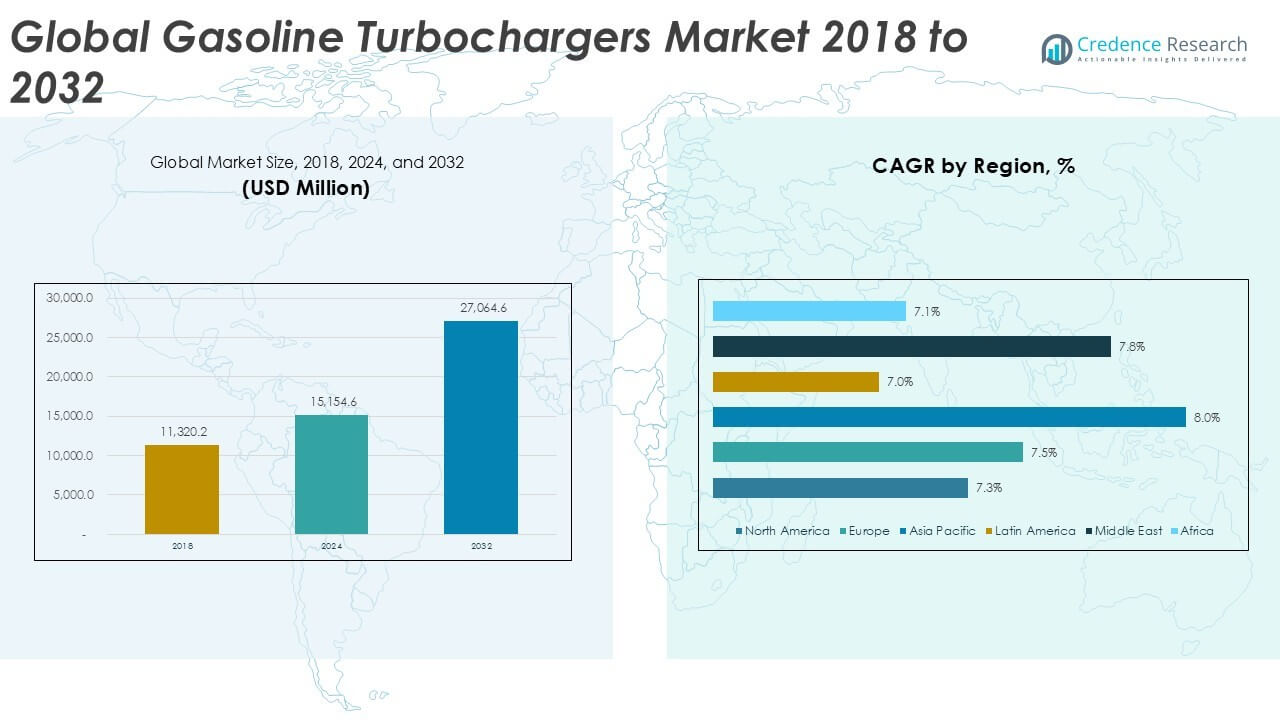
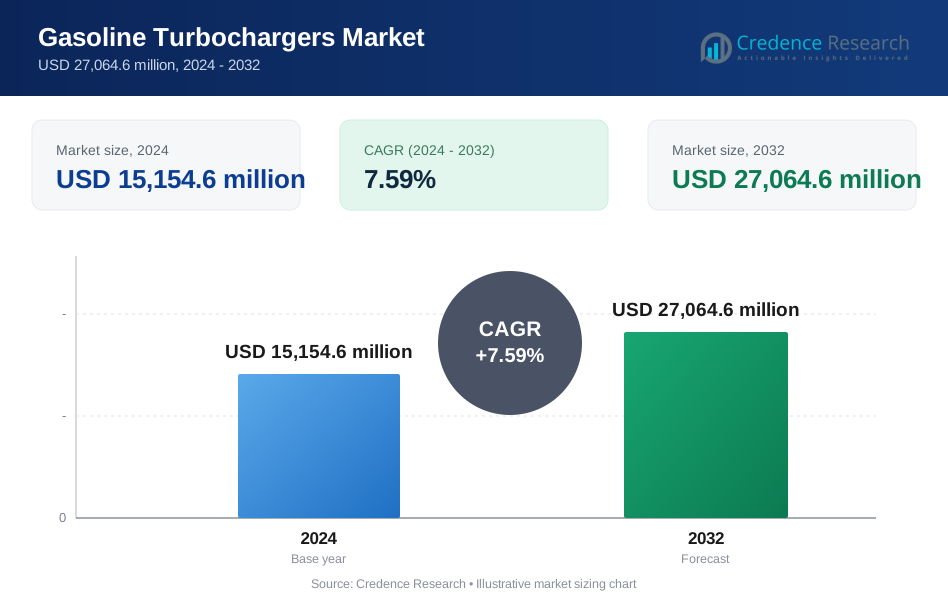
The Global Gasoline Turbochargers market size was valued at USD 11,320.2 million in 2018, increased to USD 15,154.6 million in 2024, and is anticipated to reach USD 27,064.6 million by 2032, growing at a CAGR of 7.59% during the forecast period.
| REPORT ATTRIBUTE | DETAILS |
|---|---|
| Historical Period | 2020-2023 |
| Base Year | 2024 |
| Forecast Period | 2025-2032 |
| Gasoline Turbochargers Market Size 2024 | USD 15,154.6 million |
| Gasoline Turbochargers Market, CAGR | 7.59% |
| Gasoline Turbochargers Market Size 2032 | USD 27,064.6 million |
Top players in the global gasoline turbochargers market include Garrett Motion Inc., BorgWarner Inc., IHI Corporation, Continental AG, and Mitsubishi Heavy Industries, Ltd. These companies lead with broad portfolios, advanced technologies, and strong ties with global automotive OEMs. BorgWarner and Garrett maintain a stronghold in passenger vehicle applications, while IHI and Mitsubishi focus on performance and regional-specific platforms. Continental integrates turbocharging with electronics and hybrid systems. Asia Pacific emerged as the leading regional market in 2024, accounting for 35.6% of global revenue, driven by high vehicle production in China, India, and Japan alongside rising adoption of turbocharged gasoline engines.
Gasoline Turbochargers Market Insights
- The global gasoline turbochargers market was valued at USD 15,154.6 million in 2024 and is expected to reach USD 27,064.6 million by 2032, growing at a CAGR of 7.59%.
- Rising demand for fuel-efficient and downsized gasoline engines is a major driver, supported by global emission regulations and consumer preference for better mileage without sacrificing performance.
- A key trend is the integration of turbochargers in hybrid and mild-hybrid gasoline vehicles, particularly in compact and mid-sized passenger cars, which dominate the segment with over 65% share.
- The market faces restraints from the accelerating shift toward battery electric vehicles and the high cost of advanced turbo technologies such as VGT and e-turbos.
- Asia Pacific leads with 35.6% market share in 2024, followed by North America at 25.7% and Europe at 22.0%, driven by high automotive production and adoption of emission-compliant turbocharged gasoline vehicles.
Gasoline Turbochargers Market Segmentation Analysis:
By Vehicle:
Passenger cars dominate the global gasoline turbochargers market, accounting for over 65% of the revenue share in 2024. The segment benefits from rising demand for fuel-efficient and performance-oriented vehicles in both developed and emerging economies. Turbochargers are widely adopted in compact and mid-sized gasoline cars to comply with emission norms while maintaining engine power. The shift toward downsized engines with higher power output also supports adoption. Additionally, growth in urban vehicle ownership and production of hybrid gasoline cars further boosts the passenger car segment's influence across global markets. In contrast, Low Commercial Vehicles (LCVs) and High Commercial Vehicles (HCVs) together hold a smaller yet growing share. LCVs gain traction in logistics and last-mile delivery applications, especially in Asia-Pacific and Latin America, where fuel efficiency and payload balancing are key. HCVs adopt turbochargers at a slower pace due to higher diesel dominance, yet the transition to cleaner gasoline variants for intracity transport and regulated emission compliance in Europe and North America fosters gradual growth.
- For instance, most gasoline turbochargers supplied for compact and mid‑sized cars like the Ford EcoBoost series use turbocharging to boost power from smaller engines while maintaining efficiency, aligning with broader industry trends toward turbocharged gasoline engines in daily vehicles.
By Technology:
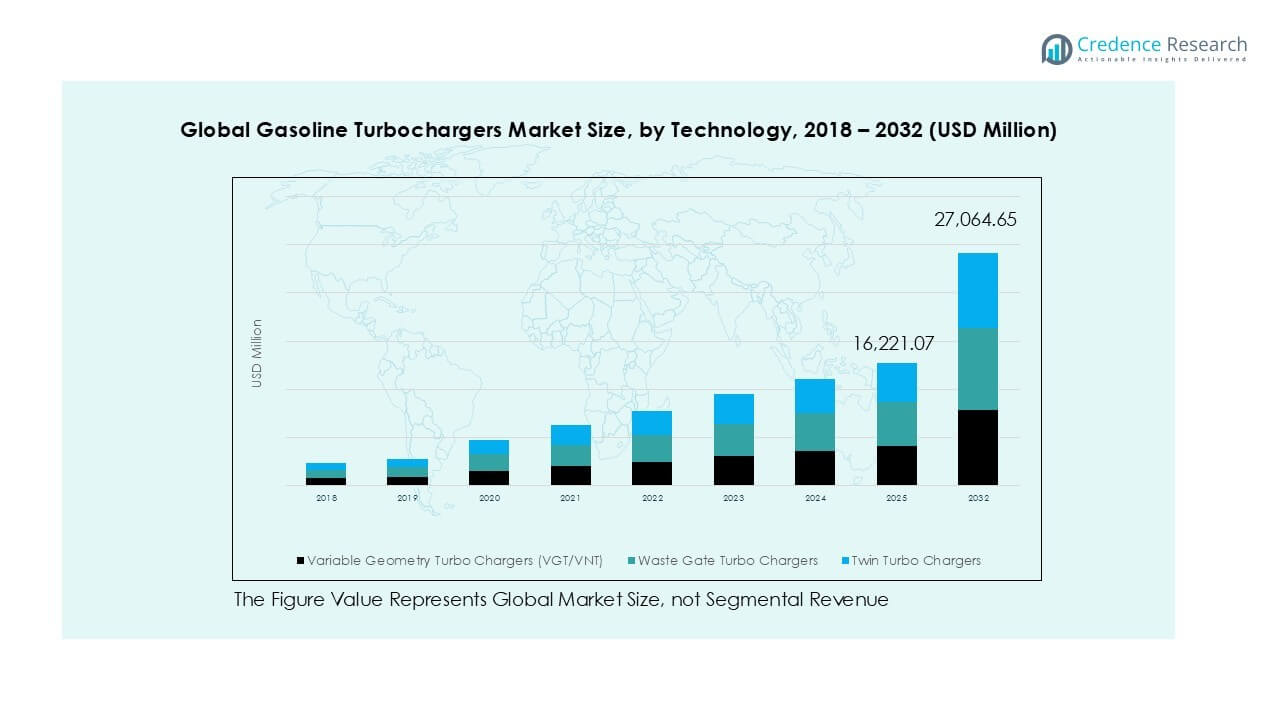
Variable Geometry Turbochargers (VGT/VNT) lead the market by technology, contributing nearly 48% of the total gasoline turbocharger revenue in 2024. Their ability to deliver optimal boost pressure across a wide engine speed range enhances both performance and fuel economy. VGT systems are increasingly integrated into passenger and light commercial vehicles, especially in regions with stringent CO₂ emission regulations such as Europe and the U.S. Automakers prefer VGTs for their flexibility in supporting diverse engine sizes, particularly in premium and mid-range vehicles. Waste Gate Turbochargers follow as the second-largest segment due to their cost-effectiveness and simpler design, making them ideal for mass-market gasoline cars. Their wide-scale use in small engine platforms across Asia-Pacific supports volume growth. Meanwhile, Twin Turbochargers hold a niche but expanding share, driven by high-performance vehicle segments requiring rapid acceleration and reduced turbo lag. Twin setups are increasingly used in sports and luxury models in North America, Europe, and China, aligning with growing consumer interest in performance-based gasoline vehicles.
- For instance, Garrett Motion has sold 40 million VNT turbochargers across gasoline and diesel applications, reflecting broad adoption of VGT technology in turbocharged engines that balance power and efficiency.
Gasoline Turbochargers Market Key Growth Drivers
Rising Global Demand for Fuel Efficiency and Engine Downsizing
Governments and consumers continue to demand better fuel economy without sacrificing engine power. Gasoline turbochargers enable automakers to meet this demand through smaller, lighter engines that maintain high output. Turbocharging boosts air intake, improving combustion efficiency and reducing fuel consumption. This is particularly critical in compact and mid-sized vehicles, where space and weight are limited. Regulatory pressure, such as EU CO₂ standards and U.S. CAFE targets, accelerates this shift. Automakers worldwide adopt turbochargers to balance fuel economy, performance, and compliance. As engine downsizing becomes the norm, the demand for efficient turbocharger systems across vehicle classes remains strong and widespread.
- For instance, Ford’s EcoBoost engines use turbocharging to deliver similar torque to larger displacement engines while improving fuel efficiency compared with non‑turbo variants.
Increasing Stringency of Global Emission Norms
Stringent emission norms across Europe, China, and North America drive widespread adoption of turbochargers in gasoline engines. Turbochargers help reduce NOx and CO₂ emissions by enabling better combustion control and allowing for smaller engines. Technologies like VGT and twin-scroll turbochargers allow OEMs to meet emissions regulations without compromising vehicle performance. In particular, Euro 6/7, China VI, and U.S. Tier 3 standards compel manufacturers to integrate turbocharging solutions into gasoline platforms. These norms apply to both passenger and light commercial vehicles, expanding the market’s addressable base. As countries tighten their emission rules further, turbochargers are set to play a critical role in ensuring environmental compliance across fleets.
Growth in Passenger Vehicle Production and Urban Vehicle Ownership
The expansion of urban populations and growing middle-class income levels boost passenger vehicle sales, especially in Asia-Pacific and Latin America. Gasoline engines dominate this segment, and the inclusion of turbochargers supports performance, acceleration, and fuel savings key priorities for urban drivers. Markets like India, Indonesia, Brazil, and Mexico witness robust demand for compact and subcompact cars fitted with turbocharged engines. Automakers target this rising demand with value-engineered turbocharged variants, expanding consumer access. Additionally, the rising trend of personal vehicle ownership in post-pandemic urban settings, especially among younger consumers, supports the deployment of turbocharged gasoline cars across entry and mid-level vehicle segments.
Gasoline Turbochargers Market Key Trends & Opportunities
Integration of Turbochargers in Hybrid and Mild-Hybrid Gasoline Vehicles
The rise of 48V mild hybrids and full-hybrid gasoline vehicles presents new growth avenues for turbocharger manufacturers. These electrified systems rely on small displacement gasoline engines, which require turbochargers to deliver required power output while maintaining fuel efficiency. Automakers like Toyota, Honda, and Hyundai increasingly offer turbocharged hybrid variants, especially in sedans and compact SUVs. Turbochargers help maintain dynamic performance despite the reduced engine size, complementing electric motor assistance. This trend aligns with automakers’ decarbonization goals while offering consumers an efficient alternative to diesel or full-electric options. Suppliers have responded by developing turbochargers compatible with hybrid systems, opening up a long-term growth segment.
- For instance, Hyundai unveiled a next‑generation hybrid powertrain that integrates a 2.5‑liter turbo hybrid unit in its latest models, combining turbocharged gasoline performance with electric assist to improve overall power and efficiency.
Advancements in Twin-Turbo and Electrically Assisted Turbocharging Technologies
Technological innovations in twin-turbo and e-turbo systems offer performance gains, reduced turbo lag, and better low-end torque. Electrically assisted turbochargers, currently adopted in high-performance and luxury vehicles, are expected to move toward premium mass-market segments by 2030. These systems enable more precise boost control and quicker response times. OEMs like Mercedes-Benz and Audi have already adopted e-turbos, while Tier 1 suppliers such as BorgWarner and Garrett Motion invest heavily in this domain. This trend opens a window of opportunity for specialized turbocharger suppliers to serve niche markets and upgrade legacy designs, as consumers increasingly demand performance alongside fuel economy in gasoline vehicles.
Gasoline Turbochargers Market Key Challenges
Growing Shift Toward Battery Electric Vehicles (BEVs)
The rapid adoption of BEVs globally presents a long-term threat to gasoline turbochargers. As full-electric drivetrains require no internal combustion engine, the relevance of turbochargers declines in a fully electrified future. Governments offer incentives for EV adoption, and several automakers are pledging full-electric transitions in the 2030s. Europe and China lead this shift, which may reduce demand for gasoline turbocharger systems over the next two decades. Although hybrids may cushion the impact short-term, the full electrification of personal transport especially in urban and regulatory-driven markets remains a significant challenge to the long-term viability of turbocharger markets in gasoline vehicles.
High Cost and Complexity of Advanced Turbocharger Technologies
While advanced turbocharger systems like VGT and e-turbos offer performance and efficiency gains, they come with higher production costs and engineering complexity. These systems require precise calibration, robust materials, and thermal management systems to ensure long-term durability. This complexity raises the total cost of ownership for both automakers and end-users. In price-sensitive regions like South Asia or Africa, this cost barrier limits adoption, particularly in the entry-level vehicle segment. Additionally, the requirement for specialized maintenance and lack of skilled service infrastructure in some regions may hinder market penetration for high-end turbocharging technologies.
Regional Analysis
North America
North America held a market size of USD 2,955.71 million in 2018, rising to USD 3,891.26 million in 2024 and projected to reach USD 6,793.23 million by 2032, growing at a CAGR of 7.3%. The region accounted for approximately 25.7% of the global gasoline turbochargers market in 2024. Growth is driven by rising demand for fuel-efficient vehicles, strict emission norms under CAFE regulations, and the expanding production of passenger and light commercial vehicles. The U.S. leads adoption, with automakers integrating turbochargers into new model platforms to meet performance expectations while complying with evolving environmental regulations.
Europe
Europe’s gasoline turbochargers market reached USD 2,502.90 million in 2018 and expanded to USD 3,329.24 million in 2024. It is expected to attain USD 5,894.68 million by 2032 at a CAGR of 7.5%. The region captured 22.0% of the global market share in 2024. Strict EU CO₂ emission standards and high penetration of turbocharged gasoline cars in countries like Germany, France, and the UK drive market growth. The shift from diesel to gasoline powertrains further fuels demand. European automakers lead in integrating advanced turbo technologies such as VGT and twin-turbo systems across performance and mid-range vehicle categories.
Asia Pacific
Asia Pacific led the global gasoline turbochargers market with USD 3,924.72 million in 2018 and grew to USD 5,391.13 million in 2024. It is projected to reach USD 9,954.38 million by 2032, registering the fastest CAGR of 8.0%. The region represented the highest market share of 35.6% in 2024. Strong automotive production hubs in China, Japan, India, and South Korea support high-volume turbocharger demand. The rise in compact car sales, urban vehicle ownership, and government mandates for cleaner transportation significantly contribute to adoption. Domestic automakers increasingly integrate turbochargers to balance cost-efficiency with stricter emission compliance in fast-growing economies.
Latin America
Latin America’s gasoline turbochargers market grew from USD 991.65 million in 2018 to USD 1,284.67 million in 2024 and is forecast to reach USD 2,192.24 million by 2032 at a CAGR of 7.0%. The region accounted for 8.5% of the global market share in 2024. Brazil and Mexico dominate regional vehicle production and consumption, with growing consumer preference for performance-oriented small gasoline engines. Automakers adopt turbochargers to meet regional fuel efficiency requirements while offering competitive engine designs. Although the market remains price-sensitive, the transition toward cleaner engine technology is gradually supporting turbocharger penetration across newer vehicle fleets.
Middle East
The Middle East market rose from USD 541.11 million in 2018 to USD 732.18 million in 2024 and is projected to reach USD 1,326.17 million by 2032, advancing at a CAGR of 7.8%. The region held a 4.8% share of the global gasoline turbochargers market in 2024. GCC countries lead demand, with rising investments in modern passenger vehicles that offer better performance and fuel economy. As fuel subsidy reforms take effect and governments push for cleaner air standards, OEMs are increasing the share of turbocharged gasoline vehicles in new lineups. Demand is also rising in the premium SUV segment.
Africa
Africa’s gasoline turbochargers market stood at USD 404.13 million in 2018, reached USD 526.08 million in 2024, and is expected to grow to USD 903.96 million by 2032 at a CAGR of 7.1%. The region represented around 3.5% of the global market in 2024. Although smaller in size, Africa's growth is fueled by expanding vehicle imports and local assembly in countries like South Africa, Nigeria, and Egypt. Rising awareness of fuel economy and increasing availability of turbocharged compact gasoline cars are supporting adoption. However, cost sensitivity and limited aftermarket infrastructure still pose challenges to rapid market expansion.
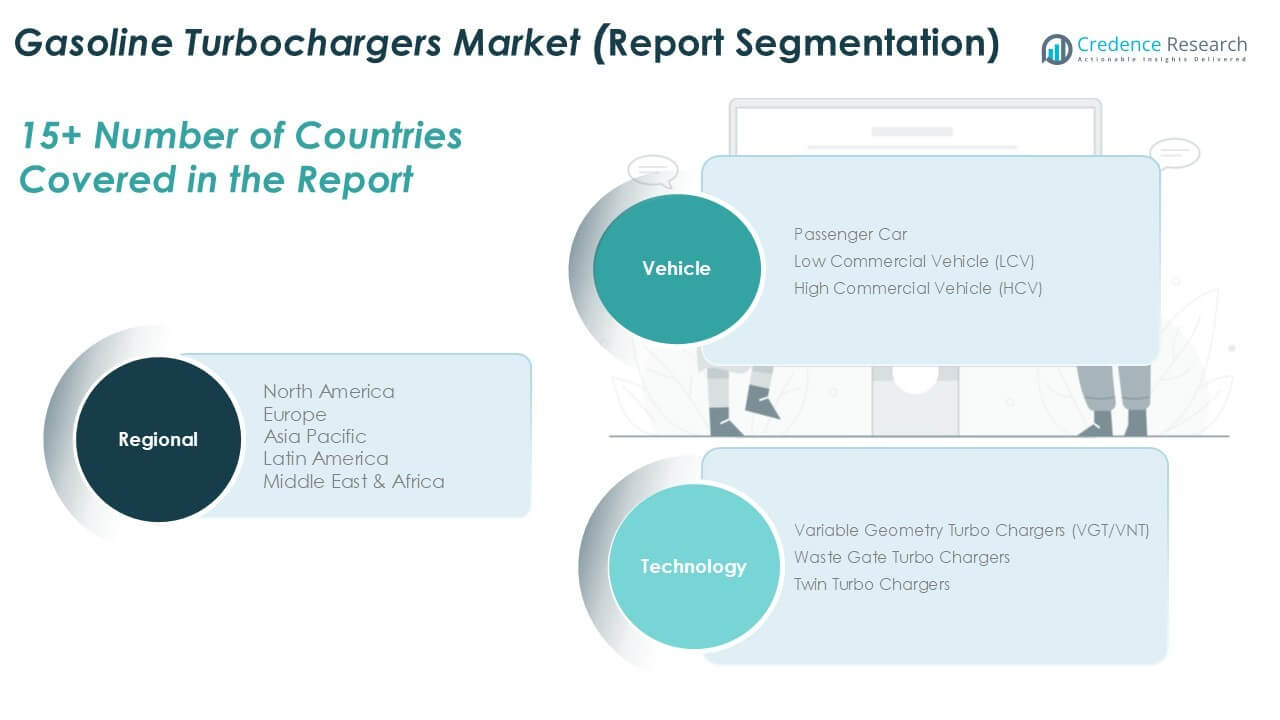
Gasoline Turbochargers Market Segmentations:
By Vehicle:
- Passenger Car
- Low Commercial Vehicle (LCV)
- High Commercial Vehicle (HCV)
By Technology:
- Variable Geometry Turbo Chargers (VGT/VNT)
- Waste Gate Turbo Chargers
- Twin Turbo Chargers
By Geography:
- North America
- U.S.
- Canada
- Mexico
- Europe
- Germany
- France
- U.K.
- Italy
- Spain
- Rest of Europe
- Asia Pacific
- China
- Japan
- India
- South Korea
- South-east Asia
- Rest of Asia Pacific
- Latin America
- Brazil
- Argentina
- Rest of Latin America
- Middle East & Africa
- GCC Countries
- South Africa
- Rest of the Middle East and Africa
Gasoline Turbochargers Market Competitive Landscape
The global gasoline turbochargers market features a mix of established multinational players and niche component specialists competing on technology, cost, and regional presence. Leading companies such as Garrett Motion Inc., BorgWarner Inc., IHI Corporation, and Continental AG dominate the market through their extensive product portfolios and strong OEM relationships. These players focus heavily on R&D to introduce advanced technologies like variable geometry turbochargers and electrically assisted systems. Mitsubishi Heavy Industries and Cummins Turbo Technologies maintain a strong presence in performance and commercial vehicle segments. Meanwhile, companies like Melett Ltd. and other emerging suppliers serve the aftermarket and remanufacturing sectors. Strategic partnerships, capacity expansions, and sustainability-focused innovations define key growth strategies. Financial strength and global supply capabilities give larger firms a competitive edge, especially in meeting emission norms across regions. Mergers, acquisitions, and joint ventures are also shaping the competitive dynamics, enabling companies to tap into new geographies and diversify their customer base.
Key Player Analysis
- Garrett Motion Inc.
- BorgWarner Inc.
- IHI Corporation
- Continental AG
- Mitsubishi Heavy Industries, Ltd.
- Cummins Turbo Technologies
- Melett Ltd.
- Other Key Players
Recent Developments
- In Jul 2025, BorgWarner Inc. secured new strategic gasoline turbocharger contracts with a global OEM for compact and hybrid vehicles.
- In April 2025, Garrett Motion Inc. Showcased breakthroughs in electrification and advanced turbo tech at Auto Shanghai 2025.
- In 2025, a subsidiary plant of Mitsubishi Heavy Industries, Ltd. (MHI) reached its 10th anniversary and celebrated a major production milestone for automotive turbochargers.
Report Coverage
The research report offers an in-depth analysis based on Vehicle, Technology and Geography. It details leading market players, providing an overview of their business, product offerings, investments, revenue streams, and key applications. Additionally, the report includes insights into the competitive environment, SWOT analysis, current market trends, as well as the primary drivers and constraints. Furthermore, it discusses various factors that have driven market expansion in recent years. The report also explores market dynamics, regulatory scenarios, and technological advancements that are shaping the industry. It assesses the impact of external factors and global economic changes on market growth. Lastly, it provides strategic recommendations for new entrants and established companies to navigate the complexities of the market.
Future Outlook
- Demand for gasoline turbochargers will rise as automakers continue engine downsizing for fuel efficiency.
- Adoption of turbochargers in hybrid and mild-hybrid vehicles will expand across global markets.
- Electrically assisted turbocharger technologies will gain traction in high-performance and premium segments.
- Asia Pacific will remain the largest market due to high vehicle production and urbanization.
- Manufacturers will invest in lightweight, high-efficiency turbo materials to improve engine performance.
- OEMs will increase integration of twin-turbo systems in sports and luxury vehicle platforms.
- Regulatory compliance will drive turbocharger adoption in light commercial gasoline vehicles.
- Aftermarket demand for turbocharger replacements and remanufacturing will support long-term growth.
- Strategic collaborations and acquisitions will continue among key players to expand regional reach.
- The transition to full electric vehicles will gradually challenge growth beyond 2035 in mature markets
Request a Free Sample
Fill in your details and we'll send you a free sample report.
- Sample data tables & charts
- Research methodology
Need a Custom Version of This Report?
Tailor the scope, geography, or segments to your exact requirements.
- Custom geography or segment scope
- Direct access to our analyst team
Frequently Asked Questions
What is the current market size for Global Gasoline Turbochargers market, and what is its projected size in 2032?
At what Compound Annual Growth Rate is the Global Gasoline Turbochargers market projected to grow between 2024 and 2032?
Which Global Gasoline Turbochargers market segment held the largest share in 2024?
What are the primary factors fueling the growth of the Global Gasoline Turbochargers market?
Who are the leading companies in the Global Gasoline Turbochargers market?
Which region commanded the largest share of the Global Gasoline Turbochargers market in 2024?
Table of Content
Chapter 1. Report Introduction
- 1.1 Report Description & Purpose
- 1.1.1 Report Title & Market Definition
- 1.1.2 Unique Selling Propositions (USP) & Key Differentiators
- 1.1.3 Value Proposition for Stakeholders
- 1.2 Research Objectives
- 1.2.1 Market Sizing Objectives (Volume & Revenue)
- 1.2.2 Segmentation Objectives
- 1.2.3 Competitive Intelligence Objectives
- 1.2.4 Forecast & Scenario Objectives
- 1.3 Report Scope
- 1.3.1 Gasoline Turbochargers Scope – Types & Subtypes Covered
- 1.3.2 Geographic Scope – Regions & Countries Covered
- 1.3.3 Historical Period, Base Year & Forecast Period (2024; forecast to 2032)
- 1.3.4 Inclusions & Exclusions
- 1.4 HS Code & Classification Framework
- 1.5 Currency, Units & Pricing Basis
- 1.6 Target Stakeholders
- 1.7 Limitations & Assumptions
Chapter 2. Executive Summary
- 2.1 Global Gasoline Turbochargers Market Snapshot
- 2.1.1 Market Size – Historical (2024) & Forecast (2024-2032) (2024: USD 15,154.6 million → 2032: USD 27,064.6 million)
- 2.1.2 Volume & Revenue – Global Totals
- 2.1.3 Key Market Highlights – Top Five Facts
- 2.2 Gasoline Turbochargers Market Segmentation Snapshot
- 2.2.1 Market Split by Region – 2024 vs. 2032
- 2.3 Competitive Snapshot
- 2.3.1 Top 10 Players by Revenue Share – 2024
- 2.3.2 Top 10 Players by Volume Share – 2024
- 2.3.3 Recent Strategic Developments (18-Month Summary)
- 2.4 Key Investment Highlights & Strategic Conclusions
Chapter 3. Gasoline Turbochargers Market Dynamics & Industry Analysis
- 3.1 Market Overview & Context
- 3.1.1 Gasoline Turbochargers Market Position in the Broader Automotive Value Chain
- 3.1.2 OEM vs. Replacement Market Dynamics
- 3.1.3 Market Maturity & Development Stage by Region
- 3.2 Gasoline Turbochargers Market Drivers
- 3.3 Gasoline Turbochargers Market Restraints & Challenges
- 3.4 Gasoline Turbochargers Market Opportunities
- 3.5 Porter's Five Forces Analysis
- 3.5.1 Threat of New Entrants
- 3.5.2 Bargaining Power of Suppliers
- 3.5.3 Bargaining Power of Buyers
- 3.5.4 Threat of Substitutes
- 3.5.5 Competitive Rivalry – Intensity Assessment
- 3.6 Gasoline Turbochargers Value Chain Analysis
- 3.6.1 Upstream – Raw Material/Input Suppliers
- 3.6.1.1 Raw Material/Input 1
- 3.6.1.2 Raw Material/Input 2
- 3.6.1.3 Raw Material/Input 3
- 3.6.2 Midstream – Production/Manufacturing/Service Delivery
- 3.6.2.1 Production/Process Overview
- 3.6.2.2 Key Facility Locations & Capacity by Manufacturer
- 3.6.3 Downstream – Distribution & End Consumer
- 3.6.3.1 Primary Channel – B2B/OEM
- 3.6.3.2 Secondary Channels – Dealer, Retail, Online, Direct
- 3.6.4 Value Chain Profitability Analysis
- 3.6.1 Upstream – Raw Material/Input Suppliers
- 3.7 PESTEL Analysis
- 3.7.1 Political Factors
- 3.7.2 Economic Factors
- 3.7.3 Social Factors
- 3.7.4 Technological Factors
- 3.7.5 Environmental Factors
- 3.7.6 Legal Factors
- 3.8 Gasoline Turbochargers Supply Chain Analysis
- 3.8.1 Raw Material/Input Supply Risk Assessment
- 3.8.2 Manufacturing Concentration Risk (Geographic Exposure)
- 3.8.3 Trade Disruption Impact Analysis
- 3.9 Regulatory & Policy Landscape
Note: The regulatory and policy landscape section covers regulations based on their applicability to the market, Gasoline Turbochargers category, geography, and scope of the study. Only regulatory frameworks with a material impact on operations, compliance, trade, sustainability, or market access are analyzed in detail.
Chapter 4. Key Investment Pockets & Opportunity Analysis
- 4.1 Gasoline Turbochargers Market Attractiveness Analysis
- 4.1.1 By Region – Investment Attractiveness Matrix (Volume × CAGR)
- 4.2 Absolute Revenue Growth Opportunity
- 4.2.1 By Region – Absolute USD Growth Through 2032
- 4.3 Incremental Volume Opportunity
- 4.3.1 By Region – Incremental Volume Through 2032
- 4.3.2 Segment – Incremental Volume
- 4.4 Emerging Submarket Opportunity Deep Dive (Subject to Applicability)
- 4.5 Emerging Market Opportunity Scorecards
- 4.5.1 United States
- 4.5.2 Europe
- 4.5.3 Asia
- 4.5.4 Middle East & Africa
Note: Emerging Market Opportunity Scorecards will be included based on relevance and strategic importance. Regions listed are indicative and may vary depending on data availability and market dynamics.
Chapter 5. Gasoline Turbochargers Import-Export Analysis & Trade Flows
- 5.1 Global Trade Overview
- 5.1.1 Global Export Value by Country (2024)
- 5.1.2 Global Export Volume by Country (2024)
- 5.1.3 Global Import Value by Country (2024)
- 5.1.4 Global Import Volume by Country (2024)
- 5.1.5 Net Trade Balance by Country (2024)
- 5.2 Export Analysis – Segment
- 5.2.1 Type 1 (HS Code)
- 5.2.2 Type 2 (HS Code)
- 5.2.3 Type 3 (HS Code)
- 5.2.4 Type 4 (HS Code)
- 5.2.5 Type 5 (HS Code)
- 5.3 Import Analysis – Segment
- 5.3.1 Type 1 (HS Code)
- 5.3.2 Type 2 (HS Code)
- 5.3.3 Type 3 (HS Code)
- 5.3.4 Type 4 (HS Code)
- 5.3.5 Type 5 (HS Code)
- 5.4 Average Unit Trade Prices
- 5.4.1 Average Export Price – Segment & Country
- 5.4.2 Average Import Price – Segment & Source Country
- 5.4.3 Price Trends (2024)
- 5.5 Key Trade Route Analysis
- 5.5.1 Trade Route 1
- 5.5.2 Trade Route 2
- 5.5.3 Trade Route 3
- 5.5.4 Trade Route 4
- 5.5.5 Trade Route 5
- 5.6 Trade Policy Impact Assessment
- 5.6.1 US Anti-Dumping & Section 301 Tariffs
- 5.6.2 EU Customs Union Impact
- 5.6.3 Major Free Trade Agreements
- 5.6.4 USMCA Rules of Origin
Note: Trade policy analysis will be included only where relevant to the Gasoline Turbochargers market.
Chapter 6. Competitive Landscape & Company Benchmarking
- 6.1 Gasoline Turbochargers Market Concentration & Structure
- 6.1.1 Herfindahl-Hirschman Index (HHI) – vs. 2024
- 6.1.2 Tier 1, Tier 2 & Tier 3 Market Structure
- 6.1.3 Global, Regional & Local Player Dynamics
- 6.2 Gasoline Turbochargers Market Share Analysis – 2024
- 6.2.1 Global Revenue Share by Company
- 6.2.2 Global Volume Share by Company
- 6.2.3 Regional Revenue Share
- 6.2.4 Market Share Evolution ( vs. 2024)
- 6.2.5 OEM Segment Share by Company
- 6.2.6 Replacement Segment Share by Company
- 6.3 Production/Delivery Capacity & Facility Analysis
- 6.3.1 Global Installed Capacity
- 6.3.2 Capacity Utilization Rates
- 6.3.3 Production/Output Volume
- 6.3.4 Facility Locations & Capacity Map
- 6.3.5 Planned Capacity Additions
- 6.4 Gasoline Turbochargers Competitive Benchmarking Matrix
- 6.4.1 Revenue, Volume, CAGR & Profitability Comparison
- 6.4.2 Channel Revenue Mix
- 6.4.3 Geographic Revenue Exposure
- 6.4.4 R&D Intensity
- 6.4.5 Sustainability Maturity
- 6.5 Strategic Developments in Gasoline Turbochargers (Last 24 Months)
- 6.5.1 Mergers, Acquisitions & Divestments
- 6.5.2 New Gasoline Turbochargers Launches
- 6.5.3 Facility Expansions
- 6.5.4 Strategic Alliances, Joint Ventures & Partnerships
- 6.5.5 Distribution Expansion & Market Entry
- 6.5.6 Sustainability & ESG Initiatives
- 6.6 Competitive Strategy Mapping
- 6.6.1 Leader, Challenger, Follower & Niche Classification
- 6.6.2 Pricing Strategy Comparison
- 6.6.3 Channel Strategy Matrix
Note: Strategic developments are included based on their materiality and the availability of reliable information.
Chapter 7. Global Gasoline Turbochargers Market – By Distribution Channel
- 7.1 Segment Overview
- 7.1.1 Volume & Revenue Split by Channel (2024 & 2032)
- 7.1.2 Channel Mix Evolution (2024-2032)
Chapter 8. Regional Market Analysis – Global Overview
- 8.1 Global Regional Overview
- 8.1.1 Regional Volume Share
- 8.1.2 Regional Revenue Share
- 8.1.3 Regional Volume by Region
- 8.1.4 Regional Revenue by Region
- 8.1.5 Regional Forecast Through 2032
- 8.2 Cross-Regional Segment Analysis
- 8.2.1 By Distribution Channel
- 8.2.2 By Brand/Price Tier
Chapter 9. North America Gasoline Turbochargers Market
- 9.1 United States
- 9.2 Canada
- 9.3 Mexico
Chapter 10. Europe Gasoline Turbochargers Market
- 10.1 Germany
- 10.2 France
- 10.3 Italy
- 10.4 United Kingdom
- 10.5 Spain
- 10.6 Poland
- 10.7 Russia
- 10.8 Netherlands
- 10.9 Belgium
- 10.10 Sweden
- 10.11 Denmark
- 10.12 Norway
- 10.13 Rest of Europe
Chapter 11. Asia Pacific Gasoline Turbochargers Market
- 11.1 China
- 11.2 India
- 11.3 Japan
- 11.4 South Korea
- 11.5 Thailand
- 11.6 Indonesia
- 11.7 Vietnam
- 11.8 Malaysia
- 11.9 Australia
- 11.10 Rest of Asia Pacific
Chapter 12. Latin America Gasoline Turbochargers Market
- 12.1 Brazil
- 12.2 Argentina
- 12.3 Colombia
- 12.4 Chile
- 12.5 Rest of Latin America
Chapter 13. Middle East Gasoline Turbochargers Market
- 13.1 Saudi Arabia
- 13.2 United Arab Emirates
- 13.3 Turkey
- 13.4 Israel
- 13.5 Iran
- 13.6 Rest of the Middle East
Chapter 14. Africa Gasoline Turbochargers Market
- 14.1 South Africa
- 14.2 Egypt
- 14.3 Nigeria
- 14.4 Morocco
- 14.5 Rest of Africa
Chapter 15. Gasoline Turbochargers Company Profiles
- 15.1 [Company 01]
- 15.1.1 Company Overview
- 15.1.2 Key Management Personnel
- 15.1.3 Products & Services Portfolio
- 15.1.4 Financial Performance
- 15.1.5 Key Market Focus & Geographic Presence
- 15.1.6 Recent Developments & Strategic Initiatives
Note: The company profile list is preliminary and may change based on research findings, market developments, data availability, and client requirements.
Chapter 16. Appendices
- Appendix A – List of Abbreviations & Acronyms
- Appendix B – Industry Classification Code Reference – Full Series
- Appendix C – Production & Capacity Data Tables
- Appendix D – End-Use & Demand Base Tables
- Appendix E – Consumption & Replacement Rate Assumptions
- Appendix F – ASP Reference Tables
- Appendix G – Manufacturing & Facility Database
- Appendix H – Import-Export Data Tables
- Appendix I – Regulatory Summary Tables
- Appendix J – Primary Research Participant List (Anonymized)
- Appendix K – Primary Research Questionnaire Framework
- Appendix L – Data Sources & Bibliography
- Appendix M – Market Size Divergence & Source Comparison
Chapter 17. Research Methodology
- 17.1 Research Framework & Philosophy
- 17.2 Secondary Research – Sources, Hierarchy & Data Extraction
- 17.3 Data Modeling – Bottom-Up & Top-Down Market Sizing
- 17.4 Primary Research – Stakeholder Framework, LOI & Sample Sizes
- 17.5 Forecast Methodology – Regression, Scenario & Sensitivity Analysis
- 17.6 Quality Control – Four-Layer Validation Framework
- 17.7 Limitations & Standard Assumptions
- 17.8 Disclaimer
