
| REPORT ATTRIBUTE | DETAILS |
|---|---|
| Historical Period | 2019-2022 |
| Base Year | 2023 |
| Forecast Period | 2024-2032 |
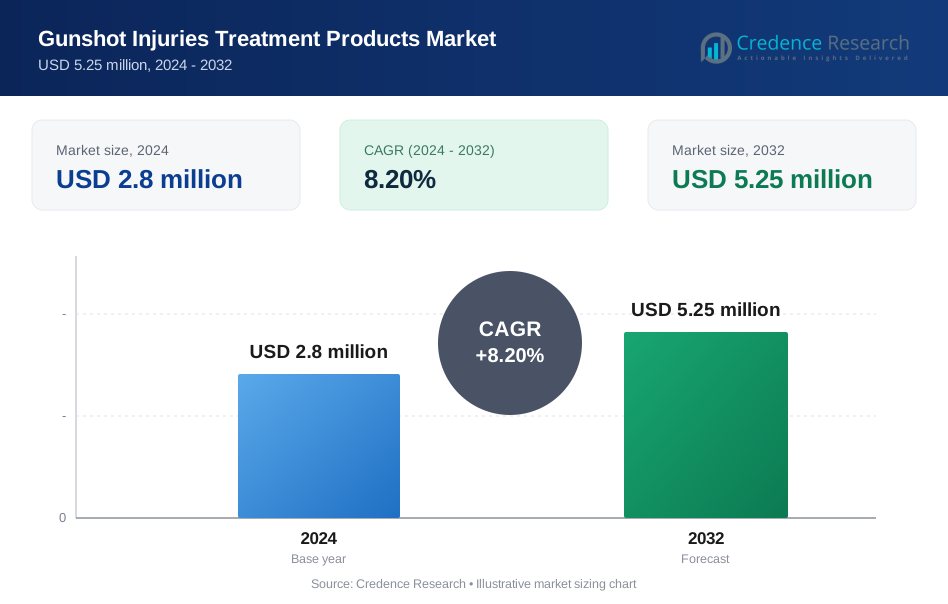
| Gunshot Injuries Treatment Products Market Size 2024 | USD 2.8 Million |
| Gunshot Injuries Treatment Products Market, CAGR | 8.20% |
| Gunshot Injuries Treatment Products Market Size 2032 | USD 5.25 Million |
Market Overview
The global market for gunshot injuries treatment products is projected to grow from USD 2.8 million in 2024 to USD 5.25 million by 2032, at a compound annual growth rate (CAGR) of 8.20%.
The market for gunshot injuries treatment products is driven by the rising incidence of gun-related violence and accidents globally, along with increasing demand for advanced wound care technologies. Government initiatives aimed at improving trauma care and emergency medical services further bolster market growth. Additionally, advancements in hemostatic products and wound closure devices, coupled with growing awareness of effective trauma management, are key trends shaping the market. The development of portable and easy-to-use treatment solutions for first responders also supports market expansion, as rapid intervention is crucial in reducing mortality and complications from gunshot injuries.
The geographical analysis of the gunshot injuries treatment products market reveals significant activity in North America and Europe, driven by high incidence rates of gun-related injuries and advanced healthcare infrastructure. Key players in this market include Stryker Corporation, RevMedx, Medtrade Products Ltd, and Zhejiang Haichuang Medical Device Co., Ltd. These companies are at the forefront of innovation, developing advanced products like Xstat, Airwrap, and Floseal to enhance trauma care. Their collaborative efforts and investments in research and development are crucial for addressing the increasing demand for effective treatment solutions across various regions.
Market Drivers
Increasing Incidence of Gunshot Injuries
The rising rates of violence and crime, both in urban and rural regions, significantly contribute to the growing number of gunshot injuries. This escalation in gun-related incidents directly fuels the demand for effective treatment solutions. For instance, according to the Centers for Disease Control and Prevention (CDC), there were more than 48,000 firearm-related deaths in the United States in 2022. In addition, accidental shootings, particularly those involving children, are a critical factor driving the market for gunshot injuries treatment products. Furthermore, conflicts and peacekeeping operations across the globe result in a high incidence of gunshot wounds among military personnel and law enforcement officers, highlighting the need for advanced and reliable medical treatments.
Advancements in Medical Technology
Technological advancements in medical treatments have greatly enhanced the management of gunshot injuries. The development of innovative hemostatic agents capable of rapidly controlling bleeding is vital in improving survival rates in critical trauma situations. For instance, minimally invasive surgery (MIS) techniques have allowed for faster recovery times and reduced hospital stays, improving gunshot injury treatment efficacy overall. Moreover, advanced wound care products, such as antimicrobial dressings and negative pressure wound therapy, play a crucial role in preventing infections and promoting faster healing. In addition, improvements in surgical techniques, including minimally invasive procedures, help reduce complications and improve long-term patient outcomes, making gunshot injuries more manageable.
Improved Trauma Care
The availability of well-trained emergency medical services (EMS) personnel and faster response times can significantly impact the survival rates of gunshot injury victims. Additionally, specialized trauma centers equipped with advanced facilities and skilled medical professionals are essential for managing complex gunshot injuries. These trauma centers ensure that patients receive the immediate care required to mitigate severe complications. As trauma care systems improve globally, the demand for gunshot injury treatment products continues to rise, reflecting the critical need for effective, lifesaving medical interventions.
Government Initiatives and Rising Awareness
Government initiatives, including public health campaigns aimed at reducing gun violence and promoting responsible firearm handling, contribute to a growing awareness of gunshot injury risks. At the same time, stricter gun control regulations help to reduce the overall incidence of gun-related injuries. Rising public awareness of the availability and benefits of advanced gunshot injury treatment products also drives demand, as more individuals and institutions recognize the importance of immediate, effective treatment options in improving patient outcomes.
Market Trends
Emphasis on Hemostasis and Advanced Wound Care
The growing focus on rapid blood loss control has positioned hemostatic agents as a critical component in gunshot injury treatment. Developing innovative agents capable of swiftly controlling bleeding can significantly improve survival rates, particularly in emergency situations. Advanced materials like chitosan, graphene, and nanofibers are now being explored for their superior hemostatic properties, offering more effective and durable solutions. In addition, infection prevention remains a key priority in wound management, as gunshot wounds are highly susceptible to infections. Antimicrobial dressings, especially silver-based products, are gaining traction due to their broad-spectrum antimicrobial properties. These advancements are not only enhancing infection control but also reducing the overall risk of complications in gunshot wound care, driving further innovation in the market.
Technological Advancements in Wound Healing and Cost-Effective Solutions
Negative pressure wound therapy (NPWT) is emerging as a game-changer in the management of complex gunshot injuries. By promoting tissue growth, reducing infection risks, and improving overall healing outcomes, NPWT systems are gaining popularity. As technology advances, newer NPWT systems are becoming more portable and user-friendly, allowing for easier integration into various healthcare settings. Minimally invasive surgical techniques, including endoscopic surgery, are also evolving, focusing on reducing tissue damage and complications. Alongside these innovations, personalized medicine is advancing with tailored treatments based on genomics and proteomics, offering individualized care for improved outcomes. As healthcare costs rise, there is also increasing demand for affordable gunshot injury treatment products, particularly in regions with limited resources. Generic alternatives and cost-effective solutions are becoming essential, ensuring broader access to life-saving care.
Market Challenges Analysis
Regulatory Hurdles and Limited Reimbursement
The development of new medical devices for gunshot injury treatment faces significant regulatory hurdles. Strict regulations govern the approval processes, requiring comprehensive documentation and rigorous testing to ensure safety and efficacy. For instance, the FDA recently cleared a new hemostatic gel, Traumagel, which can stop bleeding from gunshot wounds within seconds. This meticulous approach, while essential for patient safety, can result in time-consuming and costly approval timelines, ultimately delaying the market introduction of innovative products. Additionally, limited insurance coverage for advanced treatment options poses a substantial challenge, particularly in regions with lower healthcare reimbursement rates. Payers often conduct thorough cost-benefit analyses to assess whether the benefits of these new products justify their higher costs, further complicating access to life-saving technologies. This combination of regulatory and reimbursement challenges can inhibit market growth and the adoption of advanced treatment solutions.
Ethical Concerns and High R&D Costs
Ethical considerations also complicate the landscape for gunshot injury treatment products. Some technologies designed for treating gunshot wounds may have potential dual-use applications, raising significant ethical dilemmas regarding their potential misuse. Ensuring equitable access to these essential products across diverse socioeconomic backgrounds and geographic locations remains a pressing challenge. Furthermore, the high costs associated with research and development (R&D) can hinder the progress of new products. Developing innovative treatments requires substantial financial investments, and funding for medical device development is often limited, particularly in niche markets such as gunshot injury care. The need for competitive differentiation is critical, as established players dominate the market with strong brand recognition and extensive distribution networks. New entrants may struggle to differentiate their products, particularly in a landscape characterized by variable regional needs influenced by crime rates and healthcare infrastructure. Overall, these challenges create a complex environment for the development and distribution of effective gunshot injury treatment products.
Market Segmentation Analysis:
By Type:
The market for gunshot injuries treatment products can be segmented by type, with key offerings including XStat, Airwrap, and Floseal. XStat is a notable hemostatic device designed to control bleeding rapidly, making it particularly valuable in emergency situations. Its innovative sponge-based technology expands upon contact with blood, effectively sealing wounds and minimizing blood loss. Airwrap, on the other hand, employs a unique inflatable compression technique that provides real-time control of hemorrhaging in critical trauma cases. This method not only helps to stabilize the patient but also allows for quicker transport to advanced care facilities. Floseal is a gelatin-based hemostatic matrix that combines with the patient’s blood to form a stable clot, enhancing the efficacy of bleeding control during surgical interventions. Together, these products address various needs within the trauma care landscape, catering to emergency responders and healthcare providers who require effective solutions for managing gunshot wounds.
By Application:
In terms of application, the gunshot injuries treatment products market is categorized into hospitals, pharmacies, and online pharmacies. Hospitals represent the largest segment, as they are primary healthcare facilities equipped to handle severe trauma cases. The availability of advanced trauma care services and specialized personnel in hospitals ensures prompt and effective treatment of gunshot injuries. Pharmacies also play a crucial role in this market by providing over-the-counter wound care products, antimicrobial dressings, and hemostatic agents, thereby facilitating immediate access to essential treatments. Online pharmacies are gaining traction as well, driven by the increasing trend of e-commerce and the growing preference for convenient purchasing options. The expansion of telemedicine and remote consultations further enhances the appeal of online pharmacies, making it easier for individuals to access necessary treatment products without the need to visit a physical location. Collectively, these application segments highlight the diverse channels through which gunshot injury treatment products are distributed, ensuring widespread accessibility to critical care solutions.
Segments:
Based on Type:
- XStat
- Airwrap
- Floseal
Based on Application:
- Hospitals
- Pharmacies
- Online Pharmacies
Based on the Geography:
- North America
- U.S.
- Canada
- Mexico
- Europe
- Germany
- France
- U.K.
- Italy
- Spain
- Rest of Europe
- Asia Pacific
- China
- Japan
- India
- South Korea
- South-east Asia
- Rest of Asia Pacific
- Latin America
- Brazil
- Argentina
- Rest of Latin America
- Middle East & Africa
- GCC Countries
- South Africa
- Rest of the Middle East and Africa
Regional Analysis
North America
North America holds a significant share of the gunshot injuries treatment products market, accounting for approximately 40% of the total market revenue. This dominance is primarily attributed to the high incidence of gun-related injuries and a well-established healthcare infrastructure. The United States, in particular, experiences a considerable number of gunshot incidents annually, which drives demand for advanced treatment solutions. For instance, in 2019, close to 40,000 people died from gun injuries in the U.S., and about twice that number suffered nonfatal injuries. Hospitals and trauma centers in the region are equipped with cutting-edge medical technologies, including XStat, Airwrap, and Floseal, ensuring that healthcare professionals have access to effective tools for managing severe injuries. Additionally, strong government initiatives and funding for trauma care programs further enhance the market's growth. Increased awareness of gun violence and its implications has also led to a focus on developing innovative treatment options, solidifying North America’s leading position in this market.
Europe
Europe represents another significant market for gunshot injuries treatment products, contributing approximately 25% of the global market share. The region faces challenges related to gun violence, albeit at a lower level than in North America, which still necessitates effective trauma care solutions. Countries such as the United Kingdom, Germany, and France have made substantial investments in healthcare infrastructure, enhancing their capacity to treat gunshot injuries effectively. The emphasis on research and development in medical technology fosters innovation, leading to the introduction of advanced products tailored for trauma management. Furthermore, increasing collaboration between healthcare providers and medical device manufacturers is promoting the availability of innovative treatment options. As public awareness surrounding gun violence rises, European countries are also focusing on implementing comprehensive trauma care systems, which, in turn, drives demand for effective gunshot injury treatment products. This proactive approach positions Europe as a key player in the global market landscape.
Key Player Analysis
- RevMedx
- Stryker Corporation
- Medtrade Products Ltd
- Floseal
- Xstat
- Airwrap
- Zhejiang Haichuang Medical Device Co., Ltd.
Competitive Analysis
The competitive landscape of the gunshot injuries treatment products market features several leading players, including Stryker Corporation, RevMedx, Medtrade Products Ltd, and Zhejiang Haichuang Medical Device Co., Ltd. These companies are actively engaged in developing innovative solutions that address the critical need for effective trauma care. Leading players are leveraging their expertise in medical technology to introduce innovative hemostatic devices and wound care products designed for optimal performance. Investments in research and development are essential for these companies to stay competitive, as they aim to enhance product efficacy and improve patient outcomes. Strategic partnerships and collaborations are also common, enabling firms to expand their distribution networks and reach a broader customer base. As the market evolves, maintaining a strong competitive edge requires continuous adaptation to changing healthcare needs and regulatory environments, along with a commitment to quality and accessibility in gunshot injury treatment solutions.
Recent Developments
- In October 2024, Stryker completed the acquisition of Vertos Medical Inc., expanding their interventional pain management solutions.
- In October 2024, Stryker completed the acquisition of NICO Corporation, expanding minimally invasive solutions for brain tumor removal and stroke care.
- In February 2023, Medtrade entered into an exclusive agreement with Laubscher & Co AG and partnered with Dahlhausen® Medizintechnik to reach maternity units across Germany and Austria.
Market Concentration & Characteristics
The market concentration for gunshot injuries treatment products exhibits a moderate level of consolidation, with several key players dominating the landscape while allowing for the presence of smaller firms. Major companies invest heavily in research and development to innovate and enhance their product offerings, which include advanced hemostatic agents and wound care solutions. This focus on innovation drives competition, encouraging firms to differentiate their products through unique features and improved performance. Additionally, the market is characterized by a strong emphasis on regulatory compliance, as companies must navigate rigorous approval processes to ensure their products meet safety and efficacy standards. The growing awareness of gun violence and the increasing demand for effective treatment options further stimulate market dynamics. As healthcare providers seek reliable solutions, the market is expected to evolve, leading to potential collaborations and mergers that may reshape the competitive landscape while enhancing product availability and accessibility.
Report Coverage
The research report offers an in-depth analysis based on Type, Application and Geography. It details leading market players, providing an overview of their business, product offerings, investments, revenue streams, and key applications. Additionally, the report includes insights into the competitive environment, SWOT analysis, current market trends, as well as the primary drivers and constraints. Furthermore, it discusses various factors that have driven market expansion in recent years. The report also explores market dynamics, regulatory scenarios, and technological advancements that are shaping the industry. It assesses the impact of external factors and global economic changes on market growth. Lastly, it provides strategic recommendations for new entrants and established companies to navigate the complexities of the market.
Future Outlook
- The demand for innovative gunshot injuries treatment products is expected to rise significantly due to increasing gun violence globally.
- Advances in medical technology will lead to the development of more effective hemostatic agents and wound care solutions.
- The integration of telemedicine and remote monitoring will enhance access to treatment for gunshot injuries, particularly in underserved areas.
- A growing focus on personalized medicine will drive the development of tailored treatment approaches based on individual patient needs.
- Increased collaboration between healthcare providers and medical device manufacturers will facilitate the introduction of new and effective products.
- Stricter regulatory standards will necessitate ongoing investments in compliance and quality assurance measures.
- The rise of online pharmacies will provide greater accessibility to gunshot injury treatment products for consumers.
- Emerging markets in developing regions will present new opportunities for growth as healthcare infrastructure improves.
- Continued emphasis on cost-effective solutions will influence product development, making treatments more accessible.
- Ethical considerations surrounding gun violence and healthcare equity will shape future policies and product offerings in the market.
Request a Free Sample
Fill in your details and we'll send you a free sample report.
- Sample data tables & charts
- Research methodology
Need a Custom Version of This Report?
Tailor the scope, geography, or segments to your exact requirements.
- Custom geography or segment scope
- Direct access to our analyst team
Frequently Asked Questions
What is the current size of the Gunshot Injuries Treatment Products market?
What factors are driving the growth of the Gunshot Injuries Treatment Products market?
What are the key segments within the Gunshot Injuries Treatment Products market?
What are some challenges faced by the Gunshot Injuries Treatment Products market?
Who are the major players in the Gunshot Injuries Treatment Products market?
Table of Content
Chapter 1 Market Segmentation
- 1.1 Segmentation Framework
- 1.1.1 Product and Service Classification
- 1.1.2 Application and End-Use Classification
- 1.1.3 Technology and Solution Classification
- 1.1.4 Customer and Distribution Channel Classification
- 1.1.5 Geographic Segmentation
- 1.1.6 Market Segment Definitions and Boundaries
Chapter 2 Introduction
- 2.1 Report Objectives and Scope
- 2.2 Product Definition and Industry Terminology
- 2.3 Market Inclusions and Exclusions
- 2.4 Research Process
- 2.4.1 Primary Research and Expert Interviews
- 2.4.2 Secondary Research and Source Review
- 2.4.3 Top-Down and Bottom-Up Estimation
- 2.4.4 Data Triangulation and Verification
- 2.5 Market Size Measurement Basis
- 2.5.1 2024: USD 2.8 million → 2032: USD 5.25 million
- 2.6 Historical and Forecast Reference Periods
- 2.6.1 Base Year: 2024
- 2.6.2 Forecast Period: 2024-2032
- 2.7 Research Assumptions and Limitations
Chapter 3 Executive Summary
- 3.1 Market Snapshot and Key Findings
- 3.2 Base-Year Market Size, 2024
- 3.3 Forecast Market Size, 2032
- 3.4 Revenue and Volume Growth Outlook
- 3.5 Key Demand and Supply Indicators
- 3.6 Leading Market Segments
- 3.7 Fastest-Growing Market Opportunities
- 3.8 Regional Performance Highlights
- 3.9 Technology and Industry Transformation
- 3.10 Competitive Landscape Summary
- 3.11 Analyst View and Strategic Implications
Chapter 4 Global Gunshot Injuries Treatment Products Market Trends and Developments
- 4.1 Historical Industry Development
- 4.2 Recent Market Trends and Developments
- 4.3 Demand and Customer Behavior Trends
- 4.4 Technology and Product Innovation
- 4.5 Artificial Intelligence, Automation and Digitalization
- 4.6 Local Manufacturing and Supply Chain Realignment
- 4.7 Industry Partnerships, Mergers and Acquisitions
- 4.8 Sustainability and Circular Economy Developments
- 4.9 Government and Private Sector Investment Trends
- 4.10 Emerging Business Models and Commercialization
- 4.11 Industry Developments and Announcements
Chapter 5 Global Gunshot Injuries Treatment Products Market Production, Supply and Demand Analysis
- 5.1 Demand Trend and Consumption Analysis
- 5.2 Demand Forecast, 2024-2032
- 5.3 Production and Output Trend
- 5.4 Production and Output Forecast, 2024-2032
- 5.5 Installed Capacity and Capacity Utilization
- 5.6 Company-Wise Production Plants and Statistics
- 5.6.1 Installed Production Capacity
- 5.6.2 Actual Production
- 5.6.3 Planned Capacity and Expansion Targets
- 5.7 Supply Chain Structure and Procurement Trends
- 5.8 Supply-Demand Gap and Bottlenecks
- 5.9 Import Dependence and Sourcing Structure
- 5.10 Contract Manufacturing and Outsourcing
- 5.11 Regional Supply and Demand Concentration
Chapter 6 Global Gunshot Injuries Treatment Products Market Pricing Analysis
- 6.1 Pricing Structure and Measurement
- 6.2 Historical Pricing Trends
- 6.3 Pricing Outlook, 2024-2032
- 6.4 Average Selling Price and Unit Economics
- 6.5 Pricing by Product and Market Segment
- 6.6 Geographic Pricing Differences
- 6.7 Key Input, Energy, Labor and Logistics Costs
- 6.8 Contract Pricing and Purchasing Models
- 6.9 Pricing Sensitivity and Competitive Positioning
- 6.10 Price, Margin and Profitability Implications
Chapter 7 Global Gunshot Injuries Treatment Products Market Dynamics
- 7.1 Market Growth Drivers
- 7.1.1 Demand-Side Drivers
- 7.1.2 Technology and Innovation Drivers
- 7.1.3 Infrastructure and Investment Drivers
- 7.1.4 Regulatory and Policy Drivers
- 7.2 Market Restraints
- 7.2.1 Cost and Affordability Constraints
- 7.2.2 Technology and Adoption Barriers
- 7.2.3 Supply Chain and Operational Constraints
- 7.3 Market Challenges
- 7.3.1 Competitive Pressure and Margin Erosion
- 7.3.2 Skills, Infrastructure and Implementation Gaps
- 7.4 Emerging Market Opportunities
- 7.5 Market Dynamics Impact and Time-Horizon Assessment
Chapter 8 Global Gunshot Injuries Treatment Products Value Chain Analysis
- 8.1 Industry Value Chain Overview
- 8.2 Upstream Suppliers and Critical Inputs
- 8.3 Technology and Component Providers
- 8.4 Manufacturing or Service Delivery
- 8.5 Distribution, Channel Partners and Integrators
- 8.6 Downstream Applications and End Users
- 8.7 Value Addition and Profit Pools
- 8.8 Vertical Integration and Outsourcing
- 8.9 Supplier Concentration and Risk
- 8.10 Supply Chain Localization and Resilience
Chapter 9 Global Gunshot Injuries Treatment Products Market Regulations and Policies
- 9.1 Relevant Laws, Standards and Compliance Frameworks
- 9.2 Product, Service, Safety and Quality Requirements
- 9.3 Government Policies, Incentives and Subsidies
- 9.4 Imports, Exports and Trade Barriers
- 9.5 Public Procurement and Local Content Requirements
- 9.6 Environmental and Sustainability Compliance
- 9.7 Upcoming Policy Changes and Market Implications
Chapter 10 Global Gunshot Injuries Treatment Products Market Hotspots and Opportunities
- 10.1 Market Opportunity Mapping and Growth Hotspots
- 10.2 High-Growth Applications and Customer Groups
- 10.3 Underserved Markets and White-Space Opportunities
- 10.4 Emerging Technology and Product Opportunities
- 10.5 New Capacity and Investment Hotspots
- 10.6 Market Entry and Expansion Opportunities
- 10.7 Distribution and Partnership Opportunities
- 10.8 Near-Term and Long-Term Commercial Potential
- 10.9 Opportunity Attractiveness and Execution Risks
Chapter 11 Global Gunshot Injuries Treatment Products Market Outlook, 2024-2032
- 11.1 Market Size and Analysis
- 11.1.1 Revenue (Market Measurement: 2024: USD 2.8 million → 2032: USD 5.25 million)
- 11.1.2 Market Volume and Quantity Sold
- 11.1.3 Historical Market Size
- 11.1.4 Base-Year Market Size, 2024
- 11.2 Market Forecast, 2024-2032
- 11.2.1 Revenue Forecast to 2032
- 11.2.2 Volume Forecast to 2032
- 11.2.3 CAGR and Year-on-Year Growth
- 11.2.4 Incremental Revenue Opportunity
- 11.3 Forecast Assumptions and Scenario Analysis
- 11.3.1 Base-Case Forecast
- 11.3.2 Optimistic and Conservative Scenarios
- 11.3.3 Technology, Pricing and Policy Sensitivities
- 11.4 Market Attractiveness and Growth Outlook
Chapter 12 Global Gunshot Injuries Treatment Products Market Segmentation and Outlook
- 12.1 Segmentation Summary and Market Shares, 2024
- 12.2 Largest and Fastest-Growing Segments
- 12.3 Segment Growth Comparison
- 12.4 Segment Attractiveness and Priority Matrix
Chapter 13 Global Gunshot Injuries Treatment Products Geographic Market Outlook, 2024-2032
- 13.1 Regional Market Size and Share, 2024
- 13.2 Regional Market Forecast, 2024-2032
- 13.3 Regional Pricing, Production and Demand Differences
- 13.4 North America
- 13.4.1 United States
- 13.4.2 Canada
- 13.4.3 Mexico
- 13.5 Europe
- 13.5.1 Germany
- 13.5.2 France
- 13.5.3 Italy
- 13.5.4 United Kingdom
- 13.5.5 Spain
- 13.5.6 Poland
- 13.5.7 Russia
- 13.5.8 Netherlands
- 13.5.9 Belgium
- 13.5.10 Sweden
- 13.5.11 Denmark
- 13.5.12 Norway
- 13.5.13 Rest of Europe
- 13.6 Asia Pacific
- 13.6.1 China
- 13.6.2 India
- 13.6.3 Japan
- 13.6.4 South Korea
- 13.6.5 Thailand
- 13.6.6 Indonesia
- 13.6.7 Vietnam
- 13.6.8 Malaysia
- 13.6.9 Australia
- 13.6.10 Rest of Asia Pacific
- 13.7 Latin America
- 13.7.1 Brazil
- 13.7.2 Argentina
- 13.7.3 Colombia
- 13.7.4 Chile
- 13.7.5 Rest of Latin America
- 13.8 Middle East
- 13.8.1 Saudi Arabia
- 13.8.2 United Arab Emirates
- 13.8.3 Turkey
- 13.8.4 Israel
- 13.8.5 Iran
- 13.8.6 Rest of the Middle East
- 13.9 Africa
- 13.9.1 South Africa
- 13.9.2 Egypt
- 13.9.3 Nigeria
- 13.9.4 Morocco
- 13.9.5 Rest of Africa
- 13.10 Regional Investment, Policy and Supply Chain Differences
- 13.11 Regional Competitive Landscape
- 13.12 Geographic Growth Hotspots
Chapter 14 Global Gunshot Injuries Treatment Products Technology, Innovation and Sustainability Outlook
- 14.1 Technology Landscape and Maturity
- 14.2 Product, Process and Service Innovation
- 14.3 AI, Automation and Digital Tools in the Industry
- 14.4 Technology Adoption and Performance Benchmarking
- 14.5 Innovation Pipeline and R&D Investment
- 14.6 Patent and Intellectual Property Trends
- 14.7 Energy Efficiency and Resource Management
- 14.8 Sustainability, Recycling and Circularity
- 14.9 Technology Roadmap, 2024-2032
- 14.10 Risks of Obsolescence and Technology Substitution
Chapter 15 Global Gunshot Injuries Treatment Products Market Key Strategic Imperatives
- 15.1 Growth and Market Entry Priorities
- 15.2 High-Return Products and Segments
- 15.3 Pricing, Profitability and Cost Optimization
- 15.4 Technology Investment and Product Differentiation
- 15.5 Supply Chain Localization and Resilience
- 15.6 Distribution and Customer Acquisition
- 15.7 Partnership, Acquisition and Capacity Strategy
- 15.8 Regional Expansion Priorities
- 15.9 Short-, Medium- and Long-Term Actions
Chapter 16 Competition Outlook
- 16.1 Industry Competition Characteristics
- 16.2 Market Structure and Concentration
- 16.3 Market Share and Competitive Positioning, 2024
- 16.4 Company-Wise Revenue and Product Benchmarking
- 16.5 Production and Service Capacity Benchmarking
- 16.6 Technology, Pricing and Differentiation
- 16.7 Regional Footprint and Distribution Strength
- 16.8 Mergers, Acquisitions and Strategic Alliances
- 16.9 New Entrants and Competitive Threats
- 16.10 Porter's Five Forces and Industry Attractiveness
- 16.11 Competitive Outlook, 2024-2032
Chapter 17 Company Profiles
- 17.1 Company Coverage and Selection Criteria
- 17.2 Leading Market Participants – Standard Profile Structure
- 17.2.1 Business Description
- 17.2.2 Company Ownership and Geographic Presence
- 17.2.3 Product and Service Portfolio
- 17.2.4 Manufacturing and Operating Footprint
- 17.2.5 Production Capacity and Expansion Plans
- 17.2.6 Financial Performance and Investment
- 17.2.7 Market Share and Competitive Position
- 17.2.8 Technology and Innovation Capabilities
- 17.2.9 Strategic Alliances or Partnerships
- 17.2.10 Recent Developments
- 17.2.11 Growth Strategy and Outlook
- 17.3 Other Relevant Market Participants
Note: Every listed company is profiled on the structure shown under the first company. The company list is preliminary and may change based on research findings, market developments, data availability and client requirements.
Chapter 18 Disclaimer
- 18.1 Research and Forecast Disclaimer
- 18.2 Data Source and Estimation Limitations
Note: The depth of individual sections depends on data availability for this market. Volume, capacity, trade and other unit-based metrics are included where applicable.
