
Market Overview:
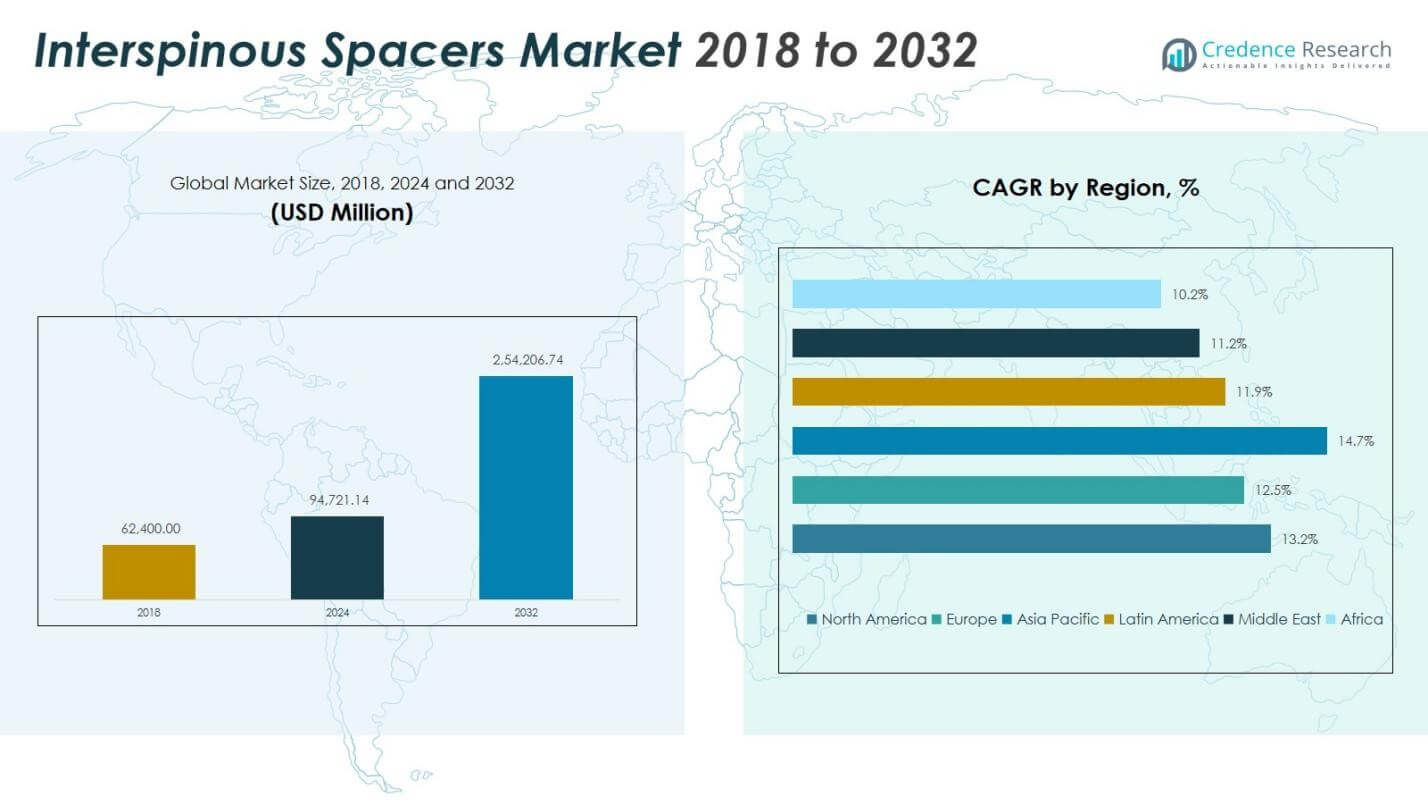
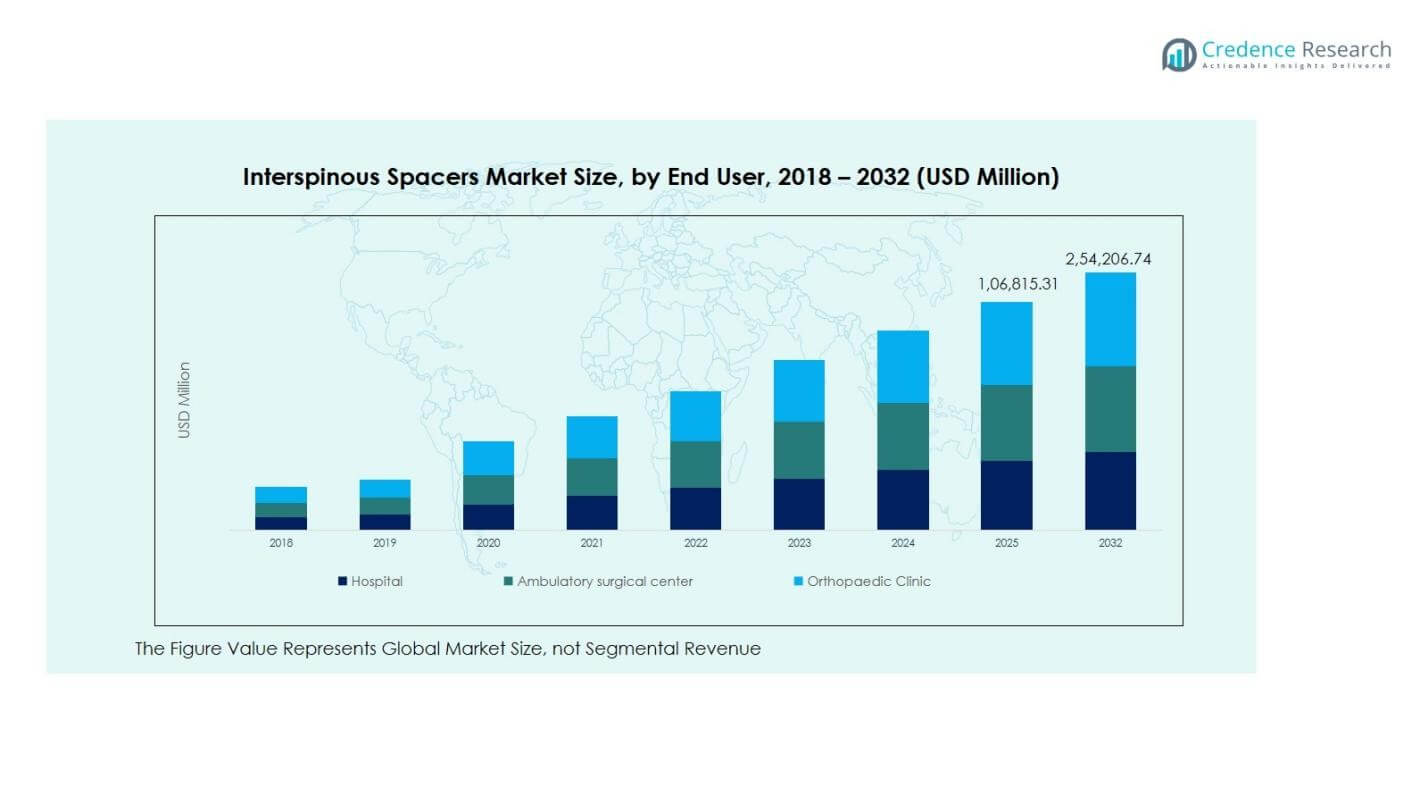
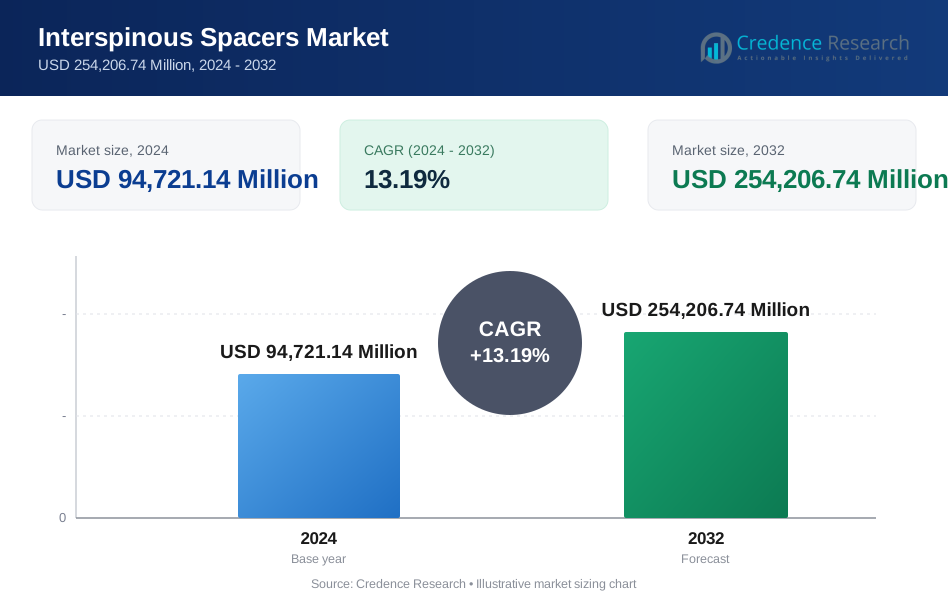
Interspinous Spacers Market size was valued at USD 62,400.00 Million in 2018 and increased to USD 94,721.14 Million in 2024; it is anticipated to reach USD 254,206.74 Million by 2032, growing at a CAGR of 13.19% during the forecast period.
| REPORT ATTRIBUTE | DETAILS |
|---|---|
| Historical Period | 2020-2023 |
| Base Year | 2024 |
| Forecast Period | 2025-2032 |
| Interspinous Spacers Market Size 2024 | USD 94,721.14 million |
| Interspinous Spacers Market, CAGR | 13.19% |
| Interspinous Spacers Market Size 2032 | USD 254,206.74 million |
Market Insights
- Strong market growth is driven by rising cases of lumbar spinal stenosis and degenerative disc disease, increasing demand for minimally invasive spinal procedures, and expanding adoption of Static (Non-compressible Spacers) with a 57.8 percent share in 2024.
- Market trends reflect expanding use of motion-preserving implants, technological advancements in spacer design, and increasing procedure shifts toward ambulatory surgical centers supported by favorable clinical outcomes and surgeon preference.
- Market dynamics are influenced by innovation strategies of major players and ongoing product portfolio expansion, alongside pricing pressures and reimbursement disparities that remain key barriers across cost-sensitive healthcare environments.
- Regional performance is led by North America with a 34.8% share in 2024, followed by Europe at 29.5% and Asia Pacific at 22.7%, with emerging regions showing gradual procedural adoption and investment expansion.
Market Segmentation Analysis:
By Product
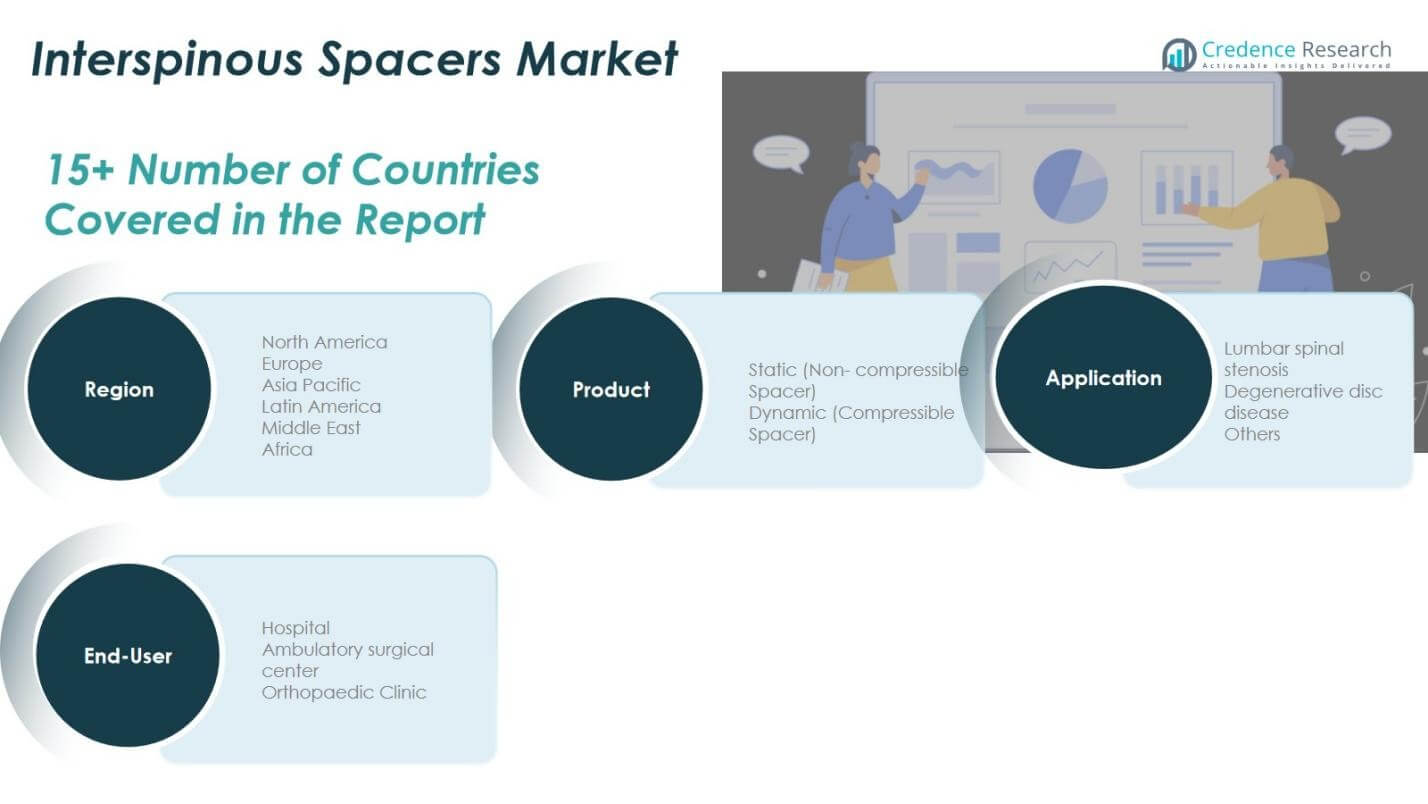
The Interspinous Spacers Market by product is led by Static (Non-compressible Spacers), which accounted for 57.8% market share in 2024, driven by their proven long-term stability, lower mechanical failure risk, and strong adoption in patients requiring sustained vertebral distraction. Demand is further supported by favorable clinical outcomes, wider surgeon familiarity, and higher usage in elderly patients with advanced lumbar degeneration. Dynamic (Compressible Spacers) held the remaining 42.2% share, benefiting from their motion-preserving capability and increasing preference in younger, active patients, although adoption remains comparatively lower due to higher device costs and variable clinical evidence.
- For instance, Medtronic's X-STOP, a titanium static spacer, provides indirect decompression by limiting spinal extension, showing significant improvements over nonoperative treatment in clinical trials with success rates comparable to laminectomy but lower morbidity.
By Application
Based on application, Lumbar Spinal Stenosis emerged as the dominant segment with 65.4% market share in 2024, supported by the rising prevalence of age-related spinal narrowing, high procedural volumes, and strong clinical acceptance of interspinous spacers as a minimally invasive alternative to decompression surgery. Degenerative Disc Disease accounted for 24.7% share, driven by the growing burden of chronic low-back pain and increasing focus on motion-preserving interventions, while the Others category represented 9.9% share, covering trauma-related indications and revision procedures with comparatively lower procedural frequency.
- For instance, Boston Scientific's Superion Indirect Decompression System treats moderate lumbar spinal stenosis, achieving 84.3% clinical success across Zurich Claudication Questionnaire domains at 4 years post-implantation in a clinical study of 89 patients.
By End-User
In terms of end-user, Hospitals dominated the Interspinous Spacers Market with 56.3% market share in 2024, supported by advanced surgical infrastructure, higher patient inflow, strong reimbursement access, and the availability of multidisciplinary spine-care teams. Ambulatory Surgical Centers accounted for 28.5% share, driven by the shift toward day-care minimally invasive spine procedures, shorter recovery time, and cost-efficient operative settings. Orthopaedic Clinics held 15.2% share, primarily contributing to pre- and post-operative management and selective outpatient interventions, although procedural capacity remains lower compared to hospital-based surgical environments.
Key Growth Drivers
Rising Prevalence of Degenerative Spine Disorders
The Interspinous Spacers Market experiences strong growth due to the increasing prevalence of degenerative spinal conditions, particularly lumbar spinal stenosis and degenerative disc disease among aging populations. Surgeons and patients increasingly prefer interspinous spacers as a minimally invasive alternative to spinal fusion and laminectomy because these devices reduce post-operative pain, preserve motion, and support faster recovery. Growing sedentary lifestyles, obesity trends, and higher life expectancy further expand the patient pool requiring spinal stabilization procedures. In addition, improving access to specialty spine care and greater clinical awareness among healthcare professionals continue to reinforce demand across both developed and emerging healthcare markets.
- For instance, InSpan's interspinous-interlaminar fixation device yielded low revision rates of 1.8% at L4-5 and 4.4% at L5-S1 over five years in spinal stenosis patients treated without fusion. Patients experienced up to 80% improvement in VAS pain scores
Shift Toward Minimally Invasive Spine Interventions
Market growth is driven by the accelerating shift toward minimally invasive spine surgery techniques supported by shorter hospital stays, reduced rehabilitation time, and lower complication rates. Interspinous spacers align well with value-based care models and increasingly replace conventional open surgeries in suitable patient groups. Continuous product improvements, such as enhanced biomechanical strength and refined implant materials, further improve clinical outcomes and surgeon confidence. Growth is also supported by expanding procedural adoption in ambulatory surgical centers and orthopedic day-care settings, particularly where patients and payers prefer cost-efficient, motion-preserving treatment approaches over fusion-based stabilization procedures.
- For instance, Boston Scientific's Superion Indirect Decompression System, an interspinous spacer for lumbar spinal stenosis, demonstrated 80% patient satisfaction at 12 months in a real-world registry of over 1,500 patients, with back pain severity improving by 48% from preoperative levels.
Technological Advancements and Product Innovation
Advancements in implant design, imaging-guided placement techniques, and material science significantly strengthen market expansion for interspinous spacers. Manufacturers increasingly develop customizable spacer platforms with improved durability, dynamic stabilization capability, and greater anatomical compatibility, resulting in reduced revision rates and improved patient satisfaction. Ongoing investment in R&D supports new product launches targeting broader indications, including early-stage degenerative disease and multi-level stabilization procedures. Strong clinical research pipelines and supportive regulatory clearances enhance surgeon acceptance globally, while expanding collaboration between device manufacturers and spine care institutions continues to drive innovation and widen adoption across healthcare systems.
Key Trends & Opportunities
Growing Adoption in Outpatient and Ambulatory Care Settings
A major market trend is the increasing transition of interspinous spacer procedures from hospital operating rooms to outpatient and ambulatory surgical centers. Shorter recovery periods, reduced anesthesia requirements, and streamlined patient discharge models make these devices highly suitable for day-care spine procedures. This shift creates opportunities for manufacturers to design implants optimized for efficient workflow, faster implantation time, and minimally invasive surgical access. Rising payer emphasis on cost containment further encourages outpatient adoption, while advancements in same-day recovery protocols expand treatment acceptance among both surgeons and patients seeking lower-risk spinal intervention alternatives.
- For instance, InSpan LLC's InSpan interspinous process device (IPD) supports outpatient L4-L5 fixation for degenerative spinal stenosis in ambulatory surgery centers.
Expanding Use in Motion-Preserving and Early-Intervention Therapies
The market benefits from a growing trend toward motion-preserving spine solutions, creating opportunities for interspinous spacers in early-stage degenerative spine management. Surgeons increasingly prefer interventions that delay or reduce the need for spinal fusion, particularly in active and middle-aged patient populations. Expanding research into dynamic stabilization technologies supports innovation in compressible spacer systems with improved biomechanical adaptability. Manufacturers are also exploring hybrid treatment approaches where spacers complement decompression procedures, enabling broader clinical application. These developments open new therapeutic pathways and reinforce the market’s role within evolving conservative-to-surgical spine care treatment frameworks.
- For instance, Medtronic's X-STOP spacer implantation in 175 patients with lumbar spinal stenosis improved Oswestry Disability Index scores from 32.6% preoperatively to 20.3% at 24 months, with 59% achieving clinically significant gains at one year.
Key Challenges
Clinical Outcome Variability and Revision Procedure Risk
One of the major challenges affecting the Interspinous Spacers Market is the variability in long-term clinical outcomes across different patient profiles and device types. Some patient groups experience symptom recurrence or device migration, leading to revision procedures that increase treatment cost and recovery burden. Variations in surgical expertise, implant selection, and anatomical suitability contribute to inconsistent results, which may limit wider adoption in complex or multi-level degenerative cases. Payers and regulatory bodies increasingly scrutinize outcome data, requiring stronger long-term evidence to support reimbursement approvals and broader clinical positioning of interspinous spacer technologies.
Reimbursement Constraints and Cost Pressures in Healthcare Systems
Reimbursement limitations in several markets continue to challenge adoption, particularly where payers classify interspinous spacers as alternative or discretionary treatment options. Inconsistent coverage policies, cost-effectiveness assessments, and budget constraints across public and private healthcare systems often slow procedure volumes despite clinical benefits. Hospitals and ambulatory centers must balance device procurement expenses against surgical productivity targets, which may restrict use in cost-sensitive regions. Price competition among manufacturers further intensifies margin pressure. Strengthening reimbursement pathways, health-economic validation, and payer engagement remain essential to overcoming financial barriers and sustaining broader market expansion.
Regional Analysis
North America
North America held a market share of 34.8% in 2024 and remained the leading region in the Interspinous Spacers Market, supported by strong adoption of minimally invasive spinal procedures and advanced clinical infrastructure. The regional market grew from USD 25,091.04 Million in 2018 to USD 37,670.03 Million in 2024 and is projected to reach USD 100,971.37 Million by 2032, registering a CAGR of 13.2%. Growth is reinforced by high diagnosis rates of lumbar spinal stenosis, robust reimbursement systems, and expanding use of motion-preserving spacer implants across hospitals and ambulatory surgical centers.
Europe
Europe accounted for a 29.5% market share in 2024, driven by widespread clinical acceptance of interspinous spacer procedures and strong presence of leading orthopedic device manufacturers. The market increased from USD 17,721.60 Million in 2018 to USD 25,932.06 Million in 2024, and it is expected to reach USD 66,030.88 Million by 2032, reflecting a CAGR of 12.5%. Growth across Germany, the UK, France, Italy, and Spain is supported by structured spine-care pathways, favorable regulatory approvals, and growing adoption of minimally invasive stabilization techniques among aging patient populations.
Asia Pacific
Asia Pacific recorded 22.7% market share in 2024 and represents the fastest-growing region due to rising healthcare investments and expanding access to advanced spinal care. The market increased from USD 13,416.00 Million in 2018 to USD 21,392.37 Million in 2024, and it is projected to reach USD 64,136.56 Million by 2032, registering a CAGR of 14.7%. Growth is driven by large patient pools in China, Japan, India, and South Korea, increasing diagnosis of degenerative spine disorders, and growing procedure adoption in hospitals and medical tourism-supported healthcare facilities.
Latin America
Latin America represented 6.1% market share in 2024, supported by gradual expansion of minimally invasive spine procedures and improving availability of specialist surgical services. The market rose from USD 3,282.24 Million in 2018 to USD 4,924.55 Million in 2024, and it is projected to reach USD 12,067.19 Million by 2032, growing at a CAGR of 11.9%. Brazil, Mexico, and Argentina lead procedure adoption due to strengthening private healthcare networks and rising awareness of motion-preserving spine treatments, although reimbursement gaps continue to influence overall treatment uptake.
Middle East
The Middle East accounted for 3.4% market share in 2024, driven by increasing investments in premium hospital infrastructure and rising uptake of minimally invasive spine surgery. The market increased from USD 1,803.36 Million in 2018 to USD 2,509.49 Million in 2024, and it is expected to reach USD 5,848.15 Million by 2032, reflecting a CAGR of 11.2%. Countries such as Saudi Arabia, the United Arab Emirates, and Qatar are expanding adoption through specialist orthopedic centers and medical tourism programs, although uneven reimbursement coverage limits broader market penetration.
Africa
Africa contributed 3.5% market share in 2024, with growth primarily concentrated in regions with developing tertiary care infrastructure. The market expanded from USD 1,085.76 Million in 2018 to USD 2,292.64 Million in 2024, and it is projected to reach USD 5,152.58 Million by 2032, registering a CAGR of 10.2%. Increasing prevalence of spinal disorders, gradual expansion of private hospitals, and selective introduction of cost-effective spacer solutions support market progress, although limited specialist availability and constrained healthcare budgets continue to restrict procedural volumes across several countries.
Market Segmentations:
By Product
- Static (Non-compressible Spacers)
- Dynamic (Compressible Spacers)
By Application
- Lumbar Spinal Stenosis
- Degenerative Disc Disease
- Others
By End-User
- Hospitals
- Ambulatory Surgical Centers
- Orthopaedic Clinics
By Geography
- North America
- U.S.
- Canada
- Mexico
- Europe
- Germany
- France
- U.K.
- Italy
- Spain
- Rest of Europe
- Asia Pacific
- China
- Japan
- India
- South Korea
- South-east Asia
- Rest of Asia Pacific
- Latin America
- Brazil
- Argentina
- Rest of Latin America
- Middle East & Africa
- GCC Countries
- South Africa
- Rest of the Middle East and Africa
Competitive Landscape
Competitive landscape analysis in the Interspinous Spacers Market is shaped by leading companies such as Boston Scientific Corporation, Medtronic Plc, Stryker Corporation, Zimmer Biomet Holdings Inc., Globus Medical Inc., NuVasive Inc., Orthofix Medical Inc., and Alphatec Holdings Inc., which collectively influence product innovation, clinical adoption, and global distribution strategies. The market is characterized by continuous investment in minimally invasive spinal technologies, dynamic stabilization devices, and advanced implant materials aimed at improving procedural outcomes and reducing revision rates. Players compete on clinical evidence generation, surgeon training programs, and regulatory approvals to strengthen brand credibility and hospital partnerships. Strategic initiatives such as portfolio expansion, mergers and acquisitions, and collaborations with spine care centers support market penetration across high-growth regions. Increasing focus on motion-preserving solutions, patient-specific implants, and cost-efficient spacer systems further intensifies competition, while emerging regional manufacturers strengthen their presence through value-driven offerings and targeted distribution networks in developing healthcare markets.
Key Player Analysis
- Boston Scientific Corporation (USA)
- Globus Medical Inc. (USA)
- Johnson & Johnson (USA)
- Life Spine, Inc. (USA)
- Alphatec Holdings Inc. (USA)
- Medtronic Plc (Ireland)
- NuVasive, Inc. (USA)
- Zimmer Biomet Holdings Inc. (USA)
- Mikai S.p.A. (Italy)
- Stryker Corporation (USA)
- Aurora Spine, Inc. (USA)
- Orthofix Medical Inc. (USA)
- Arca Medica GmbH (Germany)
- BM Korea Co., Ltd. (South Korea)
Recent Developments
- In March 2025, Aurora Spine Corporation completed patient enrollment in its REFINE clinical study of the ZIP™ Interspinous Fixation device, marking progress in evaluating its safety and efficacy for degenerative disc disease patients.
- In March 2025, Spinal Simplicity’s Minuteman® G5 interspinous fusion device received regulatory clearance for commercial use in Australia and New Zealand, expanding its global market reach.
- In January 2025, Stryker announced a definitive agreement to sell its U.S. spinal implants business, including interspinous spacer-related operations, with the transaction expected to close in the first half of 2025.
Report Coverage
The research report offers an in-depth analysis based on Product, Application, End User and Geography. It details leading market players, providing an overview of their business, product offerings, investments, revenue streams, and key applications. Additionally, the report includes insights into the competitive environment, SWOT analysis, current market trends, as well as the primary drivers and constraints. Furthermore, it discusses various factors that have driven market expansion in recent years. The report also explores market dynamics, regulatory scenarios, and technological advancements that are shaping the industry. It assesses the impact of external factors and global economic changes on market growth. Lastly, it provides strategic recommendations for new entrants and established companies to navigate the complexities of the market.
Future Outlook
- The market will witness increasing adoption of minimally invasive spinal stabilization procedures across hospitals and ambulatory surgical centers.
- Rising prevalence of degenerative spine disorders and aging population will continue to drive procedural demand.
- Motion-preserving and dynamic spacer technologies will gain stronger clinical acceptance in suitable patient groups.
- Manufacturers will focus on product innovation, durability enhancement, and improved anatomical compatibility.
- Outpatient spine surgery expansion will create opportunities for cost-efficient and day-care spacer implantation.
- Growing investment in clinical research and long-term outcome evidence will support broader reimbursement inclusion.
- Emerging markets in Asia Pacific, Latin America, and the Middle East will experience accelerated adoption.
- Strategic partnerships between device manufacturers and specialty spine centers will strengthen training and procedural expertise.
- Digital surgical planning tools and image-guided implantation techniques will enhance procedural precision.
- Competitive differentiation will increasingly shift toward patient-specific solutions and value-based care models.
Request a Free Sample
Fill in your details and we'll send you a free sample report.
- Sample data tables & charts
- Research methodology
Need a Custom Version of This Report?
Tailor the scope, geography, or segments to your exact requirements.
- Custom geography or segment scope
- Direct access to our analyst team
Frequently Asked Questions
What is the current market size for Interspinous Spacers Market, and what is its projected size in 2032?
At what Compound Annual Growth Rate is the Interspinous Spacers Market projected to grow between 2024 and 2032?
Which Interspinous Spacers Market segment held the largest share in 2024?
What are the primary factors fueling the growth of the Interspinous Spacers Market?
Who are the leading companies in the Interspinous Spacers Market?
Which region commanded the largest share of the Interspinous Spacers Market in 2024?
Table of Content
Chapter 1. Report Introduction
- 1.1 Report Description & Purpose
- 1.1.1 Report Title & Market Definition
- 1.1.2 Unique Selling Propositions (USP) & Key Differentiators
- 1.1.3 Value Proposition for Stakeholders
- 1.2 Research Objectives
- 1.2.1 Market Sizing Objectives (Volume & Revenue)
- 1.2.2 Segmentation Objectives
- 1.2.3 Competitive Intelligence Objectives
- 1.2.4 Forecast & Scenario Objectives
- 1.3 Report Scope
- 1.3.1 Interspinous Spacers Scope – Types & Subtypes Covered
- 1.3.2 Geographic Scope – Regions & Countries Covered
- 1.3.3 Historical Period, Base Year & Forecast Period (2024; forecast to 2032)
- 1.3.4 Inclusions & Exclusions
- 1.4 HS Code & Classification Framework
- 1.5 Currency, Units & Pricing Basis
- 1.6 Target Stakeholders
- 1.7 Limitations & Assumptions
Chapter 2. Executive Summary
- 2.1 Global Interspinous Spacers Market Snapshot
- 2.1.1 Market Size – Historical (2024) & Forecast (2024-2032) (2024: USD 94,721.14 Million → 2032: USD 254,206.74 Million)
- 2.1.2 Volume & Revenue – Global Totals
- 2.1.3 Key Market Highlights – Top Five Facts
- 2.2 Interspinous Spacers Market Segmentation Snapshot
- 2.2.1 Market Split by Region – 2024 vs. 2032
- 2.3 Competitive Snapshot
- 2.3.1 Top 10 Players by Revenue Share – 2024
- 2.3.2 Top 10 Players by Volume Share – 2024
- 2.3.3 Recent Strategic Developments (18-Month Summary)
- 2.4 Key Investment Highlights & Strategic Conclusions
Chapter 3. Interspinous Spacers Market Dynamics & Industry Analysis
- 3.1 Market Overview & Context
- 3.1.1 Interspinous Spacers Market Position in the Broader Automotive Value Chain
- 3.1.2 OEM vs. Replacement Market Dynamics
- 3.1.3 Market Maturity & Development Stage by Region
- 3.2 Interspinous Spacers Market Drivers
- 3.3 Interspinous Spacers Market Restraints & Challenges
- 3.4 Interspinous Spacers Market Opportunities
- 3.5 Porter's Five Forces Analysis
- 3.5.1 Threat of New Entrants
- 3.5.2 Bargaining Power of Suppliers
- 3.5.3 Bargaining Power of Buyers
- 3.5.4 Threat of Substitutes
- 3.5.5 Competitive Rivalry – Intensity Assessment
- 3.6 Interspinous Spacers Value Chain Analysis
- 3.6.1 Upstream – Raw Material/Input Suppliers
- 3.6.1.1 Raw Material/Input 1
- 3.6.1.2 Raw Material/Input 2
- 3.6.1.3 Raw Material/Input 3
- 3.6.2 Midstream – Production/Manufacturing/Service Delivery
- 3.6.2.1 Production/Process Overview
- 3.6.2.2 Key Facility Locations & Capacity by Manufacturer
- 3.6.3 Downstream – Distribution & End Consumer
- 3.6.3.1 Primary Channel – B2B/OEM
- 3.6.3.2 Secondary Channels – Dealer, Retail, Online, Direct
- 3.6.4 Value Chain Profitability Analysis
- 3.6.1 Upstream – Raw Material/Input Suppliers
- 3.7 PESTEL Analysis
- 3.7.1 Political Factors
- 3.7.2 Economic Factors
- 3.7.3 Social Factors
- 3.7.4 Technological Factors
- 3.7.5 Environmental Factors
- 3.7.6 Legal Factors
- 3.8 Interspinous Spacers Supply Chain Analysis
- 3.8.1 Raw Material/Input Supply Risk Assessment
- 3.8.2 Manufacturing Concentration Risk (Geographic Exposure)
- 3.8.3 Trade Disruption Impact Analysis
- 3.9 Regulatory & Policy Landscape
Note: The regulatory and policy landscape section covers regulations based on their applicability to the market, Interspinous Spacers category, geography, and scope of the study. Only regulatory frameworks with a material impact on operations, compliance, trade, sustainability, or market access are analyzed in detail.
Chapter 4. Key Investment Pockets & Opportunity Analysis
- 4.1 Interspinous Spacers Market Attractiveness Analysis
- 4.1.1 By Region – Investment Attractiveness Matrix (Volume × CAGR)
- 4.2 Absolute Revenue Growth Opportunity
- 4.2.1 By Region – Absolute USD Growth Through 2032
- 4.3 Incremental Volume Opportunity
- 4.3.1 By Region – Incremental Volume Through 2032
- 4.3.2 Segment – Incremental Volume
- 4.4 Emerging Submarket Opportunity Deep Dive (Subject to Applicability)
- 4.5 Emerging Market Opportunity Scorecards
- 4.5.1 United States
- 4.5.2 Europe
- 4.5.3 Asia
- 4.5.4 Middle East & Africa
Note: Emerging Market Opportunity Scorecards will be included based on relevance and strategic importance. Regions listed are indicative and may vary depending on data availability and market dynamics.
Chapter 5. Interspinous Spacers Import-Export Analysis & Trade Flows
- 5.1 Global Trade Overview
- 5.1.1 Global Export Value by Country (2024)
- 5.1.2 Global Export Volume by Country (2024)
- 5.1.3 Global Import Value by Country (2024)
- 5.1.4 Global Import Volume by Country (2024)
- 5.1.5 Net Trade Balance by Country (2024)
- 5.2 Export Analysis – Segment
- 5.2.1 Type 1 (HS Code)
- 5.2.2 Type 2 (HS Code)
- 5.2.3 Type 3 (HS Code)
- 5.2.4 Type 4 (HS Code)
- 5.2.5 Type 5 (HS Code)
- 5.3 Import Analysis – Segment
- 5.3.1 Type 1 (HS Code)
- 5.3.2 Type 2 (HS Code)
- 5.3.3 Type 3 (HS Code)
- 5.3.4 Type 4 (HS Code)
- 5.3.5 Type 5 (HS Code)
- 5.4 Average Unit Trade Prices
- 5.4.1 Average Export Price – Segment & Country
- 5.4.2 Average Import Price – Segment & Source Country
- 5.4.3 Price Trends (2024)
- 5.5 Key Trade Route Analysis
- 5.5.1 Trade Route 1
- 5.5.2 Trade Route 2
- 5.5.3 Trade Route 3
- 5.5.4 Trade Route 4
- 5.5.5 Trade Route 5
- 5.6 Trade Policy Impact Assessment
- 5.6.1 US Anti-Dumping & Section 301 Tariffs
- 5.6.2 EU Customs Union Impact
- 5.6.3 Major Free Trade Agreements
- 5.6.4 USMCA Rules of Origin
Note: Trade policy analysis will be included only where relevant to the Interspinous Spacers market.
Chapter 6. Competitive Landscape & Company Benchmarking
- 6.1 Interspinous Spacers Market Concentration & Structure
- 6.1.1 Herfindahl-Hirschman Index (HHI) – vs. 2024
- 6.1.2 Tier 1, Tier 2 & Tier 3 Market Structure
- 6.1.3 Global, Regional & Local Player Dynamics
- 6.2 Interspinous Spacers Market Share Analysis – 2024
- 6.2.1 Global Revenue Share by Company
- 6.2.2 Global Volume Share by Company
- 6.2.3 Regional Revenue Share
- 6.2.4 Market Share Evolution ( vs. 2024)
- 6.2.5 OEM Segment Share by Company
- 6.2.6 Replacement Segment Share by Company
- 6.3 Production/Delivery Capacity & Facility Analysis
- 6.3.1 Global Installed Capacity
- 6.3.2 Capacity Utilization Rates
- 6.3.3 Production/Output Volume
- 6.3.4 Facility Locations & Capacity Map
- 6.3.5 Planned Capacity Additions
- 6.4 Interspinous Spacers Competitive Benchmarking Matrix
- 6.4.1 Revenue, Volume, CAGR & Profitability Comparison
- 6.4.2 Channel Revenue Mix
- 6.4.3 Geographic Revenue Exposure
- 6.4.4 R&D Intensity
- 6.4.5 Sustainability Maturity
- 6.5 Strategic Developments in Interspinous Spacers (Last 24 Months)
- 6.5.1 Mergers, Acquisitions & Divestments
- 6.5.2 New Interspinous Spacers Launches
- 6.5.3 Facility Expansions
- 6.5.4 Strategic Alliances, Joint Ventures & Partnerships
- 6.5.5 Distribution Expansion & Market Entry
- 6.5.6 Sustainability & ESG Initiatives
- 6.6 Competitive Strategy Mapping
- 6.6.1 Leader, Challenger, Follower & Niche Classification
- 6.6.2 Pricing Strategy Comparison
- 6.6.3 Channel Strategy Matrix
Note: Strategic developments are included based on their materiality and the availability of reliable information.
Chapter 7. Global Interspinous Spacers Market – By Distribution Channel
- 7.1 Segment Overview
- 7.1.1 Volume & Revenue Split by Channel (2024 & 2032)
- 7.1.2 Channel Mix Evolution (2024-2032)
Chapter 8. Regional Market Analysis – Global Overview
- 8.1 Global Regional Overview
- 8.1.1 Regional Volume Share
- 8.1.2 Regional Revenue Share
- 8.1.3 Regional Volume by Region
- 8.1.4 Regional Revenue by Region
- 8.1.5 Regional Forecast Through 2032
- 8.2 Cross-Regional Segment Analysis
- 8.2.1 By Distribution Channel
- 8.2.2 By Brand/Price Tier
Chapter 9. North America Interspinous Spacers Market
- 9.1 United States
- 9.2 Canada
- 9.3 Mexico
Chapter 10. Europe Interspinous Spacers Market
- 10.1 Germany
- 10.2 France
- 10.3 Italy
- 10.4 United Kingdom
- 10.5 Spain
- 10.6 Poland
- 10.7 Russia
- 10.8 Netherlands
- 10.9 Belgium
- 10.10 Sweden
- 10.11 Denmark
- 10.12 Norway
- 10.13 Rest of Europe
Chapter 11. Asia Pacific Interspinous Spacers Market
- 11.1 China
- 11.2 India
- 11.3 Japan
- 11.4 South Korea
- 11.5 Thailand
- 11.6 Indonesia
- 11.7 Vietnam
- 11.8 Malaysia
- 11.9 Australia
- 11.10 Rest of Asia Pacific
Chapter 12. Latin America Interspinous Spacers Market
- 12.1 Brazil
- 12.2 Argentina
- 12.3 Colombia
- 12.4 Chile
- 12.5 Rest of Latin America
Chapter 13. Middle East Interspinous Spacers Market
- 13.1 Saudi Arabia
- 13.2 United Arab Emirates
- 13.3 Turkey
- 13.4 Israel
- 13.5 Iran
- 13.6 Rest of the Middle East
Chapter 14. Africa Interspinous Spacers Market
- 14.1 South Africa
- 14.2 Egypt
- 14.3 Nigeria
- 14.4 Morocco
- 14.5 Rest of Africa
Chapter 15. Interspinous Spacers Company Profiles
- 15.1 [Company 01]
- 15.1.1 Company Overview
- 15.1.2 Key Management Personnel
- 15.1.3 Products & Services Portfolio
- 15.1.4 Financial Performance
- 15.1.5 Key Market Focus & Geographic Presence
- 15.1.6 Recent Developments & Strategic Initiatives
Note: The company profile list is preliminary and may change based on research findings, market developments, data availability, and client requirements.
Chapter 16. Appendices
- Appendix A – List of Abbreviations & Acronyms
- Appendix B – Industry Classification Code Reference – Full Series
- Appendix C – Production & Capacity Data Tables
- Appendix D – End-Use & Demand Base Tables
- Appendix E – Consumption & Replacement Rate Assumptions
- Appendix F – ASP Reference Tables
- Appendix G – Manufacturing & Facility Database
- Appendix H – Import-Export Data Tables
- Appendix I – Regulatory Summary Tables
- Appendix J – Primary Research Participant List (Anonymized)
- Appendix K – Primary Research Questionnaire Framework
- Appendix L – Data Sources & Bibliography
- Appendix M – Market Size Divergence & Source Comparison
Chapter 17. Research Methodology
- 17.1 Research Framework & Philosophy
- 17.2 Secondary Research – Sources, Hierarchy & Data Extraction
- 17.3 Data Modeling – Bottom-Up & Top-Down Market Sizing
- 17.4 Primary Research – Stakeholder Framework, LOI & Sample Sizes
- 17.5 Forecast Methodology – Regression, Scenario & Sensitivity Analysis
- 17.6 Quality Control – Four-Layer Validation Framework
- 17.7 Limitations & Standard Assumptions
- 17.8 Disclaimer
