Market Overview:
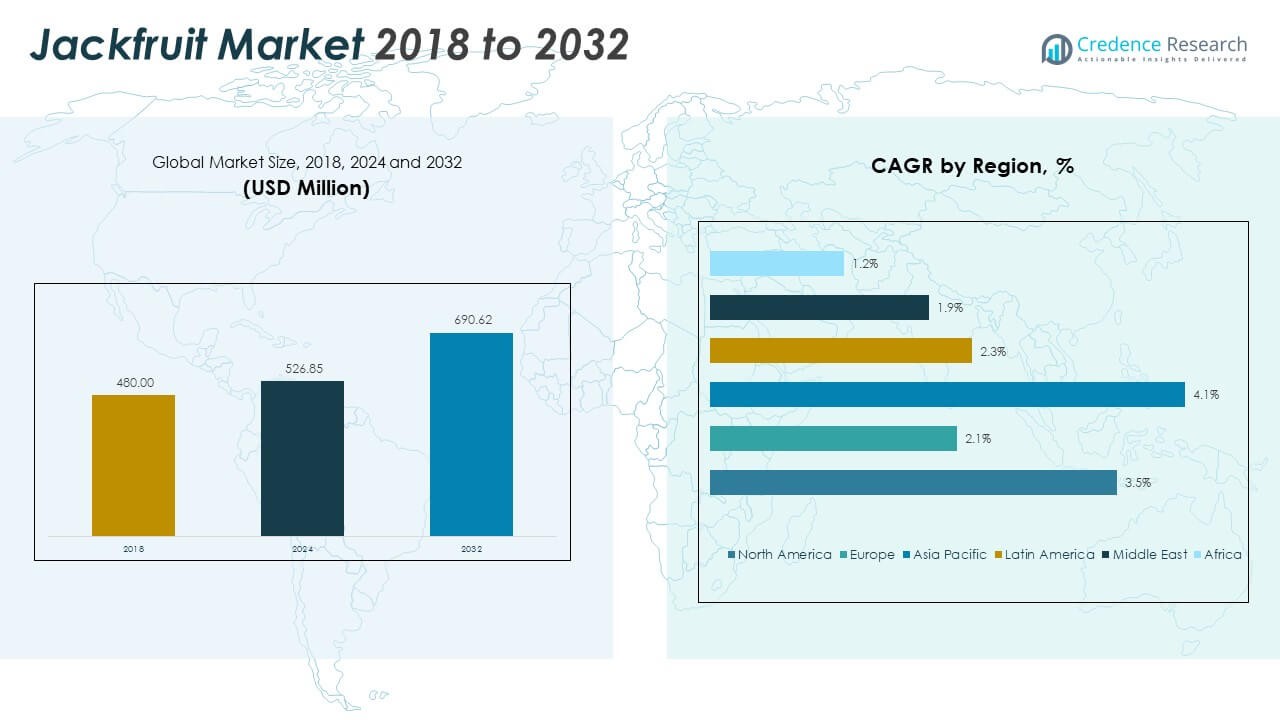
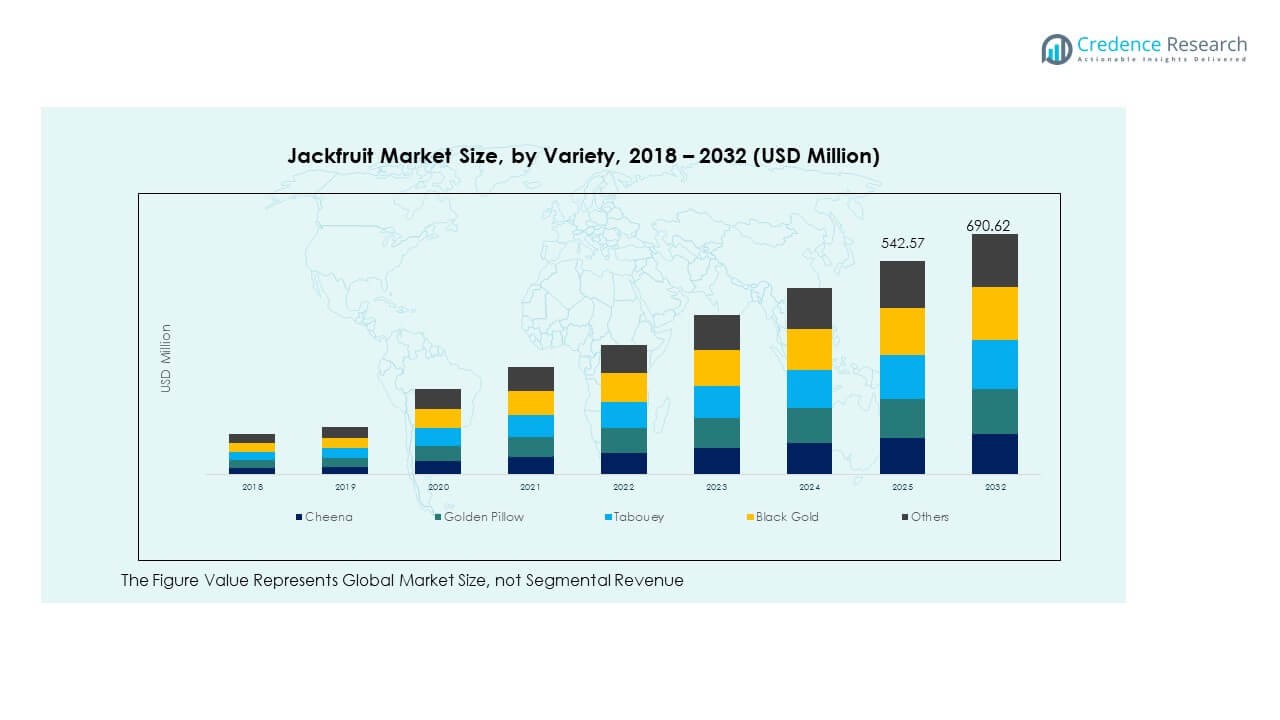
The Jackfruit Market size was valued at USD 480.00 million in 2018 to USD 526.85 million in 2024 and is anticipated to reach USD 690.62 million by 2032, at a CAGR of 3.51% during the forecast period.
| REPORT ATTRIBUTE | DETAILS |
|---|---|
| Historical Period | 2020-2023 |
| Base Year | 2024 |
| Forecast Period | 2025-2032 |
| Jackfruit Market Size 2024 | USD 526.85 Million |
| Jackfruit Market, CAGR | 3.51% |
| Jackfruit Market Size 2032 | USD 690.62 Million |
The key driver for the market’s growth is rising demand for healthy, natural, and vegan-friendly food options. Jackfruit’s high fiber content and low-fat composition support its inclusion in health-conscious diets. The food and beverage industry is incorporating jackfruit into plant-based meals, snacks, and beverages, responding to evolving consumer preferences. Supportive government policies promoting sustainable agriculture and fruit-based processing also enhance its global production and export potential.
Asia-Pacific dominates the global market due to favorable climatic conditions and large-scale cultivation in countries like India, Bangladesh, and Thailand. North America and Europe are emerging growth regions, supported by increasing vegan populations and greater retail availability of tropical fruit-based products. Latin America shows steady expansion driven by local production and growing export capacity, while the Middle East and Africa exhibit rising adoption through specialty stores and import-led supply chains.
Market Insights:
- The Jackfruit Market was valued at USD 480.00 million in 2018, reached USD 526.85 million in 2024, and is projected to attain USD 690.62 million by 2032, expanding at a CAGR of 3.51% during the forecast period.
- Asia Pacific leads with a 55% market share, driven by abundant cultivation in India, Thailand, and Bangladesh, coupled with strong domestic consumption and export support.
- North America holds 20% and Europe 14% of the global share, supported by growing vegan trends, expanding retail availability, and increasing product innovations in processed jackfruit.
- Asia Pacific remains the fastest-growing region, fueled by government-backed agricultural programs, growing fruit-based processing industries, and expanding export capabilities.
- Among varieties, Cheena and Golden Pillow collectively account for over 40% share due to high yield and consumer preference, while Black Gold and Cochin segments together contribute nearly 30%, reflecting their strong export demand and superior pulp quality.
Market Drivers
Rising Consumer Demand for Plant-Based Meat Alternatives
Growing awareness of plant-based diets drives the Jackfruit Market, supported by global vegan movements and meat reduction campaigns. Jackfruit’s fibrous texture closely mimics meat, increasing its use in ready-to-eat and frozen meals. Food brands are expanding portfolios with jackfruit-based curries, tacos, and sandwiches to attract flexitarian consumers. The rise in chronic health conditions linked to red meat is pushing consumers toward cleaner options. Restaurants and quick-service chains are adding plant-based menu items to meet new demand. Governments promoting sustainable agriculture also support fruit-based protein production. Online platforms enhance product reach, improving accessibility across regions. The category’s ability to blend nutrition, taste, and sustainability strengthens its long-term growth.
Growing Awareness of Health and Nutritional Benefits
Consumers increasingly associate jackfruit with rich nutrient content, fiber, and antioxidants, boosting its inclusion in daily diets. The Jackfruit Market benefits from rising adoption among health-conscious consumers seeking natural energy sources. Its low-calorie and low-fat profile make it suitable for diabetic and weight-conscious populations. Functional food producers use jackfruit extracts in smoothies, snacks, and supplements for added nutritional value. Health campaigns highlight its vitamin and mineral richness, fostering greater recognition among global audiences. Fitness enthusiasts use jackfruit as a natural carbohydrate replacement in training diets. Packaged food producers promote clean-label formulations featuring the fruit. The market’s alignment with holistic wellness and preventive nutrition trends continues to strengthen consumer trust.
- For instance, a clinical trial published in 2021 showed that patients consuming green jackfruit flour had 25% fewer calories, 33% fewer net carbohydrates, and 57% more fiber per serving compared to conventional flour, and it demonstrated measurable improvements in glycemic control in type-2 diabetes patients.
Expansion of Processed and Packaged Food Applications
The global demand for processed foods containing jackfruit is increasing due to changing consumption habits. The Jackfruit Market benefits from food processors launching shelf-stable, frozen, and dehydrated variants for urban consumers. Manufacturers develop vacuum-packed and ready-to-cook options to extend shelf life and reduce waste. The growing retail presence of tropical fruit-based snacks is expanding category visibility. Packaging innovations ensure nutrient retention and improve convenience for on-the-go consumers. Companies invest in flavor adaptation to appeal to Western palates. Private-label brands in supermarkets are increasing product diversity. The expanding food retail infrastructure supports higher distribution efficiency and consumer penetration across multiple geographies.
Government Support for Sustainable Agriculture and Export Expansion
Government policies promoting fruit cultivation and processing are strengthening the Jackfruit Market’s production chain. Agricultural boards in India, Sri Lanka, and Bangladesh provide subsidies and training for jackfruit farmers. Export initiatives target high-value markets in North America and Europe, where tropical fruit imports are increasing. R&D institutions invest in post-harvest management and value-added product innovation. Sustainability policies encourage cultivation methods that reduce waste and improve yield quality. Collaborations between cooperatives and exporters streamline supply chains. The food processing sector receives incentives for fruit dehydration and pulp extraction. Such initiatives ensure consistent quality, enhance farmer income, and support long-term export growth.
- For instance, agricultural research institutions in Karnataka have conducted varietal improvement programs for jackfruit to enhance yield stability and fruit quality. These initiatives, supported by state agricultural universities, focus on developing high-yielding and disease-resistant cultivars suited to local agro-climatic conditions.
Market Trends
Innovation in Value-Added Products and Functional Food Development
Product innovation drives the Jackfruit Market toward diversification in processed and functional food categories. Manufacturers develop jackfruit-based protein powders, snacks, and beverages to meet fitness and wellness demands. Food technology companies experiment with fermentation and dehydration techniques to preserve flavor and nutrition. The rising appeal of clean-label and allergen-free foods supports this trend. Ready-to-eat jackfruit meals are gaining shelf space in health stores and supermarkets. Snack producers use jackfruit seeds for high-protein formulations. Brands highlight sustainability credentials and eco-friendly packaging to attract ethical consumers. Product innovation continues to reinforce jackfruit’s role as a multipurpose functional ingredient.
- For instance, Fiber Foods’ PrimeJack® employs a patent-pending dehydration technology that produces shelf-stable jackfruit with 57% fiber content (8.1g/100g rehydrated). The process reduces product volume by 90%, cutting transport emissions and extending shelf life for global shipment.
Rapid Expansion of Vegan and Vegetarian Food Service Chains
The global increase in vegan and vegetarian food outlets accelerates demand for jackfruit-based menu items. The Jackfruit Market benefits from restaurant partnerships promoting sustainable dining. Quick-service restaurants and cafés introduce jackfruit wraps, burgers, and curries to attract conscious eaters. Food delivery platforms feature vegan options prominently, improving accessibility. Culinary influencers and chefs experiment with jackfruit recipes, enhancing awareness. Frozen meal companies target urban consumers with easy-preparation options. The rise of plant-based protein innovation continues to shape consumer perceptions. Foodservice adoption reinforces jackfruit’s mainstream acceptance across both developed and emerging regions.
Increasing Integration of Digital Retail and E-Commerce Platforms
E-commerce growth supports the expansion of jackfruit-based product sales across international markets. The Jackfruit Market leverages online platforms to connect manufacturers directly with consumers. Subscription models and wellness boxes featuring tropical fruits are becoming popular. Small enterprises benefit from digital marketing and influencer-led product promotions. E-retailers highlight sustainability certifications and product sourcing transparency. Global health food marketplaces are increasing their tropical fruit portfolios. Online visibility supports the growth of niche brands in competitive regions. Digital retail integration ensures steady market expansion and improved consumer engagement worldwide.
- For instance, Upton’s Naturals (US) has its Original Jackfruit 2.2-lb bulk packs actively listed for sale on major online retailers like BuyItByTheCase and VeganEssentials in 2025, expanding vegan SKUs for sandwiches, burgers, wraps, and bowls, and commercially supplying frozen jackfruit for retail and foodservice channels.
Focus on Sustainability and Circular Production Practices
Sustainability remains a defining trend influencing procurement and processing strategies in the Jackfruit Market. Companies emphasize zero-waste production, utilizing seeds and peels for by-products like flour and animal feed. Eco-friendly farming practices reduce environmental impact and improve yield consistency. Food producers adopt biodegradable packaging to meet regulatory standards. Sustainable farming certifications are attracting environmentally conscious investors. Local cooperatives promote organic farming, ensuring traceability and fair-trade compliance. Global brands use carbon-neutral labeling to strengthen brand image. Such initiatives align consumer preference with ethical sourcing, reinforcing long-term brand loyalty.
Market Challenges Analysis
Limited Supply Chain Infrastructure and Post-Harvest Management Issues
Inefficient supply chain networks and poor storage conditions hinder the Jackfruit Market’s growth in several regions. The fruit’s short shelf life increases waste during transport and handling. Small farmers lack access to cold storage facilities and efficient logistics. Limited mechanization leads to inconsistent quality and higher production losses. The absence of standardized processing technologies reduces competitiveness in export markets. Supply chain fragmentation also affects pricing stability. Exporters struggle to meet global quality standards due to limited infrastructure. Strengthening farm-to-market systems and improving cold chain investment remain key industry challenges.
Low Consumer Awareness and Market Penetration in Non-Tropical Regions
Consumer awareness about jackfruit’s culinary versatility remains low in many Western countries. The Jackfruit Market faces slow penetration due to limited product education and cultural familiarity. Many consumers associate it only with exotic fruit rather than a protein-rich food alternative. Retailers hesitate to allocate shelf space without consistent demand patterns. Marketing campaigns remain localized, restricting broader consumer engagement. Lack of standardized product labeling creates confusion among first-time buyers. Import costs further elevate product prices, affecting affordability. Expanding consumer education and global awareness campaigns is critical for overcoming these barriers.
Market Opportunities
Expansion of Export Potential and Entry into New Geographic Markets
Rising global interest in tropical and plant-based foods offers new trade opportunities for the Jackfruit Market. Exporters can target Europe, North America, and the Middle East, where vegan trends are increasing. Governments support agricultural exports through subsidies and product certifications. Technological advancements in packaging extend product lifespan during shipment. Strategic alliances between cooperatives and processors enable efficient value chain management. Improved branding and organic certifications enhance product appeal in international markets. Logistics partnerships expand reach to untapped regions. Strengthening trade policies and infrastructure development will further support export diversification.
Growth in Food Processing and Alternative Protein Industries
Expanding demand for natural meat alternatives creates opportunities in the Jackfruit Market. Food processors invest in texture optimization and flavor enhancement technologies. Jackfruit’s versatility makes it suitable for meat substitutes, bakery fillings, and confectionery. The alternative protein industry recognizes it as a sustainable ingredient source. Startups and established brands focus on R&D to create innovative product lines. Growing partnerships between producers and retailers support commercial scalability. Technological innovation ensures higher yield and cost efficiency. The evolving global preference for plant-based diets strengthens long-term market potential.
Market Segmentation Analysis:
The Jackfruit Market is segmented
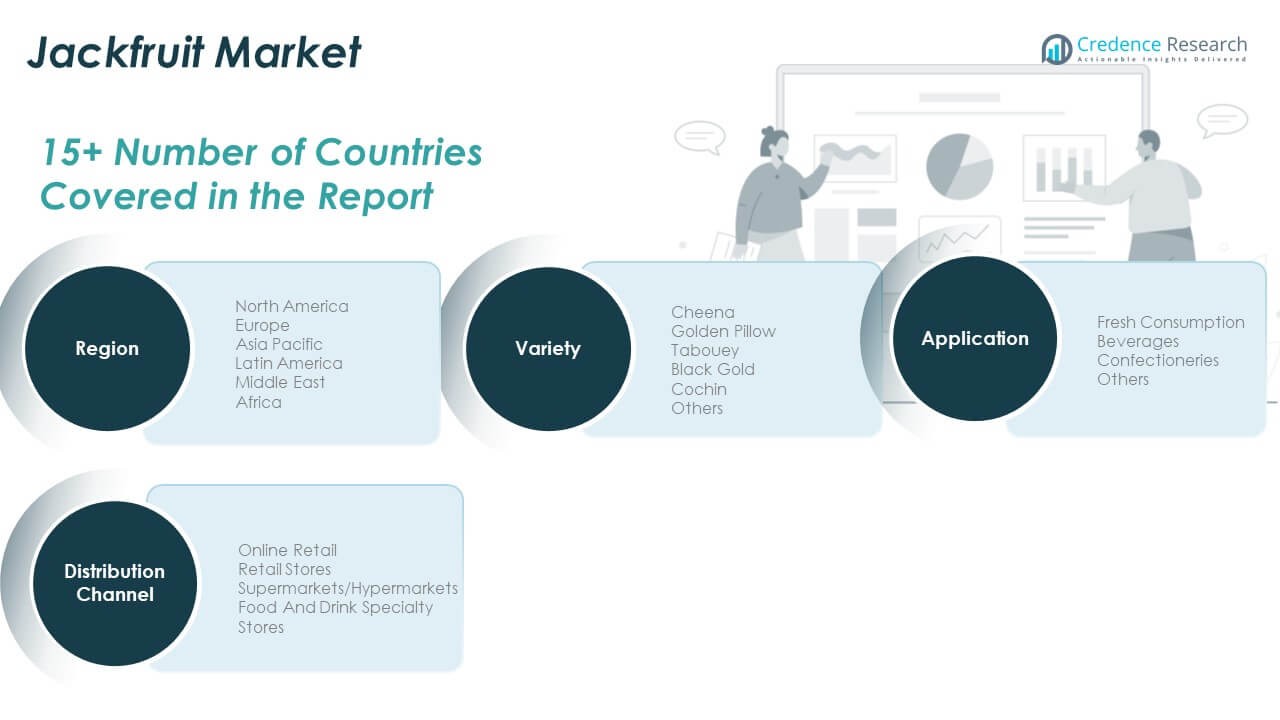
By variety into Cheena, Golden Pillow, Tabouey, Black Gold, Cochin, and Others. Cheena and Golden Pillow varieties lead due to their high yield, rich flavor, and strong acceptance in both fresh and processed food segments. Black Gold and Cochin varieties are gaining traction in international trade because of superior pulp quality and extended shelf life. Growing export activities and hybrid cultivation practices support their increased adoption among farmers and food processors.
- For instance, several Indian agribusiness exporters promote jackfruit varieties such as Black Gold and Cochin for international markets, emphasizing quality grading, proper packaging, and compliance with food safety standards to meet global trade requirements.
By application, the market is divided into Fresh Consumption, Beverages, Confectioneries, and Others. Fresh consumption dominates due to widespread use of raw fruit and seeds in traditional diets across Asia-Pacific. It also finds use in frozen and dehydrated forms for urban retail. The beverages and confectionery segments are expanding with rising demand for natural flavoring and fruit-based products. Increasing awareness about plant-based nutrition is further boosting its use in functional and organic food manufacturing.
- For instance, Campco launched jackfruit éclairs in July 2021, using around 100 kg of jackfruit flesh per tonne of toffees, offering a nine-month shelf life, and initially targeting markets in Karnataka and Kerala.
By distribution channel, segmentation includes Online Stores, Supermarkets/Hypermarkets, Specialty Stores, and Others. Supermarkets and hypermarkets hold the major share due to strong consumer reach and availability of multiple product varieties. Specialty stores cater to niche consumers seeking organic or premium-quality jackfruit products. Online stores are rapidly expanding, supported by growing e-commerce penetration and digital marketing. It benefits from efficient supply chains and home delivery services that enhance convenience and accessibility across domestic and international markets.
Segmentation:
By Variety
- Cheena
- Golden Pillow
- Tabouey
- Black Gold
- Cochin
- Others
By Application
- Fresh Consumption
- Beverages
- Confectioneries
- Others
By Distribution Channel
- Online Stores
- Supermarkets/Hypermarkets
- Specialty Stores
- Others
By Region
- North America
- U.S.
- Canada
- Mexico
- Europe
- Germany
- France
- U.K.
- Italy
- Spain
- Rest of Europe
- Asia Pacific
- China
- Japan
- India
- South Korea
- South-east Asia
- Rest of Asia Pacific
- Latin America
- Brazil
- Argentina
- Rest of Latin America
- Middle East & Africa
- GCC Countries
- South Africa
- Rest of the Middle East and Africa
Regional Analysis:
North America
The North America Jackfruit Market size was valued at USD 100.03 million in 2018 to USD 107.47 million in 2024 and is anticipated to reach USD 140.54 million by 2032, at a CAGR of 3.5% during the forecast period. North America holds an estimated 20% market share, driven by increasing consumer preference for plant-based and clean-label products. The U.S. dominates regional demand, supported by growing vegan and vegetarian populations. Food manufacturers are expanding product portfolios with frozen, canned, and ready-to-eat jackfruit meals. Retail distribution through health food chains and supermarkets boosts visibility. Import reliance from Asia-Pacific remains high due to limited domestic cultivation. Rising awareness about sustainable and alternative proteins is further driving market acceptance. Product innovation and branding focused on taste and convenience enhance regional growth prospects.
Europe
The Europe Jackfruit Market size was valued at USD 70.56 million in 2018 to USD 72.06 million in 2024 and is anticipated to reach USD 84.78 million by 2032, at a CAGR of 2.1% during the forecast period. Europe accounts for nearly 14% of the global market, with strong demand from the UK, Germany, and France. Growing awareness of tropical fruits and plant-based diets fuels adoption in retail and foodservice sectors. European consumers value organic and ethically sourced products, supporting imports from certified suppliers. Companies are expanding private-label offerings of dried and frozen jackfruit products. Retail penetration in health and specialty food stores continues to rise. Importers benefit from government incentives promoting sustainable sourcing. The region’s steady preference for innovative meat substitutes strengthens long-term growth potential.
Asia Pacific
The Asia Pacific Jackfruit Market size was valued at USD 260.64 million in 2018 to USD 291.79 million in 2024 and is anticipated to reach USD 400.77 million by 2032, at a CAGR of 4.1% during the forecast period. Asia Pacific leads the global market with nearly 55% share, supported by abundant cultivation and strong domestic demand. India, Bangladesh, and Thailand are key producers, with favorable agro-climatic conditions promoting large-scale harvesting. Rising investments in food processing industries enhance export potential. Local manufacturers are launching packaged and dehydrated jackfruit for urban consumers. Governments encourage fruit-based entrepreneurship and sustainable farming initiatives. Technological improvements in preservation and cold-chain logistics improve market efficiency. The region’s dominance is strengthened by its role as a key supplier to international markets.
Latin America
The Latin America Jackfruit Market size was valued at USD 23.38 million in 2018 to USD 25.34 million in 2024 and is anticipated to reach USD 30.09 million by 2032, at a CAGR of 2.3% during the forecast period. Latin America represents nearly 5% of the global market, with Brazil being the primary contributor. The region’s tropical climate supports favorable cultivation, while domestic consumption is expanding in processed food formats. Export activities to North America and Europe are growing due to improved trade logistics. Food companies are introducing value-added products such as jackfruit snacks and purees. Urbanization and lifestyle shifts are increasing demand for ready-to-eat fruit products. Investments in agricultural training and sustainable practices enhance productivity. The region is emerging as a potential exporter in the global fruit value chain.
Middle East
The Middle East Jackfruit Market size was valued at USD 15.12 million in 2018 to USD 15.33 million in 2024 and is anticipated to reach USD 17.68 million by 2032, at a CAGR of 1.9% during the forecast period. The region contributes nearly 3% of the total market share, supported by import-driven consumption. Demand is rising in the UAE and Saudi Arabia through supermarkets and specialty retailers. Consumers are increasingly exploring tropical fruits as part of premium and health-conscious diets. Food importers collaborate with Asian suppliers for consistent supply. Distribution networks are expanding to include frozen and dried product categories. The growing hospitality and tourism industries enhance demand for exotic fruit ingredients. Strategic alliances with exporters are improving product visibility and supply stability.
Africa
The Africa Jackfruit Market size was valued at USD 10.27 million in 2018 to USD 14.86 million in 2024 and is anticipated to reach USD 16.76 million by 2032, at a CAGR of 1.2% during the forecast period. Africa accounts for nearly 3% market share, primarily led by South Africa and Egypt. The region’s growth is supported by gradual adoption of fruit-based processed foods. Domestic cultivation is increasing in tropical zones with favorable weather conditions. Imports from Asia-Pacific supplement limited regional production. Awareness about jackfruit’s nutritional benefits is slowly improving through urban retail exposure. Food processors explore its potential for canned and dried fruit categories. Expanding supermarket chains and online grocery platforms enhance accessibility. Investments in agri-food infrastructure are expected to improve long-term market potential.
Key Player Analysis:
- Jackfruit365
- Nutty Yogi
- The Jackfruit Company
- Artocarpus Foods Pvt. Ltd.
- NatureLoC
- Madam Sun
- Island Valley Delights
- Mother Dairy Fruit & Vegetable Pvt. Ltd.
- Anna Food Products
- Frubites
Competitive Analysis:
The Jackfruit Market is characterized by moderate competition, with key players focusing on product innovation, distribution expansion, and sustainability. Companies such as Jackfruit365, The Jackfruit Company, Nutty Yogi, and Artocarpus Foods Pvt. Ltd. emphasize developing processed and ready-to-eat formats to meet rising consumer demand. It benefits from growing collaborations between food processors and retail chains to strengthen global reach. Firms invest in branding strategies highlighting nutritional and environmental benefits to attract health-conscious buyers. The market witnesses new entrants leveraging e-commerce platforms for faster penetration. Established brands enhance product quality through improved preservation and packaging technologies. Partnerships with exporters and agricultural cooperatives support supply consistency and pricing stability. Competitive positioning depends on innovation, scalability, and strategic marketing that align with the expanding plant-based food ecosystem.
Recent Developments:
- In October 2024, The Jackfruit Company, a Colorado-based leading US producer of jackfruit products, secured a $5 million Series B extension from existing investors including InvestEco, Creadev, and Grosvenor Food & AgTech. The fresh capital is intended to help the company refine its plant-based meat products, made from whole jackfruit, and accelerate expansion within the US market.
Report Coverage:
The research report offers an in-depth analysis based on Variety, Application and Distribution Channel. It details leading market players, providing an overview of their business, product offerings, investments, revenue streams, and key applications. Additionally, the report includes insights into the competitive environment, SWOT analysis, current market trends, as well as the primary drivers and constraints. Furthermore, it discusses various factors that have driven market expansion in recent years. The report also explores market dynamics, regulatory scenarios, and technological advancements that are shaping the industry. It assesses the impact of external factors and global economic changes on market growth. Lastly, it provides strategic recommendations for new entrants and established companies to navigate the complexities of the market.
Future Outlook:
- Rising global adoption of plant-based diets will continue to strengthen demand for jackfruit-based food products.
- Expanding product innovations such as frozen, canned, and ready-to-eat options will enhance consumer accessibility.
- Increasing use of jackfruit as a natural meat substitute will drive growth in the processed food industry.
- Investments in food preservation, packaging, and supply chain technology will improve product stability and reduce waste.
- Online retail platforms will boost market reach, offering wider availability across domestic and international markets.
- Government initiatives supporting sustainable farming and fruit-based processing will enhance production efficiency.
- Partnerships between exporters and retailers will expand trade opportunities in high-growth regions.
- Demand from vegan and flexitarian consumers will influence product diversification and branding strategies.
- Growing use of jackfruit in beverages, confectioneries, and health snacks will broaden application scope.
- Continuous innovation in cultivation and processing will sustain long-term competitiveness in global markets.

Request a Free Sample
Fill in your details and we'll send you a free sample report.
- Sample data tables & charts
- Research methodology
Market Dynamics
Rising Consumer Demand for Plant-Based Meat Alternatives
Jackfruit’s fibrous texture and nutritional profile make it an attractive meat substitute, driving its adoption in ready-to-eat meals, frozen foods, and restaurant menus as consumers seek healthier and more sustainable protein options.
Growing Awareness of Health and Nutritional Benefits
Jackfruit is increasingly recognized for its high fiber, low fat, and rich nutrient content, leading health-conscious consumers and functional food producers to incorporate it into daily diets, snacks, and supplements.
Expansion of Processed and Packaged Food Applications
Food processors are launching shelf-stable, frozen, and dehydrated jackfruit products to meet urban demand for convenience, while packaging innovations and flavor adaptation are broadening appeal in Western markets.
Government Support for Sustainable Agriculture and Export Expansion
Subsidies, training, and export initiatives from governments in key producing countries are strengthening the production chain, improving quality, and enabling greater access to high-value international markets.
Innovation in Value-Added Products and Functional Food Development
Manufacturers are developing jackfruit-based protein powders, snacks, and beverages, leveraging new processing technologies and clean-label trends to diversify product offerings and attract wellness-focused consumers.
Need a Custom Version of This Report?
Tailor the scope, geography, or segments to your exact requirements.
- Custom geography or segment scope
- Direct access to our analyst team
Frequently Asked Questions
What is the current market size for the Jackfruit Market, and what is its projected size in 2032?
At what Compound Annual Growth Rate is the Jackfruit Market projected to grow between 2024 and 2032?
Which Jackfruit Market segment held the largest share in 2024?
What are the primary factors fueling the growth of the Jackfruit Market?
Who are the leading companies in the Jackfruit Market?
Which region commanded the largest share of the Jackfruit Market in 2024?
Table of Content
Chapter 1 Market Segmentation
- 1.1 Segmentation Framework
- 1.1.1 Product and Service Classification
- 1.1.2 Application and End-Use Classification
- 1.1.3 Technology and Solution Classification
- 1.1.4 Customer and Distribution Channel Classification
- 1.1.5 Geographic Segmentation
- 1.1.6 Market Segment Definitions and Boundaries
- 1.2 By Variety
- 1.2.1 Cheena
- 1.2.2 Golden Pillow
- 1.2.3 Tabouey
- 1.2.4 Black Gold
- 1.2.5 Cochin
- 1.2.6 Others
- 1.3 By Application
- 1.3.1 Fresh Consumption
- 1.3.2 Beverages
- 1.3.3 Confectioneries
- 1.3.4 Others
Chapter 2 Introduction
- 2.1 Report Objectives and Scope
- 2.2 Product Definition and Industry Terminology
- 2.3 Market Inclusions and Exclusions
- 2.4 Research Process
- 2.4.1 Primary Research and Expert Interviews
- 2.4.2 Secondary Research and Source Review
- 2.4.3 Top-Down and Bottom-Up Estimation
- 2.4.4 Data Triangulation and Verification
- 2.5 Market Size Measurement Basis
- 2.5.1 2024: USD 526.85 million → 2032: USD 690.62 million
- 2.6 Historical and Forecast Reference Periods
- 2.6.1 Base Year: 2024
- 2.6.2 Forecast Period: 2024-2032
- 2.7 Research Assumptions and Limitations
Chapter 3 Executive Summary
- 3.1 Market Snapshot and Key Findings
- 3.2 Base-Year Market Size, 2024
- 3.3 Forecast Market Size, 2032
- 3.4 Revenue and Volume Growth Outlook
- 3.5 Key Demand and Supply Indicators
- 3.6 Leading Market Segments
- 3.7 Fastest-Growing Market Opportunities
- 3.8 Regional Performance Highlights
- 3.9 Technology and Industry Transformation
- 3.10 Competitive Landscape Summary
- 3.11 Analyst View and Strategic Implications
Chapter 4 Global Jackfruit Market Trends and Developments
- 4.1 Historical Industry Development
- 4.2 Recent Market Trends and Developments
- 4.3 Demand and Customer Behavior Trends
- 4.4 Technology and Product Innovation
- 4.5 Artificial Intelligence, Automation and Digitalization
- 4.6 Local Manufacturing and Supply Chain Realignment
- 4.7 Industry Partnerships, Mergers and Acquisitions
- 4.8 Sustainability and Circular Economy Developments
- 4.9 Government and Private Sector Investment Trends
- 4.10 Emerging Business Models and Commercialization
- 4.11 Industry Developments and Announcements
Chapter 5 Global Jackfruit Market Production, Supply and Demand Analysis
- 5.1 Demand Trend and Consumption Analysis
- 5.2 Demand Forecast, 2024-2032
- 5.3 Production and Output Trend
- 5.4 Production and Output Forecast, 2024-2032
- 5.5 Installed Capacity and Capacity Utilization
- 5.6 Company-Wise Production Plants and Statistics
- 5.6.1 Installed Production Capacity
- 5.6.2 Actual Production
- 5.6.3 Planned Capacity and Expansion Targets
- 5.7 Supply Chain Structure and Procurement Trends
- 5.8 Supply-Demand Gap and Bottlenecks
- 5.9 Import Dependence and Sourcing Structure
- 5.10 Contract Manufacturing and Outsourcing
- 5.11 Regional Supply and Demand Concentration
Chapter 6 Global Jackfruit Market Pricing Analysis
- 6.1 Pricing Structure and Measurement
- 6.2 Historical Pricing Trends
- 6.3 Pricing Outlook, 2024-2032
- 6.4 Average Selling Price and Unit Economics
- 6.5 Pricing by Product and Market Segment
- 6.6 Geographic Pricing Differences
- 6.7 Key Input, Energy, Labor and Logistics Costs
- 6.8 Contract Pricing and Purchasing Models
- 6.9 Pricing Sensitivity and Competitive Positioning
- 6.10 Price, Margin and Profitability Implications
Chapter 7 Global Jackfruit Market Dynamics
- 7.1 Market Growth Drivers
- 7.1.1 Demand-Side Drivers
- 7.1.2 Technology and Innovation Drivers
- 7.1.3 Infrastructure and Investment Drivers
- 7.1.4 Regulatory and Policy Drivers
- 7.2 Market Restraints
- 7.2.1 Cost and Affordability Constraints
- 7.2.2 Technology and Adoption Barriers
- 7.2.3 Supply Chain and Operational Constraints
- 7.3 Market Challenges
- 7.3.1 Competitive Pressure and Margin Erosion
- 7.3.2 Skills, Infrastructure and Implementation Gaps
- 7.4 Emerging Market Opportunities
- 7.5 Market Dynamics Impact and Time-Horizon Assessment
Chapter 8 Global Jackfruit Value Chain Analysis
- 8.1 Industry Value Chain Overview
- 8.2 Upstream Suppliers and Critical Inputs
- 8.3 Technology and Component Providers
- 8.4 Manufacturing or Service Delivery
- 8.5 Distribution, Channel Partners and Integrators
- 8.6 Downstream Applications and End Users
- 8.7 Value Addition and Profit Pools
- 8.8 Vertical Integration and Outsourcing
- 8.9 Supplier Concentration and Risk
- 8.10 Supply Chain Localization and Resilience
Chapter 9 Global Jackfruit Market Regulations and Policies
- 9.1 Relevant Laws, Standards and Compliance Frameworks
- 9.2 Product, Service, Safety and Quality Requirements
- 9.3 Government Policies, Incentives and Subsidies
- 9.4 Imports, Exports and Trade Barriers
- 9.5 Public Procurement and Local Content Requirements
- 9.6 Environmental and Sustainability Compliance
- 9.7 Upcoming Policy Changes and Market Implications
Chapter 10 Global Jackfruit Market Hotspots and Opportunities
- 10.1 Market Opportunity Mapping and Growth Hotspots
- 10.2 High-Growth Applications and Customer Groups
- 10.3 Underserved Markets and White-Space Opportunities
- 10.4 Emerging Technology and Product Opportunities
- 10.5 New Capacity and Investment Hotspots
- 10.6 Market Entry and Expansion Opportunities
- 10.7 Distribution and Partnership Opportunities
- 10.8 Near-Term and Long-Term Commercial Potential
- 10.9 Opportunity Attractiveness and Execution Risks
Chapter 11 Global Jackfruit Market Outlook, 2024-2032
- 11.1 Market Size and Analysis
- 11.1.1 Revenue (Market Measurement: 2024: USD 526.85 million → 2032: USD 690.62 million)
- 11.1.2 Market Volume and Quantity Sold
- 11.1.3 Historical Market Size
- 11.1.4 Base-Year Market Size, 2024
- 11.2 Market Forecast, 2024-2032
- 11.2.1 Revenue Forecast to 2032
- 11.2.2 Volume Forecast to 2032
- 11.2.3 CAGR and Year-on-Year Growth
- 11.2.4 Incremental Revenue Opportunity
- 11.3 Forecast Assumptions and Scenario Analysis
- 11.3.1 Base-Case Forecast
- 11.3.2 Optimistic and Conservative Scenarios
- 11.3.3 Technology, Pricing and Policy Sensitivities
- 11.4 Market Attractiveness and Growth Outlook
Chapter 12 Global Jackfruit Market Segmentation and Outlook
- 12.1 Segmentation Summary and Market Shares, 2024
- 12.2 Largest and Fastest-Growing Segments
- 12.3 By Variety - Market Size and Forecast, 2024-2032
- 12.3.1 Segment Definition and Scope
- 12.3.2 Historical Market Size
- 12.3.3 Revenue Forecast, 2024-2032
- 12.3.4 Volume Forecast, 2024-2032
- 12.3.5 Base-Year Market Share, 2024
- 12.3.6 Segment CAGR and Growth Drivers
- 12.3.7 Subsegment Market Size and Forecast
- 12.3.7.1 Cheena
- 12.3.7.2 Golden Pillow
- 12.3.7.3 Tabouey
- 12.3.7.4 Black Gold
- 12.3.7.5 Cochin
- 12.3.7.6 Others
- 12.3.8 Subsegment Pricing and Adoption Trends
- 12.3.9 Leading Suppliers and Competition
- 12.3.10 Regional Demand and Opportunities
- 12.4 By Application - Market Size and Forecast, 2024-2032
- 12.4.1 Segment Definition and Scope
- 12.4.2 Historical Market Size
- 12.4.3 Revenue Forecast, 2024-2032
- 12.4.4 Volume Forecast, 2024-2032
- 12.4.5 Base-Year Market Share, 2024
- 12.4.6 Segment CAGR and Growth Drivers
- 12.4.7 Subsegment Market Size and Forecast
- 12.4.7.1 Fresh Consumption
- 12.4.7.2 Beverages
- 12.4.7.3 Confectioneries
- 12.4.7.4 Others
- 12.4.8 Subsegment Pricing and Adoption Trends
- 12.4.9 Leading Suppliers and Competition
- 12.4.10 Regional Demand and Opportunities
- 12.5 Segment Growth Comparison
- 12.6 Segment Attractiveness and Priority Matrix
Chapter 13 Global Jackfruit End-Use and Application Market Outlook
- 13.1 End-Use Industry and Customer Demand Structure
- 13.2 Leading Applications and Customer Groups
- 13.3 End-Use Market Size, Share and Forecast
- 13.4 Major End-Use Industry Deep Dives
- 13.4.1 Customer Requirements and Use Cases
- 13.4.2 Demand and Replacement Cycles
- 13.4.3 Technical and Regulatory Considerations
- 13.4.4 Purchasing and Procurement Models
- 13.4.5 Leading Vendors and Distribution Channels
- 13.4.6 Forecast and Commercial Opportunities
- 13.5 Emerging Applications and Cross-Segment Demand
- 13.6 End-Use Industry Investment Priorities
Chapter 14 Global Jackfruit Geographic Market Outlook, 2024-2032
- 14.1 Regional Market Size and Share, 2024
- 14.2 Regional Market Forecast, 2024-2032
- 14.3 Regional Pricing, Production and Demand Differences
- 14.4 North America
- 14.4.1 United States
- 14.4.2 Canada
- 14.4.3 Mexico
- 14.5 Europe
- 14.5.1 Germany
- 14.5.2 France
- 14.5.3 Italy
- 14.5.4 United Kingdom
- 14.5.5 Spain
- 14.5.6 Poland
- 14.5.7 Russia
- 14.5.8 Netherlands
- 14.5.9 Belgium
- 14.5.10 Sweden
- 14.5.11 Denmark
- 14.5.12 Norway
- 14.5.13 Rest of Europe
- 14.6 Asia Pacific
- 14.6.1 China
- 14.6.2 India
- 14.6.3 Japan
- 14.6.4 South Korea
- 14.6.5 Thailand
- 14.6.6 Indonesia
- 14.6.7 Vietnam
- 14.6.8 Malaysia
- 14.6.9 Australia
- 14.6.10 Rest of Asia Pacific
- 14.7 Latin America
- 14.7.1 Brazil
- 14.7.2 Argentina
- 14.7.3 Colombia
- 14.7.4 Chile
- 14.7.5 Rest of Latin America
- 14.8 Middle East
- 14.8.1 Saudi Arabia
- 14.8.2 United Arab Emirates
- 14.8.3 Turkey
- 14.8.4 Israel
- 14.8.5 Iran
- 14.8.6 Rest of the Middle East
- 14.9 Africa
- 14.9.1 South Africa
- 14.9.2 Egypt
- 14.9.3 Nigeria
- 14.9.4 Morocco
- 14.9.5 Rest of Africa
- 14.10 Regional Investment, Policy and Supply Chain Differences
- 14.11 Regional Competitive Landscape
- 14.12 Geographic Growth Hotspots
Chapter 15 Global Jackfruit Technology, Innovation and Sustainability Outlook
- 15.1 Technology Landscape and Maturity
- 15.2 Product, Process and Service Innovation
- 15.3 AI, Automation and Digital Tools in the Industry
- 15.4 Technology Adoption and Performance Benchmarking
- 15.5 Innovation Pipeline and R&D Investment
- 15.6 Patent and Intellectual Property Trends
- 15.7 Energy Efficiency and Resource Management
- 15.8 Sustainability, Recycling and Circularity
- 15.9 Technology Roadmap, 2024-2032
- 15.10 Risks of Obsolescence and Technology Substitution
Chapter 16 Global Jackfruit Market Key Strategic Imperatives
- 16.1 Growth and Market Entry Priorities
- 16.2 High-Return Products and Segments
- 16.3 Pricing, Profitability and Cost Optimization
- 16.4 Technology Investment and Product Differentiation
- 16.5 Supply Chain Localization and Resilience
- 16.6 Distribution and Customer Acquisition
- 16.7 Partnership, Acquisition and Capacity Strategy
- 16.8 Regional Expansion Priorities
- 16.9 Short-, Medium- and Long-Term Actions
Chapter 17 Competition Outlook
- 17.1 Industry Competition Characteristics
- 17.2 Market Structure and Concentration
- 17.3 Market Share and Competitive Positioning, 2024
- 17.4 Company-Wise Revenue and Product Benchmarking
- 17.5 Production and Service Capacity Benchmarking
- 17.6 Technology, Pricing and Differentiation
- 17.7 Regional Footprint and Distribution Strength
- 17.8 Mergers, Acquisitions and Strategic Alliances
- 17.9 New Entrants and Competitive Threats
- 17.10 Porter's Five Forces and Industry Attractiveness
- 17.11 Competitive Outlook, 2024-2032
Chapter 18 Company Profiles
- 18.1 Company Coverage and Selection Criteria
- 18.2 Jackfruit365
- 18.2.1 Business Description
- 18.2.2 Company Ownership and Geographic Presence
- 18.2.3 Product and Service Portfolio
- 18.2.4 Manufacturing and Operating Footprint
- 18.2.5 Production Capacity and Expansion Plans
- 18.2.6 Financial Performance and Investment
- 18.2.7 Market Share and Competitive Position
- 18.2.8 Technology and Innovation Capabilities
- 18.2.9 Strategic Alliances or Partnerships
- 18.2.10 Recent Developments
- 18.2.11 Growth Strategy and Outlook
- 18.3 Nutty Yogi
- 18.4 The Jackfruit Company
- 18.5 Artocarpus Foods Pvt. Ltd.
- 18.6 NatureLoC
- 18.7 Madam Sun
- 18.8 Island Valley Delights
- 18.9 Mother Dairy Fruit & Vegetable Pvt. Ltd.
- 18.10 Anna Food Products
- 18.11 Frubites
- 18.12 Other Relevant Market Participants
Note: Every listed company is profiled on the structure shown under the first company. The company list is preliminary and may change based on research findings, market developments, data availability and client requirements.
Chapter 19 Disclaimer
- 19.1 Research and Forecast Disclaimer
- 19.2 Data Source and Estimation Limitations
Note: The depth of individual sections depends on data availability for this market. Volume, capacity, trade and other unit-based metrics are included where applicable.