
Market Insights
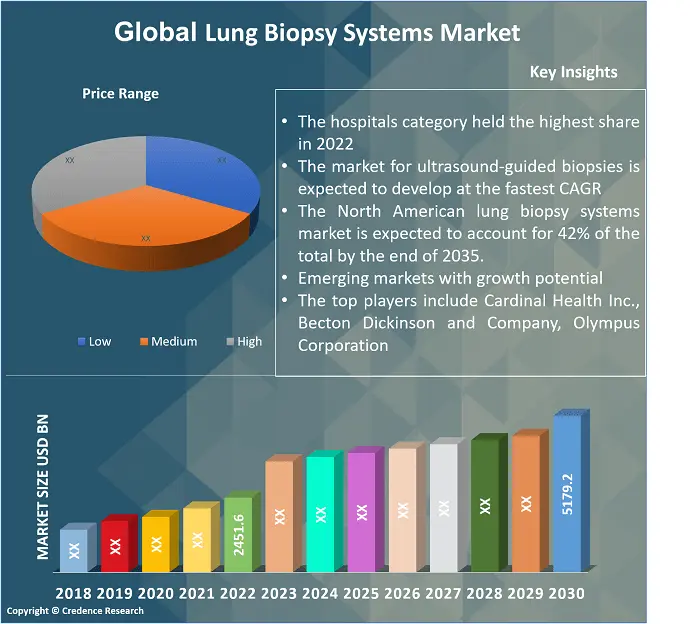
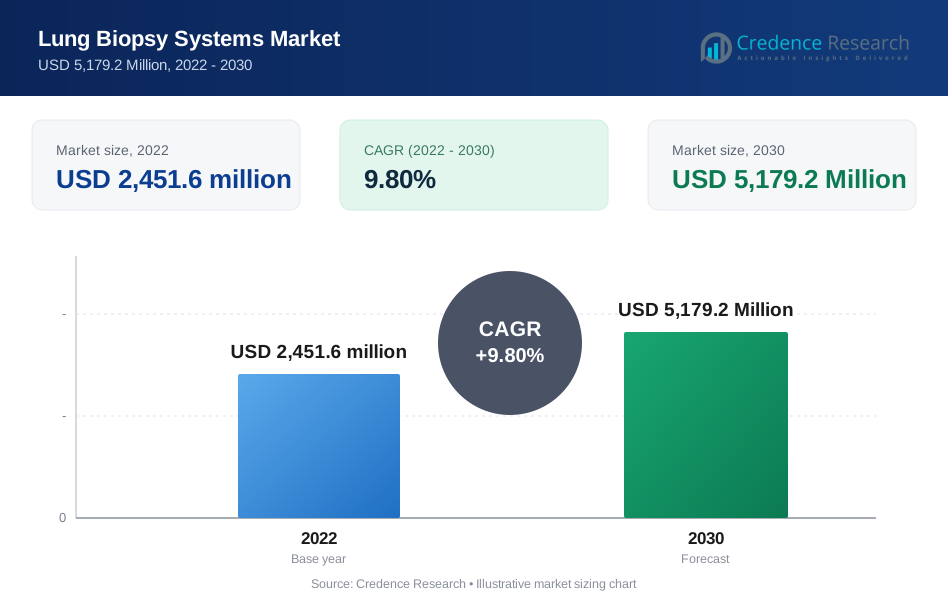
- The global demand for Lung Biopsy Systems was valued at USD 2451.6 million in 2022 and is expected to reach USD 5179.2 Million in 2030, growing at a CAGR of 9.80% between 2023 and 2030.
- The needle-based biopsy industry is likely to increase at the quickest rate over the forecast period.
- The market for ultrasound-guided biopsies is estimated to grow at the quickest CAGR throughout the forecast period, while the CT guided biopsy segment held the most share in 2022.
- In 2022, hospitals had the largest market share, while diagnostic laboratories also contributed significantly to the market.
- Lung cancer is the top cause of death in both sexes. Other lung disorders account for a sizable portion of the Lung Biopsy Systems Market.
- Percutaneous lung biopsy systems have a higher market demand, while transbronchial lung biopsy systems also contribute significantly to the sector.
- The fastest expanding industry in the Lung is biopsy needles. Another important market category is the Biopsy Systems Market and Guidance Systems Market.
- High-end lung biopsy systems have a bigger market demand than mid-range and economy lung biopsy systems, yet both are critical in the business.
- The North American lung biopsy systems market is estimated to account for 42% of the total by the end of 2035, while the Asia Pacific lung biopsy systems market is expected to be the second biggest throughout the forecast period.
Executive Summary
Market Definition
The Lung Biopsy Systems Market refers to the market for medical equipment and systems used in lung biopsies. Lung biopsy is a technique that takes a tiny sample of lung tissue for diagnostic reasons. There are several types of lung biopsy systems on the market, including needle-based devices, bronchoscopic biopsy systems, and surgical biopsy systems. These devices are used by healthcare practitioners to acquire tissue samples from the lungs in order to diagnose and treat various lung illnesses such as cancer, infections, and inflammatory diseases. The market for lung biopsy systems is being driven by factors such as the rising frequency of lung disorders, developments in biopsy methods, and the growing desire for minimally invasive procedures.
Market Overview
It is anticipated that between 2023 and 2030, the worldwide Lung Biopsy Systems Market will expand at a compound annual growth rate (CAGR) of 9.80%. From USD 2451.6 million in 2022, the market is projected to be worth USD 5179.2 million by 2030.
The Lung Biopsy Systems Market is concerned with the various instruments and systems used to perform lung biopsies. These techniques assist doctors in diagnosing and treating a variety of lung disorders such as cancer, infections, and inflammatory illnesses. Needle-based devices, bronchoscopic biopsy systems, and surgical biopsy systems are all available on the market. The increased frequency of lung disorders, as well as advances in biopsy procedures, are driving the expansion of this market. It is a critical field in the medical sector for accurate diagnosis and successful patient treatment.
Segmentation By Type of Lung Biopy Procedure
- During the projected period, the needle-based biopsy sector is expected to grow at the fastest rate. Needle biopsy is a method that involves extracting cells from an individual's body and evaluating them in clinical laboratories. Core-needle biopsy, fine-needle aspiration, and other techniques are commonly used for needle-biopsy.
- Surgical biopsy is commonly used by healthcare professionals for accurate and thorough tissue examination.
Segmentation By Guidance Method
- During the projected period, the market for ultrasound-guided biopsies is expected to develop at the fastest CAGR because of the increasing usage of this technology for cancer detection in diagnostic laboratories, as well as its numerous benefits and broad uses. These benefits include high throughput, high efficiency, precision, and low invasiveness, all of which are expected to fuel the market expansion of this category.
- The CT guided biopsy segment had the highest share in 2022 and is expected to increase the quickest during the forecast period 2023-2030.
Segmentation by End-User
- The hospitals category held the highest share in 2022 and is expected to expand the quickest over the projected period of 2023-2030. The hospitals market segment owned over 68% of the global market share for biopsy tools due to the widespread availability of cutting-edge medical equipment and reimbursement rules.
- The diagnostic laboratoires also makes a substantial contribution to the market.
Segmentation by Indication
- Lung cancer is still the leading cause of mortality in both sexes. It is projected that 439.2 new instances of cancer are diagnosed per 100,000 men and women each year.
- Other lung diseases comprise a significant section of the Lung Biopsy Systems Market.
Segmentation by End-Use Industry
- In the Lung Biopsy Systems Market, percutaneous lung biopsy systems have a larger market demand. Percutaneous biopsies are minimally invasive techniques in which lung tissue is accessed via the skin. This method has a number of advantages, including a faster recovery time, a lower risk of complications, and the capacity to target deep-seated lesions.
- Transbronchial lung biopsy systems also make a substantial contribution to the industry. Using a bronchoscope placed into the airways, samples of lung tissue are obtained.
Segmentation by Product Type
- Biopsy needles are the fastest growing sector in the Lung Biopsy Systems Market. These needles are essential for collecting tissue samples for correct diagnosis. Advances in needle technology, such as improved design, increased visibility, and improved tissue collecting capabilities, have all led to their growing popularity.
- Guidance systems are another key market sector. During the biopsy operation, these technologies give real-time imaging and exact localization of the target location.
Segmentation by Price Range
- High-End Lung Biopsy Systems have a larger market demand than Mid-Range and Economy Lung Biopsy Systems. These high-end devices have sophisticated features such as increased imaging capabilities, precision targeting, and improved tissue sample methodologies. They are frequently selected by healthcare professionals that value accuracy, efficiency, and the capacity to manage complex situations.
- Mid-Range Lung Biopsy Systems are very important in the industry. These systems strike a compromise between sophisticated features and price.
Segmentation by Region
- The North American lung biopsy systems market is expected to account for 42% of the total by the end of 2035.
- During the projection period, the Asia Pacific lung biopsy systems market is predicted to be the second largest.
- The rest of the world, including Latin America, the Middle East, and Africa, supplies the remaining demand for Lung Biopsy Systems .
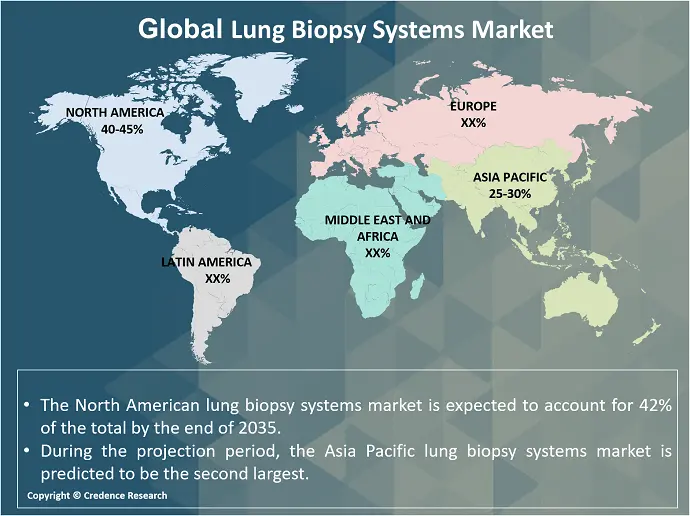
The North American lung biopsy systems market hold the largest market share, driven by increased research and clinical trials to explore a novel approach to lung cancer therapy. As a result, demand for lung biopsy equipment in the region is projected to grow to support these efforts. According to data, North America will see a 25% rise in clinical drug trial initiations globally in 2021.
However, the Asia Pacific lung biopsy systems market is expected to be the second biggest during the forecast period, driven by rising air pollution caused by the region's fast urbanization and industrialization. For example, medical authorities link a dramatic increase in occurrences of chest and throat disease, as well as several respiratory disorders, to India's deteriorating air pollution. As a result, the region's need for lung biopsy systems has increased. India, a rapidly developing country with a burgeoning population, suffers from severe air pollution, which is projected to kill more than 25,000 people in Delhi each year.
Key Highlights of the Report
The global Lung Biopsy Systems Market is segmented By Type of Lung Biopy Procedure, Guidance Method, End-User, Access Method, Product Type, Price Range and region. In 2022, the hospitals category had the biggest proportion. In addition, the market for ultrasound-guided biopsies is predicted to grow at the quickest CAGR, whereas percutaneous lung biopsy systems have a higher market demand. Also, the fastest expanding area in the Lung Biopsy Systems Market is biopsy needles, with North America leading the market growth.
The increased prevalence of lung illnesses, developments in biopsy technologies, and an increase in demand for less invasive procedures are driving the market. Also, the high cost of lung biopsy equipment, limited access to contemporary healthcare facilities in some countries, and tight regulatory requirements for product clearance are also key market constraints.
Nonetheless, North America has the greatest market share for lung biopsy systems, owing to increasing research and clinical trials to investigate a fresh approach to lung cancer therapy. During the projection period, however, the Asia Pacific lung biopsy systems market is predicted to be the second largest, owing to increased air pollution caused by the region's rapid urbanization and industrialisation.
What Elements Are Driving the Global Market for Lung Biopsy Systems ?
Several reasons drive the Lung Biopsy Systems Market. The rising frequency of lung disorders has increased the demand for diagnostic techniques such as lung biopsies. Furthermore, developments in biopsy methods have enhanced the accuracy and efficacy of these treatments, resulting in better patient outcomes. Furthermore, there is an increasing need for less invasive procedures, which provide advantages such as shorter recovery times and fewer difficulties.
What Are The Main Obstacles That The Global Lung Biopsy Systems Market Faces?
Despite the strong development possibilities, the Lung Biopsy Systems Market is not without its challenges. One of the most significant obstacles is the expensive cost of these devices, which might limit their accessibility, particularly in resource-constrained situations. In addition, in some areas, access to modern healthcare facilities may be limited, which may impede the use of lung biopsy equipment. Also, producers may face time and budget constraints due to onerous regulatory requirements for product clearance.
What Market Development Prospects Are There For Lung Biopsy Systems Globally?
The Lung Biopsy Systems Market offers several potential prospects. With their expanding healthcare infrastructure and increased emphasis on improving healthcare outcomes, emerging markets have enormous development potential. Furthermore, technical advancements in lung biopsy systems, such as enhanced imaging techniques and biopsy equipment, can increase the operations' accuracy and efficiency. Collaborations and partnerships among industry participants can also encourage R&D projects, resulting in the discovery of novel procedures and solutions for lung biopsies.
Market Drivers
The global Lung Biopsy Systems Market is driven by several factors. The following are the key drivers of the global Lung Biopsy Systems Market:
Rising Cancer Rates
A biopsy is a diagnostic technique that helps discover cancer and non-cancerous abnormalities in the human body. The rising prevalence of cancer in the population is expected to fuel the global expansion of the biopsy instrument market. For example, in Canada, cancer is the top cause of death among the population, while in the United States, it is the second-highest cause after heart disease. According to the American Cancer Society, there were 1.9 million new cancer diagnoses and 693,000 cancer deaths in 2018. Prostate cancers are the most prevalent malignancies diagnosed in men in North America, but breast cancers continue to be the most common in women. Additionally, lung cancer is still the leading cause of mortality in both sexes. It is projected that 439.2 new instances of cancer are diagnosed per 100,000 men and women each year.
According to the National Health Profile, the number of instances of common malignancies in India grew by 324% between 2017 and 2018, including cervical, oral, and breast cancer. Furthermore, the overall number of patients visiting Noncommunicable Diseases (NCD) clinics more than doubled between 2017 and 2018, reaching 35 million and 66 million, respectively. Rapid changes in lifestyle, as well as the intake of alcohol and tobacco products, are among the major factors contributing to an increase in cancer rates among the population.
Market Restraints
The global Lung Biopsy Systems Market faces some challenges that may hinder its growth. These include the following:
High Cost Of Lung Biopsy Systems
These devices are outfitted with cutting-edge technology and necessitate accuracy to deliver correct outcomes. Research & development, manufacture, and maintenance are all included in the cost. The intricacy of the technology, as well as the requirement for specialized training, add to the overall cost. However, it is vital to note that these systems are critical in recognizing and treating lung cancer, a severe health risk. Medical innovations and market competition may help bring down prices over time. Meanwhile, healthcare professionals and organizations are working hard to make these systems more accessible and cheap for patients.
Opportunities
The global Lung Biopsy Systems Market offers significant growth opportunities. These include the following:
Technological Innovations
These developments make the procedure more precise, efficient, and less intrusive for patients. The area is being transformed by new technology such as robotic-assisted biopsy equipment and image-guided procedures. They enable surgeons to precisely target lung lesions and retrieve tissue samples while causing minimum harm to healthy tissue in the surrounding area. This increases not just diagnostic accuracy but also patient pain and recovery time. Furthermore, advances in imaging technology and data processing are improving biopsy interpretation, resulting in more tailored treatment approaches.
Competitive Landscape
Key Players
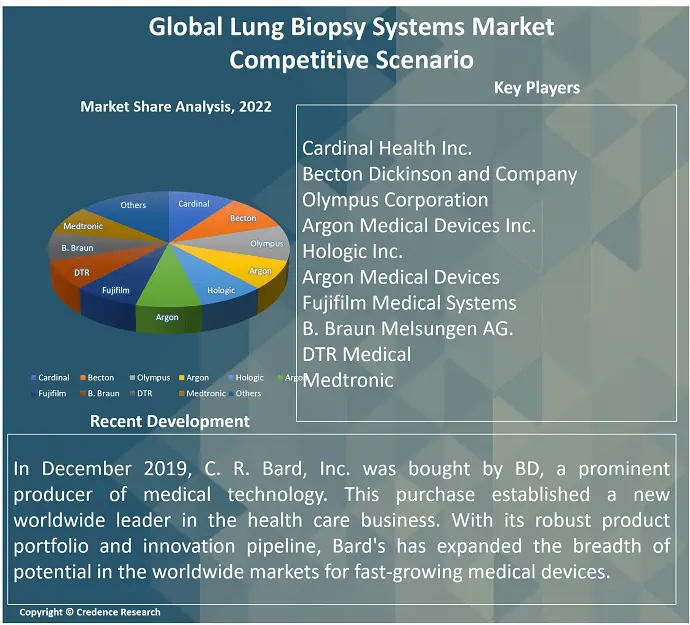
The global Lung Biopsy Systems Market is highly competitive, with several key players. Some of the major players in the market and their market share are as follows:
- Cardinal Health Inc.
- Becton Dickinson and Company
- Olympus Corporation
- Argon Medical Devices Inc.
- Hologic Inc.
- Argon Medical Devices
- Fujifilm Medical Systems
- B. Braun Melsungen AG.
- DTR Medical
- Medtronic
These organizations prioritize product innovation, Disease Area expansion, and mergers and acquisitions to stay competitive.
The global Lung Biopsy Systems Market's key players continually seek to stay ahead by offering new Speciess and developments.
In August 2018, Hologic introduced the Brevera Breast Biopsy System, which includes CorLumina Imaging Technology. The tool aids in breast biopsy and verification in real time. The solution improves workflow, increases patient satisfaction, and streamlines the overall biopsy procedure. The system is the first of its type, and it is designed to improve biopsy accuracy through real-time imaging.
In December 2019, the FDA approved Medtronic's Stealth Autoguide, a brain surgical guiding device. It is a robotic guiding system designed for the spatial placement and orientation of instrument holders and other equipment used in neurosurgery operations. The Stealth Autoguide Platform has been approved for use in biopsy procedures by the firm.
Summary of Key Findings
- The high cost of lung biopsy systems limits market expansion.
- Market segmented By Type of Lung Biopy Procedure, Guidance Method, End-User, Access Method, Product Type, Price Range and region
- High-End Lung Biopsy Systems have a larger market demand than Mid-Range and Economy Lung Biopsy Systems
- The fastest expanding industry in the Lung is biopsy needles.
- North America is leading market growth; the market is highly competitive with key players including Cardinal Health Inc., Becton Dickinson and Company, Olympus Corporation, Argon Medical Devices Inc., Hologic Inc.
Future Outlook
- There is an increasing need for minimally invasive techniques.
- Biopsy method advancements
- Rising incidence of lung disorders
- Technological developments in lung biopsy systems
- Growing use of precision medicine
- Expansion of healthcare infrastructure
- Raising awareness and early diagnosis of lung ailments
- Emerging markets with growth potential
- Industry collaborations and alliances
- Focus on improving patient outcomes and lowering healthcare costs
Segmentation
By Type of Lung Biopsy Procedure:
- Needle Biopsy
- Surgical Biopsy
By Guidance Method:
- CT-Guided Lung Biopsy
- Ultrasound-Guided Lung Biopsy
- Fluoroscopy-Guided Lung Biopsy
- Bronchoscopy
By End-User:
- Hospitals
- Diagnostic Laboratories
- Ambulatory Surgical Centers
By Indication:
- Lung Cancer
- Interstitial Lung Disease (ILD)
- Infection
- Other Lung Conditions
By Access Method:
- Percutaneous
- Transbronchial
- Open Surgical
By Product Type:
- Biopsy Needles
- Biopsy Guns
- Guidance Systems
- Accessories
By Product Type:
- High-End Lung Biopsy Systems
- Mid-Range Lung Biopsy Systems
- Economy Lung Biopsy Systems
- By Region
- North America
- US
- Canada
- Mexico
- Europe
- Germany
- France
- UK.
- Italy
- Spain
- Rest of Europe
- Asia Pacific
- China
- Japan
- India
- South Korea
- South-east Asia
- Rest of Asia Pacific
- Latin America
- Brazil
- Argentina
- Rest of Latin America
- Middle East & Africa
- GCC Countries
- South Africa
- Rest of Middle East and Africa
- North America
Adjacent Markets
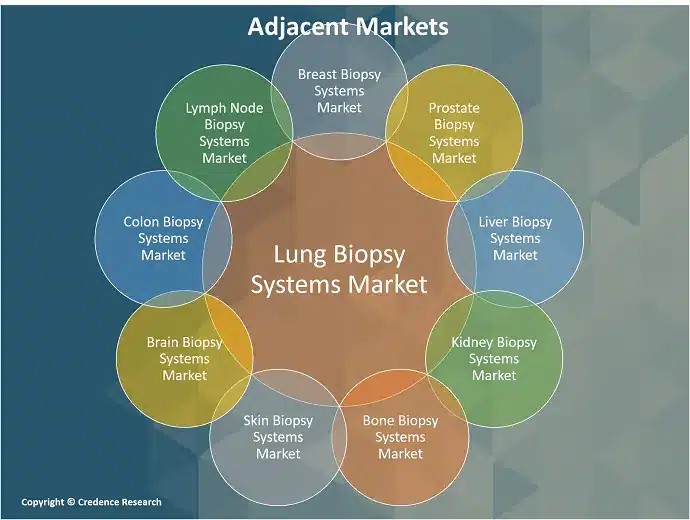
In the Lung Biopsy Systems Market, there are several adjacent markets which has high revenue growth opportunities. The key adjacent markets for Lung Biopsy Systems Market-
Request a Free Sample
Fill in your details and we'll send you a free sample report.
- Sample data tables & charts
- Research methodology
Need a Custom Version of This Report?
Tailor the scope, geography, or segments to your exact requirements.
- Custom geography or segment scope
- Direct access to our analyst team
Frequently Asked Questions
What is the current Species of the worldwide Lung Biopsy Systems Market?
What is the predicted growth rate of the Lung Biopsy Systems Market between 2023 and 2030?
Which segment has the most market share end-user?
Which access method equipment segment governs the market demand for Lung Biopsy Systems ?
Which Guidance Method segment is predicted to grow at the fastest growth segment over the forecast period?
Which region is driving the Lung Biopsy Systems industry forward?
Who are the major players in the global Lung Biopsy Systems Market?
What are the major market drivers of the Lung Biopsy Systems industry?
What are the major market restraints of the Lung Biopsy Systems industry?
What are the major market opportunities of the Lung Biopsy Systems industry?
Table of Content
Chapter 1. Report Introduction
- 1.1 Report Description & Purpose
- 1.1.1 Report Title & Market Definition
- 1.1.2 Unique Selling Propositions (USP) & Key Differentiators
- 1.1.3 Value Proposition for Stakeholders
- 1.2 Research Objectives
- 1.2.1 Market Sizing Objectives (Volume & Revenue) (Volume Where Applicable)
- 1.2.2 Segmentation Objectives
- 1.2.3 Competitive Intelligence Objectives
- 1.2.4 Forecast & Scenario Objectives
- 1.3 Report Scope
- 1.3.1 Lung Biopsy Systems Scope – Segments & Subsegments Covered
- 1.3.2 Geographic Scope – Regions & Countries Covered
- 1.3.3 Historical Period, Base Year & Forecast Period (2022; forecast to 2030)
- 1.3.4 Inclusions & Exclusions
- 1.4 Industry Classification & Applicable Codes
- 1.5 Currency, Measurement Units & Valuation Basis
- 1.6 Target Stakeholders
- 1.7 Limitations & Assumptions
Chapter 2. Executive Summary
- 2.1 Global Lung Biopsy Systems Market Snapshot
- 2.1.1 Market Size – Historical (2022) & Forecast (2022-2030) (2022: USD 2,451.6 million → 2030: USD 5,179.2 Million)
- 2.1.2 Volume & Revenue – Global Totals (Volume Where Applicable)
- 2.1.3 Key Market Highlights – Top Five Facts
- 2.2 Lung Biopsy Systems Market Segmentation Snapshot
- 2.2.1 Market Split by Region – 2022 vs. 2030
- 2.3 Competitive Snapshot
- 2.3.1 Top 10 Players by Revenue Share – 2022
- 2.3.2 Top 10 Players by Volume Share – 2022 (Volume Where Applicable)
- 2.3.3 Recent Strategic Developments (18-Month Summary)
- 2.4 Key Investment Highlights & Strategic Conclusions
Chapter 3. Lung Biopsy Systems Market Dynamics & Industry Analysis
- 3.1 Market Overview & Context
- 3.1.1 Lung Biopsy Systems Market Position in the Broader Industry Value Chain
- 3.1.2 Demand Structure & Purchasing Dynamics
- 3.1.3 Market Maturity & Development Stage by Region
- 3.2 Lung Biopsy Systems Market Drivers
- 3.3 Lung Biopsy Systems Market Restraints & Challenges
- 3.4 Lung Biopsy Systems Market Opportunities
- 3.5 Porter's Five Forces Analysis
- 3.5.1 Threat of New Entrants
- 3.5.2 Bargaining Power of Suppliers
- 3.5.3 Bargaining Power of Buyers
- 3.5.4 Threat of Substitutes
- 3.5.5 Competitive Rivalry – Intensity Assessment
- 3.6 Lung Biopsy Systems Value Chain Analysis
- 3.6.1 Upstream – Key Inputs, Resources & Suppliers
- 3.6.1.1 Key Input/Resource 1
- 3.6.1.2 Key Input/Resource 2
- 3.6.1.3 Key Input/Resource 3
- 3.6.2 Midstream – Core Operations & Value Creation
- 3.6.2.1 Operating Model & Process Overview
- 3.6.2.2 Key Operating Locations & Capabilities by Company
- 3.6.3 Downstream – Market Channels & End Users
- 3.6.3.1 Direct Sales & Customer Engagement Channels
- 3.6.3.2 Indirect Sales, Intermediaries & Partner Channels
- 3.6.4 Value Chain Profitability Analysis
- 3.6.1 Upstream – Key Inputs, Resources & Suppliers
- 3.7 PESTEL Analysis
- 3.7.1 Political Factors
- 3.7.2 Economic Factors
- 3.7.3 Social Factors
- 3.7.4 Technological Factors
- 3.7.5 Environmental Factors
- 3.7.6 Legal Factors
- 3.8 Lung Biopsy Systems Supply Chain Analysis
- 3.8.1 Critical Input & Resource Availability Risk Assessment
- 3.8.2 Supplier & Operational Concentration Risk (Geographic Exposure)
- 3.8.3 Supply & Service Disruption Impact Analysis
- 3.9 Regulatory & Policy Landscape
Note: The regulatory and policy landscape section covers regulations based on their applicability to the market, Lung Biopsy Systems category, geography, and scope of the study. Only regulatory frameworks with a material impact on operations, compliance, trade, sustainability, or market access are analyzed in detail.
Chapter 4. Key Investment Pockets & Opportunity Analysis
- 4.1 Lung Biopsy Systems Market Attractiveness Analysis
- 4.1.1 By Region – Investment Attractiveness Matrix (Market Size × CAGR)
- 4.2 Absolute Revenue Growth Opportunity
- 4.2.1 By Region – Absolute Revenue Growth Through 2030
- 4.3 Incremental Demand Opportunity
- 4.3.1 By Region – Incremental Demand Through 2030
- 4.3.2 Segment – Incremental Demand
- 4.4 Emerging Submarket Opportunity Deep Dive (Subject to Applicability)
- 4.5 Priority Market Opportunity Scorecards
- 4.5.1 United States
- 4.5.2 Europe
- 4.5.3 Asia
- 4.5.4 Middle East & Africa
Note: Priority market opportunity scorecards reflect the geographic scope and strategic relevance of the study. Listed markets are indicative and may be adapted to the industry.
Chapter 5. Lung Biopsy Systems Cross-Border Trade & Market Access Analysis
- 5.1 International Trade & Cross-Border Activity Overview
- 5.1.1 Global Export Value by Country (2022)
- 5.1.2 Global Export Volume by Country (2022) (Volume Where Applicable)
- 5.1.3 Global Import Value by Country (2022)
- 5.1.4 Global Import Volume by Country (2022) (Volume Where Applicable)
- 5.1.5 Net Trade Balance by Country (2022)
- 5.2 Export Analysis – Segment
- 5.2.1 Category 1 (Applicable Classification Code)
- 5.2.2 Category 2 (Applicable Classification Code)
- 5.2.3 Category 3 (Applicable Classification Code)
- 5.2.4 Category 4 (Applicable Classification Code)
- 5.2.5 Category 5 (Applicable Classification Code)
- 5.3 Import Analysis – Segment
- 5.3.1 Category 1 (Applicable Classification Code)
- 5.3.2 Category 2 (Applicable Classification Code)
- 5.3.3 Category 3 (Applicable Classification Code)
- 5.3.4 Category 4 (Applicable Classification Code)
- 5.3.5 Category 5 (Applicable Classification Code)
- 5.4 Cross-Border Pricing & Transaction Benchmarks
- 5.4.1 Export Pricing – Segment & Country
- 5.4.2 Import Pricing – Segment & Source Country
- 5.4.3 Price Trends (2022)
- 5.5 Key Cross-Border Trade & Delivery Routes
- 5.5.1 Cross-Border Trade/Delivery Route 1
- 5.5.2 Cross-Border Trade/Delivery Route 2
- 5.5.3 Cross-Border Trade/Delivery Route 3
- 5.5.4 Cross-Border Trade/Delivery Route 4
- 5.5.5 Cross-Border Trade/Delivery Route 5
- 5.6 Trade Policy & Market Access Impact Assessment
- 5.6.1 Tariff & Non-Tariff Barriers
- 5.6.2 Regional Trade & Economic Integration Frameworks
- 5.6.3 Bilateral & Multilateral Trade Agreements
- 5.6.4 Cross-Border Operating, Licensing & Localization Requirements
Note: This chapter applies where cross-border trade or delivery is relevant to Lung Biopsy Systems. Goods, services, and digital offerings are assessed using applicable classifications and transaction measures. Import-export volumes, trade balances, and route analyses are included only where meaningful to the market.
Chapter 6. Competitive Landscape & Company Benchmarking
- 6.1 Lung Biopsy Systems Market Concentration & Structure
- 6.1.1 Herfindahl-Hirschman Index (HHI) – the historical period vs. 2022
- 6.1.2 Leading, Mid-Sized & Emerging Player Structure
- 6.1.3 Global, Regional & Local Player Dynamics
- 6.2 Lung Biopsy Systems Market Share Analysis – 2022
- 6.2.1 Global Revenue Share by Company
- 6.2.2 Global Volume Share by Company (Volume Where Applicable)
- 6.2.3 Regional Revenue Share
- 6.2.4 Market Share Evolution (the historical period vs. 2022)
- 6.2.5 Company Market Share by Key Segment
- 6.2.6 Company Market Share by Customer Group
- 6.3 Operating Scale, Capacity & Infrastructure Analysis
- 6.3.1 Global Operating Scale & Supply Capacity
- 6.3.2 Resource Utilization & Operating Efficiency
- 6.3.3 Output, Service Delivery & Activity Metrics
- 6.3.4 Operating Footprint & Infrastructure Map
- 6.3.5 Planned Operational & Capacity Expansion
- 6.4 Lung Biopsy Systems Competitive Benchmarking Matrix
- 6.4.1 Revenue, Growth, Profitability & Operating Metric Comparison
- 6.4.2 Channel Revenue Mix
- 6.4.3 Geographic Revenue Exposure
- 6.4.4 R&D Intensity
- 6.4.5 Sustainability Maturity
- 6.5 Strategic Developments in Lung Biopsy Systems (Last 24 Months)
- 6.5.1 Mergers, Acquisitions & Divestments
- 6.5.2 New Products, Services & Solutions in Lung Biopsy Systems
- 6.5.3 Operational & Infrastructure Expansions
- 6.5.4 Strategic Alliances, Joint Ventures & Partnerships
- 6.5.5 Distribution Expansion & Market Entry
- 6.5.6 Sustainability & ESG Initiatives
- 6.6 Competitive Strategy Mapping
- 6.6.1 Leader, Challenger, Follower & Niche Classification
- 6.6.2 Pricing Strategy Comparison
- 6.6.3 Channel Strategy Matrix
Note: Strategic developments are included based on their materiality and the availability of reliable information.
Chapter 7. Global Lung Biopsy Systems Market – By Sales & Delivery Channel
- 7.1 Segment Overview
- 7.1.1 Volume & Revenue Split by Channel (2022 & 2030) (Volume Where Applicable)
- 7.1.2 Channel Mix Evolution (2022-2030)
Chapter 8. Regional Market Analysis – Global Overview
- 8.1 Global Regional Overview
- 8.1.1 Regional Volume Share (Volume Where Applicable)
- 8.1.2 Regional Revenue Share
- 8.1.3 Regional Volume by Region (Volume Where Applicable)
- 8.1.4 Regional Revenue by Region
- 8.1.5 Regional Forecast Through 2030
- 8.2 Cross-Regional Segment Analysis
- 8.2.1 By Sales & Delivery Channel
- 8.2.2 By Competitive Positioning & Price Tier
Chapter 9. North America Lung Biopsy Systems Market
- 9.1 United States
- 9.2 Canada
- 9.3 Mexico
Chapter 10. Europe Lung Biopsy Systems Market
- 10.1 Germany
- 10.2 France
- 10.3 Italy
- 10.4 United Kingdom
- 10.5 Spain
- 10.6 Poland
- 10.7 Russia
- 10.8 Netherlands
- 10.9 Belgium
- 10.10 Sweden
- 10.11 Denmark
- 10.12 Norway
- 10.13 Rest of Europe
Chapter 11. Asia Pacific Lung Biopsy Systems Market
- 11.1 China
- 11.2 India
- 11.3 Japan
- 11.4 South Korea
- 11.5 Thailand
- 11.6 Indonesia
- 11.7 Vietnam
- 11.8 Malaysia
- 11.9 Australia
- 11.10 Rest of Asia Pacific
Chapter 12. Latin America Lung Biopsy Systems Market
- 12.1 Brazil
- 12.2 Argentina
- 12.3 Colombia
- 12.4 Chile
- 12.5 Rest of Latin America
Chapter 13. Middle East Lung Biopsy Systems Market
- 13.1 Saudi Arabia
- 13.2 United Arab Emirates
- 13.3 Turkey
- 13.4 Israel
- 13.5 Iran
- 13.6 Rest of the Middle East
Chapter 14. Africa Lung Biopsy Systems Market
- 14.1 South Africa
- 14.2 Egypt
- 14.3 Nigeria
- 14.4 Morocco
- 14.5 Rest of Africa
Chapter 15. Lung Biopsy Systems Company Profiles
- 15.1 [Company 01]
- 15.1.1 Company Overview
- 15.1.2 Key Management Personnel
- 15.1.3 Products & Services Portfolio
- 15.1.4 Financial Performance
- 15.1.5 Key Market Focus & Geographic Presence
- 15.1.6 Recent Developments & Strategic Initiatives
Note: The company profile list is preliminary and may change based on research findings, market developments, data availability, and client requirements.
Chapter 16. Appendices
- Appendix A – List of Abbreviations & Acronyms
- Appendix B – Industry Classification Code Reference – Full Series
- Appendix C – Supply, Output & Operating Capacity Data Tables
- Appendix D – End-Use & Demand Base Tables
- Appendix E – Demand, Adoption & Usage Assumptions
- Appendix F – Pricing & Revenue Metric Reference Tables
- Appendix G – Company Operations & Infrastructure Database
- Appendix H – Cross-Border Trade & Activity Data Tables (Where Applicable)
- Appendix I – Regulatory Summary Tables
- Appendix J – Primary Research Participant List (Anonymized)
- Appendix K – Primary Research Questionnaire Framework
- Appendix L – Data Sources & Bibliography
- Appendix M – Market Size Divergence & Source Comparison
Chapter 17. Research Methodology
- 17.1 Research Framework & Philosophy
- 17.2 Secondary Research – Sources, Hierarchy & Data Extraction
- 17.3 Data Modeling – Bottom-Up & Top-Down Market Sizing
- 17.4 Primary Research – Stakeholder Framework, LOI & Sample Sizes
- 17.5 Forecast Methodology – Regression, Scenario & Sensitivity Analysis
- 17.6 Quality Control – Four-Layer Validation Framework
- 17.7 Limitations & Standard Assumptions
- 17.8 Disclaimer
