Market Overview
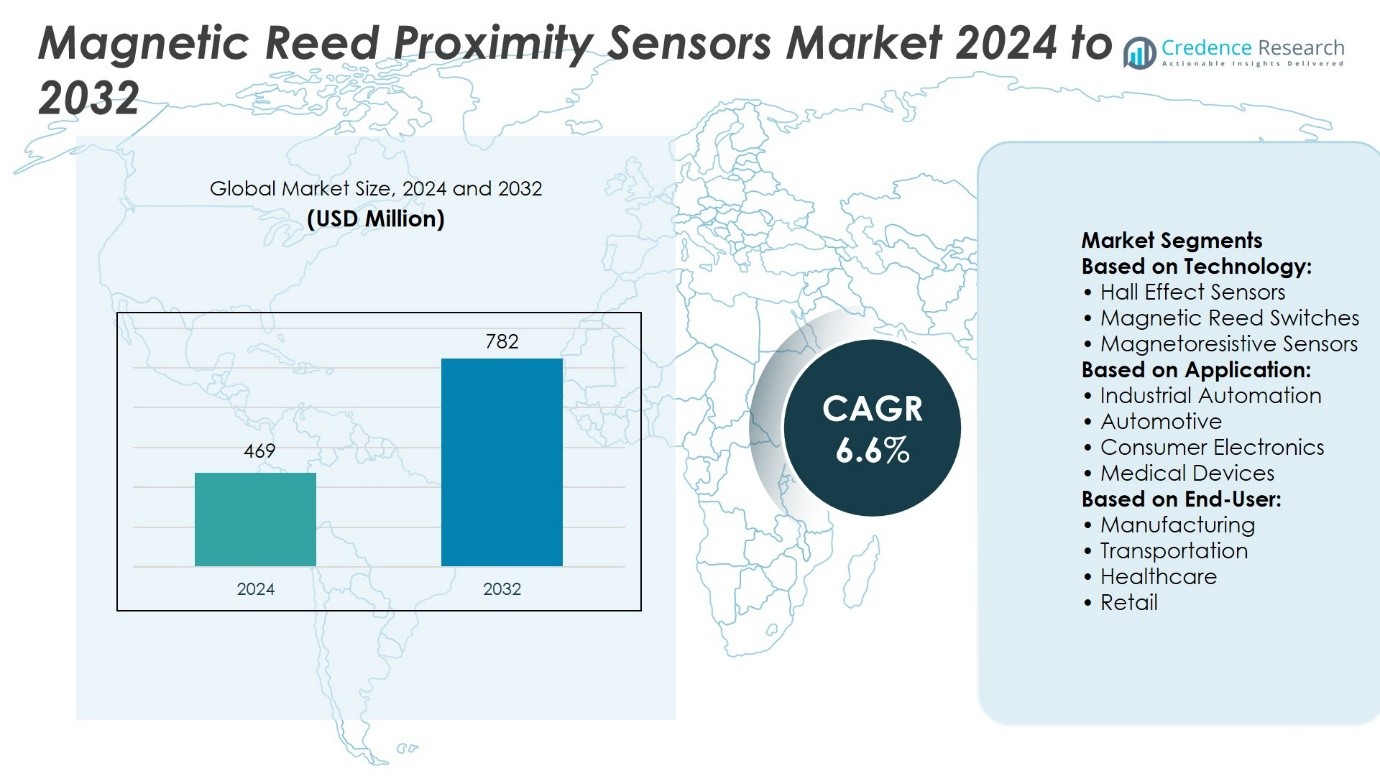
Magnetic Reed Proximity Sensors Market size was valued at USD 469 million in 2024 and is anticipated to reach USD 782 million by 2032, at a CAGR of 6.6% during the forecast period.
| REPORT ATTRIBUTE |
DETAILS |
| Historical Period |
2020-2024 |
| Base Year |
2024 |
| Forecast Period |
2025-2032 |
| Magnetic Reed Proximity Sensors Market Size 2024 |
USD 469 Million |
| Magnetic Reed Proximity Sensors Market, CAGR |
6.6% |
| Magnetic Reed Proximity Sensors Market Size 2032 |
USD 782 Million |
The Magnetic Reed Proximity Sensors Market grows through strong drivers such as rising demand in automotive systems, industrial automation, and medical devices where reliability and precision remain critical. It benefits from increasing use in consumer electronics and smart home applications that require compact, low-power, and durable sensing solutions. The market reflects trends including miniaturization, integration with IoT platforms, and the development of rugged designs suited for harsh environments. It also aligns with the shift toward energy-efficient technologies and smart connectivity, positioning reed proximity sensors as essential components across diverse industries with expanding global adoption.
The Magnetic Reed Proximity Sensors Market demonstrates strong geographical presence across North America, Europe, Asia-Pacific, Latin America, and the Middle East & Africa, with Asia-Pacific holding the largest share due to its strong electronics and automotive manufacturing base. North America and Europe maintain steady growth through industrial automation and healthcare applications, while Latin America and MEA show emerging potential. Key players driving competition and innovation include Infineon Technologies, Honeywell, STMicroelectronics, Siemens, Omron, NXP Semiconductors, Panasonic, Schneider Electric, Sick AG, and Bourns.
Access crucial information at unmatched prices!
Request your sample report today & start making informed decisions powered by Credence Research Inc.!
Download Sample
Market Insights
- Magnetic Reed Proximity Sensors Market size was valued at USD 469 million in 2024 and is projected to reach USD 782 million by 2032, growing at a CAGR of 6.6%.
- Rising demand in automotive systems, industrial automation, and medical devices drives consistent market expansion.
- Miniaturization, IoT integration, and rugged sensor designs define the key trends shaping future product development.
- Strong competition exists among multinational corporations and specialized firms focusing on innovation and application-specific solutions.
- Limitations in durability and switching frequency compared with solid-state alternatives act as market restraints.
- Asia-Pacific holds the largest share due to its strong electronics and automotive manufacturing base, while North America and Europe show steady growth.
- Key players such as Infineon Technologies, Honeywell, STMicroelectronics, Siemens, Omron, NXP Semiconductors, Panasonic, Schneider Electric, Sick AG, and Bourns continue to drive technological advancement and market competitiveness.
Market Drivers
Rising Demand from Automotive and Transportation Applications
The Magnetic Reed Proximity Sensors Market gains momentum from increasing use in automotive and transportation systems. Automakers integrate these sensors for functions such as gear position detection, brake monitoring, and door locking mechanisms. The technology ensures durability under extreme temperature and vibration conditions, making it suitable for harsh environments. It supports vehicle safety systems through precise signal switching and reliable performance. Growing adoption of electric and hybrid vehicles further expands opportunities, as sensor requirements rise for battery management and charging systems. Companies strengthen supply capabilities to meet global automotive production demand.
- For instance, Continental AG deploys its magnetic Reed proximity sensors in over 22 million vehicles annually for gear position and door-lock detection systems—demonstrating both the scale and operational integration of the technology in modern automotive manufacturing.
Expanding Utilization in Consumer Electronics and Smart Devices
The market benefits from the growing role of reed proximity sensors in smartphones, tablets, and wearable devices. Manufacturers integrate them into portable electronics for functions including flip detection, accessory sensing, and low-power standby features. It helps enhance product life cycles by enabling efficient energy management and compact system design. Rising popularity of smart home devices also supports sensor demand across appliances and security systems. Developers focus on miniaturization and high sensitivity to support evolving consumer electronics. Strong alignment with IoT-enabled ecosystems reinforces their adoption in next-generation devices.
- For instance, NXP Semiconductors’ NMH1000 ultra‑low power magnetic switch sensor, used in smart accessories and wearable devices, operates with a current consumption of only 75 nA at a 1 Hz sampling rate and is available in an extremely compact DFN package measuring just 1.4 × 1.4 × 0.85 mm.
Increasing Adoption in Industrial Automation and Robotics
Industrial automation continues to fuel demand for magnetic reed proximity sensors across assembly lines and robotics. It provides reliable position and limit detection for machinery operating in fast-paced environments. Manufacturers rely on the sensors for high repeatability and consistent output in monitoring moving parts. Expanding use in packaging, logistics, and process industries highlights their versatility. Robotics developers prefer reed sensors due to their immunity to dust and moisture, supporting uninterrupted industrial workflows. Continuous investment in smart factory infrastructure drives further integration of these sensors.
Strong Emphasis on Medical Devices and Healthcare Equipment
Healthcare applications create strong opportunities for magnetic reed proximity sensors. Medical device manufacturers deploy them in infusion pumps, respiratory devices, and diagnostic equipment. It ensures patient safety by enabling precise measurement and operational accuracy in life-support systems. Demand increases in hospital and homecare settings, where compact and highly reliable sensors are critical. The market expands further with the rising use of portable and wearable medical technologies. Manufacturers improve sensor design to comply with stringent healthcare quality standards while meeting growing global demand.
Market Trends
Growing Shift Toward Miniaturization and Compact Designs
The Magnetic Reed Proximity Sensors Market reflects a growing trend toward smaller, lighter, and more compact sensors. Manufacturers prioritize miniaturization to meet the requirements of modern consumer electronics and portable medical devices. It supports design flexibility and enables integration into slim and lightweight products. Demand rises for compact solutions in smartwatches, tablets, and handheld equipment. Companies invest in advanced production techniques to achieve higher sensitivity in smaller packages. This trend strengthens the adoption of reed proximity sensors in space-constrained applications.
- For instance, according to a 2025 industry analysis, the global automotive sector alone consumes approximately 150 million reed proximity sensor units annually—a figure that reflects large-scale adoption of compact sensor designs by manufacturers such as TE Connectivity, STG, and Hamlin (now part of Littelfuse).
Rising Focus on Integration with IoT and Smart Connectivity
The market demonstrates a clear movement toward integration with IoT platforms and connected systems. Sensor designs increasingly support wireless communication and remote monitoring capabilities. It enhances the ability to transmit data in real time across consumer, industrial, and healthcare applications. Smart homes, smart factories, and connected vehicles benefit from seamless interaction with reed sensors. Manufacturers highlight compatibility with IoT protocols to increase customer adoption. This alignment with digital ecosystems ensures long-term growth potential.
- For instance, Honeywell reported that more than 100 million of its wireless IoT-enabled sensors are deployed globally across smart buildings and industrial facilities, with each unit capable of transmitting data at rates up to 250 kbps using low-power wireless protocols such as Zigbee and Bluetooth Low Energy.
Increasing Emphasis on Energy Efficiency and Low Power Consumption
Energy efficiency emerges as a critical trend in the magnetic reed proximity sensor space. Developers focus on low-power models that extend device battery life in consumer and medical electronics. It ensures continuous operation without frequent maintenance or replacement. Industrial customers value low energy requirements that reduce operational costs while maintaining performance. Advances in circuit design support reduced current draw while preserving durability. This direction aligns strongly with sustainability goals across multiple industries.
Expanding Role in Harsh and Specialized Environments
The market shows expanding applications in environments exposed to moisture, dust, and extreme temperatures. Reed sensors remain popular due to their sealed design and resistance to contaminants. It drives adoption in automotive, aerospace, and heavy industrial machinery where robust performance is essential. Growing investment in renewable energy projects creates additional use cases in wind turbines and solar tracking systems. Manufacturers develop ruggedized versions to withstand long-term exposure to challenging conditions. This expansion strengthens the market’s relevance in specialized sectors.
Market Challenges Analysis
High Competition from Alternative Sensing Technologies
The Magnetic Reed Proximity Sensors Market faces strong competition from advanced technologies such as Hall-effect and optical sensors. Many manufacturers prefer alternatives that offer faster response times, longer operational life, and higher precision. It creates pressure on reed sensor providers to differentiate through cost efficiency and application-specific advantages. Substitution risk remains significant in automotive and industrial sectors where performance standards continue to rise. Customers seek sensors with extended durability and low maintenance requirements, which sometimes favor competing technologies. This challenge compels reed sensor developers to enhance product reliability while maintaining affordability.
Limitations in Durability and Switching Capabilities
Durability challenges continue to limit the adoption of magnetic reed proximity sensors in high-demand applications. Mechanical wear on reed contacts reduces their operational lifespan when compared with solid-state options. It restricts use in environments that require high switching frequencies or exposure to continuous vibrations. The need for frequent replacements can increase operational costs for end users, reducing market appeal. Manufacturers must invest in improved sealing, better material composition, and innovative designs to overcome these weaknesses. Addressing these limitations is critical for maintaining relevance in demanding industrial and automotive settings.
Market Opportunities
Expanding Applications in Renewable Energy and Smart Infrastructure
The Magnetic Reed Proximity Sensors Market holds strong opportunities in renewable energy projects and smart infrastructure development. Wind turbines, solar tracking systems, and energy storage solutions require durable sensors that operate reliably in harsh outdoor conditions. It supports critical functions such as position detection, safety monitoring, and operational efficiency. Growing investment in smart grids also creates demand for sensors capable of precise switching and long-term stability. Governments encourage infrastructure modernization, which further expands applications for reed sensors. This opportunity enables manufacturers to align with sustainability-driven growth sectors.
Rising Demand from Healthcare and Portable Medical Devices
Healthcare applications create long-term opportunities for reed proximity sensors. Infusion pumps, diagnostic systems, and respiratory equipment rely on accurate sensing for patient safety and performance reliability. It enhances the value of reed sensors due to their compact size, low power needs, and sealed design. The rising popularity of portable and wearable medical technologies further expands their role in healthcare markets. Strong demand for cost-effective and reliable sensing solutions in hospitals and homecare settings supports broader adoption. This opportunity allows suppliers to strengthen their presence in high-value medical device manufacturing.
Market Segmentation Analysis:
By Technology
The Magnetic Reed Proximity Sensors Market divides into Hall effect sensors, magnetic reed switches, and magnetoresistive sensors. Magnetic reed switches remain widely used due to their cost-effectiveness, simple design, and strong performance in low-power applications. Hall effect sensors gain traction for applications requiring faster response times and higher durability, especially in automotive and industrial environments. Magnetoresistive sensors demonstrate rising demand because of their sensitivity and ability to detect weak magnetic fields, making them suitable for advanced electronics. It reflects a competitive balance among technologies where reed switches maintain dominance in traditional uses, while Hall effect and magnetoresistive solutions expand their roles in innovation-driven sectors.
- For instance,Littelfuse produces more than 100 million reed switch units annually, enabling reliable low-power detection functions in consumer electronics and portable medical devices.
By Application
Industrial automation represents a major application area for magnetic reed proximity sensors. It relies on precise position detection and reliable switching functions across assembly lines and robotics. Automotive applications continue to grow, supported by the need for safety systems, door and brake monitoring, and electric vehicle charging components. Consumer electronics create opportunities through integration in smartphones, wearables, and smart home devices, where compact size and energy efficiency are critical. Medical devices also expand demand, with sensors playing roles in infusion pumps, diagnostic tools, and respiratory systems. It demonstrates the versatility of reed proximity sensors across diverse industries.
- For instance, NXP Semiconductors has shipped over 1.5 billion MEMS sensors into automotive applications—used in systems such as airbag triggers and position sensing—demonstrating the extensive integration of compact magnetic sensor technologies in vehicles.
By End User
Manufacturing remains a key end user, where sensors ensure equipment reliability and efficient production processes. The transportation sector relies on them for automotive systems and rail applications that demand precision and durability. Healthcare contributes significantly through adoption in portable medical devices and hospital-based equipment. Retail also incorporates reed proximity sensors in security systems, electronic locks, and automated point-of-sale solutions. It highlights the adaptability of these sensors across sectors with varying performance requirements. End users continue to value reed proximity sensors for their reliability, affordability, and ability to function in challenging conditions.
Segments:
Based on Technology:
- Hall Effect Sensors
- Magnetic Reed Switches
- Magnetoresistive Sensors
Based on Application:
- Industrial Automation
- Automotive
- Consumer Electronics
- Medical Devices
Based on End-User:
- Manufacturing
- Transportation
- Healthcare
- Retail
Based on the Geography:
- North America
- Europe
- UK
- France
- Germany
- Italy
- Spain
- Russia
- Belgium
- Netherlands
- Austria
- Sweden
- Poland
- Denmark
- Switzerland
- Rest of Europe
- Asia Pacific
- China
- Japan
- South Korea
- India
- Australia
- Thailand
- Indonesia
- Vietnam
- Malaysia
- Philippines
- Taiwan
- Rest of Asia Pacific
- Latin America
- Brazil
- Argentina
- Peru
- Chile
- Colombia
- Rest of Latin America
- Middle East
- UAE
- KSA
- Israel
- Turkey
- Iran
- Rest of Middle East
- Africa
- Egypt
- Nigeria
- Algeria
- Morocco
- Rest of Africa
Regional Analysis
North America
North America holds a market share of around 28% in the Magnetic Reed Proximity Sensors Market. Strong demand arises from the automotive industry, where sensors support advanced driver assistance systems and electric vehicle infrastructure. It also benefits from widespread adoption in industrial automation, with manufacturers in the United States and Canada investing in smart factories and robotics. Consumer electronics add further momentum, particularly with the integration of reed sensors in portable and smart devices. Healthcare applications remain robust, as medical device manufacturers leverage reed sensors for infusion pumps, diagnostic tools, and monitoring systems. The established presence of leading players and continued investment in IoT integration reinforce North America’s steady contribution to global revenues.
Europe
Europe accounts for about 25% of the market share, supported by its advanced automotive and industrial sectors. Germany, France, and the United Kingdom serve as key markets due to strong manufacturing bases and technological innovation. It benefits from strict regulatory frameworks that emphasize safety, energy efficiency, and environmental standards, which create opportunities for reed sensors in automotive and renewable energy applications. Industrial automation and robotics adoption remain significant, particularly in Germany’s high-tech industries. Healthcare also contributes strongly, with European companies producing diagnostic and patient-monitoring equipment that rely on reed sensor integration. Continuous investments in sustainable technologies further support regional growth.
Asia-Pacific
Asia-Pacific represents the largest share at approximately 32%, driven by rapid industrialization and expansion of consumer electronics manufacturing. China, Japan, South Korea, and India act as primary markets, with a high concentration of global electronics production facilities. It benefits from extensive adoption in smartphones, tablets, and smart appliances, where compact and energy-efficient sensors are critical. The automotive sector, particularly in China and Japan, also creates demand for reed sensors in safety and powertrain systems. Healthcare markets expand as countries strengthen medical infrastructure and portable device adoption. Asia-Pacific’s cost-effective production capabilities and growing domestic demand ensure its position as the global leader in the market.
Latin America
Latin America holds a smaller but growing market share of around 8%. Demand arises from the automotive industry in Brazil and Mexico, where reed proximity sensors support both conventional and electric vehicle applications. It also benefits from expanding industrial automation, with regional manufacturing facilities adopting cost-effective sensor solutions. Consumer electronics adoption grows in urban areas, particularly with the rising popularity of smartphones and connected devices. Healthcare applications remain limited but show potential as local medical device production increases. Regional growth remains tied to investment in infrastructure and technology transfer from multinational companies.
Middle East & Africa
The Middle East & Africa capture approximately 7% of the market share. Demand arises from oil and gas industries that require durable sensing solutions in harsh environments. It also benefits from infrastructure development, where smart building projects and security systems adopt reed proximity sensors. Automotive markets in South Africa and the Gulf states provide further opportunities, particularly for safety and electronic locking applications. Healthcare adoption is expanding slowly, with reed sensors used in essential medical equipment. The region shows potential for growth through investments in renewable energy projects and industrial modernization.
Shape Your Report to Specific Countries or Regions & Enjoy 30% Off!
Key Player Analysis
Competitive Analysis
The Magnetic Reed Proximity Sensors Market features include Infineon Technologies, Sick AG, Honeywell, Panasonic, STMicroelectronics, Siemens, Omron, Bourns, NXP Semiconductors, and Schneider Electric. The Magnetic Reed Proximity Sensors Market demonstrates intense competition driven by innovation, product reliability, and application diversity. Companies focus on developing compact, energy-efficient, and durable sensors that meet the demands of automotive, industrial automation, consumer electronics, and healthcare sectors. Market participants strengthen their portfolios by integrating smart connectivity and IoT compatibility, ensuring seamless adoption in modern digital ecosystems. Continuous investment in research and development enhances sensor sensitivity, durability, and performance under harsh conditions. Competition also extends to regional expansion, with firms targeting high-growth markets in Asia-Pacific and North America while reinforcing their presence in Europe. Partnerships with OEMs and system integrators support long-term growth, while customization of solutions for specific industries builds stronger customer relationships. The market remains highly dynamic, with success determined by technological leadership, adaptability, and global reach.
Recent Developments
- In August 2025, Advanced digital communication interfaces such as CAN bus and IO-Link are being integrated into new sensor models to enhance industrial connectivity, with an increasing focus on predictive maintenance applications using sensor data analytics.
- In September 2023, ROHM developed a compact 2.0mm × 1.0mm proximity sensor, the RPR-0720, optimized for applications requiring attachment/detachment and proximity detection.
- In August 2023, Littelfuse unveiled the world’s smallest reed switch sensors. The newly introduced Littelfuse 59155 and 59156 are touted as the smallest reed switches available on the market. Measuring just 12.7 x 9 x 3 mm, these compact switches enable designers and engineers to integrate sensors into previously challenging spaces or reduce the overall footprint of their designs.
- In April 2023, Semtech will add to PerSe proximity sensors. Semtech has expanded its PerSe product portfolio with the release of a sensing human proximity sensor for smartphones.
Market Concentration & Characteristics
The Magnetic Reed Proximity Sensors Market shows a moderately consolidated structure with a mix of global corporations and specialized regional manufacturers. It reflects strong competition where leading players hold significant shares through diversified portfolios, while smaller firms compete by offering niche and customized solutions. The market emphasizes durability, compact design, and low-power performance, which align with the needs of automotive, industrial, consumer electronics, and healthcare applications. It demonstrates steady adoption in environments requiring reliable operation under dust, moisture, and temperature extremes. Growth opportunities remain linked to smart connectivity, IoT integration, and energy-efficient designs that improve device longevity. It also reflects consistent demand in both mature and emerging economies, supported by the expansion of automation, renewable energy, and portable medical devices. The overall market structure highlights innovation, cost competitiveness, and regional adaptability as defining characteristics.
Report Coverage
The research report offers an in-depth analysis based on Technology, Application, End-User and Geography. It details leading market players, providing an overview of their business, product offerings, investments, revenue streams, and key applications. Additionally, the report includes insights into the competitive environment, SWOT analysis, current market trends, as well as the primary drivers and constraints. Furthermore, it discusses various factors that have driven market expansion in recent years. The report also explores market dynamics, regulatory scenarios, and technological advancements that are shaping the industry. It assesses the impact of external factors and global economic changes on market growth. Lastly, it provides strategic recommendations for new entrants and established companies to navigate the complexities of the market.
Future Outlook
- The market will expand with rising adoption in automotive safety and electric vehicle systems.
- It will gain traction in industrial automation as smart factories increase sensor integration.
- Demand will grow in consumer electronics with the need for compact and energy-efficient components.
- It will find new opportunities in medical devices that require precise and reliable sensing.
- Manufacturers will focus on miniaturization to support advanced portable and wearable technologies.
- IoT integration will strengthen market relevance in connected homes and smart infrastructure.
- It will benefit from renewable energy projects that require durable sensors in harsh environments.
- Companies will invest in product innovation to improve sensitivity and extend operational life.
- The market will experience stronger competition from alternative sensing technologies.
- It will continue to expand across emerging economies with rising industrial and consumer demand.



