
Mobile Data Protection Market Overview:
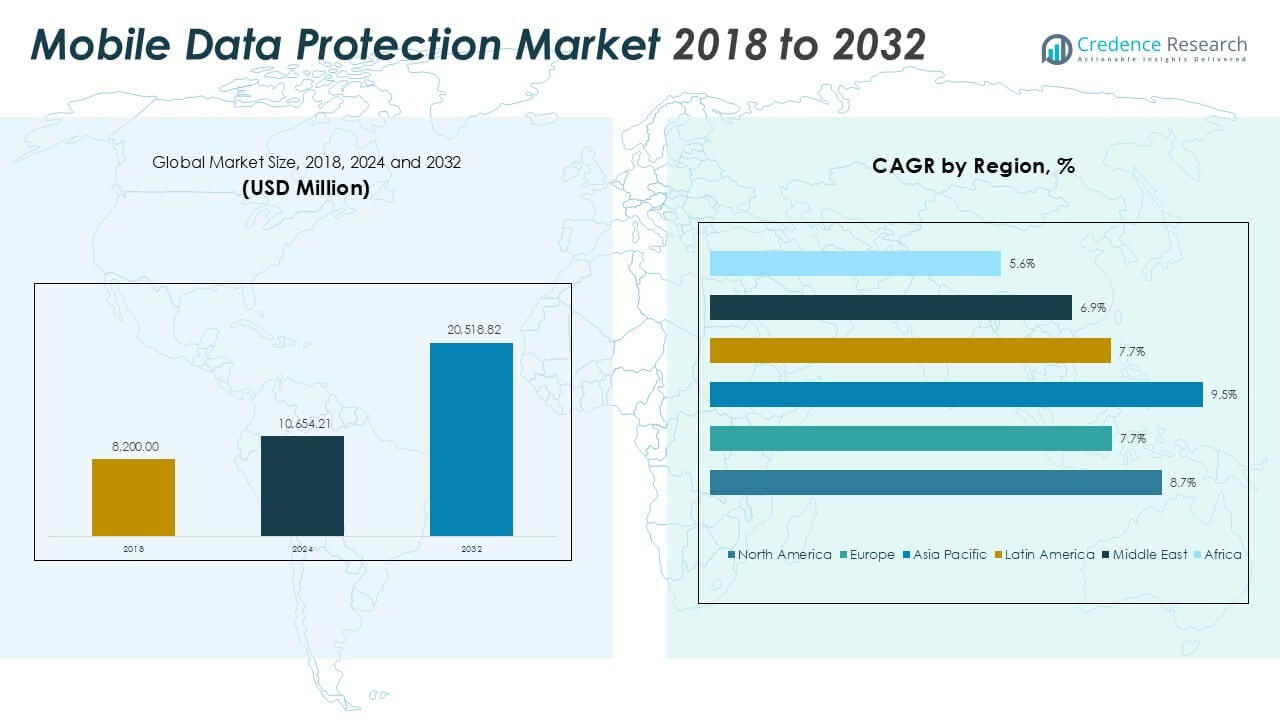
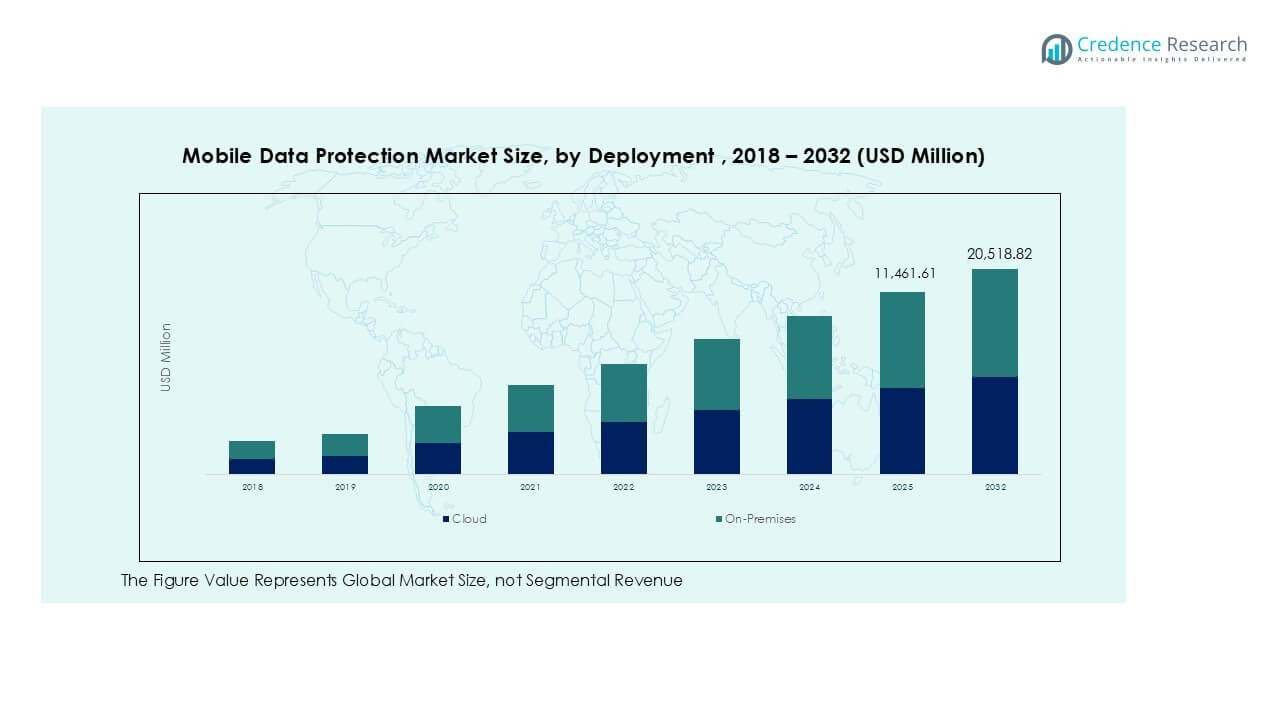
The Mobile Data Protection market size was valued at USD 6,200.00 million in 2018 and increased to USD 11,279.60 million in 2024. It is anticipated to reach USD 43,968.09 million by 2032, growing at a CAGR of 18.68% during the forecast period.
| REPORT ATTRIBUTE | DETAILS |
|---|---|
| Historical Period | 2020-2023 |
| Base Year | 2024 |
| Forecast Period | 2025-2032 |
| Mobile Data Protection Market Size 2024 | USD 11,279.60 million |
| Mobile Data Protection Market , CAGR | 18.68% |
| Mobile Data Protection Market Size 2032 | USD 43,968.09 million |
Top players in the Mobile Data Protection market include Broadcom Inc. (Symantec), Microsoft Corporation, IBM Corporation, Trend Micro Incorporated, and McAfee LLC. These companies lead the market with advanced endpoint protection solutions, strong cloud integration, and global customer bases. Microsoft and Broadcom dominate through scalable platforms and built-in security features tailored for enterprise mobility. IBM and Trend Micro focus on AI-driven threat detection and cross-platform support, while McAfee offers seamless mobile device and data control. Regionally, Asia Pacific leads the global market with a 25.9% share in 2024, driven by rapid digitization, mobile adoption, and growing cybersecurity investments across China, India, and Southeast Asia. North America follows closely with a 25.4% share, backed by regulatory compliance, early tech adoption, and the presence of key market players. Europe holds a 14.8% share, propelled by GDPR-led adoption and high enterprise security awareness across BFSI and public sectors.
Mobile Data Protection Market Insights
- The Mobile Data Protection market was valued at USD 6,200.00 million in 2018 and reached USD 11,279.60 million in 2024; it is projected to hit USD 43,968.09 million by 2032, growing at a CAGR of 18.68% during the forecast period.
- Rising adoption of BYOD policies, hybrid work models, and increased mobile workforce are key drivers accelerating the demand for scalable mobile data protection solutions.
- Integration with Unified Endpoint Management (UEM) platforms and AI-based real-time threat detection tools are shaping market trends, enhancing security management across mobile endpoints.
- Leading players include Microsoft, Broadcom (Symantec), IBM, Trend Micro, and McAfee, all focusing on cloud-based protection, strategic partnerships, and innovation to strengthen market position.
- Asia Pacific leads the market with a 25.9% share, followed by North America at 25.4% and Europe at 14.8%; the software segment remains dominant by component due to its centralized encryption and control capabilities.
Mobile Data Protection Market Segmentation Analysis:
By Component
The software segment dominated the Mobile Data Protection market, accounting for the largest revenue share in 2024. Organizations prioritize software-based solutions for features like data encryption, remote wipe, and device tracking. The flexibility, scalability, and seamless integration of software tools with enterprise mobility management systems drive adoption. Increasing threats to mobile endpoints and the need for centralized policy enforcement strengthen demand for software over services. While services continue to grow, especially for deployment and training, software remains the primary investment area due to its direct role in ensuring data security across devices.
- For instance, Microsoft secures mobile endpoints through Intune, which provides unified management for hundreds of millions of devices globally. The platform enables IT administrators to enforce security standards, such as mandatory encryption and remote wipe capabilities, to protect corporate data across Android and iOS fleets.
By Deployment
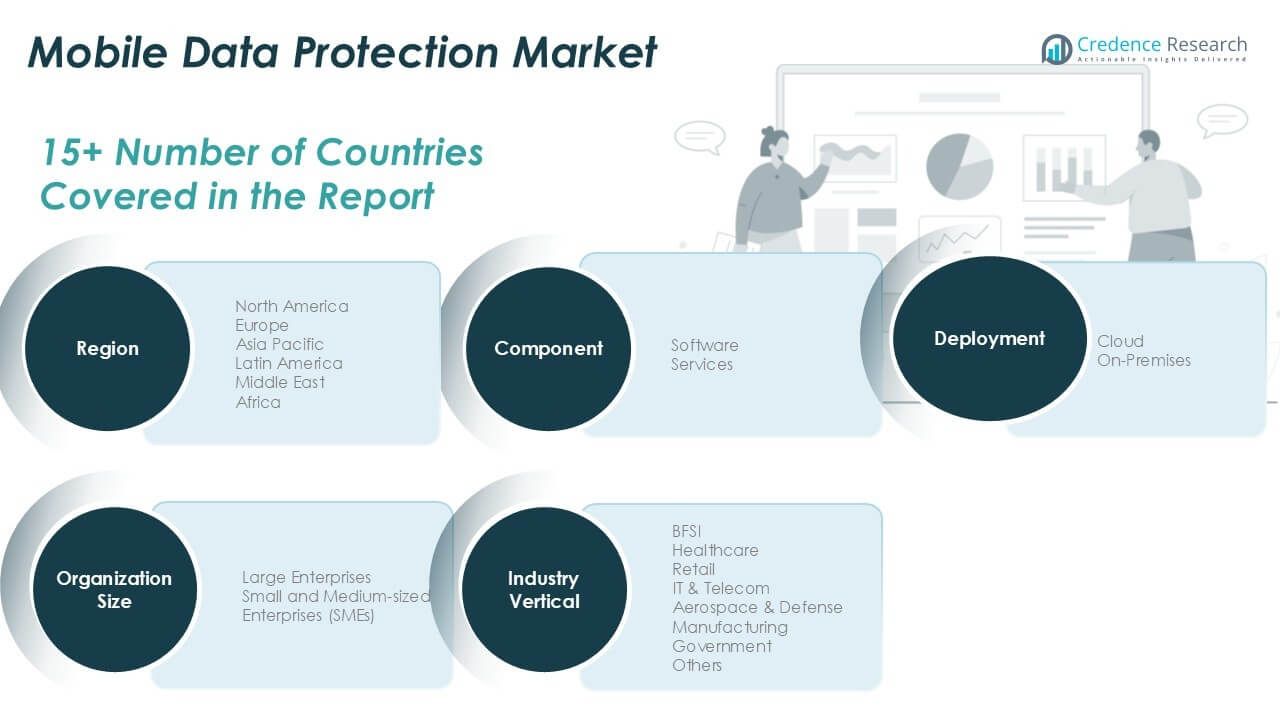
The cloud segment led the market in terms of deployment, holding the majority share in 2024. Cloud-based mobile data protection offers scalability, remote accessibility, and reduced infrastructure costs, making it the preferred choice for both large enterprises and SMEs. The rise in remote work, BYOD (Bring Your Own Device) policies, and cross-border collaboration accelerates cloud adoption. Cloud platforms also support real-time updates and continuous compliance monitoring. In contrast, on-premises solutions cater to organizations with strict data sovereignty requirements, but their high setup and maintenance costs limit widespread use compared to cloud models.
- For instance, Omnissa, Workspace ONE supports mobile data protection by managing tens of millions of devices through cloud-based policy enforcement, automated compliance monitoring, and integrated mobile threat defense.
By Organization Size
Large enterprises held the dominant share in the mobile data protection market in 2024, driven by the volume of sensitive data and the complexity of IT ecosystems. These organizations invest heavily in robust cybersecurity frameworks and mobile security protocols. Their adoption of enterprise mobility and cloud-first strategies further elevates the need for advanced mobile data protection tools. SMEs are increasingly adopting solutions as mobile workforce models grow, but budget constraints and limited IT staff often lead them to opt for simplified or bundled offerings. Nonetheless, SME adoption is expected to grow with the availability of affordable, cloud-based solutions.
Mobile Data Protection Market Key Growth Drivers
Rising Mobile Workforce and BYOD Adoption
The rapid expansion of remote work and BYOD (Bring Your Own Device) culture significantly drives the Mobile Data Protection market. Organizations now allow employees to access corporate data through personal smartphones, tablets, and laptops, increasing security risks. This shift demands robust data protection solutions that safeguard information across various endpoints without compromising user flexibility. Mobile data protection software ensures secure data transfer, encryption, and remote access control. Enterprises are investing in scalable solutions to manage device diversity and maintain compliance with internal security policies. With hybrid work becoming standard, demand for endpoint-centric protection continues to rise, fueling steady market growth globally.
- For instance, IBM reported managing over 10 million mobile devices through its MaaS360 platform, enabling encryption, remote wipe, and access control across mixed employee-owned endpoints.
Stringent Data Protection Regulations and Compliance Mandates
Growing regulatory pressure from frameworks such as GDPR, CCPA, and HIPAA is pushing organizations to adopt strong mobile data protection measures. Businesses must now ensure full compliance in securing customer and operational data, regardless of the access point. Failure to meet regulatory standards leads to reputational damage and heavy penalties. Mobile Data Protection solutions provide the necessary controls for encryption, policy enforcement, user authentication, and audit readiness. Organizations view compliance not just as an obligation but as a strategic imperative to build customer trust. This regulatory environment is prompting a shift from reactive to proactive cybersecurity investments, boosting market expansion.
- For instance, Microsoft supports compliance across over 90 global regulatory standards through its mobile security and compliance management tools integrated with enterprise mobility platforms.
Increasing Cybersecurity Threats Targeting Mobile Endpoints
The rise in mobile malware, phishing attacks, and zero-day vulnerabilities has made mobile devices a prime target for cybercriminals. Employees accessing enterprise systems from multiple networks create more entry points for attackers. As mobile endpoints become integral to workflows, ensuring their protection becomes mission-critical. Mobile Data Protection solutions mitigate risks through real-time threat detection, data encryption, and secure containerization. Companies are integrating these tools with broader security ecosystems like SIEM and EDR platforms. With threat vectors becoming more sophisticated, especially in sectors like finance and healthcare, investments in mobile endpoint defense are accelerating, making this a key market growth driver.
Mobile Data Protection Market Key Trends & Opportunities
Shift Toward Unified Endpoint Management (UEM)
A major trend shaping the Mobile Data Protection market is the integration of solutions with Unified Endpoint Management (UEM) platforms. Enterprises seek centralized tools to manage and secure various endpoints, including mobile, desktop, and IoT devices. Mobile data protection capabilities embedded within UEM frameworks provide seamless policy control, device tracking, and data encryption. This convergence reduces complexity and enhances operational efficiency. Vendors offering cross-platform protection and AI-powered threat analytics are gaining traction. The move toward UEM not only addresses IT challenges but also opens new growth avenues for mobile data protection providers targeting full-stack enterprise security.
- For instance, Omnissa (formerly VMware) reports that Workspace ONE manages tens of millions of endpoints worldwide, providing a single UEM platform that integrates mobile data protection, device tracking, and encryption.
Emergence of AI and ML for Real-Time Threat Detection
Artificial Intelligence (AI) and Machine Learning (ML) are revolutionizing how organizations detect and respond to mobile threats. These technologies enable real-time behavioral analysis, anomaly detection, and automated threat mitigation. As cyberattacks grow more sophisticated, traditional rule-based systems fall short. AI-driven mobile data protection tools can identify patterns of malicious behavior across networks and devices, offering faster response capabilities. This trend presents a major opportunity for vendors to differentiate their offerings. It also enhances data protection in dynamic environments like remote work, where device and user behavior constantly evolve, requiring adaptive and intelligent protection layers.
Mobile Data Protection Market Key Challenges
Complexity in Managing Diverse Device Ecosystems
Enterprises often face challenges in securing a wide variety of mobile devices, operating systems, and applications. The diversity in employee-owned and company-issued devices introduces fragmentation in policy enforcement. Ensuring consistent protection across Android, iOS, and legacy platforms requires advanced tools and IT expertise. Additionally, different device manufacturers may impose limitations on data control and encryption capabilities. This complexity slows down deployment and raises operational costs. Without a standardized framework, organizations struggle to maintain unified security policies. Managing such fragmented ecosystems remains a key barrier to seamless mobile data protection and affects solution scalability for large enterprises.
Limited Awareness Among SMEs and Cost Constraints
Small and medium-sized enterprises often lack the resources and awareness to adopt robust mobile data protection strategies. Many SMEs underestimate the risk of data breaches through mobile endpoints and prioritize other operational needs over cybersecurity. High initial costs and lack of dedicated IT staff deter adoption, especially for advanced solutions requiring ongoing monitoring and management. Vendors must address this challenge by offering cost-effective, easy-to-deploy solutions tailored for SMEs. While cloud-based models reduce costs, awareness and education are critical to improving adoption rates. Without this shift, a significant portion of the market remains underprotected, exposing businesses to avoidable threats.
Mobile Data Protection Market Regional Analysis
North America
North America held a major share in the Mobile Data Protection market, with a value of USD 2,182.40 million in 2018, rising to USD 3,920.72 million in 2024, and is projected to reach USD 15,261.40 million by 2032. With a CAGR of 18.7%, the region accounted for approximately 25.4% of global market revenue in 2024. The U.S. leads due to early technology adoption, strong regulatory enforcement, and increasing investments in mobile security. Growth is further supported by BYOD policies across industries and the presence of major cybersecurity vendors offering scalable data protection solutions.
Europe
Europe captured a significant portion of the Mobile Data Protection market, growing from USD 1,331.76 million in 2018 to USD 2,307.50 million in 2024 and projected to reach USD 8,378.24 million by 2032. With a CAGR of 17.6%, Europe represented around 14.8% of the global market in 2024. Strict data protection laws such as GDPR have driven widespread adoption of mobile security tools. Countries like Germany, France, and the UK lead in deploying enterprise-grade solutions, especially across BFSI and healthcare sectors, which demand compliance and secure endpoint management.
Asia Pacific
Asia Pacific emerged as the fastest-growing regional market, expanding from USD 2,008.80 million in 2018 to USD 3,776.93 million in 2024 and projected to hit USD 15,885.70 million by 2032, at a CAGR of 19.8%. In 2024, the region held the largest market share at 25.9%, slightly surpassing North America. Rapid digitization, expanding mobile user base, and increasing cyberattacks have accelerated demand for mobile data protection. Countries like China, India, Japan, and South Korea are investing in cloud infrastructure and cybersecurity frameworks to secure corporate data and mobile endpoints.
Latin America
Latin America recorded steady growth in the Mobile Data Protection market, rising from USD 322.40 million in 2018 to USD 579.66 million in 2024 and forecasted to reach USD 2,060.78 million by 2032. With a CAGR of 17.3%, the region held a 3.8% share in 2024. Brazil and Mexico lead the market due to increased digital banking activity and public sector modernization. Growing awareness of data security and the adoption of SaaS-based mobile protection tools among SMEs are key contributors to market expansion in the region.
Middle East
The Mobile Data Protection market in the Middle East increased from USD 192.20 million in 2018 to USD 322.52 million in 2024 and is expected to reach USD 1,103.84 million by 2032. With a CAGR of 16.8%, the region contributed approximately 2.1% of global market share in 2024. Countries like the UAE and Saudi Arabia are driving demand with large-scale smart city projects and digital transformation initiatives. Government mandates on cybersecurity standards and growing enterprise mobility are pushing organizations to invest in endpoint protection across sectors.
Africa
Africa’s Mobile Data Protection market grew from USD 162.44 million in 2018 to USD 372.27 million in 2024 and is projected to reach USD 1,278.12 million by 2032, at a CAGR of 16.4%. It accounted for 2.4% of the global market in 2024. South Africa, Nigeria, and Kenya are key contributors, driven by expanding fintech ecosystems and increased smartphone penetration. Despite infrastructure challenges, rising awareness around mobile security and compliance in the financial and public sectors supports gradual adoption. Affordable cloud-based protection tools are expected to drive future growth in the region.
Mobile Data Protection Market Segmentations:
By Component:
- Software
- Services
By Deployment:
- Cloud
- On-Premises
By Organization Size:
- Large Enterprises
- Small and Medium-sized Enterprises (SMEs)
By Industry Vertical:
- BFSI
- Healthcare
- Retail
- IT & Telecom
- Aerospace & Defense
- Manufacturing
- Government
- Others
By Geography:
- North America
- U.S.
- Canada
- Mexico
- Europe
- Germany
- France
- U.K.
- Italy
- Spain
- Rest of Europe
- Asia Pacific
- China
- Japan
- India
- South Korea
- South-east Asia
- Rest of Asia Pacific
- Latin America
- Brazil
- Argentina
- Rest of Latin America
- Middle East & Africa
- GCC Countries
- South Africa
- Rest of the Middle East and Africa
Competitive Landscape
The Mobile Data Protection market is highly competitive, with leading technology firms and cybersecurity vendors driving innovation through robust product portfolios and strategic partnerships. Companies such as Broadcom Inc. (Symantec), Microsoft Corporation, IBM Corporation, and Trend Micro dominate the space with comprehensive endpoint protection platforms integrated into enterprise security ecosystems. Microsoft leverages its cloud-native Defender platform, while Broadcom’s Symantec solutions offer advanced threat prevention across mobile devices. Emerging players like Blackberry and Check Point Software emphasize secure containerization and AI-driven threat detection. Market leaders focus on expanding cloud-based offerings, enabling remote work security, and improving compliance features. Mergers, acquisitions, and R&D investments are frequent, aimed at strengthening threat intelligence capabilities and mobile endpoint control. Competitive advantage is often achieved through real-time protection, ease of deployment, and scalability. As businesses prioritize zero-trust frameworks and unified endpoint management, vendors with flexible, integrated solutions are well-positioned to capture market share across enterprise and SME segments.
Key Player Analysis
- Broadcom Inc. (Symantec)
- Microsoft Corporation
- IBM Corporation
- Trend Micro Incorporated
- Dell Inc.
- Hewlett Packard Enterprise Development LP
- Blackberry Limited
- Check Point Software Technologies Ltd.
- VMware, Inc.
- McAfee LLC
- Oracle Corporation
- SAP SE
Recent Developments
- In October 2025, Microsoft extended Defender for Endpoint to correlate real-time threats across iOS, Android, Windows, and macOS, isolating compromised mobile devices within 5 seconds.
- In August 2025, ENISA issued binding technical standards requiring runtime application self-protection and certificate pinning in EU finance apps by January 2026.
Report Coverage
The research report offers an in-depth analysis based on Component, Deployment, Organization Size, Industry Vertical and Geography. It details leading market players, providing an overview of their business, product offerings, investments, revenue streams, and key applications. Additionally, the report includes insights into the competitive environment, SWOT analysis, current market trends, as well as the primary drivers and constraints. Furthermore, it discusses various factors that have driven market expansion in recent years. The report also explores market dynamics, regulatory scenarios, and technological advancements that are shaping the industry. It assesses the impact of external factors and global economic changes on market growth. Lastly, it provides strategic recommendations for new entrants and established companies to navigate the complexities of the market.
Future Outlook
- Demand for cloud-based mobile data protection solutions will grow with remote and hybrid work expansion.
- Enterprises will increasingly integrate mobile security with unified endpoint management platforms.
- AI and machine learning will play a larger role in real-time mobile threat detection.
- Regulatory compliance requirements will continue to drive adoption across industries.
- Mobile data protection in SMEs will rise due to affordable SaaS-based solutions.
- Growth in mobile commerce and digital banking will boost demand for endpoint encryption.
- The healthcare and BFSI sectors will adopt advanced protection tools for sensitive data.
- Vendors will focus on zero-trust architecture to enhance mobile access security.
- Edge computing and IoT device growth will expand mobile data protection scope.
- Asia Pacific will maintain leadership due to rapid mobile adoption and digital transformation.
Request a Free Sample
Fill in your details and we'll send you a free sample report.
- Sample data tables & charts
- Research methodology
Need a Custom Version of This Report?
Tailor the scope, geography, or segments to your exact requirements.
- Custom geography or segment scope
- Direct access to our analyst team
Frequently Asked Questions
What is the current market size for Mobile Data Protection market, and what is its projected size in 2032?
At what Compound Annual Growth Rate is the Mobile Data Protection market projected to grow between 2024 and 2032?
Which Mobile Data Protection market segment held the largest share in 2024?
What are the primary factors fueling the growth of the Mobile Data Protection market?
Who are the leading companies in the Mobile Data Protection market?
Which region commanded the largest share of the Mobile Data Protection market in 2024?
Table of Content
Chapter 1. Report Introduction
- 1.1 Report Description & Purpose
- 1.1.1 Report Title & Market Definition
- 1.1.2 Unique Selling Propositions (USP) & Key Differentiators
- 1.1.3 Value Proposition for Stakeholders
- 1.2 Research Objectives
- 1.2.1 Market Sizing Objectives (Volume & Revenue)
- 1.2.2 Segmentation Objectives
- 1.2.3 Competitive Intelligence Objectives
- 1.2.4 Forecast & Scenario Objectives
- 1.3 Report Scope
- 1.3.1 Mobile Data Protection Scope – Types & Subtypes Covered
- 1.3.2 Geographic Scope – Regions & Countries Covered
- 1.3.3 Historical Period, Base Year & Forecast Period (2024; forecast to 2032)
- 1.3.4 Inclusions & Exclusions
- 1.4 HS Code & Classification Framework
- 1.5 Currency, Units & Pricing Basis
- 1.6 Target Stakeholders
- 1.7 Limitations & Assumptions
Chapter 2. Executive Summary
- 2.1 Global Mobile Data Protection Market Snapshot
- 2.1.1 Market Size – Historical (2024) & Forecast (2024-2032) (2024: USD 11,279.60 million → 2032: USD 43,968.09 million)
- 2.1.2 Volume & Revenue – Global Totals
- 2.1.3 Key Market Highlights – Top Five Facts
- 2.2 Mobile Data Protection Market Segmentation Snapshot
- 2.2.1 Market Split by Region – 2024 vs. 2032
- 2.3 Competitive Snapshot
- 2.3.1 Top 10 Players by Revenue Share – 2024
- 2.3.2 Top 10 Players by Volume Share – 2024
- 2.3.3 Recent Strategic Developments (18-Month Summary)
- 2.4 Key Investment Highlights & Strategic Conclusions
Chapter 3. Mobile Data Protection Market Dynamics & Industry Analysis
- 3.1 Market Overview & Context
- 3.1.1 Mobile Data Protection Market Position in the Broader Automotive Value Chain
- 3.1.2 OEM vs. Replacement Market Dynamics
- 3.1.3 Market Maturity & Development Stage by Region
- 3.2 Mobile Data Protection Market Drivers
- 3.3 Mobile Data Protection Market Restraints & Challenges
- 3.4 Mobile Data Protection Market Opportunities
- 3.5 Porter's Five Forces Analysis
- 3.5.1 Threat of New Entrants
- 3.5.2 Bargaining Power of Suppliers
- 3.5.3 Bargaining Power of Buyers
- 3.5.4 Threat of Substitutes
- 3.5.5 Competitive Rivalry – Intensity Assessment
- 3.6 Mobile Data Protection Value Chain Analysis
- 3.6.1 Upstream – Raw Material/Input Suppliers
- 3.6.1.1 Raw Material/Input 1
- 3.6.1.2 Raw Material/Input 2
- 3.6.1.3 Raw Material/Input 3
- 3.6.2 Midstream – Production/Manufacturing/Service Delivery
- 3.6.2.1 Production/Process Overview
- 3.6.2.2 Key Facility Locations & Capacity by Manufacturer
- 3.6.3 Downstream – Distribution & End Consumer
- 3.6.3.1 Primary Channel – B2B/OEM
- 3.6.3.2 Secondary Channels – Dealer, Retail, Online, Direct
- 3.6.4 Value Chain Profitability Analysis
- 3.6.1 Upstream – Raw Material/Input Suppliers
- 3.7 PESTEL Analysis
- 3.7.1 Political Factors
- 3.7.2 Economic Factors
- 3.7.3 Social Factors
- 3.7.4 Technological Factors
- 3.7.5 Environmental Factors
- 3.7.6 Legal Factors
- 3.8 Mobile Data Protection Supply Chain Analysis
- 3.8.1 Raw Material/Input Supply Risk Assessment
- 3.8.2 Manufacturing Concentration Risk (Geographic Exposure)
- 3.8.3 Trade Disruption Impact Analysis
- 3.9 Regulatory & Policy Landscape
Note: The regulatory and policy landscape section covers regulations based on their applicability to the market, Mobile Data Protection category, geography, and scope of the study. Only regulatory frameworks with a material impact on operations, compliance, trade, sustainability, or market access are analyzed in detail.
Chapter 4. Key Investment Pockets & Opportunity Analysis
- 4.1 Mobile Data Protection Market Attractiveness Analysis
- 4.1.1 By Region – Investment Attractiveness Matrix (Volume × CAGR)
- 4.2 Absolute Revenue Growth Opportunity
- 4.2.1 By Region – Absolute USD Growth Through 2032
- 4.3 Incremental Volume Opportunity
- 4.3.1 By Region – Incremental Volume Through 2032
- 4.3.2 Segment – Incremental Volume
- 4.4 Emerging Submarket Opportunity Deep Dive (Subject to Applicability)
- 4.5 Emerging Market Opportunity Scorecards
- 4.5.1 United States
- 4.5.2 Europe
- 4.5.3 Asia
- 4.5.4 Middle East & Africa
Note: Emerging Market Opportunity Scorecards will be included based on relevance and strategic importance. Regions listed are indicative and may vary depending on data availability and market dynamics.
Chapter 5. Mobile Data Protection Import-Export Analysis & Trade Flows
- 5.1 Global Trade Overview
- 5.1.1 Global Export Value by Country (2024)
- 5.1.2 Global Export Volume by Country (2024)
- 5.1.3 Global Import Value by Country (2024)
- 5.1.4 Global Import Volume by Country (2024)
- 5.1.5 Net Trade Balance by Country (2024)
- 5.2 Export Analysis – Segment
- 5.2.1 Type 1 (HS Code)
- 5.2.2 Type 2 (HS Code)
- 5.2.3 Type 3 (HS Code)
- 5.2.4 Type 4 (HS Code)
- 5.2.5 Type 5 (HS Code)
- 5.3 Import Analysis – Segment
- 5.3.1 Type 1 (HS Code)
- 5.3.2 Type 2 (HS Code)
- 5.3.3 Type 3 (HS Code)
- 5.3.4 Type 4 (HS Code)
- 5.3.5 Type 5 (HS Code)
- 5.4 Average Unit Trade Prices
- 5.4.1 Average Export Price – Segment & Country
- 5.4.2 Average Import Price – Segment & Source Country
- 5.4.3 Price Trends (2024)
- 5.5 Key Trade Route Analysis
- 5.5.1 Trade Route 1
- 5.5.2 Trade Route 2
- 5.5.3 Trade Route 3
- 5.5.4 Trade Route 4
- 5.5.5 Trade Route 5
- 5.6 Trade Policy Impact Assessment
- 5.6.1 US Anti-Dumping & Section 301 Tariffs
- 5.6.2 EU Customs Union Impact
- 5.6.3 Major Free Trade Agreements
- 5.6.4 USMCA Rules of Origin
Note: Trade policy analysis will be included only where relevant to the Mobile Data Protection market.
Chapter 6. Competitive Landscape & Company Benchmarking
- 6.1 Mobile Data Protection Market Concentration & Structure
- 6.1.1 Herfindahl-Hirschman Index (HHI) – vs. 2024
- 6.1.2 Tier 1, Tier 2 & Tier 3 Market Structure
- 6.1.3 Global, Regional & Local Player Dynamics
- 6.2 Mobile Data Protection Market Share Analysis – 2024
- 6.2.1 Global Revenue Share by Company
- 6.2.2 Global Volume Share by Company
- 6.2.3 Regional Revenue Share
- 6.2.4 Market Share Evolution ( vs. 2024)
- 6.2.5 OEM Segment Share by Company
- 6.2.6 Replacement Segment Share by Company
- 6.3 Production/Delivery Capacity & Facility Analysis
- 6.3.1 Global Installed Capacity
- 6.3.2 Capacity Utilization Rates
- 6.3.3 Production/Output Volume
- 6.3.4 Facility Locations & Capacity Map
- 6.3.5 Planned Capacity Additions
- 6.4 Mobile Data Protection Competitive Benchmarking Matrix
- 6.4.1 Revenue, Volume, CAGR & Profitability Comparison
- 6.4.2 Channel Revenue Mix
- 6.4.3 Geographic Revenue Exposure
- 6.4.4 R&D Intensity
- 6.4.5 Sustainability Maturity
- 6.5 Strategic Developments in Mobile Data Protection (Last 24 Months)
- 6.5.1 Mergers, Acquisitions & Divestments
- 6.5.2 New Mobile Data Protection Launches
- 6.5.3 Facility Expansions
- 6.5.4 Strategic Alliances, Joint Ventures & Partnerships
- 6.5.5 Distribution Expansion & Market Entry
- 6.5.6 Sustainability & ESG Initiatives
- 6.6 Competitive Strategy Mapping
- 6.6.1 Leader, Challenger, Follower & Niche Classification
- 6.6.2 Pricing Strategy Comparison
- 6.6.3 Channel Strategy Matrix
Note: Strategic developments are included based on their materiality and the availability of reliable information.
Chapter 7. Global Mobile Data Protection Market – By Distribution Channel
- 7.1 Segment Overview
- 7.1.1 Volume & Revenue Split by Channel (2024 & 2032)
- 7.1.2 Channel Mix Evolution (2024-2032)
Chapter 8. Regional Market Analysis – Global Overview
- 8.1 Global Regional Overview
- 8.1.1 Regional Volume Share
- 8.1.2 Regional Revenue Share
- 8.1.3 Regional Volume by Region
- 8.1.4 Regional Revenue by Region
- 8.1.5 Regional Forecast Through 2032
- 8.2 Cross-Regional Segment Analysis
- 8.2.1 By Distribution Channel
- 8.2.2 By Brand/Price Tier
Chapter 9. North America Mobile Data Protection Market
- 9.1 United States
- 9.2 Canada
- 9.3 Mexico
Chapter 10. Europe Mobile Data Protection Market
- 10.1 Germany
- 10.2 France
- 10.3 Italy
- 10.4 United Kingdom
- 10.5 Spain
- 10.6 Poland
- 10.7 Russia
- 10.8 Netherlands
- 10.9 Belgium
- 10.10 Sweden
- 10.11 Denmark
- 10.12 Norway
- 10.13 Rest of Europe
Chapter 11. Asia Pacific Mobile Data Protection Market
- 11.1 China
- 11.2 India
- 11.3 Japan
- 11.4 South Korea
- 11.5 Thailand
- 11.6 Indonesia
- 11.7 Vietnam
- 11.8 Malaysia
- 11.9 Australia
- 11.10 Rest of Asia Pacific
Chapter 12. Latin America Mobile Data Protection Market
- 12.1 Brazil
- 12.2 Argentina
- 12.3 Colombia
- 12.4 Chile
- 12.5 Rest of Latin America
Chapter 13. Middle East Mobile Data Protection Market
- 13.1 Saudi Arabia
- 13.2 United Arab Emirates
- 13.3 Turkey
- 13.4 Israel
- 13.5 Iran
- 13.6 Rest of the Middle East
Chapter 14. Africa Mobile Data Protection Market
- 14.1 South Africa
- 14.2 Egypt
- 14.3 Nigeria
- 14.4 Morocco
- 14.5 Rest of Africa
Chapter 15. Mobile Data Protection Company Profiles
- 15.1 [Company 01]
- 15.1.1 Company Overview
- 15.1.2 Key Management Personnel
- 15.1.3 Products & Services Portfolio
- 15.1.4 Financial Performance
- 15.1.5 Key Market Focus & Geographic Presence
- 15.1.6 Recent Developments & Strategic Initiatives
Note: The company profile list is preliminary and may change based on research findings, market developments, data availability, and client requirements.
Chapter 16. Appendices
- Appendix A – List of Abbreviations & Acronyms
- Appendix B – Industry Classification Code Reference – Full Series
- Appendix C – Production & Capacity Data Tables
- Appendix D – End-Use & Demand Base Tables
- Appendix E – Consumption & Replacement Rate Assumptions
- Appendix F – ASP Reference Tables
- Appendix G – Manufacturing & Facility Database
- Appendix H – Import-Export Data Tables
- Appendix I – Regulatory Summary Tables
- Appendix J – Primary Research Participant List (Anonymized)
- Appendix K – Primary Research Questionnaire Framework
- Appendix L – Data Sources & Bibliography
- Appendix M – Market Size Divergence & Source Comparison
Chapter 17. Research Methodology
- 17.1 Research Framework & Philosophy
- 17.2 Secondary Research – Sources, Hierarchy & Data Extraction
- 17.3 Data Modeling – Bottom-Up & Top-Down Market Sizing
- 17.4 Primary Research – Stakeholder Framework, LOI & Sample Sizes
- 17.5 Forecast Methodology – Regression, Scenario & Sensitivity Analysis
- 17.6 Quality Control – Four-Layer Validation Framework
- 17.7 Limitations & Standard Assumptions
- 17.8 Disclaimer
