
Nano Copper Oxide Market Overview:
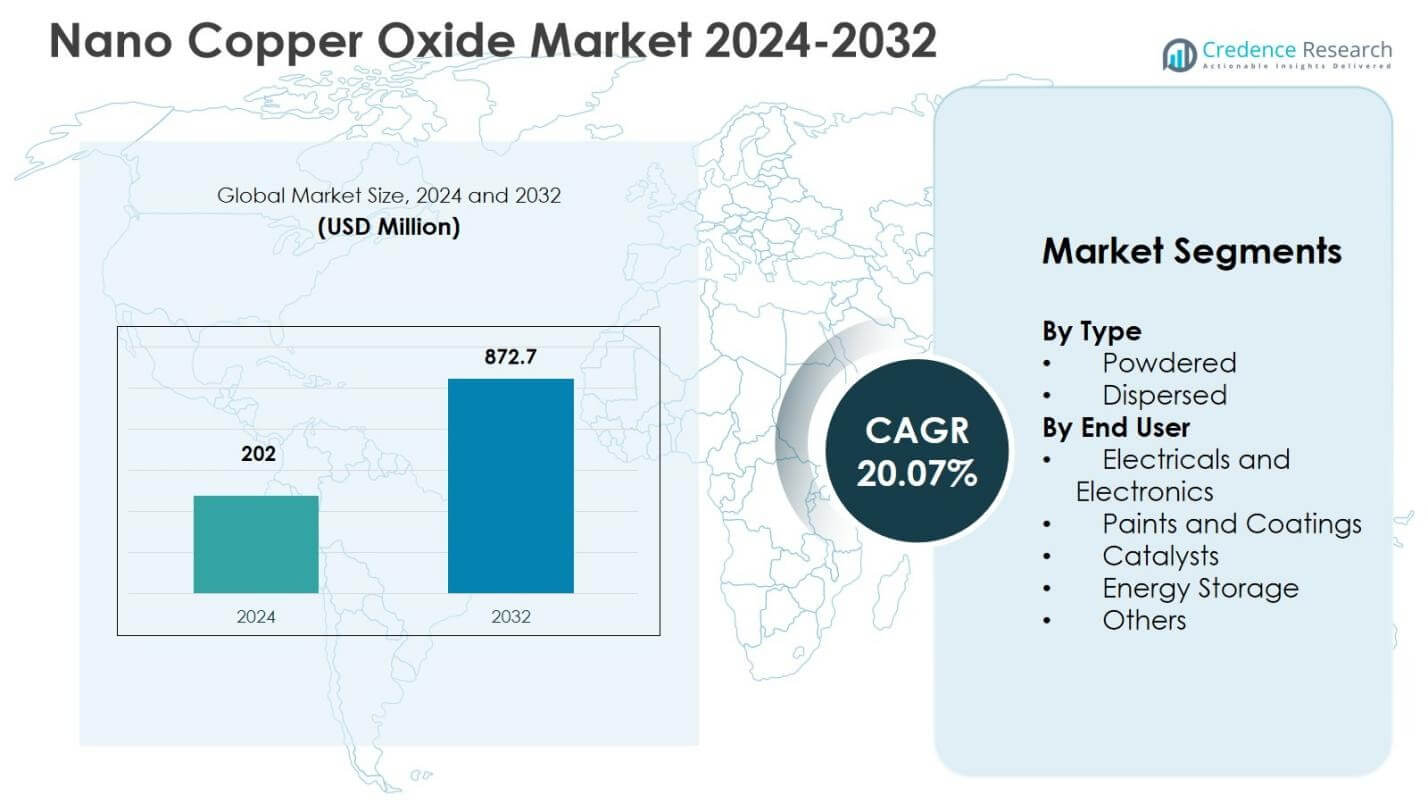
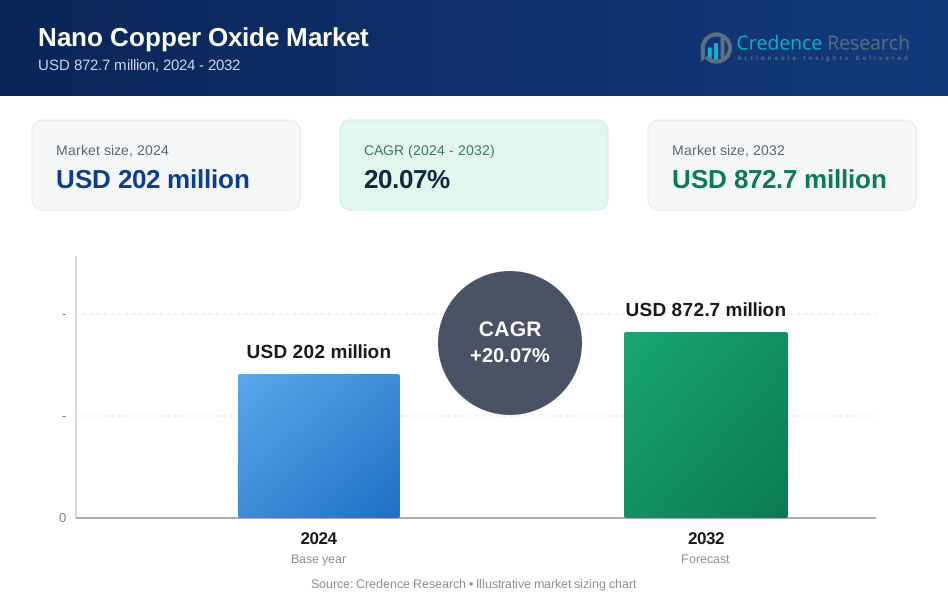
Nano Copper Oxide Market size was valued at USD 202 million in 2024 and is anticipated to reach USD 872.7 million by 2032, at a CAGR of 20.07% during the forecast period.
| REPORT ATTRIBUTE | DETAILS |
|---|---|
| Historical Period | 2020-2023 |
| Base Year | 2024 |
| Forecast Period | 2025-2032 |
| Nano Copper Oxide Market Size 2024 | USD 202 million |
| Nano Copper Oxide Market, CAGR | 20.07% |
| Nano Copper Oxide Market Size 2032 | USD 872.7 million |
Nano Copper Oxide Market Insights
- Market growth is primarily driven by rising demand from electricals and electronics, which accounted for a 34.8% segment share in 2024, supported by increasing use in semiconductors, conductive inks, sensors, and miniaturized electronic components.
- Key market trends include growing adoption in antimicrobial coatings and energy storage applications, while powdered nano copper oxide dominated the type segment with a 63.4% share in 2024 due to ease of handling, high purity, and broad industrial usability.
- Market restraints include high production costs, complex synthesis processes, and regulatory scrutiny related to health and environmental safety, which impact scalability and adoption in price-sensitive applications.
- Regionally, Asia Pacific led the market with a 41.6% share in 2024, followed by North America at 27.3% and Europe at 22.1%, reflecting strong electronics manufacturing, battery production, and nanomaterial research activity.
Nano Copper Oxide Market Segmentation Analysis:
By Type:
By type, the Nano Copper Oxide Market is segmented into powdered and dispersed forms, with powdered nano copper oxide dominating the segment with a 63.4% market share in 2024. The dominance of the powdered form is driven by its high purity, superior surface reactivity, ease of storage, and cost-effective handling across large-scale manufacturing processes. Powdered nano copper oxide is extensively used in catalysts, conductive inks, ceramics, and antimicrobial formulations, where precise particle control is critical. Its compatibility with solid-state processing and widespread availability further support adoption, particularly in industrial and research-grade applications.
- For instance, Nanografi Nano Technology supplies powdered copper oxide nanoparticles as catalysts for organic transformations and biofuel generation, leveraging their high surface area for enhanced reaction efficiency.
By End User:
By end user, the market includes electricals and electronics, paints and coatings, catalysts, energy storage, and others, with electricals and electronics accounting for the largest share of 34.8% in 2024. This dominance is supported by rising demand for nano copper oxide in semiconductors, conductive components, sensors, and printed electronics due to its excellent electrical conductivity and thermal stability. Rapid expansion of consumer electronics, EV components, and miniaturized electronic devices has accelerated material adoption. Additionally, its role in enhancing circuit efficiency and durability strengthens its position across advanced electronic manufacturing applications.
- For instance, Recyclekaro and BARC signed an MoU to produce high-purity copper oxide nanoparticles from e-waste printed circuit boards for electronics sustainability. This advances circular economy practices in conductive component manufacturing.
Key Growth Drivers
Expanding Demand from Electricals and Electronics
The Nano Copper Oxide Market is strongly driven by rising demand from the electricals and electronics sector, where nano copper oxide is increasingly used in semiconductors, conductive inks, sensors, and printed electronic components. Its high electrical conductivity, thermal stability, and oxidation resistance support improved device performance and miniaturization. Rapid growth in consumer electronics, electric vehicles, and smart devices has intensified the need for advanced nanomaterials that enhance efficiency and reliability. Manufacturers are adopting nano copper oxide to improve signal integrity, reduce energy losses, and support high-density circuit designs across advanced electronic applications.
- For instance, Copprint develops rapid self-sintering nano copper inks that achieve up to 50% bulk copper conductivity after just 2 seconds of sintering at low temperatures under air, enabling printed electronics on substrates like paper and PET for RFID antennas and flexible circuits.
Growth in Energy Storage and Battery Applications
The expanding deployment of energy storage systems is another key driver supporting the Nano Copper Oxide Market. Nano copper oxide is widely used in lithium-ion batteries, supercapacitors, and electrode materials due to its high surface area and excellent electrochemical properties. These characteristics improve charge capacity, cycling stability, and energy density, which are critical for renewable energy integration and electric mobility. Rising investments in EV batteries, grid-scale storage, and portable power solutions, supported by government incentives for clean energy, continue to accelerate market adoption.
- For instance, Hollow nano copper oxide (Cu₂O) nanostructures delivered specific capacitance of 164 F g⁻¹ at 10 mV s⁻¹, 70% higher than solid counterparts due to increased redox sites and ion channels. These structures retained 99% capacitance after 3000 cycles at 5 A g⁻¹, boosting cyclability via efficient de-intercalation.
Rising Use in Catalysts and Industrial Processing
Increasing utilization of nano copper oxide in catalytic and industrial processes significantly contributes to market growth. Its enhanced catalytic activity supports applications in chemical synthesis, oxidation reactions, and emission control systems. Industries such as petrochemicals, pharmaceuticals, and environmental engineering are adopting nano copper oxide to improve reaction efficiency and reduce operational costs. Growing regulatory pressure for cleaner industrial processes and reduced emissions further supports its adoption in pollution control catalysts and wastewater treatment solutions across global manufacturing sectors.
Key Trends & Opportunities
Growing Adoption in Antimicrobial and Coating Applications
A major trend in the Nano Copper Oxide Market is the increasing use of antimicrobial coatings across healthcare, construction, and consumer goods industries. Nano copper oxide offers strong antibacterial and antifungal properties, making it suitable for coatings on medical devices, hospital surfaces, packaging materials, and interior architectural finishes. Rising awareness of hygiene standards and infection prevention has accelerated demand for functional coatings. This trend creates significant opportunities for manufacturers to develop advanced nano-enabled paints, coatings, and surface treatments for both commercial and residential applications.
- For instance, Copper Armour™, a copper-based composite coating with embedded particles, reduces bacterial burden by over 99.9% on high-touch hospital surfaces such as bed rails, overbed tables, and IV poles compared to standard surfaces, as shown in in vitro tests and a nine-week ICU pilot study.
Technological Advancements in Nanomaterial Manufacturing
Continuous advancements in nanomaterial processing technologies present substantial opportunities for market expansion. Improved synthesis methods, including sol-gel processing, hydrothermal techniques, and environmentally friendly production routes, have enhanced particle consistency, purity, and scalability. These innovations enable reliable performance in electronics, energy storage, and catalytic applications. Increased collaboration between research institutions and industrial manufacturers is accelerating product commercialization, while improved production efficiency is supporting broader adoption across high-volume industrial and consumer markets.
- For instance, Cerion Nanomaterials employs solution-based sol-gel precursors to produce homogeneous inorganic nanoparticles like TiO2, enabling precise control over size and properties for industrial applications.
Key Challenges
High Production Costs and Manufacturing Complexity
High production costs and complex manufacturing requirements remain a major challenge for the Nano Copper Oxide Market. Achieving uniform particle size, controlled morphology, and high purity requires advanced equipment and strict quality control, increasing capital and operational expenditures. Small and mid-sized manufacturers often face difficulties in scaling production while maintaining consistent performance standards. These cost constraints can limit adoption in price-sensitive industries and emerging markets, affecting overall market penetration.
Health, Safety, and Regulatory Concerns
Health, safety, and regulatory challenges also restrict market growth. The potential environmental and health impacts of nanoparticle exposure have led to increased scrutiny from regulatory authorities. Compliance with evolving safety standards related to handling, disposal, and environmental release adds complexity to manufacturing and distribution. Limited long-term toxicological data further complicates regulatory approvals, particularly in healthcare and consumer applications. Addressing these concerns through standardized safety protocols and sustainable production practices remains critical for long-term market development.
Regional Analysis
North America
North America held a 27.3% market share in 2024 in the Nano Copper Oxide Market, driven by strong demand from electronics, energy storage, and advanced materials research. The region benefits from a well-established semiconductor industry, growing adoption of conductive inks, and increasing investments in lithium-ion battery manufacturing. The presence of advanced R&D infrastructure and early adoption of nanotechnology across industrial and academic institutions further supports market growth. Rising use of nano copper oxide in antimicrobial coatings and catalysts for environmental applications also contributes to sustained demand across the United States and Canada.
Europe
Europe accounted for a 22.1% market share in 2024, supported by strong demand from catalysts, coatings, and energy-related applications. Stringent environmental regulations have encouraged the adoption of nano copper oxide in emission control catalysts and sustainable industrial processes. The region also shows growing utilization in antimicrobial paints and advanced coatings for healthcare and construction sectors. Countries such as Germany, France, and the United Kingdom continue to invest in nanomaterial innovation, supported by government-funded research programs and collaborations between academic institutions and manufacturers.
Asia Pacific
Asia Pacific dominated the Nano Copper Oxide Market with a 41.6% market share in 2024, driven by rapid expansion of electronics manufacturing, battery production, and industrial processing. China, Japan, South Korea, and India lead regional demand due to large-scale semiconductor fabrication, EV battery manufacturing, and cost-effective production capabilities. Strong government support for renewable energy, electric mobility, and domestic electronics manufacturing has accelerated material adoption. The presence of large consumer electronics supply chains and increasing investments in nanotechnology research further reinforce the region’s leadership position.
Latin America
Latin America captured a 5.4% market share in 2024, supported by growing industrialization and increasing use of nano copper oxide in catalysts and coatings. Expanding chemical processing industries and gradual adoption of advanced materials in energy and environmental applications are driving demand. Countries such as Brazil and Mexico are witnessing increased investments in renewable energy and industrial manufacturing, supporting niche adoption of nanomaterials. While the market remains smaller compared to developed regions, improving technological capabilities and rising awareness of nanotechnology benefits are contributing to steady regional growth.
Middle East & Africa
The Middle East & Africa region accounted for a 3.6% market share in 2024, driven by emerging applications in catalysts, energy storage, and industrial coatings. Growth is supported by increasing investments in energy infrastructure, water treatment, and industrial diversification initiatives across the Middle East. The use of nano copper oxide in catalytic and environmental applications is gaining traction as industries focus on efficiency and emission reduction. Although adoption remains limited, expanding industrial projects and gradual integration of advanced materials are expected to support long-term market development.
Nano Copper Oxide Market Segmentations:
By Type
- Powdered
- Dispersed
By End User
- Electricals and Electronics
- Paints and Coatings
- Catalysts
- Energy Storage
- Others
By Geography
- North America
- U.S.
- Canada
- Mexico
- Europe
- Germany
- France
- U.K.
- Italy
- Spain
- Rest of Europe
- Asia Pacific
- China
- Japan
- India
- South Korea
- South-east Asia
- Rest of Asia Pacific
- Latin America
- Brazil
- Argentina
- Rest of Latin America
- Middle East & Africa
- GCC Countries
- South Africa
- Rest of the Middle East and Africa
Competitive Landscape
Competitive landscape analysis of the Nano Copper Oxide Market features key players including Merck KGaA, Sigma-Aldrich, Nanophase Technologies Corporation, US Research Nanomaterials, Inc., Nanoshel LLC, and Nanocs, Inc.. The market is moderately consolidated, with competition driven by product purity, particle size control, dispersion stability, and application-specific performance. Leading companies focus on expanding nano copper oxide portfolios for electronics, energy storage, catalysts, and antimicrobial coatings. Strategic priorities include investments in advanced synthesis technologies, scale-up of production capabilities, and customization for end-user requirements. Partnerships with research institutions and electronics manufacturers support innovation and faster commercialization. Companies also emphasize regulatory compliance and sustainable manufacturing to address safety and environmental concerns. Emerging players compete by offering cost-competitive materials and tailored solutions for niche applications, while established players leverage strong distribution networks and brand credibility to maintain market leadership.
Key Player Analysis
- Nanocs, Inc.
- Merck KGaA
- US Research Nanomaterials, Inc.
- Innovationslabor Dr. Spintig GmbH
- Sigma-Aldrich
- Nanophase Technologies Corporation
- Toda Kogyo Corp.
- Nanoshel LLC
- SmartMembranes GmbH
- Alfa Aesar
Recent Developments
- In February 2024, Recyclekaro and BARC signed a Memorandum of Understanding (MoU) to produce high-purity copper oxide nanoparticles from recycled printed circuit boards, promoting sustainable practices in the electronics industry.
- In 2024, scientists at the Institute of Nano Science and Technology (INST), Mohali, developed a sustainable copper-based catalyst with a "morning star" (star-like) nanostructure.
Report Coverage
The research report offers an in-depth analysis based on Type, End User and Geography. It details leading market players, providing an overview of their business, product offerings, investments, revenue streams, and key applications. Additionally, the report includes insights into the competitive environment, SWOT analysis, current market trends, as well as the primary drivers and constraints. Furthermore, it discusses various factors that have driven market expansion in recent years. The report also explores market dynamics, regulatory scenarios, and technological advancements that are shaping the industry. It assesses the impact of external factors and global economic changes on market growth. Lastly, it provides strategic recommendations for new entrants and established companies to navigate the complexities of the market.
Future Outlook
- The market will experience strong growth driven by expanding applications in electronics, energy storage, and advanced coatings.
- Increasing adoption in lithium-ion batteries and supercapacitors will support long-term demand.
- Continued miniaturization of electronic components will accelerate the use of nano copper oxide in conductive materials.
- Antimicrobial and self-cleaning coatings will gain wider acceptance across healthcare and construction sectors.
- Advancements in nanomaterial synthesis will improve product consistency and scalability.
- Manufacturers will focus on application-specific formulations to enhance performance and differentiation.
- Growing investments in renewable energy and electric mobility will strengthen demand momentum.
- Asia Pacific will remain the leading production and consumption hub due to strong manufacturing ecosystems.
- Regulatory focus on safety and environmental compliance will shape product development strategies.
- Strategic collaborations and capacity expansions will intensify competition and innovation across the market.
Request a Free Sample
Fill in your details and we'll send you a free sample report.
- Sample data tables & charts
- Research methodology
Need a Custom Version of This Report?
Tailor the scope, geography, or segments to your exact requirements.
- Custom geography or segment scope
- Direct access to our analyst team
Frequently Asked Questions
What is the current market size for the Nano Copper Oxide Market, and what is its projected size in 2032?
At what Compound Annual Growth Rate is the Nano Copper Oxide Market projected to grow between 2024 and 2032?
Which Nano Copper Oxide Market segment held the largest share in 2024?
What are the primary factors fueling the growth of the Nano Copper Oxide Market?
Who are the leading companies in the Nano Copper Oxide Market?
Which region commanded the largest share of the Nano Copper Oxide Market in 2024?
Table of Content
Chapter 1. Report Introduction
- 1.1 Report Description & Purpose
- 1.1.1 Report Title & Market Definition
- 1.1.2 Unique Selling Propositions (USP) & Key Differentiators
- 1.1.3 Value Proposition for Stakeholders
- 1.2 Research Objectives
- 1.2.1 Market Sizing Objectives (Volume & Revenue)
- 1.2.2 Segmentation Objectives
- 1.2.3 Competitive Intelligence Objectives
- 1.2.4 Forecast & Scenario Objectives
- 1.3 Report Scope
- 1.3.1 Nano Copper Oxide Scope – Types & Subtypes Covered
- 1.3.2 Geographic Scope – Regions & Countries Covered
- 1.3.3 Historical Period, Base Year & Forecast Period (2024; forecast to 2032)
- 1.3.4 Inclusions & Exclusions
- 1.4 HS Code & Classification Framework
- 1.5 Currency, Units & Pricing Basis
- 1.6 Target Stakeholders
- 1.7 Limitations & Assumptions
Chapter 2. Executive Summary
- 2.1 Global Nano Copper Oxide Market Snapshot
- 2.1.1 Market Size – Historical (2024) & Forecast (2024-2032) (2024: USD 202 million → 2032: USD 872.7 million)
- 2.1.2 Volume & Revenue – Global Totals
- 2.1.3 Key Market Highlights – Top Five Facts
- 2.2 Nano Copper Oxide Market Segmentation Snapshot
- 2.2.1 Market Split by Region – 2024 vs. 2032
- 2.3 Competitive Snapshot
- 2.3.1 Top 10 Players by Revenue Share – 2024
- 2.3.2 Top 10 Players by Volume Share – 2024
- 2.3.3 Recent Strategic Developments (18-Month Summary)
- 2.4 Key Investment Highlights & Strategic Conclusions
Chapter 3. Nano Copper Oxide Market Dynamics & Industry Analysis
- 3.1 Market Overview & Context
- 3.1.1 Nano Copper Oxide Market Position in the Broader Automotive Value Chain
- 3.1.2 OEM vs. Replacement Market Dynamics
- 3.1.3 Market Maturity & Development Stage by Region
- 3.2 Nano Copper Oxide Market Drivers
- 3.3 Nano Copper Oxide Market Restraints & Challenges
- 3.4 Nano Copper Oxide Market Opportunities
- 3.5 Porter's Five Forces Analysis
- 3.5.1 Threat of New Entrants
- 3.5.2 Bargaining Power of Suppliers
- 3.5.3 Bargaining Power of Buyers
- 3.5.4 Threat of Substitutes
- 3.5.5 Competitive Rivalry – Intensity Assessment
- 3.6 Nano Copper Oxide Value Chain Analysis
- 3.6.1 Upstream – Raw Material/Input Suppliers
- 3.6.1.1 Raw Material/Input 1
- 3.6.1.2 Raw Material/Input 2
- 3.6.1.3 Raw Material/Input 3
- 3.6.2 Midstream – Production/Manufacturing/Service Delivery
- 3.6.2.1 Production/Process Overview
- 3.6.2.2 Key Facility Locations & Capacity by Manufacturer
- 3.6.3 Downstream – Distribution & End Consumer
- 3.6.3.1 Primary Channel – B2B/OEM
- 3.6.3.2 Secondary Channels – Dealer, Retail, Online, Direct
- 3.6.4 Value Chain Profitability Analysis
- 3.6.1 Upstream – Raw Material/Input Suppliers
- 3.7 PESTEL Analysis
- 3.7.1 Political Factors
- 3.7.2 Economic Factors
- 3.7.3 Social Factors
- 3.7.4 Technological Factors
- 3.7.5 Environmental Factors
- 3.7.6 Legal Factors
- 3.8 Nano Copper Oxide Supply Chain Analysis
- 3.8.1 Raw Material/Input Supply Risk Assessment
- 3.8.2 Manufacturing Concentration Risk (Geographic Exposure)
- 3.8.3 Trade Disruption Impact Analysis
- 3.9 Regulatory & Policy Landscape
Note: The regulatory and policy landscape section covers regulations based on their applicability to the market, Nano Copper Oxide category, geography, and scope of the study. Only regulatory frameworks with a material impact on operations, compliance, trade, sustainability, or market access are analyzed in detail.
Chapter 4. Key Investment Pockets & Opportunity Analysis
- 4.1 Nano Copper Oxide Market Attractiveness Analysis
- 4.1.1 By Region – Investment Attractiveness Matrix (Volume × CAGR)
- 4.2 Absolute Revenue Growth Opportunity
- 4.2.1 By Region – Absolute USD Growth Through 2032
- 4.3 Incremental Volume Opportunity
- 4.3.1 By Region – Incremental Volume Through 2032
- 4.3.2 Segment – Incremental Volume
- 4.4 Emerging Submarket Opportunity Deep Dive (Subject to Applicability)
- 4.5 Emerging Market Opportunity Scorecards
- 4.5.1 United States
- 4.5.2 Europe
- 4.5.3 Asia
- 4.5.4 Middle East & Africa
Note: Emerging Market Opportunity Scorecards will be included based on relevance and strategic importance. Regions listed are indicative and may vary depending on data availability and market dynamics.
Chapter 5. Nano Copper Oxide Import-Export Analysis & Trade Flows
- 5.1 Global Trade Overview
- 5.1.1 Global Export Value by Country (2024)
- 5.1.2 Global Export Volume by Country (2024)
- 5.1.3 Global Import Value by Country (2024)
- 5.1.4 Global Import Volume by Country (2024)
- 5.1.5 Net Trade Balance by Country (2024)
- 5.2 Export Analysis – Segment
- 5.2.1 Type 1 (HS Code)
- 5.2.2 Type 2 (HS Code)
- 5.2.3 Type 3 (HS Code)
- 5.2.4 Type 4 (HS Code)
- 5.2.5 Type 5 (HS Code)
- 5.3 Import Analysis – Segment
- 5.3.1 Type 1 (HS Code)
- 5.3.2 Type 2 (HS Code)
- 5.3.3 Type 3 (HS Code)
- 5.3.4 Type 4 (HS Code)
- 5.3.5 Type 5 (HS Code)
- 5.4 Average Unit Trade Prices
- 5.4.1 Average Export Price – Segment & Country
- 5.4.2 Average Import Price – Segment & Source Country
- 5.4.3 Price Trends (2024)
- 5.5 Key Trade Route Analysis
- 5.5.1 Trade Route 1
- 5.5.2 Trade Route 2
- 5.5.3 Trade Route 3
- 5.5.4 Trade Route 4
- 5.5.5 Trade Route 5
- 5.6 Trade Policy Impact Assessment
- 5.6.1 US Anti-Dumping & Section 301 Tariffs
- 5.6.2 EU Customs Union Impact
- 5.6.3 Major Free Trade Agreements
- 5.6.4 USMCA Rules of Origin
Note: Trade policy analysis will be included only where relevant to the Nano Copper Oxide market.
Chapter 6. Competitive Landscape & Company Benchmarking
- 6.1 Nano Copper Oxide Market Concentration & Structure
- 6.1.1 Herfindahl-Hirschman Index (HHI) – vs. 2024
- 6.1.2 Tier 1, Tier 2 & Tier 3 Market Structure
- 6.1.3 Global, Regional & Local Player Dynamics
- 6.2 Nano Copper Oxide Market Share Analysis – 2024
- 6.2.1 Global Revenue Share by Company
- 6.2.2 Global Volume Share by Company
- 6.2.3 Regional Revenue Share
- 6.2.4 Market Share Evolution ( vs. 2024)
- 6.2.5 OEM Segment Share by Company
- 6.2.6 Replacement Segment Share by Company
- 6.3 Production/Delivery Capacity & Facility Analysis
- 6.3.1 Global Installed Capacity
- 6.3.2 Capacity Utilization Rates
- 6.3.3 Production/Output Volume
- 6.3.4 Facility Locations & Capacity Map
- 6.3.5 Planned Capacity Additions
- 6.4 Nano Copper Oxide Competitive Benchmarking Matrix
- 6.4.1 Revenue, Volume, CAGR & Profitability Comparison
- 6.4.2 Channel Revenue Mix
- 6.4.3 Geographic Revenue Exposure
- 6.4.4 R&D Intensity
- 6.4.5 Sustainability Maturity
- 6.5 Strategic Developments in Nano Copper Oxide (Last 24 Months)
- 6.5.1 Mergers, Acquisitions & Divestments
- 6.5.2 New Nano Copper Oxide Launches
- 6.5.3 Facility Expansions
- 6.5.4 Strategic Alliances, Joint Ventures & Partnerships
- 6.5.5 Distribution Expansion & Market Entry
- 6.5.6 Sustainability & ESG Initiatives
- 6.6 Competitive Strategy Mapping
- 6.6.1 Leader, Challenger, Follower & Niche Classification
- 6.6.2 Pricing Strategy Comparison
- 6.6.3 Channel Strategy Matrix
Note: Strategic developments are included based on their materiality and the availability of reliable information.
Chapter 7. Global Nano Copper Oxide Market – By Distribution Channel
- 7.1 Segment Overview
- 7.1.1 Volume & Revenue Split by Channel (2024 & 2032)
- 7.1.2 Channel Mix Evolution (2024-2032)
Chapter 8. Regional Market Analysis – Global Overview
- 8.1 Global Regional Overview
- 8.1.1 Regional Volume Share
- 8.1.2 Regional Revenue Share
- 8.1.3 Regional Volume by Region
- 8.1.4 Regional Revenue by Region
- 8.1.5 Regional Forecast Through 2032
- 8.2 Cross-Regional Segment Analysis
- 8.2.1 By Distribution Channel
- 8.2.2 By Brand/Price Tier
Chapter 9. North America Nano Copper Oxide Market
- 9.1 United States
- 9.2 Canada
- 9.3 Mexico
Chapter 10. Europe Nano Copper Oxide Market
- 10.1 Germany
- 10.2 France
- 10.3 Italy
- 10.4 United Kingdom
- 10.5 Spain
- 10.6 Poland
- 10.7 Russia
- 10.8 Netherlands
- 10.9 Belgium
- 10.10 Sweden
- 10.11 Denmark
- 10.12 Norway
- 10.13 Rest of Europe
Chapter 11. Asia Pacific Nano Copper Oxide Market
- 11.1 China
- 11.2 India
- 11.3 Japan
- 11.4 South Korea
- 11.5 Thailand
- 11.6 Indonesia
- 11.7 Vietnam
- 11.8 Malaysia
- 11.9 Australia
- 11.10 Rest of Asia Pacific
Chapter 12. Latin America Nano Copper Oxide Market
- 12.1 Brazil
- 12.2 Argentina
- 12.3 Colombia
- 12.4 Chile
- 12.5 Rest of Latin America
Chapter 13. Middle East Nano Copper Oxide Market
- 13.1 Saudi Arabia
- 13.2 United Arab Emirates
- 13.3 Turkey
- 13.4 Israel
- 13.5 Iran
- 13.6 Rest of the Middle East
Chapter 14. Africa Nano Copper Oxide Market
- 14.1 South Africa
- 14.2 Egypt
- 14.3 Nigeria
- 14.4 Morocco
- 14.5 Rest of Africa
Chapter 15. Nano Copper Oxide Company Profiles
- 15.1 [Company 01]
- 15.1.1 Company Overview
- 15.1.2 Key Management Personnel
- 15.1.3 Products & Services Portfolio
- 15.1.4 Financial Performance
- 15.1.5 Key Market Focus & Geographic Presence
- 15.1.6 Recent Developments & Strategic Initiatives
Note: The company profile list is preliminary and may change based on research findings, market developments, data availability, and client requirements.
Chapter 16. Appendices
- Appendix A – List of Abbreviations & Acronyms
- Appendix B – Industry Classification Code Reference – Full Series
- Appendix C – Production & Capacity Data Tables
- Appendix D – End-Use & Demand Base Tables
- Appendix E – Consumption & Replacement Rate Assumptions
- Appendix F – ASP Reference Tables
- Appendix G – Manufacturing & Facility Database
- Appendix H – Import-Export Data Tables
- Appendix I – Regulatory Summary Tables
- Appendix J – Primary Research Participant List (Anonymized)
- Appendix K – Primary Research Questionnaire Framework
- Appendix L – Data Sources & Bibliography
- Appendix M – Market Size Divergence & Source Comparison
Chapter 17. Research Methodology
- 17.1 Research Framework & Philosophy
- 17.2 Secondary Research – Sources, Hierarchy & Data Extraction
- 17.3 Data Modeling – Bottom-Up & Top-Down Market Sizing
- 17.4 Primary Research – Stakeholder Framework, LOI & Sample Sizes
- 17.5 Forecast Methodology – Regression, Scenario & Sensitivity Analysis
- 17.6 Quality Control – Four-Layer Validation Framework
- 17.7 Limitations & Standard Assumptions
- 17.8 Disclaimer
