
Market Overview:
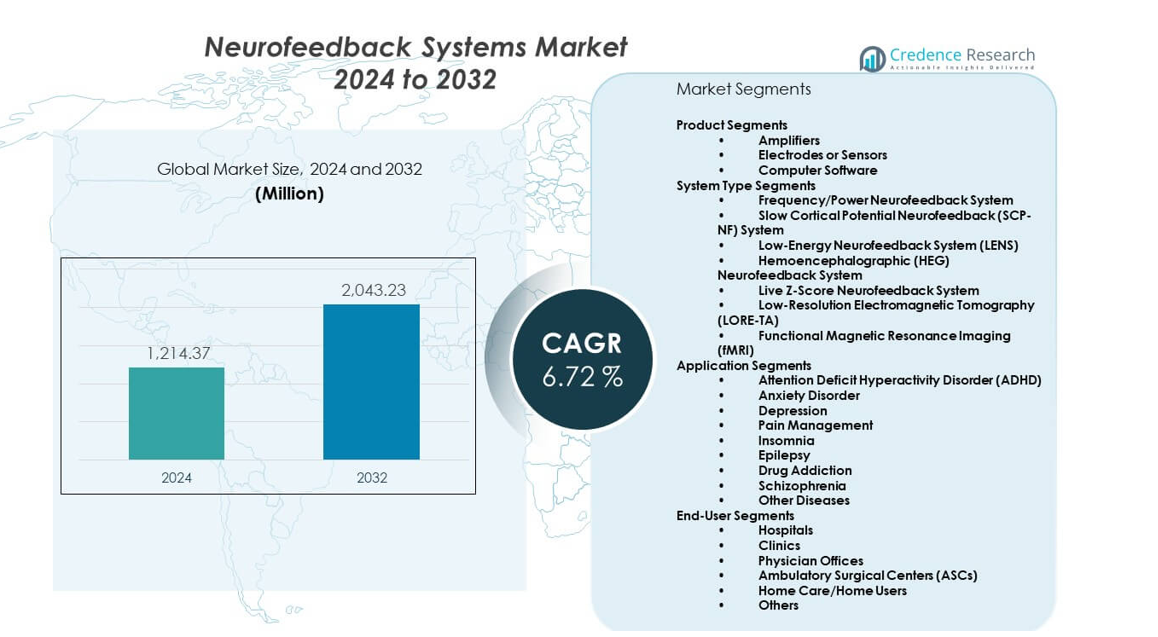
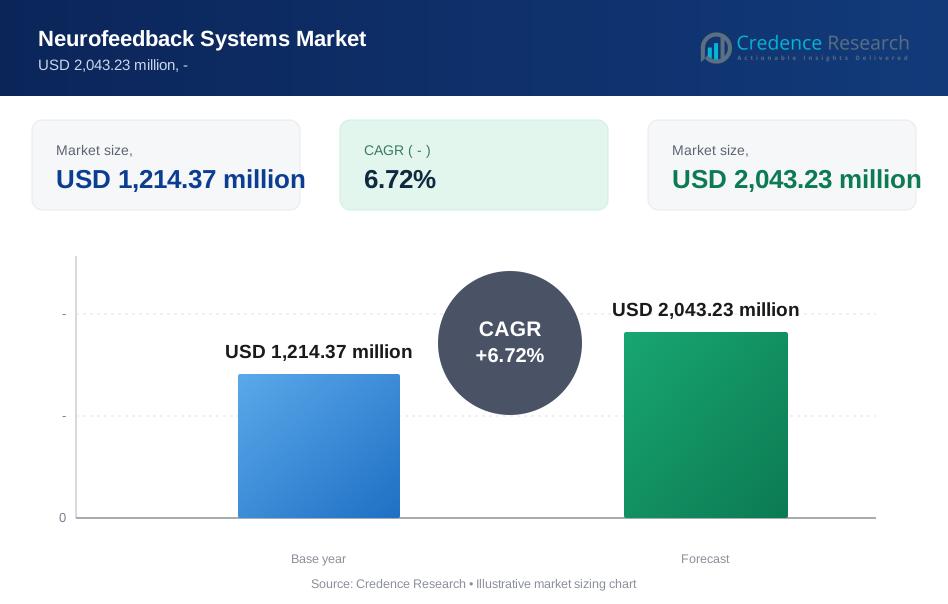
The Neurofeedback Systems Market is projected to grow from USD 1,214.37 million in 2024 to an estimated USD 2,043.23 million by 2032, with a compound annual growth rate (CAGR) of 6.72% from 2024 to 2032.
| REPORT ATTRIBUTE | DETAILS |
|---|---|
| Historical Period | 2020-2023 |
| Base Year | 2024 |
| Forecast Period | 2025-2032 |
| Neurofeedback Systems Market Size 2024 | USD 1,214.37 million |
| Neurofeedback Systems Market CAGR | 6.72% |
| Neurofeedback Systems Market Size 2032 | USD 2,043.23 million |
Stronger awareness of neurotherapy lifts interest in solutions that support cognitive improvement. Clinics integrate systems to help patients manage attention issues, stress disorders, and behavioral challenges. Developers add AI-driven feedback loops that increase accuracy during sessions. Hospitals use neurofeedback tools to support rehabilitation for trauma and stroke cases. Wellness providers adopt advanced headsets that improve user engagement. Rising preference for drug-free approaches lifts wider demand for digital brain training across many groups.
North America leads due to strong clinical adoption and early access to advanced neurotechnology. Europe follows with steady use across mental health centers and neurorehabilitation programs. Asia Pacific is the fastest-growing region as rising healthcare investments expand neurotherapy access. Countries such as China, Japan, and South Korea advance adoption through rising awareness around cognitive wellness and growing use in sports training. Emerging markets in Latin America and the Middle East show rising interest as clinics expand brain-health services and invest in modern neurofeedback tools.
Market Insights:
- The Neurofeedback Systems Market is valued at USD 1,214.37 million in 2024 and is projected to reach USD 2,043.23 million by 2032, growing at a CAGR of 6.72%, driven by rising demand for non-invasive cognitive and behavioral therapy tools.
- North America (42%), Europe (28%), and Asia Pacific (20%) hold the largest shares due to strong clinical adoption, advanced neurotechnology infrastructure, and rising use of digital neurotherapy across rehabilitation and mental-health programs.
- Asia Pacific (fastest-growing, 20% share) expands rapidly due to increased mental-health investments, broader use in education and sports training, and growing adoption of cost-effective portable neurofeedback devices.
- Product distribution shows Amplifiers (38%) leading due to their core role in signal accuracy, followed by Electrodes/Sensors (34%) supported by rising use in clinical and home-care applications.
- Application distribution is led by ADHD (32%), followed by Anxiety Disorder (22%), reflecting strong clinical preference for drug-free cognitive regulation tools across major treatment centers.
Market Drivers:
Rising Need For Non-Invasive Cognitive And Behavioral Support Solutions
Growing demand for drug-free interventions pushes strong adoption across clinics. Many patients prefer methods that avoid long medication cycles. Hospitals integrate systems that support attention, anxiety, and mood therapy. Providers value tools that track brain-wave activity in real time. Software advances improve accuracy during neurofeedback sessions. The Neurofeedback Systems Market gains momentum due to its role in mental health programs. Therapy centers use portable units to expand care access. Wellness groups promote these tools for stress reduction and performance support. User interest strengthens due to wider awareness of brain-training benefits.
- For instance, Neuroelectrics’ Starstim device delivers multi-modal neurofeedback with 8- and 32-channel EEG configurations, enabling real-time monitoring across clinical programs.
Growing Deployment Of Neurofeedback Systems Across Rehabilitation And Neurology Programs
Rehabilitation centers use systems to support recovery after trauma or stroke. Clinicians rely on structured sessions to help patients regain cognitive control. Neurology units deploy advanced EEG interfaces that monitor brain rhythms. AI-enhanced tools guide users through personalized training loops. Developers upgrade algorithms to ensure consistent output in varied conditions. Hospitals expand procurement due to wider use in neurotherapy protocols. Sports groups explore neurofeedback for motor focus improvement. The Neurofeedback Systems Market benefits from stronger integration into structured rehab plans. Broader clinical endorsement lifts professional confidence.
- For instance, Thought Technology’s ProComp Infiniti supports 8-channel EEG recording tailored for neurorehabilitation workflows and standardized therapy protocols.
Strong Uptake Of Portable And Home-Use Neurofeedback Devices Across Consumer Groups
Portable systems gain traction among users seeking personal wellness support. Direct-to-consumer models attract interest from first-time learners. Compact units allow flexible use during daily routines. Developers promote headsets with simple interfaces for broad adoption. Cloud-linked dashboards help users track progress across long periods. Home-care applications grow due to rising mental health awareness. Wellness platforms integrate guided neurofeedback routines. The Neurofeedback Systems Market sees strong growth from this consumer shift. Remote access appeals to high-stress user groups across many regions.
Rising Investment In Digital Therapeutics And AI-Driven Neurofeedback Platforms
Digital therapeutics firms expand solutions that blend neurofeedback with behavioral tools. AI-powered systems offer faster interpretation during each session. Clinics value data-driven insights that reduce assessment gaps. Software developers refine machine-learning models to detect performance patterns. Hospitals explore these systems to enhance therapy planning. Broader regulatory support lifts adoption across structured care. Investors fund developers focused on digital brain-health tools. The Neurofeedback Systems Market strengthens due to this innovation wave. Technology progress helps lift accuracy and reinforces industry credibility.
Market Trends:
Expansion Of Hybrid Neurofeedback Models That Combine Cognitive Training And Behavioral Monitoring
Developers design systems that merge neurofeedback with behavioral tracking features. Clinics use hybrid platforms to monitor both brain activity and daily patterns. Integrated dashboards help therapists plan structured care. AI tools identify user-specific stress or focus triggers. Wearable sensors supply continuous data during routine activities. Hybrid designs appeal to wellness operators promoting full-spectrum brain care. Many rehab teams use these tools to track detailed patient responses. The Neurofeedback Systems Market adopts hybrid formats across regions. Wider integration boosts user satisfaction and engagement.
- For instance, InteraXon’s Muse headband combines EEG with motion and heart-rate sensors, recording data across 4 EEG channels to support cognitive-behavioral feedback models.
Growing Interest In Cloud-Based Neurofeedback Platforms With Real-Time Data Access
Cloud-linked systems help therapists access patient data from remote sites. Clinics use centralized dashboards to monitor session results across locations. Cloud models support unified progress tracking with strong accuracy. Remote specialists guide sessions without physical presence. Software upgrades reach users instantly through secure networks. Cloud-based systems help teams scale without adding heavy hardware loads. Families value remote-care support for children managing focus issues. The Neurofeedback Systems Market gains visibility through cloud-first strategies. Higher connectivity speeds support wider distribution.
- For instance, Myndlift offers a cloud-connected neurofeedback platform integrating 2-channel EEG headsets that stream encrypted data to clinicians for remote supervision.
Rapid Adoption Of Wearable EEG And Sensor-Based Neurofeedback Solutions
Wearable EEG devices deliver lighter and more comfortable user experiences. Developers design compact sensors that improve signal clarity. Athletes use wearables to help manage focus before training events. Students explore wearable tools to improve attention. Clinicians value systems that reduce setup time. Software refinements strengthen real-time interpretation during sessions. Growth of smart health devices increases user interest. The Neurofeedback Systems Market sees strong momentum in wearable-linked formats. Portable designs help expand adoption among younger groups.
Shift Toward Personalized Neurofeedback Programs Tailored To User Behavior Patterns
Clinics use data-driven tools to create tailored training paths. Algorithms detect patterns that influence cognitive performance. Personalized dashboards show detailed progress metrics. Many patients respond well to structured plans based on their brain rhythms. Software models adapt stimulus changes during each session. Therapists value the precision this approach delivers. Personalized programs help raise patient compliance near long-term goals. The Neurofeedback Systems Market shifts toward these adaptive formats. User satisfaction improves due to training relevance.
Market Challenges Analysis:
High Equipment Costs And Limited Standardization Across Neuroscience Protocols
High upfront prices restrict access for smaller clinics. Many centers avoid upgrades due to cost-sensitive budgets. Lack of standard protocols creates variation between therapy outcomes. Clinicians face difficulty comparing results across different system brands. Developers struggle to align software outputs with common benchmarks. Inconsistent training quality affects patient confidence. New users need guidance before their first sessions. The Neurofeedback Systems Market faces slower expansion in price-sensitive areas. Wider affordability efforts could improve adoption across underserved regions.
Shortage Of Skilled Neurofeedback Practitioners And Slow Regulatory Alignment
Limited availability of trained specialists reduces service reach. Many regions lack structured certification initiatives. Complex EEG interpretation requires advanced knowledge. Inexperienced users face steep learning curves during early stages. Regulatory clarity for digital brain-care tools remains incomplete. Developers navigate varied regional rules during launches. Slow approvals delay system availability in key markets. The Neurofeedback Systems Market sees delays where rules remain unclear. Clearer guidance and training programs can lift future adoption.
Market Opportunities:
Rising Scope For Neurofeedback Integration In Corporate Wellness, Sports Training, And Education Programs
Corporations explore neurofeedback tools to support employee focus and stress control. Sports groups integrate training routines that help with mental readiness. Schools test systems that improve classroom attention. Clinics partner with wellness providers to expand reach. AI-enabled dashboards support easy implementation across large groups. Developers design affordable packages for institutional buyers. The Neurofeedback Systems Market benefits from broader sector participation. Expansion into structured programs creates strong revenue potential.
Growing Expansion Potential In Emerging Markets Supported By Digital Health Investments
Emerging regions invest in modern mental health infrastructure. Telehealth networks help reach users in remote locations. Clinics adopt portable neurofeedback platforms with guided software. Hospitals explore low-cost models to support rehabilitation services. Training partnerships help build practitioner skills. Developers gain advantage by offering multi-language platforms. Demand rises with higher awareness around brain-wellness solutions. The Neurofeedback Systems Market can scale faster through localized strategies. Widening digital adoption strengthens long-term growth.
Market Segmentation Analysis:
Product Segments
Amplifiers lead due to their critical role in capturing accurate brain signals. Electrodes or sensors hold steady demand because they support real-time monitoring across clinical and home settings. Computer software grows fast due to rising adoption of AI-enabled analytics and cloud-linked platforms. The Neurofeedback Systems Market gains strength from deeper integration of hardware and software tools that improve precision and session quality.
- For instance, BrainMaster Technologies’ Discovery 24E amplifier captures 24-channel EEG with high-resolution 24-bit sampling, supporting clinical-grade signal precision.
System Type Segments
Frequency/Power Neurofeedback Systems secure wide use due to flexible training applications. SCP-NF systems expand their role in supporting cognitive regulation programs. LENS solutions gain attention for quicker session cycles. HEG systems see strong demand across wellness and focus-training programs. Live Z-Score systems grow due to their structured feedback loops. LORE-TA tools attract specialists that require deeper brain-mapping detail. fMRI-based systems remain niche but gain interest in advanced research programs.
- For instance, NeuroGuide’s LORE-TA Z-score system provides 19-channel quantitative EEG mapping used for advanced neurophysiological assessment and training.
Application Segments
ADHD treatment accounts for major use due to strong evidence supporting neurofeedback outcomes. Anxiety and depression programs use structured protocols that improve emotional regulation. Pain management teams adopt systems to support chronic condition control. Insomnia and epilepsy programs integrate tailored brain-wave training modules. Centers exploring drug addiction and schizophrenia therapies expand use across neurobehavioral cases. Other disease categories widen the clinical reach of neurofeedback platforms.
End-User Segments
Hospitals integrate neurofeedback into broader neurorehabilitation programs. Clinics deploy portable systems to support mental health and behavioral therapy. Physician offices adopt compact units for focused cognitive assessments. ASCs use structured systems for short-session interventions. Home users drive strong adoption of wearable neurofeedback devices.
Segmentation:
Product Segments
- Amplifiers
- Electrodes or Sensors
- Computer Software
System Type Segments
- Frequency/Power Neurofeedback System
- Slow Cortical Potential Neurofeedback (SCP-NF) System
- Low-Energy Neurofeedback System (LENS)
- Hemoencephalographic (HEG) Neurofeedback System
- Live Z-Score Neurofeedback System
- Low-Resolution Electromagnetic Tomography (LORE-TA)
- Functional Magnetic Resonance Imaging (fMRI)
Application Segments
- Attention Deficit Hyperactivity Disorder (ADHD)
- Anxiety Disorder
- Depression
- Pain Management
- Insomnia
- Epilepsy
- Drug Addiction
- Schizophrenia
- Other Diseases
End-User Segments
- Hospitals
- Clinics
- Physician Offices
- Ambulatory Surgical Centers (ASCs)
- Home Care/Home Users
- Others
Regional Segments
- North America
- U.S.
- Canada
- Mexico
- Europe
- Germany
- France
- U.K.
- Italy
- Spain
- Rest of Europe
- Asia Pacific
- China
- Japan
- India
- South Korea
- South-east Asia
- Rest of Asia Pacific
- Latin America
- Brazil
- Argentina
- Rest of Latin America
- Middle East & Africa
- GCC Countries
- South Africa
- Rest of the Middle East and Africa
Regional Analysis:
North America
North America holds the largest share of the Neurofeedback Systems Market due to strong clinical adoption and early integration of digital neurotherapy tools. Hospitals and clinics use advanced EEG-based systems to support ADHD, anxiety, and cognitive rehabilitation programs. High awareness of drug-free mental health treatments strengthens demand across adult and pediatric groups. Research institutions adopt high-end platforms for neuroscientific studies. Home-use devices gain strong traction among wellness users seeking stress and focus improvement. The region maintains leadership through steady investment in AI-enabled neurofeedback technologies. It continues to shape global standards for product quality and clinical validation.
Europe
Europe accounts for the second-largest share, supported by structured neurotherapy programs across Germany, the United Kingdom, France, and the Netherlands. Clinics deploy neurofeedback solutions to support behavioral disorders, sleep issues, and chronic stress management. Neurology centers integrate advanced systems into rehabilitation pathways. Strong regulatory frameworks encourage careful adoption of certified devices. Home-use models expand across wellness and focus-training applications. Growing research investments strengthen the foundation for neurofeedback innovation. The Neurofeedback Systems Market benefits from broad acceptance among mental health professionals in this region.
Asia Pacific
Asia Pacific holds a fast-rising share driven by expanding mental health infrastructure across China, Japan, South Korea, and India. Hospitals integrate neurofeedback into neurorehabilitation and cognitive therapy services. Growing awareness of non-invasive treatments increases demand among younger users. Sports and education sectors explore neurofeedback to improve focus and performance. Local manufacturers introduce cost-effective systems that support wider access. Telehealth networks help deliver guided sessions to remote areas. The region grows faster due to strong population size and rising adoption of digital brain-health tools.
Key Player Analysis:
- BrainMaster Technologies, Inc.
- BEE Medic GmbH
- Mitsar Co. Ltd.
- Thought Technology Ltd.
- Myndlift Ltd.
- Mind Media
- NeuroCare Group AG
- Neurobit Systems
- Narbis
- Mindfield Biosystems Ltd.
- NeuroSky Inc.
- InteraXon Inc.
- Neuroelectrics Corporation
- NIRx Medical Technologies LLC
- Brain Vision LLC
- Brainquiry
- Wearable Sensing
- Emotiv
Competitive Analysis:
Competition in the Neurofeedback Systems Market centers on product innovation, software accuracy, and clinical validation. Leading companies invest in EEG signal quality, AI-driven analytics, and user-friendly interfaces to secure stronger market presence. Developers enhance wearable designs to attract wellness and home users. Clinical providers prefer systems with proven reliability across ADHD, anxiety, and rehabilitation programs. Firms strengthen distribution networks to improve access in hospitals and clinics. It gains further momentum through partnerships with mental health centers and training institutes. Established brands also focus on regulatory approvals to maintain trust across regions.
Recent Developments:
- In November 2025, NeuroSky Inc. announced a transformative joint venture with ZKTeco, a Chinese multimodal AI and intelligent systems innovator. Announced on November 17, 2025, this partnership combines NeuroSky's industry-leading EEG and ECG biosensing technology with ZKTeco's strengths in BioCV, AIoT, and hardware ecosystems. The joint venture focuses on delivering "Chip + Emotion Cloud + Industry Ecosystem" solutions, launching an Emotion Cloud Services Platform for workforce attention training, emotional wellness, and EEG-based identity authentication applications. The global supply chain spans manufacturing and deployment networks across China, Thailand, the United States, Saudi Arabia, and Spain, with backing from the 2025 Bangkok Declaration on Brain-Computer Interfaces co-led by both companies.
- In Canada, Interaxon Inc. unveiled Muse S Athena in March 2025, representing a significant advancement in consumer brain health technology. Announced on March 17, 2025, Athena became the world's first consumer wearable integrating dual-brain sensors: electroencephalography (EEG) for brain activity monitoring and functional near-infrared spectroscopy (fNIRS) for measuring oxygen levels in the frontal cortex. In October 2025, Interaxon launched enhanced sleep platform features including AI Coach, Deep Sleep Stimulation technology, and Smart Alarm functionality, expanding Muse's capabilities beyond meditation into comprehensive cognitive fitness monitoring. Available at $474.99 USD, these platforms deliver research-grade neuroscience accessibility for everyday cognitive fitness and brain health optimization.
- In February 2025, NeuroCare Group AG announced a EUR 19.3 million investment from Impact Expansion (Luxembourg) and follow-on investment from existing shareholder TVM Capital Healthcare. This capital injection, announced on February 5, 2025, supports the company's global expansion strategy and enhanced development of its best-practice mental health platform integrating rTMS, QEEG, neurofeedback, and cloud-based clinical tools for personalized treatment delivery.
Report Coverage:
The research report offers an in-depth analysis based on Product Segments, System Type Segments, Application Segments, End-User Segments, and Regional Segments. It details leading market players, providing an overview of their business, product offerings, investments, revenue streams, and key applications. Additionally, the report includes insights into the competitive environment, SWOT analysis, current market trends, as well as the primary drivers and constraints. Furthermore, it discusses various factors that have driven market expansion in recent years. The report also explores market dynamics, regulatory scenarios, and technological advancements that are shaping the industry. It assesses the impact of external factors and global economic changes on market growth. Lastly, it provides strategic recommendations for new entrants and established companies to navigate the complexities of the market.
Future Outlook:
- Growth in clinical neurotherapy programs will expand adoption across major healthcare networks.
- Rising interest in non-invasive mental health tools will lift demand among younger users.
- AI-driven neurofeedback analytics will strengthen therapy precision and personalization.
- Home-use systems will gain wider traction through affordable and portable device launches.
- Partnerships between clinics and digital therapeutics firms will improve structured care delivery.
- Wearable EEG technology will support stronger uptake in wellness, sports, and education sectors.
- Regulatory clarity will improve adoption across Europe, North America, and Asia Pacific.
- Training programs for practitioners will expand, reducing skill shortages.
- Cloud-based dashboards will enhance long-term patient monitoring and remote supervision.
- Strong consumer awareness around brain-health solutions will support steady global growth.
Request a Free Sample
Fill in your details and we'll send you a free sample report.
- Sample data tables & charts
- Research methodology
Need a Custom Version of This Report?
Tailor the scope, geography, or segments to your exact requirements.
- Custom geography or segment scope
- Direct access to our analyst team
Frequently Asked Questions
What is the current market size for the Neurofeedback Systems Market, and what is its projected size in 2032?
At what Compound Annual Growth Rate is the Neurofeedback Systems Market projected to grow between 2025 and 2032?
What are the primary factors fueling the growth of the Neurofeedback Systems Market?
Who are the major players in this market?
Who are the leading companies in the Neurofeedback Systems Market?
Table of Content
Chapter 1. Report Introduction
- 1.1 Report Description & Purpose
- 1.1.1 Report Title & Market Definition
- 1.1.2 Unique Selling Propositions (USP) & Key Differentiators
- 1.1.3 Value Proposition for Stakeholders
- 1.2 Research Objectives
- 1.2.1 Market Sizing Objectives (Volume & Revenue)
- 1.2.2 Segmentation Objectives
- 1.2.3 Competitive Intelligence Objectives
- 1.2.4 Forecast & Scenario Objectives
- 1.3 Report Scope
- 1.3.1 Neurofeedback Systems Scope – Types & Subtypes Covered
- 1.3.2 Geographic Scope – Regions & Countries Covered
- 1.3.3 Historical Period, Base Year & Forecast Period (the historical period; forecast to the forecast period)
- 1.3.4 Inclusions & Exclusions
- 1.4 HS Code & Classification Framework
- 1.5 Currency, Units & Pricing Basis
- 1.6 Target Stakeholders
- 1.7 Limitations & Assumptions
Chapter 2. Executive Summary
- 2.1 Global Neurofeedback Systems Market Snapshot
- 2.1.1 Market Size – Historical (the historical period) & Forecast (the forecast period) (base year: USD 1,214.37 million → forecast year: USD 2,043.23 million)
- 2.1.2 Volume & Revenue – Global Totals
- 2.1.3 Key Market Highlights – Top Five Facts
- 2.2 Neurofeedback Systems Market Segmentation Snapshot
- 2.2.1 Market Split by Region – vs.
- 2.3 Competitive Snapshot
- 2.3.1 Top 10 Players by Revenue Share –
- 2.3.2 Top 10 Players by Volume Share –
- 2.3.3 Recent Strategic Developments (18-Month Summary)
- 2.4 Key Investment Highlights & Strategic Conclusions
Chapter 3. Neurofeedback Systems Market Dynamics & Industry Analysis
- 3.1 Market Overview & Context
- 3.1.1 Neurofeedback Systems Market Position in the Broader Automotive Value Chain
- 3.1.2 OEM vs. Replacement Market Dynamics
- 3.1.3 Market Maturity & Development Stage by Region
- 3.2 Neurofeedback Systems Market Drivers
- 3.3 Neurofeedback Systems Market Restraints & Challenges
- 3.4 Neurofeedback Systems Market Opportunities
- 3.5 Porter's Five Forces Analysis
- 3.5.1 Threat of New Entrants
- 3.5.2 Bargaining Power of Suppliers
- 3.5.3 Bargaining Power of Buyers
- 3.5.4 Threat of Substitutes
- 3.5.5 Competitive Rivalry – Intensity Assessment
- 3.6 Neurofeedback Systems Value Chain Analysis
- 3.6.1 Upstream – Raw Material/Input Suppliers
- 3.6.1.1 Raw Material/Input 1
- 3.6.1.2 Raw Material/Input 2
- 3.6.1.3 Raw Material/Input 3
- 3.6.2 Midstream – Production/Manufacturing/Service Delivery
- 3.6.2.1 Production/Process Overview
- 3.6.2.2 Key Facility Locations & Capacity by Manufacturer
- 3.6.3 Downstream – Distribution & End Consumer
- 3.6.3.1 Primary Channel – B2B/OEM
- 3.6.3.2 Secondary Channels – Dealer, Retail, Online, Direct
- 3.6.4 Value Chain Profitability Analysis
- 3.6.1 Upstream – Raw Material/Input Suppliers
- 3.7 PESTEL Analysis
- 3.7.1 Political Factors
- 3.7.2 Economic Factors
- 3.7.3 Social Factors
- 3.7.4 Technological Factors
- 3.7.5 Environmental Factors
- 3.7.6 Legal Factors
- 3.8 Neurofeedback Systems Supply Chain Analysis
- 3.8.1 Raw Material/Input Supply Risk Assessment
- 3.8.2 Manufacturing Concentration Risk (Geographic Exposure)
- 3.8.3 Trade Disruption Impact Analysis
- 3.9 Regulatory & Policy Landscape
Note: The regulatory and policy landscape section covers regulations based on their applicability to the market, Neurofeedback Systems category, geography, and scope of the study. Only regulatory frameworks with a material impact on operations, compliance, trade, sustainability, or market access are analyzed in detail.
Chapter 4. Key Investment Pockets & Opportunity Analysis
- 4.1 Neurofeedback Systems Market Attractiveness Analysis
- 4.1.1 By Region – Investment Attractiveness Matrix (Volume × CAGR)
- 4.2 Absolute Revenue Growth Opportunity
- 4.2.1 By Region – Absolute USD Growth Through the forecast period
- 4.3 Incremental Volume Opportunity
- 4.3.1 By Region – Incremental Volume Through the forecast period
- 4.3.2 Segment – Incremental Volume
- 4.4 Emerging Submarket Opportunity Deep Dive (Subject to Applicability)
- 4.5 Emerging Market Opportunity Scorecards
- 4.5.1 United States
- 4.5.2 Europe
- 4.5.3 Asia
- 4.5.4 Middle East & Africa
Note: Emerging Market Opportunity Scorecards will be included based on relevance and strategic importance. Regions listed are indicative and may vary depending on data availability and market dynamics.
Chapter 5. Neurofeedback Systems Import-Export Analysis & Trade Flows
- 5.1 Global Trade Overview
- 5.1.1 Global Export Value by Country (the historical period)
- 5.1.2 Global Export Volume by Country (the historical period)
- 5.1.3 Global Import Value by Country (the historical period)
- 5.1.4 Global Import Volume by Country (the historical period)
- 5.1.5 Net Trade Balance by Country (the historical period)
- 5.2 Export Analysis – Segment
- 5.2.1 Type 1 (HS Code)
- 5.2.2 Type 2 (HS Code)
- 5.2.3 Type 3 (HS Code)
- 5.2.4 Type 4 (HS Code)
- 5.2.5 Type 5 (HS Code)
- 5.3 Import Analysis – Segment
- 5.3.1 Type 1 (HS Code)
- 5.3.2 Type 2 (HS Code)
- 5.3.3 Type 3 (HS Code)
- 5.3.4 Type 4 (HS Code)
- 5.3.5 Type 5 (HS Code)
- 5.4 Average Unit Trade Prices
- 5.4.1 Average Export Price – Segment & Country
- 5.4.2 Average Import Price – Segment & Source Country
- 5.4.3 Price Trends (the historical period)
- 5.5 Key Trade Route Analysis
- 5.5.1 Trade Route 1
- 5.5.2 Trade Route 2
- 5.5.3 Trade Route 3
- 5.5.4 Trade Route 4
- 5.5.5 Trade Route 5
- 5.6 Trade Policy Impact Assessment
- 5.6.1 US Anti-Dumping & Section 301 Tariffs
- 5.6.2 EU Customs Union Impact
- 5.6.3 Major Free Trade Agreements
- 5.6.4 USMCA Rules of Origin
Note: Trade policy analysis will be included only where relevant to the Neurofeedback Systems market.
Chapter 6. Competitive Landscape & Company Benchmarking
- 6.1 Neurofeedback Systems Market Concentration & Structure
- 6.1.1 Herfindahl-Hirschman Index (HHI) – vs.
- 6.1.2 Tier 1, Tier 2 & Tier 3 Market Structure
- 6.1.3 Global, Regional & Local Player Dynamics
- 6.2 Neurofeedback Systems Market Share Analysis –
- 6.2.1 Global Revenue Share by Company
- 6.2.2 Global Volume Share by Company
- 6.2.3 Regional Revenue Share
- 6.2.4 Market Share Evolution ( vs. )
- 6.2.5 OEM Segment Share by Company
- 6.2.6 Replacement Segment Share by Company
- 6.3 Production/Delivery Capacity & Facility Analysis
- 6.3.1 Global Installed Capacity
- 6.3.2 Capacity Utilization Rates
- 6.3.3 Production/Output Volume
- 6.3.4 Facility Locations & Capacity Map
- 6.3.5 Planned Capacity Additions
- 6.4 Neurofeedback Systems Competitive Benchmarking Matrix
- 6.4.1 Revenue, Volume, CAGR & Profitability Comparison
- 6.4.2 Channel Revenue Mix
- 6.4.3 Geographic Revenue Exposure
- 6.4.4 R&D Intensity
- 6.4.5 Sustainability Maturity
- 6.5 Strategic Developments in Neurofeedback Systems (Last 24 Months)
- 6.5.1 Mergers, Acquisitions & Divestments
- 6.5.2 New Neurofeedback Systems Launches
- 6.5.3 Facility Expansions
- 6.5.4 Strategic Alliances, Joint Ventures & Partnerships
- 6.5.5 Distribution Expansion & Market Entry
- 6.5.6 Sustainability & ESG Initiatives
- 6.6 Competitive Strategy Mapping
- 6.6.1 Leader, Challenger, Follower & Niche Classification
- 6.6.2 Pricing Strategy Comparison
- 6.6.3 Channel Strategy Matrix
Note: Strategic developments are included based on their materiality and the availability of reliable information.
Chapter 7. Global Neurofeedback Systems Market – By Distribution Channel
- 7.1 Segment Overview
- 7.1.1 Volume & Revenue Split by Channel ( & )
- 7.1.2 Channel Mix Evolution (the forecast period)
Chapter 8. Regional Market Analysis – Global Overview
- 8.1 Global Regional Overview
- 8.1.1 Regional Volume Share
- 8.1.2 Regional Revenue Share
- 8.1.3 Regional Volume by Region
- 8.1.4 Regional Revenue by Region
- 8.1.5 Regional Forecast Through the forecast period
- 8.2 Cross-Regional Segment Analysis
- 8.2.1 By Distribution Channel
- 8.2.2 By Brand/Price Tier
Chapter 9. North America Neurofeedback Systems Market
- 9.1 United States
- 9.2 Canada
- 9.3 Mexico
Chapter 10. Europe Neurofeedback Systems Market
- 10.1 Germany
- 10.2 France
- 10.3 Italy
- 10.4 United Kingdom
- 10.5 Spain
- 10.6 Poland
- 10.7 Russia
- 10.8 Netherlands
- 10.9 Belgium
- 10.10 Sweden
- 10.11 Denmark
- 10.12 Norway
- 10.13 Rest of Europe
Chapter 11. Asia Pacific Neurofeedback Systems Market
- 11.1 China
- 11.2 India
- 11.3 Japan
- 11.4 South Korea
- 11.5 Thailand
- 11.6 Indonesia
- 11.7 Vietnam
- 11.8 Malaysia
- 11.9 Australia
- 11.10 Rest of Asia Pacific
Chapter 12. Latin America Neurofeedback Systems Market
- 12.1 Brazil
- 12.2 Argentina
- 12.3 Colombia
- 12.4 Chile
- 12.5 Rest of Latin America
Chapter 13. Middle East Neurofeedback Systems Market
- 13.1 Saudi Arabia
- 13.2 United Arab Emirates
- 13.3 Turkey
- 13.4 Israel
- 13.5 Iran
- 13.6 Rest of the Middle East
Chapter 14. Africa Neurofeedback Systems Market
- 14.1 South Africa
- 14.2 Egypt
- 14.3 Nigeria
- 14.4 Morocco
- 14.5 Rest of Africa
Chapter 15. Neurofeedback Systems Company Profiles
- 15.1 [Company 01]
- 15.1.1 Company Overview
- 15.1.2 Key Management Personnel
- 15.1.3 Products & Services Portfolio
- 15.1.4 Financial Performance
- 15.1.5 Key Market Focus & Geographic Presence
- 15.1.6 Recent Developments & Strategic Initiatives
Note: The company profile list is preliminary and may change based on research findings, market developments, data availability, and client requirements.
Chapter 16. Appendices
- Appendix A – List of Abbreviations & Acronyms
- Appendix B – Industry Classification Code Reference – Full Series
- Appendix C – Production & Capacity Data Tables
- Appendix D – End-Use & Demand Base Tables
- Appendix E – Consumption & Replacement Rate Assumptions
- Appendix F – ASP Reference Tables
- Appendix G – Manufacturing & Facility Database
- Appendix H – Import-Export Data Tables
- Appendix I – Regulatory Summary Tables
- Appendix J – Primary Research Participant List (Anonymized)
- Appendix K – Primary Research Questionnaire Framework
- Appendix L – Data Sources & Bibliography
- Appendix M – Market Size Divergence & Source Comparison
Chapter 17. Research Methodology
- 17.1 Research Framework & Philosophy
- 17.2 Secondary Research – Sources, Hierarchy & Data Extraction
- 17.3 Data Modeling – Bottom-Up & Top-Down Market Sizing
- 17.4 Primary Research – Stakeholder Framework, LOI & Sample Sizes
- 17.5 Forecast Methodology – Regression, Scenario & Sensitivity Analysis
- 17.6 Quality Control – Four-Layer Validation Framework
- 17.7 Limitations & Standard Assumptions
- 17.8 Disclaimer
