
Market Overview:
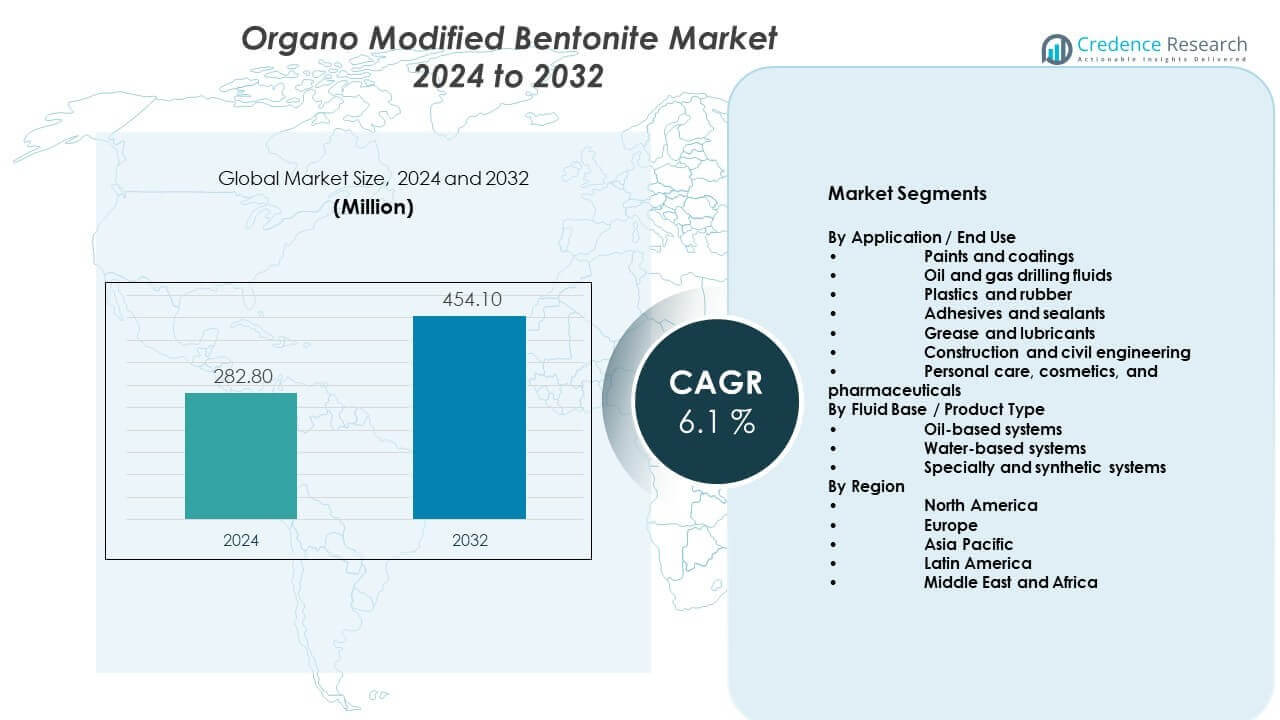
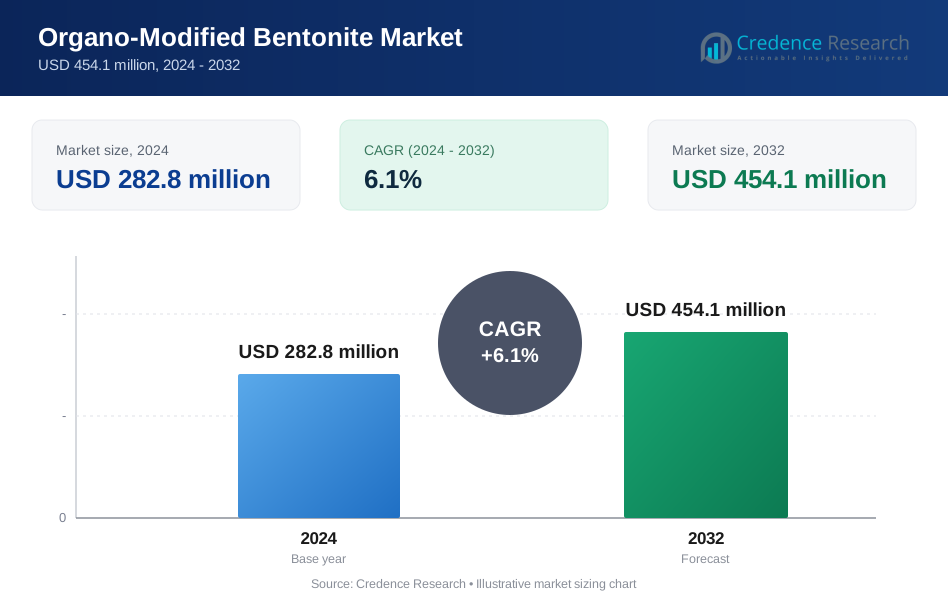
The Organo modified bentonite market is projected to grow from USD 282.8 million in 2024 to an estimated USD 454.1 million by 2032, registering a compound annual growth rate of 6.1% from 2024 to 2032.
| REPORT ATTRIBUTE | DETAILS |
|---|---|
| Historical Period | 2020-2023 |
| Base Year | 2024 |
| Forecast Period | 2025-2032 |
| Organo-Modified Bentonite Market Size 2024 | USD 283.8 million |
| Organo-Modified Bentonite Market, CAGR | 6.1% |
| Organo-Modified Bentonite Market Size 2032 | USD 454.1 million |
Growth in the Organo modified bentonite market is driven by rising use in oilfield drilling fluids, where the material enhances viscosity and suspension stability. Paints and coatings producers rely on organo modified bentonite to achieve smooth application and storage stability. Grease and lubricant manufacturers adopt these additives for thermal resistance and performance consistency. Environmental regulations also support demand for low-toxicity and efficient additives. Infrastructure development and industrial production further strengthen consumption across construction chemicals and process industries.
North America leads the Organo modified bentonite market due to strong oil and gas drilling activity and mature coatings industries. The United States shows wide adoption across energy, lubricants, and industrial formulations. Europe follows, supported by advanced manufacturing and strict environmental standards in countries such as Germany and France. Asia Pacific emerges as a high-growth region, driven by industrial expansion in China and India. Latin America shows gradual uptake linked to resource extraction and infrastructure projects.
Market Insights:
- The market grows from USD 282.8 million in 2024 to USD 454.1 million by 2032, at 6.1% CAGR.
- North America (32%), Asia Pacific (30%), and Europe (26%) lead due to drilling, manufacturing scale, and regulations.
- Asia Pacific is the fastest-growing region with 30% share, driven by industrial growth and infrastructure spending.
- By application, oil and gas drilling fluids lead with about 38% share, followed by paints and coatings at 24%.
- By product type, oil-based systems hold about 55% share, while water-based and specialty systems share 45%.
Market Drivers:
Rising Demand From Oilfield Drilling And Completion Fluids
The Organo modified bentonite market benefits from steady oilfield activity across major producing regions. Drilling fluid systems require strong viscosity control under pressure. This material supports stable suspension of cuttings. Operators prefer additives with predictable performance. It handles temperature variation well. Shale and deep well projects raise usage levels. Service companies focus on formulation reliability. This driver sustains long-term industrial demand.
- For instance, MI-SWACO (Schlumberger) reports that its organophilic clay systems maintain rheological stability in oil-based muds at temperatures exceeding 150 °C, supporting extended drilling intervals without fluid failure.
Growing Adoption In Industrial Coatings And Surface Protection Applications
Coatings producers seek additives that improve flow control and storage stability. The Organo modified bentonite market gains traction in solvent-based systems. Manufacturers value controlled thickening behavior. The material supports uniform film formation. Industrial coatings require resistance to settling issues. Performance consistency improves production efficiency. Demand grows from protective coating segments. This driver strengthens volume consumption.
- For instance, BYK (ALTANA Group) confirms that its organoclay additives deliver stable yield values in industrial coatings after six months of storage, reducing pigment settling during long-term shelf testing.
Expansion Of Grease And Lubricant Manufacturing Activities Globally
Lubricant producers require additives that tolerate heat and load stress. The Organo modified bentonite market addresses this technical requirement effectively. The material improves structure retention in greases. Equipment operators prefer longer lubrication cycles. Stable formulations reduce maintenance frequency. Automotive and industrial machinery sectors support demand. Producers invest in premium grease formulations. This driver supports stable market growth.
Rising Emphasis On Process Stability Across Industrial Manufacturing
Process industries require additives with repeatable functional behavior. The Organo modified bentonite market aligns with strict quality benchmarks. Chemical processors seek batch consistency. Reliable rheology control improves throughput rates. Manufacturing lines benefit from fewer formulation errors. Quality compliance drives supplier preference. End users favor proven performance grades. This factor supports sustained adoption.
Market Trends:
Shift Toward Customized Grades For Specific End-Use Requirements
The Organo modified bentonite market shows a shift toward tailored product grades. Producers develop solutions for targeted applications. End users demand precise viscosity profiles. Customization improves formulation compatibility. Suppliers invest in application testing programs. Technical validation supports buyer confidence. Customers prefer solution-driven suppliers. This trend reshapes competitive strategies.
- For instance, Laviosa Chimica Mineraria developed customized organoclay grades optimized for grease formulations that retain structural consistency after 100,000 stroke penetration tests, meeting strict lubricant performance standards.
Growing Use In Specialty Chemical And High-Value Formulations
Specialty chemical producers expand additive use in advanced formulations. The Organo modified bentonite market gains presence in niche products. Demand rises from adhesives and sealants. Controlled flow supports application accuracy. Producers seek predictable material interaction. Performance validation supports faster adoption. Specialty segments value technical reliability. This trend adds market depth.
- For instance, Elementis plc reports that its organo-modified bentonite additives improve sag resistance in solvent-based adhesives, maintaining uniform bead profiles during vertical application tests used in industrial bonding systems.
Increasing Preference For Materials Supporting Regulatory Alignment
Regulatory scrutiny influences additive selection across industries. The Organo modified bentonite market aligns with safer formulation needs. Manufacturers reduce dependence on high-toxicity alternatives. Compliance simplifies approval processes. Buyers favor materials with documented safety records. Regulatory clarity supports long-term sourcing decisions. This trend shapes material substitution patterns. Market acceptance improves steadily.
Rising Importance Of Technical Service And Application Expertise
Customers expect support beyond basic material supply. The Organo modified bentonite market reflects this service-focused shift. Producers offer formulation guidance and trials. Technical teams assist during scale-up stages. Application success builds long-term relationships. Service quality influences contract renewals. Knowledge transfer adds supplier value. This trend favors experienced manufacturers.
Market Challenges Analysis:
Volatility In Raw Material Availability And Processing Economics
The Organo modified bentonite market faces challenges from raw material supply fluctuations. Feedstock availability varies across regions. Mining conditions affect quality consistency. Processing costs show sensitivity to energy prices. Manufacturers manage cost stability carefully. Price volatility impacts procurement planning. Smaller producers face margin pressure. Supply uncertainty affects long-term contracts.
Technical Barriers In High-Performance And Sensitive Applications
Certain applications demand narrow performance tolerances. The Organo modified bentonite market encounters limits in sensitive formulations. Compatibility issues arise with complex chemistries. Extensive testing increases development timelines. End users require proof of consistency. Qualification processes delay adoption cycles. Technical failures raise replacement risks. These barriers slow penetration in select segments.
Market Opportunities:
Expansion Across Emerging Industrial And Infrastructure Markets
The Organo modified bentonite market holds opportunity in emerging economies. Infrastructure development drives demand for construction chemicals. Local manufacturing capacity expands steadily. Industrialization raises additive consumption levels. New users seek proven performance materials. Regional suppliers form distribution partnerships. Market entry barriers remain manageable. Growth potential remains strong.
Product Innovation Focused On High-Value End Uses
Innovation creates opportunity through advanced material grades. The Organo modified bentonite market benefits from performance-focused development. High-value applications demand superior rheology control. Producers invest in formulation research. Differentiated products command premium pricing. End users reward functional reliability. Innovation strengthens competitive positioning. Long-term demand outlook remains favorable.
Market Segmentation Analysis:
By Application / End Use
The Organo modified bentonite market shows broad adoption across multiple end-use industries. Paints and coatings rely on this material for viscosity control and anti-settling performance. Oil and gas drilling fluids use it to stabilize rheology in demanding downhole conditions. Plastics and rubber formulations apply organoclay to enhance dispersion and mechanical strength. Adhesives and sealants benefit from improved flow control and storage stability. Grease and lubricants use it to maintain structure under heat and load stress. Construction and civil engineering applications depend on it for consistency in mortars and waterproofing systems. Personal care, cosmetics, and pharmaceuticals apply refined grades to achieve smooth texture and stable suspension.
- For instance, Tolsa Group confirms that its organoclay grades (such as the Pangel range) improve grease consistency and rheological stability over a wide temperature range, supporting high-load lubrication and anti-settling performance in industrial applications.
By Fluid Base / Product Type
Oil-based systems represent a key segment due to strong demand from drilling fluids and industrial coatings. These systems require organophilic behavior to maintain performance in non-aqueous environments. Water-based systems show steady growth, supported by coatings, adhesives, and construction materials seeking controlled rheology. Specialty and synthetic systems address high-temperature and chemically sensitive applications. These grades serve advanced formulations with strict performance limits. Product selection depends on compatibility, temperature tolerance, and dispersion efficiency. This segmentation reflects diverse formulation needs across industries.
- For instance, Elementis states that its BENTONE® specialty organoclay additives like BENTONE® 38 and BENTONE® 42 maintain viscosity stability in synthetic-base fluids exposed to extreme temperatures, often tested at or above 120 °C or 250 °F, supporting high-performance formulation needs in the oilfield and lubricant industries.
Segmentation:
By Application / End Use
- Paints and coatings
- Oil and gas drilling fluids
- Plastics and rubber
- Adhesives and sealants
- Grease and lubricants
- Construction and civil engineering
- Personal care, cosmetics, and pharmaceuticals
By Fluid Base / Product Type
- Oil-based systems
- Water-based systems
- Specialty and synthetic systems
By Region
- North America
- U.S.
- Canada
- Mexico
- Europe
- Germany
- France
- U.K.
- Italy
- Spain
- Rest of Europe
- Asia Pacific
- China
- Japan
- India
- South Korea
- South-east Asia
- Rest of Asia Pacific
- Latin America
- Brazil
- Argentina
- Rest of Latin America
- Middle East & Africa
- GCC Countries
- South Africa
- Rest of the Middle East and Africa
Regional Analysis:
North America
The Organo modified bentonite market in North America holds nearly 32% market share. The region benefits from strong oil and gas drilling activity. Industrial coatings and lubricant production support steady consumption. The United States leads due to advanced formulation practices. Demand remains stable across drilling fluids and specialty chemicals. Suppliers focus on performance consistency and technical support. This region shows mature but resilient demand patterns.
Europe
Europe accounts for around 26% market share in the Organo modified bentonite market. Germany, France, and Italy drive regional demand through coatings and specialty chemicals. Strict environmental standards shape material selection choices. Industrial users value compliance-ready additives. Growth remains steady across construction chemicals and lubricants. The region favors high-quality and customized grades. Strong manufacturing base supports long-term consumption.
Asia Pacific, Latin America, And Middle East & Africa
Asia Pacific represents about 30% market share and shows the fastest expansion. China and India lead demand due to industrial growth and infrastructure projects. Local producers support cost-competitive supply. Latin America holds close to 7% market share, driven by oilfield activity. Brazil and Argentina remain key contributors. The Middle East & Africa accounts for nearly 5% market share, supported by drilling and construction projects. Emerging demand strengthens regional diversification.
Key Player Analysis:
- BYK (ALTANA Group)
- Elementis plc
- Clariant
- BASF SE
- Laviosa
- Southern Clay Products
- Imerys
- Minerals Technologies Inc.
- MI-SWACO
- Tolsa
- Zhejiang Huate Industry Group
- Fenghong New Material
- Camp-Shinning
- Huawei Bentonite
- Qinghong New Material
- HongYu New Material
- Changan Renheng
- Ashapura Group
Competitive Analysis:
The Organo modified bentonite market features a mix of global specialty chemical companies and strong regional producers. Leading players focus on product performance, grade customization, and application-specific solutions. Companies compete on rheology efficiency, dispersion quality, and consistency across formulations. Large firms benefit from integrated supply chains and strong technical service teams. Regional manufacturers compete through cost efficiency and proximity to end users. Strategic partnerships support access to oilfield and coatings customers. Product differentiation remains a key competitive factor. Innovation focuses on high-temperature and low-toxicity grades. Market competition stays moderately fragmented with stable long-term positioning.
Recent Developments:
- In a significant strategic move announced on November 26, 2025, Elementis plc completed its acquisition of UK-based Alchemy Ingredients Limited for an enterprise value of approximately $22 million on a cash-free, debt-free basis. Alchemy specializes in innovative, high-quality, sustainable rheology modifier ingredients for the personal care industry, with key technologies centered on oil gelling (Sucragel® and Sapogel® families) and water gelling (Clearthix® and Sclerothix®) products. This acquisition aligns with Elementis' Elevate Elementis strategy, which prioritizes disciplined, high-quality bolt-on acquisitions to strengthen core specialty additives capabilities. Alchemy demonstrated strong organic growth with FY25 revenue expected to exceed $6 million with attractive margins. The transaction complements Elementis' existing hectorite mineral portfolio and enhances its position in the growing natural skincare market, leveraging its global sales and distribution network to scale the business. Earlier in April 2024, Elementis achieved a significant product milestone with the launch of Bentone Hydroluxe 360, an all-natural hectorite-based solution designed for suspension and stability challenges in natural formulations, achieving 100% natural certification with over 700 samples distributed following its market introduction.
- Clariant continues to advance its specialty clay portfolio with emphasis on foundry applications and sustainable formulations. The company's GEKO® bentonite product line, made from the highest quality natural clay minerals, demonstrates excellent precision and processability characteristics essential for iron and steel casting operations. Clariant's recent product innovations, including TexCare™ One Terra polymer technology announced in October 2025, reflect the company's broader commitment to sustainable specialty chemicals development, though this particular launch addresses laundry formulations rather than organo-modified bentonite applications specifically.
- Wyo-Ben Inc., a leading provider of high-quality drilling fluids and minerals, announced the acquisition of the bentonite operations of M-I Swaco (a Schlumberger division) in November 2023. The strategic acquisition, centered on bentonite operations located in Greybull, Wyoming, strengthened Wyo-Ben's position as an industry leader by combining complementary strengths and expertise. CEO David Brown emphasized the acquisition's alignment with long-term growth strategy and the ability to provide a more comprehensive suite of products and services to global customers. The combined entity benefits from M-I Swaco's established global presence and extensive customer base, enabling accelerated growth and market expansion while delivering enhanced value for customers and shareholders through improved operational efficiencies and technical innovation.
- Imerys executed two major strategic initiatives during the research period. In September 2024, the company launched Imerys Bentonite Pro, a new bentonite-based product line specifically engineered for foundry sands and drilling applications, representing the company's commitment to expanding its specialty minerals portfolio. Building on this momentum, Imerys showcased its comprehensive multimineral portfolio at the European Coatings Show 2025 (March 25-27), where the company presented sustainable solutions for paints, coatings, and building markets at Hall 3, Booth 461. A highlight of Imerys' ECS 2025 presentation was the introduction of ImprUV™, a new mineral solution designed to maximize UV durability of exterior paints by improving color stability and reducing chalking effects. This innovation reflects Imerys' strategic focus on addressing sustainability challenges in the construction industry while maintaining product performance standards.
Report Coverage:
The research report offers an in-depth analysis based on By Application / End Use and By Fluid Base / Product Type segments. It details leading market players, providing an overview of their business, product offerings, investments, revenue streams, and key applications. Additionally, the report includes insights into the competitive environment, SWOT analysis, current market trends, as well as the primary drivers and constraints. Furthermore, it discusses various factors that have driven market expansion in recent years. The report also explores market dynamics, regulatory scenarios, and technological advancements that are shaping the industry. It assesses the impact of external factors and global economic changes on market growth. Lastly, it provides strategic recommendations for new entrants and established companies to navigate the complexities of the market.
Future Outlook:
- Demand will remain steady across oilfield drilling, coatings, and lubricant formulations.
- Product customization will gain priority to meet specific end-use performance needs.
- Asia Pacific will continue to attract new capacity and supplier investments.
- Regulatory focus will encourage adoption of compliant and safer additive grades.
- Technical service capability will influence supplier selection decisions.
- Specialty chemical applications will expand organoclay usage beyond core industries.
- Innovation will target high-temperature and shear-stable formulations.
- Regional producers will strengthen competitiveness through cost and supply proximity.
- Strategic partnerships will support market access in emerging regions.
- Long-term demand will depend on industrial production stability and energy activity.
Request a Free Sample
Fill in your details and we'll send you a free sample report.
- Sample data tables & charts
- Research methodology
Need a Custom Version of This Report?
Tailor the scope, geography, or segments to your exact requirements.
- Custom geography or segment scope
- Direct access to our analyst team
Frequently Asked Questions
What is the current market size for Organo modified bentonite market, and what is its projected size in 2032?
At what Compound Annual Growth Rate is the Organo modified bentonite market projected to grow between 2025 and 2032?
Which Organo modified bentonite market segment held the largest share in 2024?
What are the primary factors fueling the growth of the Organo modified bentonite market?
Who are the leading companies in the Organo modified bentonite market?
Which region commanded the largest share of the Organo modified bentonite market in 2024?
Table of Content
Chapter 1. Report Introduction
- 1.1 Report Description & Purpose
- 1.1.1 Report Title & Market Definition
- 1.1.2 Unique Selling Propositions (USP) & Key Differentiators
- 1.1.3 Value Proposition for Stakeholders
- 1.2 Research Objectives
- 1.2.1 Market Sizing Objectives (Volume & Revenue)
- 1.2.2 Segmentation Objectives
- 1.2.3 Competitive Intelligence Objectives
- 1.2.4 Forecast & Scenario Objectives
- 1.3 Report Scope
- 1.3.1 Organo-Modified Bentonite Scope – Types & Subtypes Covered
- 1.3.2 Geographic Scope – Regions & Countries Covered
- 1.3.3 Historical Period, Base Year & Forecast Period (2024; forecast to 2032)
- 1.3.4 Inclusions & Exclusions
- 1.4 HS Code & Classification Framework
- 1.5 Currency, Units & Pricing Basis
- 1.6 Target Stakeholders
- 1.7 Limitations & Assumptions
Chapter 2. Executive Summary
- 2.1 Global Organo-Modified Bentonite Market Snapshot
- 2.1.1 Market Size – Historical (2024) & Forecast (2024-2032) (2024: USD 282.8 million → 2032: USD 454.1 million)
- 2.1.2 Volume & Revenue – Global Totals
- 2.1.3 Key Market Highlights – Top Five Facts
- 2.2 Organo-Modified Bentonite Market Segmentation Snapshot
- 2.2.1 Market Split by Region – 2024 vs. 2032
- 2.3 Competitive Snapshot
- 2.3.1 Top 10 Players by Revenue Share – 2024
- 2.3.2 Top 10 Players by Volume Share – 2024
- 2.3.3 Recent Strategic Developments (18-Month Summary)
- 2.4 Key Investment Highlights & Strategic Conclusions
Chapter 3. Organo-Modified Bentonite Market Dynamics & Industry Analysis
- 3.1 Market Overview & Context
- 3.1.1 Organo-Modified Bentonite Market Position in the Broader Automotive Value Chain
- 3.1.2 OEM vs. Replacement Market Dynamics
- 3.1.3 Market Maturity & Development Stage by Region
- 3.2 Organo-Modified Bentonite Market Drivers
- 3.3 Organo-Modified Bentonite Market Restraints & Challenges
- 3.4 Organo-Modified Bentonite Market Opportunities
- 3.5 Porter's Five Forces Analysis
- 3.5.1 Threat of New Entrants
- 3.5.2 Bargaining Power of Suppliers
- 3.5.3 Bargaining Power of Buyers
- 3.5.4 Threat of Substitutes
- 3.5.5 Competitive Rivalry – Intensity Assessment
- 3.6 Organo-Modified Bentonite Value Chain Analysis
- 3.6.1 Upstream – Raw Material/Input Suppliers
- 3.6.1.1 Raw Material/Input 1
- 3.6.1.2 Raw Material/Input 2
- 3.6.1.3 Raw Material/Input 3
- 3.6.2 Midstream – Production/Manufacturing/Service Delivery
- 3.6.2.1 Production/Process Overview
- 3.6.2.2 Key Facility Locations & Capacity by Manufacturer
- 3.6.3 Downstream – Distribution & End Consumer
- 3.6.3.1 Primary Channel – B2B/OEM
- 3.6.3.2 Secondary Channels – Dealer, Retail, Online, Direct
- 3.6.4 Value Chain Profitability Analysis
- 3.6.1 Upstream – Raw Material/Input Suppliers
- 3.7 PESTEL Analysis
- 3.7.1 Political Factors
- 3.7.2 Economic Factors
- 3.7.3 Social Factors
- 3.7.4 Technological Factors
- 3.7.5 Environmental Factors
- 3.7.6 Legal Factors
- 3.8 Organo-Modified Bentonite Supply Chain Analysis
- 3.8.1 Raw Material/Input Supply Risk Assessment
- 3.8.2 Manufacturing Concentration Risk (Geographic Exposure)
- 3.8.3 Trade Disruption Impact Analysis
- 3.9 Regulatory & Policy Landscape
Note: The regulatory and policy landscape section covers regulations based on their applicability to the market, Organo-Modified Bentonite category, geography, and scope of the study. Only regulatory frameworks with a material impact on operations, compliance, trade, sustainability, or market access are analyzed in detail.
Chapter 4. Key Investment Pockets & Opportunity Analysis
- 4.1 Organo-Modified Bentonite Market Attractiveness Analysis
- 4.1.1 By Region – Investment Attractiveness Matrix (Volume × CAGR)
- 4.2 Absolute Revenue Growth Opportunity
- 4.2.1 By Region – Absolute USD Growth Through 2032
- 4.3 Incremental Volume Opportunity
- 4.3.1 By Region – Incremental Volume Through 2032
- 4.3.2 Segment – Incremental Volume
- 4.4 Emerging Submarket Opportunity Deep Dive (Subject to Applicability)
- 4.5 Emerging Market Opportunity Scorecards
- 4.5.1 United States
- 4.5.2 Europe
- 4.5.3 Asia
- 4.5.4 Middle East & Africa
Note: Emerging Market Opportunity Scorecards will be included based on relevance and strategic importance. Regions listed are indicative and may vary depending on data availability and market dynamics.
Chapter 5. Organo-Modified Bentonite Import-Export Analysis & Trade Flows
- 5.1 Global Trade Overview
- 5.1.1 Global Export Value by Country (2024)
- 5.1.2 Global Export Volume by Country (2024)
- 5.1.3 Global Import Value by Country (2024)
- 5.1.4 Global Import Volume by Country (2024)
- 5.1.5 Net Trade Balance by Country (2024)
- 5.2 Export Analysis – Segment
- 5.2.1 Type 1 (HS Code)
- 5.2.2 Type 2 (HS Code)
- 5.2.3 Type 3 (HS Code)
- 5.2.4 Type 4 (HS Code)
- 5.2.5 Type 5 (HS Code)
- 5.3 Import Analysis – Segment
- 5.3.1 Type 1 (HS Code)
- 5.3.2 Type 2 (HS Code)
- 5.3.3 Type 3 (HS Code)
- 5.3.4 Type 4 (HS Code)
- 5.3.5 Type 5 (HS Code)
- 5.4 Average Unit Trade Prices
- 5.4.1 Average Export Price – Segment & Country
- 5.4.2 Average Import Price – Segment & Source Country
- 5.4.3 Price Trends (2024)
- 5.5 Key Trade Route Analysis
- 5.5.1 Trade Route 1
- 5.5.2 Trade Route 2
- 5.5.3 Trade Route 3
- 5.5.4 Trade Route 4
- 5.5.5 Trade Route 5
- 5.6 Trade Policy Impact Assessment
- 5.6.1 US Anti-Dumping & Section 301 Tariffs
- 5.6.2 EU Customs Union Impact
- 5.6.3 Major Free Trade Agreements
- 5.6.4 USMCA Rules of Origin
Note: Trade policy analysis will be included only where relevant to the Organo-Modified Bentonite market.
Chapter 6. Competitive Landscape & Company Benchmarking
- 6.1 Organo-Modified Bentonite Market Concentration & Structure
- 6.1.1 Herfindahl-Hirschman Index (HHI) – vs. 2024
- 6.1.2 Tier 1, Tier 2 & Tier 3 Market Structure
- 6.1.3 Global, Regional & Local Player Dynamics
- 6.2 Organo-Modified Bentonite Market Share Analysis – 2024
- 6.2.1 Global Revenue Share by Company
- 6.2.2 Global Volume Share by Company
- 6.2.3 Regional Revenue Share
- 6.2.4 Market Share Evolution ( vs. 2024)
- 6.2.5 OEM Segment Share by Company
- 6.2.6 Replacement Segment Share by Company
- 6.3 Production/Delivery Capacity & Facility Analysis
- 6.3.1 Global Installed Capacity
- 6.3.2 Capacity Utilization Rates
- 6.3.3 Production/Output Volume
- 6.3.4 Facility Locations & Capacity Map
- 6.3.5 Planned Capacity Additions
- 6.4 Organo-Modified Bentonite Competitive Benchmarking Matrix
- 6.4.1 Revenue, Volume, CAGR & Profitability Comparison
- 6.4.2 Channel Revenue Mix
- 6.4.3 Geographic Revenue Exposure
- 6.4.4 R&D Intensity
- 6.4.5 Sustainability Maturity
- 6.5 Strategic Developments in Organo-Modified Bentonite (Last 24 Months)
- 6.5.1 Mergers, Acquisitions & Divestments
- 6.5.2 New Organo-Modified Bentonite Launches
- 6.5.3 Facility Expansions
- 6.5.4 Strategic Alliances, Joint Ventures & Partnerships
- 6.5.5 Distribution Expansion & Market Entry
- 6.5.6 Sustainability & ESG Initiatives
- 6.6 Competitive Strategy Mapping
- 6.6.1 Leader, Challenger, Follower & Niche Classification
- 6.6.2 Pricing Strategy Comparison
- 6.6.3 Channel Strategy Matrix
Note: Strategic developments are included based on their materiality and the availability of reliable information.
Chapter 7. Global Organo-Modified Bentonite Market – By Distribution Channel
- 7.1 Segment Overview
- 7.1.1 Volume & Revenue Split by Channel (2024 & 2032)
- 7.1.2 Channel Mix Evolution (2024-2032)
Chapter 8. Regional Market Analysis – Global Overview
- 8.1 Global Regional Overview
- 8.1.1 Regional Volume Share
- 8.1.2 Regional Revenue Share
- 8.1.3 Regional Volume by Region
- 8.1.4 Regional Revenue by Region
- 8.1.5 Regional Forecast Through 2032
- 8.2 Cross-Regional Segment Analysis
- 8.2.1 By Distribution Channel
- 8.2.2 By Brand/Price Tier
Chapter 9. North America Organo-Modified Bentonite Market
- 9.1 United States
- 9.2 Canada
- 9.3 Mexico
Chapter 10. Europe Organo-Modified Bentonite Market
- 10.1 Germany
- 10.2 France
- 10.3 Italy
- 10.4 United Kingdom
- 10.5 Spain
- 10.6 Poland
- 10.7 Russia
- 10.8 Netherlands
- 10.9 Belgium
- 10.10 Sweden
- 10.11 Denmark
- 10.12 Norway
- 10.13 Rest of Europe
Chapter 11. Asia Pacific Organo-Modified Bentonite Market
- 11.1 China
- 11.2 India
- 11.3 Japan
- 11.4 South Korea
- 11.5 Thailand
- 11.6 Indonesia
- 11.7 Vietnam
- 11.8 Malaysia
- 11.9 Australia
- 11.10 Rest of Asia Pacific
Chapter 12. Latin America Organo-Modified Bentonite Market
- 12.1 Brazil
- 12.2 Argentina
- 12.3 Colombia
- 12.4 Chile
- 12.5 Rest of Latin America
Chapter 13. Middle East Organo-Modified Bentonite Market
- 13.1 Saudi Arabia
- 13.2 United Arab Emirates
- 13.3 Turkey
- 13.4 Israel
- 13.5 Iran
- 13.6 Rest of the Middle East
Chapter 14. Africa Organo-Modified Bentonite Market
- 14.1 South Africa
- 14.2 Egypt
- 14.3 Nigeria
- 14.4 Morocco
- 14.5 Rest of Africa
Chapter 15. Organo-Modified Bentonite Company Profiles
- 15.1 [Company 01]
- 15.1.1 Company Overview
- 15.1.2 Key Management Personnel
- 15.1.3 Products & Services Portfolio
- 15.1.4 Financial Performance
- 15.1.5 Key Market Focus & Geographic Presence
- 15.1.6 Recent Developments & Strategic Initiatives
Note: The company profile list is preliminary and may change based on research findings, market developments, data availability, and client requirements.
Chapter 16. Appendices
- Appendix A – List of Abbreviations & Acronyms
- Appendix B – Industry Classification Code Reference – Full Series
- Appendix C – Production & Capacity Data Tables
- Appendix D – End-Use & Demand Base Tables
- Appendix E – Consumption & Replacement Rate Assumptions
- Appendix F – ASP Reference Tables
- Appendix G – Manufacturing & Facility Database
- Appendix H – Import-Export Data Tables
- Appendix I – Regulatory Summary Tables
- Appendix J – Primary Research Participant List (Anonymized)
- Appendix K – Primary Research Questionnaire Framework
- Appendix L – Data Sources & Bibliography
- Appendix M – Market Size Divergence & Source Comparison
Chapter 17. Research Methodology
- 17.1 Research Framework & Philosophy
- 17.2 Secondary Research – Sources, Hierarchy & Data Extraction
- 17.3 Data Modeling – Bottom-Up & Top-Down Market Sizing
- 17.4 Primary Research – Stakeholder Framework, LOI & Sample Sizes
- 17.5 Forecast Methodology – Regression, Scenario & Sensitivity Analysis
- 17.6 Quality Control – Four-Layer Validation Framework
- 17.7 Limitations & Standard Assumptions
- 17.8 Disclaimer
