
Market Overview
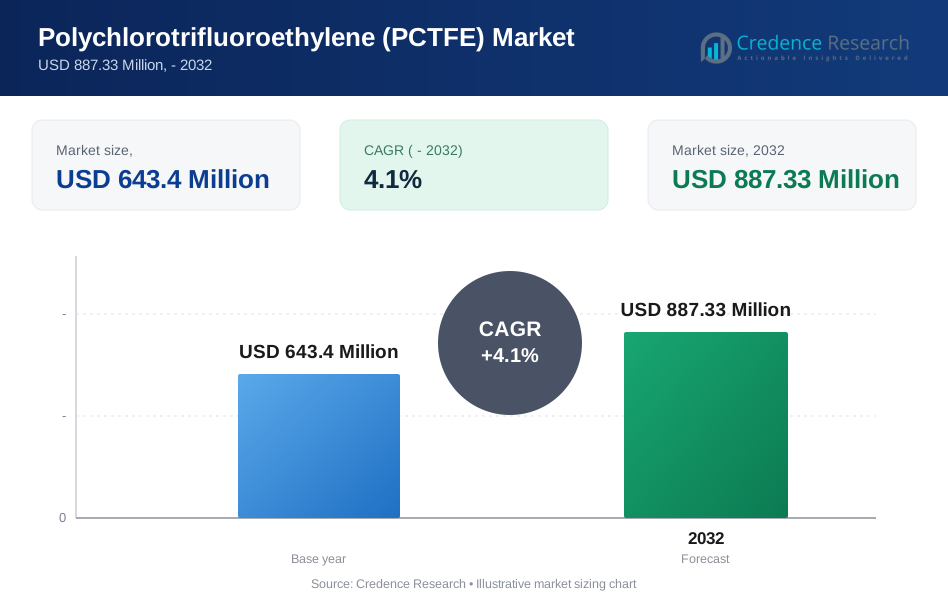
Polychlorotrifluoroethylene Market size was valued at USD 643.4 Million in 2024 and is anticipated to reach USD 887.33 Million by 2032, at a CAGR of 4.1% during the forecast period.
| REPORT ATTRIBUTE | DETAILS |
|---|---|
| Historical Period | 2020-2023 |
| Base Year | 2024 |
| Forecast Period | 2025-2032 |
| Polychlorotrifluoroethylene Market Size 2024 | USD 643.4 Million |
| Polychlorotrifluoroethylene Market, CAGR | 4.1% |
| Polychlorotrifluoroethylene Market Size 2032 | USD 887.33 Million |
The Polychlorotrifluoroethylene market features prominent players such as Solvay, DuPont, SAINT-GOBAIN, Honeywell International Inc., HaloPolymer, Everflon Fluoropolymers, Arkema, Zhejiang Juhua Co., Ltd., Akzo Nobel N.V., and DAIKIN INDUSTRIES, Ltd., each strengthening their position through material innovation and advanced processing capabilities. These companies support expanding applications across electronics, pharmaceuticals, and aerospace through high-barrier films, precision components, and corrosion-resistant parts. North America leads the global market with a 37% share, driven by strong semiconductor production and advanced pharmaceutical packaging. Europe follows with 29%, supported by aerospace and medical industries, while Asia Pacific holds 26%, reflecting rapid expansion in electronics manufacturing.
Market Insights
- The Polychlorotrifluoroethylene market was valued at USD 643.4 Million in 2024 and is projected to reach USD 887.33 Million by 2032, growing at a CAGR of 4.1%.
- Growth is driven by rising demand for moisture-barrier films and high-performance insulation across electronics and pharmaceutical packaging.
- Trends show increasing use of advanced PCTFE films and tubing as industries shift toward materials with strong chemical and thermal resistance, with films holding about 41% share in 2024.
- Competition intensifies as major producers expand capacity, enhance polymer purity, and strengthen partnerships with electronics, aerospace, and medical sectors.
- North America leads with 37% share in 2024, followed by Europe at 29% and Asia Pacific at 26%, supported by strong semiconductor and pharmaceutical activity across these regions.
Market Segmentation Analysis:
By Application
Films held the dominant position in 2024 with about 41% share of the Polychlorotrifluoroethylene market. Strong demand came from producers that rely on high barrier strength, low gas permeability, and chemical resistance for industrial packaging and technical laminates. Films also gained traction in electronics because engineers use these sheets for insulation layers that withstand heat and harsh solvents. Wire and tube applications grew at a steady pace due to rising use in corrosion-prone environments, while coatings advanced in niche aerospace and chemical handling needs. Expanding demand for high-performance fluoropolymer films helped this segment keep a clear lead.
- For instance, Liveo Research reports Aclar PCTFE laminates with WVTR of 0.06 g/m²·day. This figure appears in its laminated film flyer for pharma blister uses.
By End Use
Electrical and electronics led this category in 2024 with nearly 44% share. Manufacturers used PCTFE for insulation, sensor housings, dielectric components, and protective layers that need dimensional stability and moisture resistance. Growth stayed strong as chip fabrication, precision connectors, and semiconductor packaging required materials with low outgassing and strong thermal endurance. The pharmaceutical sector followed due to rising adoption in vial seals, barrier films, and freeze-drying applications. Aerospace applications expanded in small volumes for lightweight, chemical-resistant parts. Steady investments in electronics production helped electrical and electronics remain the largest end-use segment
- For instance, Welch Fluorocarbon lists Aclar 33C film with a typical Water Vapor Transmission Rate (WVTR) of \(0.05\text{\ g/m}^{2}\cdot \text{day}\) (at \(100^{\circ }\text{F}\)/100% RH).
Key Growth Drivers
Rising Demand in High-Performance Electronics
Producers in the electronics sector increased adoption of PCTFE due to its strong dielectric stability, low moisture absorption, and chemical resistance. These qualities support advanced sensor housings, semiconductor packaging, and precision insulation layers. Expanding production of high-density circuits and communication hardware pushed manufacturers to choose fluoropolymers that maintain strength under heat and corrosive environments. This trend strengthened PCTFE’s role as a preferred material in critical electronic components.
- For instance, Sterling Plastics states its PCTFE shows short-term dielectric strength of 500 volts per mil. This value is measured on 0.125 inch thick samples using ASTM D149.
Expansion of Pharmaceutical Barrier Applications
Pharmaceutical firms relied more on PCTFE because its barrier strength protects drug formulations against moisture and reactive gases. Demand rose in blister packs, vial seals, and freeze-drying containers where stability and long shelf life matter. Global growth in biologics and sensitive formulations increased the need for packaging that prevents degradation during storage. These advantages made PCTFE a vital material for modern medical packaging solutions.
- For instance, Honeywell’s Aclar Accel 1700 film lists a typical WVTR of \(0.155\text{\ g/m}^{2}\cdot \text{day}\) when tested at \(37.8^{\circ }\text{C}\) (\(100^{\circ }\text{F}\)) and 100% relative humidity (tested via ASTM F1249).
Growing Use in Aerospace and Industrial Insulation
Aerospace and industrial systems adopted PCTFE for tubing, seals, and insulation parts due to its ability to retain dimensional stability under extreme temperatures. Producers favored the material for lightweight components that resist corrosion and mechanical stress. Rising investment in aircraft maintenance, high-pressure gas systems, and chemical transfer lines supported further uptake. Strong performance in safety-critical applications continues to drive material preference.
Key Trends and Opportunities
Shift Toward Advanced Fluoropolymer Films
Manufacturers invested in improved PCTFE films that offer higher clarity, better tensile strength, and enhanced vapor resistance. These advancements opened new uses in flexible electronics, technical laminates, and precision optical layers. Producers also explored hybrid multilayer structures that deliver stronger protective properties. This shift created opportunities for suppliers to expand into premium barrier solutions.
- For instance, Fluorotherm cites a PCTFE moisture permeability constant of 0.2 g per metre over 24 hours. The same sheet lists volume resistivity at 2×10¹⁷ ohm-centimetres under ASTM D257.
Adoption of Lightweight and Corrosion-Resistant Components
Industrial systems and aerospace programs focused on reducing weight and improving durability, which expanded opportunities for PCTFE. The polymer’s ability to maintain stability in corrosive and cryogenic settings allowed engineers to replace heavier metal components. Growing demand for high-efficiency equipment encouraged material upgrades across tubing, seals, and valve components. This trend supports long-term adoption in specialized fields.
- For instance, Daikin provides application guidelines for NEOFLON PCTFE (Polychlorotrifluoroethylene) valve seats, which are commonly used in cryogenic applications for specific liquefied gases such as LNG, LO2, LN2, LH2, and LPG with an operational temperature range typically between \(-250^{\circ }\text{C}\) and ambient temperature.
Key Challenges
High Production Costs and Processing Complexity
PCTFE manufacturing requires controlled polymerization and specialized equipment, which raises production costs. The material’s processing behavior also demands precise temperature management and advanced molding systems. These factors increase final component prices and limit adoption in cost-sensitive markets. Producers must balance performance needs with affordability to maintain competitiveness.
Limited Supply Base and Raw Material Constraints
A small number of global suppliers and dependence on specific fluorochemical feedstocks create supply risks. Any disruption in raw material production or regulatory changes can affect availability. This tight supply structure restricts rapid scaling when demand spikes across pharmaceuticals or electronics. Companies working with PCTFE often face long lead times and limited sourcing flexibility.
Regional Analysis
North America
North America held the leading position in the Polychlorotrifluoroethylene market in 2024 with about 37% share. Demand grew due to strong adoption in electronics, aerospace, and pharmaceutical packaging, supported by advanced manufacturing bases in the United States. Producers benefited from widespread use of high-performance fluoropolymer films and moisture-barrier materials. Growth in semiconductor fabrication and defense programs also strengthened consumption. Rising investments in precision medical packaging further reinforced regional dominance.
Europe
Europe accounted for nearly 29% share of the market in 2024. The region saw steady demand from pharmaceutical firms, aerospace manufacturers, and specialty chemical producers. Strong regulatory focus on product reliability encouraged adoption of high-barrier and chemically resistant materials. Germany, France, and the United Kingdom remained key users driven by expansion in electronics assembly and medical packaging sectors. Ongoing innovation in lightweight aerospace components supported further use of PCTFE across major industrial clusters.
Asia Pacific
Asia Pacific represented about 26% share in 2024 and remained the fastest-expanding region. Growth came from rising production of electronics, semiconductors, and industrial equipment across China, Japan, South Korea, and India. Manufacturers increased use of PCTFE films, coatings, and tubing for devices that require moisture control and chemical protection. Expanding pharmaceutical packaging operations added strong momentum. Regional demand strengthened as local producers upgraded materials for high-performance engineering applications.
Latin America
Latin America captured around 5% share of the market in 2024. Growth remained moderate but steady due to rising use of PCTFE in niche pharmaceutical packaging and industrial components. Brazil and Mexico led consumption as manufacturers adopted better barrier materials for medical storage and chemical handling. Increasing investment in electronics assembly and precision tubing also supported market presence. Adoption continues to grow as industries shift toward durable and corrosion-resistant fluoropolymers.
Middle East and Africa
Middle East and Africa held nearly 3% share in 2024, with demand driven by specialized industrial, pharmaceutical, and aerospace applications. Growth stayed modest but stable as industries in the region expanded chemical processing, medical packaging, and high-performance insulation needs. Countries such as the United Arab Emirates and South Africa showed greater uptake due to rising investment in advanced manufacturing technologies. Market expansion is gradual yet supported by increasing awareness of fluoropolymer performance benefits.
Market Segmentations:
By Application
- Films
- Wire & tube
- Coatings
- Others
By End Use
- Pharmaceutical
- Electrical & Electronics
- Aerospace
- Others
By Geography
- North America
- U.S.
- Canada
- Mexico
- Europe
- Germany
- France
- U.K.
- Italy
- Spain
- Rest of Europe
- Asia Pacific
- China
- Japan
- India
- South Korea
- South-east Asia
- Rest of Asia Pacific
- Latin America
- Brazil
- Argentina
- Rest of Latin America
- Middle East & Africa
- GCC Countries
- South Africa
- Rest of the Middle East and Africa
Competitive Landscape
The competitive landscape of the Polychlorotrifluoroethylene market is shaped by Solvay, DuPont, SAINT-GOBAIN, Honeywell International Inc., HaloPolymer, Everflon Fluoropolymers, Arkema, Zhejiang Juhua Co., Ltd., Akzo Nobel N.V., and DAIKIN INDUSTRIES, Ltd. Market participants focus on expanding production capacity, improving polymer purity levels, and strengthening distribution networks to meet rising demand from electronics, pharmaceuticals, and aerospace sectors. Many companies invest in advanced processing technologies to enhance film clarity, moisture-barrier strength, and chemical resistance. Strategic collaborations with downstream manufacturers support tailored product offerings for high-performance applications. Firms also emphasize innovation to address evolving regulatory requirements and sustainability goals. Continuous investment in R&D, competitive pricing strategies, and regional expansion remain central to maintaining market relevance and securing long-term growth.
Key Player Analysis
- Solvay
- DuPont
- SAINT-GOBAIN
- Honeywell International Inc.
- HaloPolymer
- Everflon Fluoropolymers
- Arkema
- Zhejiang Juhua Co., Ltd.
- Akzo Nobel N.V.
- DAIKIN INDUSTRIES, Ltd.
Recent Developments
- In 2025, Zhejiang Juhua announced a strategic partnership with Shin-Etsu Chemical to co-develop and co-produce high-purity polychlorotrifluoroethylene polymers for packaging, electronics, and automotive applications.
- In 2025, Daikin Industries continues to promote its NEOFLON PCTFE M-Series, noted for excellent mechanical properties, hardness, and chemical resistance comparable to PTFE and PFA.
- In 2023, Arkema completed a 50% capacity expansion for its Kynar PVDF fluoropolymers at its Pierre-Bénite facility in France, specifically targeting high-growth sectors such as batteries and semiconductors
Report Coverage
The research report offers an in-depth analysis based on Application, End-Use and Geography. It details leading market players, providing an overview of their business, product offerings, investments, revenue streams, and key applications. Additionally, the report includes insights into the competitive environment, SWOT analysis, current market trends, as well as the primary drivers and constraints. Furthermore, it discusses various factors that have driven market expansion in recent years. The report also explores market dynamics, regulatory scenarios, and technological advancements that are shaping the industry. It assesses the impact of external factors and global economic changes on market growth. Lastly, it provides strategic recommendations for new entrants and established companies to navigate the complexities of the market.
Future Outlook
- The market will see steady growth as demand rises in electronics and semiconductor insulation.
- Pharmaceutical packaging will expand due to higher use of moisture-barrier materials.
- Aerospace adoption will increase as manufacturers seek lightweight and corrosion-resistant components.
- Advances in high-clarity and high-barrier PCTFE films will open new application areas.
- Industrial tubing and valve systems will adopt more PCTFE for chemical and cryogenic resistance.
- Producers will invest in improved processing technologies to enhance material efficiency.
- Supply chain diversification will strengthen as manufacturers seek stable raw material sources.
- Environmental compliance will push companies to refine production methods.
- Growing demand for precision medical devices will support long-term market expansion.
- Emerging regions will gain momentum as local industries upgrade to high-performance fluoropolymers.
Request a Free Sample
Fill in your details and we'll send you a free sample report.
- Sample data tables & charts
- Research methodology
Need a Custom Version of This Report?
Tailor the scope, geography, or segments to your exact requirements.
- Custom geography or segment scope
- Direct access to our analyst team
Frequently Asked Questions
What is the current market size for Polychlorotrifluoroethylene Market, and what is its projected size in 2032?
At what Compound Annual Growth Rate is the Polychlorotrifluoroethylene Market projected to grow between 2025 and 2032?
What are the key packages of PCTFE?
What factors are riding the growth of the PCTFE market?
What are the major demanding situations confronted by using the PCTFE marketplace?
Which areas are witnessing substantial growth inside the PCTFE marketplace?
What are the important thing corporations running within the PCTFE marketplace?
Are there any environmental worries related to PCTFE?
What is the future outlook for the PCTFE marketplace?
Who are the leading companies in the Polychlorotrifluoroethylene Market?
Table of Content
Chapter 1. Report Introduction
- 1.1 Report Description & Purpose
- 1.1.1 Report Title & Market Definition
- 1.1.2 Unique Selling Propositions (USP) & Key Differentiators
- 1.1.3 Value Proposition for Stakeholders
- 1.2 Research Objectives
- 1.2.1 Market Sizing Objectives (Volume & Revenue)
- 1.2.2 Segmentation Objectives
- 1.2.3 Competitive Intelligence Objectives
- 1.2.4 Forecast & Scenario Objectives
- 1.3 Report Scope
- 1.3.1 Polychlorotrifluoroethylene (PCTFE) Scope – Types & Subtypes Covered
- 1.3.2 Geographic Scope – Regions & Countries Covered
- 1.3.3 Historical Period, Base Year & Forecast Period (the historical period; forecast to 2032)
- 1.3.4 Inclusions & Exclusions
- 1.4 HS Code & Classification Framework
- 1.5 Currency, Units & Pricing Basis
- 1.6 Target Stakeholders
- 1.7 Limitations & Assumptions
Chapter 2. Executive Summary
- 2.1 Global Polychlorotrifluoroethylene (PCTFE) Market Snapshot
- 2.1.1 Market Size – Historical (the historical period) & Forecast (2032) (base year: USD 643.4 Million → 2032: USD 887.33 Million)
- 2.1.2 Volume & Revenue – Global Totals
- 2.1.3 Key Market Highlights – Top Five Facts
- 2.2 Polychlorotrifluoroethylene (PCTFE) Market Segmentation Snapshot
- 2.2.1 Market Split by Region – vs. 2032
- 2.3 Competitive Snapshot
- 2.3.1 Top 10 Players by Revenue Share –
- 2.3.2 Top 10 Players by Volume Share –
- 2.3.3 Recent Strategic Developments (18-Month Summary)
- 2.4 Key Investment Highlights & Strategic Conclusions
Chapter 3. Polychlorotrifluoroethylene (PCTFE) Market Dynamics & Industry Analysis
- 3.1 Market Overview & Context
- 3.1.1 Polychlorotrifluoroethylene (PCTFE) Market Position in the Broader Automotive Value Chain
- 3.1.2 OEM vs. Replacement Market Dynamics
- 3.1.3 Market Maturity & Development Stage by Region
- 3.2 Polychlorotrifluoroethylene (PCTFE) Market Drivers
- 3.3 Polychlorotrifluoroethylene (PCTFE) Market Restraints & Challenges
- 3.4 Polychlorotrifluoroethylene (PCTFE) Market Opportunities
- 3.5 Porter's Five Forces Analysis
- 3.5.1 Threat of New Entrants
- 3.5.2 Bargaining Power of Suppliers
- 3.5.3 Bargaining Power of Buyers
- 3.5.4 Threat of Substitutes
- 3.5.5 Competitive Rivalry – Intensity Assessment
- 3.6 Polychlorotrifluoroethylene (PCTFE) Value Chain Analysis
- 3.6.1 Upstream – Raw Material/Input Suppliers
- 3.6.1.1 Raw Material/Input 1
- 3.6.1.2 Raw Material/Input 2
- 3.6.1.3 Raw Material/Input 3
- 3.6.2 Midstream – Production/Manufacturing/Service Delivery
- 3.6.2.1 Production/Process Overview
- 3.6.2.2 Key Facility Locations & Capacity by Manufacturer
- 3.6.3 Downstream – Distribution & End Consumer
- 3.6.3.1 Primary Channel – B2B/OEM
- 3.6.3.2 Secondary Channels – Dealer, Retail, Online, Direct
- 3.6.4 Value Chain Profitability Analysis
- 3.6.1 Upstream – Raw Material/Input Suppliers
- 3.7 PESTEL Analysis
- 3.7.1 Political Factors
- 3.7.2 Economic Factors
- 3.7.3 Social Factors
- 3.7.4 Technological Factors
- 3.7.5 Environmental Factors
- 3.7.6 Legal Factors
- 3.8 Polychlorotrifluoroethylene (PCTFE) Supply Chain Analysis
- 3.8.1 Raw Material/Input Supply Risk Assessment
- 3.8.2 Manufacturing Concentration Risk (Geographic Exposure)
- 3.8.3 Trade Disruption Impact Analysis
- 3.9 Regulatory & Policy Landscape
Note: The regulatory and policy landscape section covers regulations based on their applicability to the market, Polychlorotrifluoroethylene (PCTFE) category, geography, and scope of the study. Only regulatory frameworks with a material impact on operations, compliance, trade, sustainability, or market access are analyzed in detail.
Chapter 4. Key Investment Pockets & Opportunity Analysis
- 4.1 Polychlorotrifluoroethylene (PCTFE) Market Attractiveness Analysis
- 4.1.1 By Region – Investment Attractiveness Matrix (Volume × CAGR)
- 4.2 Absolute Revenue Growth Opportunity
- 4.2.1 By Region – Absolute USD Growth Through 2032
- 4.3 Incremental Volume Opportunity
- 4.3.1 By Region – Incremental Volume Through 2032
- 4.3.2 Segment – Incremental Volume
- 4.4 Emerging Submarket Opportunity Deep Dive (Subject to Applicability)
- 4.5 Emerging Market Opportunity Scorecards
- 4.5.1 United States
- 4.5.2 Europe
- 4.5.3 Asia
- 4.5.4 Middle East & Africa
Note: Emerging Market Opportunity Scorecards will be included based on relevance and strategic importance. Regions listed are indicative and may vary depending on data availability and market dynamics.
Chapter 5. Polychlorotrifluoroethylene (PCTFE) Import-Export Analysis & Trade Flows
- 5.1 Global Trade Overview
- 5.1.1 Global Export Value by Country (the historical period)
- 5.1.2 Global Export Volume by Country (the historical period)
- 5.1.3 Global Import Value by Country (the historical period)
- 5.1.4 Global Import Volume by Country (the historical period)
- 5.1.5 Net Trade Balance by Country (the historical period)
- 5.2 Export Analysis – Segment
- 5.2.1 Type 1 (HS Code)
- 5.2.2 Type 2 (HS Code)
- 5.2.3 Type 3 (HS Code)
- 5.2.4 Type 4 (HS Code)
- 5.2.5 Type 5 (HS Code)
- 5.3 Import Analysis – Segment
- 5.3.1 Type 1 (HS Code)
- 5.3.2 Type 2 (HS Code)
- 5.3.3 Type 3 (HS Code)
- 5.3.4 Type 4 (HS Code)
- 5.3.5 Type 5 (HS Code)
- 5.4 Average Unit Trade Prices
- 5.4.1 Average Export Price – Segment & Country
- 5.4.2 Average Import Price – Segment & Source Country
- 5.4.3 Price Trends (the historical period)
- 5.5 Key Trade Route Analysis
- 5.5.1 Trade Route 1
- 5.5.2 Trade Route 2
- 5.5.3 Trade Route 3
- 5.5.4 Trade Route 4
- 5.5.5 Trade Route 5
- 5.6 Trade Policy Impact Assessment
- 5.6.1 US Anti-Dumping & Section 301 Tariffs
- 5.6.2 EU Customs Union Impact
- 5.6.3 Major Free Trade Agreements
- 5.6.4 USMCA Rules of Origin
Note: Trade policy analysis will be included only where relevant to the Polychlorotrifluoroethylene (PCTFE) market.
Chapter 6. Competitive Landscape & Company Benchmarking
- 6.1 Polychlorotrifluoroethylene (PCTFE) Market Concentration & Structure
- 6.1.1 Herfindahl-Hirschman Index (HHI) – vs.
- 6.1.2 Tier 1, Tier 2 & Tier 3 Market Structure
- 6.1.3 Global, Regional & Local Player Dynamics
- 6.2 Polychlorotrifluoroethylene (PCTFE) Market Share Analysis –
- 6.2.1 Global Revenue Share by Company
- 6.2.2 Global Volume Share by Company
- 6.2.3 Regional Revenue Share
- 6.2.4 Market Share Evolution ( vs. )
- 6.2.5 OEM Segment Share by Company
- 6.2.6 Replacement Segment Share by Company
- 6.3 Production/Delivery Capacity & Facility Analysis
- 6.3.1 Global Installed Capacity
- 6.3.2 Capacity Utilization Rates
- 6.3.3 Production/Output Volume
- 6.3.4 Facility Locations & Capacity Map
- 6.3.5 Planned Capacity Additions
- 6.4 Polychlorotrifluoroethylene (PCTFE) Competitive Benchmarking Matrix
- 6.4.1 Revenue, Volume, CAGR & Profitability Comparison
- 6.4.2 Channel Revenue Mix
- 6.4.3 Geographic Revenue Exposure
- 6.4.4 R&D Intensity
- 6.4.5 Sustainability Maturity
- 6.5 Strategic Developments in Polychlorotrifluoroethylene (PCTFE) (Last 24 Months)
- 6.5.1 Mergers, Acquisitions & Divestments
- 6.5.2 New Polychlorotrifluoroethylene (PCTFE) Launches
- 6.5.3 Facility Expansions
- 6.5.4 Strategic Alliances, Joint Ventures & Partnerships
- 6.5.5 Distribution Expansion & Market Entry
- 6.5.6 Sustainability & ESG Initiatives
- 6.6 Competitive Strategy Mapping
- 6.6.1 Leader, Challenger, Follower & Niche Classification
- 6.6.2 Pricing Strategy Comparison
- 6.6.3 Channel Strategy Matrix
Note: Strategic developments are included based on their materiality and the availability of reliable information.
Chapter 7. Global Polychlorotrifluoroethylene (PCTFE) Market – By Distribution Channel
- 7.1 Segment Overview
- 7.1.1 Volume & Revenue Split by Channel ( & 2032)
- 7.1.2 Channel Mix Evolution (2032)
Chapter 8. Regional Market Analysis – Global Overview
- 8.1 Global Regional Overview
- 8.1.1 Regional Volume Share
- 8.1.2 Regional Revenue Share
- 8.1.3 Regional Volume by Region
- 8.1.4 Regional Revenue by Region
- 8.1.5 Regional Forecast Through 2032
- 8.2 Cross-Regional Segment Analysis
- 8.2.1 By Distribution Channel
- 8.2.2 By Brand/Price Tier
Chapter 9. North America Polychlorotrifluoroethylene (PCTFE) Market
- 9.1 United States
- 9.2 Canada
- 9.3 Mexico
Chapter 10. Europe Polychlorotrifluoroethylene (PCTFE) Market
- 10.1 Germany
- 10.2 France
- 10.3 Italy
- 10.4 United Kingdom
- 10.5 Spain
- 10.6 Poland
- 10.7 Russia
- 10.8 Netherlands
- 10.9 Belgium
- 10.10 Sweden
- 10.11 Denmark
- 10.12 Norway
- 10.13 Rest of Europe
Chapter 11. Asia Pacific Polychlorotrifluoroethylene (PCTFE) Market
- 11.1 China
- 11.2 India
- 11.3 Japan
- 11.4 South Korea
- 11.5 Thailand
- 11.6 Indonesia
- 11.7 Vietnam
- 11.8 Malaysia
- 11.9 Australia
- 11.10 Rest of Asia Pacific
Chapter 12. Latin America Polychlorotrifluoroethylene (PCTFE) Market
- 12.1 Brazil
- 12.2 Argentina
- 12.3 Colombia
- 12.4 Chile
- 12.5 Rest of Latin America
Chapter 13. Middle East Polychlorotrifluoroethylene (PCTFE) Market
- 13.1 Saudi Arabia
- 13.2 United Arab Emirates
- 13.3 Turkey
- 13.4 Israel
- 13.5 Iran
- 13.6 Rest of the Middle East
Chapter 14. Africa Polychlorotrifluoroethylene (PCTFE) Market
- 14.1 South Africa
- 14.2 Egypt
- 14.3 Nigeria
- 14.4 Morocco
- 14.5 Rest of Africa
Chapter 15. Polychlorotrifluoroethylene (PCTFE) Company Profiles
- 15.1 [Company 01]
- 15.1.1 Company Overview
- 15.1.2 Key Management Personnel
- 15.1.3 Products & Services Portfolio
- 15.1.4 Financial Performance
- 15.1.5 Key Market Focus & Geographic Presence
- 15.1.6 Recent Developments & Strategic Initiatives
Note: The company profile list is preliminary and may change based on research findings, market developments, data availability, and client requirements.
Chapter 16. Appendices
- Appendix A – List of Abbreviations & Acronyms
- Appendix B – Industry Classification Code Reference – Full Series
- Appendix C – Production & Capacity Data Tables
- Appendix D – End-Use & Demand Base Tables
- Appendix E – Consumption & Replacement Rate Assumptions
- Appendix F – ASP Reference Tables
- Appendix G – Manufacturing & Facility Database
- Appendix H – Import-Export Data Tables
- Appendix I – Regulatory Summary Tables
- Appendix J – Primary Research Participant List (Anonymized)
- Appendix K – Primary Research Questionnaire Framework
- Appendix L – Data Sources & Bibliography
- Appendix M – Market Size Divergence & Source Comparison
Chapter 17. Research Methodology
- 17.1 Research Framework & Philosophy
- 17.2 Secondary Research – Sources, Hierarchy & Data Extraction
- 17.3 Data Modeling – Bottom-Up & Top-Down Market Sizing
- 17.4 Primary Research – Stakeholder Framework, LOI & Sample Sizes
- 17.5 Forecast Methodology – Regression, Scenario & Sensitivity Analysis
- 17.6 Quality Control – Four-Layer Validation Framework
- 17.7 Limitations & Standard Assumptions
- 17.8 Disclaimer
