Market Overview:
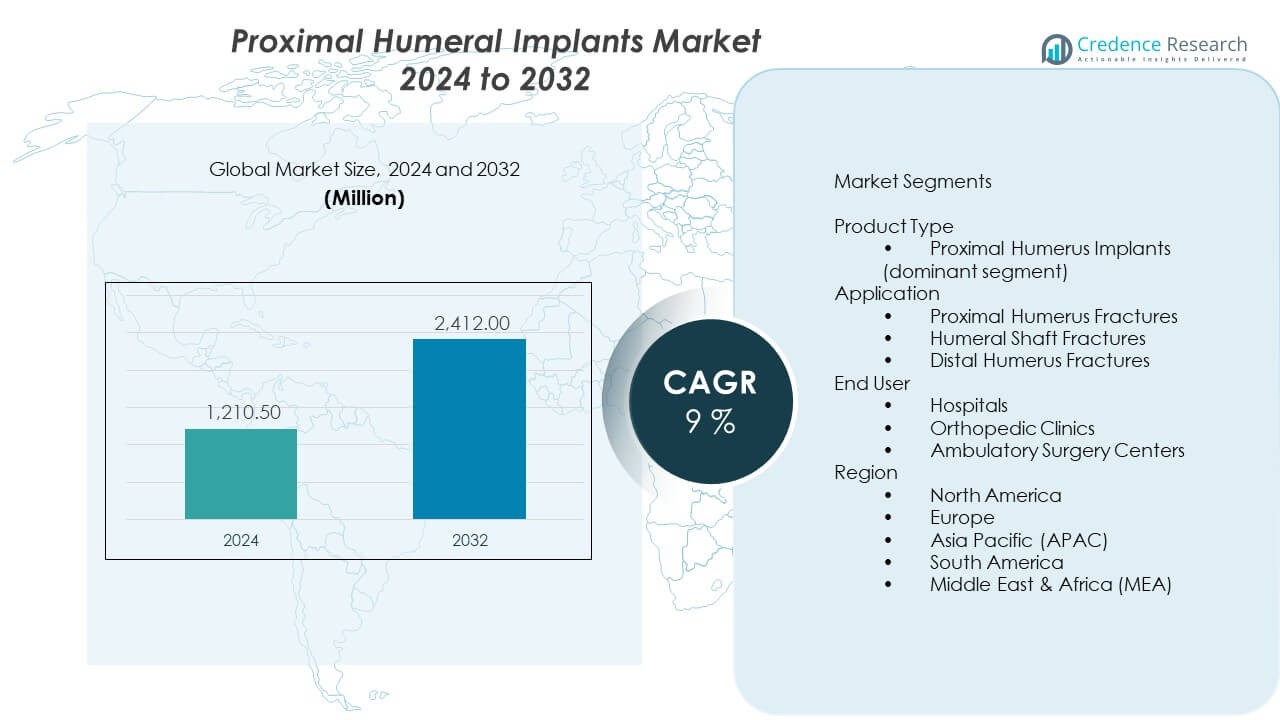
The Proximal Humeral Implants Market is projected to grow from USD 1,210.5 million in 2024 to an estimated USD 2,412 million by 2032, with a compound annual growth rate (CAGR) of 9% from 2024 to 2032. Rising demand for shoulder reconstruction procedures supports steady growth across hospitals and orthopedic centers.| REPORT ATTRIBUTE | DETAILS |
|---|---|
| Historical Period | 2020-2023 |
| Base Year | 2024 |
| Forecast Period | 2025-2032 |
| Proximal Humeral Implants Market Size 2024 | USD 1,210.5 Million |
| Proximal Humeral Implants Market, CAGR | 9% |
| Proximal Humeral Implants Market Size 2032 | USD 2,412 Million |
Strong demand for trauma care drives wider adoption of proximal humeral implants. Surgeons prefer advanced fixation and replacement systems that support stable healing after fractures. The growth of outpatient orthopedic surgeries increases the use of modular and anatomically contoured implants. Aging populations raise the number of fracture cases linked to osteoporosis, which boosts procedural volume. Manufacturers enhance implant coatings and designs to reduce complications and improve postoperative recovery across diverse patient groups.
North America leads due to strong surgical infrastructure, high procedure rates, and early uptake of next-generation implant technologies. Europe follows with broad adoption supported by established orthopedic care networks and higher clinical awareness. Asia Pacific emerges as the fastest-growing region due to rising healthcare expansion, improving trauma care, and a sharp increase in fracture incidence across aging populations. Latin America and the Middle East show growing demand as access to specialized orthopedic services improves across major urban centers.
Market Insights:
- The Proximal humeral implants market is valued at USD 1,210.5 million in 2024 and is projected to reach USD 2,412 million by 2032, growing at a 9% CAGR during the forecast period.
- North America (38%), Europe (30%), and APAC (22%) hold the largest shares due to strong trauma care systems, advanced orthopedic networks, and rising fracture management capacity.
- APAC, holding 22%, is the fastest-growing region, driven by expanding trauma infrastructure, higher fracture incidence, and growing surgical adoption.
- Proximal humerus implants account for an estimated 62% of product-type share, supported by high usage in fracture reconstruction.
- Hospitals contribute around 58% of end-user share due to higher procedure volume and access to advanced implant systems.
Market Drivers:
Rising Surgical Volumes in Orthopedic Trauma Care
Rising fracture cases push hospitals to expand shoulder reconstruction capacity. Surgeons handle more proximal humerus trauma linked to aging populations. Demand for stable fixation grows across emergency departments. The Proximal humeral implants market gains traction through rising case complexity. It supports broader adoption of plates, nails, and stem systems. Better perioperative care encourages faster return-to-function goals. Hospitals invest in implants that reduce revision rates. Trauma centers adopt systems that streamline surgical workflows.
- For instance, a study of Zimmer Biomet’s A.L.P.S. proximal humerus locking plate in 15 patients reported 100% union with a mean union time of 15.1 weeks and no avascular necrosis, highlighting reliable fixation in demanding trauma cases.
Growing Adoption of Anatomically Designed Implant Systems
Surgeons choose implants that match patient anatomy with higher precision. Anatomical shaping helps achieve stable alignment in complex fractures. Demand rises for devices with smoother motion profiles after healing. The Proximal humeral implants market benefits from stronger clinical outcomes. It encourages hospitals to shift toward advanced designs. Better matching supports joint preservation and faster rehabilitation. Doctors value instruments that reduce soft-tissue disruption. Use expands in facilities with skilled orthopedic teams.
- For instance, a district general hospital series using DePuy Synthes’ PHILOS plate in 41 proximal humerus fractures achieved radiological union within eight weeks in 40 cases, with only four complications, demonstrating strong stability in multi-part fractures.
Advances in Biomaterials and Implant Surface Technologies
Manufacturers introduce surface treatments that support better bone integration. Coatings promote improved healing responses during early recovery. Hospitals prefer materials with strong corrosion resistance. The Proximal humeral implants market grows through rising technology upgrades. It gains support from improved biocompatibility features. Surgeons depend on coatings that reduce infection risk. New alloys support long-term endurance under active lifestyles. Implant stability improves across diverse patient age groups.
Shift Toward Outpatient and Minimally Invasive Shoulder Procedures
Ambulatory centers perform more shoulder surgeries each year. Smaller incisions reduce recovery timelines and improve patient comfort. Surgeons adopt implants suited for shorter operative cycles. The Proximal humeral implants market gains momentum from procedural efficiency. It fits modern care models that focus on faster discharge. Patients return sooner to routine activities through improved care pathways. Clinics prefer systems that simplify instrumentation. Demand grows across high-volume outpatient networks.
Market Trends:
Growth of Patient-Specific and Preoperative Planning Technologies
Software platforms guide surgeons in planning complex fracture repairs. Three-dimensional models support accurate implant positioning. Demand rises for procedures built around custom digital workflows. The Proximal humeral implants market evolves with broader adoption of planning tools. It benefits from improved visual guidance during surgery. Hospitals adopt systems that reduce alignment errors. Custom insights support better fixation outcomes. Clinics optimize surgical steps through digital integration.
- For instance, analysis shoulder arthroplasties performed with the ExactechGPS computer-assisted navigation and planning system showed that cases were completed as planned, with navigation-related complications in only 0.05% of patients, underlining high accuracy and safety.
Rising Integration of Robotic and Navigation-Assisted Systems
Navigation tools guide surgeons through detailed anatomical pathways. Robotic support improves accuracy in implant placement. Demand for automated alignment grows in complex trauma cases. The Proximal humeral implants market advances through higher precision needs. It gains momentum from hospitals adopting smart platforms. Controlled cutting and targeting reduce surgical variability. Teams value systems that support repeatable outcomes. Robotics strengthens confidence during demanding procedures.
- For instance, recent augmented reality–assisted navigation studies in reverse shoulder arthroplasty reported significantly reduced absolute error between planned and achieved glenoid inclination and version, confirming higher placement precision compared with conventional methods and supporting more reliable shoulder reconstruction.
Shift Toward Lightweight, High-Strength Implant Materials
Manufacturers explore new alloys that reduce implant weight. Stronger materials support reliable fixation under active use. Surgeons choose systems with higher fatigue resistance. The Proximal humeral implants market follows material innovation trends. It supports designs that maintain strength under repetitive motion. Engineers refine structures for optimal load transfer. Hospitals adopt lighter constructs that improve patient comfort. Growth aligns with rising preference for advanced material science.
Expansion of Reverse Shoulder Reconstruction in Complex Cases
Reverse techniques gain traction for complicated fracture patterns. Surgeons adopt designs that offer stronger deltoid-driven movement. Demand grows for implants supporting severe bone loss. The Proximal humeral implants market aligns with this shift in clinical practice. It supports broader use across elderly care settings. Better functional recovery encourages wider use. Doctors trust reverse systems for high-stability performance. Adoption expands across trauma and degenerative indications.
Market Challenges Analysis:
High Revision Rates and Clinical Complication Risks
Complications challenge long-term fixation stability across diverse patient groups. Surgeons face risks linked to non-union, implant loosening, and infection. Complex fractures raise chances of biomechanical failure. The Proximal humeral implants market must overcome variable bone quality. It sees slower adoption in regions with limited surgical expertise. Hospitals manage postoperative instability concerns in older patients. Device selection becomes difficult in osteoporotic conditions. Training gaps influence procedure consistency across institutions.
Cost Pressures and Limited Access in Resource-Constrained Regions
High implant prices restrict adoption in lower-income markets. Insurance coverage varies across healthcare systems. Limited trauma infrastructure slows advanced implant uptake. The Proximal humeral implants market faces challenges tied to affordability levels. It must address supply inconsistencies in remote areas. Hospitals depend on budget approvals for major orthopedic purchases. Economic strain delays upgrade cycles. Uneven access affects patient outcomes across global regions.
Market Opportunities:
Rising Demand for Advanced Shoulder Reconstruction Solutions Across Emerging Regions
Healthcare expansion supports greater access to orthopedic trauma care. Surgeons in emerging markets adopt modern fixation technologies. The Proximal humeral implants market gains opportunities through rising surgical capacity. It benefits from investments in trauma centers and improved imaging systems. Growth aligns with rising fracture incidence across aging populations. Hospitals seek implants that reduce long-term disability. Better training programs improve procedural confidence. Demand rises across both public and private facilities.
Growing Interest in Smart Implants and Real-Time Monitoring Technologies
Engineers explore implants with embedded sensors for performance tracking. Data-driven insights improve postoperative decision-making. The Proximal humeral implants market sees potential in connected device innovations. It supports hospitals focusing on predictive recovery models. Surgeons gain value from remote monitoring capabilities. Smart platforms enable early detection of complications. Adoption grows across research-driven orthopedic networks. Integration strengthens long-term patient management.
Market Segmentation Analysis:
Product Type
Proximal humerus implants dominate the product landscape due to strong use in fracture stabilization and joint reconstruction. Surgeons prefer these systems for reliable fixation, alignment control, and stable postoperative recovery. The Proximal humeral implants market gains traction through wider adoption of anatomically shaped plates, intramedullary nails, and stem-based devices that support varied clinical needs. It benefits from rising interest in advanced biomaterials and improved surgical instrumentation that strengthens procedural outcomes across trauma centers.
- For instance, a Taiwanese comparison of Zimmer Biomet’s A.L.P.S. and DePuy Synthes’ PHILOS plates in 66 patients reported an overall union rate of 98.5% and a significantly lower complication rate in the A.L.P.S. group, highlighting the performance of refined anatomic locking designs.
Application
Proximal humerus fractures lead demand due to high incidence among elderly patients with osteoporosis. Surgeons handle greater procedural volume in this group, which drives preference for locking plates and hybrid fixation systems. Humeral shaft fractures create steady demand for nails and plates that support controlled rotational stability. Distal humerus fractures require more complex fixation patterns, which guides uptake of specialized implants designed for joint preservation. Each application segment supports focused advancements in implant geometry and surface coatings.
- For instance, treatment of 28 proximal and combined proximal–shaft humeral fractures with Stryker’s T2 proximal humeral nail achieved healing in a mean 2.7 months, with only one delayed union and one asymptomatic humeral head necrosis, underscoring strong performance in both proximal and diaphyseal patterns.
End User
Hospitals remain the primary end users due to strong surgical capacity, trauma infrastructure, and access to advanced imaging support. Orthopedic clinics expand their role through rising elective and trauma-focused shoulder procedures. Ambulatory surgery centers gain momentum by adopting minimally invasive approaches that reduce patient stay and improve recovery timelines. Each end-user segment shapes purchasing patterns based on surgeon preference, case complexity, and procedural workflow requirements.
Segmentation:
Product Type
- Proximal Humerus Implants (dominant segment)
Application
- Proximal Humerus Fractures
- Humeral Shaft Fractures
- Distal Humerus Fractures
End User
- Hospitals
- Orthopedic Clinics
- Ambulatory Surgery Centers
Region
- North America
- U.S.
- Canada
- Mexico
- Europe
- Germany
- France
- U.K.
- Italy
- Spain
- Rest of Europe
- Asia Pacific
- China
- Japan
- India
- South Korea
- South-east Asia
- Rest of Asia Pacific
- Latin America
- Brazil
- Argentina
- Rest of Latin America
- Middle East & Africa
- GCC Countries
- South Africa
- Rest of the Middle East and Africa
Regional Analysis:
North America
North America holds the leading share of the global landscape, accounting for 38% of the Proximal humeral implants market. Strong trauma care systems support wider adoption of advanced fixation and reconstruction implants. Hospitals across the United States invest in updated plating and nailing systems to improve functional recovery after shoulder fractures. Surgeons rely on specialized instrumentation that enables precise alignment in complex trauma cases. The region benefits from early access to technological upgrades and faster regulatory approvals. It maintains high procedure volume due to active elderly populations and greater awareness of surgical treatment pathways.
Europe
Europe captures 30% of the market share and shows stable adoption across advanced orthopedic centers. Countries with strong trauma networks use structured clinical protocols that encourage widespread implant utilization. The Proximal humeral implants market gains steady traction through improved fixation techniques supported by regional training programs. It benefits from greater focus on anatomical implants that maintain joint mobility after fracture repair. Demand grows in Germany, France, and the United Kingdom due to rising osteoporosis-linked fracture rates. Hospitals and clinics adopt devices that reduce complication risk and support predictable rehabilitation outcomes.
Asia Pacific (APAC)
Asia Pacific secures 22% of the market and stands as the fastest-growing region due to expanding trauma infrastructure. Hospitals in China and India upgrade orthopedic departments to handle rising fracture incidence across both urban and rural populations. Surgeons adopt modern plating and nailing systems that support faster recovery under higher patient load. The Proximal humeral implants market advances through stronger investment in training programs and improved access to imaging technologies. It shows rapid expansion as private hospitals increase shoulder reconstruction volumes. Growth accelerates further through wider insurance coverage and rising awareness of surgical treatment options across emerging economies.
Key Player Analysis:
- Zimmer Biomet Holdings
- DePuy Synthes (Johnson & Johnson)
- Stryker Corporation
- Smith & Nephew plc
- Exactech, Inc.
- Arthrex, Inc.
- Medartis
- Wright Medical Group N.V
- Braun
- Medacta International
Competitive Analysis:
Leading manufacturers focus on expanding advanced fixation and reconstruction portfolios. The Proximal humeral implants market features strong competition among global orthopedic companies that invest in design upgrades, biomaterial improvements, and surgical instrumentation. It benefits from continuous product refinement that improves fixation strength and operative efficiency. Firms enhance coating technologies to support better bone integration. Strategic expansions increase surgeon access to optimized plating and nailing systems. Companies strengthen training programs that improve procedural consistency. Market competition intensifies as hospitals demand systems that reduce revision rates and improve functional outcomes.
Recent Developments:
- In March 2025, Zimmer Biomet also showcased a broad portfolio of orthopedic and musculoskeletal innovations at the AAOS annual meeting, including technologies for shoulder reconstruction that complement their proximal humeral implants, further reinforcing their leadership in upper extremity reconstruction.
- Zimmer Biomet's OsseoFit® Stemless Shoulder System, cleared by the FDA in late 2024, continues to be adopted in clinical settings, offering a bone-preserving stemless shoulder implant designed for stable biological fixation by matching the natural asymmetric humeral anatomy.
Report Coverage:
The research report offers an in-depth analysis based on product, application, end user, and regional segments. It details leading market players, providing an overview of their business, product offerings, investments, revenue streams, and key applications. Additionally, the report includes insights into the competitive environment, SWOT analysis, current market trends, as well as the primary drivers and constraints. Furthermore, it discusses various factors that have driven market expansion in recent years. The report also explores market dynamics, regulatory scenarios, and technological advancements that are shaping the industry. It assesses the impact of external factors and global economic changes on market growth. Lastly, it provides strategic recommendations for new entrants and established companies to navigate the complexities of the market.
Future Outlook:
- Rising need for advanced plating systems will support broader clinical adoption.
- Demand for anatomically shaped implants will increase across trauma centers.
- Growing interest in predictive digital planning will influence surgical workflows.
- Hospitals will invest more in systems that reduce revision risk.
- Surgeons will adopt stronger biomaterial-based implants for complex fractures.
- Reverse reconstruction procedures will gain traction for severe damage cases.
- Outpatient centers will expand usage through minimally invasive techniques.
- APAC markets will accelerate adoption with expanding trauma care networks.
- Smart implants will gain attention for improved postoperative monitoring.
- Training programs will strengthen regional expertise in shoulder trauma repair.

Request a Free Sample
Fill in your details and we'll send you a free sample report.
- Sample data tables & charts
- Research methodology
Market Dynamics
Rising Surgical Volumes in Orthopedic Trauma Care
Increasing incidence of shoulder fractures, particularly among aging populations, is driving hospitals to expand their capacity for shoulder reconstruction procedures, boosting demand for proximal humeral implants.
Growing Adoption of Anatomically Designed Implant Systems
Surgeons are increasingly choosing implants that closely match patient anatomy, resulting in better alignment, improved functional outcomes, and faster rehabilitation, which accelerates market growth.
Advances in Biomaterials and Implant Surface Technologies
Manufacturers are introducing new coatings and materials that enhance bone integration, reduce infection risk, and improve implant longevity, making advanced implants more attractive to hospitals and surgeons.
Shift Toward Outpatient and Minimally Invasive Shoulder Procedures
The expansion of ambulatory surgery centers and minimally invasive techniques is increasing the use of modular and anatomically contoured implants, supporting procedural efficiency and faster patient recovery.
Expansion of Trauma Care Infrastructure in Emerging Markets
Healthcare investments in Asia Pacific and other emerging regions are improving access to advanced orthopedic trauma care, leading to higher adoption rates of proximal humeral implants as fracture incidence rises.
Need a Custom Version of This Report?
Tailor the scope, geography, or segments to your exact requirements.
- Custom geography or segment scope
- Direct access to our analyst team
Frequently Asked Questions
What is the current market size for the Proximal humeral implants market, and what is its projected size in 2032?
At what Compound Annual Growth Rate is the Proximal humeral implants market projected to grow between 2024 and 2032?
Which Proximal humeral implants market segment held the largest share in 2024?
What are the primary factors fueling the growth of the Proximal humeral implants market?
Who are the leading companies in the Proximal humeral implants market?
Which region commanded the largest share of the Proximal humeral implants market in 2024?
Table of Content
Chapter 1 Market Segmentation
- 1.1 Segmentation Framework
- 1.1.1 Product and Service Classification
- 1.1.2 Application and End-Use Classification
- 1.1.3 Technology and Solution Classification
- 1.1.4 Customer and Distribution Channel Classification
- 1.1.5 Geographic Segmentation
- 1.1.6 Market Segment Definitions and Boundaries
- 1.2 By End User
- 1.2.1 Hospitals
- 1.2.2 Orthopedic Clinics
- 1.2.3 Ambulatory Surgery Centers
- 1.3 By Application
- 1.3.1 Proximal Humerus Fractures
- 1.3.2 Humeral Shaft Fractures
- 1.3.3 Distal Humerus Fractures
- 1.4 By Product Type
- 1.4.1 Proximal Humerus Implants
- 1.4.2 Intramedullary Nails
- 1.4.3 Plates and Screws
- 1.4.4 Stem-Based Devices
Chapter 2 Introduction
- 2.1 Report Objectives and Scope
- 2.2 Product Definition and Industry Terminology
- 2.3 Market Inclusions and Exclusions
- 2.4 Research Process
- 2.4.1 Primary Research and Expert Interviews
- 2.4.2 Secondary Research and Source Review
- 2.4.3 Top-Down and Bottom-Up Estimation
- 2.4.4 Data Triangulation and Verification
- 2.5 Market Size Measurement Basis
- 2.5.1 2024: USD 1,210.5 million → 2032: USD 2,412 million
- 2.6 Historical and Forecast Reference Periods
- 2.6.1 Base Year: 2024
- 2.6.2 Forecast Period: 2024-2032
- 2.7 Research Assumptions and Limitations
Chapter 3 Executive Summary
- 3.1 Market Snapshot and Key Findings
- 3.2 Base-Year Market Size, 2024
- 3.3 Forecast Market Size, 2032
- 3.4 Revenue and Volume Growth Outlook
- 3.5 Key Demand and Supply Indicators
- 3.6 Leading Market Segments
- 3.7 Fastest-Growing Market Opportunities
- 3.8 Regional Performance Highlights
- 3.9 Technology and Industry Transformation
- 3.10 Competitive Landscape Summary
- 3.11 Analyst View and Strategic Implications
Chapter 4 Global Proximal Humeral Implants Market Trends and Developments
- 4.1 Historical Industry Development
- 4.2 Recent Market Trends and Developments
- 4.3 Demand and Customer Behavior Trends
- 4.4 Technology and Product Innovation
- 4.5 Artificial Intelligence, Automation and Digitalization
- 4.6 Local Manufacturing and Supply Chain Realignment
- 4.7 Industry Partnerships, Mergers and Acquisitions
- 4.8 Sustainability and Circular Economy Developments
- 4.9 Government and Private Sector Investment Trends
- 4.10 Emerging Business Models and Commercialization
- 4.11 Industry Developments and Announcements
Chapter 5 Global Proximal Humeral Implants Market Production, Supply and Demand Analysis
- 5.1 Demand Trend and Consumption Analysis
- 5.2 Demand Forecast, 2024-2032
- 5.3 Production and Output Trend
- 5.4 Production and Output Forecast, 2024-2032
- 5.5 Installed Capacity and Capacity Utilization
- 5.6 Company-Wise Production Plants and Statistics
- 5.6.1 Installed Production Capacity
- 5.6.2 Actual Production
- 5.6.3 Planned Capacity and Expansion Targets
- 5.7 Supply Chain Structure and Procurement Trends
- 5.8 Supply-Demand Gap and Bottlenecks
- 5.9 Import Dependence and Sourcing Structure
- 5.10 Contract Manufacturing and Outsourcing
- 5.11 Regional Supply and Demand Concentration
Chapter 6 Global Proximal Humeral Implants Market Pricing Analysis
- 6.1 Pricing Structure and Measurement
- 6.2 Historical Pricing Trends
- 6.3 Pricing Outlook, 2024-2032
- 6.4 Average Selling Price and Unit Economics
- 6.5 Pricing by Product and Market Segment
- 6.6 Geographic Pricing Differences
- 6.7 Key Input, Energy, Labor and Logistics Costs
- 6.8 Contract Pricing and Purchasing Models
- 6.9 Pricing Sensitivity and Competitive Positioning
- 6.10 Price, Margin and Profitability Implications
Chapter 7 Global Proximal Humeral Implants Market Dynamics
- 7.1 Market Growth Drivers
- 7.1.1 Demand-Side Drivers
- 7.1.2 Technology and Innovation Drivers
- 7.1.3 Infrastructure and Investment Drivers
- 7.1.4 Regulatory and Policy Drivers
- 7.2 Market Restraints
- 7.2.1 Cost and Affordability Constraints
- 7.2.2 Technology and Adoption Barriers
- 7.2.3 Supply Chain and Operational Constraints
- 7.3 Market Challenges
- 7.3.1 Competitive Pressure and Margin Erosion
- 7.3.2 Skills, Infrastructure and Implementation Gaps
- 7.4 Emerging Market Opportunities
- 7.5 Market Dynamics Impact and Time-Horizon Assessment
Chapter 8 Global Proximal Humeral Implants Value Chain Analysis
- 8.1 Industry Value Chain Overview
- 8.2 Upstream Suppliers and Critical Inputs
- 8.3 Technology and Component Providers
- 8.4 Manufacturing or Service Delivery
- 8.5 Distribution, Channel Partners and Integrators
- 8.6 Downstream Applications and End Users
- 8.7 Value Addition and Profit Pools
- 8.8 Vertical Integration and Outsourcing
- 8.9 Supplier Concentration and Risk
- 8.10 Supply Chain Localization and Resilience
Chapter 9 Global Proximal Humeral Implants Market Regulations and Policies
- 9.1 Relevant Laws, Standards and Compliance Frameworks
- 9.2 Product, Service, Safety and Quality Requirements
- 9.3 Government Policies, Incentives and Subsidies
- 9.4 Imports, Exports and Trade Barriers
- 9.5 Public Procurement and Local Content Requirements
- 9.6 Environmental and Sustainability Compliance
- 9.7 Upcoming Policy Changes and Market Implications
Chapter 10 Global Proximal Humeral Implants Market Hotspots and Opportunities
- 10.1 Market Opportunity Mapping and Growth Hotspots
- 10.2 High-Growth Applications and Customer Groups
- 10.3 Underserved Markets and White-Space Opportunities
- 10.4 Emerging Technology and Product Opportunities
- 10.5 New Capacity and Investment Hotspots
- 10.6 Market Entry and Expansion Opportunities
- 10.7 Distribution and Partnership Opportunities
- 10.8 Near-Term and Long-Term Commercial Potential
- 10.9 Opportunity Attractiveness and Execution Risks
Chapter 11 Global Proximal Humeral Implants Market Outlook, 2024-2032
- 11.1 Market Size and Analysis
- 11.1.1 Revenue (Market Measurement: 2024: USD 1,210.5 million → 2032: USD 2,412 million)
- 11.1.2 Market Volume and Quantity Sold
- 11.1.3 Historical Market Size
- 11.1.4 Base-Year Market Size, 2024
- 11.2 Market Forecast, 2024-2032
- 11.2.1 Revenue Forecast to 2032
- 11.2.2 Volume Forecast to 2032
- 11.2.3 CAGR and Year-on-Year Growth
- 11.2.4 Incremental Revenue Opportunity
- 11.3 Forecast Assumptions and Scenario Analysis
- 11.3.1 Base-Case Forecast
- 11.3.2 Optimistic and Conservative Scenarios
- 11.3.3 Technology, Pricing and Policy Sensitivities
- 11.4 Market Attractiveness and Growth Outlook
Chapter 12 Global Proximal Humeral Implants Market Segmentation and Outlook
- 12.1 Segmentation Summary and Market Shares, 2024
- 12.2 Largest and Fastest-Growing Segments
- 12.3 By End User - Market Size and Forecast, 2024-2032
- 12.3.1 Segment Definition and Scope
- 12.3.2 Historical Market Size
- 12.3.3 Revenue Forecast, 2024-2032
- 12.3.4 Volume Forecast, 2024-2032
- 12.3.5 Base-Year Market Share, 2024
- 12.3.6 Segment CAGR and Growth Drivers
- 12.3.7 Subsegment Market Size and Forecast
- 12.3.7.1 Hospitals
- 12.3.7.2 Orthopedic Clinics
- 12.3.7.3 Ambulatory Surgery Centers
- 12.3.8 Subsegment Pricing and Adoption Trends
- 12.3.9 Leading Suppliers and Competition
- 12.3.10 Regional Demand and Opportunities
- 12.4 By Application - Market Size and Forecast, 2024-2032
- 12.4.1 Segment Definition and Scope
- 12.4.2 Historical Market Size
- 12.4.3 Revenue Forecast, 2024-2032
- 12.4.4 Volume Forecast, 2024-2032
- 12.4.5 Base-Year Market Share, 2024
- 12.4.6 Segment CAGR and Growth Drivers
- 12.4.7 Subsegment Market Size and Forecast
- 12.4.7.1 Proximal Humerus Fractures
- 12.4.7.2 Humeral Shaft Fractures
- 12.4.7.3 Distal Humerus Fractures
- 12.4.8 Subsegment Pricing and Adoption Trends
- 12.4.9 Leading Suppliers and Competition
- 12.4.10 Regional Demand and Opportunities
- 12.5 By Product Type - Market Size and Forecast, 2024-2032
- 12.5.1 Segment Definition and Scope
- 12.5.2 Historical Market Size
- 12.5.3 Revenue Forecast, 2024-2032
- 12.5.4 Volume Forecast, 2024-2032
- 12.5.5 Base-Year Market Share, 2024
- 12.5.6 Segment CAGR and Growth Drivers
- 12.5.7 Subsegment Market Size and Forecast
- 12.5.7.1 Proximal Humerus Implants
- 12.5.7.2 Intramedullary Nails
- 12.5.7.3 Plates and Screws
- 12.5.7.4 Stem-Based Devices
- 12.5.8 Subsegment Pricing and Adoption Trends
- 12.5.9 Leading Suppliers and Competition
- 12.5.10 Regional Demand and Opportunities
- 12.6 Segment Growth Comparison
- 12.7 Segment Attractiveness and Priority Matrix
Chapter 13 Global Proximal Humeral Implants End-Use and Application Market Outlook
- 13.1 End-Use Industry and Customer Demand Structure
- 13.2 Leading Applications and Customer Groups
- 13.3 End-Use Market Size, Share and Forecast
- 13.4 Major End-Use Industry Deep Dives
- 13.4.1 Customer Requirements and Use Cases
- 13.4.2 Demand and Replacement Cycles
- 13.4.3 Technical and Regulatory Considerations
- 13.4.4 Purchasing and Procurement Models
- 13.4.5 Leading Vendors and Distribution Channels
- 13.4.6 Forecast and Commercial Opportunities
- 13.5 Emerging Applications and Cross-Segment Demand
- 13.6 End-Use Industry Investment Priorities
Chapter 14 Global Proximal Humeral Implants Geographic Market Outlook, 2024-2032
- 14.1 Regional Market Size and Share, 2024
- 14.2 Regional Market Forecast, 2024-2032
- 14.3 Regional Pricing, Production and Demand Differences
- 14.4 North America
- 14.4.1 United States
- 14.4.2 Canada
- 14.4.3 Mexico
- 14.5 Europe
- 14.5.1 Germany
- 14.5.2 France
- 14.5.3 Italy
- 14.5.4 United Kingdom
- 14.5.5 Spain
- 14.5.6 Poland
- 14.5.7 Russia
- 14.5.8 Netherlands
- 14.5.9 Belgium
- 14.5.10 Sweden
- 14.5.11 Denmark
- 14.5.12 Norway
- 14.5.13 Rest of Europe
- 14.6 Asia Pacific
- 14.6.1 China
- 14.6.2 India
- 14.6.3 Japan
- 14.6.4 South Korea
- 14.6.5 Thailand
- 14.6.6 Indonesia
- 14.6.7 Vietnam
- 14.6.8 Malaysia
- 14.6.9 Australia
- 14.6.10 Rest of Asia Pacific
- 14.7 Latin America
- 14.7.1 Brazil
- 14.7.2 Argentina
- 14.7.3 Colombia
- 14.7.4 Chile
- 14.7.5 Rest of Latin America
- 14.8 Middle East
- 14.8.1 Saudi Arabia
- 14.8.2 United Arab Emirates
- 14.8.3 Turkey
- 14.8.4 Israel
- 14.8.5 Iran
- 14.8.6 Rest of the Middle East
- 14.9 Africa
- 14.9.1 South Africa
- 14.9.2 Egypt
- 14.9.3 Nigeria
- 14.9.4 Morocco
- 14.9.5 Rest of Africa
- 14.10 Regional Investment, Policy and Supply Chain Differences
- 14.11 Regional Competitive Landscape
- 14.12 Geographic Growth Hotspots
Chapter 15 Global Proximal Humeral Implants Technology, Innovation and Sustainability Outlook
- 15.1 Technology Landscape and Maturity
- 15.2 Product, Process and Service Innovation
- 15.3 AI, Automation and Digital Tools in the Industry
- 15.4 Technology Adoption and Performance Benchmarking
- 15.5 Innovation Pipeline and R&D Investment
- 15.6 Patent and Intellectual Property Trends
- 15.7 Energy Efficiency and Resource Management
- 15.8 Sustainability, Recycling and Circularity
- 15.9 Technology Roadmap, 2024-2032
- 15.10 Risks of Obsolescence and Technology Substitution
Chapter 16 Global Proximal Humeral Implants Market Key Strategic Imperatives
- 16.1 Growth and Market Entry Priorities
- 16.2 High-Return Products and Segments
- 16.3 Pricing, Profitability and Cost Optimization
- 16.4 Technology Investment and Product Differentiation
- 16.5 Supply Chain Localization and Resilience
- 16.6 Distribution and Customer Acquisition
- 16.7 Partnership, Acquisition and Capacity Strategy
- 16.8 Regional Expansion Priorities
- 16.9 Short-, Medium- and Long-Term Actions
Chapter 17 Competition Outlook
- 17.1 Industry Competition Characteristics
- 17.2 Market Structure and Concentration
- 17.3 Market Share and Competitive Positioning, 2024
- 17.4 Company-Wise Revenue and Product Benchmarking
- 17.5 Production and Service Capacity Benchmarking
- 17.6 Technology, Pricing and Differentiation
- 17.7 Regional Footprint and Distribution Strength
- 17.8 Mergers, Acquisitions and Strategic Alliances
- 17.9 New Entrants and Competitive Threats
- 17.10 Porter's Five Forces and Industry Attractiveness
- 17.11 Competitive Outlook, 2024-2032
Chapter 18 Company Profiles
- 18.1 Company Coverage and Selection Criteria
- 18.2 Zimmer Biomet Holdings
- 18.2.1 Business Description
- 18.2.2 Company Ownership and Geographic Presence
- 18.2.3 Product and Service Portfolio
- 18.2.4 Manufacturing and Operating Footprint
- 18.2.5 Production Capacity and Expansion Plans
- 18.2.6 Financial Performance and Investment
- 18.2.7 Market Share and Competitive Position
- 18.2.8 Technology and Innovation Capabilities
- 18.2.9 Strategic Alliances or Partnerships
- 18.2.10 Recent Developments
- 18.2.11 Growth Strategy and Outlook
- 18.3 DePuy Synthes (Johnson & Johnson)
- 18.4 Stryker Corporation
- 18.5 Smith & Nephew plc
- 18.6 Exactech, Inc.
- 18.7 Arthrex, Inc.
- 18.8 Medartis
- 18.9 Wright Medical Group N.V
- 18.10 B. Braun
- 18.11 Medacta International
- 18.12 Other Relevant Market Participants
Note: Every listed company is profiled on the structure shown under the first company. The company list is preliminary and may change based on research findings, market developments, data availability and client requirements.
Chapter 19 Disclaimer
- 19.1 Research and Forecast Disclaimer
- 19.2 Data Source and Estimation Limitations
Note: The depth of individual sections depends on data availability for this market. Volume, capacity, trade and other unit-based metrics are included where applicable.