| REPORT ATTRIBUTE | DETAILS |
|---|---|
| Historical Period | 2020-2023 |
| Base Year | 2024 |
| Forecast Period | 2025-2032 |
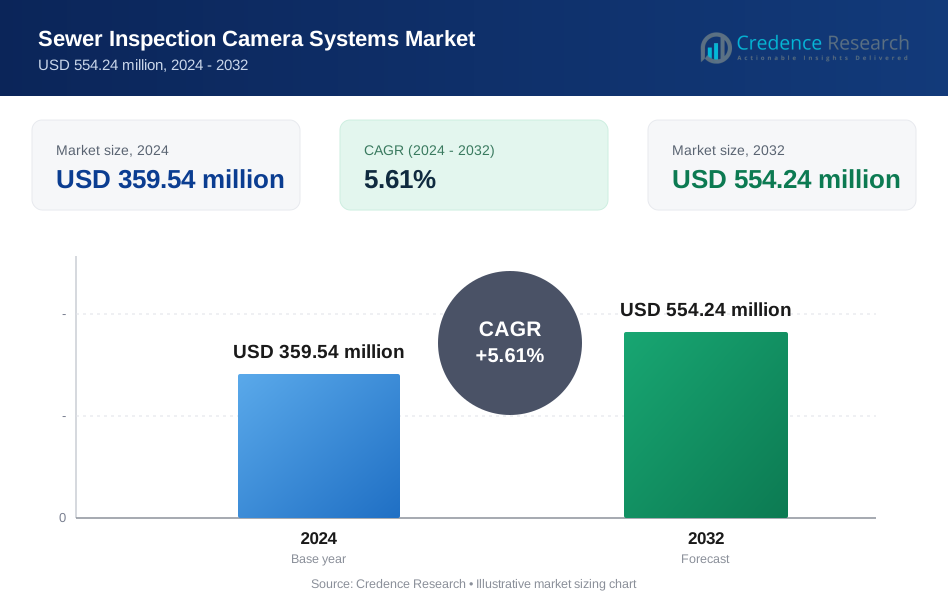
| Sewer Inspection Camera Systems Market Size 2024 | USD 359.54 million |
| Sewer Inspection Camera Systems Market, CAGR | 5.61% |
| Sewer Inspection Camera Systems Market Size 2032 | USD 554.24 million |
Market Overview
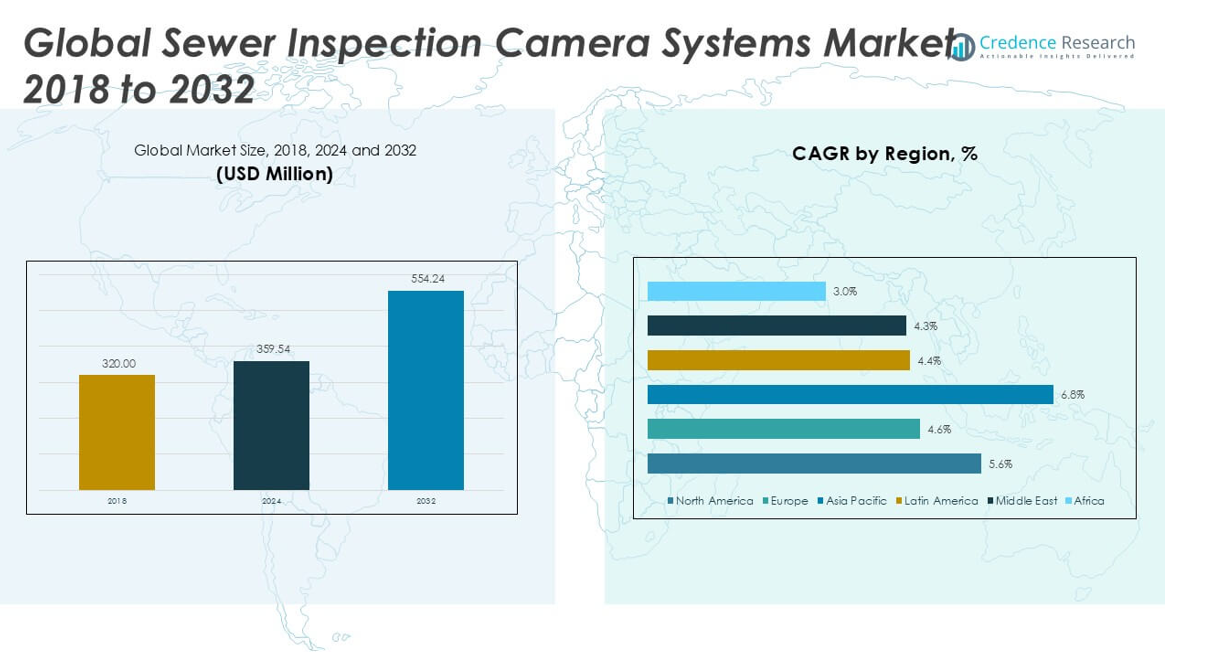
The Sewer Inspection Camera Systems market size was valued at USD 320.00 million in 2018, reached USD 359.54 million in 2024, and is anticipated to reach USD 554.24 million by 2032, at a CAGR of 5.61% during the forecast period.
The Sewer Inspection Camera Systems market is led by key players such as VU-Rite, Envirosight LLC, Kummert GmbH, USA Borescopes, and Troglotech, who collectively dominate the competitive landscape through advanced product offerings and strong regional presence. These companies are focusing on technological innovation, including wireless connectivity, high-resolution imaging, and self-propelled systems to enhance inspection efficiency and user convenience. North America holds the largest regional share, accounting for 41.5% of the global market in 2024, driven by aging sewer infrastructure and high adoption of advanced maintenance solutions. Asia Pacific follows with a rapidly growing share of 29.3%, supported by urban expansion and infrastructure development.
Market Insights
- The Sewer Inspection Camera Systems market was valued at USD 359.54 million in 2024 and is projected to reach USD 554.24 million by 2032, growing at a CAGR of 5.61% during the forecast period.
- Market growth is driven by the rising need for efficient sewer maintenance, increasing urbanization, and government regulations promoting preventive infrastructure inspection.
- The market is witnessing a strong trend towards wireless, portable, and self-propelled camera systems, with portable systems emerging as a dominant segment due to their flexibility and ease of use.
- The competitive landscape is shaped by key players such as VU-Rite, Envirosight LLC, Kummert GmbH, and USA Borescopes, focusing on innovation, product expansion, and strategic partnerships to strengthen their global presence.
- North America holds the largest regional market share at 41.5%, followed by Asia Pacific at 29.3%, while Europe contributes 18.5%, supported by infrastructure upgrades and increasing sewer network coverage.
Market Segmentation Analysis:
By Product Type:
The wired sewer inspection cameras segment dominates the product type category, holding the largest market share due to their reliable connectivity and consistent image quality. These cameras are widely preferred for long-distance inspections in complex sewer networks. However, wireless sewer inspection cameras are rapidly gaining traction, driven by demand for easier deployment and enhanced mobility. Portable cameras also contribute significantly, favored for their convenience in residential and small commercial inspections. Combination sewer inspection camera systems, which integrate various technologies, are expected to grow as they offer versatile inspection solutions tailored to diverse operational needs.
- For instance, Envirosight’s ROVVER X crawler uses a Kevlar-reinforced cable available in 984 ft and 1,640 ft lengths, enabling deep mainline exploration without signal degradation.
By Camera Specification:
Within camera specifications, the segment with camera resolutions above 1080p leads the market, accounting for the highest revenue share. High-resolution cameras provide superior image clarity, enabling accurate defect detection and detailed condition assessments. Camera lens diameters ranging between 15mm and 25mm dominate due to their optimal balance of maneuverability and visual coverage in narrow pipes. A field of view between 120° and 160° is preferred as it offers comprehensive inspection coverage without compromising image quality. Advances in resolution and optics continue to drive demand for enhanced diagnostic capabilities.
- For instance, Troglotech’s T804 push-rod system includes a 61 m (200 ft) rod and provides up to 32 hours of video recording on a flash card, ensuring extended inspection capability with full HD capture.
By Deployment Method:
Manual deployment remains the dominant segment in sewer inspection cameras, favored for its cost-effectiveness and suitability in varied environments. However, automated deployment is gaining momentum due to its efficiency in large-scale municipal projects. Remote-controlled deployment offers enhanced operational control and safety, especially in hazardous or inaccessible areas, which is driving its adoption. Self-propelled cameras are increasingly adopted for their ability to navigate complex pipeline systems independently, reducing labor intensity and improving inspection speed. Growing urban infrastructure development supports expansion across all deployment methods.
Market Overview
Growing Demand for Efficient Infrastructure Maintenance
The increasing need for timely and cost-effective maintenance of aging sewer infrastructure is a significant driver for the Sewer Inspection Camera Systems market. Municipalities and service providers are focusing on minimizing downtime and reducing maintenance costs by adopting advanced inspection solutions. Sewer inspection cameras enable quick identification of blockages, cracks, and structural defects, allowing for precise interventions. This demand is further amplified by stringent government regulations promoting preventive maintenance, which accelerates the adoption of these systems across urban and industrial areas.
- For instance, Troglotech’s T804 system supports up to 8 hours of continuous operation on a single charge and includes an integral DVR capable of storing 32 hours of footage on a CF card, allowing for extended, uninterrupted inspections without data loss.
Rising Urbanization and Expanding Sewer Networks
Rapid urbanization and the continuous expansion of sewer networks are fueling the demand for advanced sewer inspection solutions. As new residential, commercial, and industrial zones develop, the need for regular monitoring and maintenance of the increasing pipeline infrastructure intensifies. Sewer inspection camera systems offer a reliable and efficient method to inspect and maintain these growing networks. Additionally, the construction of smart cities is enhancing the need for technologically integrated sewer management, propelling market growth.
- For instance, Envirosight’s ROVVER X crawler employs a 984-foot Kevlar cable rated at 2,000 lb break strength, enabling deep mainline inspections with durable durability and minimal signal interference.
Technological Advancements in Inspection Systems
Technological innovations, including the integration of high-resolution cameras, real-time video streaming, self-cleaning mechanisms, and digital zoom functionalities, are significantly driving the Sewer Inspection Camera Systems market. The development of wireless and portable systems has improved operational flexibility and accessibility, especially in complex or hard-to-reach sewer lines. These advancements reduce inspection time and improve accuracy, attracting municipalities, utilities, and service providers seeking reliable, user-friendly solutions for sewer maintenance and monitoring.
Key Trends & Opportunities
Increasing Adoption of Wireless and Portable Systems
The trend toward wireless and portable sewer inspection camera systems is gaining momentum due to their ease of use, mobility, and improved access to confined spaces. These systems offer flexibility for on-site operators, enabling efficient inspection in areas without the need for extensive setup. As the demand for compact and lightweight inspection tools grows, manufacturers are focusing on developing portable solutions with enhanced battery life and connectivity, creating opportunities for product differentiation and market expansion.
- For instance, USA Borescopes’ MC360 pan‑and‑tilt pipe camera includes a 60 m push‑rod cable, operates via wireless remote control, and records directly onto an SD card using a built-in QWERTY keyboard for onsite annotation.
Integration with Digital and Automated Technologies
The integration of sewer inspection camera systems with digital platforms, automation, and remote-control functionalities is an emerging opportunity in the market. Automated and self-propelled deployment systems are becoming popular due to their ability to perform thorough inspections with minimal human intervention. Additionally, the incorporation of AI-based image analysis and cloud-based data storage is improving defect detection and inspection reporting, offering significant efficiency gains and opening new avenues for smart sewer management solutions.
- For instance, Envirosight’s Quickview 360 pole camera completes a manhole scan in 5 minutes, supports AI-powered defect coding, and uploads data to the cloud for immediate analysis.
Key Challenges
High Initial Investment and Maintenance Costs
One of the primary challenges in the Sewer Inspection Camera Systems market is the high initial investment and ongoing maintenance expenses associated with advanced inspection equipment. Small-scale service providers and municipalities with limited budgets may find it difficult to adopt these systems despite their long-term benefits. The cost barrier often slows down the decision-making process and limits market penetration, particularly in developing regions where infrastructure funding is constrained.
Technical Limitations in Complex Sewer Networks
Despite technological advancements, sewer inspection cameras can face operational limitations in extremely narrow, obstructed, or highly corroded pipelines. Navigating complex sewer geometries and capturing high-quality images in challenging environments remain technical hurdles. These limitations may result in incomplete inspections, requiring additional manual efforts or alternative methods. Overcoming these challenges through continued product innovation is crucial for ensuring comprehensive pipeline assessment and broader system applicability.
Data Management and Integration Challenges
Managing large volumes of video data and integrating inspection results with existing infrastructure management systems pose significant challenges for operators. Efficiently storing, analyzing, and retrieving inspection records require robust software and skilled personnel. Additionally, ensuring data security, particularly when cloud-based storage is involved, can complicate system implementation. These data management complexities may delay adoption for some users, especially those lacking technical expertise or digital infrastructure.
Regional Analysis
North America
North America held the largest market share of approximately 41.5% in 2024, with a market size of USD 147.62 million, growing from USD 132.80 million in 2018. The market is projected to reach USD 227.30 million by 2032, registering a CAGR of 5.6% during the forecast period. The region’s growth is driven by aging sewer infrastructure, stringent regulatory frameworks, and the rapid adoption of advanced inspection technologies. Municipalities and utility companies in the United States and Canada are increasingly investing in sewer inspection systems to ensure preventive maintenance and reduce costly emergency repairs.
Europe
Europe accounted for a market share of approximately 18.5% in 2024, reaching USD 65.50 million from USD 61.57 million in 2018, and is expected to grow to USD 93.20 million by 2032 at a CAGR of 4.6%. The demand in Europe is supported by growing environmental regulations and the modernization of old sewer systems. Countries like Germany, the UK, and France are focusing on improving public sanitation infrastructure and deploying advanced inspection solutions to meet strict quality and environmental standards. The market is also benefiting from rising awareness regarding proactive sewer management.
Asia Pacific
Asia Pacific represented a significant 29.3% market share in 2024, increasing from USD 88.00 million in 2018 to USD 102.77 million in 2024, and is projected to reach USD 173.75 million by 2032 with a robust CAGR of 6.8%. The rapid urbanization, expanding municipal infrastructure, and growing investments in smart cities across China, India, and Southeast Asia are fueling market growth. The increasing need for efficient sewer maintenance in densely populated cities is accelerating the adoption of portable and wireless inspection systems. The region is anticipated to offer the highest growth potential during the forecast period.
Latin America
Latin America contributed approximately 5.1% to the global market in 2024, growing from USD 16.38 million in 2018 to USD 18.19 million in 2024, and is expected to reach USD 25.53 million by 2032 at a CAGR of 4.4%. The market growth is driven by urban development projects, especially in Brazil and Mexico, and increasing government initiatives to modernize sewer systems. Rising investments in water management infrastructure and the gradual adoption of modern inspection equipment are further supporting the market expansion across the region.
Middle East
The Middle East held a market share of around 4.0% in 2024, increasing from USD 12.74 million in 2018 to USD 13.44 million in 2024, with expectations to reach USD 18.79 million by 2032 at a CAGR of 4.3%. Growth in this region is supported by infrastructural developments, particularly in the UAE and Saudi Arabia, where smart city initiatives and large-scale municipal projects are underway. The demand for sewer inspection camera systems is gradually rising as governments emphasize efficient waste management and preventive maintenance strategies to support rapid urban expansion.
Africa
Africa accounted for approximately 3.4% of the global market in 2024, increasing from USD 8.51 million in 2018 to USD 12.01 million in 2024, and is projected to reach USD 15.68 million by 2032, growing at a CAGR of 3.0%. Although the market size remains relatively smaller compared to other regions, there is a growing interest in adopting advanced sewer inspection systems to tackle aging infrastructure and improve sanitation in key urban centers. Government-led initiatives and international infrastructure investments are expected to moderately support market growth in Africa over the forecast period.
Market Segmentations:
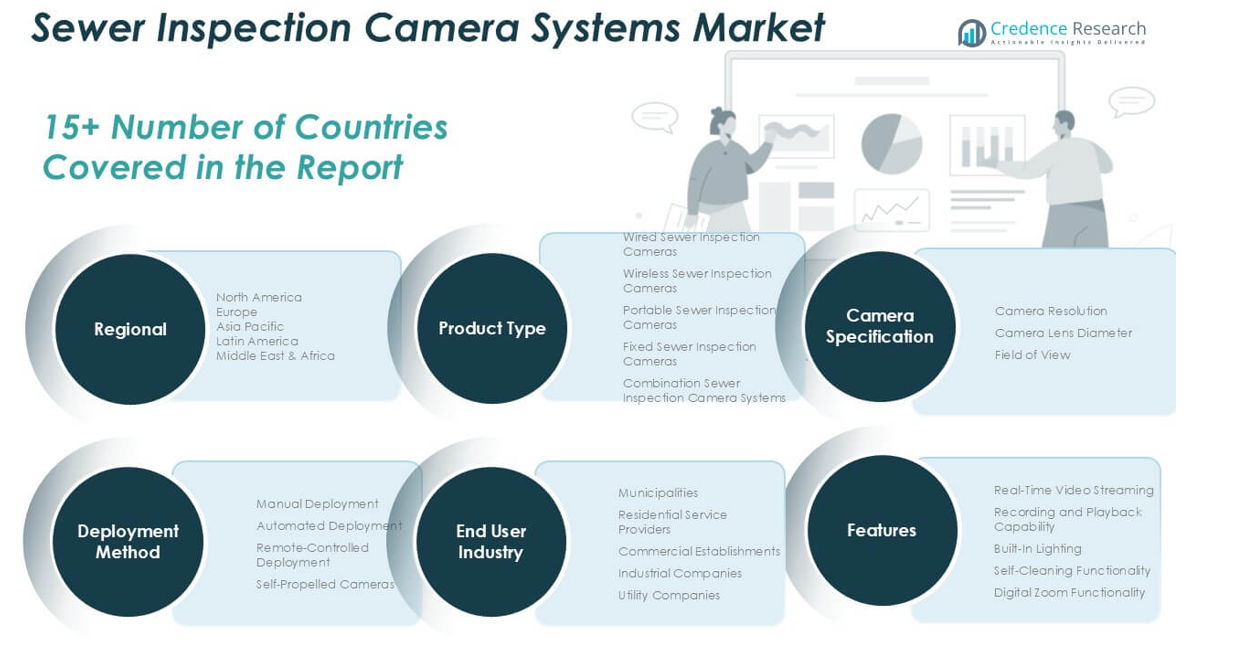
By Product Type
- Wired Sewer Inspection Cameras
- Wireless Sewer Inspection Cameras
- Portable Sewer Inspection Cameras
- Fixed Sewer Inspection Cameras
- Combination Sewer Inspection Camera Systems
By Camera Specification
- Camera Resolution
- Camera Lens Diameter
- Field of View
By Deployment Method
- Manual Deployment
- Automated Deployment
- Remote-Controlled Deployment
- Self-Propelled Cameras
By End User Industry
- Municipalities
- Residential Service Providers
- Commercial Establishments
- Industrial Companies
- Utility Companies
By Features
- Real-Time Video Streaming
- Recording and Playback Capability
- Built-In Lighting
- Self-Cleaning Functionality
- Digital Zoom Functionality
By Geography
- North America
- U.S.
- Canada
- Mexico
- Europe
- Germany
- France
- U.K.
- Italy
- Spain
- Rest of Europe
- Asia Pacific
- China
- Japan
- India
- South Korea
- South-east Asia
- Rest of Asia Pacific
- Latin America
- Brazil
- Argentina
- Rest of Latin America
- Middle East & Africa
- GCC Countries
- South Africa
- Rest of the Middle East and Africa
Competitive Landscape
The competitive landscape of the Sewer Inspection Camera Systems market is characterized by the presence of several established and emerging players striving to enhance their market position through product innovation, strategic partnerships, and geographic expansion. Key companies such as VU-Rite, Envirosight LLC, Kummert GmbH, and USA Borescopes are focusing on developing advanced systems with features like high-resolution imaging, wireless connectivity, and self-propelled capabilities to meet evolving customer demands. Manufacturers are also emphasizing user-friendly designs and integration with digital platforms to improve inspection efficiency. The market is moderately fragmented, with regional players like PH & Associates and Gorlitz Sewer & Drain offering competitive solutions tailored to local infrastructure needs. Companies are actively engaging in mergers, acquisitions, and collaborations to expand their product portfolios and global reach. Additionally, the adoption of automated and remote-controlled deployment systems is creating new growth avenues for innovative market entrants, intensifying competition across both developed and emerging regions.
Key Player Analysis
- VU-Rite
- PH & Associates
- USA Borescopes
- Xcam Cameras
- Gorlitz Sewer & Drain
- Envirosight LLC
- Kummert GmbH
- GEJOS KANAL-TV
- NICOM Technologies
- Jetter Nozzles Store
- Camtronics
- Troglotech
- MyTan
Recent Developments
- In April 2024, Ricoh Company, Ltd. announced its acquisition of natif.ai, a German startup specializing in artificial intelligence (AI)-driven Intelligent Capture, advanced image recognition, and optical character recognition (OCR) technologies.
- In June 2023, Ricoh Company, Ltd. launched the RICOH SC-20, an inspection camera that works utilizing image recognition technology. The camera is designed for real-time verification of the accurate performance of manual work processes.
- In March 2022, Omron Automation launched a series of affordable, compact board-level cameras specifically designed for embedded vision applications. The Omron B Series GigE Vision cameras are fully featured and do not require an enclosure.
Market Concentration & Characteristics
The Sewer Inspection Camera Systems Market demonstrates moderate to high market concentration, with a few key players controlling significant revenue shares. It features a blend of established manufacturers and regional suppliers competing on technology, pricing, and product customization. The market focuses on advanced imaging capabilities, portability, and wireless connectivity to meet the demand for precise and efficient sewer inspections. It responds quickly to technological advancements and regulatory requirements that push operators to adopt modern inspection solutions. The competitive environment encourages companies to invest in product innovation and strategic partnerships to secure market position. Product differentiation based on camera resolution, deployment flexibility, and integrated software solutions remains critical to maintaining competitiveness. Companies prioritize ease of operation, real-time video capabilities, and automated deployment systems to meet user expectations. The market benefits from stable demand in developed regions and rising infrastructure investments in emerging areas. It shows steady growth, driven by infrastructure maintenance needs and increasing urban sewer network coverage.
Report Coverage
The research report offers an in-depth analysis based on Product Type, Camera Specification, Deployment Method, End User Industry, Features and Geography. It details leading market players, providing an overview of their business, product offerings, investments, revenue streams, and key applications. Additionally, the report includes insights into the competitive environment, SWOT analysis, current market trends, as well as the primary drivers and constraints. Furthermore, it discusses various factors that have driven market expansion in recent years. The report also explores market dynamics, regulatory scenarios, and technological advancements that are shaping the industry. It assesses the impact of external factors and global economic changes on market growth. Lastly, it provides strategic recommendations for new entrants and established companies to navigate the complexities of the market.
Future Outlook
- The market is expected to experience steady growth driven by increasing demand for preventive sewer maintenance solutions.
- Wireless and portable sewer inspection camera systems will see higher adoption due to their ease of use and mobility.
- Automated and self-propelled deployment methods will gain popularity for improving inspection efficiency and reducing manual efforts.
- High-resolution imaging and advanced digital features will become standard in future sewer inspection camera systems.
- Integration of AI-based defect detection and cloud-based data management will enhance inspection accuracy and reporting.
- Growing urbanization and expanding sewer networks will continue to create opportunities across emerging markets.
- Key players will focus on strategic partnerships and technological collaborations to strengthen their market presence.
- The demand for user-friendly and cost-effective systems will rise among small and mid-sized service providers.
- North America and Asia Pacific will remain dominant regions, supported by strong infrastructure investments.
- Regulatory emphasis on environmental safety and efficient waste management will continue to support market growth.
Request a Free Sample
Fill in your details and we'll send you a free sample report.
- Sample data tables & charts
- Research methodology
Market Dynamics
Aging Sewer Infrastructure and Preventive Maintenance Mandates
Municipalities and utilities are increasingly investing in advanced inspection camera systems to address the challenges of aging sewer networks and comply with government regulations that require preventive maintenance, reducing the risk of costly emergency repairs.
Urbanization and Expansion of Sewer Networks
Rapid urban growth and the development of new residential, commercial, and industrial zones are driving the need for regular monitoring and maintenance of expanding sewer infrastructure, boosting demand for efficient inspection solutions.
Technological Advancements in Camera Systems
Innovations such as high-resolution imaging, wireless connectivity, self-propelled deployment, and integration with digital platforms are making sewer inspection cameras more effective and user-friendly, encouraging broader adoption across diverse end users.
Shift Toward Wireless and Portable Solutions
The growing preference for wireless and portable camera systems, which offer greater mobility and ease of use in confined or hard-to-reach spaces, is expanding the market, particularly among small service providers and in rapidly urbanizing regions.
Integration with AI and Cloud-Based Data Management
The adoption of AI-powered defect detection and cloud-based data storage is enhancing inspection accuracy, streamlining reporting, and enabling smarter infrastructure management, which is increasingly valued by municipalities and utilities seeking operational efficiency.
Need a Custom Version of This Report?
Tailor the scope, geography, or segments to your exact requirements.
- Custom geography or segment scope
- Direct access to our analyst team
Frequently Asked Questions
What is the current size of the Sewer Inspection Camera Systems Market?
What are the key segments within the Sewer Inspection Camera Systems Market?
What are some challenges faced by the Sewer Inspection Camera Systems Market?
Who are the major players in the Sewer Inspection Camera Systems Market?
Table of Content
Chapter 1 Market Segmentation
- 1.1 Segmentation Framework
- 1.1.1 Product and Service Classification
- 1.1.2 Application and End-Use Classification
- 1.1.3 Technology and Solution Classification
- 1.1.4 Customer and Distribution Channel Classification
- 1.1.5 Geographic Segmentation
- 1.1.6 Market Segment Definitions and Boundaries
- 1.2 By Product Type
- 1.2.1 Wired Sewer Inspection Cameras
- 1.2.2 Wireless Sewer Inspection Cameras
- 1.2.3 Portable Sewer Inspection Cameras
- 1.2.4 Fixed Sewer Inspection Cameras
- 1.2.5 Combination Sewer Inspection Camera Systems
- 1.3 By Deployment Method
- 1.3.1 Manual Deployment
- 1.3.2 Automated Deployment
- 1.3.3 Remote-Controlled Deployment
- 1.3.4 Self-Propelled Cameras
- 1.4 By End User Industry
- 1.4.1 Municipalities
- 1.4.2 Residential Service Providers
- 1.4.3 Commercial Establishments
- 1.4.4 Industrial Companies
- 1.4.5 Utility Companies
- 1.5 By Camera Specification
- 1.5.1 Camera Resolution
- 1.5.2 Camera Lens Diameter
- 1.5.3 Field of View
Chapter 2 Introduction
- 2.1 Report Objectives and Scope
- 2.2 Product Definition and Industry Terminology
- 2.3 Market Inclusions and Exclusions
- 2.4 Research Process
- 2.4.1 Primary Research and Expert Interviews
- 2.4.2 Secondary Research and Source Review
- 2.4.3 Top-Down and Bottom-Up Estimation
- 2.4.4 Data Triangulation and Verification
- 2.5 Market Size Measurement Basis
- 2.5.1 2024: USD 359.54 million → 2032: USD 554.24 million
- 2.6 Historical and Forecast Reference Periods
- 2.6.1 Base Year: 2024
- 2.6.2 Forecast Period: 2024-2032
- 2.7 Research Assumptions and Limitations
Chapter 3 Executive Summary
- 3.1 Market Snapshot and Key Findings
- 3.2 Base-Year Market Size, 2024
- 3.3 Forecast Market Size, 2032
- 3.4 Revenue and Volume Growth Outlook
- 3.5 Key Demand and Supply Indicators
- 3.6 Leading Market Segments
- 3.7 Fastest-Growing Market Opportunities
- 3.8 Regional Performance Highlights
- 3.9 Technology and Industry Transformation
- 3.10 Competitive Landscape Summary
- 3.11 Analyst View and Strategic Implications
Chapter 4 Global Sewer Inspection Camera Systems Market Trends and Developments
- 4.1 Historical Industry Development
- 4.2 Recent Market Trends and Developments
- 4.3 Demand and Customer Behavior Trends
- 4.4 Technology and Product Innovation
- 4.5 Artificial Intelligence, Automation and Digitalization
- 4.6 Local Manufacturing and Supply Chain Realignment
- 4.7 Industry Partnerships, Mergers and Acquisitions
- 4.8 Sustainability and Circular Economy Developments
- 4.9 Government and Private Sector Investment Trends
- 4.10 Emerging Business Models and Commercialization
- 4.11 Industry Developments and Announcements
Chapter 5 Global Sewer Inspection Camera Systems Market Production, Supply and Demand Analysis
- 5.1 Demand Trend and Consumption Analysis
- 5.2 Demand Forecast, 2024-2032
- 5.3 Production and Output Trend
- 5.4 Production and Output Forecast, 2024-2032
- 5.5 Installed Capacity and Capacity Utilization
- 5.6 Company-Wise Production Plants and Statistics
- 5.6.1 Installed Production Capacity
- 5.6.2 Actual Production
- 5.6.3 Planned Capacity and Expansion Targets
- 5.7 Supply Chain Structure and Procurement Trends
- 5.8 Supply-Demand Gap and Bottlenecks
- 5.9 Import Dependence and Sourcing Structure
- 5.10 Contract Manufacturing and Outsourcing
- 5.11 Regional Supply and Demand Concentration
Chapter 6 Global Sewer Inspection Camera Systems Market Pricing Analysis
- 6.1 Pricing Structure and Measurement
- 6.2 Historical Pricing Trends
- 6.3 Pricing Outlook, 2024-2032
- 6.4 Average Selling Price and Unit Economics
- 6.5 Pricing by Product and Market Segment
- 6.6 Geographic Pricing Differences
- 6.7 Key Input, Energy, Labor and Logistics Costs
- 6.8 Contract Pricing and Purchasing Models
- 6.9 Pricing Sensitivity and Competitive Positioning
- 6.10 Price, Margin and Profitability Implications
Chapter 7 Global Sewer Inspection Camera Systems Market Dynamics
- 7.1 Market Growth Drivers
- 7.1.1 Demand-Side Drivers
- 7.1.2 Technology and Innovation Drivers
- 7.1.3 Infrastructure and Investment Drivers
- 7.1.4 Regulatory and Policy Drivers
- 7.2 Market Restraints
- 7.2.1 Cost and Affordability Constraints
- 7.2.2 Technology and Adoption Barriers
- 7.2.3 Supply Chain and Operational Constraints
- 7.3 Market Challenges
- 7.3.1 Competitive Pressure and Margin Erosion
- 7.3.2 Skills, Infrastructure and Implementation Gaps
- 7.4 Emerging Market Opportunities
- 7.5 Market Dynamics Impact and Time-Horizon Assessment
Chapter 8 Global Sewer Inspection Camera Systems Value Chain Analysis
- 8.1 Industry Value Chain Overview
- 8.2 Upstream Suppliers and Critical Inputs
- 8.3 Technology and Component Providers
- 8.4 Manufacturing or Service Delivery
- 8.5 Distribution, Channel Partners and Integrators
- 8.6 Downstream Applications and End Users
- 8.7 Value Addition and Profit Pools
- 8.8 Vertical Integration and Outsourcing
- 8.9 Supplier Concentration and Risk
- 8.10 Supply Chain Localization and Resilience
Chapter 9 Global Sewer Inspection Camera Systems Market Regulations and Policies
- 9.1 Relevant Laws, Standards and Compliance Frameworks
- 9.2 Product, Service, Safety and Quality Requirements
- 9.3 Government Policies, Incentives and Subsidies
- 9.4 Imports, Exports and Trade Barriers
- 9.5 Public Procurement and Local Content Requirements
- 9.6 Environmental and Sustainability Compliance
- 9.7 Upcoming Policy Changes and Market Implications
Chapter 10 Global Sewer Inspection Camera Systems Market Hotspots and Opportunities
- 10.1 Market Opportunity Mapping and Growth Hotspots
- 10.2 High-Growth Applications and Customer Groups
- 10.3 Underserved Markets and White-Space Opportunities
- 10.4 Emerging Technology and Product Opportunities
- 10.5 New Capacity and Investment Hotspots
- 10.6 Market Entry and Expansion Opportunities
- 10.7 Distribution and Partnership Opportunities
- 10.8 Near-Term and Long-Term Commercial Potential
- 10.9 Opportunity Attractiveness and Execution Risks
Chapter 11 Global Sewer Inspection Camera Systems Market Outlook, 2024-2032
- 11.1 Market Size and Analysis
- 11.1.1 Revenue (Market Measurement: 2024: USD 359.54 million → 2032: USD 554.24 million)
- 11.1.2 Market Volume and Quantity Sold
- 11.1.3 Historical Market Size
- 11.1.4 Base-Year Market Size, 2024
- 11.2 Market Forecast, 2024-2032
- 11.2.1 Revenue Forecast to 2032
- 11.2.2 Volume Forecast to 2032
- 11.2.3 CAGR and Year-on-Year Growth
- 11.2.4 Incremental Revenue Opportunity
- 11.3 Forecast Assumptions and Scenario Analysis
- 11.3.1 Base-Case Forecast
- 11.3.2 Optimistic and Conservative Scenarios
- 11.3.3 Technology, Pricing and Policy Sensitivities
- 11.4 Market Attractiveness and Growth Outlook
Chapter 12 Global Sewer Inspection Camera Systems Market Segmentation and Outlook
- 12.1 Segmentation Summary and Market Shares, 2024
- 12.2 Largest and Fastest-Growing Segments
- 12.3 By Product Type - Market Size and Forecast, 2024-2032
- 12.3.1 Segment Definition and Scope
- 12.3.2 Historical Market Size
- 12.3.3 Revenue Forecast, 2024-2032
- 12.3.4 Volume Forecast, 2024-2032
- 12.3.5 Base-Year Market Share, 2024
- 12.3.6 Segment CAGR and Growth Drivers
- 12.3.7 Subsegment Market Size and Forecast
- 12.3.7.1 Wired Sewer Inspection Cameras
- 12.3.7.2 Wireless Sewer Inspection Cameras
- 12.3.7.3 Portable Sewer Inspection Cameras
- 12.3.7.4 Fixed Sewer Inspection Cameras
- 12.3.7.5 Combination Sewer Inspection Camera Systems
- 12.3.8 Subsegment Pricing and Adoption Trends
- 12.3.9 Leading Suppliers and Competition
- 12.3.10 Regional Demand and Opportunities
- 12.4 By Deployment Method - Market Size and Forecast, 2024-2032
- 12.4.1 Segment Definition and Scope
- 12.4.2 Historical Market Size
- 12.4.3 Revenue Forecast, 2024-2032
- 12.4.4 Volume Forecast, 2024-2032
- 12.4.5 Base-Year Market Share, 2024
- 12.4.6 Segment CAGR and Growth Drivers
- 12.4.7 Subsegment Market Size and Forecast
- 12.4.7.1 Manual Deployment
- 12.4.7.2 Automated Deployment
- 12.4.7.3 Remote-Controlled Deployment
- 12.4.7.4 Self-Propelled Cameras
- 12.4.8 Subsegment Pricing and Adoption Trends
- 12.4.9 Leading Suppliers and Competition
- 12.4.10 Regional Demand and Opportunities
- 12.5 By End User Industry - Market Size and Forecast, 2024-2032
- 12.5.1 Segment Definition and Scope
- 12.5.2 Historical Market Size
- 12.5.3 Revenue Forecast, 2024-2032
- 12.5.4 Volume Forecast, 2024-2032
- 12.5.5 Base-Year Market Share, 2024
- 12.5.6 Segment CAGR and Growth Drivers
- 12.5.7 Subsegment Market Size and Forecast
- 12.5.7.1 Municipalities
- 12.5.7.2 Residential Service Providers
- 12.5.7.3 Commercial Establishments
- 12.5.7.4 Industrial Companies
- 12.5.7.5 Utility Companies
- 12.5.8 Subsegment Pricing and Adoption Trends
- 12.5.9 Leading Suppliers and Competition
- 12.5.10 Regional Demand and Opportunities
- 12.6 By Camera Specification - Market Size and Forecast, 2024-2032
- 12.6.1 Segment Definition and Scope
- 12.6.2 Historical Market Size
- 12.6.3 Revenue Forecast, 2024-2032
- 12.6.4 Volume Forecast, 2024-2032
- 12.6.5 Base-Year Market Share, 2024
- 12.6.6 Segment CAGR and Growth Drivers
- 12.6.7 Subsegment Market Size and Forecast
- 12.6.7.1 Camera Resolution
- 12.6.7.2 Camera Lens Diameter
- 12.6.7.3 Field of View
- 12.6.8 Subsegment Pricing and Adoption Trends
- 12.6.9 Leading Suppliers and Competition
- 12.6.10 Regional Demand and Opportunities
- 12.7 Segment Growth Comparison
- 12.8 Segment Attractiveness and Priority Matrix
Chapter 13 Global Sewer Inspection Camera Systems End-Use and Application Market Outlook
- 13.1 End-Use Industry and Customer Demand Structure
- 13.2 Leading Applications and Customer Groups
- 13.3 End-Use Market Size, Share and Forecast
- 13.4 Major End-Use Industry Deep Dives
- 13.4.1 Customer Requirements and Use Cases
- 13.4.2 Demand and Replacement Cycles
- 13.4.3 Technical and Regulatory Considerations
- 13.4.4 Purchasing and Procurement Models
- 13.4.5 Leading Vendors and Distribution Channels
- 13.4.6 Forecast and Commercial Opportunities
- 13.5 Emerging Applications and Cross-Segment Demand
- 13.6 End-Use Industry Investment Priorities
Chapter 14 Global Sewer Inspection Camera Systems Geographic Market Outlook, 2024-2032
- 14.1 Regional Market Size and Share, 2024
- 14.2 Regional Market Forecast, 2024-2032
- 14.3 Regional Pricing, Production and Demand Differences
- 14.4 North America
- 14.4.1 United States
- 14.4.2 Canada
- 14.4.3 Mexico
- 14.5 Europe
- 14.5.1 Germany
- 14.5.2 France
- 14.5.3 Italy
- 14.5.4 United Kingdom
- 14.5.5 Spain
- 14.5.6 Poland
- 14.5.7 Russia
- 14.5.8 Netherlands
- 14.5.9 Belgium
- 14.5.10 Sweden
- 14.5.11 Denmark
- 14.5.12 Norway
- 14.5.13 Rest of Europe
- 14.6 Asia Pacific
- 14.6.1 China
- 14.6.2 India
- 14.6.3 Japan
- 14.6.4 South Korea
- 14.6.5 Thailand
- 14.6.6 Indonesia
- 14.6.7 Vietnam
- 14.6.8 Malaysia
- 14.6.9 Australia
- 14.6.10 Rest of Asia Pacific
- 14.7 Latin America
- 14.7.1 Brazil
- 14.7.2 Argentina
- 14.7.3 Colombia
- 14.7.4 Chile
- 14.7.5 Rest of Latin America
- 14.8 Middle East
- 14.8.1 Saudi Arabia
- 14.8.2 United Arab Emirates
- 14.8.3 Turkey
- 14.8.4 Israel
- 14.8.5 Iran
- 14.8.6 Rest of the Middle East
- 14.9 Africa
- 14.9.1 South Africa
- 14.9.2 Egypt
- 14.9.3 Nigeria
- 14.9.4 Morocco
- 14.9.5 Rest of Africa
- 14.10 Regional Investment, Policy and Supply Chain Differences
- 14.11 Regional Competitive Landscape
- 14.12 Geographic Growth Hotspots
Chapter 15 Global Sewer Inspection Camera Systems Technology, Innovation and Sustainability Outlook
- 15.1 Technology Landscape and Maturity
- 15.2 Product, Process and Service Innovation
- 15.3 AI, Automation and Digital Tools in the Industry
- 15.4 Technology Adoption and Performance Benchmarking
- 15.5 Innovation Pipeline and R&D Investment
- 15.6 Patent and Intellectual Property Trends
- 15.7 Energy Efficiency and Resource Management
- 15.8 Sustainability, Recycling and Circularity
- 15.9 Technology Roadmap, 2024-2032
- 15.10 Risks of Obsolescence and Technology Substitution
Chapter 16 Global Sewer Inspection Camera Systems Market Key Strategic Imperatives
- 16.1 Growth and Market Entry Priorities
- 16.2 High-Return Products and Segments
- 16.3 Pricing, Profitability and Cost Optimization
- 16.4 Technology Investment and Product Differentiation
- 16.5 Supply Chain Localization and Resilience
- 16.6 Distribution and Customer Acquisition
- 16.7 Partnership, Acquisition and Capacity Strategy
- 16.8 Regional Expansion Priorities
- 16.9 Short-, Medium- and Long-Term Actions
Chapter 17 Competition Outlook
- 17.1 Industry Competition Characteristics
- 17.2 Market Structure and Concentration
- 17.3 Market Share and Competitive Positioning, 2024
- 17.4 Company-Wise Revenue and Product Benchmarking
- 17.5 Production and Service Capacity Benchmarking
- 17.6 Technology, Pricing and Differentiation
- 17.7 Regional Footprint and Distribution Strength
- 17.8 Mergers, Acquisitions and Strategic Alliances
- 17.9 New Entrants and Competitive Threats
- 17.10 Porter's Five Forces and Industry Attractiveness
- 17.11 Competitive Outlook, 2024-2032
Chapter 18 Company Profiles
- 18.1 Company Coverage and Selection Criteria
- 18.2 VU-Rite
- 18.2.1 Business Description
- 18.2.2 Company Ownership and Geographic Presence
- 18.2.3 Product and Service Portfolio
- 18.2.4 Manufacturing and Operating Footprint
- 18.2.5 Production Capacity and Expansion Plans
- 18.2.6 Financial Performance and Investment
- 18.2.7 Market Share and Competitive Position
- 18.2.8 Technology and Innovation Capabilities
- 18.2.9 Strategic Alliances or Partnerships
- 18.2.10 Recent Developments
- 18.2.11 Growth Strategy and Outlook
- 18.3 Envirosight LLC
- 18.4 Kummert GmbH
- 18.5 USA Borescopes
- 18.6 Troglotech
- 18.7 PH & Associates
- 18.8 Gorlitz Sewer & Drain
- 18.9 GEJOS KANAL-TV
- 18.10 NICOM Technologies
- 18.11 Camtronics
- 18.12 Other Relevant Market Participants
Note: Every listed company is profiled on the structure shown under the first company. The company list is preliminary and may change based on research findings, market developments, data availability and client requirements.
Chapter 19 Disclaimer
- 19.1 Research and Forecast Disclaimer
- 19.2 Data Source and Estimation Limitations
Note: The depth of individual sections depends on data availability for this market. Volume, capacity, trade and other unit-based metrics are included where applicable.