
| REPORT ATTRIBUTE | DETAILS |
|---|---|
| Historical Period | 2020-2023 |
| Base Year | 2024 |
| Forecast Period | 2025-2032 |
| Tulip Wind Turbines Market Size 2023 | USD 153.24 million |
| Tulip Wind Turbines Market, CAGR | 6.45% |
| Tulip Wind Turbines Market Size 2032 | USD 268.96 million |
Market Overview
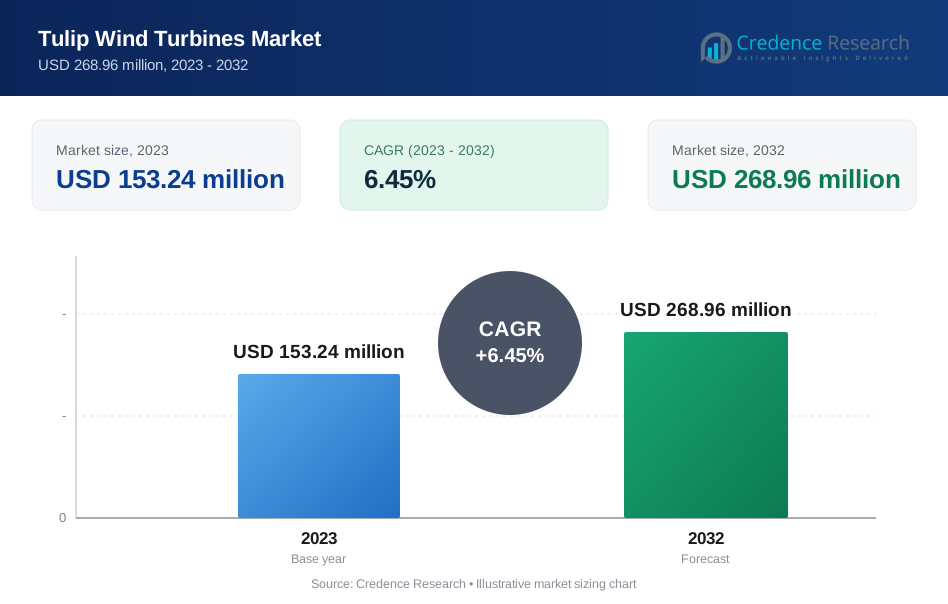
The global Tulip Wind Turbines Market is projected to grow from USD 153.24 million in 2023 to USD 268.96 million by 2032, expanding at a CAGR of 6.45%.
The growth of the global Tulip Wind Turbines market is driven by increasing demand for renewable energy sources and advancements in wind turbine technology. As nations focus on reducing carbon emissions and transitioning to sustainable energy, Tulip Wind Turbines offer an innovative solution due to their higher efficiency and lower environmental impact compared to traditional wind turbines. Additionally, government incentives and policies promoting green energy projects are further accelerating market adoption. Technological innovations, such as improved turbine design and enhanced materials, are also contributing to the market’s growth by boosting performance and reducing operational costs. Furthermore, the rising investment in offshore wind energy projects and the need for more efficient energy generation are creating lucrative opportunities. The combination of environmental consciousness, technological advancements, and supportive regulations is expected to continue driving the market expansion of Tulip Wind Turbines in the coming years.
The Global Tulip Wind Turbines market exhibits diverse growth patterns across regions, driven by varying renewable energy policies and infrastructure development. North America and Europe lead in adoption due to robust government support, technological advancements, and extensive renewable energy projects. In Asia-Pacific, countries like China and India are rapidly expanding their wind energy capacities, leveraging Tulip Wind Turbines to meet increasing energy demands. Latin America and the Middle East & Africa are emerging markets, supported by investments in renewable infrastructure and untapped wind energy potential. Prominent players in this market include Flower Turbines, Wuxi Flyt New Energy Technology Co. Ltd, Leviathan Energy LLC, RexCo Technology, and General Electric. These companies focus on innovation, strategic partnerships, and expanding their regional presence to meet the rising demand for sustainable energy solutions. Their efforts contribute significantly to advancing the adoption of Tulip Wind Turbines globally.
Market Insights
- The Global Tulip Wind Turbines market was valued at USD 153.24 million in 2023 and is expected to reach USD 268.96 million by 2032, growing at a CAGR of 6.45%.
- The demand for renewable energy solutions is driving the adoption of Tulip Wind Turbines, particularly in regions with strong renewable energy policies.
- Technological advancements, such as improved turbine efficiency and durability, are fueling market growth.
- The market is trending towards offshore wind energy projects, where Tulip Wind Turbines offer efficiency in harsh environments.
- Competitive pressure is increasing, with major players like General Electric and Flower Turbines innovating to capture market share.
- High initial investment and regulatory challenges are key restraints hindering faster market expansion.
- North America and Europe dominate the market, while the Asia-Pacific and Latin American regions are emerging as growth opportunities for Tulip Wind Turbines.
Market Drivers
Growing Demand for Renewable Energy
The increasing global shift towards renewable energy is a major driver for the Tulip Wind Turbines market. Governments and industries are prioritizing clean energy solutions to reduce carbon emissions and combat climate change. For instance, a report by the Indian Ministry of New and Renewable Energy highlights the ambitious targets set by countries for carbon neutrality. Tulip Wind Turbines, with their advanced technology and efficiency, are becoming a preferred choice. Their ability to generate energy sustainably positions them as a key player in the renewable energy sector, driving substantial market growth.
Technological Advancements in Wind Turbine Design
Innovations in wind turbine technology are significantly boosting the adoption of Tulip Wind Turbines. These turbines feature cutting-edge designs that enhance energy efficiency, reduce noise pollution, and lower the cost of maintenance. For instance, according to a survey by the Global Wind Energy Council, technological improvements such as better aerodynamics and durable materials have increased the operational life and performance of these turbines. As a result, Tulip Wind Turbines are becoming more cost-competitive with other energy generation methods, making them an attractive option for both private and commercial sectors.
Supportive Government Policies and Incentives
Government policies and incentives aimed at promoting green energy have played a crucial role in the growth of Tulip Wind Turbines. Many countries offer financial subsidies, tax breaks, and grants to encourage investments in renewable energy projects. For example, the Indian Ministry of New and Renewable Energy provides various incentives, including financial subsidies and tax breaks, to support the deployment of wind energy projects. These supportive regulations help lower the initial investment costs, making it easier for businesses and utilities to deploy Tulip Wind Turbines. Additionally, government mandates on renewable energy production have created a conducive environment for the market's expansion, ensuring a steady demand for these turbines.
Increasing Offshore Wind Energy Projects
The rise in offshore wind energy projects is another significant market driver for Tulip Wind Turbines. Offshore locations offer higher wind speeds and less interference from human activities, making them ideal for large-scale turbine installations. Tulip Wind Turbines, with their superior efficiency and durability, are well-suited for offshore environments. The growing number of offshore wind farms worldwide is expected to further propel the demand for these turbines, contributing to the market's continued growth.
Market Trends
Increasing Adoption of Offshore Wind Farms
One of the most prominent trends in the global Tulip Wind Turbines market is the growing adoption of offshore wind farms. These turbines, with their advanced design and high efficiency, are ideal for offshore locations where wind speeds are optimal for energy production. For instance, the Global Wind Energy Council's 2024 report highlights the increasing number of offshore wind projects driven by the need for clean energy and minimal environmental disruption. This trend is expected to continue as more nations invest in offshore wind infrastructure.
Focus on Energy Efficiency and Cost Reduction
There is a notable trend toward improving the energy efficiency and reducing the cost of wind energy production. Tulip Wind Turbines, with their enhanced performance and advanced materials, contribute significantly to reducing the overall operational costs. Innovations in turbine design, such as improved blade aerodynamics and longer lifespan components, are further driving this trend. As energy efficiency becomes a key focus for both developers and utilities, Tulip Wind Turbines are gaining preference due to their lower maintenance requirements and higher energy output, making them a cost-effective solution.
Integration of Digital Technologies
The integration of digital technologies, such as the Internet of Things (IoT) and predictive analytics, is transforming the wind energy sector. Tulip Wind Turbines are increasingly being equipped with smart sensors and monitoring systems that collect data in real-time, enabling predictive maintenance and enhancing operational efficiency. These digital solutions allow for better performance optimization, early detection of potential issues, and reduced downtime, leading to greater energy generation. The trend toward digitalization is helping wind turbine operators optimize energy output, resulting in increased demand for Tulip Wind Turbines.
Growing Investment in Green Energy Infrastructure
Another key trend driving the Tulip Wind Turbines market is the surge in investment in green energy infrastructure. As countries seek to transition from fossil fuels to renewable energy sources, there is a significant push to expand wind energy capacity. This includes both onshore and offshore wind farms, with a particular focus on integrating advanced turbine technologies like those found in Tulip Wind Turbines. Increased funding from both public and private sectors is creating opportunities for market expansion, ensuring that the trend toward green energy infrastructure will support the long-term growth of Tulip Wind Turbines.
Market Challenges Analysis
High Initial Investment and Infrastructure Costs
One of the major challenges facing the global Tulip Wind Turbines market is the high initial investment required for their installation and infrastructure development. While Tulip Wind Turbines offer long-term cost savings through improved efficiency, the upfront capital needed for manufacturing, transportation, and installation remains significant. This can be a barrier for smaller companies and emerging markets with limited financial resources. Additionally, the construction of wind farms, especially offshore, involves considerable investments in specialized infrastructure, including platforms, cables, and grid connectivity. These high costs may slow down the adoption of Tulip Wind Turbines in certain regions, particularly in developing economies that are still transitioning to renewable energy.
Regulatory and Environmental Challenges
Another challenge in the Tulip Wind Turbines market is navigating the complex regulatory and environmental requirements that vary across regions. Many countries have strict environmental regulations regarding the construction and operation of wind farms, which can lead to delays and increased project costs. For instance, according to a study by the Indian Ministry of New and Renewable Energy, the permitting process for wind turbines, especially in offshore locations, can be time-consuming due to concerns over marine ecosystems, wildlife impacts, and local community opposition. Additionally, some regions have not yet developed comprehensive regulatory frameworks to accommodate the rapid growth of renewable energy projects. These regulatory hurdles can hinder the pace of adoption and create uncertainty for companies looking to invest in Tulip Wind Turbines.
Market Opportunities
Expanding Focus on Renewable Energy in Emerging Markets
The global shift towards renewable energy presents significant opportunities for the Tulip Wind Turbines market, particularly in emerging economies. Many developing countries are increasingly investing in green energy solutions to meet their growing energy demands and reduce dependence on fossil fuels. Tulip Wind Turbines, with their efficient design and adaptability, are well-suited to support these nations' renewable energy goals. Government initiatives, such as subsidies, tax incentives, and international collaborations, further encourage the adoption of advanced wind turbines in these regions. As these markets expand their renewable energy infrastructure, the demand for Tulip Wind Turbines is expected to rise, creating a substantial growth opportunity.
Advancements in Offshore Wind Energy Projects
The rapid development of offshore wind energy projects offers another significant opportunity for the Tulip Wind Turbines market. Offshore locations provide access to stronger and more consistent wind patterns, making them ideal for energy generation. Tulip Wind Turbines are particularly advantageous in these settings due to their innovative design, which enhances efficiency and reduces maintenance requirements. Increased investment in offshore wind farms, supported by government policies and funding from private stakeholders, is expected to drive the deployment of these turbines. Additionally, advancements in floating turbine technology open up possibilities for installation in deeper waters, further expanding the market potential for Tulip Wind Turbines in the offshore segment.
Market Segmentation Analysis:
By Type:
The global Tulip Wind Turbines market is segmented by type into Vertical Axis Wind Turbine (VAWT) and Horizontal Axis Wind Turbine (HAWT). VAWTs are gaining traction due to their compact design, which allows them to function efficiently in urban settings and areas with variable wind directions. Their ability to operate quietly and generate power at lower wind speeds makes them suitable for residential and small-scale applications. On the other hand, HAWTs dominate the market due to their high efficiency and scalability in large-scale energy production. These turbines are extensively deployed in offshore and utility-scale projects, where strong and consistent wind currents maximize energy generation. Technological advancements in both types, such as improved blade materials and aerodynamic designs, are further enhancing their performance and adoption. This segmentation highlights the diverse applicability of Tulip Wind Turbines, catering to different energy demands and geographical constraints.
By Application:
The application segment of the Tulip Wind Turbines market includes Energy Production, Heating, and Others. Energy production dominates this segment, driven by increasing global efforts to transition to renewable energy sources. Tulip Wind Turbines, known for their efficiency and sustainability, are widely used in wind farms for electricity generation, both onshore and offshore. The heating segment is also witnessing growth, particularly in regions with colder climates where wind turbines are integrated with heating systems for residential and industrial use. The "Others" category encompasses innovative uses, including hybrid systems and niche energy projects. These turbines are also being explored for integration with IoT technologies to optimize energy usage. The diverse applications of Tulip Wind Turbines underline their versatility in addressing global energy challenges, supported by favorable government policies and increasing investments in renewable energy infrastructure.
Segments:
Based on Type:
- Vertical Axis Wind Turbine (VAWT)
- Horizontal Axis Wind Turbine (HAWT)
Based on Application:
- Energy Production
- Heating
- Others
Based on End-User:
- Commercial
- Residential
- Utilities
- Others
Based on the Geography:
- North America
- U.S.
- Canada
- Mexico
- Europe
- UK
- France
- Germany
- Italy
- Spain
- Russia
- Belgium
- Netherlands
- Austria
- Sweden
- Poland
- Denmark
- Switzerland
- Rest of Europe
- Asia Pacific
- China
- Japan
- South Korea
- India
- Australia
- Thailand
- Indonesia
- Vietnam
- Malaysia
- Philippines
- Taiwan
- Rest of Asia Pacific
- Latin America
- Brazil
- Argentina
- Peru
- Chile
- Colombia
- Rest of Latin America
- Middle East
- UAE
- KSA
- Israel
- Turkey
- Iran
- Rest of Middle East
- Africa
- Egypt
- Nigeria
- Algeria
- Morocco
- Rest of Africa
Regional Analysis
North America
North America holds a significant market share in the global Tulip Wind Turbines market, accounting for approximately 35% in 2023. The region's dominance is attributed to substantial investments in renewable energy projects and favorable government policies supporting wind energy. The United States, in particular, has emerged as a key contributor, driven by large-scale offshore wind farm projects and advancements in turbine technology. Canada also plays a crucial role, leveraging its vast wind resources to meet its renewable energy goals. The presence of leading manufacturers and a robust supply chain further enhances the region’s market position. As North America continues its transition toward sustainable energy solutions, the demand for innovative turbines like Tulip Wind Turbines is projected to grow steadily.
Europe
Europe represents approximately 30% of the market share, establishing itself as a pioneer in wind energy adoption, particularly in offshore projects. Countries like Germany, Denmark, and the United Kingdom are at the forefront of this growth, benefiting from strong governmental support and extensive coastlines ideal for wind energy generation. The European Union's stringent carbon emission reduction targets and incentives for renewable energy projects have further accelerated the deployment of Tulip Wind Turbines. Technological advancements, such as floating turbine designs, are opening up deeper water installations, enabling Europe to maintain its leadership in offshore wind energy production. With continued investment and innovation, Europe remains a critical market for Tulip Wind Turbines.
Asia-Pacific
The Asia-Pacific region is experiencing rapid growth in the Tulip Wind Turbines market, holding around 20% market share in 2023. Countries such as China, India, and Japan are key contributors, driven by escalating energy demands and government initiatives to diversify energy sources. China leads the region with extensive wind energy installations, supported by favorable policies and significant investments in infrastructure. India is also emerging as a strong player, emphasizing wind energy to meet its ambitious renewable energy targets. The region's growing focus on reducing reliance on fossil fuels and addressing energy shortages positions Asia-Pacific as a promising market for Tulip Wind Turbines.
Latin America
Latin America holds a smaller market share, estimated at 10%, but is emerging as a region with significant growth potential. Brazil and Mexico are leading the adoption of wind energy in the region, driven by abundant wind resources and supportive government policies. The region’s focus on reducing greenhouse gas emissions and increasing energy access to underserved areas supports the adoption of Tulip Wind Turbines. Investments in renewable energy infrastructure and international collaborations are further expected to enhance market growth. Latin America’s untapped wind resources present a compelling opportunity for expansion in the coming years.
Key Player Analysis
- Flower Turbines
- Wuxi Flyt New Energy Technology Co. Ltd
- Start Engine
- Leviathan Energy LLC
- RexCo Technology
- Saur Energy
- Solar Impulse Foundation
- Gamesa
- Ming Yang
- General Electric
Competitive Analysis
The competitive landscape of the Global Tulip Wind Turbines market is marked by the presence of several leading players, each contributing unique innovations and capabilities. Key players include Flower Turbines, Wuxi Flyt New Energy Technology Co. Ltd, Leviathan Energy LLC, RexCo Technology, Saur Energy, Solar Impulse Foundation, Gamesa, Ming Yang, and General Electric. The market is highly competitive, with players focusing on enhancing the efficiency and performance of Tulip Wind Turbines through technological advancements. For instance, a report by the Global Wind Energy Council highlights that companies are differentiating themselves by offering specialized turbine designs, such as vertical-axis wind turbines (VAWTs) for urban and residential applications, as well as larger turbines for industrial-scale projects. The market's competitive dynamics are influenced by key factors such as the need for cost-effective, reliable, and high-efficiency turbines to meet the growing demand for renewable energy. Additionally, companies are investing in research and development to improve turbine designs, reduce maintenance costs, and increase energy output.
Strategic partnerships and collaborations are crucial in this market, as companies aim to expand their reach and tap into new regional markets, particularly in emerging economies where wind energy adoption is growing. Players are also focusing on regulatory compliance and ensuring their products meet the sustainability standards set by various governments. With increasing global demand for renewable energy solutions, companies that focus on technological innovation, cost reduction, and geographical expansion are expected to maintain a competitive edge.
Recent Developments
- In January 2024, Suzlon Group secured a new order for 225 MW of wind energy from Everrenew Energy. Under this agreement, Suzlon will install 75 wind turbine generators, each with a rated capacity of 3 MW and featuring a Hybrid Lattice Tubular tower. These turbines will be set up at Everrenew Energy’s sites in Vengaimandalam, Trichy district, and Ottapidaram, Tuticorin district in Tamil Nadu.
- In 2023, India installed 2.8 GW of new wind energy capacity, marking a significant 56% increase from the 1.8 GW added in 2022. By the end of December 2023, the country’s total wind capacity had reached 44.7 GW, up from 41.9 GW at the end of 2022. Notably, in the fourth quarter of 2023, India added 552 MW of wind power capacity, a remarkable 141% increase compared to the same period the previous year.
- In January 2023, Braun Windturbinen GmbH, a German wind turbine manufacturer, announced the installation of 7.5 kW small wind turbines. The system features three turbines operating parallel to the grid with the Smart Wind SW7.5 model and includes a 6.0 kW heating rod as a backup heating system. When the grid-parallel operation reaches 2.5 kW, the heating rod is automatically activated based on the turbine’s characteristic curve. Additionally, the system includes adjustable monitoring for domestic hot water temperature, which is integrated with the small wind turbine.
- In November 2023, GE Vernova reached an agreement with O2 Power Private Limited to supply, install, and commission 36 units of its reliable 2.7–132 onshore wind turbines for a 97 MW wind power project in Maharashtra, India.
- In September 2022, Flower Turbines, Inc., a Small Vertical Axis Wind Turbine firm, celebrates its Grand Opening in Lubbock, West Texas, with the Lubbock Chamber of Commerce, at its operating and production headquarters.
- In July 2022, WEG has announced the debut of its latest wind turbine platform, which has a 7 MW capacity and a rotor diameter of 172 meters. This wind turbine is thought to be the largest in use in the Brazilian market. The new design, with its increased power and efficiency, improves output for wind generation projects.
Market Concentration & Characteristics
The market concentration of Global Tulip Wind Turbines is moderate, with a mix of large, established players and smaller, specialized companies driving growth. The industry is characterized by innovation and technology-driven competition, where companies focus on enhancing turbine efficiency, reducing operational costs, and expanding their product portfolios. While the market is not dominated by a single player, leading companies maintain a competitive edge through strategic partnerships, research and development, and expansion into new geographic regions. The market is also marked by a shift towards niche solutions, such as vertical-axis wind turbines (VAWTs) and hybrid systems, catering to residential, commercial, and off-grid energy applications. With the growing demand for sustainable energy sources, there is an increasing focus on turbines that offer higher performance with minimal environmental impact. Companies in the Tulip Wind Turbines market typically exhibit strong research and development capabilities, allowing them to meet evolving market needs. Additionally, regulatory factors play a significant role, with firms striving to meet global sustainability targets and local energy policies. As the demand for renewable energy solutions continues to rise, the market is expected to see further fragmentation, with both established and emerging players vying for market share through innovation, efficiency, and sustainability-driven strategies.
Report Coverage
The research report offers an in-depth analysis based on Type, Application, End-User and Geography. It details leading market players, providing an overview of their business, product offerings, investments, revenue streams, and key applications. Additionally, the report includes insights into the competitive environment, SWOT analysis, current market trends, as well as the primary drivers and constraints. Furthermore, it discusses various factors that have driven market expansion in recent years. The report also explores market dynamics, regulatory scenarios, and technological advancements that are shaping the industry. It assesses the impact of external factors and global economic changes on market growth. Lastly, it provides strategic recommendations for new entrants and established companies to navigate the complexities of the market.
Future Outlook
- The Global Tulip Wind Turbines market is expected to grow steadily, driven by increasing demand for renewable energy solutions.
- Technological advancements will continue to enhance turbine efficiency and performance, reducing costs and improving reliability.
- There will be a growing adoption of vertical-axis wind turbines (VAWTs) for residential and urban applications.
- More countries are likely to introduce favorable regulations and policies to promote the use of wind energy.
- The market will see increased investments in offshore wind energy projects, utilizing Tulip Wind Turbines for harsh environments.
- Hybrid systems combining Tulip Wind Turbines with other renewable energy sources will become more prevalent.
- Expansion into emerging markets, especially in Asia-Pacific and Latin America, will drive market growth.
- Companies will increasingly focus on sustainability, aiming to meet global renewable energy targets.
- Strategic collaborations and partnerships between turbine manufacturers and energy providers will enhance market reach.
- The competition in the market will intensify, with both established players and new entrants innovating to meet demand.
Request a Free Sample
Fill in your details and we'll send you a free sample report.
- Sample data tables & charts
- Research methodology
Need a Custom Version of This Report?
Tailor the scope, geography, or segments to your exact requirements.
- Custom geography or segment scope
- Direct access to our analyst team
Frequently Asked Questions
What is the current size of the Global Tulip Wind Turbines Market?
What factors are driving the growth of the Global Tulip Wind Turbines Market?
What are the key segments within the Global Tulip Wind Turbines Market?
What are some challenges faced by the Global Tulip Wind Turbines Market?
Who are the major players in the Global Tulip Wind Turbines Market?
Table of Content
Chapter 1. Report Introduction
- 1.1 Report Description & Purpose
- 1.1.1 Report Title & Market Definition
- 1.1.2 Unique Selling Propositions (USP) & Key Differentiators
- 1.1.3 Value Proposition for Stakeholders
- 1.2 Research Objectives
- 1.2.1 Market Sizing Objectives (Volume & Revenue) (Volume Where Applicable)
- 1.2.2 Segmentation Objectives
- 1.2.3 Competitive Intelligence Objectives
- 1.2.4 Forecast & Scenario Objectives
- 1.3 Report Scope
- 1.3.1 Tulip Wind Turbines Scope – Segments & Subsegments Covered
- 1.3.2 Geographic Scope – Regions & Countries Covered
- 1.3.3 Historical Period, Base Year & Forecast Period (2023; forecast to 2032)
- 1.3.4 Inclusions & Exclusions
- 1.4 Industry Classification & Applicable Codes
- 1.5 Currency, Measurement Units & Valuation Basis
- 1.6 Target Stakeholders
- 1.7 Limitations & Assumptions
Chapter 2. Executive Summary
- 2.1 Global Tulip Wind Turbines Market Snapshot
- 2.1.1 Market Size – Historical (2023) & Forecast (2023-2032) (2023: USD 153.24 million → 2032: USD 268.96 million)
- 2.1.2 Volume & Revenue – Global Totals (Volume Where Applicable)
- 2.1.3 Key Market Highlights – Top Five Facts
- 2.2 Tulip Wind Turbines Market Segmentation Snapshot
- 2.2.1 Market Split by Region – 2023 vs. 2032
- 2.3 Competitive Snapshot
- 2.3.1 Top 10 Players by Revenue Share – 2023
- 2.3.2 Top 10 Players by Volume Share – 2023 (Volume Where Applicable)
- 2.3.3 Recent Strategic Developments (18-Month Summary)
- 2.4 Key Investment Highlights & Strategic Conclusions
Chapter 3. Tulip Wind Turbines Market Dynamics & Industry Analysis
- 3.1 Market Overview & Context
- 3.1.1 Tulip Wind Turbines Market Position in the Broader Industry Value Chain
- 3.1.2 Demand Structure & Purchasing Dynamics
- 3.1.3 Market Maturity & Development Stage by Region
- 3.2 Tulip Wind Turbines Market Drivers
- 3.3 Tulip Wind Turbines Market Restraints & Challenges
- 3.4 Tulip Wind Turbines Market Opportunities
- 3.5 Porter's Five Forces Analysis
- 3.5.1 Threat of New Entrants
- 3.5.2 Bargaining Power of Suppliers
- 3.5.3 Bargaining Power of Buyers
- 3.5.4 Threat of Substitutes
- 3.5.5 Competitive Rivalry – Intensity Assessment
- 3.6 Tulip Wind Turbines Value Chain Analysis
- 3.6.1 Upstream – Key Inputs, Resources & Suppliers
- 3.6.1.1 Key Input/Resource 1
- 3.6.1.2 Key Input/Resource 2
- 3.6.1.3 Key Input/Resource 3
- 3.6.2 Midstream – Core Operations & Value Creation
- 3.6.2.1 Operating Model & Process Overview
- 3.6.2.2 Key Operating Locations & Capabilities by Company
- 3.6.3 Downstream – Market Channels & End Users
- 3.6.3.1 Direct Sales & Customer Engagement Channels
- 3.6.3.2 Indirect Sales, Intermediaries & Partner Channels
- 3.6.4 Value Chain Profitability Analysis
- 3.6.1 Upstream – Key Inputs, Resources & Suppliers
- 3.7 PESTEL Analysis
- 3.7.1 Political Factors
- 3.7.2 Economic Factors
- 3.7.3 Social Factors
- 3.7.4 Technological Factors
- 3.7.5 Environmental Factors
- 3.7.6 Legal Factors
- 3.8 Tulip Wind Turbines Supply Chain Analysis
- 3.8.1 Critical Input & Resource Availability Risk Assessment
- 3.8.2 Supplier & Operational Concentration Risk (Geographic Exposure)
- 3.8.3 Supply & Service Disruption Impact Analysis
- 3.9 Regulatory & Policy Landscape
Note: The regulatory and policy landscape section covers regulations based on their applicability to the market, Tulip Wind Turbines category, geography, and scope of the study. Only regulatory frameworks with a material impact on operations, compliance, trade, sustainability, or market access are analyzed in detail.
Chapter 4. Key Investment Pockets & Opportunity Analysis
- 4.1 Tulip Wind Turbines Market Attractiveness Analysis
- 4.1.1 By Region – Investment Attractiveness Matrix (Market Size × CAGR)
- 4.2 Absolute Revenue Growth Opportunity
- 4.2.1 By Region – Absolute Revenue Growth Through 2032
- 4.3 Incremental Demand Opportunity
- 4.3.1 By Region – Incremental Demand Through 2032
- 4.3.2 Segment – Incremental Demand
- 4.4 Emerging Submarket Opportunity Deep Dive (Subject to Applicability)
- 4.5 Priority Market Opportunity Scorecards
- 4.5.1 United States
- 4.5.2 Europe
- 4.5.3 Asia
- 4.5.4 Middle East & Africa
Note: Priority market opportunity scorecards reflect the geographic scope and strategic relevance of the study. Listed markets are indicative and may be adapted to the industry.
Chapter 5. Tulip Wind Turbines Cross-Border Trade & Market Access Analysis
- 5.1 International Trade & Cross-Border Activity Overview
- 5.1.1 Global Export Value by Country (2023)
- 5.1.2 Global Export Volume by Country (2023) (Volume Where Applicable)
- 5.1.3 Global Import Value by Country (2023)
- 5.1.4 Global Import Volume by Country (2023) (Volume Where Applicable)
- 5.1.5 Net Trade Balance by Country (2023)
- 5.2 Export Analysis – Segment
- 5.2.1 Category 1 (Applicable Classification Code)
- 5.2.2 Category 2 (Applicable Classification Code)
- 5.2.3 Category 3 (Applicable Classification Code)
- 5.2.4 Category 4 (Applicable Classification Code)
- 5.2.5 Category 5 (Applicable Classification Code)
- 5.3 Import Analysis – Segment
- 5.3.1 Category 1 (Applicable Classification Code)
- 5.3.2 Category 2 (Applicable Classification Code)
- 5.3.3 Category 3 (Applicable Classification Code)
- 5.3.4 Category 4 (Applicable Classification Code)
- 5.3.5 Category 5 (Applicable Classification Code)
- 5.4 Cross-Border Pricing & Transaction Benchmarks
- 5.4.1 Export Pricing – Segment & Country
- 5.4.2 Import Pricing – Segment & Source Country
- 5.4.3 Price Trends (2023)
- 5.5 Key Cross-Border Trade & Delivery Routes
- 5.5.1 Cross-Border Trade/Delivery Route 1
- 5.5.2 Cross-Border Trade/Delivery Route 2
- 5.5.3 Cross-Border Trade/Delivery Route 3
- 5.5.4 Cross-Border Trade/Delivery Route 4
- 5.5.5 Cross-Border Trade/Delivery Route 5
- 5.6 Trade Policy & Market Access Impact Assessment
- 5.6.1 Tariff & Non-Tariff Barriers
- 5.6.2 Regional Trade & Economic Integration Frameworks
- 5.6.3 Bilateral & Multilateral Trade Agreements
- 5.6.4 Cross-Border Operating, Licensing & Localization Requirements
Note: This chapter applies where cross-border trade or delivery is relevant to Tulip Wind Turbines. Goods, services, and digital offerings are assessed using applicable classifications and transaction measures. Import-export volumes, trade balances, and route analyses are included only where meaningful to the market.
Chapter 6. Competitive Landscape & Company Benchmarking
- 6.1 Tulip Wind Turbines Market Concentration & Structure
- 6.1.1 Herfindahl-Hirschman Index (HHI) – vs. 2023
- 6.1.2 Leading, Mid-Sized & Emerging Player Structure
- 6.1.3 Global, Regional & Local Player Dynamics
- 6.2 Tulip Wind Turbines Market Share Analysis – 2023
- 6.2.1 Global Revenue Share by Company
- 6.2.2 Global Volume Share by Company (Volume Where Applicable)
- 6.2.3 Regional Revenue Share
- 6.2.4 Market Share Evolution ( vs. 2023)
- 6.2.5 Company Market Share by Key Segment
- 6.2.6 Company Market Share by Customer Group
- 6.3 Operating Scale, Capacity & Infrastructure Analysis
- 6.3.1 Global Operating Scale & Supply Capacity
- 6.3.2 Resource Utilization & Operating Efficiency
- 6.3.3 Output, Service Delivery & Activity Metrics
- 6.3.4 Operating Footprint & Infrastructure Map
- 6.3.5 Planned Operational & Capacity Expansion
- 6.4 Tulip Wind Turbines Competitive Benchmarking Matrix
- 6.4.1 Revenue, Growth, Profitability & Operating Metric Comparison
- 6.4.2 Channel Revenue Mix
- 6.4.3 Geographic Revenue Exposure
- 6.4.4 R&D Intensity
- 6.4.5 Sustainability Maturity
- 6.5 Strategic Developments in Tulip Wind Turbines (Last 24 Months)
- 6.5.1 Mergers, Acquisitions & Divestments
- 6.5.2 New Products, Services & Solutions in Tulip Wind Turbines
- 6.5.3 Operational & Infrastructure Expansions
- 6.5.4 Strategic Alliances, Joint Ventures & Partnerships
- 6.5.5 Distribution Expansion & Market Entry
- 6.5.6 Sustainability & ESG Initiatives
- 6.6 Competitive Strategy Mapping
- 6.6.1 Leader, Challenger, Follower & Niche Classification
- 6.6.2 Pricing Strategy Comparison
- 6.6.3 Channel Strategy Matrix
Note: Strategic developments are included based on their materiality and the availability of reliable information.
Chapter 7. Global Tulip Wind Turbines Market – By Sales & Delivery Channel
- 7.1 Segment Overview
- 7.1.1 Volume & Revenue Split by Channel (2023 & 2032) (Volume Where Applicable)
- 7.1.2 Channel Mix Evolution (2023-2032)
Chapter 8. Regional Market Analysis – Global Overview
- 8.1 Global Regional Overview
- 8.1.1 Regional Volume Share (Volume Where Applicable)
- 8.1.2 Regional Revenue Share
- 8.1.3 Regional Volume by Region (Volume Where Applicable)
- 8.1.4 Regional Revenue by Region
- 8.1.5 Regional Forecast Through 2032
- 8.2 Cross-Regional Segment Analysis
- 8.2.1 By Sales & Delivery Channel
- 8.2.2 By Competitive Positioning & Price Tier
Chapter 9. North America Tulip Wind Turbines Market
- 9.1 United States
- 9.2 Canada
- 9.3 Mexico
Chapter 10. Europe Tulip Wind Turbines Market
- 10.1 Germany
- 10.2 France
- 10.3 Italy
- 10.4 United Kingdom
- 10.5 Spain
- 10.6 Poland
- 10.7 Russia
- 10.8 Netherlands
- 10.9 Belgium
- 10.10 Sweden
- 10.11 Denmark
- 10.12 Norway
- 10.13 Rest of Europe
Chapter 11. Asia Pacific Tulip Wind Turbines Market
- 11.1 China
- 11.2 India
- 11.3 Japan
- 11.4 South Korea
- 11.5 Thailand
- 11.6 Indonesia
- 11.7 Vietnam
- 11.8 Malaysia
- 11.9 Australia
- 11.10 Rest of Asia Pacific
Chapter 12. Latin America Tulip Wind Turbines Market
- 12.1 Brazil
- 12.2 Argentina
- 12.3 Colombia
- 12.4 Chile
- 12.5 Rest of Latin America
Chapter 13. Middle East Tulip Wind Turbines Market
- 13.1 Saudi Arabia
- 13.2 United Arab Emirates
- 13.3 Turkey
- 13.4 Israel
- 13.5 Iran
- 13.6 Rest of the Middle East
Chapter 14. Africa Tulip Wind Turbines Market
- 14.1 South Africa
- 14.2 Egypt
- 14.3 Nigeria
- 14.4 Morocco
- 14.5 Rest of Africa
Chapter 15. Tulip Wind Turbines Company Profiles
- 15.1 [Company 01]
- 15.1.1 Company Overview
- 15.1.2 Key Management Personnel
- 15.1.3 Products & Services Portfolio
- 15.1.4 Financial Performance
- 15.1.5 Key Market Focus & Geographic Presence
- 15.1.6 Recent Developments & Strategic Initiatives
Note: The company profile list is preliminary and may change based on research findings, market developments, data availability, and client requirements.
Chapter 16. Appendices
- Appendix A – List of Abbreviations & Acronyms
- Appendix B – Industry Classification Code Reference – Full Series
- Appendix C – Supply, Output & Operating Capacity Data Tables
- Appendix D – End-Use & Demand Base Tables
- Appendix E – Demand, Adoption & Usage Assumptions
- Appendix F – Pricing & Revenue Metric Reference Tables
- Appendix G – Company Operations & Infrastructure Database
- Appendix H – Cross-Border Trade & Activity Data Tables (Where Applicable)
- Appendix I – Regulatory Summary Tables
- Appendix J – Primary Research Participant List (Anonymized)
- Appendix K – Primary Research Questionnaire Framework
- Appendix L – Data Sources & Bibliography
- Appendix M – Market Size Divergence & Source Comparison
Chapter 17. Research Methodology
- 17.1 Research Framework & Philosophy
- 17.2 Secondary Research – Sources, Hierarchy & Data Extraction
- 17.3 Data Modeling – Bottom-Up & Top-Down Market Sizing
- 17.4 Primary Research – Stakeholder Framework, LOI & Sample Sizes
- 17.5 Forecast Methodology – Regression, Scenario & Sensitivity Analysis
- 17.6 Quality Control – Four-Layer Validation Framework
- 17.7 Limitations & Standard Assumptions
- 17.8 Disclaimer
